


44,99 €
Mehr erfahren.
- Herausgeber: John Wiley & Sons
- Kategorie: Geisteswissenschaft
- Sprache: Englisch
Future Families explores the variety of family forms which characterize our contemporary culture, while addressing the implications of these increasingly diverse family units on child development. * Reveals the diversity of new family forms based on the most current research on fathers, same-gender parents, new reproductive technologies, and immigrant families * Illustrates that children and adults can thrive in a variety of non-traditional family forms * Shows the interrelatedness of new trends in family organization through the common themes of embedded families and caregiving in community and cultural contexts * Features an interdisciplinary approach, drawing from works in areas that include child development, family studies, sociology, cross-cultural scholarship, ethnic studies, biology, neuroscience, anthropology and even architecture * Sets an agenda for future research in the area of families by identifying important gaps in our knowledge about families and parenting
Sie lesen das E-Book in den Legimi-Apps auf:
Seitenzahl: 804
Veröffentlichungsjahr: 2013
Ähnliche




















Contents
Preface
Acknowledgments
About the Author
1 Challenges to the Ideal Family Form
The Myth of the Historical Baseline
From Past to Present
Meet the Families
The Evans: The “Ideal” Nuclear Family
The Millers: The Dual Career, Outsourcing Family
Baker–Ashe: The Cohabitating Family
The Winstons: The Single-Mother-by-Choice Family
The Fuller Family: The Adolescent Mother Family
The Tremblay–Bailey Family: The Stepparent Family
Standish–McCLoud: The Lesbian Parent Family
The Lewin Family: The Reverse Role Family
The Darcys: The Assisted Reproductive Technology Family
The Dorados: The Extended Family
The Benningtons and the Winfields: The Intergenerational Families
How Did We Get Here? The Changing Historical Context of Families
Beyond the Nuclear Family: The Interdependent Model of Contemporary Parenting
Many Forms of Shared Child Responsibility
Families Do Not Exist in a Social Vacuum: Parents, Extra Familial Partners, and the Development of Social Capital
Some Further Guiding Assumptions
Process and Form Need to Be Considered for Understanding Families
The Goals of Family Socialization
Different Cultures, Different Families
Different Ethnicities, Different Families
Many Disciplines Are Necessary to Understand the Variety of Family Forms
A Developmental Perspective on Families Is Useful
A Brief Orientation to the Goals of the Book
2 Changing Parental Roles
Setting the Stage for the New Roles in Contemporary Families
To Work or Not to Work: The Implications of the Rise of Maternal Employment
The Emergence of Fathers as More Equal and Competent Caregivers
Who Benefits from Increased Father Involvement? Mothers, Fathers, and Children Too
No Reason to Worry: Fathers, Not Just Mothers, are Biologically Prepared for Parenting
Another Reason Not to Worry about Paternal Caregiving: Fathers Are Competent Caregivers
A Matter of Play: Do Mothers and Fathers Provide Unique Experiences for Their Children?
How Mutable Are These Stylistic Differences?
A Further Challenge to the “Ideal” Family Form: The Reverse Role Family
And the Children Are Fine Too When Mom Goes to Work and Children Go to Child Care
Reflections
3 Further Assaults on the “Ideal” Family Form
The Changing Face of Divorce
What Causes Divorce?
The Consequences of Divorce
Who Is Affected Most?
Divorce and the Single-Parent Household
Does Custody Matter?
Not All Divorced Families Are Alike: Why Some Families Work Better Than Others
Remarriage: Harmful or Helpful?
Not All Single-Parent Families Are a Result of Divorce: The Rise of Other Types of Single-Parent Families
Two Profiles of Single-Mother Families
Poor Single Mothers
The Fate of Children in Single-Parent Families?
Not All Poor Single Moms Are Alike; Not All Children Have Problems
A New Group of Single Mothers: Single Mothers by Choice
Are There Advantages of Being a Single Mother?
Single Fathers: A Growing Family Form
Single Fathers: Myth versus Reality
The Cohabitating Family: An Increasingly Common Alternative to Marriage
Challenges for Cohabitating Families
What Happens to the Children of Cohabitating Parents?
Is Family Form the Culprit? In Search of Explanations
Is Marriage the Solution for Improving Children’s Development?
What Is the Future of This Family Form?
Reflections
4 Same-Gender Families
The Controversy about the Wisdom of Same-Gender Parent Families Is Alive and Well
How Prevalent Are Same-Gender Parent Families?
Routes to Parenthood among Gay/Lesbian Couples
The Challenges of Same-Gender Parenting
Division of Household Responsibilities in Same-Gender Families
Parenting Practices in Same-Gender Families
Is Gender of Parent or Family Process More Important?
Factors that Alter Parenting Processes in Same-Gender Families
Growing Up in a Same-Gender Parent Family: Harmful or Helpful for Children’s Development?
Beyond Neutral: Advantages for Parents and Children of Same-Gender Families
Challenges to the “Ideal” Family Form
Reflections
5 How Many “Parents” Are Too Many? Insights from the Assisted Reproductive Technologies Front
What Are the Assisted Reproductive Technologies?
Is the Myth of the “Ideal” Family at Risk When Family Formation Is Achieved by Use of ART
Who Are the Consumers of ART? Another Case of Class, Race, and Age Discrimination
The Rights of Parents, Children, and Biological Contributors and the Protection of the “Ideal” Family Form
Who Is Right – the Nondisclosers or the Disclosers?
Is Three or More a Crowd? The Effects of Contact between Surrogates, Donors, or Donor Siblings
The New Legal Landscape and the Rights of Donors and Surrogates
Are ART Parents Adequate and Are Their Children Developing Normally?
Are Children Conceived through the Use of ART at Risk?
Reflections
6 Many Mothers, Many Fathers, Many Others
Beyond Mothers and Fathers: Siblings as Caregivers
Beyond the Nuclear Family: Grandparents as Caregivers
Beyond the Nuclear Family: Aunts and Uncles
Beyond Family: Nonrelatives as Caregivers
Variability in the Distribution of Caregiving Responsibilities
Cautionary Tales: The Israeli Kibbutz and American Communes as Extreme Forms of Cooperative Childcare
Reflections
7 All about Relatives and Fictive Relatives
Lessons from North American Indigenous Families
African American Families: Kin and Fictive Kin
Latino Families: A Further Challenge to the “Ideal” Family Form
Asian American Families: Another Lesson in Interdependence
The Immigrant Paradox and the Bicultural Family
Divided by Borders: Transnational Families as New Family Forms
The Implications of Transnational Families for Our Definition of the “Ideal” Family
Lessons from Immigrant Families
Reflections
8 Multiple Caregivers
Is Parenting Beneficial for the Parent? The Impact of Being a Parent on Adult Development
Beyond Parents: Do Relatives as Caregivers Benefit Too?
Nonrelatives as Caregivers/Socializers
Reflections
9 In Support of Alternative Family Forms
The Legal Landscape: Treacherous Terrain for All but the “Ideal” Family Form
MEDICAL ESTABLISHMENT AND NEW FAMILY FORMS
GOVERNMENT FAMILY POLICY INITIATIVES
Child Care: Another Policy Challenge
Family–Workplace Policies
Depictions of Family in the Media: Beyond the “Ideal” Family form
Harnessing Innovations in Communication Technology to Reduce Distance between Families
Can We Design More Family Friendly Communities?
Final Reflections
References
Index
Praise forFuture Families
“Ross Parke’s wonderful book arrives in a time when political culture wars have intensified (again), with widely clashing views about what ideal families should be like. Parke provides a detailed and engaging account of the diversity of contemporary families, laying waste along the way to many widely-held myths about what is healthy for parents and children that have dominated current discussions without paying attention to the evidence. This book will serve as the new go-to reference source for family scholars and their students in the social sciences and humanities. It will also be required reading for (open-minded) political decision-makers and family-service providers who are concerned with how we allocate resources for families, especially in these times of economic distress.”
Carolyn and Philip Cowan, Professors Emeriti of Psychology, University of California, Berkeley
“Future Families: Diverse Forms, Rich Possibilities is the best introduction to the topic of family diversity that I have seen to date. A succinct but remarkably comprehensive treatment of the topic of family diversity.”
Frank Furstenberg, The Zellerbach Family Professor of Sociology, University of Pennsylvania
“This is the most important book on the family to have been written in the 21st Century. It is unsurpassed in terms of its sensitive and erudite consideration of the key questions raised by contemporary family forms and the extent to which these questions can be answered by empirical research. It brings the topic alive by including real-world examples and discussion of the social and psychological implications of Future Families – a ‘must-read’ for everyone with an interest in family life today.”
Susan Golombok, Professor of Psychology and Director of The Centre for Family Research, University of Cambridge
“Even Tolstoy, who thought ‘all happy families resemble one another’, could not have imagined the diversity of forms those happy families take, but Ross Parke has. In this innovative book he provides context, understanding, and the scientific basis for appreciating differences in numbers of parents, gender of parents, and sources of children. His scholarship will inform professionals, parents, policymakers, students, and faculty about the continuing changes in modern family structure and life.”
Arnold Sameroff, Professor Emeritus of Psychology, University of Michigan
This edition first published 2013© 2013 John Wiley & Sons, Inc
Registered OfficeJohn Wiley & Sons, Ltd, The Atrium, Southern Gate, Chichester, West Sussex, PO19 8SQ, UK
Editorial Offices350 Main Street, Malden, MA 02148-5020, USA9600 Garsington Road, Oxford, OX4 2DQ, UKThe Atrium, Southern Gate, Chichester, West Sussex, PO19 8SQ, UK
For details of our global editorial offices, for customer services, and for information about how to apply for permission to reuse the copyright material in this book please see our website at www.wiley.com/wiley-blackwell.
The right of Ross D. Parke to be identified as the author of this work has been asserted in accordance with the UK Copyright, Designs and Patents Act 1988.
All rights reserved. No part of this publication may be reproduced, stored in a retrieval system, or transmitted, in any form or by any means, electronic, mechanical, photocopying, recording or otherwise, except as permitted by the UK Copyright, Designs and Patents Act 1988, without the prior permission of the publisher.
Wiley also publishes its books in a variety of electronic formats. Some content that appears in print may not be available in electronic books.
Designations used by companies to distinguish their products are often claimed as trademarks. All brand names and product names used in this book are trade names, service marks, trademarks or registered trademarks of their respective owners. The publisher is not associated with any product or vendor mentioned in this book.
Limit of Liability/Disclaimer of Warranty: While the publisher and author(s) have used their best efforts in preparing this book, they make no representations or warranties with respect to the accuracy or completeness of the contents of this book and specifically disclaim any implied warranties of merchantability or fitness for a particular purpose. It is sold on the understanding that the publisher is not engaged in rendering professional services and neither the publisher nor the author shall be liable for damages arising herefrom. If professional advice or other expert assistance is required, the services of a competent professional should be sought.
Library of Congress Cataloging-in-Publication Data
Parke, Ross D.Future families: diverse forms, rich possibilities/Ross D. Parke.pages cmIncludes bibliographical references and index.
ISBN 978-0-470-67445-1 (cloth) – ISBN 978-0-470-67449-9 (pbk.) 1. Families. I. Title. HQ728.P28 2013306.85–dc23
2013012093
A catalogue record for this book is available from the British Library.
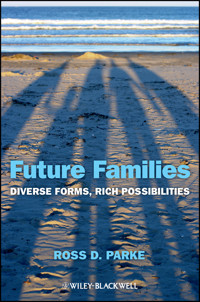
Cover image: Cover photograph courtesy of Heather Camerio.Cover design by Design Deluxe.
Preface
Like many books, this one has been percolating during many years of reading, research, and writing and has been advanced most of all by discussions with colleagues and students. The book brings together my varied interests in new family forms and is based on my own and others’ research on fathers, same-gender parents, new reproductive technologies, immigrant families, cross-cultural insights about family forms, and the implications of these issues for children’s social and emotional development.
I have been studying families since the 1960s when I began this journey with observations of fathers and newborns. I thought that in a decade or so parental roles would shift and men and women would be equal partners in parenting. Although the revolution never happened, there has been a gradual steady evolution in the way that parents organize their family roles and responsibilities. This book chronicles these shifts, but this was only the beginning. The very definition of family has been changing and the concept of the ideal or perfect family has been challenged by a variety of shifts. Instead of the two-parent nuclear family rearing their biological offspring, the traditional family form has been moved off center stage by a wide range of other family forms. Single mothers and single fathers have become more common, either as a result of divorce or by design. Stepfamilies have emerged as a more prevalent family form in the aftermath of the rise in divorce rates. Even marriage itself has declined as more couples have chosen to cohabit instead of marrying, with children often being part of the cohabitating household.
Who can become parents has shifted through advances in assisted reproductive technologies. This has allowed previously infertile couples or individuals to achieve their goal of parenthood, as well as providing an alternative pathway to parenthood for same-sex couples. The increased prevalence of same-sex parents as a family form, combined with the mounting evidence that children reared in these family contexts are well adjusted, has led discussions away from a focus on the gender of parents and the necessity of opposite-sex parents as the family unit to a focus on parenting processes. One of the central messages of this book is that family process trumps family form. Shifts in social science away from our Western-centric bias has led to a reexamination of other cultures and their historical reminder that our myopic focus on the Western ideal family form of two opposite-sex parents and their biological children is found less often in past cultures. Instead, in many other cultures cooperative community-based models of parenting in which parental caregiving and supervisory responsibilities are shared with kin and nonkin are common. Similar models of cooperative caregiving are found among African American families as well as among recent waves of immigrant families from Central and South America and Asia. The lessons that can be learned from these groups can usefully inform our contemporary dialogues about the effects of new family forms on children by highlighting the fact that children can thrive in a variety of family forms, especially if there is sufficient community support for all forms of families. In response to recent suggestions that parenting may be detrimental to one’s mental health, especially happiness and life satisfaction, we address this issue by showing that caregiving is, in fact, not only good for children but good for the adult providers as well. The policy implications of these shifts in family forms are addressed with the goal of achieving more equitable social policies for all family forms and not just the ideal family form, which is the narrow template that guides many of our current policies. Suggestions are offered for overcoming the barriers that limit our acceptance of new family forms since increased acceptance of these family forms can potentially benefit children’s socioemotional development.
The book brings together a set of issues that are often treated independently but that share the common thread of challenging our notion of an ideal family form. Moreover, the book goes beyond mere description to examine the implications of these forms for children’s development. For example, books on a variety of specific family issues such as child care, working mothers, shifting parental roles, same-sex parents, cultural and ethnic issues, and the assisted reproductive technologies have appeared in recent years, but they often fail to assess the implications of these changes for children’s development.
In addition, many earlier books treat the changing family issues as separate and independent rather than as a unified set of social changes. Often, they offer a variety of perspectives of the individual authors without the benefit of any overarching theme or argument that links the disparate but related changes in families. In addition, they are often written from the perspective of a single discipline and therefore fail to capture the richness of the issues that do, indeed, cut across disciplinary boundaries. As a corrective, the scope of this book is interdisciplinary and draws from work in many areas beyond my own field of developmental psychology, including sociology, cross-cultural scholarship, ethnic studies, anthropology, history, legal studies, economics, neuroscience, and even architecture and design. As is being increasingly recognized, families are too important and too complex to be left in the hands of a single discipline.
The book is best thought of as a stimulus to new conversations about our conception of families and an exploration of the implications of changing family forms for children’s social and emotional development. The goal is to generate dialogue about our cultural definition of families and to argue for a broadened view of families beyond some imagined ideal form. A related goal is to build a new scholarly agenda to guide future research on families by identifying new avenues for future researchers and policy makers. However, it would be mistaken to assume that scholars or politicians own these issues. Many of the topics addressed here are being debated and discussed not only in seminar rooms and in political caucuses but among ordinary but concerned individuals around water coolers, in parental playgroups, and over lunch across the nation. Although the book will be thoroughly grounded in the empirical literature from a variety of disciplines, my goal is to make the book accessible to a wider general audience of individuals who are interested in social trends in families and the implications of these trends for our children. To appeal to a general readership, I limited the use of jargon (or carefully define technical terms when needed), while providing qualitative material in the form of quotes from real families to draw readers into the narrative and to illustrate the quantitative findings. So the hope is that parents and others concerned about the changing nature of families in our society will profit from this book as well.
Acknowledgments
A host of individuals have contributed to this book. I owe a great deal to the students and colleagues who have shared in my research program on families and shared their ideas and insights at the University of Wisconsin, the Fels Research Institute, the University of Cincinnati College of Medicine, the University of Illinois, and, for the past 20 years, at the University of California, Riverside (UCR). Scott Coltrane, my sociologist colleague, has been an integral part of this journey and shared my interests in fathers, changing family roles, and immigrant families as part of our collaborative work at the Center for Family Studies at UCR. The Center for Society and Ideas at UCR provided an opportunity for an interdisciplinary seminar on the implications of the new reproductive technologies on families. Robin DiMatteo, a health psychologist, Christine Gailey, an anthropologist and women’s studies scholar, Scott Coltrane, a family sociologist, and myself, a developmental psychologist, formed this group, and our deliberations and writing informed chapter five on assisted reproductive technologies (ART). In addition, several individuals have offered scholarly material as well as helpful critiques of drafts of this book. My long time colleagues and friends, Carolyn and Philip Cowan, provided detailed feedback on the whole book as did Scott Coltrane. Several individuals provided helpful comments on portions of the book, including Susan Golombok, Charlotte Patterson, Patricia East, Mary Gauvain, Bonnie Leadbeater, Ernestine Avila, Tanya Ann Nieri, Raymond Buriel, Melinda Leidy, and Michele Adams. Les Whitbeck, Melissa Walls, and Brian Armenta shared their work on North American indigenous families. Sonya Lyubomirsky sent me her recent work on the effects of being a caregiver on psychological well-being. Marc Bornstein shared new material on the neurological preparedness of adults for caregiving. Charlotte Patterson directed me to the most recent work on same sex-parent families. Susan Golombok alerted me to the latest studies on families using assisted reproductive technologies. Several anonymous reviewers provided me with helpful and cogent feedback. Heather Vogel provided assistance with the bibliography. Alison Clarke-Stewart, my wife, collaborator, and best friend, encouraged me to write this book even though it moved me out of my comfort zone while discouraging me from taking on easier and safer projects. Her editing and formatting expertise are unrivaled as is her support and critique of my ideas.
Finally, thanks to the Wiley Blackwell editorial team for their support and guidance. Matt Bennett recognized the value of the book and offered the book contract, while Danielle Descoteaux oversaw the book after Matt departed. Her support and responsiveness to my many queries are greatly appreciated. Karen Shield guided the production phase of the book, N. Yassar Arafat oversaw with great care the copyediting phase of the book, and Olivia Evans and her team designed a cover that nicely captured the themes of the book.
About the Author
Ross D. Parke was Distinguished Professor of Psychology and Director of the Center for Family Studies at the University of California, Riverside. He also taught at the University of Illinois at Urbana-Champaign and at the University of Wisconsin. He is Past President of the Society for Research in Child Development, from which he received the Distinguished Scientific Contribution to Child Development Award, and of the Developmental Psychology Division of the American Psychological Association, from which he received the G. Stanley Hall Award for his contributions to developmental psychology. He has served as editor of the Journal of Family Psychology and Developmental Psychology and was associate editor of Child Development. He is the author of Fatherhood, coauthor of Throwaway Dads: The Myths and Barriers That Keep Men from Being the Fathers They Want to Be and Social Development, and coeditor of Family–Peer Relationships: In Search of the Linkages; Children in Time and Place; Exploring Family Relationships with Other Social Contexts; and Strengthening Couple Relationships for Optimal Child Development. He obtained his PhD from the University of Waterloo, Ontario, Canada, and his work has focused on early social relationships in infancy and childhood, the effects of punishment, aggression, child abuse, fathers’ roles in child development, links between family and peer social systems, ethnic variations in families, and the effects of new reproductive technologies on families. He is highly regarded as a textbook author with seven editions of Child Psychology: A Contemporary Viewpoint to his credit.
1
Challenges to the Ideal Family Form
Family is not a static institution but one that is constantly being reworked, reshaped, reimagined and reenacted in complex and dynamic ways (Abbie Goldberg, 2010)
As Michael Sandel (2004) argued in his provocative essay, “The case against perfection,” as a society we are concerned about achieving perfection in many spheres of our lives, including ideal physical beauty enhanced through the use of surgery and drugs, athletic perfection created by performance enhancing substances, and “designer” babies produced through the application of new reproductive technologies. This concept of the pursuit of perfection can be extended to contemporary views of families as well. Just as our society has developed notions of perfect thighs, ideal faces, and endorsement-worthy athletes, it has developed a cultural image of a perfect or ideal family. Every society and historical era invents and legitimates a particular version of the family in terms of the identity of members, their rights and responsibilities toward each other and their children (Coltrane & Collins, 2001). In our own society, the concept of an “ideal” family form incorporates the traditional ideas about Dad as breadwinner and Mom as homemaker living with their children in a safe suburban setting surrounded by a manicured lawn and a white picket fence. The cultural embodiment of this “ideal” family is the nuclear family form consisting of two heterosexual parents who conceive and rear their biological children, and is the template against which other family forms are judged. According to a national survey in Canada, 80% of Canadians believe two married, heterosexual parents and their children constitute a family (Ipsos Reid Poll, September, 2010). Similar views prevail in the United States as well. Consider a US report Counted Out: Same-Sex Relations and American’s Definitions of Family by sociologist Brian Powell and his colleagues (2010) which also found that the most agreed-upon definition of a family was a husband, a wife, and their children. Fewer agreed that single-parent families, married couples without children, or cohabitating couples with children constituted a family.
Perhaps this notion has its roots in our distant past as anthropologist Meredith Small has noted:
There’s something ‘right’ about a nuclear family, or so we think. Family, we’re taught by culture and religion, ‘should’ be composed of a mother, father and at least two kids, preferably one of each sex. That ideal was recently underscored by finding a 4600-year-old mass grave in Germany containing thirteen individuals, many of them children. Poignantly, some adults were buried facing each other, with their arms entwined. But even more poignant, scientists from the University of Bristol and University of Adelaide used DNA analysis to link one couple with their two children, the oldest evidence of a nuclear family. This report tugs at our heart strings because it fits with what our culture has embraced as the definition of a family. As such, those bodies laid to rest together seem to confirm that the nuclear family is an ancient, and therefore evolutionarily selected, ‘natural’ human grouping (Small, December, 2008).
In spite of the fact that the heterosexual nuclear family is currently conceived of as both normative and ideal, and may have existed in ancient times, it is also true that it has been neither normative nor ideal in other times in human history. Even in our own contemporary society this particular family form is fast becoming less prevalent and coexists with a wide variety of other family forms. My goal of this book is to explore these other forms, which, in reality, reflect how many families in Western cultures live, and to explore not only the viability of these forms as contexts in which children are raised but to discuss their possible advantages as well. By fully embracing a range of family forms rather than presuming a single form is ideal, we can better align our social policies to support a diversity of child rearing environments. Both adults and children will benefit from our heightened appreciation of this rich array of family forms.
As a guide to the concept of the “ideal” family form that will be a recurring theme throughout the book, turn to Table 1.1 for a schematic summary of the contrasting ways in which the nuclear family form and other family forms differ from each other.
Lesen Sie weiter in der vollständigen Ausgabe!
Lesen Sie weiter in der vollständigen Ausgabe!
Lesen Sie weiter in der vollständigen Ausgabe!
Lesen Sie weiter in der vollständigen Ausgabe!
Lesen Sie weiter in der vollständigen Ausgabe!
Lesen Sie weiter in der vollständigen Ausgabe!
Lesen Sie weiter in der vollständigen Ausgabe!
Lesen Sie weiter in der vollständigen Ausgabe!
Lesen Sie weiter in der vollständigen Ausgabe!
Lesen Sie weiter in der vollständigen Ausgabe!




