


18,99 €
Mehr erfahren.
- Herausgeber: John Wiley & Sons
- Kategorie: Geisteswissenschaft
- Serie: Understanding Children's Worlds
- Sprache: Englisch
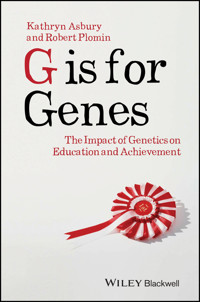
G is for Genes shows how a dialogue between geneticists and educationalists can have beneficial results for the education of all children—and can also benefit schools, teachers, and society at large.
- Draws on behavioral genetic research from around the world, including the UK-based Twins’ Early Development Study (TEDS), one of the largest twin studies in the world
- Offers a unique viewpoint by bringing together genetics and education, disciplines with a historically difficult relationship
- Shows that genetic influence is not the same as genetic determinism and that the environment matters at least as much as genes
- Designed to spark a public debate about what naturally-occurring individual differences mean for education and equality
Sie lesen das E-Book in den Legimi-Apps auf:
Seitenzahl: 314
Veröffentlichungsjahr: 2013
Ähnliche




















Table of Contents
Series Page
Title Page
Copyright
Dedication
Acknowledgements
Part One: In Theory
Chapter 1: Genetics, Schools, and Learning
The Aims and Assumptions of Education
Diverse Opportunities to Draw Out Individual Potential
DNA in the Classroom
In Summary…
Chapter 2: How We Know What We Know
Twins: A Natural Experiment
DNA Sequencing
Chapter 3: The 3Rs: Reading, wRiting…
From DNA to ABC
Environmental Influences on Reading Ability
Struggling Readers
The Genetics of Writing Ability
Chapter 4: … and 'Rithmetic
So, Why are Some People Better at Math than Others?
How does Nurture Affect Mathematical Ability?
Chapter 5: Physical Education: Who, What, Why, Where, and How?
Genes, Sports, and Smoking
Obesity, Genes, and Environment
The Heritability of Fitness
Gym Class Heroes
In Summary…
Chapter 6: Science: A Different Way of Thinking?
Differences Between the Sexes
In Summary…
Chapter 7: How do IQ and Motivation Fit In?
IQ + Genetics = Controversy (and Name-calling)
Self-Confidence and Motivation
Improving Confidence and Cognition in the Classroom
Chapter 8: Special Educational Needs: Ideas and Inspiration
The Expansion of Special Educational Needs
Personalized Learning in Action
In Summary…
Chapter 9: “Clones” in the Classroom
Positivity and Achievement
Clones in the Classroom
Chapter 10: Mind the Gap: Social Status and School Quality
Low SES: What Does It Look Like?
What Does the Heritability of SES Mean?
School Quality
Chapter 11: Genetics and Learning: The Big Ideas
Big Idea #1: Achievement and Ability Vary, Partly for Genetic Reasons
Big Idea #2: The Abnormal is Normal
Big Idea #3: Continuity is Genetic and Change is Environmental
Big Idea #4: Genes are Generalists and Environments are Specialists
Big Idea #5: Environments are Influenced by Genes
Big Idea #6: The Environments that Matter Most are Unique to Individuals
Big Idea #7: Equality of Opportunity Requires Diversity of Opportunity
Part Two: In Practice
Chapter 12: Personalization in Practice
So, What Can Be Done to Make Teaching and Learning More Personalized?
A Good “Mindset” for Learning
Other Ways to Personalize Learning
In Summary…
Chapter 13: Eleven Policy Ideas
1. Minimize the Core Curriculum and Test Basic Skills
2. Increase Choice
3. Forget About Labels
4. Teach the Child, As Well As the Class
5. Teach Children How To Succeed
6. Promote Equal Opportunities from an Early Age as a Foundation for Social Mobility in the Future
7. Equalize Extracurricular Opportunities at School
8. Create a Two Stage PE Program
9. Change the Destination
10. Train New Teachers in Genetics and Give Them the Tools to Put it Into Practice
11. Big Is Beautiful
Chapter 14: Education Secretary for a Day
Index
Understanding Children's Worlds
Series Editor: Judy Dunn
The study of children's development can have a profound influence on how children are brought up, cared for and educated. Many psychologists argue that, even if our knowledge is incomplete, we have a responsibility to attempt to help those concerned with the care, education and study of children by making what we know available to them. The central aim of this series is to encourage developmental psychologists to set out the findings and~the implications of their research for others—teachers, doctors, social workers, students and fellow researchers—whose work involves the care, education and study of young children and their families. The information and the ideas that have grown from recent research form an important resource which should be available to them. This series provides an opportunity for psychologists to present their work in a way that is interesting, intelligible and substantial, and to discuss what its consequences may be for those who care for, and teach children: not to offer simple prescriptive advice to other professionals, but to make important and innovative research accessible to them.
This edition first published 2014
© 2014 John Wiley & Sons, Inc.
Registered Office
John Wiley & Sons Ltd, The Atrium, Southern Gate, Chichester, West Sussex, PO19 8SQ, UK
Editorial Offices
350 Main Street, Malden, MA 02148-5020, USA
9600 Garsington Road, Oxford, OX4 2DQ, UK
The Atrium, Southern Gate, Chichester, West Sussex, PO19 8SQ, UK
For details of our global editorial offices, for customer services, and for information about how to apply for permission to reuse the copyright material in this book please see our website at www.wiley.com/wiley-blackwell.
The right of Kathryn Asbury and Robert Plomin to be identified as the authors of this work has been asserted in accordance with the UK Copyright, Designs and Patents Act 1988.
All rights reserved. No part of this publication may be reproduced, stored in a retrieval system, or transmitted, in any form or by any means, electronic, mechanical, photocopying, recording or otherwise, except as permitted by the UK Copyright, Designs and Patents Act 1988, without the prior permission of the publisher.
Wiley also publishes its books in a variety of electronic formats. Some content that appears in print may not be available in electronic books.
Designations used by companies to distinguish their products are often claimed as trademarks. All brand names and product names used in this book are trade names, service marks, trademarks or registered trademarks of their respective owners. The publisher is not associated with any product or vendor mentioned in this book.
Limit of Liability/Disclaimer of Warranty: While the publisher and author(s) have used their best efforts in preparing this book, they make no representations or warranties with respect to the accuracy or completeness of the contents of this book and specifically disclaim any implied warranties of merchantability or fitness for a particular purpose. It is sold on the understanding that the publisher is not engaged in rendering professional services and neither the publisher nor the author shall be liable for damages arising herefrom. If professional advice or other expert assistance is required, the services of a competent professional should be sought.
Library of Congress Cataloging-in-Publication Data
Asbury, Kathryn.
G is for genes : the impact of genetics on education and achievement / Kathryn Asbury and Robert Plomin.
pages cm.—(Understanding children's worlds ; 13)
Includes bibliographical references and index.
ISBN 978-1-118-48278-0 (hardback)—ISBN 978-1-118-48281-0 (paperback) 1. Learning ability–Genetic aspects. 2. Academic achievement. 3. Behavior genetics. I. Plomin, Robert, 1948– II. Title.
LB1134.A83 2013
370.15′23–dc23
2013017491
A catalogue record for this book is available from the British Library.
Cover image: © nathan Knowles / Getty Images
Cover design by www.cyandesign.co.uk
Acknowledgements
This book began as an idea several years ago, and its writing has been informed and inspired by discussions with generous colleagues at London's Institute of Psychiatry ever since, for which we thank them. Our field, behavioral genetics, is developing at considerable speed and we look forward to continuing and extending those discussions in tandem with new developments in both genetics and education.
The writing of G is for Genes was made possible by funding from the British Academy in the form of a Postdoctoral Fellowship awarded to KA, and our research into the school environment is funded by the US National Institutes of Health. We thank both bodies for believing in the importance of this endeavor.
We thank Peter Tallack of The Science Factory, and Professor Judy Dunn for their invaluable support and encouragement as we prepared to submit our draft manuscript for publication. Both contributed ideas which have made G is for Genes a better book, and both were a pleasure to work with. Thanks also to Nick Asbury for coming up with our title.
A particularly special thank you is owed to Jonah Asbury who helped in ways too numerous to mention but, in particular, we thank him for his generously given editorial advice which was always “on the money.” Finally, we thank the thousands of families who make up the Twins' Early Development Study (TEDS). We have dedicated our book to these families because, although we have become accustomed to their generosity, it really is astonishing that they find time in their busy lives to contribute to science and society on such a regular basis. They make our research possible and we are eternally grateful.
Part One
In Theory
Chapter 1
Genetics, Schools, and Learning
The science of genetics is changing our world at an ever-increasing pace. We can now analyze and modify DNA to test for serious illnesses and treat them before they become life-threatening, to catch criminals and exonerate the innocent, and to create energy sources that will protect our planet. Geneticists have cast their nets far and wide to influence and inform medicine and public health, agriculture, energy and the environment, law, and social policy. Education, however, is glaringly absent from this list, and schools remain untouched by the lessons of genetics. This, we believe, needs to change.
One way of helping each and every child to fulfill their academic potential is to harness the lessons of genetic research. We now know a great deal—though not by any means everything—about the ways that genes influence learning, and about how children's DNA interacts with their experiences at home and school. It's time for educationalists and policy makers to sit down with geneticists to apply these findings to educational practice. It will make for better schools, thriving children, and, in the long run, a more fulfilled and effective population. That's what we want schools and education to achieve, isn't it?
Lesen Sie weiter in der vollständigen Ausgabe!
Lesen Sie weiter in der vollständigen Ausgabe!
Lesen Sie weiter in der vollständigen Ausgabe!
Lesen Sie weiter in der vollständigen Ausgabe!
Lesen Sie weiter in der vollständigen Ausgabe!
Lesen Sie weiter in der vollständigen Ausgabe!
Lesen Sie weiter in der vollständigen Ausgabe!
Lesen Sie weiter in der vollständigen Ausgabe!
Lesen Sie weiter in der vollständigen Ausgabe!
Lesen Sie weiter in der vollständigen Ausgabe!
Lesen Sie weiter in der vollständigen Ausgabe!
Lesen Sie weiter in der vollständigen Ausgabe!
Lesen Sie weiter in der vollständigen Ausgabe!
Lesen Sie weiter in der vollständigen Ausgabe!
Lesen Sie weiter in der vollständigen Ausgabe!




