


9,99 €
Mehr erfahren.
- Herausgeber: 50Minutes.com
- Kategorie: Fachliteratur
- Serie: Management & Marketing
- Sprache: Englisch
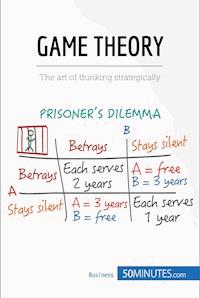
The art of thinking strategically
This book is a practical and accessible guide to understanding and implementing game theory, providing you with the essential information and saving time.
In 50 minutes you will be able to:
• Quickly master the concept of strategic behavior and interactive decisions
• Anticipate the actions of your opponents to react accordingly and maximize gains
• Find the key to cooperating in order to reach collective goals
ABOUT 50MINUTES.COM| Management & Marketing
50MINUTES.COM provides the tools to quickly understand the main theories and concepts that shape the economic world of today. Our publications are easy to use and they will save you time. They provide elements of theory and case studies, making them excellent guides to understand key concepts in just a few minutes. In fact, they are the starting point to take action and push your business to the next level.
Das E-Book können Sie in Legimi-Apps oder einer beliebigen App lesen, die das folgende Format unterstützen:
Seitenzahl: 32
Veröffentlichungsjahr: 2015
Ähnliche











Game theory
Key information
Names: Game theory, strategic behaviour theory, interactive decision theory.Uses: Justification of social laws and norms in order to maintain cooperation within a group; political decision-making; understanding power relations in negotiations; conflict analysis tool; tool to generate confidence within a group; applications in logic and set theory; applications in economics, biology, computer science and the theory of evolution.Why is it successful? Game theory is an excellent tool for negotiations, as it encourages us to reflect on the complexity of social interactions and shows that:individuals, companies and countries are mutually interdependent;interaction is beneficial for resolving shared problems;cooperation is not easy to implement;in some cases, where each individual acts in their own interest, the shared interest may not be reached;there are various ways of making strategic choices in a cooperative situation.Key words:Interaction: a collective action in which a player performs an action or makes a decision that is influenced by another player.Strategy: a full specification of a player’s behaviour in any situation where they are required to play.Introduction
Every day, all agents (animals, natural and legal persons or economic agents, including politicians, consumers, employers and manufacturers) and communities (sports teams, countries, armies, etc.) interact with each other when making decisions. These interactions can range from cooperation to conflict.
The field of game theory is very broad and its applications can be found in areas as diverse as international relations, economics, political science, philosophy and history, among others. This theory develops the tools to analyse behaviours (economic, social, etc.) in the form of strategy games.
History
The first analyses of strategy games date back to the Renaissance. However, it was not until the 19th and 20th centuries that a theory on the subject was really formalised. The game theorists of that era include in particular the mathematicians and economists Antoine Augustin Cournot, Émile Borel, John von Neumann, Oskar Morgenstern and John Forbes Nash, whose respective contributions will be explored in more detail in the following section.
Good to know: the Renaissance
This was a European movement extending from the late Middle Ages to the early modern period. It was characterised by a change in mentality in the literary, artistic and scientific domains and by the circulation of knowledge among scholars. The Renaissance began in Italy and spread across Europe from the 16th century onwards.
Definition of the model
Game theory studies the consequences of strategic interaction between rational agents (players) pursuing their own unique objectives, within a clearly defined framework. These interactions include negotiation, competition, mutual assistance, and the provision of a good or service, among others, which are all possible actions that will lead to a result. The outcome results in a payoff, positive or negative, for each individual who took part in the game.
The purpose of this theory is to show that individuals, companies and even countries are mutually interdependent and it is in their best interests to find a balance in order to make their interactions beneficial to all. This theory also encourages us to realise that even if cooperation is not easy, it is better to understand it than to fight it.
Theory
Game theory and its philosophers
The beginnings of game theory, strictly speaking, are found in the works of mathematicians from the first half of the 19th century.
Antoine Augustin Cournot
The first person to study the strategic aspects of interactions between economic agents was Antoine Augustin Cournot (French mathematician, philosopher and economist, 1801-1877). His 1838 book Researches into the Mathematical Principles of the Theory of Wealth




