


9,59 €
Mehr erfahren.
- Herausgeber: Forum
- Kategorie: Geisteswissenschaft
- Sprache: Englisch
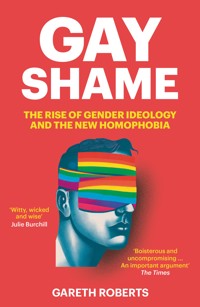
'Boisterous and uncompromising ... An important argument' The Times 'Witty, wicked and wise' Julie Burchill Homophobia is making a major comeback under the guise of the ideology of 'gender identity'. The enforcers of this new creed insist that attraction to people of the same sex is 'hateful'. They argue that effeminate men and butch women can't just be gay, but must 'really' be trans. How and why was the older gay-rights activism, which gifted such progress to homosexual people, hijacked? In this passionate, witty polemic, Gareth Roberts answers these questions and argues that we need a new gay-liberation movement.
Das E-Book können Sie in Legimi-Apps oder einer beliebigen App lesen, die das folgende Format unterstützen:
Seitenzahl: 352
Veröffentlichungsjahr: 2024
Ähnliche




















Contents
Introduction: Goodbye Sex, Hello GenderGlossaryAuthor Note1. Behind the Painted Smile 2. Sisters and Brothers 3. Tacky 4. Queering the Pitch or Stop Making Sense 5. Gaslight 6. The Leap 7. No Homo 8. Gaystrip One 9. Captured 10. Mean Boys Conclusion: An End and a Beginning EndnotesResourcesAcknowledgementsIntroduction
Goodbye Sex, Hello Gender
To me truth has airy properties with buoyant and lyrical effects; and when anything drastic starts up from some light cause it only proves to me that something false has got into the world.
Muriel Spark, The Curtain Blown by the Breeze (1961)
It is 2007. I’m meeting up with friends in central London. I’ve arrived early – I always do – and so I’m sat in The Yard in Soho’s Rupert Street waiting for them to show up. The Yard is one of those smallish places that gets very crowded very quickly, but it’s early, offices-just-shutting twilight time, so I’ve got myself a drink and grabbed us one of the leather sofas on the upper level. The ambience is relaxed and amiable, fresh air – or as fresh as you’ll get in Zone 1 – blowing in through the large open veranda windows.
Seated close by are two other early birds, young men in their very late teens or early twenties. I’m thirty-nine, so these two are from about the second or third generation younger than mine who will reach adulthood in my lifetime. But as I watch them – chatting, drinking, maybe flirting with each other (who knows – I could never read those signals even when aimed directly into my face) – I experience a package of complicated emotions.
Because they’re so relaxed. They have absolutely none of the nervous energy of the low-in-the-food-chain prey animal that I’ve seen in gay men, and in the mirror, for decades; that furtive look, the body language of the shoplifter awaiting a hand on the shoulder any second. They don’t wobble their heads while talking in that peculiar way many gay men somehow picked up when we were teenagers. They’re dressed well but spectacularly casually, with no secret signals encoded in their clothing. The Yard’s big, wide windows look down on to the street below, in contrast to the blacked-out, boarded-up low-light gay venues of my own youth, with their exposed wiring, stained carpets and walls that it was not a good idea to lean against if you wanted to retain the colour of your shirt. There is also nothing of the committee, of the municipal vegetarian pasta-bake and photocopying-fluid aroma of worthy campaigning.
I remind myself that it’s a mistake to romanticise glimpses of other people’s lives. No doubt these men have, or will have, dishonours and struggles and frustrations of their own. But, just here and just now, they seem so free.
I feel happy for them, but there’s a tang of sour grapes in my emotional bouquet too. Because they are of an entirely new generation, without AIDS or HIV as a swift death sentence, without widespread public scorn and ancient music-hall cruelty, without constant attacks and lies in the press, and with an automatic assumption of legal rights about which they will never have to think twice. Theirs is a new world that my generation – licensed by the social and technological innovations of our time – had made for them to flourish in, and they cannot appreciate it. They don’t even know it. And that’s wonderful.
But, you know, I would’ve liked a bit of that. I would’ve loved it.
For myself, I’m thinking how nice it will be not to have to worry about all that any more. To slide into middle age, maybe wearing the almost inevitable tapestry waistcoat and slightly more jewellery than necessary of the older homosexual man. There are things in the news to be worried about and life will have its inevitable battles, but this particular one is done.
To be homosexual will soon be – maybe already is, on this evidence – just like having blue eyes or ginger hair. Nothing special. Mission, at least in the cities of the Western world, well on the way to being pretty much accomplished.
Whip cut to the present day …
What the hell happened?
I’m writing in 2023. What was known, for better or worse, as the ‘gay community’ in 2007 has now transitioned into the LGBTQ+ movement, adding the T for Transgender and the Q for Queer (whatever that means) and the + for … well, your guess is as good as mine.
Homophobia is rife and right out in the open. In its definitional sense, homosexuality – as we all of us, for it, against it, and the great mass of indifferent about it, accepted it – no longer exists. Dictionaries and bodies from the Royal Borough of Greenwich to the BBC define ‘gay’ and ‘lesbian’ to mean sexually attracted to the same ‘gender’, not sex. The use of the phrase ‘same-sex attraction’ is referred to regularly online as a ‘transphobic dog whistle’, while a charity established for lesbians, gays and bisexuals is dubbed a ‘far-right hate group’. The same charity is dragged to court and two years of costly and utterly pointless legal wrangling for daring not to include ‘trans’ in its remit.
The broadcast media actively suppresses the voices of dissenting lesbians and gay men who refuse to accept this and speak up.
In élite circles it is considered bad form at best to state that there are two sexes. Impeccably liberal public cultural figures are disowned as ‘Nazis’ merely for expressing polite disquiet. Authors, directors, administrators, journalists and politicians are threatened and very often fired, and then the cultural élite class – from Polly Toynbee to Dara Ó Briain to Stewart Lee – tells them helpfully that they are imagining it all.
Nancy Kelley, departing chief executive officer of what remains, nominally anyway, the UK’s leading gay rights charity Stonewall (formed in 1988 for the advancement of gay people), compares lesbians to anti-Semites – ‘sexual racists’.1 Paul Roberts, CEO of the LGBT Consortium – an umbrella group covering all British LGBTQ+ charities – states in the court case mentioned above that men can be lesbians, because a woman is whoever says they are a woman. In the same case a day later, a KC attempts to ‘gotcha’ a lesbian witness by exposing her apparently sinister ‘belief’ that men cannot be lesbians.2 Lesbians are ejected from Pride marches for having the temerity to state that they only fancy women. Gay men are assaulted at such occasions for protesting that they fancy only men.
Children who don’t conform to the societal expectations of their sex are encouraged and ‘affirmed’ to think that they are a new category of person called ‘transgender’, and steered towards untested puberty-blocking drugs and medically sanctioned mutilation. Objecting to this – wanting kids to be content with their bodies and their nascent sexualities, whatever these might be – is categorised as abhorrent ‘trans conversion therapy’ by, along with many others, a gaggle of inanely grinning Members of Parliament.
Ever more colours and shapes are jammed on to the already very silly and kindergartenish rainbow flag, including a red umbrella for ‘sex work’ (a euphemism for prostitution). This is on top of a massive transgender chevron and additional stripes representing skin colours that were apparently previously excluded (possibly for the good reason that no skin colour, of any hue, is part of the chromatic spectrum). Ever barmier new identities are invented, each coining its own neologism – pansexual, aromantic, demisexual – each claiming an equal parity and each demanding ‘validation’.
Ever crazier denunciations and cancellations and ‘better be careful what you say’ signals – some of them so blunt as to be hardly signals at all, and more in the line of threats – are dished out to naysayers via the now-ubiquitous social media and the sad, clickbaity online ruins of what was the gay press. Enforcement of these new rules is carried out not by the elected government of the country but by faceless, unaccountable ‘moderators’ in distant, dismal California.
As they say, funny how life turns out. I certainly never expected to spend much of my autumn years being outraged on behalf of lesbians and fuming about men trashing women’s basic rights to privacy or fairness in sport. I didn’t anticipate the gay rights movement transmogrifying into a cross between the Church of Scientology, Heathers: The Musical and Act 4 of The Crucible.
We’ve all seen so many futuristic dystopias at the movies, from mutant zombies in a radioactive wasteland to hermetically sealed machine environments. This one – a society reordered so as not to hurt the feelings of a tiny minority of the delusional – wasn’t on the list. Was this inadmissible complacency? No. I could have foreseen none of this back in The Yard, in 2007. Because nobody could.
How did we get from there to here?
There is always something crazy going on in this new world. Not a day passes by without some gender insanity rearing its ‘cutely’ tilted head. I’ll take a week at random – I stuck a pin in a calendar and got the week ending 25 September 2022 – as an example, and pick out just a few of the top stories for you. (You don’t want to imagine the week before.)
So, in that week alone:
The National Education Union pulled a positive review of a book for teenagers, Sex and Gender by Phoebe Rose, from its magazine, saying, ‘The concepts in the book are not consistent with the union’s policy on LGBT+ education and support for trans and non-binary students. The union regrets that it has, unwittingly, through publication of a positive review of this book, appeared to support the ideas in this book.’ The dangerous and terrifying ideas in this book? That there is nothing wrong with children or teens who don’t conform to sex stereotypes, and that such kids are just fine as they are.A male Canadian woodwork teacher is wearing absolutely enormous prosthetic breasts while teaching. The Halton District School Board is standing squarely behind this man’s freedom of expression, saying, ‘The HDSB recognises the rights of students, staff, parents/guardians and community members to equitable treatment without discrimination based upon gender identity and gender expression. Gender identity and gender expression are protected grounds under the Ontario Human Rights Code.’ In other words, it may be illegal to criticise this blatant fetishistic exhibitionist.An Irish Green Party councillor, Karen Power, swooped on the Twitter account of a local library that merely followed the accounts of two sex realists, barrister Allison Bailey and author J. K. Rowling. Whoever ran the account has been quietly ‘dealt with’ behind closed doors. Councillor Power responded to criticism of her actions by posting a simpering selfie – with the Bell’s Palsy expression often adopted by genderists – and saying how she had been targeted by ‘the far-right’.It was discovered that WPATH – the World Professional Association for Transgender Health (the international body of ‘best practice’ for what is known as ‘transgender health care’, which recently hosted its ‘Scientific Symposium’ in – where else? – Canada) – has now listed eunuchs as a gender identity category, and engaged positively with a castration fetish website.Masked counter-protesters attended an event in Brighton by the group Standing For Women (SFW). They threw smoke bombs at the speakers. A policy assistant to a Labour MP screamed into the face of a baby brought by a supporter of SFW that it was being raised as ‘fascist filth’. The police made two arrests among the counter-protesters, one for sexual assault and another for assault and possession of a knife.Long-established American current affairs magazine The Atlantic says that there’s no evidence that men are generally physically stronger than women.A maths teacher in Swindon is taking legal action against a school that sacked him for refusing to affirm a girl’s new ‘gender identity’, at least until her parents had been informed – in the school’s words, this ‘violated his [sic, i.e. the girl’s] dignity’.It’s a world gone absolutely insane. Every obvious objection to genderism sounds like an appeal to ridicule. Why? Because genderism is ridiculous. It is all simultaneously highly comic and highly disturbing.
My natural instinct (like many others’, I suspect) is to avoid hyperbole. But there’s a crisis in the Western world over sex and gender, and a civil war among homosexual people, male and female, about ‘gender identity’. I’ll be talking here mostly about Britain, but in our globalised world it’s impossible to isolate the influence of ideas, particularly those metastasising from the tumorous organ of American academia. And the UK is interesting for its comparative level of resistance – so far – to the ideology of genderism.
I’m writing at a moment of flux in the sex/gender debate and in the general politics of the UK. The ruling Conservative Party has been dragged painfully slowly (for now) to a more reasonable position on sex, while the Labour Opposition remains tangled in the folds of genderism, despite some cautious shifts. If Labour gets into power, as seems very likely, any progress that sex-realist campaigners have made may be swept away in short order. The UK may become just another of the Western countries that has fallen into step with genderism.
Some personal history. In my young adulthood I kept only a vague eye on the gay rights skirmishes of the day. This was because I knew that other people with more suitable temperaments for the fray, including the prelapsarian Stonewall, were doing the spadework. My interactions were limited to nods of approval, the occasional appreciative cheer, and bunging them the odd fiver. Also, I come from a generation and a background where making conspicuous negative judgements of other people’s behaviour – when that behaviour is lawful – is regarded as suspect.
The righteousness of my position makes me queasy. I’m not used to having such a firm opinion on any live issue, but then I expect I’d feel much the same if creationism or faked moon landings became embedded suddenly in our culture. You have to take this seriously, which is difficult if you are used to cracking tasteless gags about serious things. In a functional democracy (which I think ours was in its muddled way until very recently) you don’t expect to have to take a stand on a matter of basic observable reality that comes with risk attached. I have no wish to cast the first stone, or indeed any of the subsequent stones, particularly on matters of sexual morality between consenting adults.
But here we are.
This is not a book about ‘transgender’ people per se, though I will suggest that these individuals are often being very badly advised. And it is only tangentially about lesbians and women’s rights. There have been several excellent works from women coming from that perspective – from Kathleen Stock, Helen Joyce and Abigail Shrier among others – that I strongly recommend (see Further Reading). I don’t really think that men can be feminists, I certainly don’t think that men can be women; and feminism, as we shall see, now includes such a heaving smorgasbord of conflicting ideas (and, indeed, men) that as a term it has become sadly almost meaningless. The general awfulness of ‘male feminists’ – riding in like Sir Galahads – has made it feel a bit awkward for a bloke to talk about women’s rights at all. But we must try and ignore that, because those rights are very important – and they concern everybody.
No, as is appropriate in this identitarian age, I’m going to stay mostly in my ‘lane’. Gay men, strange as it may seem, are responsible for a lot of the spread of genderism, which from its redefinition of sex onwards is blatantly, obviously homophobic. This is an ideology that says there is something wrong with camp little boys and butch little girls and that they need to be fixed. Research, time after time, shows that left alone, the vast majority of these kids grow up to be gay men and lesbians. And some gay men have cheered on the ideology behind this, and they have enforced it and spread its poison. Shame on them! This book is an attempt to figure out why, and put that into context.
One big thing I’ve discovered writing this book is how massive and complex this subject is, because it’s about what happens when you upend the very basics of human reality. The idea that genderism is demanding nothing more than tidying up a bit of admin for a marginalised minority is for the birds. It is a very complex, multi-factorial phenomenon, with no immediately obvious, quickly graspable reasons for its swift fermentation and, sad to say, fewer still practical answers.
On the other hand, there are two sexes, bish bosh.
The individual chapters of the book will examine how we got here, and what the different aspects of the situation signify. I will start off in the foothills of sexual orientation with a survey of gay men in the West today, then hike up the escarpments of culture, history, the influence of academia, etc., and from there climb to the lofty peak – the nature of genderism and its regrettable rise.
I’ve never been ‘proud’ of my sexuality in the modern sense, in much the same way that I’ve never felt ‘proud’ to possess brown eyes, but until the enthusiastic adoption of genderism by many gay men came along, I was never embarrassed by it.
This is what I mean by gay shame. Now let’s examine it.
Glossary
Before we begin, we need to define some terms. The terminology around sex and gender has a strange tendency to lose its moorings and to mean different – sometimes extremely different – things to different people. These terms were generated mainly from academia, so they’re often confusing, ungainly and prose-killing (you try building up to a clunker of a word like ‘homophobic’ at the end of a sentence).
It can, very quickly, become baffling, particularly when words are used to describe the opposite of reality, e.g. ‘woman’ or ‘trans woman’ for ‘man’. This glossary is my attempt to bolt down these words to fixed and understandable concepts. For example, I use the word genderism – not employed widely – to distinguish what is a distinct (though irrational) belief system.
Using your opponents’ words and terms puts their frame around your picture, and puts you on the back foot before you even start. I don’t say ‘biological sex’, for example, because there is no other kind of sex class. It doesn’t need a qualifier. I am plain about correctly sexing people and about medical injury, etc., because it is important to be accurate. Mincing your words doesn’t have any ameliorating effect on genderists; they will denounce you however ‘careful’ you are.
Please note that these definitions are for the purposes of this book only. In the wider world I’m afraid you’re on your own and will have to use your own judgement.
Anti-homo My coinage. This is my attempt to pin down the specific genderist brand of homophobia, which can – confusingly – be championed by gay men.
Autogynephilia (AGP) The syndrome where a man is sexually aroused by pretending to be or imagining himself to be a woman.
Bisexual A person of either sex sexually attracted to both sexes.
Cancel culture This is the popular term for the intimidation of people with the ‘wrong’ opinions, by a small number of crazed online children and disturbed young adults. It is enabled by older people who have mistaken a small section of the miseducated younger middle class for public opinion.
Gay Slang term for (usually male) homosexual person. (The Dutch homo would be better in my opinion, but in the English-speaking world it retains negative playground connotations.)
Gender The behavioural attributes ascribed to and expected from either of the two sexes. These vary widely across different cultures.
Gender-critical See Sex realism
Gender identity The mysterious sexed soul of a person, which genderists believe can be either the same as their sex or of the opposite sex, or even a bespoke thing.
Genderism The ideology that advocates the misty concept of gender identity, and its primacy, as opposed to the reality and importance of sex.
Genderist A supporter of the concept of gender identity and denier of the human sex binary.
Heterosexual A person of either sex who is sexually attracted exclusively to the opposite sex.
Homophobia We have only one word to cover the full gamut of discomfort, disapproval, disgust and rage towards homosexuality, but I’m afraid it will have to do for clarity’s sake (but see Anti-homo above).
Homosexual A person of either sex who is sexually attracted exclusively to their own sex.
Lesbian A woman sexually attracted exclusively to women.
LGBTQ+ etc. The umbrella term used by genderists to incorporate homosexual and bisexual people along with all manner of other ‘identities’. Amusingly, you will sometimes see individuals described as LGBTQ+, or even describing themselves as such, e.g. ‘an LGBTQ+ man’. Can you be all of those things at the same time? This is a bit like describing a cow as a cow-horse-dog-window-chair.
Man An adult human male.
Non-binary A person who rejects their categorisation as male or female, despite being either male or female.
Queer A twentieth-century slur word for homosexual, repurposed by American academia to mean mildly wacky and unconventional, like a Goth or a Marilyn Manson fan. Often used by nerdy heterosexuals in a failed attempt to look fashionable.
Sex The division by which humans are classified on the basis of their chromosomes and reproductive functionality (whether it works or not). There are two sexes, male and female. It’s extremely irritating for writers and readers that English (and most Western languages) uses the word sex both for this, and also as an abbreviation for sexual intercourse. It makes it that much harder, for example, to be clear when you’re talking about people who reject sex – do you mean they reject the sex binary, or they reject having sex?
Sex realism The school of thought that repudiates the concept of gender identity. I prefer this to gender-critical, as it is clearer and doesn’t use and thus acknowledge the word ‘gender’.
Trans/Transgender An umbrella term which most people take to mean transsexuals, but which now refers also to cross-dressers, male heterosexual fetishists and exhibitionists, and anybody (including children) who doesn’t fit into narrow Western cultural sex stereotypes. (Rationally speaking, that latter category includes 100 per cent of the human population, but as we shall see, genderism is not a rational movement.)
Trans-identifying man A man who claims to be a woman. It is particularly important to understand that such people are men, not women.
Trans-identifying woman A woman who claims to be a man.
Transsexual A person who suffers so severely from body dysmorphia – a mental condition of believing that their sex is at variance with the sex of their mysterious and unquantifiable inner being – that they are treated with synthetic hormones and surgically modified to supposedly resemble a person of the opposite sex.
Transphobic A nonsense word of no fixed meaning. The public, reasonably enough, think it refers to people who are mean to transsexuals. But this is not how activists use it. Stating the basic fact that there are two sexes is, apparently, ‘transphobic’. It is used by genderists in an attempt to shame and silence opponents, and to taint dissenters with the same kind of social opprobrium reserved for violent criminals, racists or abusers.
Woman An adult human female. So there.
Author note
NOTE 1 I am often quite rude in this book about Americans and the British middle class. To be clear, I don’t think there’s anything inherently wrong about being either of these things – on the latter count I have become fatally compromised because I eat vegan sushi and I live in West London – but I do think a lot of our problems originate from elements in both groups.
NOTE 2 I have no interest in, and no interest in shaking a condemning finger at, the consensual sexual peccadilloes of adults in private (or whatever attire they decide to put on for the duration).
NOTE 3 I have started from scratch in this book, to appeal to the widest possible readership. This is not an academic text, which is no doubt a relief for you (and me). If you are unfamiliar with this battle, much of what you read in these pages may baffle you, even stun you, and severely strain your credulity.
I promise you, it’s all true.
1
Behind the Painted Smile
Just thinking about the lusts of men makes me want to heave.
Anthony Shaffer, dialogue of Hotel Porter in Alfred Hitchcock’s Frenzy (1972)
The lives of homosexual men are now out in the open. We beam from television commercials, we populate the soaps and the TV dramas, we are sportsmen and soldiers, we present and we host. Our weddings get covered in the press with nary an eyebrow raised. We bring up children. There we are, right in the mainstream. The job is done. Supposedly.
So much ‘representation’ – and yet so much unexamined. We live in an unprecedented time for homosexual men. Men can set up home together in a couple and are increasingly less likely to experience overt disapproval or stigma (or worse). There is also much less pressure (at least in some settings) to shack up with an unfortunate woman and breed (regardless of what we might be getting up to behind her back).
This is all so brand new, and we treat it as nothing worth writing home about, as if we’ve been doing it for years. We have yet to even develop cultural touchstones about male relationships and the roles we play in them. For example, in real life I’ve often heard people remark that in male couples it tends to go that there’s the Fun One and the Sensible One (sometimes the Dull One). But things like that haven’t even started to make their way into the wider culture, or even into gay culture. For all the incessant talk of homosexual men, we hardly ever actually talk about ourselves. We don’t have anything akin to the cultural superstructure of heterosexuality – no codes and caveats, no centuries of example to fall back on, no lore of what works and what doesn’t. We’re making it up as we go along, and it often seems like we can’t even be bothered to do that.
I think before we head directly into the gender wrangle it’s important to look at the lives of gay men, so often ignored because everybody’s wrangling about gender. (I’m going to confine my remit to gay men here – lesbians are not so much overshadowed by the other letters of the LGBTQ+ as blotted out entirely, despite going ‘ladies first’, and in this as in the physical world they deserve their own place.) I think this journey will illuminate and inform the main topic when we reach it. There are reasons why some gay men have taken to genderism like ducks to ducks.
These are the secrets, dirty or otherwise, the talking points about homosexual men that nobody wants to talk about or make a point of. The things we keep to ourselves, the things we all ‘know’ but that nobody wants to discuss, at least in public. Acres of gay press and no actual coverage (and even less since the rise of genderism). We are legally equal, and yet in our comprehension of ourselves and our place in the world I would suggest not much further forward.
Pretty much nobody is examining these issues, as we are scared of what we might have to confront, and everybody must wear the rictus grin of LGBTQ+. The common thread linking the following issues is a lack of depth, a failure to think and an unexamined acceptance of certain things without stopping to wonder either why they happen, or who benefits.
What is gay?
Firstly and most obviously, there is the difference between what we might call ‘gayness’ – a modern Western cultural expression of male homosexuality – and male homosexuality per se. We mistake the two concepts for each other all the time, so much so that it’s hard to keep them distinct in one’s mind.
Men have always had sex with other men, for sure. But being gay – a distinct identity as a sub-category of male with its own supposedly attached codes and behaviours – is very new indeed, newer still than the nineteenth-century coining of the word ‘homosexual’ itself.
The very idea of being openly and exclusively homosexual is shockingly recent. It’s a categorisation that would not have made any sense to generations just a few before our own. (This is not to say that it is necessarily an inaccurate or negative framing – just because a concept is new, it doesn’t mean it’s wrong. We should remember here that before the concept was named, open and/or exclusive homosexuality was simply not practically possible.) In the ancient world (misleadingly similar to ours on the surface sometimes) there were rigid, codified divisions between master/slave, native/foreigner, etc. But there was no such big deal between a man having sex with a man or having sex with a woman. The ancients were certainly aware of the difference – they had no problem distinguishing the sexes – but they didn’t make a song and dance about it like we do (or at least not the same song and dance).
This is certainly not to say that this was an idyllic era of unrestrained eroticism and freedom. Only the freeborn citizen had any power to withhold their consent at all, to sex or anything else. Slaves of either sex, and shockingly of any age, were fair game. These status differentials, brutal to our eyes, were the essential frisson of ancient sex. The kind of male homosexuality venerated in most Ancient Greek and Ancient Roman culture is not sex between male equals as we know it, but between adult men and teenage boys: between Socrates and his pupil Alcibiades, or Greek hero Achilles and Patroclus in The Iliad, or the Roman Emperor Hadrian and his ‘favourite’ Antinous. All three were married to women when they took these teenagers as their ‘beloveds’. The people of antiquity would find the idea of adult male social equals in a marriage-style home-based relationship – something we now view as almost obvious and ordinary – unfathomably strange.
This view of homosexuality, as goings-on between man and teenager, is not so entirely distant a concept, and definitely not so historically remote as the Athenian golden age. We venerate Oscar Wilde, who lived barely a century ago, and quote the words of his younger lover Lord Alfred Douglas in his 1892 poem Two Loves of ‘the love that dare not speak its name’ as if we were talking about male homosexuality as we understand it. In fact, as the full context makes clear, the ‘love’ in question refers to the relationship between an older and younger man. Wilde was questioned about this line at his trial for gross indecency in 1895, and described it as ‘the great affection of an elder for a younger man’ which had been ‘entirely misunderstood’ and mistaken for sexual love. His most famous speech, and he was lying! It was a lie to cover up sexual behaviour – hiring economically deprived (barely legal in our era) young men for sex – that even now would at least border on criminality.
Open and exclusive male homosexuality between adults is a staggeringly new social and cultural innovation. But then, a lot of modern things are, and it doesn’t make them bad. However, it is, I think, worth bearing this recentness in mind when we talk about it, particularly when people say that being gay is their ‘true’ or ‘authentic’ self. It may well be that technology and modernity have freed Western men (to a certain extent) to live as gay men if they desire – but this carries with it a whole ton of cultural baggage, specific to our times, that we frequently assume is innate and intrinsic but is of more recent vintage than the motor car or the washing machine. Let’s have a look at some of those old bags.
Something to tell you, guys
The gay lifeline is established and repeated across the media and has become embedded in our TV and film culture. It runs like this. As you’re growing up you are terribly – yet photogenically – sad. Things are bleak and miserable. You stare out of rainy windows and sneak furtive glances in swimming baths and showers. (There are always swimming scenes in these things. It’s enough to give you a verruca just watching them.) You realise that in your estimation it is not fat-bottomed girls but hairy-arsed blokes that make the rockin’ world go round. Then you announce your orientation to the world, at which point bing! You undergo a soap powder-style before/after metamorphosis into your authentic self. You partake in a parade or two, wave a little flag, meet a similar chap, somewhere a glockenspiel plays, you post nice photos to your Insta, under which people reply ‘you got this babes #loveislove’, and then you never have any problems in life again.
Don’t get me wrong. I think the modern procedure of releasing a considered YouTube video beginning, ‘Hi guys, I’ve got something to tell you all’ is a better way of revealing the dread truth than shouting ‘AND BY THE WAY I’M A POOF!’ at your mother during a row by the cat food in Sainsbury’s.
But there is something so limiting and so pathetically small about it, reducing all homosexual men to cutesy identical drones. There is a seemingly endless string of teen ‘coming out’ stories in films and TV, particularly in soap operas, usually involving suspiciously boy band-looking actors angling for teenybopper hearts and/or a National Television Award. The tradition continues with ever more banal results, e.g. Call Me by Your Name and Heartstopper, though it has now expanded to include people coming out as ‘queer’, etc. (which is like confessing that you are a Sagittarius). These stories are always the same and nearly always absolutely terrible, with grotesquely dreary characters, though the possibly semi-psychotic Ben Mitchell of EastEnders is at least fun. (My favourite homosexual male TV character is Omar Little in The Wire. His sexuality was about the one hundred and twenty-seventh most interesting thing about him, which is how it tends to go with real people in real life.) This flattening out of life as it is actually lived conceals so much. And as we will see in a later chapter, it’s aesthetically bland, which has in part inspired the ‘queer’ movement, though only so far as to spark an equally unconvincing style in reaction.
The same stock phrases are heard again and again when youngsters, and older people, reveal themselves or, in that grisly 1960s phrase, ‘come out’. My favourite is when people say ‘At last I can be who I am’. This reflects an unquestioned and positively peculiar cultural idea, unique to our time and place, that a person’s sexual orientation is who and what they are. Not their family background, not their social class, not their nationality, not even their temperament or their character, but this frankly dull characteristic shared by millions of other people. Surely the whole point is that it doesn’t or shouldn’t matter? If we stop every day to ‘celebrate’ every newly confirmed homosexual person that comes along we’ll be out of confetti before elevenses. And, also, exhausted.
The reiteration of this sexual revelation as the turning point in a person’s life is irritating nonsense. If you’re fretting about that gas bill you’ve hidden behind the clock, if you can’t abide your sister’s husband and think she must be insane to put up with him, if you are forever haunted by a figure with no face declaiming Victorian nursery rhymes on your staircase, ‘coming out’ will not help you. All of that will still be there, stubbornly unchanged by your dazzling transformation. I thought as a teen that when I got into the company of my fellow gay men I would no longer be a bit of an outsider, for surely I would be among my own kind. Ten minutes in, and they were saying ‘You’re a bit of an odd creature, aren’t you?’
It’s fitting that television, or at least video in its YouTube form, has become the home of coming out. Getting gluts of gays onto the box has long been the aim of a certain kind of campaigner. Personally, I’ve never understood the logic of the idea that if something isn’t on television it isn’t really happening, and that if television reflected the Weltanschauung of activists then the population would swiftly and inevitably fall into line. That if we only have a certain high percentage of ethnic minorities chopping peppers in enormous kitchens in Ocado adverts then the country would be fully racially harmonious and civilised; that when the soaps finally cover all of the available social issues with helplines and links to supportive websites running over the credits, society will be healed. I suppose this strange oversupply and overcorrection is not exactly a bad thing – but one gets the sense of gays (and ethnic people) being wheeled on and off on castors to make the TV posh classes feel even more pleased with themselves. It makes you feel like a prop in their virtue cupboard.
Before the ascent of the gays to television staple, there was something joyous about finding stuff out for yourself about the state of gay play in the physical world. When TV was rammed with evasions and euphemisms and camp old jokes, discovering the true nature of homosexual things, for good and ill, was a fascinating little journey. Even so, there still remains a world of difference between the map of the gays we see on TV and the territory we explore in the flesh. (The grim ‘HIYA BABES!’ world of the BBC’s recent reality show I Kissed a Boy is a case in point.) They hardly ever show the difficult, interesting or actually sexy bits.
So you’ve ‘come out’. Whoopee! You’ve got this, babes! #loveislove.
Now what?
You can watch gay TV shows and listen to gay music or gay podcasts, read gay books and gay magazines, go on gay holidays, wear gay clothes and sip gay drinks. Your gay interests will be advanced by gay ‘community leaders’ like The Lord Cashman and Peter Tatchell, and you can cheer and ‘celebrate’ gay MPs like Chris Bryant and Lloyd Russell-Moyle.
What a wonderful gay world. And that was before genderism descended, before gay was swallowed up by LGBTQ+, and made it all even worse. Gay men have adopted an essentially superficial and image-based version of what being homosexual is: a vibe, a look, a set of codes, unmoored from history and from material reality. This made them easy prey for genderism, which is just that and nothing else. If you’re living in a mirage yourself, how can you notice someone else’s?
All that meat and no potatoes
There is an obvious asymmetry between the sexualities of men and women. There are forests of research on this, but thankfully you can skip those by using your own brain. Humans are evolved animals like all others. Our physical embodiments reflect our reproductive functions. It could not be any other way. As a consequence, men are inclined to be sexually promiscuous and women to be less so. (Yes, there are exceptions in both sexes, and variations between cultures, but that doesn’t change the statistical mean of these behaviours. Let me stress that acknowledging this doesn’t mean that you ‘approve’ of it. The question of moral approval of fact shouldn’t even arise; you can tut-tut at mathematics all you like, but pi will still be the ratio of the circumference of a circle to its diameter.)
What happens, then, when you remove women from the sex equation?
Gay men’s understanding of female sexuality is evidently not borne from hands-on experience. I will attempt to swerve the gaucheness of the taxi driver, polymath and latter-day ‘trans ally’ Stephen Fry, who in 2010 told Attitude magazine, ‘I feel sorry for straight men. The only reason women will have sex with them is that sex is the price they are willing to pay for a relationship with a man, which is what they want. Of course, a lot of women will deny this and say, “Oh no, but I love sex, I love it!” But do they go around having it the way that gay men do?’
This statement is interesting for its implicit assumption that being on the eternally randy gay male carousel is the norm if you are a person that enjoys sex (which I’m assuming most of us do, or at least did when fish were jumping and the cotton was high). Women’s attitude to sexual pleasure is viewed as abnormal.
But cabbie Fry is right when he refers to gay men being at it like rabbits. When the moderating factor of the female sex is removed, men (generally) follow their evolved pattern and shag and shag, and shag again.
There is a massive difference in the risk balance between men, and the risk balance between men and women. I was once groped three times as I walked down London’s Old Compton Street. I thought ‘Not bad eh, still got it, Roberts scores and the crowd goes wild’, etc. I consider it highly unlikely that a woman in a similar situation would view such an occurrence with equal delight, and for good reason. The risk factor of indiscriminate sexual contact with men – be it violence or unwanted pregnancy – is so much higher.
Men are differently invested emotionally in sex. Straight men’s eyes often pop out on envious stalks when you tell them of the accessibility and variety of sex on easy offer in the gay world. I can’t count the number of heterosexual men I know who rely on their female partners to clear up after their social faux pas




