


30,99 €
Mehr erfahren.
- Herausgeber: John Wiley & Sons
- Kategorie: Geisteswissenschaft
- Sprache: Englisch
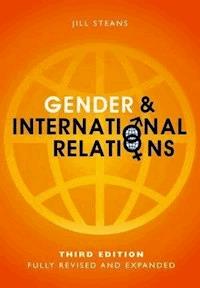
The third edition of Jill Steans’ popular and highly respected text offers a comprehensive and up to date introduction to gender in international relations today. Its nine chapters have been fully revised and expanded to cover key issues, developments and debates in the field including:
- the state and citizenship
- gender, sexuality and human rights
- conflict, peace and security
- narratives and representational practices in international politics
- global political economy
- development and gender in global governance
Guiding students competently through complex theoretical and conceptual issues, the book is careful to ground its discussions in contemporary concerns, such as the War on Terror and its legacy, the ‘securitisation’ of human rights, the Arab Spring, the global financial crisis, contemporary challenges to global institutions, and ethical dilemmas that arise in negotiating gender issues and politics in a culturally diverse world. Each chapter features questions for reflection, seminar activities, further reading and web links to highlight key points and provide contemporary illustrations. A glossary of key terms is also included for easy reference.
Gender and International Relations will be essential reading for students and scholars of gender, international relations, global politics and related courses.
Sie lesen das E-Book in den Legimi-Apps auf:
Seitenzahl: 592
Veröffentlichungsjahr: 2013
Ähnliche




















Gender and International Relations
Gender and International Relations
Theory, Practice, Policy
Third Edition
JILL STEANS
polity
Copyright © Jill Steans 2013
The right of Jill Steans to be identified as Author of this Work has been asserted in accordance with the UK Copyright, Designs and Patents Act 1988.
First published in 2013 by Polity Press
Polity Press65 Bridge StreetCambridge CB2 1UR, UK
Polity Press350 Main StreetMalden, MA 02148, USA
All rights reserved. Except for the quotation of short passages for the purpose of criticism and review, no part of this publication may be reproduced, stored in a retrieval system, or transmitted, in any form or by any means, electronic, mechanical, photocopying, recording or otherwise, without the prior permission of the publisher.
ISBN-13: 978-0-7456-7012-6
A catalogue record for this book is available from the British Library.
The publisher has used its best endeavours to ensure that the URLs for external websites referred to in this book are correct and active at the time of going to press. However, the publisher has no responsibility for the websites and can make no guarantee that a site will remain live or that the content is or will remain appropriate.
Every effort has been made to trace all copyright holders, but if any have been inadvertently overlooked the publisher will be pleased to include any necessary credits in any subsequent reprint or edition.
For further information on Polity, visit our website: www.politybooks.com
Contents
Acknowledgements
Introduction
1. Gender in International Relations
2. Feminist International Relations
3. States, Nations and Citizenship
4. Gender, Sexuality and Human Rights
5. Conflict, Peace and Violence
6. Security and Peacekeeping
7. Telling Stories
8. Global Political Economy
9. Global Governance
10. Transnational Feminist Politics
Conclusion
Glossary of Key Terms and Concepts
Notes
Extended Reading
Index
Acknowledgements
My thanks go to Olivia Mooney, Heather Owen, Nadia Siddiqui and Jochebed Fening who undertook literature searchers in a number of areas covered in the book. The resources which enabled this support were afforded to me by the Department of Political Science and International Studies (POLSIS), University of Birmingham. I would like to express my gratitude to three anonymous readers of the first draft of this manuscript; their helpful, insightful and constructive comments have, I hope, resulted in a much improved book. It is always a pleasure to work with Louise Knight at Polity Press. On this occasion I benefited from the assistance of David Winters too (also Polity Press). My thanks also go to Leigh Mueller for her thorough and efficient work at the copy-editing stage. Last, but not least, the writing of this book would not have been possible without the continuing love and support of Luke and Ria.
Introduction
The first edition of Gender and International Relations was published in 1998. At that time, there was a growing specialist literature on gender, inspired – initially – by a special issue of the journal Millennium devoted to the theme of ‘Gender and International Relations’1 (1988) and the publication of Cynthia Enloe’s engaging book Bananas, Beaches and Bases (1989).2 While gender studies and feminist theories had long been accommodated within other branches of the social sciences, prior to the appearance of these publications International Relations (IR) had not much noticed the relevance of gender in international relations/politics and had scarcely engaged with feminist theories or gender and sexuality studies.
The 1990s was also a significant decade with regard to gender issues in the practice of international politics. At the Fourth United Nations (UN) Conference on Women, held in Beijing in 1995, efforts to ‘mainstream’ gender into all substantive areas of international and national policy, which began at an earlier meeting in Nairobi, gained significant momentum. Since 1995, gender mainstreaming has given rise to a plethora of policies and some landmark developments in international law; for example, in human rights, asylum and humanitarian intervention.
Regardless of whether or not one regards gender as now ‘mainstream’, or (still) marginal,3 both within the academic study of IR and in the practice of international politics, the visibility of gender issues has been much heightened since the first edition of Gender in International Relations appeared.4 Over the same period of time, in addition to generating a specialized literature that covers all substantive areas of study in the discipline, feminist scholars have also contributed to substantive debates within IR theory. Whereas, in 1998, the production of a text on Gender and IR necessitated the mining of related fields of study, such as Sociology, Cultural Studies, Development Studies, Women’s Studies, Gender Studies, Political Science and International Law, and the synthesis of diverse literatures in order to create a discourse on gender in IR, this time around, the challenge has rather lain in deciding what to include and what to (reluctantly) omit from this book.
Ironically, even as ‘first-wave’ feminists in IR pointed to entrenched biases in the construction of the discipline and occasionally complained about marginalization, much (not all) of the earlier literature on gender in IR tended to centre on women in IR – the first two editions of Gender and International Relations included. This is not to say feminist scholars, or those who adopted an – ostensibly – impartial approach to gender, wholly conflated gender and women. Feminist theory is characterized by a conviction that gender is social, not a ‘natural’ or ‘essential’ trait or facet of identity. Moreover, gender is frequently understood in relational terms (how relations between women and men are constructed), or as discursively constructed. Therefore, men and masculinities have always figured in the study of gender in IR. However, from the publication of the Millennium special issue and Enloe’s landmark book onwards, early works on gender in IR tended to be driven – one way or another – by the project of making women visible in international politics.
There is, of course, nothing wrong with research projects that make women visible in the field. Moreover, the ‘gender as a variable’ approach can and might be legitimately put to the service of informing policy-making that is ‘women friendly’. This is an objective of many gender mainstreaming initiatives. However, as Terrell Carver5 has objected, gender is not a synonym for women. Since the mid-1990s, there have been debates that speak to the marginalization of men and masculinities in the literature on gender in IR. Whether or not this complaint was actually justified, at that time, is a moot point. Subsequently, there has certainly been an expanding literature on masculinities in IR. While it is acknowledged that the coverage of ‘gender’ in this book continues to reflect the prevalence of scholarship on women in IR, more space is afforded to contemporary work on men and masculinities.
The challenges involved in writing a book that reflects the breadth and diversity of contemporary work on gender in IR has been rendered all the more daunting by developments in the areas of sexuality in IR and in world politics. In regard to the latter, the early twenty-first century has seen significant developments in LGBT (Lesbian, Gay, Bi-Sexual and Transgender) rights. The Yogyakarta Principles,6 a set of international principles relating to gender identity, sexual orientation and human rights which affirm international legal standards, is a case in point. However, even as the critical interrogation of gender and sexuality was a part of the ‘first wave’ of feminist IR, it is an area that has been – and to a large extent still is – under-investigated in substantive research projects and, consequently, remains marginalized in much of the literature. Once again, this book attempts to counter the marginalization of gender and sexuality in the study of IR by including some discussion of both theoretical and policy approaches to gender and sexuality and by highlighting key developments and debates surrounding LGBT rights.
The major themes of this text, as the sub-title suggests, are theory, practice and policy. These themes serve as a useful organizing device, nicely encapsulating the content of subsequent chapters. The approach taken in this book is not theory driven, but theory does nevertheless inform discussions on the substantive issue areas and topics covered. Theory covers both theoretical approaches and debates that have informed the trajectory of development of the discipline of IR as a whole. While IR has a distinctive agenda and focus, it is but one strand of the social sciences. IR theorists, therefore, are necessarily engaged in larger, cross-cutting intellectual debates and theoretical discussions that have informed developments in social sciences and social theory as a whole. In this respect, feminist theories and theories on gender and sexuality are not ‘marginal’ at all, but are very much central to the social sciences, and should be recognized as such.
In the usages employed in this book, ‘practice’ refers to a range of things. While the discussion should not be rendered overly complex at this juncture, in a certain sense the act of theorizing is a form of practice. How we conceptualize, map and theorize gender has important consequences for how we adjudge the relevance of gender. How we think about gender, in turn, shapes the world in which we live. For example, if we take gender to be a variable, the knowledge generated by our research might better inform policy-making. However, while the reduction of gender to a category or variable is – arguably – necessary for the purpose of problem-solving, a different kind of ‘problem’ is thereby created. We exclude – and perhaps make invisible – social relations of gender and/or the discursive construction of gender and the practices by which gender is reproduced. Policy is implicated here. ‘Practice’ can also refer to the practices of states – in the making of war, in the conduct of diplomacy or in the design of foreign policy, for example. Alternatively, the term ‘practice’ might be used to describe the activities of non-state actors: social movements or non-governmental organizations (NGOs), who through acts of protest and dissent, or in their advocacy work and lobbying activities, try to influence events and make a difference in international relations.
The meaning of ‘policy’ is self-evident. However, the making of policy takes place in a variety of institutionalized contexts: in national parliaments, in regional organizations (the European Union, for example) and in international organizations. Consider here, for example, the significant influence that the International Monetary Fund (IMF) has exerted over the fiscal, monetary and, by extension, social and welfare policies of Greece, in this new age of financial crisis and austerity. Policy-making processes, the implementation of specific policies and the monitoring of policies similarly involve a range of ‘actors’, including elite decision makers within institutions and NGOs.
This book reflects both developments in the discipline and events in the ‘real world’. They are necessarily interconnected. In Chapters 1 and 2, the study of gender in international relations is introduced in a way that reflects the diversity of approaches. This will better enable the user of this book to contextualize and make sense of theoretical discussions encountered from time to time throughout this book. It will also enable the reader to appreciate better the empirical focus and import of work in discrete sub-fields, such as conflict or governance for example, covered in subsequent chapters. Chapter 1 is biased towards problem-solving approaches in the study of gender in IR. It includes, however, some discussion of critiques and criticisms of such approaches. Chapter 2 focuses on feminist IR specifically and also includes a brief introduction to current work on men and masculinities and gender identity and sexualities.
Chapter 3 is devoted to what is conventionally thought to be the very core of IR – the state and inter-national, inter-state relations. Here, the state is first defined as a ‘bounded community’. There then follows a discussion of the various ways in which state identities and boundaries are constructed and how gender is implicated in the construction and reproduction of boundaries and identities.
In Chapter 4, the focus turns to human rights. Human rights exemplify an alternative tradition of thinking in IR which necessarily engages with states and state practices, but which also challenges state-centric thinking. This is because discourse on human rights arises out of (ostensibly) universal values and cosmopolitan visions of international political organization and international society. In this chapter, these values and visions are grounded concretely in issues surrounding women’s rights and LGBT rights.
Chapter 5 is the first of two chapters that centre on peace, violence and security. This chapter engages current debates about the problematic construction of gender in discussions of conflict, peace and violence. Chapter 6 further develops the themes of conflict and peace. Here the scope of discussions initiated in chapter 5 is expanded to include security and peacekeeping. Theoretical concerns are elaborated in the context of concrete discussions of policy, notably United Nations Security Resolution 1325 (UNSCR1325). Greater coverage is afforded to critiques of policy and problem-solving measures in international relations, particularly gender mainstreaming. This chapter also affords some coverage of masculinities and issues of gender and sexuality in security and peacekeeping contexts.
Chapter 7 is something of a ‘stand-alone’ chapter in that it is not concerned with a discrete issue area or subject area in IR. It is rather concerned with (relatively) recent developments in IR theory – specifically narrative approaches (‘story-telling’) and representational practices. This includes, but is not limited to, how gender issues in international politics are represented and simultaneously constructed in the media and in cultural texts like films. The justification for including a chapter on narrative, discourse and practices of representation at this juncture is that it allows for a more lengthy discussion of complex methodological, ontological and epistemological issues. These discussions are grounded in narratives on and representations of the War on Terror.
Chapters 8 and 9 also form a discrete section of the book. Chapter 8 maps out the gendered nature of global political economy (GPE) and development. At the time of writing, the world is experiencing the shock waves of global financial crisis, the ripples of which are likely to continue to touch the lives of peoples across the world over the life of this text. It is important, therefore, to interrogate how gender both informs and is shaped by global political and economic processes.
Chapter 9 is devoted to the topic of global governance. Political economy and development are substantive areas of interest within the literature on global governance. Grounding discussions of global governance in the complexities of managing inter-related political, economic and social relations affords an opportunity to delve deeper into the role of international institutions and NGOs in the ‘governance’ of gender.
Chapter 10 is concerned with transnational political networks and attempts to forge political solidarity across national boundaries, concentrating specifically on the feminist movement. While focusing exclusively on feminism, the theoretical discussions of how transnational identities are constructed, the problem of unequal power relations between – in this case – women in different geographical and social locations throughout the world, and the recurring refrain that there is a need for a new, dialogic model and practice if the project of solidarity is to be realized, resonates in wider debates about transnational political action.
The conclusion briefly pulls together the core themes of the book as a whole, attempts to take stock of the field of gender and / gender in IR and anticipates possible future research trajectories.
The style of this book is very different from that of the first edition of Gender and International Relations. While part of the project to ‘gender IR’ necessitated the production of teaching texts, the first wave of literature had to do something more – create a discourse within the field. As such, earlier literature tended to take the form of ‘student friendly’ monographs or texts that were ‘hybrids’, so to speak: somewhere between efforts to synthesize literatures, concepts and theories that had been developed elsewhere and bringing them to bear on substantive issues and problems in IR. The task now is to produce a text that can reflect, and synthesize as far as possible current literatures and present the material in a student-friendly, coherent and, hopefully, accessible way. For this reason, this edition of Gender and International Relations includes more pedagogical features, such as bullet points and boxes that highlight key concepts, authors and debates and which also provide contemporary illustrations and examples.
The language of gender in IR can be challenging (epistemology, ontology and so forth). An attempt has been made herein to simplify discussions as far as possible, without falsely representing gender in IR and the literatures covered here as ‘easy’ to grasp. The discussions, arguments, debates and critiques set out in the following pages do require some effort to assimilate and understand. To assist in this task, in addition to highlighting key points and including boxes, further reading, questions for reflection and suggested seminar activities are included at the end of each chapter. An extended reading list is included at the end of the book. The author is aware that different audiences will use this book: students of IR and students in related fields of study who share an interest in world politics, but who are not necessarily schooled in the specific issues and debates that have preoccupied IR scholars. Therefore, some space has been afforded to the elaboration of the same, as and when adjudged helpful. Terms that require further explanation are highlighted in bold at first usage and included in a glossary of terms at the end of the book.
CHAPTER 1
Gender in International Relations
Introduction
This is the first of two chapters that introduce the study of gender in international relations. Taken together, these two introductory chapters convey a flavour of the many ways in which one can think about gender and a number of different ways in which gender can inform the study of world politics. In the first instance, this chapter follows the logic of a ‘common-sense’ approach to gender. That is, the chapter focuses on how gender conceived as difference informs both the theory and practice of international relations. To aid understanding, concepts and theoretical discussions are grounded in substantive issues and concrete examples are supplied and elaborated. The chapter concludes with a brief overview of the debate on the distinction between ‘bringing gender into’ problem-solving approaches in IR and feminist IR. Feminist IR is afforded in-depth attention in chapter 2.
Gender as Difference
In everyday usage, the terms ‘gender’ and ‘sex’ are often used interchangeably. Indeed, one might say that the belief that gender differences are rooted in ‘natural’ or biological difference between men and women, and so are essential differences, is so prevalent that the proposition is still often simply accepted as uncontroversial. In other words, the relationship between sex and gender and the ‘reality’ of essential gender difference is imbued as ‘common-sense.’
That gender is very often conflated with sex and the meaning of gender regarded as self-evident can be demonstrated by pointing to how beliefs about gender often give rise to prejudices against groups and individuals who confound gender stereotypes. In consequence, pejorative terms come to be attached to people and types of behaviour that do not conform to this common-sense view of the relationship between biological sex differences and gender differences. Thus ‘masculine’ women might be derided for acting ‘butch’, empathetic men might be labelled ‘effeminate’, homosexuals characterized as ‘queer’ and so on. People who do not conform to widely held gender stereotypes might be castigated as odd, or deviant, or might even be represented as posing a threat or danger to mainstream society.
CONCEPT
Intersex
Upon hearing that a friend or relative has given birth to a baby, one of the first questions usually asked is: Is it a boy or a girl? Having established the biological sex of a child, it is also very common for friends and relatives then to buy gifts that are deemed appropriate given the gender of the newborn baby. Sex and gender stereotyping begins in the very first hours and days of life and continues thereafter.
For very many people, however, the question boy or girl? is not so easy to answer. It is estimated that in one in every 2,000 births, the sex of the child is indeterminate. Children born with a physiology or anatomy that differs from conventional notions of what constitutes a ‘normal’ male or female are referred to as intersex people.1 The condition is actually relatively common: as common as the incidence of the birth of twins. It is estimated that, in a city the size of London or New York, there will be some 100,000 people who were born intersex.2
Socially and culturally determined ideas about what is ‘normal’ and ‘abnormal’ in regard to sex and gender create tremendous psychological and social problems for intersex people (and their parents and other family members) as they try to come to terms with ‘difference’. There remains considerable ignorance surrounding the condition in societies at large. It is common for intersex people to be put under pressure to undergo surgery or some other form of medical intervention, and such is the stigma surrounding intersex that people are often denied information about their condition at birth. Today, intersex is regarded as much as a social issue as a personal one. More support groups and services are available to intersex people and their families that not only offer advice and support to individuals, but also make efforts to educate better the population at large about intersex in order to address and remove the ignorance, prejudice and social stigmatization that intersex people encounter.
Throughout history, the claim has been made that women and men are fundamentally different from one another. Very often this notion of difference has been used to support the claim that women are inferior to men. Claims about women’s inferiority alert us to the deeper issues of power that are necessarily encountered when one begins to interrogate the meaning of gender. The Greek philosopher Aristotle held that the masculine was an active, creative force, while the feminine was passive.3 Those who defend Aristotle point out that he placed equal emphasis on women’s and men’s happiness, which he thought to be vital to a good society. Nevertheless, from Aristotle onwards, the history of Western philosophical, social and political thought has been characterized by a strong and recurring theme: women and men are different and this difference matters.
From the seventeenth century onwards, the emergence of capitalism in Western states gave rise to a body of liberal political thought. In the eighteenth century, an emerging middle class began to demand that state power be circumscribed in regard to the ‘private realm’ of the family and the market. This increasingly influential class of people also demanded political and legal rights and political representation. Such claims were couched in the language of rationalism: rights claims were rooted in what liberals argued to be the universal human capacity for rational thought which meant that people were able to determine their own best interests and stake a claim to a share in political power. In practice, however, the state granted rights to only a narrow group of people – white, middle-class and upper-class men who, as property owners, were recognized as holding a stake in the political community; others were excluded. Women, along with men from specific social groups – working-class men and, in some cases, men from ethnic minority groups – were denied access to political power, legal personality and citizenship and excluded from public life (denied the right to vote or seek public office). Moreover, this ‘universal’ capacity for rational thought was, in practice, only ever applied to men – rationality was deemed to be a masculine characteristic. The justification for excluding women from public and political life and the subjugation of women to male authority was that women were not ‘rational’ beings, but rather ‘irrational’, driven by their emotions. Therefore, women were unable to make autonomous choices and look out for their own interests – in other words, women were in need of protection.
Lesen Sie weiter in der vollständigen Ausgabe!
Lesen Sie weiter in der vollständigen Ausgabe!
Lesen Sie weiter in der vollständigen Ausgabe!
Lesen Sie weiter in der vollständigen Ausgabe!
Lesen Sie weiter in der vollständigen Ausgabe!
Lesen Sie weiter in der vollständigen Ausgabe!
Lesen Sie weiter in der vollständigen Ausgabe!
Lesen Sie weiter in der vollständigen Ausgabe!
Lesen Sie weiter in der vollständigen Ausgabe!
Lesen Sie weiter in der vollständigen Ausgabe!
Lesen Sie weiter in der vollständigen Ausgabe!
Lesen Sie weiter in der vollständigen Ausgabe!
Lesen Sie weiter in der vollständigen Ausgabe!
Lesen Sie weiter in der vollständigen Ausgabe!




