


188,99 €
Mehr erfahren.
- Herausgeber: John Wiley & Sons
- Kategorie: Fachliteratur
- Sprache: Englisch
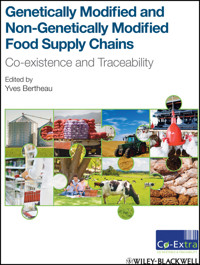
In the European Union nations, and other countries including Japan, Australia and Malaysia, it is a legal requirement that food products containing genetically modified organism (GMO) materials are labelled as such in order that customers may make informed purchasing decisions. For manufacturers and consumers to be confident about these assertions, systems must be in place along the entire food chain which support the co-existence of GM and non GM materials whilst maintaining a strict segregation between the two.
This book is an output of a European Union-funded project entitled "Co-Extra: GM and non-GM food and feed supply chains: their Co-Existence and Traceability". The objective of this four year project is to provide practical tools and methods for implementing co-existence that will:
- enable the co-existence of genetically modified (GM) and non-GM crops
- enable the segregation and tracing of genetically modified organism (GMO) materials and derived products along the food and feed chains
- anticipate the future expansion of the use of GMOs
The project is designed to foster a robustly science-based debate amongst all of the stakeholders involved in the food and feed chains, and the tools will be assessed not only from a technical point of view but with regard to the economic and legal aspects. It also surveys the GMO-related legal regimes and practices that exist in and beyond the EU.
This book examines the practical tools and methods available to implement the co-existence and traceability of GM and non-GM food materials along the entire food and feed chains, as demanded by consumers and by legislation in force in the EU and elsewhere. GM and Non-GM Supply Foods is a source of valuable information for food manufacturers, food research institutions and regulatory bodies internationally.
Sie lesen das E-Book in den Legimi-Apps auf:
Seitenzahl: 1933
Veröffentlichungsjahr: 2012
Ähnliche



















Table of Contents
Cover
Dedication
Title page
Copyright page
List of Contributors
Foreword
Part 1: Introduction
1 Introduction to the GM and Non-GM Supply Chain Co-Existence and Traceability
1.1 INTRODUCTION
1.2 GMO DEVELOPMENT
1.3 OPINIONS AND ATTITUDES OF EUROPEAN CITIZENS AND CONSUMERS
1.4 THE DIFFERENT REGULATORY FRAMES AND RISK PERCEPTION
1.5 EUROPEAN TRACEABILITY AND CO-EXISTENCE FRAMES
1.6 OTHER ISSUES
1.7 CONCLUSION
Part 2: Managing Gene Flow
2 Contributions of Pollen and Seed to Impurity in Crops – A Comparison of Maize, Oilseed Rape and Beet
2.1 INTRODUCTION
2.2 MAIZE
2.3 OILSEED RAPE
2.4 BEET
2.5 COMPARISON OF SPECIES BASED ON PLANT TRAITS
3 Co-Existence Issues of GM Sugar Beet
3.1 INTRODUCTION
3.2 SUGAR BEET IN THE WORLD
3.3 OVERVIEW OF SUGAR BEET BIOLOGY AND AGRONOMY
3.4 PRE-CULTIVATION CO-EXISTENCE ISSUES
3.5 CONSEQUENCES OF CO-EXISTENCE FOR THE CROPPING SYSTEM IN A REGION
3.6 CONSEQUENCES OF CO-EXISTENCE FOR THE GENETIC RESOURCES
3.7 POST-HARVEST CO-EXISTENCE ISSUES
3.8 CONCLUSION
4 Ex Ante Evaluation of Gene Flow in Oilseed Rape with Cropping System Models
4.1 INTRODUCTION
4.2 MODELLING APPROACH
4.3 THE SIMULATION METHODOLOGY
4.4 PERSPECTIVES
5 Biological Containment Strategies for Transgenic Crops
5.1 INTRODUCTION
5.2 AUXOTROPHY
5.3 INHIBITION OF FLOWERING AND COMPLETE STERILITY
5.4 CLEISTOGAMY
5.5 TRANSGENE EXCISION
5.6 CHLOROPLAST TRANSFORMATION
5.7 MALE STERILITY
5.8 PARTHENOCARPY
5.9 APOMIXIS
5.10 REDUCED SHATTERING
5.11 BLOCKING SEED GERMINATION
5.12 INHIBITING SEED DORMANCY
5.13 TRANSGENIC MITIGATION
5.14 CONCLUDING REMARKS
6 Long-Distance Pollen Flow in Large Fragmented Landscapes
6.1 INTRODUCTION
6.2 EVIDENCE FOR LONG-DISTANCE CROSS-POLLINATION OF MAIZE
6.3 MODELLING REGIONAL POLLEN TRANSPORT
6.4 MODEL EVALUATION
6.5 SIMULATED REGIONAL POLLEN DISPERSAL
6.6 CONCLUSIONS AND PERSPECTIVES
7 Current and Future Availability of Non-Genetically Modified Soybean Seeds in the USA, Brazil and Argentina
7.1 INTRODUCTION
7.2 GLOBAL OVERVIEW OF THE SOYBEAN AND SOYBEAN SEED MARKETS AND RELATED SHORT-TERM ISSUES
7.3 SOYBEAN PLANT BREEDING AND AVAILABILITY OF NON-GM SOYBEAN SEEDS
7.4 THE FUTURE OF NON-GM PLANT BREEDING
7.5 CONCLUSION
Part 3: Co-Existence in Food and Feed Supply Chains
8 Consumers’ Opinions and Attitudes Towards Co-Existence of GM and Non-GM Food Products
8.1 INTRODUCTION
8.2 STUDY METHODOLOGY
8.3 LITERATURE REVIEW RESULTS
8.4 CONSUMER SURVEY RESULTS
8.5 CONCLUSIONS
9 Evaluation of Collection Strategies for Landscape and Product Flow Management
9.1 INTRODUCTION
9.2 EVALUATION OF CO-EXISTENCE MANAGEMENT STRATEGIES FOR GRAIN MERCHANTS
9.3 EVALUATION OF COLLECTION STRATEGIES AT THE LANDSCAPE LEVEL
9.4 CONCLUSION
10 Empirical Analysis of Co-Existence in Commodity Supply Chains
10.1 INTRODUCTION
10.2 FRAMEWORK
10.3 METHODOLOGY
10.4 RESULTS
10.5 CONCLUSION
11 Modelling and Assessing the Impacts of the Co-Existence Between GM and non-GM Supply Chains: The Starch Maize Supply Chain Example
11.1 INTRODUCTION
11.2 MATERIAL FLOW AND RISKS OF COMMINGLING IN THE STARCH MAIZE SUPPLY CHAIN
11.3 MODEL DESCRIPTION
11.4 SENSITIVITY ANALYSIS
11.5 RESULTS AND DISCUSSION
11.6 CONCLUSION
12 Costs of Segregation and Traceability Between GM and Non-GM Supply Chains of Single Crop and Compound Food/Feed Products
12.1 OBJECTIVES
12.2 INTRODUCTION AND REGULATORY FRAMEWORK
12.3 METHODOLOGY
12.4 RESULTS
12.5 CONCLUSIONS
13 Labelling and Co-Existence Regulation of GMOs and Non-GMOs: An Economic Perspective
13.1 INTRODUCTION
13.2 TO WHAT EXTENT DO CONSUMERS VALUE NON-GM GOODS OVER GM GOODS AND WHY?
13.3 LABELLING MAY IMPROVE WELFARE BUT IS NOT A FIRST-RANK POLICY TO ADDRESS CONSUMER CONCERNS
13.4 EXTERNALITY COSTS OF CO-EXISTENCE WITHOUT A CO-EXISTENCE REGULATION
13.5 CO-EXISTENCE REGULATION
13.6 CONCLUSION
APPENDIX
14 Co-Existence and Traceability in Supply Chains: A Case Study on Belgian Compound Feed
14.1 COMPOUND FEED PRODUCTION
14.2 TRACEABILITY AND SEGREGATION SYSTEMS
14.3 OTHER COSTS AND BENEFITS ALONG THE SUPPLY CHAIN
14.4 CHANGING STRATEGIES
14.5 CONCLUSION
Part 4: Traceability and Controls in Food and Feed Supply Chains
15 GMO Sampling Strategies in Food and Feed Chains
15.1 INTRODUCTION
15.2 THE EC RECOMMENDATION 2004/787: METHODOLOGIES, APPLICATIONS AND LIMITATIONS
15.3 CO-EXTRA RESULTS FOR DIFFERENT SCENARIOS OF THE FOOD AND FEED CHAIN
15.4 CONCLUSION
16 Harmonised Reference Genes and PCR Assays for GMO Quantification
16.1 INTRODUCTION: REGULATORY FRAMEWORK ON REFERENCE ASSAYS
16.2 OVERVIEW OF EXISTING REFERENCE ASSAYS
16.3 RELIABILITY TESTING OF EXISTING REFERENCE ASSAYS
16.4 HARMONISED DEFINITIONS, TERMINOLOGY AND TECHNICAL CRITERIA FOR DESIGNING NEW REFERENCE ASSAYS
16.5 CORE COLLECTIONS FOR SPECIFICITY, UNIFORMITY AND STABILITY TESTING OF REFERENCE ASSAYS FOR GMO QUANTIFICATION
16.6 CONCLUSION
17 The Modular Approach in GMO Quality Control and Enforcement Support Systems
17.1 ENFORCING THE LEGAL GMO FRAMEWORK BY HARMONISED CONTROL ANALYSIS
17.2 VALIDATION OF GMO TEST METHODS: A MODULAR VERSUS A GLOBAL APPROACH
17.3 CO-EXTRA ASSESSMENT OF THE MODULAR APPROACH IN GMO ANALYSIS
17.4 DECISION SUPPORT SYSTEMS (DSS) WITHIN A MODULAR APPROACH
17.5 MODULAR APPROACHES AND ENFORCEMENT IMPLEMENTATION
17.6 CONCLUSION
18 Reliability and Cost of GMO Detection
18.1 INTRODUCTION
18.2 ACCURATE DETERMINATION OF THE LIMIT OF DETECTION ASSOCIATED WITH GMO ANALYSIS
18.3 IMPROVEMENTS IN THE LIMIT OF QUANTIFICATION
18.4 RELIABILITY OF GMO QUANTIFICATION
18.5 DNA EXTRACTION FROM HIGHLY PROCESSED MATRIXES
18.6 EVALUATION OF ALTERNATIVE CHEMISTRIES IN REAL-TIME PCR
18.7 EVALUATION OF DIFFERENT MACHINES FOR GMO QUANTIFICATION BY REAL-TIME PCR
18.8 EVALUATION OF AUTOMATION POTENTIAL IN GMO DETECTION
18.9 CONCLUSIONS AND PERSPECTIVES
19 New Multiplexing Tools for Reliable GMO Detection
19.1 INTRODUCTION
19.2 FROM DUPLEX TO OLIGOPLEX PCR
19.3 NON-PCR METHODS
19.4 HIGH GRADE MULTIPLEX APPROACHES
19.5 CONCLUSIONS
20 Towards Detection of Unknown GMOs
20.1 INTRODUCTION
20.2 CLASSIFICATIONS OF GMOs RELEVANT TO DETECTION
20.3 DETECTION OF GMOs – A SHORT REVIEW
20.4 DETECTION OF UNAUTHORISED GMOs
20.5 DETECTION OF UNKNOWN GMOs
20.6 CONCLUSION
21 Method Validation and Reference Materials
21.1 THE CONCEPT OF VALIDATION
21.2 SINGLE LABORATORY VALIDATION
21.3 COLLABORATIVE VALIDATION OF METHODS
21.4 INNOVATIVE STATISTICAL APPROACHES FOR METHOD VALIDATION
21.5 THE MODULAR APPROACH
21.6 THE USE OF CRMs (CERTIFIED REFERENCE MATERIALS) AND POSSIBLE ALTERNATIVES IN VIEW OF STANDARDISATION AND ACCREDITATION
21.7 ADDRESSING THE COMPATIBILITY OF THE CONTROL PLANS THROUGHOUT THE CHAINS
21.8 CONCLUSION AND PERSPECTIVES
Part 5: Legal Regimes, Liability and Redress Issues
22 Liability and Redress Options for Damage Caused by GMOs
22.1 INTRODUCTION
22.2 PREVENTION OF FUTURE HARM
22.3 REDRESS FOR DAMAGE
22.4 OUTLOOK
23 Legal Issues, an Overview on Co-Existence Policies: Technological Pluralism, Confidence Economy, Transnational Supply Chains
23.1 INTRODUCTION
23.2 THE JURIDICAL NATURE OF CO-EXISTENCE POLICY
23.3 KEYPOINTS OF SUPPLY CHAIN STRUCTURING
23.4 IMPORT SUPPLY CHAINS AND GMOs
23.5 A LIABILITY SYSTEM ADAPTED TO A CONTROVERSIAL TECHNOLOGY
23.6 CONCLUSION
24 The Judge’s Role Concerning Science in Precautionary Measures: A Shift from Guide to Arbitrator
24.1 INTRODUCTION
24.2 THE JUDGE: A GUIDE TO ADMINISTRATIVE ACTION
24.3 JUDGES AS ARBITRATORS OF SCIENTIFIC ASSESSMENTS?
24.4 CONCLUSION
Part 6: Data Integration and DSS
25 The Co-Extra Decision Support System: A Model-Based Integration of Project Results
25.1 INTRODUCTION
25.2 APPROACH AND METHODOLOGY
25.3 COMPONENTS OF THE CO-EXTRA DSS
25.4 ASSESSMENT OF ANALYTICAL METHODS
25.5 ASSESSMENT OF SAMPLING METHODS
25.6 ASSESSMENT OF PRODUCTS USING TRACEABILITY DATA
25.7 ASSESSMENT OF PROCESSES
25.8 DATABASE AND WEB-BASED IMPLEMENTATION
25.9 CONCLUSIONS
Part 7: Related Issues
26 Integration of Co-Extra Results in EU Tools for Traceability
26.1 OVERVIEW OF EU LEGISLATION ON GMOs
26.2 ACHIEVEMENTS IN THE EU HARMONISATION OF GMO ANALYSIS
26.3 CHALLENGES AHEAD
26.4 CONCLUSION
27 Labelling and Detection of GM Crops and Derived Products: Regulatory Frameworks and Research Issues in East Asia
27.1 INTRODUCTION
27.2 PEOPLE’S REPUBLIC OF CHINA
27.3 KOREA
27.4 TAIWAN
27.5 JAPAN
27.6 CONCLUSION
28 Maintaining a Supply of Non-GM Feed – A Strategic Issue for European Regional Agriculture
28.1 INTRODUCTION
28.2 THE GMO-FREE REGIONS NETWORK
28.3 THE FEED QUESTION: A MAJOR ISSUE FOR REGIONAL AGRICULTURE
28.4 GMO-FREE AGRICULTURE, A VITAL ISSUE FOR REGIONS
28.5 GETTING A SOLID STRATEGIC AND TACTICAL BACKGROUND: LESSONS FROM THE COLD WAR
28.6 AN ESSENTIAL QUESTION: WHO DECIDES ON THE DEFINITION OF A MARKET?
29 A Geographical Approach to the European Policy for the Co-Existence of GMO and Non-GMO Crops
29.1 INTRODUCTION
29.2 EU SCENARIOS FOR THE CO-EXISTENCE OF GM AND NON-GM CROPS
29.3 DEDICATED AREAS – A GEOGRAPHICAL ANALYSIS
29.4 A FEW LINES FOR THOUGHT WITH REGARD TO CO-EXISTENCE IN TERRITORIES
29.5 CONCLUSION
30 Segregating Supply Chains: a Cost–Benefit Perspective
30.1 INTRODUCTION
30.2 SOCIAL BENEFITS OF CO-EXISTENCE
30.3 CONSUMER VALUATION OF GMO-FREE FOODS
30.4 BACKGROUND ON DEVELOPMENTS IN NORTH AMERICAN WHEAT
30.5 COSTS OF SEGREGATING WHEAT TO CONFORM TO EU TRACEABILITY STANDARDS
30.6 CONTRACT MECHANISMS TO FACILITATE CO-EXISTENCE
30.7 SUMMARY AND IMPLICATIONS
30.8 CONCLUSION
31 Co-Existence and Traceability in the EU Versus IP Systems in Third Countries
31.1 INTRODUCTION
31.2 MERCOSUR AND EUROPE: DIFFERENT BUT COMPLEMENTARY
31.3 THE GM SOYBEANS IN MERCOSUR
31.4 FOOD REGULATION
31.5 EU, MERCOSUR AND TRACEABILITY
31.6 CONTRACTS AND PRIVATE REGULATIONS
31.7 THIRD PARTY CERTIFICATION COMPANIES, THE KEY PLAYERS
31.8 THE TRADERS’ ROLE
31.9 FINAL CONSIDERATIONS
Part 8: Conclusion
32 GM and Non-GM Supply Chain Co-Existence and Traceability: Context and Perspectives
32.1 INTRODUCTION
32.2 BACKGROUND
32.3 CO-EXISTENCE
32.4 TRACEABILITY
32.5 CONCLUSION
Index
This book is dedicated to:
Sylvie who illuminates my life and supports me every day,
my parents and grandparents without whom nothing would have been.
Yves Bertheau
This edition first published 2013 © 2013 by Blackwell Publishing Ltd.
Blackwell Publishing was acquired by John Wiley & Sons in February 2007. Blackwell’s publishing program has been merged with Wiley’s global Scientific, Technical and Medical business to form Wiley-Blackwell.
Registered office: John Wiley & Sons, Ltd, The Atrium, Southern Gate, Chichester, West Sussex, PO19 8SQ, UK
Editorial offices: 9600 Garsington Road, Oxford, OX4 2DQ, UK
The Atrium, Southern Gate, Chichester, West Sussex, PO19 8SQ, UK
2121 State Avenue, Ames, Iowa 50014-8300, USA
For details of our global editorial offices, for customer services and for information about how to apply for permission to reuse the copyright material in this book please see our website at www.wiley.com/wiley-blackwell.
The right of the authors to be identified as the authors of this work has been asserted in accordance with the UK Copyright, Designs and Patents Act 1988.
All rights reserved. No part of this publication may be reproduced, stored in a retrieval system, or transmitted, in any form or by any means, electronic, mechanical, photocopying, recording or otherwise, except as permitted by the UK Copyright, Designs and Patents Act 1988, without the prior permission of the publisher.
Designations used by companies to distinguish their products are often claimed as trademarks. All brand names and product names used in this book are trade names, service marks, trademarks or registered trademarks of their respective owners. The publisher is not associated with any product or vendor mentioned in this book. This publication is designed to provide accurate and authoritative information in regard to the subject matter covered. It is sold on the understanding that the publisher is not engaged in rendering professional services. If professional advice or other expert assistance is required, the services of a competent professional should be sought.
Library of Congress Cataloging-in-Publication Data
Genetically modified and non-genetically modified food supply chains : co-existence and traceability / edited by Yves Bertheau, Research Director, Institut National de la Recherche Agronomique (INRA), France.
pages cm
Includes bibliographical references and index.
ISBN 978-1-4443-3778-5
1. Genetically modified foods. 2. Food supply. I. Bertheau, Yves, editor of compilation.
TP248.65.F66G4573 2012
664–dc23
2012010718
A catalogue record for this book is available from the British Library.
Wiley also publishes its books in a variety of electronic formats. Some content that appears in print may not be available in electronic books.
Cover images (clockwise): © iStockphoto.com/YangYin; © iStockphoto.com/webphotographeer; © iStockphoto.com/AVTG; © iStockphoto.com/sansubba; © iStockphoto.com/Tupungato; © iStockphoto.com/R-J-Seymour; © iStockphoto.com/4774344sean; © iStockphoto.com/TommL
Cover design by www.hisandhersdesign.co.uk
List of Contributors
T. AllnuttThe Food and Environment Research Agency, York, UK
F. AngevinInstitut National de la Recherche Agronomique (INRA), Thiverval-Grignon, France
S. AnvarCentre de Recherche en Droit des Sciences et Techniques, Université Paris I, CNRS, Paris, France
A. AudranArvalis – Institut du végétal, Montardon, France
M. AyadiInstitut National de la Recherche Agronomique (INRA), Versailles, France
V. BaetenCRA-W, Centre wallon de Recherches agronomiques, Gembloux, Belgium
C. BahrdtEurofins GeneScan GmbH, Freiburg, Germany
N. BarguesCentre de Recherche en Droit des Sciences et Techniques, Université Paris I, CNRS, Paris, France
S. BaumlerEurofins GeneScan GmbH, Freiburg, Germany
G. BellocchiJRC-IHCP, European Commission Joint Research Centre, Institute for Health and Consumer Protection-Molecular Biology and Genomics, Ispra, Italy
G. BerbenCRA-W, Centre wallon de Recherches agronomiques, Gembloux, Belgium
K.G. BerdalNational Veterinary Institute, Oslo, Norway
Y. BertheauInstitut National de la Recherche Agronomique (INRA), Versailles, France
J. BezFhG-IVV, Fraunhofer-Gesellschaft zur Förderung der angewandten Forschung, Institute of Process Engineering and Packaging, Freising, Germany
A. BlejecNational Institute of Biology, Ljubljana, Slovenia
M. BohanecJožef Stefan Institute, Department of Knowledge Technologies, Ljubljana, Slovenia; University of Nova Gorica, Nova Gorica, Slovenia
J. BohlinNational Veterinary Institute, Oslo, Norway
M. BoninCentre de Recherche en Droit des Sciences et Techniques, Université Paris I, CNRS, Paris, France
R. BourgierInstitut National de la Recherche Agronomique (INRA), Thiverval-Grignon, France
K. BoutilierBioscience Business Unit, Plant Research International, Wageningen University and Research Center, Wageningen, Netherlands
C. Bøydler AndersenNational Veterinary Institute, Oslo, Norway
C. BreraISS, National Institute of Health, Rome, Italy
P. BrodmannBiolytix, Witterswil, Switzerland
Y. BrunetInstitut National de la Recherche Agronomique (INRA), Villenave d’Ornon, France
M. Buh GašpariNational Institute of Biology (NIB), Department of Biotechnology and Systems Biology, Ljubljana, Slovenia
M. BurnsLaboratory of the Government Chemist, Analytical Technology, London, UK
A.M. BurrelLaboratory of the Government Chemist, Analytical Technology, London, UK
K. CankarNational Institute of Biology (NIB), Department of Biotechnology and Systems Biology, Ljubljana, Slovenia
G. CanselierCentre de Recherche en Droit des Sciences et Techniques, Université Paris I, CNRS, Paris, France
Z. ergan (Deceased)Agricultural Institute of Slovenia, Ljubljana, Slovenia†
M. ChaouachiInstitut National de la Recherche Agronomique (INRA), Versailles, France
N. ColbachInstitut National de la Recherche Agronomique (INRA), Dijon, France
F.C. ColénoInstitut National de la Recherche Agronomique (INRA), Thiverval-Grignon, France
A. CollInstitute of Agro-Food Technology INTEA, Universitat de Girona, Girona, Spain
J. CopelandThe Food and Environment Research Agency, York, UK
M. Costa-FontCREDA-UPC-IRTA, Barcelona, Spain
H. DarmencyInstitut National de la Recherche Agronomique (INRA), Dijon, France
J. DavisonInstitut National de la Recherche Agronomique (INRA), Versailles, France (retired)
S. DayauInstitut National de la Recherche Agronomique (INRA), Villenave d’Ornon, France
R.A. de MaagdBioscience Business Unit, Plant Research International, Wageningen University and Research Center, Wageningen, Netherlands
M. de GiacomoISS, National Institute of Health, Rome, Italy
M. de VivoISS, National Institute of Health, Rome, Italy
M. DebeljakJožef Stefan Institute, Ljubljana, Slovenia
S. DelageInstitut National de la Recherche Agronomique (INRA), Villenave d’Ornon, France
S. DesmoulinCentre de Recherche en Droit des Sciences et Techniques, Université Paris I, CNRS, Paris, France
M. DesquilbetToulouse School of Economics and Institut National de la Recherche Agronomique (INRA), Toulouse, France
D. DobnikDept. of Biotechnology and Systems Biology, National Institute of Biology, Ljubljana, Slovenia
S. DupontInstitut National de la Recherche Agronomique (INRA), Villenave d’Ornon, France
M. EeckhoutDepartment of Food Science and Technology, Faculty of Applied Bio-Sciences Engineering, University College Ghent, Belgium
J. EscobarLaboratoire d’Aérologie, Toulouse, France
T. EsteveCentre de Recerca en Agrigenòmica (CRAG), Barcelona, Spain; Consorci CSIC-IRTA and IBMB-CSIC, Barcelona, Spain
J.A. Fernandez PiernaCRA-W, Centre wallon de Recherches agronomiques, Gembloux, Belgium
X. FoueillassarArvalis – Institut du végétal, Montardon, France
R. FreyerEurofins GeneScan GmbH, Freiburg, Germany
A. GabrielStraubing Center of Science, Weihenstephan-Triesdorf University of Applied Sciences, Germany
D. GarrigouInstitut National de la Recherche Agronomique (INRA), Villenave d’Ornon, France
G. GhezanINTA, Instituto Nacional de Tecnología Agropecuaria, Argentina
J.M. GilCREDA-UPC-IRTA, Barcelona, Spain
E. GlonLille University of Science and Technology, Department of Geography and Town and Country Planning, TVES laboratory, Villeneuve d’Ascq, France
R. GreenInstitut National de la Recherche Agronomique (INRA), Ivry-sur-Seine, France (retired)
K. GrudenDepartment of Biotechnology and Systems Biology, National Institute of Biology (NIB), Ljubljana, Slovenia
N. GrysonDepartment of Food Science and Technology, Faculty of Applied Bio-Sciences Engineering, University College Ghent, Belgium
D. GuyonInstitut National de la Recherche Agronomique (INRA), Villenave d’Ornon, France
M. GyllingFOI, Institute of Food and Resource Economics, University of Copenhagen, Denmark
S. HamelsEAT, Eppendorf Array Technologies SA, Namur, Belgium
J.K. HammittHarvard Center for Risk Analysis, Harvard School of Public Health, Harvard University, Boston, USA
M.-A. HermitteCentre de Recherche en Droit des Sciences et Techniques, Université Paris I, CNRS, Paris, France
A. HolckNofima mat AS, Aas, Norway
A. Holst-JensenNational Veterinary Institute, Oslo, Norway
A. HüskenJulius Kühn Institute, Federal Research Centre for Cultivated Plants (JKI), Institute for Biosafety of Genetically Modified Plants, Braunschweig, Germany
E. JanssenCRA-W, Centre wallon de Recherches agronomiques, Gembloux, Belgium
K. KittaNational Food Research Institute, Ibaraki, Japan
B.A. KochInstitut für Zivilrecht, Universität Innsbruck, Innsbruck, Austria
E.J. KokRIKILT Wageningen UR, Wageningen, The Netherlands
P. KozjakAgricultural Institute of Slovenia, Ljubljana, Slovenia
A. KrechEurofins GeneScan GmbH, Freiburg, Germany.
A.B. KristoffersenNational Veterinary Institute, Oslo, Norway
B.-J. KuoNational Chung Hsing University, Taichung, Taiwan
B. KuznetzovCenter Bioengineering RAS, Russia
J.L. La PazCentre de Recerca en Agrigenòmica CSIC-IRTA-UAB (CRAG), Barcelona, Spain
C. LacCNRM, Météo-France, Toulouse, France
A. LanglaisCentre de Recherche en Droit des Sciences et Techniques, Université Paris I, CNRS, Paris, France
A. LarsenFOI, Institute of Food and Ressource Economics, University of Copenhagen, Denmark
V. LavalInstitut National de la Recherche Agronomique (INRA), Versailles, France
R. LayadiConseil Régional de Bretagne, Rennes, France
M. Le BailInstitut National de la Recherche Agronomique (INRA), and AgroParisTech, Thiverval-Grignon, France
J. LecomteUniversité Paris-Sud; CNRS, Orsay, and AgroParisTech, Paris, France
B. LécroartInstitut National de la Recherche Agronomique (INRA), Thiverval-Grignon, France
C.-H. LeeRural Development Administration, Suwon, Korea
D. LeeNational Institute of Agricultural Botany, Cambridge, UK
S-H. LeeNational Agricultural Products Quality Management Service, Korea
S. LeimanisEAT, Eppendorf Array Technologies SA, Namur, Belgium
F. LeprinceArvalis – Institut du végétal, Montardon, France
M. LøvollNational Veterinary Institute, Oslo, Norway
A. LøvsethNational Veterinary Institute, Oslo, Norway
J. Luis La PazConsorci CSIC-IRTA and IBMB-CSIC, Barcelona, Spain
R. MacarthurThe Food and Environment Research Agency, York, UK
M. MaciejczakWarsaw University of Life Sciences - SGGW, Poland
A. MalcevschiDepartment of Environmental Sciences, University of Parma, Parma, Italy
N. MarmiroliDepartment of Environmental Sciences, University of Parma, Parma, Italy.
M. MazzaraJRC-IHCP, European Commission Joint Research Centre, Institute for Health and Consumer Protection, Ispra, Italy
V. MegliAgricultural Institute of Slovenia, Ljubljana, Slovenia
E. MeléCentre de Recerca en Agrigenòmica (CRAG), Barcelona, Spain
K. MenradStraubing Center of Science, Weihenstephan-Triersdorf University of Applied Sciences, Germany
A. MesséanInstitut National de la Recherche Agronomique (INRA), Thiverval-Grignon, France
J. MesseguerCentre de Recerca en Agrigenòmica (CRAG), Barcelona, Spain
M. MiragliaISS, National Institute of Health, Rome, Italy
J. MilanesiToulouse School of Economics and Institut National de la Recherche Agronomique (INRA), Toulouse, France
D. MorissetDepartment of Biotechnology and Systems Biology, National Institute of Biology, Ljubljana, Slovenia
A. NadalCentre de Recerca en Agrigenòmica (CRAG), Barcelona, Spain; Institute of Agro-Food Technology INTEA, Universitat de Girona, Girona, Spain
A. NemethEurofins GeneScan GmbH, Freiburg, Germany
C. NoivilleCentre de Recherche en Droit des Sciences et Techniques, Université Paris I, CNRS, Paris, France
R. OgerUniversity of Parma, Italy
R. OnoriISS, National Institute of Health, Rome, Italy
E. PalmaccioISS, National Institute of Health, Rome, Italy
N. PapazovaScientific Institute of Public Health (IPH), Section Biosafety and Biotechnology, Brussels, Belgium; ILVO, Institute for Agricultural and Fisheries Research, Merelbeke, Belgium
E. ParlouerService Commun des Laboratoires, Strasbourg, France
V. PelaezUniversidade Federal do Paraná, Paraná Institute of Technology (Tecpar), Brazil
N. PenselINTA, Instituto Nacional de Tecnología Agropecuaria, Argentina
J.-P. PintyLaboratoire d’Aérologie, Toulouse, France
M. PlaCentre de Recerca en Agrigenòmica (CRAG), Barcelona, Spain; Institute of Agro-Food Technology INTEA, Universitat de Girona, Girona, Spain
D. PlanJRC-IHCP, European Commission Joint Research Centre, Institute for Health and Consumer Protection, Ispra, Italy
V. PlanchonCRA-W, Centre wallon de Recherches agronomiques, Unit of Biometry, Data processing and Agrometeorology, Belgium
S. PoretInstitut National de la Recherche Agronomique (INRA), Ivry-sur-Seine, and Ecole Polytechnique, Palaiseau, France
E. PranteraISS, National Institute of Health, Rome, Italy
T.W. PrinsRIKILT Wageningen UR, Wageningen, The Netherlands
J. RemacleEAT, Eppendorf Array Technologies SA, Namur, Belgium
P. RichlEurofins GeneScan GmbH, Freiburg, Germany
R. Rocha dos SantosUNIBRASIL-QUIS, Paraná, Brazil
K. RostoharAgricultural Institute of Slovenia, Ljubljana, Slovenia
R.B. RudNational Veterinary Institute, Oslo, Norway
T. RuttinkILVO, Institute for Agricultural and Fisheries Research, Merelbeke, Belgium
C. SkjæretNational Veterinary Institute, Oslo, Norway
L-G. SolerInstitut National de la Recherche Agronomique (INRA), Ivry sur Seine, France
J. SoukupDepartment of Agroecology and Biometeorology, Faculty of Agrobiology Food and Natural Resources, Czech University of Life Sciences, Prague, Czech Republic
G.R. SquireJames Hutton Institute, Dundee, UK
M. StolzeFiBL, Forschungsinstitut für Biologischen Landbau,Switzerland
J. Šuštar-VozliAgricultural Institute of Slovenia, Ljubljana, Slovenia
M. TachikawaIbaraki University, Ibaraki, Japan
C. TapiaINTA, Instituto Nacional de Tecnología Agropecuaria, Argentina
I. TaverniersInstitute for Agricultural and Fisheries Research (ILVO), Technology and Food Sciences Unit, Merelbeke, Belgium
T. TengsNational Veterinary Institute, Oslo, Norway
R.B. TranterSchool of Agriculture, Policy and Development, University of Reading, Reading, UK
S. TrapmannJRC-IRMM, European Commission Joint Research Centre, Institute for Reference Materials and Measurements, Geel, Belgium
A. TrouillierInstitut National de la Recherche Agronomique (INRA), Ivry sur Seine, France
P. TuletCNRM, Météo-France, Toulouse, France
G. UjhelyiRIKILT Wageningen UR, Wageningen, The Netherlands
H. ValdiviaLaboratory of the Government Chemist, Analytical Technology, London, UK
M. Van den BulckeScientific Institute of Public Health, Brussels, Belgium
G. Van den EedeJRC-IHCP, European Commission Joint Research Centre, Institute for Health and Consumer Protection, Ispra, Italy
J.P. van DijkRIKILT Wageningen UR, Wageningen, The Netherlands
J.C. VarelaCentre de Recherche en Droit des Sciences et Techniques, Université Paris I, CNRS, Paris, France
J. VojvodaNational Institute of Biology (NIB), Department of Biotechnology and Systems Biology, Ljubljana, Slovenia
B. VršajAgricultural Institute of Slovenia, Ljubljana, Slovenia
W.W. WilsonNorth Dakota State University, Department of Agribusiness and Applied Economics, Fargo, USA
D. WulffEurofins GeneScan GmbH, Freiburg, Germany
L. YangShanghai Jiao Tong University, Shanghai, China
J. ŽelNational Institute of Biology (NIB), Department of Biotechnology and Systems Biology, Ljubljana, Slovenia
D. Zhang1Shanghai Jiao Ton University, Shanghai, China
D. Zhang2Groupe d’Etude et de contrôle des Variétés et Semences, laboratoire BIOGEVES, Le Magneraud, France
H. ZhangNational Veterinary Institute, Oslo, Norway; Shanghai Jiao Tong University, Shanghai, China
M. ŽnidaršiJožef Stefan Institute, Ljubljana, Slovenia
Note
† (deceased).
Foreword
In 1983, three reports from the University of Gent, the University of Washington, and the Monsanto Company showed that the Ti plasmid of Agrobacterium tumefaciens could be used to transfer foreign DNA into the plant genome, thus producing the first genetically modified (GM) plants. This discovery had enormous implications for plant genetics and agriculture. In the last 20 years, plant biotechnology has grown into a multi-billion dollar international industry while GMOs are cultivated on about 150 millions of hectares in around 25 countries.
Europe cultivates only a small amount of GM-crops (mainly GM-maize grown in Spain), though this is likely to increase in the future. This is particularly due to the European consumers’ reluctance towards GM-derived foods. The freedom of choice of European consumers has been considered by the European Commission and the Member States through a legislative frame enabling the labelling of food and feed derived from, or consisting of, GMOs. In counterpart, the freedom of producers to grow either GMO, conventional or organic products is maintained by co-existence measures along the full supply chain, that is from seed production to the retailers’ shelves.
To develop accurate product labelling and to determine a sustainable co-existence framework, several national and European research projects have been launched. The European research programs such as QPCRGMOFood and GMOChips focused first on GMO traceability and detection methods, then on co-existence issues with SIGMEA, Transcontainer and Co-Extra.
Co-Extra was for 4.5 years (2005–2009) the largest European research project on co-existence and traceability among supply chains. Co-Extra comprised 53 partners from 18 countries with more than 200 scientists with their teams. This program embraced technical, legal and socio-economic issues, starting from seed production, with questions on the availability of non-GM varieties in the long-term, to the economic costs of traceability, with pollen flow studies and detection of unapproved GMOs as some examples of the work done. Numerous papers have already been published by Co-Extra while several more detailed deliverables are available from the website.
However, after such important research, it was thought necessary to present an overview of the work done and of the results obtained through the present book.
Several non-Co-Extra authors were also asked to provide us with a summary of the results of SIGMEA and Transcontainer, modelling results not studied in the project, traceability in non-European countries with labelling policies as well as their views on, for example, GMO-free areas. Indeed, Co-Extra results show that the operators use a practical threshold of 10% of the 0.9% legal labelling threshold. This changes the paradigm of co-existence, from a flexible co-existence scheme to a dedicated production area co-existence frame. Up to now, this co-existence scheme has not been completely finalised so that technical, legal, and societal questions remain unsolved.
It is thus my pleasure to introduce this book where numerous questions find solutions, even though several others remain.
To conclude this foreword, I would like to remind readers that all the issues covered by GM and non-GM supply chain co-existence and traceability have important applications in other food and feed chain traceability areas. For instance, the strategies for detecting unapproved and unknown GMOs may be used in clinical microbiology or biodefense while the increase in the accuracy of detection methods is useful in all other areas such as gene expression. In this way, the co-existence and traceability studies of GM and non-GM supply chains contribute to the improvement of both basic and applied research, as well as to the safety and quality of food chains.
Guy RibaVice-Chairman of INRA
Part 1
Introduction
1
Introduction to the GM and Non-GM Supply Chain Co-Existence and Traceability
Y. Bertheau, J. Davison
1.1 INTRODUCTION
The arrival of GM soybeans in the European Union in 1996 was a very controversial issue with respect to both their importation and their possible cultivation. In response to this rising controversy, the European Commission and the European Member States initiated, in several steps, a strong legal framework to take into account the consumers’, producers’ and industries’ fears and viewpoints and launched several research programmes to provide appropriate technical solutions.
This book is mostly a follow up of the European research project ‘Co-Extra’ which ran from 2005 to 2009. Co-Extra was the largest EC ‘integrated project’, on co-existence and traceability in food and feed supply chains, and had a budget of 24 M€ and more than 200 scientists and their teams from 18 countries, including Russia, Argentina and Brazil.
Despite the large budget and scope of work of Co-Extra, of course not all aspects of co-existence and traceability in supply chains could be fully covered. Risk assessment and post-market monitoring were also not part of the aims of Co-Extra. Several complementary pieces of information were thus requested for this book from authors involved in similar European or national research programmes. We also integrated a synthetic contribution from several Asian colleagues working in other parts of the domain of co-existence and traceability. All these colleagues are gratefully acknowledged for their useful contributions.
A synthesis based on a compilation by the European Commission of the Publishable Final Activity Reports (PFAR) of several European projects was recently issued (European Commission, 2010b) showing the results from the more than 200 M€ of investment of the European Union spent looking for answers to citizens’ questions. The research projects covered approached risk evaluation, co-existence and traceability, but not post-market surveillance which began to be considered by the EC during the last call for proposals of the FP7 (January 2011). This PFAR synthesis may help readers to find complementary information to the issues raised in this book.
Lesen Sie weiter in der vollständigen Ausgabe!
Lesen Sie weiter in der vollständigen Ausgabe!
Lesen Sie weiter in der vollständigen Ausgabe!
Lesen Sie weiter in der vollständigen Ausgabe!
Lesen Sie weiter in der vollständigen Ausgabe!
Lesen Sie weiter in der vollständigen Ausgabe!
Lesen Sie weiter in der vollständigen Ausgabe!
Lesen Sie weiter in der vollständigen Ausgabe!
Lesen Sie weiter in der vollständigen Ausgabe!
Lesen Sie weiter in der vollständigen Ausgabe!
Lesen Sie weiter in der vollständigen Ausgabe!
Lesen Sie weiter in der vollständigen Ausgabe!
Lesen Sie weiter in der vollständigen Ausgabe!
Lesen Sie weiter in der vollständigen Ausgabe!
Lesen Sie weiter in der vollständigen Ausgabe!
Lesen Sie weiter in der vollständigen Ausgabe!
Lesen Sie weiter in der vollständigen Ausgabe!
Lesen Sie weiter in der vollständigen Ausgabe!
Lesen Sie weiter in der vollständigen Ausgabe!
Lesen Sie weiter in der vollständigen Ausgabe!
Lesen Sie weiter in der vollständigen Ausgabe!
Lesen Sie weiter in der vollständigen Ausgabe!
Lesen Sie weiter in der vollständigen Ausgabe!
Lesen Sie weiter in der vollständigen Ausgabe!
Lesen Sie weiter in der vollständigen Ausgabe!
Lesen Sie weiter in der vollständigen Ausgabe!
Lesen Sie weiter in der vollständigen Ausgabe!
Lesen Sie weiter in der vollständigen Ausgabe!
Lesen Sie weiter in der vollständigen Ausgabe!
Lesen Sie weiter in der vollständigen Ausgabe!
Lesen Sie weiter in der vollständigen Ausgabe!
Lesen Sie weiter in der vollständigen Ausgabe!
Lesen Sie weiter in der vollständigen Ausgabe!
Lesen Sie weiter in der vollständigen Ausgabe!
Lesen Sie weiter in der vollständigen Ausgabe!
Lesen Sie weiter in der vollständigen Ausgabe!
Lesen Sie weiter in der vollständigen Ausgabe!
Lesen Sie weiter in der vollständigen Ausgabe!
Lesen Sie weiter in der vollständigen Ausgabe!




