


1,99 €
Mehr erfahren.
- Herausgeber: Publisher s13381
- Kategorie: Geisteswissenschaft
- Sprache: Englisch
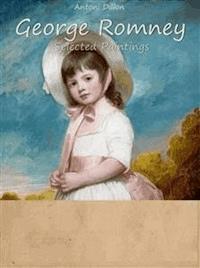
George Romney (1734 – 1802) was an English portrait painter. He was the most fashionable artist of his day, painting many leading society figures – including his artistic muse, Emma Hamilton, mistress of Lord Nelson.
Das E-Book können Sie in Legimi-Apps oder einer beliebigen App lesen, die das folgende Format unterstützen:
Veröffentlichungsjahr: 2017
Ähnliche




















George Romney
Selected Paintings
By Antoni Dillon
––––––––
First Edition
*****
Copyright © 2017 by Antoni Dillon
Table of Contents
Title Page
Copyright Page
Foreword
Paintings
Foreword
GEORGE ROMNEY (1734 – 1802) was an English portrait painter. He was the most fashionable artist of his day, painting many leading society figures – including his artistic muse, Emma Hamilton, mistress of Lord Nelson.
Romney was born in Beckside in Dalton-in-Furness, Lancashire (now part of Cumbria), the 3rd son of 11 children of John Romney, cabinet maker, and Anne Simpson. Raised in a cottage named High Cocken in modern-day Barrow-in-Furness, he was sent to school at nearby Dendron. He appears to have been an indifferent student and was withdrawn at the age of 11 and apprenticed to his father's business instead.
He proved to have a natural ability for drawing and making things from wood – including violins which he played throughout his life. From the age of 15, he was taught art informally by a local watchmaker called John Williamson, but his studies began in earnest in 1755, when he went to Kendal, at the age of 21, for a 4-year apprenticeship with local artist Christopher Steele – a portraitist who had himself studied with distinguished French artist Carlo Vanloo.
In October 1756, Romney married Mary Abbot, but the couple was immediately separated when he was called away to York on business by his employer. After a year, Steele eventually agreed to cancel the apprenticeship, at George's request, leaving the young artist – now a father of a son – free to pursue his own career as a painter.
In 1757, Romney rejoined his wife and young son in Kendal, working as a portraitist, landscape and historical painter. In this period he became friends with Adam Walker, the inventor and writer, and also pursued musical interests in his spare time. In March 1762, he parted from his wife, son and daughter, to seek his fortune in London, where he stayed until 1799. Throughout the separation, he maintained contact with his family and financially supported them, but they never lived with him in the capital.
n 1763, Romney entered his painting, The Death of General Wolfe, into a Royal Society of Arts competition. According to friends of Romney, he was awarded the second prize of 50 guineas, but this was later to reduced to 25 guineas on questionable grounds. It is said that Sir Joshua Reynolds himself was the prime mover behind this decision, a fact which may have accounted for the lifelong aversion of the two men for each other.
Despite his later success, Romney was never invited to join the Royal Academy of Arts, though he was asked, urged even, to exhibit there – nor did he ever apply to join. This decision certainly cost him valuable royal patronage and support from others connected at court. While there has been much speculation about his actual relationship with the Academy, there is no doubt that he normally remained aloof, maintaining that a good artist should succeed without being a member. His early years in the capital were something of a struggle financially. In September 1764, he traveled to Paris for a few weeks to study the works of the old masters. In 1765 he again won the second prize of 50 guineas in the Royal Society of Arts competition. In 1768, he made the acquaintance of Richard Cumberland, the dramatist, whose portrait he painted, and who was helpful in introducing him to influential patrons. He also became friends with miniature painter Ozias Humphrey. 1769 was a breakthrough year – he exhibited a large portrait of Sir George Warren and family at the Free Society of Artists, which was greatly admired and helped to lay the foundations of his future popularity. In 1770 he started to exhibit his work at the Chartered Society of Artists rather the rival "Free Society of Artists".
By 1772 Romney was financially secure enough to make the journey to Italy to study the great artists of the past, as he had always intended. He set off in March, making his way through Europe via Paris, Lyon, Marseilles, Nice, Genoa, Livorno, Florence and Pisa and arriving in Rome in June. A letter of introduction allowed him to meet the Pope, Clement XIV, who allowed him to set up scaffolding in the Vatican to study the frescoes of Raphael. He spent 18 months in Rome making studies and sketches of the great art works on view there. He returned to London in July 1775 after an absence of over 2 years.
On his return, in 1775, Romney moved to Cavendish Square, in a house formerly owned by noted portraitist Francis Cotes. Fortunately, he was offered commissions by the Duke of Richmond and his circle of friends, which helped turn the tide of fortune permanently in the artist's favour. In 1776–77, he made the acquaintance of William Hayley, striking up a lasting friendship with the writer, and painting portraits for him. 1782 was the beginning of an important new chapter in Romney's life, for in that year he was first introduced to Emma Hamilton (then called Emma Hart) who became his muse. He painted over 60 portraits of her in various poses, sometimes playing the part of historical or mythological figures.He also painted many other contemporaries, including fellow artist Mary Moser.
In 1797 Romney left his studio at 32 Cavendish Square, where he had worked for more than twenty years, to move to Holly Bush Hill in Hampstead. In Hampstead Romney embarked on a series of costly building projects, and sold the house two years later. Romney's House is now a Grade I listed building, and Romney is commemorated by a blue plaque placed on the property.
In the summer of 1799, his health broken, and after an absence of almost forty years, Romney returned to his wife, Mary, in Kendal. She nursed him during the remaining 2 years of his life until he died in November 1802.
Paintings
Portrait of a Man, 1758 /1760, oil on canvas, 641 x 568 mm




