


2,99 €
Mehr erfahren.
- Herausgeber: tredition
- Kategorie: Geisteswissenschaft
- Sprache: Englisch
The Second World War is over. Germany is just a field of rubble. The people have no accommodations. They live in ruins. So-called rubble-women provide for the first construction houses; their men are still in prisoner-of-war camps. Germany is occupied by Allied troops. Hunger is prevalent. Then the year 1949. Two German states emerge. Germany is divided and the eastern territories are under Polish and Russian administration. Millions of Germans are expelled from these territories. West Germany takes in most of the expellees. Then the economic miracle. The people in West Germany are doing well again. In 1990 the reunification. But Germany has to give up its eastern territories. -- This book reports on the history of Germany from the era of Konrad Adenauer to the great age of Angela Merkel. The reader learns about the founding of the European Union and its economic power today, too, and more.
Das E-Book können Sie in Legimi-Apps oder einer beliebigen App lesen, die das folgende Format unterstützen:
Seitenzahl: 322
Veröffentlichungsjahr: 2018
Ähnliche


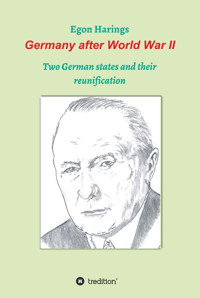
Egon Harings
Germany after World War II
Two German states and their reunification
© 2018 Egon Harings
Verlag und Druck: tredition GmbH, Hamburg
ISBN
Paperback:978-3-7469-1484-8
Hardcover:978-3-7469-1485-5
e-Book:978-3-7469-1486-2
Das Werk, einschließlich seiner Teile, ist urheberrechtlich geschützt. Jede Verwertung ist ohne Zustimmung des Verlages und des Autors unzulässig. Dies gilt insbesondere für die elektronische oder sonstige Vervielfältigung, Übersetzung, Verbreitung und öffentliche Zugänglichmachung.
Prologue
The Second World War is over, the whole of Germany is in ruins and occupied by Allied troops. The general situation in the surrender of the German “Wehrmacht” in May 1945 was so different than at the end of World War I in November 1918. In those days the Reich remained unaffected by enemy troops. Now it was not the case. Tens of millions of German soldiers were also in captivity, the German cities were bombed, tens of millions of refugees from the German eastern territories had to be accommodated. Yet all were glad that the terror came to an end. The hour of refreshing, breathing fetching and hope had begun. The word of the “Zero Hour” could be formulated hardly true in this respect.
With the promulgation of the Basic Law – the new constitution – in 1949 was established the Federal Republic of Germany to the west, while the “German Democratic Republic” was proclaimed in East (in the middle of Germany) With the East is here meant the Soviet occupation zone. The eastern German territories were under Polish administration, which should remain so until 1990. By the Peace Treaty of 1990 these German territories became Polish and Russian territories then. Saarland enjoyed a special status. It became a separate state. Only on 1 January 1957 it became a country of the Federal Republic of Germany.
The first years of the Federal Republic of Germany were called “the years of the Adenauer era”. He was the one by whom West Germany was again standing in the world. He was the one who got the last German prisoners of war from the Soviet camps. He was the one who laid the foundation of the German-French friendship, a friendship that in return formed the basis for a European community of values, which subsequently resulted in the establishment of the European Union, of course, after a few precursors. To the European Union, there was still a long way. – Germany was still divided. Two German states claimed the right to represent German interests worldwide.
Then the time has finally come. The reunification. The post-war order that was fixed cemented over 40 years shriveled away within a few months. In Germany, the Berlin Wall fell, the symbol of German division, in Europe raised the “Iron Curtain”. People had fought at great sacrifice freedom and democracy. In Germany this happened but without bloodshed.
With the opening of the East German border to the west began for the people in both parts of Germany a new era. Wall and barbed wire they are no longer separated. “We are the people”. These words brought down the GDR and led to the reunification in 1990. Father of the reunification was Helmut Kohl.
The implementation of internal unity became after the reunification the most important task of the domestic and economic policy. In East Germany, the reappraisal of the GDR past began. In 1992 right-wing violence against foreigners shocked inter alia in Rostock and Solingen the Federal Republic of Germany. Only one year later changed things in Europe. The map had to be redrawn; Czechoslovakia was divided into two states. In 1996 was then the discussion of the Bonn-saving measures, together with combating unemployment, the second major social and economic policy topic of the year.
In 1997, Germany experienced great floods. The floods on the Odra became a national task. Donations of millions of Euros flowed, 45,000 helpers were on site. Then in 1998 a turning point for Germany represented the deselection of Helmut Kohl, “the Chancellor of German Unity”. For the first time, a red-green coalition took power in Bonn. Gerhard Schröder was new Chancellor. He was after Willy Brandt and Helmut Schmidt the third Social Democrat in the Chancellery. With his government takeover ended the era of Helmut Kohl.
1999 confirmed the CDU to have illegally dealt with political donations. Loss of confidence and compensation claims led the party into an existential crisis. – This year Rau became President of Germany. In the second round of voting the delegates of the Federal Assembly elected the former Prime Minister of North Rhine-Westphalia as German President. Then, in 2000, the CDU fell by the donation scandal in a deep crisis. Wolfgang Schäuble and Helmut Kohl resigned from their posts; new leader of the CDU was Angela Merkel.
We write the year 2001. A date shaped the most people like no other. It is September 11. The image of the burning towers of the World Trade Center in New York no one gets this so quickly out of his mind. As a result of the terror it comes to the stock market crash, the US launch attacks on Afghanistan.
In 2002 there is a Flood of the Century in eastern Germany. By this flood 20 people are killed in the cities and towns along the Elbe and its tributaries, whole regions are under water, thousands of homes are destroyed. But despite all the hardship the people in the flooded areas are not alone, because the generosity of the German population is large and with public funds is helped non-bureaucratically. – This year also German soldiers are in Afghanistan. They belong to the “International Security Assistance Force” (ISAF). On 6 March, the first German soldiers are killed in Afghanistan. They die in an accident on an explosive place in Kabul. – On 22 September, the Red-Green government under Gerhard Schröder is confirmed by a narrow margin.
In 2003, a political tragedy happens. Jürgen Möllemann, former political leader of the FDP, dies during a parachute leap. The cause of the death leap has never been solved. Möllemann had come in the weeks before in severe distress. Because of his anti-Israeli statements during the election campaign of 2002, the FDP leadership had separated from him after much hesitation. The Bundestag (German Parliament) had repealed the immunity of the 57-year old and non-attached deputy of parliament only a quarter of an hour before the death leap. Prosecutors of Münster and Düsseldorf let search offices and private rooms on 25 sites in Germany, Spain, Luxembourg and Liechtenstein. Concerning Möllemann was investigated for tax fraud, breach of the Political Parties Act, deception and embezzlement.
In 2004 was the largest EU expansion. 10 states, mainly from Eastern Europe join the EU. – In Germany there was a demonstration against Hartz IV. The Bundestag approved the merger of unemployment benefit and social assistance to unemployment benefit II; thereby was caused a great resentment among the population.
2005 brought many changes. Pope John Paul II dies and a German Cardinal, Joseph Ratzinger, was elected Pope. He takes office as Benedict XVI. – This year there is also a new German Chancellor. Gerhard Schröder missed during the vote on the question of confidence the so-called “Chancellor Majority” of 301 votes of the 601-member parliament. This happened according to his wish! Now CDU/CSU was at the early federal election the strongest force ahead of the SD; but there was only a narrow margin. For CDU/CSU this margin was not enough for the intended coalition with the FDP; but there were also not enough votes for the continuation of the government of Red-Green. Now there was only one possibility, the large coalition of CDU/CSU and SPD. Angela Merkel became chancellor.
In 2006, CDU/CSU and SPD went on developing their plans for a federalism reform and the entry into a health care reform. Both they had previously prevailed in parliament.
With the year 2007 ends this book. It was the year in which Islamist terrorists tried to wreak carnage in Germany and German policemen were killed in Afghanistan. But it was also a great year for Germany, which the G8 summit in Heiligendamm showed.
Buffalo and Original Elephant
The evolution that Darwin described was well known, but no one could foresee that there would be an evolution in German history and politics.
The Germans, a great nation without an own country
We write the year 1946
The war was over since a few months and the Allies could extract reparations from their occupying zones and that without to fix the level. So there was a dividing line through Germany that was to become a lasting structural border, because the United States and Great Britain put up with the exploitation and plunder of the Soviet zone. The reparations added up, when all was done, to a multiple of that that the west zones had to produce. The west Allies had sacrificed the unity of Germany only to a short moment of the solidary harmony of the victorious powers and they had put up with the sorrow of millions of expellees.
Now the Allies passed over to the daily routine: They settled down in Germany to govern it. Each occupying zone was put in charge of a commander-in-chief, who was only answerable to his government. It was founded the “Control Council” of the Allies to coordinate all matters of the whole of Germany. But this council could pass only unanimous resolutions.
Soon there were differences between the Allies during the foundation of the occupying zones. The French refused to leave the cities Karlsruhe and Stuttgart, which they had taken during their advance in South Germany but which belonged to the U.S.-American zone after the war. Only under massive threat of the Americans they left both cities now. In Thuringia, Saxony and Mecklenburg were American troops, but they left unhesitatingly these countries soon because they belonged to the Soviet zone in the meantime. The Americans also did that, because the Soviets had occupied the whole of Berlin, but Berlin was divided in 4 sectors in the meantime. Now the Americans thought to have the possibility and the right to march into their (own) sector of Berlin, if they would leave Thuringia, Saxony and Mecklenburg.
Berlin should be administrated by the Allies together. But the Soviets had delayed the handing-over of the American, British and French sector. So American and British troops marched into Berlin without Soviet allowance and occupied their sector early in July of the year of 1945. The French followed in August of the same year.
The Catholic Church of the Rhineland says: “to pinch coal is allowed.” – A coal train from the Ruhr in 1946
The Germans, now a nation without own state, didn’t care about the political aims of the victorious powers. They had other problems! The worry of the everyday life weighed too heavily on them. There was a lack of fuel and foodstuffs. Only 60% could the occupied German countries produced themselves. For the difference of the food supply for the inhabitants in the U.S.-American and British zone had every U.S.-American and British taxpayer to pay 600 U.S.-Dollar each year. Another problem was the ruined German currency. The Nazis had financed the war over the money press, now there were 300,000,000,000 RM (Reichsmark) in circulation without equivalent value of merchandise. In Germany circulated additionally to it three currencies: RM (state-salaries were paid out by RM), the currencies of the victorious powers (which the Germans couldn’t exchange for RM) and cigarettes, which were the most important currency now, because every German could have all things, which he needed, on the black market, if he paid by cigarettes.
The natural economy was in blossom how in all time of need. Fur coats were exchanged for pots and cans, for a sack of potatoes had the people to pay a piano. The Allies and the German administrative body, which was set up by them, fought in vain with police raids against the black market that was a playground for profiteers and crooks. But the “grey market”, which settled the so-called barter transactions, was tolerated. The production didn’t function without the exchange of finished products for raw material, but the production had to get going to fulfil the commitment of reparation of the victorious powers.
The Germans pursued with great interest the trial of Nuremberg in spite of considerable every-day cares. The leading élite of the Nazis was accused, as far as the victors could take them into custody. Adolf Hitler, Joseph Goebbels and Heinrich Himmler had evaded the accusation by suicide, as we know.
The Military Court of Justice of Nuremberg
On October 1 of this year the “International Military Court of Justice of Nuremberg” passed sentence on the 24 defendants: 12 of them were sentenced to death by the rope, amongst them was “Reichsmarschall Göring”, Foreign Minister Ribbentrop, General Keitel (he was the head of the German armies in the west), the minister of the interior, Frick, the NSDAP-Gau-Leader of Franconia, Julius Streicher, the “Reichskommissar” for the Netherlands, Arthur Seyß-Inquart and “Reichsarbeiterführer” (leader of the worker of the German Empire), Robert Ley. Robert Ley and Hermann Göring escaped their execution by the rope by committing suicide. NSDAP-Reichsleiter (NSDAP-Leader of the Empire) Martin Bormann was sentenced to death “in absence”. Hitler’s substitute Heß, the minister for economic affairs, Walther Funk, and the commander-in-chief of the German navy, Erich Raeder, were sentenced to life imprisonment; the others, amongst them was the last president of the German Empire, Karl Dönitz, and “Rüstungsminister” (war minister) Albert Speer, got a term of imprisonment of some years. The president of the “German National Bank”, Hjalmar Schacht, and the so-called “Hitlers Steigbügelhalter” (Hitler’s backer/holder of his stirrup) .Franz von Papen and the head of the “German Broadcasting”, Hans Fritsche, were acquitted. After that was the whole of the German nation seized with the denazification and the “reeducation” to a “democratic spirit”. The Allies tried to filter the minor hanger-on from the principals amongst the Nazis by questionnaires. They wanted to give each hanger-on food for thought for the own investigation of conscience of the joint guilt in the crimes of the National Socialist regime.
The hoarding train of the year 1946
The Soviets made use of the denazification in their zone to carry out the expropriation of the bosses of the German industry and the big landowners. That happened on a large scale in the Russian/Soviet zone of Germany now. By it the Russians/Soviets created the basis for a socialist economy. By the action “Junkerland in Bauernhand” (noble land in farmer’s hand) changed 35% of the agriculturally used area of the Soviet occupying zone the hands now. So there were also no obstacles to a nationalization of the economy now. The Soviets had already made provisions and had German communists, who had fled from the Nazis into exile in Moscow, fetched back. On 30 April 1945 landed the “Group Ulbricht” already in Frankfurt on the Odra; the members of this group began immediately with their work after the occupation of Berlin. Walter Ulbricht, the leader of the group, was member of the KPD (Communist Party of Germany) since 1919; since 1937 he was in Soviet exile. In 1943 he had organized the National Committee “Freies Deutschland” in Moscow that had aimed to bring down Hitler and to finish the war. Also other communists took action now, so in Mecklenburg the “Group Sobottka”, in Saxony the “Group Ackermann”. “Es muss demokratisch aussehen” (it has to look democratic) said Wolfgang Leonhard, a leading member of the “Group Ulbricht”, “aber wir müssen alles in der Hand haben” (but we have to have everything in our hands). But the men around Ulbricht didn’t have the intention to carry out democratically all measures; also the representatives of the “SMAD” (Soviet Military Administration of Deutschland/Germany) saw to it that it wasn’t done. They had advised the German communists in Moscow before and they depended directly on the instructions of the Russian government. The KPD (Communistic Party of Germany) was already admitted as first (new) party in June 1945. On 21 April the KPD under Wilhelm Pieck and the SPD (Social-Democratic Party of Germany) of Middle Germany (Soviet zone) under the leadership of Otto Grotewohl decided the uniting of both parties during a common party conference in (East-) Berlin. The new party bore the name “Sozialistische Einheitspartei Deutschlands” (SED/United Socialist Party of Germany) The 800,000 members of the SPD of the Soviet zone and the 600,000 members of the KPD of the Soviet zone were not asked regarding their consent. In West Berlin was only put the uniting of both parties to the vote of the members of the SPD. That happened under the protection of the West Allies. 82% of the members of the SPD of West Berlin voted against a uniting with the communists.
The population of West Germany felt hardly something of the complicated mechanism, by which they were governed. The military government gave the orders as uppermost authority and the Germans had to obey officially these orders. The so-called “official helpers” were chosen; they could also get dismissed on the spot like Konrad Adenauer, the former Mayor of Cologne, who was chased away from his office in the year of 1933. It is true that he became Mayor of Cologne again in May 1945, because his name was in the “white list” of the Allies as adversary of the Nazis, but he was also dismissed again by the British military government in October of the same year. The alleged reason for his dismissal was: incompetence and a lack of performance of his duty.
In January of this year, after the establishment of new parties, were held elections to the municipal councils in Württemberg-Baden that belonged to the U.S.-American zone. Since October were held elections to the parliaments of the countries of the British, French and U.S.-American zone. Now Germany took the administration over more and more in West Germany. Then on December 2 was signed the “Bi-Zone Agreement” by the U.S.-American Secretary of State, James F. Byrnes, and the British Foreign Secretary, Ernest Bevin, in New York (U.S.A.). This agreement came into force on 1 January 1947. The British zone and American zone were economically fused and were to be the core of the new West-German state many months later.
On August 23 founded the British military government in Germany a new country: North Rhine-Westphalia; this country was created from the former Prussian province Westphalia and the northern part of the Prussian province Rhineland. On 21 January 1947 was the little country Lippe annexed. The capital of this new country “NRW” became Düsseldorf, the seat of the British military government in Germany.
Food Card of the American occupation zone in 1946
On 1 November was founded a new country also in the north of Germany: Lower Saxony. This new country was also created by the British military government. Now the former Prussian province Hannover and the countries Braunschweig (Brunswick), Oldenburg and Schaumburg-Lippe were a part of this new country Lower Saxony. The capital of Lower Saxony became the city Hannover.
On 22 December the German country Saarland was separated from the French-occupied zone and became a separate state within the French economic area. Thus Saarland did also not belong to the new West-German state later and that for many years.
In the end of this year could be also struck the sad balance of the great escape and the expulsion. The matter-of-fact number showed hardly the extent of the horror and the misery. The happenings should be called in closer inspection in spite of that. 220 expellees reached every hour of a day the Americanoccupied zone in the months January till November of this year. The expellees came from Czechoslovakia (Sudetenland), from there they were “legally expelled”, how it was officially called. So 1,500 transports with expellees reach South Germany in these months and that was to be not the end of the expulsion; the last expellees from Czechoslovakia reached Germany in 1952, but now they were called “late re-settlers” (what a scorn!). Also the casualty figure is shocking; during the great escape and the expulsion from East Germany (Silesia, East Prussia and East Pomerania), since 1945, lost more than 2,000,000 German women and children their life, additional to it lost also 1,100,000 German soldiers from East Germany their life during the battles there. In East Germany and Sudetenland were living more than 15,000,000 Germans before the “Second World War” and 3,500,000 of them had lost their lives in the years 1945 and 1946 there, they were killed or died of exhaustion during the run and expulsion. After the first shock by the expulsion the second shock rapidly followed for the expellees by the integration into the new home. Nobody could expect that the inhabitants of West Germany would like to admit the expellees from the east. The people of (West- and Middle) Germany, who were living in ruins, didn’t cope with the own problems and now the problems and the misery of the expellees; this was too much for them. The official departments and charitable organizations of West Germany did everything that was possible to make the integration easier. But in spite of that often carelessness and egoism on the one hand and light vulnerability on the other hand led to misunderstanding and hardening in the first time after the war.
For many expellees the odyssey did not yet find an end by assigning of an accommodation. A strong internal migration occurred just in the first years after the war. The separated families had to get brought together again and released prisoners of war were looking for their relatives or women were looking for their released sons, husbands, brothers or fathers. The bringing together of the families was still made difficult by the “Koalitionsverbot” (prohibition of coalitions) of the occupying powers. According to this prohibition it wasn’t allowed to form a union of expellees or a self-help organization. Since the most expellees were accommodated in the agricultural regions of the British and American zone, were also missing enough possibilities to work there. The misery was to find no end, because now was still following a hard winter.
Germany and the occupation zones after World War II
The eastern German territories: East Prussia, East Pomerania, Silesia
We write the year 1947
The winter 1946/47 was terrible for the German population; it was the horrible hunger winter.
The “Trümmerfrauen”, a hard work for the recovery of Germany, a hard work for women in the landscape of ruins of Germany; the most men were (still) in captivity.
After the failure of common politics of reparation recouped the Soviet Union its loss from the own zone in Germany and took the goods for the reparation, which the whole of Germany owed Russia, from there. The development of the economic difference between the eastern zone and the western zones went back to this time. Later this difference also contributed to produce a continuous refugee stream from the eastern zone (Soviet/Russian zone) to the western zones.
The division of Germany was a work of the occupying powers; the Germans couldn’t prevent them from doing that. But it was a surprise that the Germans willingly cooperated in this work. The Social Democrats (SPD) began with it. During the first conference of all members of the SPD of the whole of Germany, which was already held in September 1945 in Wennigsen close to Hannover, Schumacher, the new leader of the SPD, had not only rejected the claim of leadership of the central committee of Berlin over the whole of Germany, but also each organizational interweaving between the eastern and the western SPD. At the end of this conference Schumacher spoke with Grotewohl about the differences between the SPD-West and the SPD-East and the possible demarcation of both parts of the party.
The Christ-Democrats (CDU/CSU) and the Liberals of West Germany acted similarly. On the first conference of the leading representatives of CDU/CSU from the whole of Germany early in February of this year in Königstein in the Taunus mountains (Hessen) the CDU-chairmen of the eastern zone, Kaiser and Lemmer, tried to get in vain from the party’s friends of the western zones that, what the Soviet military governor of the eastern zone, Marshal Sokolovsky, had given them as job on the way: “There is no solution of the German matter without Russia, and there is no breaking asunder of Germany without the Germans”. Kaiser and Lemmer had to realize, that they didn’t any more have the confidence of their friends of West Germany.
Now the ancient aversion of the West-German province to Berlin and the fear of the Russians grew stronger to the feeling of an indeterminate horror that was what formed the bottom of the attitude of the West-German population towards the Soviet Union in the following decades. The special development of the politics of the east zone and the split of the system of parties was still pressed ahead with the uniting of SPD and KPD into the “Sozialistische Einheitspartei Deutschlands” (SED). But also the parties in West Germany were often at variance. So in Bavaria had taken form an independent Christian-democratic party, the CSU (ChristianSocial Union), whilst there was the CDU (ChristianDemocratic Union) in the remainder of Germany. That was to remain till today.
Now in West Germany was existent the bi-zone since some months (France had insisted on an own economic zone in Germany during the first years after the war). The bi-zone got a special weight by its economic success now, especially by the connection with the foreign change of the course of the United States. On January 7 was the American Secretary of State, Byrnes, dismissed and his successor became General Marshall. That was the transition to “containing politics” to the Soviet Union. The head of planning in the (American) State Department, Kennan, had outlined the concept of new politics. Kennan recommended to his government taking steps against a further extension of the Soviet influence by giving financial and economic aid to the free countries for the establishment of settled political conditions and for the securing of the economic stability.
Greece, that was shaken by a civil war, and Turkey, that was hard pressed by the Soviet Union, needed support in this year. On March 12 justified the American president Truman his motion to the Congress for the appropriation of a financial aid for both states. He did it by means of a message, which was designated as “Truman-Doctrine” later: “I believe that the politics of the United States must be to support free nations, which put up resistance to a tried subjection by armed minorities or by hard pressing from outside.”
Two days before the promulgation of the “Truman-Doctrine” had started a conference of the foreign ministers of the four victorious powers in Moscow. A compromise in the matter of the forming of a German central administration, the step-bystep appointment of a German government and the basics of a German constitution seemed to be near at hand now. But then in the matter of reparation it came to a clash of interests. The (American) Secretary of State, George Catlett Marshall, was out to bring about the decision on the German matter any way by the solution of the problem of reparation: Marshall rejected the Soviet claims against Germany to pay a sum of 10,000,000,000 Dollars as reparation. Additional to it the Soviet Union wanted to get materials from the regular (running) production of Germany and to reach a common control of the Ruhr (-region/Ruhr-Pot). But also that was energetically rejected by George Catlett Marshall. Molotov, the Russian Foreign Minister, wanted to measure the West Allies by their faithfulness to treaties and their good will by the fulfilment of the Soviet claims. Now there was reached no agreement. After six weeks the conference adjourned. Marshall announced after the conference, the Americans didn’t want to wait to the point of exhaustion for compromises, but they want to start immediately with the stabilization of the European economy.
The international development steered for a confrontation of the super powers and a reorganization of Germany; this meant two (new) German states, a West-German state consisting of the British zone with the countries: Schleswig-Holstein, the city state Hamburg and the countries Lower Saxony and North Rhine-Westphalia – the U.S.-American zone with the countries: Württemberg-Baden, Bavaria, Great Hessen and the city state Bremen (with the towns Bremen and Bremerhaven) – the French zone with the countries: Württemberg-Hohenzollern, (South-)Baden and the new country Rhineland-Palatinate (founded by the French occupying power on 30 August 1946, consisting of Rhine-Hessen, the Rhine-Palatinate and the southern part of the former Prussian province “Rhineland”, capital is Mainz), but without Saarland that became an independent state some months later … and an East German state consisting of the central German countries Saxony, Mecklenburg and the former Prussian provinces Prussian-Saxony, Anhalt, the western part (and so the larger part) of Brandenburg (the eastern part was administrated by Poland, since 1990 a part of Poland), Thuringia and the western part of Pomerania (the eastern part of Pomerania was also administrated by Poland and is since 1990 a part of Poland). A last attempt to prevent the imminent partition of Germany did the (new) Bavarian Minister President Hans Ehard (CSU). He invited the (new) Minister Presidents of all German countries to a conference in Munich. Ehard was vague about the topic of discussion in his letter of invitation. The Minister Presidents of the east zone demanded during a preliminary discussion on May 5 that the forming of a German central administration by an agreement of the German parties and labour unions had to be as point 1 on the agenda. Ehard wasn’t willing to make his colleagues of the east zone, who were under pressure of the SED, concessions. That was the reason now that the Minister Presidents of the east zone already left the conference of Munich before its real starting. The conference was fated from the start no great success, because the Minister Presidents of the French zone had got the instruction by their (French) military government to “don’t negotiate about the uniting of all German countries”. Also the Minister Presidents of the countries, which were governed by the SPD, had the order of their heads of party to don’t negotiate on this subject. So the final statement of the torso-conference didn’t have any effect.
The main instrument of the American “containing policy” was the generous credit programme to Europe. The Secretary of State, Marshall, presented his programme for the economic recovery of Europe (Marshall Plan) during a speech in front of students of the university Harvard on June 5. This programme should also be extended to the western zones of Germany. For this it was necessary that the administration of the bi-zone was more effectively shaped. In June were the two-zone-offices, which had worked separately up to now, centralized in Frankfurt/Main. The heads of office were named “directors”, to go round to the name “ministers” or “permanent secretary” then. It was allowed the participating governments of the countries of the bi-zone to send one representative each into the executive committee, who had to control the directors. At the head was placed a parliamentary representation, the “Wirtschaftsrat” (economic council with 104 members since February 1948), which was indirectly elected by the parliaments of the countries of the bi-zone and had restricted legislation’s competence. In the “economic council” had the middle-class parties a bare majority. They succeeded in placing a CDU-member as director of the “Wirtschaftsrat”, who supported the removal of the controlled economy. That happened to the resistance of the SPD. The members of the SPD let consequently the middle-class parties have also the other director’s posts now.
The Soviet answer to the “containing policy”, which was proclaimed by the U.S.A., was formulated by Zhdanov, a member of the Soviet Politburo, in September. Zhdanov hard attacked the United States because of their alleged striving for the world domination. He delineated the picture of two camps, which were facing irreconcilably each other. In autumn of this year everybody could feel a fundamental change of the political climate in the eastern zone. The Soviet Union drew the conclusion from the failure of its politics, which was directed to the whole of Germans and prepared the foundation of a “people’sdemocratic” separate state in the eastern zone. The leading politicians of the middle-class parties were pressed hard to oppose publicly the American politics and to take part in a “Volkskongress für Einheit und gerechten Frieden” (people’s congress for unity and just peace). The CDU-chairmen of the Soviet zone, Kaiser and Lemmer, refused to oppose, as a result they were removed from their office by the Soviet military government.
In November the foreign ministers of the four victorious powers had once more a meeting in London (England), at which the American Secretary of State, Marshall, stressed the irreconcilable differences (points of view) between east and west. Then, on December 15, he abruptly broke off the discussions. The only result of this meeting was, France agreed to take part in negotiations about the foundation of a West-German state. Now the foreign ministers of Great Britain and the U.S.A. accepted also the economic union of the Saarland with France, which the French government had already carried out in the meantime, as a token of their good will to France.
1947; SPD, the party for Germans without home!
(Silesians, East Prussians, East Pomeranians and expellees from Sudetenland)
We write the year 1948
On March 1 was founded the “Bank deutscher Länder” (the new National Bank for West Germany) in Frankfurt. Also on March 1 Professor Ludwig Erhard was elected director of the office for economic of the extended “Wirtschaftsrat” (economic council) of Frankfurt. Erhard was an energetic advocate of the free enterprise, with it he was fully in the line of American politics. On June 18 the three military governors of the western zones directed a currency reform to be done. The new currency should to be valid from 20 June. – The (West-German) currency bore the name “Deutsche Mark” (DM) now. The currency so far, the “Reichsmark” (RM), was devalued in a ration of ten to one; wages, principal and interest were exchanged in a ratio of one to one. Every West-German got 40 DM as “head-rate” on 20 June.
After the currency reform Ludwig Erhard made use of a statutory authority for the change of the price and rationing regulation and abrogated the most provisions concerning this.
The mystery to the success of the currency reform lay in the appeals to an immoral and unlawful behaviour. Factory owners and traders had hoarded large stocks in the last years, which they had withdrawn from the market. Till 20 June no one could also buy most simple things. Now everybody could suddenly buy all things by the new currency and it paid to work hard again. The currency reform, the termination of the rationing and the simultaneously starting “Marshall-Plan-Aid” were going to the initial ignition for the upward trend of the West-German economy.
The currency reform discriminated against the minor people with their savings balances and privileged the owners of objects.
This social injustice was to equalize the “Lastenausgleich” (equalization of burdens) later. But it could really be equalized only a part later then.




