


14,99 €
Mehr erfahren.
- Herausgeber: John Wiley & Sons
- Kategorie: Fachliteratur
- Serie: The Getting Started In Series
- Sprache: Englisch
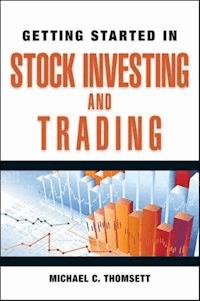
An up-to-date guide to the complex world of equities Getting Started in Stock Investing and Trading walks investors and traders through the essential information they need to know before they decide what kind of participant they want to be in equities. The book is filled with the key strategies and tools and offers a comprehensive guide for those entering this marketplace. The author does not argue that one method is better or more appropriate than another. Rather, he reveals the various methods and lets investors decide for themselves. The book covers investment risks, value investing, market strategies, trading methods such as day and swing trading, technical indicators, and diversifying your portfolio, and * Offers a thorough overview of strategies and tools that investors need to profit from the volatile equities markets * Provides examples, charts, and timely additions that reflect recent changes in the equities markets Other titles by Thomsett: Getting Started in Bonds and eight editions of Getting Started in Options. This book is another title in The Getting Started series, which makes complex issues easy to understand.
Sie lesen das E-Book in den Legimi-Apps auf:
Seitenzahl: 381
Veröffentlichungsjahr: 2010
Ähnliche














Contents
Cover
Half Title Page
Series
Title Page
Copyright
Introduction
The Potential of the Stock Market
Part 1: Investing
Chapter 1: Investment Risks
Market Risk
Leverage Risk
Knowledge and Experience Risk
Sector Risk
Political and Economic Risk
Inflation Risk and Tax Risk
Fundamental Risk
Lost Opportunity Risk
Chapter 2: Value Investment
Value Investing and Control
Value Investing Myths and Facts
Setting Standards for Buying (and Selling)
Chapter 3: Market Strategies
A Basic Strategy: Buy and Hold
A Strategic Requirement: Diversification
Other Market Strategies
Ex-Dividend Date Buying
Chapter 4: Fundamental Analysis
The Balance Sheet
The Income Statement
The P/E Ratio: Finding a Bargain-Priced Stock
Revenue and Earnings: Fundamentals Based on the Operating Statement
Working Capital: Fundamentals as a Form of Money Management
Chapter 5: Alternatives: Stocks or Mutual Funds
Investment Clubs
Types of Mutual Funds
Mutual Fund Fees
Classification by Features
Other Conduit Investments
Variable Annuities
Part 2: Trading
Chapter 6: Trading Risks
Market Risk and Volatility Risk
Leverage Risk
Short Position Risk
Extreme Reaction Risk
Technical Knowledge and Experience Risk
Technical Risk and Market Culture
Chapter 7: Trading Methods: Day and Swing Trading
Day Trading
Swing Trading
Entry and Exit Signals
Chapter 8: Charting Tools and Interpretation
Traditional Types of Charts
Candlestick Charts: The Basics
Combining Candlesticks with Western Technical Analysis
Chapter 9: Essential Technical Indicators
Support and Resistance: The Trading Range as a Defining Attribute of Price
Popular Price Patterns and Their Meaning
Trend Lines for Spotting Reversals
Breakouts and Gaps
Moving Averages, Oscillators, and Volume Tests
Chapter 10: Technical Analysis, Dow Theory, and Practice
The Efficient Market
The Random Walk
Charles Dow and His Market Theory
Part 3: Combining Investing and Trading
Chapter 11: The Contrarian Approach to Trading
The Contrarian Concept: Why Go against the Market?
Contrarians and the Permanent Bear or Bull Mentality
Value Investing and the Contrarian Approach
Valuable Strategies
Merging Technical and Fundamental in a Contrarian Strategy
Contrarian Views in Perspective
Chapter 12: Mixing Speculation and Investing
The Fundamental/Technical Combination
The Dividend Timing Trading Strategy
Applying the Combined Approach as a Diversification Method
Chapter 13: Options to Leverage and Manage Your Portfolio
Definitions and Basics
Valuation of Options
Basic Long Option Strategies
Covered Calls
The Flexibility of Options
Chapter 14: Your Sensible Approach to the Market
Popular Stock Market Myths
Going Forward from Here
Glossary
About the Author
Index
Getting Started In
STOCK INVESTING AND TRADING
Books in the Getting Started In Series
Getting Started In Currency Trading, Second Edition by Michael D. Archer
Getting Started In Forex Trading Strategies by Michael D. Archer
Getting Started In Online Day Trading by Kassandra Bentley
Getting Started In Investment Clubs by Marsha Bertrand
Getting Started In Asset Allocation by Bill Bresnan and Eric P. Gelb
Getting Started In Online Investing by David L. Brown and Kassandra Bentley
Getting Started In Chart Patterns by Thomas N. Bulkowski
Getting Started In Online Brokers by Kristine DeForge
Getting Started In Internet Auctions by Alan Elliott
Getting Started In Mutual Funds, Second Edition by Alvin D. Hall
Getting Started In Stocks by Alvin D. Hall
Getting Started In Estate Planning by Kerry Hannon
Getting Started In A Financially Secure Retirement by Henry Hebeler
Getting Started In Online Personal Finance by Brad Hill
Getting Started In REITs by Richard Imperiale
Getting Started In Internet Investing by Paul Katzeff
Getting Started in Rebuilding Your 401(k), Second Edition by Paul Katzeff
Getting Started In Security Analysis by Peter J. Klein
Getting Started In Global Investing by Robert P. Kreitler
Getting Started In ETFs by Todd K. Lofton
Getting Started In Futures, Fifth Edition by Todd Lofton
Getting Started In Candlestick Charting by Tina Logan
Getting Started In Project Management by Paula Martin and Karen Tate
Getting Started In Value Investing by Charles Mizrahi
Getting Started In Financial Information by Daniel Moreau and Tracey Longo
Getting Started In Emerging Markets by Christopher Poillon
Getting Started In Technical Analysis by Jack D. Schwager
Getting Started In Hedge Funds, Third Edition by Daniel A. Strachman
Getting Started In Fundamental Analysis by Michael C. Thomsett
Getting Started in Options, Eighth Edition by Michael C. Thomsett
Getting Started In Property Flipping by Michael C. Thomsett
Getting Started In Real Estate Investing by Michael C. Thomsett and Jean Freestone
Getting Started In Rental Income by Michael C. Thomsett
Getting Started In Six Sigma by Michael C. Thomsett
Getting Started in Stock Investing and Trading by Michael C. Thomsett
Getting Started In Swing Trading by Michael C. Thomsett
Getting Started In Tax-Savvy Investing by Andrew Westham and Don Korn
Getting Started In Annuities by Gordon M. Williamson
Getting Started In Bonds, Second Edition by Sharon Saltzgiver Wright
Getting Started In Retirement Planning by Ronald M. Yolles and Murray Yolles
Copyright © 2011 by Michael C. Thomsett. All rights reserved.
Published by John Wiley & Sons, Inc., Hoboken, New Jersey.
Published simultaneously in Canada.
No part of this publication may be reproduced, stored in a retrieval system, or transmitted in any form or by any means, electronic, mechanical, photocopying, recording, scanning, or otherwise, except as permitted under Section 107 or 108 of the 1976 United States Copyright Act, without either the prior written permission of the Publisher, or authorization through payment of the appropriate per-copy fee to the Copyright Clearance Center, Inc., 222 Rosewood Drive, Danvers, MA 01923, (978) 750-8400, fax (978) 646-8600, or on the Web at www.copyright.com. Requests to the Publisher for permission should be addressed to the Permissions Department, John Wiley & Sons, Inc., 111 River Street, Hoboken, NJ 07030, (201) 748-6011, fax (201) 748-6008, or online at http://www.wiley.com/go/permissions.
Limit of Liability/Disclaimer of Warranty: While the publisher and author have used their best efforts in preparing this book, they make no representations or warranties with respect to the accuracy or completeness of the contents of this book and specifically disclaim any implied warranties of merchantability or fitness for a particular purpose. No warranty may be created or extended by sales representatives or written sales materials. The advice and strategies contained herein may not be suitable for your situation. You should consult with a professional where appropriate. Neither the publisher nor author shall be liable for any loss of profit or any other commercial damages, including but not limited to special, incidental, consequential, or other damages.
For general information on our other products and services or for technical support, please contact our Customer Care Department within the United States at (800) 762-2974, outside the United States at (317) 572-3993 or fax (317) 572-4002.
Wiley also publishes its books in a variety of electronic formats. Some content that appears in print may not be available in electronic books. For more information about Wiley products, visit our web site at www.wiley.com.
Library of Congress Cataloging-in-Publication Data:
Thomsett, Michael C. Getting started in stock investing and trading / Michael C. Thomsett. p. cm. – (Getting started in….. ; 89) Includes index. ISBN 978-0-470-88077-7 (pbk); ISBN 978-0-470-93713-6 (ebk); ISBN 978-0-470-93714-3 (ebk); ISBN 978-1-118-03837-6 (ebk) 1. Stocks–United States. 2. Investments–United States. I. Title. HG4910.T48 2011 332.63′220973–dc22 2010028573
Introduction
The Potential of the Stock Market
In recent years, the stock market has been extremely volatile and many risks (and opportunities) were presented to investors and traders alike. Now more than ever before, it is essential for novice stock market investors to develop a complete understanding of the risks they face when money is placed in the market. This does not mean you should avoid investing; it does point out how important it is to become educated about risk in the stock market.
This book makes a distinction between investing and trading. An investor is an individual interested in identifying and buying shares of stock for long-term price appreciation, also called growth, and earning superior returns from dividends while protecting their capital. Part I of this book includes chapters about how to develop an investing program to build your portfolio based on the principles of fundamental analysis.
A trader, in comparison, is more interested in moving in and out of investment positions in the short term, making a higher volume of smaller profits. Traders rely on reading charts, spotting short-term trends, and taking advantage of the market's tendency to overreact to current news (meaning that the prices of stocks tend to move too far in one direction and then correct by reversing). This price swing is easy to spot in hindsight, but more difficult to anticipate ahead of time. Successful traders work on their skills in identifying the signs based on price charts. Part II is focused on trading skills and techniques, and is based on the principles of technical analysis.
The successful investor/trader learns how to combine the fundamental and technical analytical skills and uses both effectively. Mixing investment and trading speculation is a smart way to flexibly deal with a volatile and ever-changing market. Part III examines how this combined approach works.
The purpose in compiling this book is to present you with a range of valuable ideas, strategies, and market realities, all aimed at helping you to identify your appropriate risk tolerance level and then determine which investing and trading ideas are going to work best for you. Everyone is different, so no quick-fix or formula is going to work for everyone. In fact, trying to duplicate someone else's investing or trading system is not a wise idea because your unique profile (including income, assets, experience, and perceptions of markets and risks) demands that your approach make sense.
Today, many people are shy about the market. The volatility of recent years is a definite problem for anyone who puts capital at risk, but does that mean that staying out of the market makes sense? It does not. The alternatives are bleak. Savings rates are lower than ever before and do not outpace inflation. This means that even the modest inflation of recent years erodes the purchasing power of money left in savings. The only sensible alternative is to develop a program of investing and trading that minimizes risk while offering superior returns. Avoiding the market is just as great a problem as taking too many risks within the market; so the best approach is to develop a portfolio defensively.
A “defensively” built portfolio is one that is developed with complete knowledge about risk and opportunity, which you build and manage based on thorough research, acquired knowledge, and resistance of market forces. This book is designed with this necessity in mind. In the future, markets will go through cycles of relatively low volatility, followed by highly erratic months or even years. Investors and traders can earn profits in all kinds of markets, assuming that they have built a defensive portfolio and avoided taking risks they cannot afford. This makes it essential not only to understand risks, but also to define where you fit in the risk spectrum. Most people are going to be somewhere in the middle between extreme conservatism and extreme speculation, but that is a broad range. For this reason, both of the first two sections of the book begin with chapters examining and explaining a range of different risks.
The purpose in this endeavor is not to provide easy answers, but to help you to begin your journey into acquiring knowledge about a complex and changing stock market. Knowledge reduces risk and increases profit. This is the basic premise that has dominated the preparation of this book.
Part 1
Investing
Chapter 1
Investment Risks
Investing in stocks is an exciting, action-packed, fast-moving idea that for decades has excited many people—even those with little money to invest—with the possibility of building wealth.
It is possible to make money in stocks, but it is also possible to lose. The whole question of risk—exposure to losses due to a variety of causes—determines how slowly or quickly values change and which kinds of stock positions you end up taking. There are many industry sectors in the market, and each has its own risk characteristics. Some are especially sensitive to changes in interest rates, and others exist within a very specific market cycle of changes in profits.
risk
exposure to loss resulting from numerous market, economic, and company-specific causes.
Do you know the range of risks you face as an investor? Some people think that the sole risk they face is directly related to profitability. If you make a profit, you beat the risk; if you have a loss, you lose.
While this distinction is at the core of most investment plans, it is not the whole story. Every investor wants to earn a profit on every investment decision made. However, experienced investors also understand that it's a percentage game. You are going to have some losses along the way, and the key to succeeding is creating profits that are higher than the occasional loss, and for which the dollar amount is much greater.
Key Point
No one is able to create profits in every instance. The key to success in the market is experiencing more profits than losses.
cycle
an economic tendency for sales volume and profits to change predictably due to economic or calendar timing. Among the best-known of market cycles is that experienced in the retail trade, which goes through specific seasons of high and low sales volume based on consumer buying habits.
Lesen Sie weiter in der vollständigen Ausgabe!
Lesen Sie weiter in der vollständigen Ausgabe!
Lesen Sie weiter in der vollständigen Ausgabe!
Lesen Sie weiter in der vollständigen Ausgabe!
Lesen Sie weiter in der vollständigen Ausgabe!
Lesen Sie weiter in der vollständigen Ausgabe!
Lesen Sie weiter in der vollständigen Ausgabe!
Lesen Sie weiter in der vollständigen Ausgabe!
Lesen Sie weiter in der vollständigen Ausgabe!
Lesen Sie weiter in der vollständigen Ausgabe!
Lesen Sie weiter in der vollständigen Ausgabe!
Lesen Sie weiter in der vollständigen Ausgabe!
Lesen Sie weiter in der vollständigen Ausgabe!
Lesen Sie weiter in der vollständigen Ausgabe!
Lesen Sie weiter in der vollständigen Ausgabe!
Lesen Sie weiter in der vollständigen Ausgabe!
Lesen Sie weiter in der vollständigen Ausgabe!
Lesen Sie weiter in der vollständigen Ausgabe!




