


9,99 €
Mehr erfahren.
- Herausgeber: Spellmount
- Kategorie: Geisteswissenschaft
- Sprache: Englisch
The day after the Battle of Balaklava, the Russians attempted an armed reconnaissance of the Allied right flank aimed at the exposed Inkermann position, but the remnants of the British 2nd Division bloodily repulsed them. This book describes the Battle of Inkermann - an engagement which lasted for less than twelve hours, but was one of the bloodiest single engagements in Europe between 1815 and 1914.
Das E-Book können Sie in Legimi-Apps oder einer beliebigen App lesen, die das folgende Format unterstützen:
Veröffentlichungsjahr: 2011
Ähnliche




















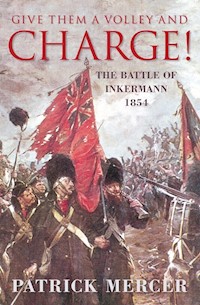
‘Give Them a Volley and Charge!’
The Battle of Inkermann, 1854
‘GIVE THEM
A VOLLEY
AND CHARGE!’
THE BATTLE OF INKERMANN, 1854
by
Patrick Mercer
First published in 1998
Spellmount an imprint of
The History Press
The Mill, Brimscombe Port
Stroud, Gloucestershire, GL5 2QG
www.thehistorypress.co.uk
This ebook edition first published in 2011
All rights reserved
© Patrick Mercer 1998, 2008, 2011
The right of Patrick Mercer, to be identified as the Author of this work has been asserted in accordance with the Copyrights, Designs and Patents Act 1988.
This ebook is copyright material and must not be copied, reproduced, transferred, distributed, leased, licensed or publicly performed or used in any way except as specifically permitted in writing by the publishers, as allowed under the terms and conditions under which it was purchased or as strictly permitted by applicable copyright law. Any unauthorised distribution or use of this text may be a direct infringement of the author’s and publisher’s rights, and those responsible may be liable in law accordingly.
EPUB ISBN 978 0 7524 7528 8
MOBI ISBN 978 0 7524 7527 1
Original typesetting by The History Press
Contents
Introduction
I
‘The bullet is a fool, the bayonet is a hero!’
II
‘Never mind forming, for God’s sake, come on, come on men!’
III
‘Raglan and Canrobert were donkeys!’
IV
‘An hour of the best training that any good troops could have!’
V
‘. . . the exemplary chastisement inflicted upon the presumption of the Allies!’
VI
‘. . . forward with the bayonet!’
VII
‘I never heard our men make such a yelling as they did this day!’
VIII
‘. . . should there be confusion in the enemy’s batteries’
IX
‘We saw five columns of the beggars advancing upon us!’
X
‘. . .save your guns, all is lost!’
XI
‘They lay as they fell, in heaps’
Bibliography
Introduction
The battle of Inkermann lasted for less than twelve hours, was one of the bloodiest single engagements in Europe between 1815 and 1914, and saw the hopes of the British, French and Turkish allies for a swift and lasting lesson to the Tsar perish. Now the battle is largely forgotten, despite the fact that in Victorian folklore its memory shone brighter than any of the other engagements of the whole Crimean War. Today ‘The Soldiers’ Battle’ is eclipsed by the Charge of the Light Brigade – a defeat that took less than half an hour and in which the casualties were counted in hundreds rather than thousands – and the memory of a nurse called Florence Nightingale who visited the Crimea only once. It is a battle that almost defies description, fought in fog over deeply broken ground and to no particular plan or strategy, a series of disparate and bitter mêlées rather than a ‘battle’ proper. To try to piece it together is difficult but fascinating; this probably accounts for the comparatively few accounts that have been written of it. To grasp it, however, the context of the Crimean War as a whole needs to be understood.
To precis the muddled circumstances, the frustrated ambitions and the jingoism that led to the War is almost as difficult as an account of Inkermann. In brief, however, its origins lay in the nineteenth-century developments of industrialism, nationalism and imperialism, changes in the European status quo brought about by the revolutions of 1848–9, British-Russian rivalry, chronic Russo–Turkish hostility, the resurgence of French Bonapartism, and the increasing divergence of Russia and western Europe. The fighting ought to be seen as two separate wars; that between Russia and Turkey around the Danube, which preceded the war fought against Russia by the coalition of France, Britain and Turkey in the Baltic as well as the Crimea.
Britain, France and Russia all had a vital interest in the future of Turkey, the vexed ‘Eastern Question’, for Turkey’s Ottoman Empire bordered Russian territories, was contiguous to France’s north African Empire and dominated the overland route to British India and her possessions in the east. Furthermore, Turkey’s opposition to Russia suited Britain, for she lay in an ideal position to neutralise any Russian threat to India or Persia, such as the Afghan War of 1839–42.
Austria also had a crucial part to play in the equation, being Turkey’s and Russia’s most powerful neighbour. However, the Tsar had restored her Hungarian kingdom to Austria’s young Emperor, and whilst she looked askance at Russian expansion into Turkish territories across the lower Danube, her debt of gratitude effectively neutralised her. Similarly, whilst Prussia was emerging as a new power, her king was related to the Tsar by marriage and had no direct interest in the Eastern Question. Thus, the Tsar’s expansionist ambitions depended principally upon a lack of opposition from Britain and France. Britain, however, stood to gain by any division of Turkish territory and she, like Russia, was alarmed by Louis Napoleon’s assumption of near dictatorial powers after the coup of 1851; new Bonapartism was attractive to neither.
Another dimension was added to the Tsar’s desire for territory and access to the Mediterranean in the shape of the 13 million Greek Orthodox subjects of the Turks. In 1829 Greece had fought for her independence from Turkey with the aid of Russia, and since then the Tsar had seen himself as the protector of those Christians still under Turkish rule. It was a lever that he could use as much or as little as he chose, and in 1850 when Catholic and Greek Orthodox monks squabbled over matters of precedence in the Holy Land, he chose to listen to the appeals of the latter. The Catholics sought the intercession of Louis Napoleon; the Sultan, meanwhile, within whose territories the Holy Land lay, found in favour of the Catholics in December 1852. Whilst on the surface it seemed to be a matter of no great consequence, the issue infuriated the Tsar and drew France, now as a direct supporter of Turkey, into clear conflict with him.
The Tsar judged that it would now be possible to fan the flames of this dispute and, with tacit British support or, at least, no opposition, the long-sought-after dismemberment of Turkey could begin in earnest.
In early 1853 he approached London and reminded the Prime Minister of the offer he had made in 1844 when such an arrangement had last been broached, namely that Britain would gain Egypt if she allowed Russia to pick at Turkey unhindered. Misjudging Britain’s lukewarm response and being unaware of hardening British opinion, the Tsar despatched Menshikov to Turkey to deliver ultimata. Britain’s influential ambassador in Turkey, Redciffe, gave every assurance to the Sultan that Britain would stand by him and he refused either to restore the Orthodox monks’ privileges or to allow the Tsar to establish a protectorate over all of his Christian subjects. A French naval squadron had already been despatched to Turkish waters, and despite its being joined by an equivalent British force, Russian troops marched into the long disputed Danubian principalities of Moldavia and Wallachia in July 1853.
Despite Austria’s attempts at mediation in Vienna, Turkey declared war on 5 October. Crossing the Danube into Wallachia, the Turks initially enjoyed some successes, but Russian counter-attacks soon occurred, the most notable, in terms of what happened later in the Crimea, being that at Oltenitsa on 4 November. The battle itself was bloody and probably rates as a tactical victory for the Turks. Strategically, however, it marked the turning point in the Turkish advance for having been mauled, they feared the approach of Russian reinforcements and fell back across the Danube. The Russian commander was General P.A. Dannenberg; one year and one day later he and the remnant of his 8,000-strong division were to see action again, this time against the British at Inkermann.
Success on land was added to at sea on 30 November when Admiral Nachimov (whom we will also meet later in the Crimea) sank a Turkish flotilla at Sinope with almost no loss to himself but killing 4,000 Turks. It was a legitimate act of war, but it served to push the divided British coalition Cabinet over the edge, which until then had allowed the British fleet no more latitude than to remain at anchor off Constantinople. Sinope caused the British to agree to a French plan to move a combined fleet into the Black Sea and to despatch troops to the Mediterranean where they could be better poised. To add weight to this, in March a joint ultimatum was sent to St Petersburg demanding a withdrawal from Moldavia and Wallachia. When this was not forthcoming, both Britain and France declared war.
After a relatively inactive winter, the Russians attacked on the Danube and besieged the fortresses of Silistria and Shumla. Meanwhile, a joint British and French force had landed at Gallipoli, and then in June moved up to the west coast of the Black Sea to Varna, there better to support the fighting on the Danube. The Russians had hoped for a quick and easy series of victories, which would cause the Turks to collapse and sue for peace before the Allies were in a position to do anything constructive. However, not only did the Turks resist well, but, more significantly, the Austrians, much against Russian expectations, moved 50,000 troops up to her borders and jeopardised her neutral status by demanding a Russian withdrawal from the principalities. With Britain and France being much more menacing and business-like than he had anticipated, with the Turks showing much more spirit than they had done in 1853, and with his territorial and diplomatic flanks unexpectedly threatened by Austria, the Tsar capitulated thus instantly removing the casus belli.
Too much was at stake, however, for the Allies to withdraw merely because the Russians had capitulated to all demands. Both Britain and France had committed themselves politically and militarily, and the temptation to continue was too great. For France a successful military adventure would solve several issues: first, it would give substance to the new Bonapartism whilst distracting people from difficulties at home; second, it would cement an ever fragile relationship with Britain, and third, it would allow the new France to be seen as a credible player in European affairs. Britain’s reasons for continuing were not so very different, but on top came the fact that public opinion was baying for military adventure; the coalition government was too weak to resist it.
All that needed to be decided now was what and where the Allies should attack. Throughout the preceding year, reconnaissances had been made of the north and west coasts of the Black Sea. It had always been assumed that no matter how the fighting around the Danube developed, the Russian Black Sea Fleet would have to be neutralised, and whilst this would be a relatively simple tactical matter at sea, its Sevastopol base would have to be reduced if the threat were ever to be removed completely. Sevastopol was more than just a naval base, it was the jewel in the crown of Russia’s influence abroad. Here was concentrated much of the wealth of southern Russia; the Crimea had been populated by native Russians during Peter’s time and it had become one of the most advanced and innovative ports and arsenals in the world; destroy it and Russia’s ambitions would be badly dented. Accordingly, in mid-September the Allied armada set sail for the Crimea with the destruction of Sevastopol as its aim.
CHAPTER I
‘The bullet is a fool, the bayonet is a hero!’
The Protagonists
‘We should have to go far back in history to find the record of a battle so fiercely contested as that of Inkermann. No instance is called to mind, this side of Thermopylae, where an invincible handful so successfully withstood the crushing force of overwhelming numbers. For eight terrible hours, 14,000 of the Allies thrust back, with great slaughter, 60,000 Russians inspired by patriotism, religious fanaticism and the stimulus of intoxication’.1
Even allowing for hyperbole, there is much truth in this account of a battle that beggars description. It should also be added that the field over which this contest raged was one of the smallest of its kind measuring some two miles by two. As a result, the slaughter was appalling; as one officer who claimed to have fought in every major engagement in the Peninsula put it,
‘never did I witness anything approaching the carnage, the fury, the fiendish deviltry [sic] of that drizzling morning . . . I saw whole ranks with their musket-stocks as men who played at quarter-staff; I saw them hang on each other like gnashing bull-dogs and roll on the ground over and over again stabbing, tearing, cutting and mangling like men who had lost every characteristic of humanity and acquired more than tiger ferocity’.2
But why did both sides go at it with such a will? An examination of both armies’ composition and fighting spirit may provide an explanation.
THE BRITISH
Alone amidst the combatants, the British Army was an all-volunteer force whose soldiers enlisted for an initial period of ten years in the Infantry or twelve in the Artillery, Cavalry or Engineers. ‘Going for a soldier’ in mid-Victorian England was still not a respectable thing to do but, as industrialism spread, so there was less need for men on the land and unemployment began to be a factor. Ten years before the Crimea a vast proportion of the Army had been made up of Irishmen, but the potato famines and emigration had sapped this source of recruits who now tended to be found from the rural and industrial working classes. Such men were tough – they had to be in order to survive into manhood – but fewer fit, healthy ploughboys or farm workers were offering themselves as recruits. Despite this, the soldiers generally met with the approval of their officers, ‘strong, hardy, well-intentioned fellows whom no nation on earth could match,’3 wrote one Guardsman, whilst a Line officer described the Grenadier company of his regiment as ‘a particularly fine set of men’.4 An important factor, perhaps, was the fact that volunteers had been called for to make up those regiments that were embarking to full strength. This allowed the sick or feeble to be left behind, thus 95th (the Derbyshire) Regiment, typical of most, received reinforcements from the 6th, 36th, 48th and 82nd Regiments. Furthermore, the average age of the other ranks who embarked for the Crimea was 26 – mature by any army of any era’s standards.
The officers are widely assumed to have been wealthy amateurs, scions of the great houses and families of England. Certainly there was an element of just that sort, and the fact that commissions and most subsequent promotions up to lieutenant-colonel (in all arms other than the Artillery and Engineers) still had to be bought confirms that most officers came from monied backgrounds. Much has been written about the iniquities of the purchase system, and indeed it was open to abuse, but it was a system that had been seen to work for several generations and to which few in the Army objected. One of the interesting corollaries of the social changes going on within Victorian England was that more and more middle-class families were now in a position not only to buy a commission for their son, but also chose to. Thus, the bourgeois sneering at the ‘children of luxury’ was beginning to give way in certain quarters to a desire for the kudos that a commissioned son might bestow on the family. One of the most damaging consequences of this trend, however, was that young men from such backgrounds were frequently the targets of bullying by sons of ‘old money’. Public opinion was influenced by a number of scandals, well publicised by Punch and similar organs, where young officers’ lives had been made intolerable by their peers. The case of Lieutenant Perry of the 46th (South Devon) Regiment was infamous; so mercilessly had he been ‘ragged’ that his case came to court martial. So much public interest was there in it that the case had to go ahead despite the fact that the 46th were due to embark for the Crimea. So many witnesses were involved in the case that only two companies were able to embark; they were to be centre stage at Inkermann.
The professional standards of the British infantry and cavalry had depended, until the early 1850s, solely on the determination of their commanding officers. With the introduction of rifles in the late 1840s, a school of musketry had been established, and in 1853 manoeuvres on a large scale had started annually at the Chobham Camp of Exercise, but much still rested upon each regiment’s internal training regime. With the Artillery and Engineers, however, things were a little more formal. Standards were established and maintained by Woolwich, and both corps were thought to compare well with those of other nations.
The tempo of training, though, depended upon the lessons learned in action. A casual glance at the operations of the British Army in the late 1840s and early 1850s would suggest that most of the Crimean army would have seen action, but this was not the case. Only one infantry battalion, 1st Rifle Brigade, had seen active service in the preceding four years (fighting the Kaffirs in South Africa), though most of the commanders at brigade level and above had a fair measure of experience. The Commander-in-Chief, Lord Raglan, was 66 years old and had lost an arm at Waterloo as one of Wellington’s ADCs. There was no question that he was an able staff officer, but he lacked experience of command, was painfully over-sensitive to the feelings of others, and had little of the iron needed to lead in battle. He was to epitomise British lack of drive at the higher levels, for he was the product of a long peace and, like so many of his contemporaries, hidebound by the dead hand of his mentor, Wellington.
The main fighting element of the British Army was its infantry battalions. By the time the army landed in the Crimea, most were about 750 to 800 strong and consisted of eight companies. One of these companies was styled ‘grenadier’ and another ‘light’; both of them had had different tactical functions in the past, but as most of the regiments had by now been equipped with the rifle and taught skirmishing tactics, their function was little different from that of the other six companies. Each regiment had a territorial title as well as a number. Thus, the 55th were the Westmorland Regiment, but owed little to that border land. In practice, territorial titles had been introduced in the eighteenth century as a recruiting expedient; these titles signified little as most regiments were known by their much-cherished numbers.
The infantry were organised into brigades of three battalions under the command of a brigadier-general, whilst each division, commanded by a major-general, consisted of two such brigades. Four divisions of infantry and one of cavalry embarked for the Crimea attached to each of which were one or two batteries of artillery armed with four 9-pound guns and two 24-pound howitzers. Also, there was a siege train which was to deploy two 18-pound guns at a critical juncture of Inkermann. To think of these divisions and brigades as tactical entities, however, would be a mistake. The component units had been thrown together in Turkey arriving mainly from the English, Irish and Mediterranean garrisons and did very little training above unit level either in Turkey or at Varna because of the pace of events and the occurrence of disease. They had to depend upon the early engagements of the war to forge any sort of tactical coherence.
The British artillery was still muzzle-loading and largely smooth-bored (though there were some rifled Lancaster guns landed from the Fleet), with the same characteristics of the guns that had been used at Waterloo. Round shot and common shell were the staple ordnance for static operations, but shrapnel rounds and canister in particular were to be responsible for most of the casualties at Inkermann. Canister had the same effect as a huge shotgun; a light container packed with iron shot was loaded into the gun-barrel which immediately fanned out from the muzzle when the gun was discharged. With an optimum range of 200–300 yards, against massed infantry it was devastating.
Less well understood, however, were the new rifles of the infantry. The 4th Division still had the old smooth-bore percussion musket which, though quicker to load, lacked the range and the stopping power of the new Minie rifles. Most of the regiments thus equipped had received their weapons whilst on the way to the Crimea in Scutari and did not properly understand the fundamental advantage that they bestowed over the old smooth-bored weapons. Whilst still muzzle-loading and requiring the use of a ramrod, the percussion Minies were capable of accurate fire well over 300 yards and would easily pass through the torso of a man.
There was some opposition to the new weapons on the grounds that a ramrod had to be employed to get the round to the very bottom of the breach in order to achieve the correct compression. Whereas, in extremis, the old smooth-bore could have a round dropped down the barrel, and a sharp tap of the butt on the ground would serve to seat the round sufficiently for it to be lethal. Furthermore, nothing had been done to adapt tactics to this new weapon despite the fact that it had been used with success against the Kaffirs in South Africa and that its characteristics and potential had been studied extensively at the School of Musketry. Thus the range of volley fire was still deemed to be that of the smooth-bore – about 100 paces. Added to which, both smooth-bore and rifle were very susceptible to rain and damp, and many weapons were too soaked to fire on the morning of Inkermann; much reliance, therefore, had to be placed on the bayonet.
One element of British tactics was to have a profound effect on the outcome of the battle, however. The British Infantry had always been taught to fight in line – shoulder to shoulder – rather than in the column common to most European countries. In the Peninsula the British had been renowned for the firmness of their battle discipline which had allowed an apparently weak line to bring most of its muskets to bear. A dense column, whilst it was terribly vulnerable to both musket and artillery fire and only allowed a small proportion of weapons to be used, at least gave those within its ranks the illusion that there was safety in numbers. The Russian columns were to fall terribly foul of the British lines in the same way that the French had fifty years before.
The renown and battle discipline of the British soldier went some way to make up for the lack of ability of most of his commanders. Raglan and the legacy of the Duke of Wellington have already been mentioned, now Raglan was surrounded by officers of very mixed merit. In command of the 1st Division was the Duke of Cambridge who, at 35, was the youngest general officer by far. He had no operational experience until he commanded his division indifferently at the Alma; at Inkermann he was to fight bravely but with little flair. Sir George De Lacy Evans, 67, commanded the 2nd Division. Having had experience in the Peninsula and during the Carlist wars he was well qualified but elderly. At the Alma he performed well and did a workmanlike job at the dress rehearsal for Inkermann on 26 October. On the day of the great battle, however, he was missing, sick on a ship in Balaklava having been thrown from his horse. In his place was his foul-mouthed, combative brigadier, Pennefather. Another Peninsula veteran, he was enormously popular with his men and had much experience in India having commanded a battalion at the epic battle of Meeanee in Scinde in 1843.
One of the most contentious figures of the early part of the campaign was Sir George Cathcart who, at 60, was commanding the 4th Division. Having just successfully fought the Eighth Kaffir War, he had hastened to the Crimea with a reputation that preceded him. Accordingly, he was given a ‘dormant commission’, that is, in the event of any mishap befalling Lord Raglan, he was to take command of the Army. Sir George Brown, who commanded the Light Division, however, was his senior and the logical successor to Raglan; lest any friction occur, the appointment was kept secret. This curious way of doing business may go a long way to explain the conduct of Cathcart at the engagements before Inkermann and at the battle itself. Quite what the effect was will never be known, however, for Cathcart was to be killed at the head of his troops during an ill-judged charge.
In spite of all of these disadvantages, the average British soldier fought with great bravery and initiative at Inkermann.
‘Where their officers and non-commissioned officers were shot down, the men banded themselves together in twos and threes and twenties – under some natural or self-elected leader – and fought the battle out. Thus in one place were eighteen privates of the 95th fighting on surrounded by upwards of 200 of the enemy . . . nine were killed and not one left the field without a wound; all fought on until their ammunition was expended and their bayonets were red with blood’.5
Or as Campbell of the 30th observed, ‘. . . some wandered and a few might go to the rear, not many, for the men were full of resolution’.6 That resolution probably stemmed from the British experience, up until then, of nothing but victory. Whilst the Alma had been most soldiers’ first taste of war – and a bloody one it had been – their enemies had been trounced. Unlike some of the cavalry, none of the infantry present had been mauled at Balaklava, and on 26 October, at the so-called battle of Little Inkermann, victory had been theirs. Similarly, the troops most heavily engaged were the 2nd Division and the Guards, the very men who had triumphed before and who knew the limitations of their adversaries. Despite the appalling conditions involved in their picquet duties before Inkermann, morale was still high and the troops were experienced enough to know what they could and could not do in battle. Their stock of courage was not yet overtaxed. They fought well; they fought for their honour and that of their regiment; they fought for their very survival. Yet the British Army was never to fight like this again in the Crimea; Inkermann was to be the high point for the British Infantry.
Underlying this high level of fighting spirit was a closeness between officers and men that is often misunderstood. For all the officers like Lieutenant John Ross Lewin of the 30th whose father, ‘. . . a Peninsula veteran, had been in eleven battles and sieges and two of his uncles had also distinguished themselves under the Duke of Wellington’,7 there was a greater proportion of officers commissioned from the ranks than might be supposed. The 47th, for instance, had three such officers and several commissions had already been granted to soldiers in recognition of the victory of the Alma. Whatever their social origins, the officers knew their men well, and there were to be many acts of selfless bravery at Inkermann which demonstrated their mutual regard. For instance, Private Palmer of the 3rd Grenadier Guards was to win the VC for springing to the defence of Sir Charles Russell Bt; similarly, the commanding officer of the 55th was engaged hand-to-hand with a Russian officer when a soldier of the Rifle Brigade ran the Russian through with his bayonet with the cheerful cry, ‘There you are, sir!’,8 whilst Major Clifford won his VC for sabreing a Russian who was attacking a soldier of the 77th and then despatching another.
Without doubt, Britain’s Crimean army had plenty of faults and was, at best, indifferently led. At Inkermann, as the epithet ‘The Soldiers’ Battle’ suggests, however, it was the common infantryman full of grim determination who ‘. . . held the ground they stood upon as long as life was in them’.9
THE RUSSIANS
Every aspect of the Tsar’s army was copied from that of the widely admired Prussian Army, though little of it perfectly. Soldiers were conscripted for a minimum of twenty-five years in the Infantry and tended to come from peasant stock. Indeed, such was the despair that a family felt once their son was to be conscripted that a party resembling a wake would be held in his honour. There was little chance of the parents seeing their boy again. Once at a regional depot, any man who showed mechanical or technical aptitude was taken for the artillery or engineers; any who had experience of horses went to the cavalry, and the remainder joined the infantry. Whilst there are plenty of other examples of just this selection procedure going on throughout history, it did mean that the soldier who bore the brunt of the fighting at Inkermann was mostly of the least promising quality.
The popular writings of Tolstoy and the account of the Pole, Hodasevich, who deserted to the British after Inkermann, show the typical Russian officer in a very poor light. Both were writing to their own agenda, the former for political ends, whilst the latter had good reason to stress the indignities which had made him desert. However, no British accounts speak of any lack of courage among the Russian officers, even if there was every sign that tactical sense and initiative were not present in any great measure. The way Russian officers were appointed hardly lent itself to this.
There were three ways in which a commission might be obtained. First, about one fifth of officers were the sons of minor nobility and came via officer cadet schools. Military education at these schools was not well developed and left the cadets scarcely better qualified than the second category, the junkers. They were normally officers’ sons who had served in the ranks for a number of years as under-officers and then passed a simple qualifying exam. Third were soldiers who had served for about ten years before passing an even simpler exam; they made up the great bulk of regimental officers.
All of these would have served to make perfectly good officers had their training encouraged any sort of daring or initiative. Suvarov’s maxim, ‘The bullet is a fool, the bayonet is a hero’, still held good at the time of the Crimea and this, linked to a distorted idea of the Prussian system, meant that the Russians relied upon heavily drilled masses wielding weapons little better than spears. Indeed, one general advised the Tsar that his troops were ready for battle because ‘. . . the men can march well with their toes pointed and their bodies rigid’.10 Inflexibility was encouraged by such training; the result was countless instances in the Crimea of Russians gaining a minor success but failing to exploit it, not because of lack of courage but simply for want of initiative by both officers and non-commissioned officers at crucial moments.
Russian minor tactics played into the hands of opponents armed with rifles: a forest of cold steel, delivered by columns which, in the words of the 1848 officers’ manual depended for success ‘. . . on the correct stretching of the toe in the march and the proper number of steps’11 made an ideal target. There were two types of column used at Inkermann: columns of companies and the so-called column of attack which consisted of a whole battalion arranged in two, parallel columns of sections each of three ranks with a depth of twelve ranks and the frontage of a company. The columns, however, were not trained to maximise their firepower, for their main aim was to deliver a blow with the bayonet, the momentum of which would be impossible to resist. For fire support they depended upon skirmishers who operated as a cloud on either flank and, more importantly, on their artillery.
The Russians were organised along Prussian lines of corps of three divisions each of two brigades both of which had four regiments. Each regiment had four battalions, and every corps had a sapper and a rifle battalion attached. In a division, the first infantry brigade were styled ‘musketeers’ and the second brigade ‘jagers’, though the actual difference seems to have extended only to matters of dress. Musketeer and jager regiments were each separately numbered with two regiments – one of musketeers and one of jagers – having the same number. Unlike the British, the numbers mattered little to the Russians for they were often changed; to them it was their territorial title which was the more important.
Each infantry division had an organic artillery brigade which had two twelve-gun field batteries of six 12 pounders and six 18 pounders as well as two twelve-gun light batteries of eight 6 pounders and four 9 pounders. The guns were all brass smooth-bores mounted on characteristic pea-green carriages which, like their British counterparts, could fire about two rounds per minute. The artillery of both sides was to have a decisive effect on the battle, as we shall see, but the Russian gunners were much more of a match for the Allies than the infantry. Well trained, equipped and led, they were probably the most competent arm of the Russian Army. In a letter to his father after Inkermann, Capt Thomas Davies makes the point that the Russian infantry
‘. . . are not to be feared by British or French troops in anything like equal proportions – say one third to two thirds of them – but their artillery is very formidable. Our loss would have been comparatively nothing on the 5th had it not been for that, which is more powerful than ours, and our guns came up slowly and after firing a few rounds of ammunition fell silent.’12
Mention should also be made of the sailors of the Black Sea Fleet. The way that they manned the defences of Sevastopol is well known and much admired, but contemporary British accounts speak with some confusion of columns of ‘marines’ or ‘naval infantry’ appearing at Inkermann. The fact is that Russian mariners were trained to act as infantry on land and sailors at sea and uniformed and equipped much like infantrymen with muskets, bayonets and crossbelts but wearing shakoes rather than helmets. Hodasevich speaks of the contempt in which these sailors were held by soldiers proper, but they were used extensively in the infantry role and appear to have acquitted themselves well.
One of the Russians’ greatest disadvantages were their small-arms by which both sailors and soldiers were poorly served. For the most part the Russians carried percussion smooth-bores converted in the 1840s from flintlock. Whilst they were quicker to load than the Allied rifles, they had only a fraction of the range and stopping power, though there were a number of rifles served out to the infantry regiments which were carried by the skirmishers and company marksmen. In addition, the rifle regiments carried a copy of the Brunswick rifle which was a vastly superior weapon to either the muskets or the smooth-bores of the infantry. As the war progressed, the Russians converted a number of their muskets into rifles and trench raiders often sought the highly prized Allied rifles. When Inkermann was fought, however, the Russians were still largely using the tactics and weapons that they had deployed against Napoleon.
Traditionally, discipline in the Russian Army had been harsh with almost barbaric methods used to perfect the drill which was supposed to bring success in battle but certainly made a splendid spectacle on parade. To that end physical punishment was dealt out by officers and non-commissioned officers alike with great vigour. A fault on parade would merit a slap or a punch, whilst rods or birches were regarded as necessary adjuncts to perfection. Scabbards and drumsticks were used liberally; being struck in the face with such was referred to as receiving the ‘toothpick’. Despite this, the Russian infantry seems to have followed its leaders willingly enough, though the Polish deserter, Hodasevich, does stress that a number of officers fell at Inkermann by their own troops’ hands. No British accounts mention such behaviour, and many eye witnesses relate how well the Russian officers led from the front and, though their appearance was less distinctive than that of their British counterparts, they made themselves obvious by constant sword-waving and bellowed encouragements. The action of one Russian officer of the Kazan Regiment at the Alma was not untypical. Very tall, he singled himself out to the British troops of the 7th Fusiliers by striding about, oblivious to British bullets, encouraging his men until he became such an object of respect to the British that they were reluctant to shoot at him. Eventually, the Fusiliers’ commanding officer had to order him to be shot.
Battle experience amongst the Russians was, for the most part, greater than that of the British; most of that experience, though, had been of defeat. The troops that mounted their attack from Sevastopol had, in most cases, seen action at the Alma, at Balaklava or at Little Inkermann. At the Alma the British had been dubbed the ‘Red Devils’13 by the Russians, who had been told that they could expect the British, a seafaring nation, only to be as expert on land as their own sailors. The artless ferocity of the assault and the number of casualties had stunned the Russians; also, they had tasted Allied artillery and the deadly Minies for the first time. At Balaklava, few infantrymen had been in action, but they had seen first the Heavy Cavalry Brigade defeat a much larger body of their own cavalry and then the Light Cavalry Brigade charge massed artillery with suicidal eagerness. Whilst the Light Brigade had been mauled, their action had left a profound impression on the Russians. Again, those troops in action at Little Inkermann had been roughly handled this time by a handful of picquets which, by the normal conventions of war, should have fallen back rather than fight to the death. In short, the Russians who had already met the British knew that they would be meeting a tough enemy.
Those who marched on Inkermann from the interior of the Crimea had yet to have any experience of fighting in this campaign, but were mostly veterans of the operations on the Danube against the Turks. Dannenberg’s drubbing at Oltenitsa has already been mentioned and it is interesting to note that he was initially ordered to attack on 4 November rather than 5 November, that is, precisely one year to the day after his defeat by the Turks. The fact that his troops were told to attack on the very day that they had completed a 250-mile march from Bessarabia was reason enough for the assault to be delayed, but Dannenberg also asked that his troops’ superstitions should be respected by not attacking on the first anniversary of a defeat. In other words, most of the Russians at Inkermann had become used to the concept of defeat; they had tasted the bitterness of casualties and retreat, and they had probably passed their fighting prime. This was in stark contrast to the British who had yet to become jaded by war. This was a British impression of their foes at Inkermann:
‘The Russian soldiers were infinitely inferior in appearance to those we met at Alma. In all that relates to discipline and courage, our late antagonists were far superior. They were all clean but ragged in the extreme. None had knapsacks but merely a little canvas bag of that disgusting, nauseous-looking stuff they call bread . . . The knapsacks, I presume, were left behind, in order that they might scale the heights on our left with greater facility . . . they appear to have been veteran troops as a large number bore the scars of previous wounds. The dead officers, as at the Alma, were with difficulty to be distinguished, from the men. Their officers behaved very well . . . It is said that the Russian soldiers had been liberally supplied with liquor previous to the commencement of the attack. Their continued and loud shouting and the impetuosity of their attack render it probable that they were under the influence of some artificial stimulus of the sort. In the canteens of many of the killed on the field was found a mixture of raki and water. The men who have fallen into our hands, though generally of short stature, are of sturdy frames, with broad chests and well-developed, muscular legs.’14
It is interesting to note that the British believed their foes to be drunk at Inkermann, whilst the Russians thought that the Light Cavalry Brigade must have been drunk to do what they did at Balaklava. Hodasevich complains, however, that the issue of raki before the attack was particularly meagre being restricted to one measure only. Perhaps all troops who are subjected to frenzied attack feel that their enemies are acting under the influence of something that they wish had been available to them too. Such then were the Russians – brave, stoic, experienced (perhaps too experienced) but lacking initiative and poorly armed. Whatever their relative merits and demerits, their endeavours, as we shall see, were very nearly the undoing of the Allies.
Notes
1. Complete History of the Russian War, p. 78
2. Ibid, p. 88
3. Wilson, p. 38




