


8,99 €
Mehr erfahren.
- Herausgeber: Editora Gente
- Kategorie: Fachliteratur
- Sprache: Englisch
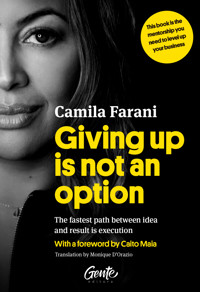
WHEN WE THINK ABOUT GREAT ENTREPRENEURS, WE NOTICE SOMETHING IN COMMON: THEY WENT BEYOND THE OBVIOUS. THEY THOUGHT OUTSIDE THE BOX. THEY SAW SOLUTIONS WHEN THE REST OF THE MARKET ONLY SAW HINDRANCES. THAT'S THE SKILL I WANT TO HELP YOU DEVELOP. Everybody knows how hard it is to own a company in the current market—mortality is high, and achieving the desired profit takes time, discipline, and planning. As you build a company, or even while still developing your business idea, you notice some of the complications that might prevent you from going forward: lack of financial control, bad time management, wanting to do everything all at once, inability to finish things, lack of collaboration and team training. However, few people know how to survive adversity, grow and reach success. To teach these and other secrets about entrepreneurship Camila Farani—businesswoman, investor, and Shark Tank Brasil shark—wrote her first book. In this book, she deals with subjects such as Brazilian informal culture, lack of specialization and the need for continuous management studies. Through recognizing the fear of taking your next step, Farani brings to you all of her knowledge from nearly twenty years of experience, which will help today's entrepreneurs become tomorrow's great business leaders. Here, you'll learn to: - Protect your business from the most common mistakes made by aspiring entrepreneurs during the first stages of a business; - Align your idea to a structured, guided business model to offer solutions that will actually attract your clientele; - Price the products and services you're offering to the market fairly; - Get out of your comfort zone, go beyond the obvious, and innovate, strengthening your business; - Build a business plan based on clarity around your resources, efficiency, judicious execution, and scale growth strategy.And, most of all, understand that, when it comes to business, giving up is not an option!
Sie lesen das E-Book in den Legimi-Apps auf:
Seitenzahl: 254
Veröffentlichungsjahr: 2022
Ähnliche



















Publisher
Rosely Boschini
Publishing Manager
Carolina Rocha
Rosângela de Araujo Pinheiro Barbosa
Junior Editor
Rafaella Carrilho
Editorial Assistant
Giulia Molina
Production Control
Fábio Esteves
Desktop Publishing & Graphic Project
Vanessa Lima
Copyediting
Bruna Miranda
Proofreading
Lorena Pimentel
Cover
Thiago de Barros
Cover Image
Etyla Mariely Nogueira
Printing
Meta
Conversion to digital format
Linea Editora
Copyright © 2022 by Camila Farani
Original Title: Desistir não é opção
O caminho mais rápido entre a ideia e os resultados se chama execução © Camila Farani 2021
Todos os direitos desta edição
são reservados à Editora Gente.
Rua Natingui, 379 – Vila Madalena
São Paulo, SP – CEP 05435-000
Telefone: (11) 3670-2500
Site: www.editoragente.com.br
E-mail: [email protected]
Cataloging-in-Publication Data (CIP)
Angélica Ilacqua CRB-8/7057
Farani, Camila
Giving up is not an option: the fastest path between idea and result is execution / Camila Farani; translated by Monique D’Orazio. - 1. ed. - São Paulo: Editora Gente, 2022.
224 p.
ISBN 978-65-5544-249-6
1. Business 2. Success in business 3. Entrepreneurship I. Title II. D’Orazio, Monique
21-4214 CDD 650.1
Index for Systematic Catalog:
1. Success in business
note from the publisher
Being an entrepreneur is not easy. Especially in a country with a frightening high business mortality rate, where extreme informality weakens companies, and the lack of entrepreneurial training makes entrepreneurs get lost in everything they need to manage. It’s no wonder that deciding to be an entrepreneur is compared to being in the open sea with a small buoy, no land in sight, seeing the sharks’ fins approaching, and not knowing what to do to save yourself.
Lucky for us, dear reader, one of those sharks is on our side: Camila Farani! In this essential guide, she offers us her knowledge of over twenty years navigating the business world. In addition, she is the only woman awarded twice as the best angel investor in Brazil. A successful businesswoman and investor like no other, she helps businesses gain traction and rise to the top. In this book, she teaches you the steps you need to follow to become the next great entrepreneur. And to be honest—I am very proud to have this great author swimming in the seas of Editora Gente!
In Giving Up is Not an Option, you’ll find practical tools to protect your business, get out of your comfort zone, and build a strategic plan to take your business to the top. For now, I’d like to make you an invitation—let’s dive in together!
Rosely Boschini – CEO and publisher at Editora Gente
I dedicate
this book to
my best friend,
teacher, fighter,
and endless source
of inspiration:
my mother,
Fátima Farani.
Acknowledgments
Writing this book has been a long-standing project in my life. So, I will share a secret: surround yourself with people who complement you.
Books gave me answers in the most decisive moments of my personal history. So, after I received so many lessons as a businesswoman, entrepreneur, and investor, it was a fundamental goal for me to share, in the most profound and accessible way, something that I hope will help thousands of other professionals.
As you know, I faithfully believe that entrepreneurship changes people’s lives. After all, it has changed mine.
Giving up Is Not an Option is the result of the support, inspiration, and challenges given to me by many people. In my lectures, I always ask, “Do you surround yourself with people who complement you or only those with whom you share an affinity?” It’s a huge misfortune to only network with people similar to us. After all, when facing differences, we open our minds. With diversity, new opportunities arise. That’s why I have many people to be grateful for—family, friends, business partners, fans...
Of course, it would be impossible to name all the people who crossed my path and contributed to my journey. But I ask permission to extend my special thanks to my Uncle Paul for the outstanding support he gave me in life—as an uncle and an entrepreneur. He taught me that being an entrepreneur means keeping your feet on the ground and taking risks. To my brother, Cassiano, one of the most brilliant minds I have ever known. To my father, Luiz Carlos, and my grandparents, who, although gone now, gave me lessons that remain part of my essence.
To Jony, Camila Fusco, Betinha, and my team, for committing to yet another project and supporting me in all aspects of my career.
To Leonardo Mota, with whom I shared a decade and who saw me grow professionally.
To you, dear reader, who will dive into these pages and surely build something incredible from the restlessness that powers your actions.
Finally, and most importantly, to my mother, Fátima, the most important human being in my universe, who gave birth to me and taught me to shine, and who literally knows that giving up is not an option.
Camila Farani
Contents
Foreword by
Caito Maia
Introduction:
Be restless
Chapter 1:
Chronic restlessness
Chapter 2:
There’s nowhere to run: the market has definitely changed
Chapter 3:
Three deadly mistakes when starting a business
Chapter 4:
The art of building non-obvious solutions
STAGE 1: CLARITY ABOUT RESOURCES
Chapter 5:
The importance of knowing yourself
Chapter 6:
Design your broader plan
Chapter 7:
Basic management of your financial assets
Chapter 8:
You don’t win this game alone
STAGE 2: BUILDING YOUR BUSINESS
Chapter 9:
Entrepreneurship with a growth vision
Chapter 10:
Don't skip steps
STAGE 3: POSITIVE SCALABILITY
Chapter 11:
Business growth
Chapter 12:
Let’s talk about investment
Chapter 13:
Always do your best
are you ready to know the heart and soul of your business?
When I received an invitation to write a foreword to this book, I immediately remembered my first contact with Camila Farani back in 2017, when I made my debut at Shark Tank Brazil. We had just started shooting the second season of the show. Out of the four sharks that season, I only knew Robinson Shiba, founder of China in Box and Gendai restaurant chains, specialized in Asian food.
Camila opened a genuine smile as she approached me and said, “Welcome, Caito”. Over time, I got close to the other sharks, but I never forgot about that welcome I got from Camila, who became a close friend of mine. Amid the madness behind the scenes of Shark Tank Brazil, she said, “Glad you’ve joined us because I heard that you love people, that you are compassionate, and do business with your heart”. I had a great feeling. I’m very aware of people’s energies.
Eventually, during that season, she invited me to chat and shared many of her insights with me. She told me good things that helped me a lot. She spoke with love and generosity, which made a massive difference to me.
So, dear reader, you should consider yourself a privileged person just to be holding this book in your hands. Camila has been an entrepreneur since her teenage years, one of the most prominent investors in Brazil, and she’s passionate about technology. She has a 360-degree view of business, both digital and traditional, brick-and-mortar businesses. However, knowing her well, I can assure you that she is much more than that. She is driven by her heart! Whether she’s doing business as an entrepreneur, investing, or negotiating, doing things with heart is her biggest competitive differentiator. In the following pages, Camila shares with us how she applies it daily.
I often say that people who invest like her see far beyond money. They are those rare individuals capable of seeing people’s souls and essence, which makes all the difference. That is a real successful entrepreneur, in my opinion. And that’s why you should read this book. I believe people need to understand that technology and business are a perfect match when they are done from a beating heart.
By the way, is it possible for a business—or anything really—to work otherwise? I doubt it, to be honest. The heart can create an impressive combination when mixed with knowledge and technology. I’ve been lecturing at Harvard for six years to the best in the world on their fields. At a certain point during the presentation, I always say, “All of you here are a billion times more technical than me, but negotiating and being an entrepreneur takes heart”. That’s when everyone stands up and claps their hands.
In these four years of Shark Tank Brazil, I had the opportunity to see Camila go from a technology enthusiast to the next level. At one point, she said to me, “You know what? I’m going to put my heart on the line”. And so, she did. If you see a picture of her in the first season and another one now, you’ll notice remarkable, impressive changes in her. Her confidence, attitude, and empowerment have expanded. Her energy nowadays is much higher. Imagine a stone that turns out to be precious when it’s cut. In Camila’s case, her internal glow has been brought to the surface—a gemstone she cut herself.
When you turn the last page of this book, you will have learned much more than just negotiation or entrepreneurship. You will have read valuable lessons about courage, ability, leadership, and the importance of having charisma, sensitivity, and broadening your vision. Entrepreneurs have to open up their minds. You cannot be restricted to your comfortable little world. Camila is an example of this because even though she used to speak about technology, she decided to go further. Nowadays, she conveys the power, transformation, and competence of a woman of her time. With her guidance, you can also expand your world. I wish you success!
Caito Maia,
Founder of Chilli Beans, the largest sunglasses brand in Latin America, shark at the Shark Tank Brasil TV show, and founder of Plano 3R, a business training platform.
be restless
I’m passionate about entrepreneurship. But that was not always the case. I was introduced to this world due to a sad situation: my father, Luiz Carlos, died when I was only four years old. From then on, my mother, Fátima, was forced to financially support our household all by herself. It was just her, my older brother Cassiano, and me. We were a family of a woman and two children—against all else. My family’s story is like many Brazilians’: we were forced to become entrepreneurs out of necessity. That is, our best chance to support ourselves and be able to cope with our predicament was to create something new and risk everything we had at hand. All this, however, did not occur immediately after the loss of my father.
Initially, my mother, who has a degree in Pedagogy, became a secretary of a private school in Rio de Janeiro, making only minimum wage. It was the only way she found to support us. I went to the school my mother worked at while my brother went to one of the best schools in town. My mother made this decision thinking about the whole family’s future since there were no resources to enroll both children at my brother’s school. However, my school was also outstanding and was critical to my early education.
Over time, however, my mother ended up in debt in her attempt to get my brother to continue to have the best possible education. At one point, because she saw no alternative to increase her income, she decided to leave the school where she worked. It was time to make a big decision. So, with the little money left from my father’s inheritance, that woman, widowed for nine years, decided to become an entrepreneur.
At that moment, my mother had BRL 30,000.1 Influenced by her brother, my Uncle Paul, she decided to set up a tobacco shop and sell cigars. But why cigars? Well, back then, my uncle was starting to move up in the world and he was kind of a reference to the family. And for him, smoking cigars was a symbol of status. Additional information: my father died of lung cancer. Well, besides the cigars, my mom decided we were going to sell coffee, too. And that’s how Tabaco Café came about. There, I got my first job when I was 14.
From that time, besides the characteristic smells of cigars and coffee, I remember the image of my mother. Without any other option, she had to bet everything she had on starting that business—a venture built out of the need to take care of her family. My mother was, and still is, a strong woman, just like her mother—my grandmother Celuta—and how they taught me to be. But at that time, I often saw my mom come home crying, because she feared she wouldn’t be able to cope with all of that new situation. She worried a lot about our future.
As an entrepreneur, my mother had no management knowledge. She didn’t know how to price her merchandise; she didn’t know how to deal with employees or how to control revenue and expenses, among many other things. She was a true warrior, but she had no notion of what it was like to face that kind of responsibility. So, naturally, the feeling of insecurity was present in every respect.
Nevertheless, my mother had ONE SINGLE certainty: the business needed to thrive for her, my brother, and I to survive. In the face of all this, I had the reinforced conviction that my mother was a fortress. At the same time, whenever I witnessed her coming home after a hard day’s work, exhausted and distressed, I felt overwhelmed by a feeling that I needed to “make it happen”. It seems that I always knew that I was the one who could and would change that reality.
In a way, that image of my mother—my most significant example of a fighter—as an exhausted and fragile person made me what I am. Restless.
I had to help in our small shop because there was no money to hire employees. So, I had to work not really of my free will but out of necessity. For the first three years, I could only help my mother after school hours. At that time, I remember waking up around 5 a.m. to go to school and how tired I got home at the end of the day after going to school in the mornings and working at the shop in the afternoons. There was nothing romantic about it.
At that time, I didn’t get paid either. Only later, when I went to law school and started studying at a different period of the day, my grandmother talked to my mother and convinced her to pay me a salary of BRL 500 a month. And while all my 18 or 19-year-old friends went out to have fun, I found myself working. At first, I didn’t like it because I felt it all was a burden that came along with responsibility.
But something starts to change
At law school, enrolling in an internship program was a mandatory requirement to earn my degree. So, at the age of 19, I swapped my routine in the café for a six-month internship at a bank. For someone training to be a lawyer, being closer to that environment could represent a step toward a dream, right?
However, one day, when I was still an intern, I realized that my mind was elsewhere, far away from the bank, Law, and everything related to that world. Suddenly, I found myself thinking about the shop, about market research and how I could improve foot traffic. At that moment, I realized that I already liked entrepreneurship. I was much more involved with the routine of the tobacco shop than I had imagined.
During that time, when I strayed from sales, I discovered my love for business, new ways of managing and circumventing obstacles, and, above all, the knowledge it brought me. So, I stayed in my internship program and finished my studies at the university—I always believed in the importance of learning and having a formal education. At that moment, I did not know which direction my life would go, so I diligently kept investing in my education until graduation.
However, after that job experience outside the café, I remember taking great interest in sales-boosting campaigns—bear in mind that I didn’t really know what revenue was back then, and I had no marketing knowledge. But I was becoming increasingly restless. So, I researched the subject.
We had some results improving our campaigns and increasing the number of customers coming to the tobacco shop. And then something interesting happened. At that time, there was a marketing board in the mall where the tobacco shop was located, and every two years, they held an election to choose new members.
I remember that someone who had been closely watching Tabaco Café came up to my mother and asked her if she would be in favor of them inviting me to be a candidate for the board. Ms. Fátima replied, “Camila? But, of course, she is a marketing expert! She is the one who does everything here!”
And that’s how I entered the election for the marketing board of the mall where we were located. In a shopping center where about 140,000 people circulated daily, I ran the election and won. There were three board members: Ricardo, who was 55 then, Vera, at 50, and myself, at 22. This experience taught me a lesson that will accompany me forever: knowing how to listen to people more experienced than us is imperative—it enriches us greatly.
I would stress this recommendation for younger people: learn to listen to those who are more experienced than you are. Often, you might overlook valuable lessons if you do not have the patience to listen carefully to what others have learned through their years on the road.
Put your learnings into practice
Throughout my life, I have always admired people who seek self-development. But I have convinced myself that we can only bring change and transformation when we put what we learn into practice. Therefore, I often say that what I like the most in Brazil are present and future entrepreneurs who are willing to transform our reality through the knowledge they have acquired with their experiences.
Currently, I am an angel investor, i.e., I help newborn businesses, like startups. Not only by investing financially, but with other resources: knowledge, networking, and expertise. I come from the real economy. From the micro-entrepreneur I was, I grew gradually with all the pain and challenges this entails. If I were to summarize in a few words what I did to get here, I would say this: I combined the fundamentals of consolidated businesses and the mindset and business model of startups and applied the result to my projects.
The path of entrepreneurs and traditional businesspeople is not a quiet one. You come across losses, new beginnings, mistakes, successes, anxieties, and dreams. But, above all, you need an insatiable desire to make it happen and deliver something that generates value for people and yourself. And that is why I wrote this book. Today there is a lot of talk about startups and innovation, but it is essential to keep this in mind: we must stop romanticizing entrepreneurship. Being an entrepreneur is not romantic. It is pure work. And I am here to show you how to effectively put your knowledge to work, mature, and grow more than you can imagine. I will help you achieve your desired success, but I warn you: you have to be committed. We don’t have time to sit on the fence. In a market of angels and sharks, you must know what you came here for to get the YES you so desperately need to take your business to the next level.
Focus on your goals
Now, think: why do you have this book in your hands? Why did you want to read it? Perhaps you may answer that you want to learn more or even that you want to solve some issues you have in your business. But tell me, where do you want to be a year from now? What is your vision for your business? Your replies may be many but remember something crucial: if you don’t know where you’re going, all roads will be wrong. If you don’t have your own strategy, it’s always someone else’s strategy. Therefore, information and learning must be accompanied by responsibility and actions—in short, goals.
You see, goals guide your focus and direct your energy. If you don’t know what you’re doing now or where you want to be in the next year, if you don’t have this crystal-clear idea from a professional point of view, you should start thinking about it as soon as possible. Life and opportunities are like a business meeting. If you go to a meeting not knowing what topics you want to negotiate or the most critical issues to discuss, you may fall into the trap of having a bunch of people sitting there for hours and leave empty-handed. You will even need to arrange another meeting to resume an incomplete list. We have all had business meetings like this before, and we’ve come out of them frustrated with unfulfilled goals. The game changes when you know exactly which outcome you need, you have clarity about your purpose and understand why you invited those people to the meeting. Do you know what I mean?
Discover your purpose, and everything will make sense
The clarity of your goals is aligned with the clarity of your purpose. I, for one, realized what my real purpose was thanks to an invitation.
In search of my development, I did an immersion at Stanford University, California. When I returned to Brazil, a professor from the Getúlio Vargas Foundation (FGV) called me and invited me to be a guest teacher there. I said to her that I didn’t have a master’s degree. I’m a lawyer, and I did some specializations. “No, we are looking for someone with hands-on experience”. And in that job opportunity, I found myself. I fell in love with that and understood that my purpose was, more and more, to effectively bring knowledge and help people to be protagonists of their own lives. Angel investing, for me, is a way of sharing knowledge about entrepreneurship, which is my purpose in life.
As a rule, what we like to do most can be our purpose. It is key to understand what you are most suited to do. In my case, I understood that I needed to create something for women, whose presence was too small in this world of entrepreneurship and investments. With that in mind, I co-founded, together with Ana Fontes—from Rede Mulher Empreendedora (RME) [Entrepeneurial Women Network]—and Maria Rita Spina Bueno—from Anjos do Brasil [Angels of Brazil]—the Mulheres Investidoras Anjo (MIA) [Angel-Investing Women], which aims to raise awareness, empower, and invest in women.
Over the last eight years, my career has taken off. I had the honor of winning some awards: in 2013, I was chosen as the young businesswoman of the Commercial Association of Rio de Janeiro. In 2016, I was selected to be Facebook Ambassador in the “She Makes History” campaign. Also, in 2016, I won the Startup Awards as the Best Angel Investor, and again in 2018, becoming twice champion since, for now, there is still no Women Investors category. In 2017, I won an award from the Women’s Entrepreneurship Day Organization (Wedo), a United Nations partner, as one of ten women in the Innovation category.
I was also the first woman to become a chairperson of a Brazilian group of angel investors, the Gávea Angels. When I took the position, there were twenty-eight investors. At the end of my management period, that number grew to seventy-two. During my two years leading Gávea Angels, from 2016 to 2018, I was committed to growing it exponentially. Upon leaving the position, I created the angel investment boutique2 G2 Capital. Basically, we combine the expertise of several professional angel investors to make more assertive investments.
As of the writing of this book, I have invested in about forty startups in various fields. I had three failures, six exits,3 one acqui-hiring,4 and I am in the process of another exit. For an angel investor, reaching an exit point means investing BRL 50,000 in a startup and receiving an amount that can vary between BRL 450,000 and more than BRL 2 million once the company takes off. We have been working to have some more exits in the upcoming few years. I am also a partner of a startup accelerator, ACE, and a micro venture capital firm. In addition, I created my first online course to be able to reach the whole country. I am also part of Shark Tank Brasil’s TV show as one of the sharks.
In case you don’t know, it’s a game show in which, every episode, entrepreneurs pitch their business ideas to potential investors, the so-called “sharks”, to get financing. At the end of each presentation, sharks set out their verdict and pose the questions they consider relevant to the decision-making. Afterward, investors decide whether to withdraw from the project or to give an investment offer to the entrepreneur, usually in exchange for a percentage of the business or proposing royalties on future sales.
I already had a background that placed me as a character in the investment and entrepreneurship ecosystem. Within the circles of which I was part, Ana Fontes, from Rede Mulher Empreendedora, suggested my name to the show’s producers to be one of the sharks. For me, playing this part is fulfilling a dream. I am telling you all this because when I look back, I see that teenager making coffee with her mother to pay their house bills. I know she didn’t think she would get this far, but I also know that she wanted to get out of that situation—not only for the money but because of what would her life be when she grew up. That girl didn’t want to be just a shop assistant in a tobacco shop. She wanted more. She wanted to explore other worlds. People talk a lot about success, but it is a very subjective concept. After all, what success means to one person may not be the same to the other. Each person has their measure of accomplishment, regardless of the size of their paycheck. So please don’t hold on to that. Instead, hold on to what you are, what you are worth, and what you will become. Following the path of our restlessness, goals, and non-conformity with your current situation that you and I, starting from this book are going to fulfill your plans, achieve your business ideal, and grow it to the extent of our restlessness.
Over the next few pages, I will give you everything I’ve learned, from resource management, team organization, and a new way of communication, to the moment you should scale. Shall we do business together?
1 [Translator’s Note] At that time, this amount would be, at most, approximately U$23,000.
2 [TN] According to Investopedia.com, a financial boutique is a small financial firm that provides specialized and personalized services for a particular segment of the market.
3 [TN] In this sense, an exit is an entrepreneur’s or investor’s strategic plan to sell their ownership or position in a company once they have met planned returns for their capital, for example, substantial profits, in a given period.
4 [TN] A blend of words “acquisition” and “hiring”. It describes a talent acquisition process by acquiring a company primarily to recruit its employees.
Chapter 1: chronic restlessness
I joke that I suffer from excessive restlessness and must have been born that way. In a critical tone, I’ve heard many people say, “You’re too restless, Camila. You always have many ideas”. But this is part of the entrepreneur nature. I don’t know anyone who doesn’t have this profile, just as I’ve never met a person recognized as a successful leader who didn’t have a natural restlessness.
Like I told you, I went to law school. In Brazil, they say that when people are not quite sure what they want to do professionally, they choose Law or Business Administration. In my case, that was true. I learned over time that it is vital to understand the influences we receive throughout our lives. My Uncle Paul, the cigar man, was a lawyer, and one day he said to me, “Camila, you’re going to be a judge”. At 18, I embarked on that idea, which was very stately. I built a mental image of myself as a judge, applied for university, and got accepted. However, in the second or third year of my course, I realized that was not what I wanted for my life. Nevertheless, everything I’ve learned from this legal background is very strategic today for me to understand, evaluate and conduct various processes as a businesswoman.
Aside school, I had already worked in all roles in the cigar shop. My resume included some experience as a cashier, doing dishes, washing lots of coffee cups, and serving customers, which I loved. One fine day, I turned to my mother and said, “This is terribly slow. Let’s do something new. I already see other coffee shops assemble iced coffee menus . . .”
“Iced coffee, Camila? What’s that? It’s fine as it is. We offer pão de queijo [Brazilian cheese bread], espressos, and cigars. It’s great!” she said, not holding back her impatience.
Of course, I didn’t give up on my idea that easily. I decided to put together a menu of iced coffees and invite a couple of friends to work with us. My vision then was for them to make the coffee recipes in front of customers, like cocktails. We’d mix it with ice cream, some of which would take alcohol. I created five new products.
However, before putting my plan into practice, I had the initiative to turn to my mother and propose, “If I increase our revenue by 30%, will you let me be a partner?” I was insistent and after tiring her out, she agreed.




