


18,99 €
Mehr erfahren.
- Herausgeber: John Wiley & Sons
- Kategorie: Geisteswissenschaft
- Serie: PESS - Polity Economy and Society Series
- Sprache: Englisch
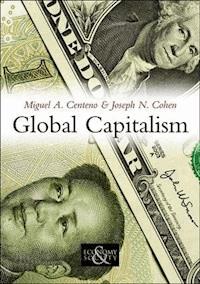
The global financial crisis has challenged many of our most authoritative economic ideologies and policies. After thirty years of reshaping the world to conform to the market, governments and societies are now calling for a retreat to a yet undefined new economic order.
In order to provide a guide to what the twenty-first-century economy might look like, this book revisits the great project of Global Capitalism. What did it actually entail? How far did it go? What were its strengths and failings? By deconstructing its core ideas and examining its empirical record, can we gain clues about how to move forward after the crisis? Miguel Centeno and Joseph Cohen define capitalism as a historically-evolving and socially-constructed institution, rooted in three core economic activities trade, finance and marketing and identify the three key challenges that any new economic system will need to surmount inequality, governance, and environmental sustainability.
This accessible and engaging book will be essential reading for students of economic sociology, and all those interested in the construction of our economic future.
Sie lesen das E-Book in den Legimi-Apps auf:
Seitenzahl: 403
Veröffentlichungsjahr: 2013
Ähnliche




















Global Capitalism
For Turi
For my parents, Stephen Cohen and Janet Gagnon
Global Capitalism
A Sociological Perspective
Miguel A. Centeno
Joseph N. Cohen
polity
Copyright © Miguel Angel Centeno and Joseph Nathan Cohen 2010
The right of Miguel Angel Centeno and Joseph Nathan Cohen to be identifi ed as Author of this Work has been asserted in accordance with the UK Copyright, Designs and Patents Act 1988.
First published in 2010 by Polity Press
Polity Press
65 Bridge Street
Cambridge CB2 1UR, UK
Polity Press
350 Main Street
Malden, MA 02148, USA
All rights reserved. Except for the quotation of short passages for the purpose of criticism and review, no part of this publication may be reproduced, stored in a retrieval system, or transmitted, in any form or by any means, electronic, mechanical, photocopying, recording or otherwise, without the prior permission of the publisher.
ISBN-13: 978-0-7456-5594-9
A catalogue record for this book is available from the British Library.
Typeset in 11 on 13 pt Sabon
by Servis Filmsetting Ltd, Stockport, Cheshire
Printed and bound by MPG Books Group, UK
The publisher has used its best endeavours to ensure that the URLs for external websites referred to in this book are correct and active at the time of going to press. However, the publisher has no responsibility for the websites and can make no guarantee that a site will remain live or that the content is or will remain appropriate.
Every effort has been made to trace all copyright holders, but if any have been inadvertently overlooked the publisher will be pleased to include any necessary credits in any subsequent reprint or edition.
For further information on Polity, visit our website: www.politybooks.com
Contents
List of Figures, Tables, and Boxes
Acknowledgments
Introduction
1
Global Capitalism
2
Trade
3
Finance and Wealth
4
Marketing and Consumption
5
Governance
6
Inequality
7
Living with Limit
Conclusion
Notes
References
Index
Figures, Tables, and Boxes
Figures
1.1
Regional shares of global wealth
2.1
World trade 39
2.2
Composition of world trade
2.3
Geography of trade
5.1
Liberalism by country
5.2
Liberalism by region
6.1
Where the poor and rich live
6.2
Development and inequality
6.3
Growth relative to the US 1950–2007
Tables
3.1
Metrics of state-level fi nancial market power: selected countries
3.2
Geographic breakdown of total portfolio investment: end of 2001 74
3.3
Metrics of international financial development by decade: median scores 1970–2005 80
4.1
Median media penetration across world regions
4.2
World’s most global valuable brands 2007
5.1
Growth, governance, life expectancy, and literacy by 1995 de-regulation score terciles
Box
4.1
Selected major consumer product innovations of the pre-war era
Acknowledgments
Miguel Centeno first needs to thank his colleagues and students in the Sociology Department at Princeton. It would be impossible to imagine a better place in which to think about the sociology of economic systems or a more rewarding environment in which to work on these issues. I especially want to thank Viviana Zelizer for teaching me what I know about the topic and first thinking of this book.
Much of the writing was done while a visitor at the University of Salamanca. Gracias a todos.
My family has put up with the standard faults of any academic plus a few extra ones of my devising and still seems to love me. For the forbearance and patience, thanks to Deborah Kaple, Alex Centeno, and Maya Centeno.
While this book was being written, I spent a lot of time in Washington, DC, saying goodbye to my brother and lifelong best friend, Arturo Girón. There are no words to describe the wonder of his life or the sadness of his death. Debbie Anker, Laura Girón, and Carlos Girón: I hope we will always remember the holidays and the beach.
Joe Cohen would like to thank my teachers at Carleton University, the University of Buenos Aires, and Princeton University. Obviously, there is Miguel Centeno, but I also feel a great debt to Paul DiMaggio, Bruce Western, and Scott Lynch for the time and effort that they invested in me.
I am also grateful to my new department at Queens College. I have enjoyed working here immensely, am grateful for all that you have done to help me manage the first years of my professorship, and for the constant investments of faith that you place in me.
I would like to thank Galit Dadoun for being my partner in the considerable task of raising our daughter and managing the chaos of our household while this book was completed. Thank you, Galit.
For Danielle: you are the light of my life, and my reason for being. Your first two years of life have brought me joy that I could not have imagined before you were born. I love you more than anything else on earth.
For the new girl, who is scheduled to be born in a month: I cannot wait to meet you, and hope we share a long life of love, laughter, and learning together.
Introduction
On November 9, 1989, the Berlin Wall collapsed, marking the final chapter of the Cold War and its long-running ideological battle. After decades of struggle between the liberal political-economic ideals of the West and those of the socialist world, the USSR’s demise appeared to resolve that conflict conclusively for experts and lay observers. Francis Fukuyama (1992) could credibly declare that the Cold War’s end stood at the “end of history,” the final victory in the long saga of democratic capitalism.
Capitalism’s decisive victory over post-Depression, midtwentieth-century dirigisme and socialism remained intact for almost twenty years. From 1989 to 2007, pro-market ideologies maintained what Thomas Kuhn (1962) might describe as a dominant paradigm, and Antonio Gramsci (1992[1927]) might call a hegemonic belief system. The superiority of free market capitalism seemed to carry the irrefutable weight of historical proof. No matter how problematic such sweeping conclusions may seem now, they were very powerful. Governments embraced and acted on the principle that unfettered, unregulated, and private sector -dominated markets were the best options for any society. This global experiment in economic reform yielded mixed results. It created previously unseen fortunes, but also new forms of insecurity and hardship. It shook societies from the stranglehold of old elites and long-running conflicts, but also gave rise to new ones.
If history ended in 1989, it may have restarted on September 15, 2008, when Lehman Brothers declared bankruptcy. This was merely a public highlight of a very deep global financial crisis that threw the world economy into a severe recession. During 2008, an astounding $25 trillion of wealth simply disappeared into thin air.1 (Some might argue that it was thin air to begin with, but that does not make the loss any easier to bear for those experiencing it.) Economies that had been growing now shrank, ships full of new goods docked not knowing if any consumers existed for their wares, and jobs that appeared secure vanished. From celebrations of the market, the media shifted to ever more sophisticated analyses of the causes and consequences of the 1930s Great Depression.
The crisis prompted hard looks at the global economy that was created in the run-up to 2008. Did our great experiment in global capitalism ultimately fail? Why? Are we better off for all of the economic liberalization reforms that took place over the past thirty years? We offer a starting point for those interested in these questions by examining the social basis, reach, effects, and net human welfare benefits of the grand experiment of global capitalism. Our purpose is to describe what global capitalism is, how deeply entrenched it became in the world’s economies, and which other societal changes ran concurrent with global capitalism’s rise.
We do this explicitly using the tools available to our academic discipline. Sociologists have been interested in capitalism since the beginning of our discipline. Different authors focused on distinctive aspects:2 Karl Marx argued that the key to capitalism was its historical development as a set of relations between those who owned things and those who had nothing to offer but their labor. For Max Weber, capitalism was defined by the centrality of exchange in a market where new spirits of rationality, asceticism, and entrepreneurship flourished. Georg Simmel was less concerned with capitalism per se and more with the central role of money in modern society. The entrepreneurial spirit of capitalism was of particular interest for Josef Schumpeter, who noted, however, how its “creative destruction” perpetually weakened the very institutions needed to maintain the system. Karl Polanyi observed that attempts at “pure” markets solely driven by interest were destined for catastrophe and that one had to understand capitalism as “embedded” in a set of social institutions which also protected what he called “social interests.” More recently, sociologists have been concerned with demonstrating how truly social economic life is through attention to social networks (Mark Granovetter), personal relationships (Viviana Zelizer), class power (William Roy, Charles Perrow), institutions (Paul DiMaggio and Walter Powell, Neil Fligstein), and specific national settings (Frank Dobbin, Ronald Dore, Mauro Guillén).
What links all these approaches and defines the sociological perspective on capitalism used in this book is a reluctance to treat it as a categorical imperative rooted in universal scientific principles, and more as a socially and historically constructed worldview. During the last two decades, many flatly declared that “there was no alternative” to capitalism (or markets, globalization, etc.). Sociologists challenged the orthodoxy of a unified set of maxims on economic governance and economic life. As a discipline, sociology always holds that there are alternatives; our task is to analyze how one predominated and why.
Given our critical tradition, there could be a temptation to treat the 2008 crisis as a vindication of our disciplinary perspectives. In our view, this is inappropriate for a variety of reasons. First, relatively few now argue for unfettered, “self-regulated” markets as a viable principle upon which to build an economy; belaboring the point with economistic “straw men” will get us nowhere. Second, sociologists were not alone in our critical viewpoints. Many others expressed similar concerns about the net economic benefit of laissez-faire, and several countries pulled back from an embrace of free markets well before 2008. The fact that we were critical is neither distinctive nor a vindication of our analytical approaches specifically. Moreover, neither the good nor the bad of the last twenty years’ economic progress can be entirely attributed to markets or the lack thereof.
This book analyzes global capitalism as a historically created social system: a structure of relationships between organizations and individuals that has evolved over time in response to challenges and promises. The global economy did not arise from a vacuum, but is the product of uncountable transactions and consequences thereof over hundreds of years. Global capitalism was socially constructed through expectations of behavior and the institutionalized rules governing it. We present the march of global capitalism as the diffusion and entrenchment of a set of authoritative, meta-theoretical principles embodied in a series of global and national institutions. We demonstrate that the result of these developments has been a global system with clear hierarchies of benefits and costs, and we propose a way of understanding how these work and the challenges they represent.
Some of the earliest commentators on the economic order that arose in the eighteenth century used the metaphor of a machine or even a clock to describe the new economy (Hirschman 1977). We believe this metaphor can provide us with a useful perspective with which to understand the creation of the global capitalist system over the last 200 years. Global capitalism was and is a spectacularly effective machine. It produces and consumes at an astounding speed. This book provides an analytical map with which to understand the inner workings of the global capitalist “clock.” Like any machine it can also break down. We provide an account of how it was built and how, in this very process, the underlying reasons for its failure may be found. We seek to pull the gears apart and demonstrate how they could both produce so much prosperity and so spectacularly come close to collapse.
The global economic system is not just any machine, but a highly complex one. Complex systems consist of a huge volume of parts each behaving at least partially autonomously (even if reacting to one another). Moreover, the interaction between the various components results in aggregate activity, which is not simply a summation of the individual behaviors, but a product of their continual response to each other’s action (a property known as “emergence”). These systems feature elaborate feedback loops leading to emergent outcomes; ones not necessarily linked to the characteristics of the individual pieces, but to the process of their interaction. These interactions, ever growing in scale and scope, make it ever more difficult to manage the system and ever more likely that small errors or failures can cascade into crises. From this perspective, the crisis of 2007–8 needs to be understood not as an aberration, but as the consequence of complexities and contradictions built into global capitalism through historical developments. It was, to use the term coined by Charles Perrow (1984), a normal accident: a systemic failure brought about by the inevitable (but unexpected) interaction of tightly integrated parts. The crisis of 2007–8 was a product of the belief that history could be escaped, that universal principles would never know an exception, and that we could enjoy the fruits of complexity without risking its dangers.
We now live on the crest of a roughly 250-year wave of unprecedented growth in material wealth, technological innovation, scientific advancement, and human population, but also one of severe social problems and industrial-strength oppression and violence. For its proponents, capitalism brings freedom and riches, and obeys basic natural laws. Its opponents see capitalism as a violation of human nature, which leads to exploitation. Both of these views have merits, but gloss over their own shortcomings and the potential validity of opposing views. The system is rife with contradictions. Capitalism does rely on an apparent human instinct for individual preservation and self-interest, and represents a system that does give people the freedom to pursue them. But it is also a historical creation mirroring distributions of power, implying that the system is neither wholly liberating nor a pure reflection of human nature. Capitalism does serve as magical processor of information, imposing a productive, materially enriching rationality on billions of apparently random acts, but it can also exacerbate systemic irrationalities and lead to its own crises and forms of economic immiseration.
A Look Ahead
We begin the next chapter by defining what we mean by global capitalism and providing a broad historical overview of its development. We wish to emphasize the paradoxical and often contradictory tendencies inside it. Building on an appreciation of the apparent inescapability (but not inevitability) of capitalism and its complexities, we emphasize its character as a “deep institution” – a socially constructed, politically contentious and deeply habituated way of understanding and practicing economic life.
The next three chapters delve inside the machine of global capitalism and analyze the three critical parts of the system: trade, finance, and consumption. Each part involves flows across the world: the first of goods and services, the second of capital, and the third of marketing. While treated separately, it is vital that the reader keep in mind that each of these structures is linked to the other. So, for example, without the creation of a global marketing arena, much of the trade flows would not exist; without the borrowing and lending of finance, trade would be impossible; without the movement of goods, the links between the various global economies would be ephemeral.
Chapter 2 presents an analysis of how the global trade system developed over the past two centuries, emphasizing the role of key institutions in developing its rules. We pay particular attention to the changes over the past two decades that may signal a transformation of the global economic hierarchy. We suggest that the global trade system is best understood as a network connecting nodes of production and consumption. Position in that network can be critical in and of itself, helping to determine how countries will participate and how they will benefit from that participation. We then explore three relationships within the global trade network: between a resource producer and its consumers, between a rich market and poorer suppliers seeking to profit from it, and between a global food system and those who rely on it for their subsistence.
The complex flows of money (the subject of the most recent crisis) are analyzed in chapter 3. Here we emphasize three concurrent trends: first, we track the rise of finance to fundamental importance in both individual enterprises and in systemic management. Over the past few decades, the accounting of and control over money became the center around which all other functions gyrated and on which decisions depended. Second, we analyze how the flow of money became truly global, with markets and ownerships knowing few national boundaries. Third, we emphasize that the ability of any authority to manage the system was strained by its size, fluidity, and increasing deregulation. The result of these trends was very much the same paradox we note in global capitalism in general: the production of revolutionary amounts of wealth thanks to the multiplication of exchanges and the increase in available capital, and an increase in systemic instability that regularly produced crises culminating in 2007 and 2008.
The social mechanism fueling the increases in both merchandise and capital flows was the revolution in global consumption analyzed in chapter 4. Modern consumer society arose in the nineteenth century, but over the last few decades this expanded to reach much larger parts of the globe in an increasingly universalized economics of desire. The rise of global marketing has brought with it new lifestyle possibilities for many, but also threats to cultural autonomy and social integration. The often hidden flows of global media created a much more global economy than had ever existed. Whether this leads to greater global integration or simply a general dissatisfaction with materialism is a core question facing global capitalism.
The second section of the book then discusses what we have identified as the three most important challenges for global capitalism: governance, inequality, and the environment. We have focused on three that call into question the survivability of the system as it stands. They do so because they defy the very ability of the system to right itself as it produces unexpected consequences. As in the case with our analysis of the three major component parts, we need to emphasize the unavoidable interaction between these challenges. So, for example, one of the problems of our common environmental future is the inequality in the degrees to which societies have abused the planet, combined with the fact that the system with which to safeguard our resources will require new forms of governance.
As recent events have demonstrated (yet again) global capitalism requires some new system of governance over and above the linking of territorial authorities. Chapter 5 discusses the challenges and promises of political control over the market. While much Cold War discourse portrayed free markets as taking place in the absence of state interference in the economy, laissez-faire is probably better characterized as a deliberate policy (and state-directed) project. The state is by far the most powerful force shaping economic life, and its active involvement is required if markets, as we know them to exist in the advanced industrial world, are to function. Global capitalism functions with a fundamental governance paradox: policy and enforcement remain within the responsibility of individual states, yet transactions occur in a space policed by none of them.
We then analyze how the fruits of capitalism are divided in chapter 6. We argue that global inequity is not merely a question of ethics, but of long-term survival. Our logic is simple: as global capitalism expands and absorbs previous non-participants, it becomes increasingly dependent on the universal acceptance of its rules and assumptions. Yet, as has always been the case, global capitalism provides many with new prosperities, but also many with the frustration of not sharing in its rewards. The global communication revolution, which is both a cause and effect of global capitalism, links us in a set of expectations and desires. Focusing on both rising inequality within countries and the continuing disparities between regions, we ask whether it is realistic to believe that the significant part of the world that does not enjoy the riches of capitalism, but is very much aware of them, will continue to stand by and accept a political and economic order that permanently excludes them.
Chapter 7 recognizes that at the very heart of capitalism there is an expectation of perpetual growth. If we are to resolve some of the inequities discussed in chapter 6 this imperative becomes even more significant. Such expectations are historical products of a millennia-long process of humans dominating nature. Yet we now find ourselves in an era of limits. We simply may not have enough raw materials to continue producing in our accustomed ways. This last chapter summarizes these limits and suggests a set of questions and issues that global capitalism must address if it is to survive the twenty-first century. In the face of this challenge, the old fights between right and left, between regulation and unfettered markets, may become irrelevant.
Having taken our machine apart, analyzed how the various components work, and discussed the new tasks which confront it, we then conclude by trying to put all the parts together again. Each of our constituent parts is linked to each of our challenges: trade and inequality, finance and governance, and consumption and the environment. This means that to address these challenges we need to rethink at least some of the basic structures of global capitalism, and perhaps all. We do not pretend to provide solutions to these dilemmas, but, rather, no more than a guide to defining the problems we face.
Examining the march of global capitalism as involving the diffusion and legitimation of a specific, socially constructed model of the economy and its governance is critical to the future of the global economy in the twenty-first century. We may be especially well served by maintaining a healthier skepticism about how well human beings can understand, much less control, complex systems such as the global economy. Most importantly, we can begin treating global capitalism not as a completely immutable, inescapable force of history, but as something that we have the power to mould.
1
Global Capitalism
Two key institutions define capitalism: private property and market exchange. Both are historically rooted, which means that they were created and shaped by past (and, for the most part, recent) generations, and do not constitute universal, timeless aspects of human society. Private property and market exchange are social institutions, which were forged, propagated, and entrenched through numerous political, economic, cultural, and even military conflicts. What we understand as “normal” or “natural” about the way the economy works is neither, and much of it is surprisingly new.
The characteristics often associated with capitalism: commerce, money, the pursuit of self-interest, and conflicts between “haves” and “have-nots,” are not defining features of capitalism or unique to it. Indeed, all were present in Soviet Russia, Feudal France, Ancient Rome, and Old Testament Israel. None of these societies would typically be described as “capitalist,” and so the term must connote something more. The institutions of private property and market exchange must be distinguished from the commonplace practice of ownership or commerce. They represent what can be described as core economic rules that underlie the social pact between modern states and societies. Private property and economic markets are legally integrated into a structure of governance. Capitalism is the economic system that operates under those rules.
Lesen Sie weiter in der vollständigen Ausgabe!
Lesen Sie weiter in der vollständigen Ausgabe!
Lesen Sie weiter in der vollständigen Ausgabe!
Lesen Sie weiter in der vollständigen Ausgabe!
Lesen Sie weiter in der vollständigen Ausgabe!
Lesen Sie weiter in der vollständigen Ausgabe!
Lesen Sie weiter in der vollständigen Ausgabe!
Lesen Sie weiter in der vollständigen Ausgabe!
Lesen Sie weiter in der vollständigen Ausgabe!
Lesen Sie weiter in der vollständigen Ausgabe!




