


18,99 €
Mehr erfahren.
- Herausgeber: John Wiley & Sons
- Kategorie: Geisteswissenschaft
- Sprache: Englisch
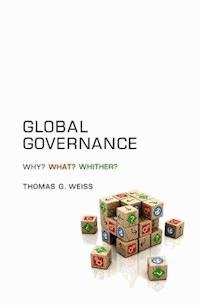
Friends and foes of international cooperation puzzle about how to explain order, stability, and predictability in a world without a central authority. How is the world governed in the absence of a world government?
This probing yet accessible book examines "global governance" or the sum of the informal and formal values, norms, procedures, and institutions that help states, intergovernmental organizations, civil society, and transnational corporations identify, understand, and address trans-boundary problems. The chasm between the magnitude of a growing number of global threats - climate change, proliferation of weapons of mass destruction, terrorism, financial instabilities, pandemics, to name a few - and the feeble contemporary political structures for international problem-solving provide compelling reasons to read this book. Fitful, tactical, and short-term local responses exist for a growing number of threats and challenges that require sustained, strategic, and longer-run global perspectives and action. Can the framework of global governance help us to better understand the reasons behind this fundamental disconnect as well as possible ways to attenuate its worst aspects? Thomas G. Weiss replies with a guardedly sanguine "yes".
Sie lesen das E-Book in den Legimi-Apps auf:
Seitenzahl: 504
Veröffentlichungsjahr: 2013
Ähnliche















Table of Contents
Cover
Title page
Copyright page
Tables and Figures
Tables
Figures
Abbreviations
About the Author
Foreword
Acknowledgments
Introduction
About the Book
CHAPTER ONE: Why Did Global Governance Emerge?
Interdependence and Globalization
The Proliferation of Nonstate Actors
Idealism Takes a Back Seat
What Happened to the Idea of World Government?
Conclusion: The Stakes
CHAPTER TWO: What Is Global Governance?
Navigating the Definitional Maze
The State and Global Governance
Power and Global Governance
Incentives and Global Governance
Conclusion: Pluses and Minuses
CHAPTER THREE: What Are Global Governance Gaps?
Knowledge
Norms
Policies
Institutions
Compliance
Conclusion
CHAPTER FOUR: Knowledge Gaps
Peace and Security
Human Rights and Humanitarian Action
Sustainable Growth
Conclusion
CHAPTER FIVE: Normative Gaps
Peace and Security
Human Rights and Humanitarian Action
Sustainable Growth
Conclusion
CHAPTER SIX: Policy Gaps
Peace and Security
Human Rights and Humanitarian Action
Sustainable Growth
Conclusion
CHAPTER SEVEN: Institutional Gaps
Peace and Security
Human Rights and Humanitarian Action
Sustainable Growth
Conclusion
CHAPTER EIGHT: Compliance Gaps
Peace and Security
Human Rights and Humanitarian Action
Sustainable Growth
Conclusion
CHAPTER NINE: Whither Global Governance?
How Full Is the Global Governance Glass?
Whither Global Governance?
Selected Readings
Index
Copyright © Thomas Weiss 2013
The right of Thomas G. Weiss to be identified as Author of this Work has been asserted in accordance with the UK Copyright, Designs and Patents Act 1988.
First published in 2013 by Polity Press
Polity Press
65 Bridge Street
Cambridge CB2 1UR, UK
Polity Press
350 Main Street
Malden, MA 02148, USA
All rights reserved. Except for the quotation of short passages for the purpose of criticism and review, no part of this publication may be reproduced, stored in a retrieval system, or transmitted, in any form or by any means, electronic, mechanical, photocopying, recording or otherwise, without the prior permission of the publisher.
ISBN-13: 978-0-7456-6045-5
ISBN-13: 978-0-7456-6046-2(pb)
ISBN-13: 978-0-7456-7006-5 (Multi-user ebook)
ISBN-13: 978-0-7456-7007-2 (Single-user ebook)
A catalogue record for this book is available from the British Library.
The publisher has used its best endeavours to ensure that the URLs for external websites referred to in this book are correct and active at the time of going to press. However, the publisher has no responsibility for the websites and can make no guarantee that a site will remain live or that the content is or will remain appropriate.
Every effort has been made to trace all copyright holders, but if any have been inadvertently overlooked the publisher will be pleased to include any necessary credits in any subsequent reprint or edition.
For further information on Polity, visit our website: www.politybooks.com
Tables and Figures
Tables
1.1 Number of international organizations founded by decade, 1900–2009
8.1 Top 20 producers of greenhouse gases, 1997 and 2010 (tons)
Figures
1.1 Number of IGOs and INGOs, 1909–2009
1.2 Percentage of global, intercontinental, and regional IGOs founded by decade, 1900–2009
1.3 Percentage of global, intercontinental, and regional NGOs founded by decade, 1900–2009
1.4 Number of global, intercontinental, and regional IGOs founded by decade, 1900–2009
1.5 Number of global, intercontinental, and regional NGOs founded by decade, 1900–2009
Abbreviations
About the Author
Thomas G. Weiss is Presidential Professor of Political Science at The City University of New York (CUNY) Graduate Center and Director of the Ralph Bunche Institute for International Studies. While completing this book, he was a resident fellow at the University of Konstanz’s Kulturwissenschaftliches Kolleg and at the University of Leuven’s Centre for Global Governance Studies; he also was non-resident fellow of the One Earth Future Foundation and research professor at the School of Oriental and African Studies, University of London. He directed the United Nations Intellectual History Project (1999–2010) and was President of the International Studies Association (2009–10), Chair of the Academic Council on the UN System (2006–9), editor of Global Governance, Research Director of the International Commission on Intervention and State Sovereignty, Research Professor at Brown University’s Watson Institute for International Studies, Executive Director of the Academic Council on the UN System and of the International Peace Academy, a member of the UN secretariat, and a consultant to several public and private agencies. He has authored or edited some 45 books and 200 articles and book chapters about multilateral approaches to international peace and security, humanitarian action, and sustainable development. His recent authored volumes include: Humanitarian Business (Polity Press, 2013); The United Nations and Changing World Politics (Westview, 2013); What’s Wrong with the United Nations and How to Fix It (Polity Press, 2012); Humanitarian Intervention: Ideas in Action (Polity Press, 2012); Thinking about Global Governance, Why People and Ideas Matter (Routledge, 2011); Humanitarianism Contested: Where Angels Fear to Tread (Routledge, 2011); Global Governance and the UN: An Unfinished Journey (Indiana University Press, 2010); and UN Ideas That Changed the World (Indiana University Press, 2009).
Foreword
Thomas G. Weiss is certainly the leading scholar of the United Nations in the United States and probably has no peer anywhere. He began publishing on the subject while still a graduate student, more than 40 years ago, even before he began his long, distinguished career inside and outside the UN system. For at least the last quarter-century – the period when his work as a scholar has dominated his work as a policymaker – he has been at the forefront of the movement to reinvigorate UN studies throughout the world. He helped create and has nurtured the Academic Council on the UN System (ACUNS, the professional association that unites scholars in the field), galvanized historians and social scientists to preserve and rethink the UN’s legacy through the UN Intellectual History Project (probably the most wide-ranging and comprehensive organizational history undertaken in any field in the last quarter of the twentieth century), and made a profound contribution to the enterprise through his own prolific scholarship.
I am one of the many UN scholars who have had a much easier time of it because we were able to ride in Tom’s wake; all of us are very grateful to him. I am especially so because he has generously included me in some of his projects. A particular case in point took place about 20 years ago at an ACUNS-sponsored conference in Tokyo, where, in a bar with Tom, Peter Hansen, and other conferees, I first heard the term “global governance” – my main subject of study ever since, and the topic of this book.
Hansen, a Danish diplomat who had had a brilliant and controversial career in the UN, was then working as the executive officer of the commission headed by former Swedish prime minister Ingvar Carlsson and former Commonwealth secretary general Shridath Ramphal. They had been tasked by the heads of the (Willy) Brandt, (Gro) Bruntland, and South (Julius) Nyerere Commissions of the 1980s to create “the daughter of all global commission reports,” something that would, once and for all, define and provide solutions for the whole host of global public policy problems that their earlier commissions had studied separately. In Tokyo, Peter told us that he was thinking of proposing that the new, as yet unnamed, group be called “The Commission on Global Governance,” and wondered what we thought of that title.
We discussed it for a while, and I initially concluded that the concept of “global governance” was mushy if not incoherent, and the term so awkward that it would never catch on. Tom was wiser, although perhaps even he did not anticipate the thousands of global governance courses and tens of thousands of books and articles on the topic that we can find today! The concept caught on because all of a much larger us (“all of humankind” is not really an exaggeration) needed a way to think about the distinct set of public policy problems that are truly global, problems that we address, usually inadequately, through lots of complicated (and often ad hoc) mechanisms, including, but not limited to, the UN system.
Since 1999, when the main report of the Commission on Global Governance was published, Tom has been at the forefront of the community of scholars and policymakers who are attempting to understand and teach about the system of global governance that we currently have, its larger functions within the globalizing economy and system of sovereign states in a world of unprecedentedly rapid technological change, its successes and failures, and ways that it can be improved.
This book represents a new stage in that community’s work. It provides a straightforward, easy-to-use, yet remarkably sophisticated way to think about the policy problems that we confront at the global level, the nature of the global governance that exists to deal with those problems, and the ways in which it can be improved. The matrix created by the schema of sites of potential gaps in governance overlaying the issue areas in which governance has taken place provides a wonderful framework for organizing knowledge that can make a real difference. I have had the opportunity to use the framework – and Tom’s insightful analysis of the issues – in teaching graduate and professional students in global governance as well as advanced undergraduates and early mid-career women policymakers from some 20 countries. I can attest that it has been of tremendous help to all of them as a template for understanding the specific problems that interest them and for developing potentially effective, often wildly innovative solutions.
This is a short book, and an unpretentious one, but it is likely to transform your understanding of global governance, making it clearer, more practical, and more realistic. I expect that you will enjoy reading it for the first time, and that you will return to it again and again.
Craig N. MurphyUniversity of Massachusetts Boston and Wellesley CollegeDecember 2012
Acknowledgments
I begin with a straightforward statement of debt to Ramesh Thakur – friend and colleague – because the pages that follow owe much to our collaboration and the lessons that I have learned from him in many contexts over the last two decades. In struggling to write our volume Global Governance and the UN: An Unfinished Journey (Bloomington: Indiana University Press, 2010), we developed a framework of “gaps” as one way to make analytical sense of the mushy notion of “global governance,” which means so many things to so many people. Having found an insightful way to make this amorphous subject manageable and meaningful with specific reference to the United Nations, I wished to sharpen and extend it in a user-friendly form for Polity Press. I also acknowledge Indiana University Press for material adapted here.
I also wish to thank Louis Emmerij and Richard Jolly, who shared directorial duties with me for over a decade in the United Nations Intellectual History Project. The above-mentioned book was written for that research effort. The current volume reflects in part my reaction to the challenge that Louis and Richard posed in their Foreword to Global Governance and the UN. They recognized “the difficulties and complications of the topic, but especially when viewed through the eyes of international relations (IR) scholars. Global governance among this fraternity and sorority is generally defined by a critical absence – as global governance without global government” (p. ix). In delivering their gentle jab, they nonetheless acknowledged that other disciplines have their own ways to avoid the hardest questions. Many economists have long done it by a predilection for free market solutions – “global governance without the need for government action.”
One of the pleasures of interdisciplinary collaboration is learning – in my case, suddenly realizing the obvious from my two economist collaborators. I had long criticized the shortcomings of the market for my own country, the United States – the so-called invisible hand rarely led to fair and just solutions – but somehow had not applied that lesson to the planet. The global financial and economic meltdown of 2008–9 resembled many less serious previous crises, which brought home the risks, problems, and enormous costs of a global economy without global government – that is, without adequate international institutions, democratic decision-making, and powers to enforce compliance.
Although countries – big and insignificant powers alike – are not yet ready to accept the limitations on their sovereignty that would be necessitated by a world government, the logic of interdependence places this possibility more squarely on the international agenda. Indeed, why is it so unthinkable that a gradual advance of intergovernmental agreements and powers could take place along the lines that most countries have seen occur nationally over the last century – and as Europe and some other areas have seen develop regionally since World War II?
Let me predict that elements of global government will emerge if life as we know it continues – not in my lifetime, to be sure, but by the turn of the next century. This book in many ways reflects an effort not to avoid the hardest questions, to pick up Emmerij and Jolly’s gauntlet and write something that might have a subtitle of Next Steps on the Journey.
One of the pleasant tasks of having finished a book is to thank those who have helped along the way. I hope that my long list will not be seen as a roundabout effort at self-congratulation. The fact that these people and institutions are found in several countries is a measure both of my good fortune and of an international community of scholars of which I am thrilled to be part.
The current volume is my most recent effort for Polity Press to condense and synthesize my own and others’ thinking about global governance – having done so earlier for the United Nations (What’s Wrong with the United Nations and How to Fix It, 2009; 2nd edn, 2012), humanitarian intervention (Humanitarian Intervention: Ideas in Action, 2007; 2nd edn, 2012), and humanitarian business (Humanitarian Business, 2013). I am grateful to Louise Knight, who challenged me to undertake this assignment. She is a wonderful commissioning editor, using a congenial mix of flattery and tough reviews to extract what I trust is a solid product from this author.
I am appreciative to the six Polity reviewers unknown to me who provided suggestions on the basis of an initial outline even before writing began, which then helped framing and drafting. And two other anonymous reviewers provided useful suggestions on the penultimate manuscript.
However, by far the most helpful criticisms came from two prominent younger scholars of global governance (actually, these days almost everyone is younger) who thoroughly read and made detailed comments to improve the penultimate draft from top to bottom. I am thus extremely appreciative for guidance from the University of Manchester’s Rorden Wilkinson, who has also been a stimulating partner in editing the Routledge series “Global Institutions.” Over the last decade, I have observed his own productive and fast-paced career (reflected in his affection for motorcycles), which should inspire other younger scholars. Certainly his probing and critical comments made it possible for me to make progress here. In addition to working together on the series that now has some 75 published titles, we also have had the pleasure of editing what we hope will be a “bunker-busting” textbook titled International Organization and Global Governance (London: Routledge, 2013).
The second set of detailed comments came from Craig Murphy, whom the University of Massachusetts at Boston was fortunate to entice away from Wellesley College in order to set up a doctoral program in global governance. And I am of course doubly grateful that he agreed to grace these pages with his Foreword. We have been pals for two decades, during which time he has invariably helped with insights on a variety of projects, personal and professional. What initially piqued my interest in the subject of this current volume was in fact one of his books, International Organization and Industrial Change: Global Governance since 1850 (Cambridge: Polity Press, 1994). As that was going to press, he began compiling, as one of the two founding editors, the first issue of the journal Global Governance: A Review of Multilateralism and International Organizations. Craig is invariably helpful and gracious, an exemplar because of his dedication to teaching and research, as well as to professional good citizenship in the International Studies Association and the Academic Council on the UN System.
In the process of writing this volume and preparing it for publication, I have encountered other debts of gratitude. I would like to single out Martin Burke, an advanced graduate student at The CUNY Graduate Center, for his remarkable assistance and insights. He provided essential helping hands at various points in both researching elements of the argument and helping to hone the clarity of the presentation. In fact, often he seemed to know better than me what I was trying to say and helped immeasurably in the final presentation. And Danielle Zach, as she has done on numerous other occasions, helped polish the final manuscript.
This book was written in 2012 while on sabbatical leave from The CUNY Graduate Center, my congenial institutional home since 1998. Public universities everywhere, disgracefully, are under attack, and so I am proud to be part of a system that still strives to provide both excellence and access. I am thankful to President William Kelly and Provost Chase Robinson for warmly and generously supporting my sabbatical leave and other adventures over the years.
I also benefited from the support of the One Earth Future (OEF) Foundation while writing this book. OEF’s Conor Seyle compiled data on actors in Chapter 1. Most importantly, I have had the pleasure of getting to know OEF’s founder, the irrepressible Marcel Arsenault; if only other successful entrepreneurs were as visionary and generous.
I was fortunate to spend time during this year at three institutions that made it possible not only to concentrate on writing but also to be surrounded by stimulating colleagues. First, Wolfgang Seibel of the University of Konstanz encouraged me to spend a half-year at the Kulturwissenschaftliches Kolleg, and he did not have to twist my arm very hard to enjoy the quiet and the intellectual sparks at the Advanced Institute along the glorious shores of the Bodensee. My gratitude is extended to him and the institute’s director, Fred Girod, for their support and friendship, and for their forbearance with mein Deutsch.
Second, I also took advantage of a kind offer from Jan Wouters, who directs the Centre for Global Governance Studies at the University of Leuven. I exploited his comradeship and knowledge of international organization and law, which were assets as I finalized this manuscript for publication. I also was able to explore the nuts and bolts of the European Union from this unusual vantage spot near Brussels.
Third, I benefited from being a non-resident research professor at the School of Oriental and African Studies, the University of London, where Dan Plesch directs the Centre for International Studies and Diplomacy and is a congenial collaborator.
Finally, this book has a double dedication. The first is to the memory of my parents, Doris May Lennon (1921–2011) and Franklin George Weiss (1919–2010). They made possible my life’s adventures without themselves ever having had my advantages. The second is to my daughters, Hannah and Rebeccah, and to my grandchildren, Amara and Kieran. They are constant reminders that what once seemed unimaginable is quite possible.
As always, I welcome comments from readers. And obviously, any remaining howlers are my responsibility.
T. G. W.Konstanz, Leuven, London, New YorkDecember 2012
Introduction
An obvious puzzle for friends and foes of international cooperation is explaining whatever international order, stability, and predictability exists despite the lack of a central authority. How is the world governed in the absence of a government for the world?
On any given day in virtually every corner of the world, numerous exchanges take place smoothly and without notice or comment. Mail is delivered emanating from 200 countries. Travelers arrive at airports, harbors, and train stations and by road across borders. Goods and services move by land, air, sea, and cyberspace. A range of other trans-boundary activities occur with the expectation of safety and security – in fact, disruptions and failures often are less frequent and spectacular in the international arena than in many countries that supposedly have functioning governments. Though of relatively recent provenance, the largely unseen economic, political, technical, and other structures that enable the provision of these global public goods are uncontroversial. Moreover, there are even more remarkable non-events, including the fact that no children are dying from smallpox, and no nuclear weapon has been unleashed since the two horrible detonations in Japan in 1945. We should marvel at how well international society functions. The proverbial Martian landing in most parts of the planet would see a large number of international transactions taking place with order, stability, and predictability. How can this possibly be the case without a government for the world? Or as John Ruggie some time ago asked, how “does the world hang together?”1
My objective is to tease out the political, ethical, legal, economic, and conceptual tensions underlying the emergence and popularity of an answer of sorts to that question, which is the title of this book, . Craig Murphy’s , another book from Polity Press, traces the origins of global governance from the middle of the nineteenth century. Numerous activities of that period are relevant precedents for contemporary problem-solving and began during an earlier period of globalization; but Murphy’s treatment of the idea is anachronistic in that the actual term was born from the offspring of a marriage between academic theory and practical policy concerns in the 1990s. Nevertheless, if the analytical lens makes sense, it also should help interpret the dynamics of historical eras prior to the term being coined.
Lesen Sie weiter in der vollständigen Ausgabe!
Lesen Sie weiter in der vollständigen Ausgabe!
Lesen Sie weiter in der vollständigen Ausgabe!
Lesen Sie weiter in der vollständigen Ausgabe!
Lesen Sie weiter in der vollständigen Ausgabe!
Lesen Sie weiter in der vollständigen Ausgabe!
Lesen Sie weiter in der vollständigen Ausgabe!
Lesen Sie weiter in der vollständigen Ausgabe!
Lesen Sie weiter in der vollständigen Ausgabe!
Lesen Sie weiter in der vollständigen Ausgabe!
Lesen Sie weiter in der vollständigen Ausgabe!




