


24,99 €
Mehr erfahren.
- Herausgeber: John Wiley & Sons
- Kategorie: Geisteswissenschaft
- Serie: War and Conflict in the Modern World
- Sprache: Englisch
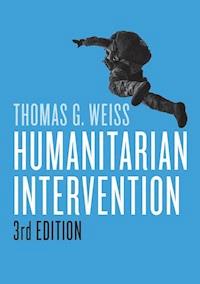
A singular development in the post-Cold War era is the use of military force to protect human beings. From Rwanda to Kosovo, Sierra Leone to East Timor, and Libya to Côte d�Ivoire, soldiers have rescued civilians in some of the world's most notorious war zones. But what about Syria? Why have we observed the Syrian slaughter and done nothing? Is humanitarian intervention in crisis? Is the so-called responsibility to protect dead or alive?
In this fully revised and expanded third edition of his highly accessible and popular text, Thomas Weiss explores these compelling questions. Drawing on a wide range of case studies and providing a persuasive overview of the theory and practice of humanitarian intervention in the modern world, he examines its political, ethical, legal, strategic, economic, and operational dimensions to highlight key debates and controversies. Neither celebratory nor complacent, his analysis is an engaging exploration of the current quandaries and future challenges for robust international humanitarian action in the twenty-first century.
Sie lesen das E-Book in den Legimi-Apps auf:
Seitenzahl: 409
Veröffentlichungsjahr: 2016
Ähnliche















Contents
Cover
Title Page
Copyright
About the Author
Foreword to the Third Edition by Gareth Evans
Preface and Acknowledgments
Abbreviations
Introduction
Notes
1 Conceptual Building Blocks
Humanitarian intervention: a contested concept
The evolution of peace operations
The politics of normative change
State sovereignty and nonintervention: two sides of the Westphalian coin
Human rights and individual sovereignty
Change and continuity in the international system
Notes
2 “Humanitarian” Interventions: Thumbnail Sketches
The nineteenth and early twentieth centuries
The Charter regime and the Cold War
The UN in the post-Cold War era
Humanitarian interventions beginning in the turbulent 1990s
Trends from the early post-Cold War years
Second guessing
The DRC, Uganda, Zimbabwe, and Darfur: nothing new?
Libya, Côte d’Ivoire, and Syria
So, why Libya, and why not Syria?
And so, why Côte d’Ivoire?
African-centric focus of the ICC
Toward new wars and new humanitarianisms
Notes
3 New Wars and New Humanitarianisms
New wars
New humanitarianisms
Measuring the costs and benefits of military humanitarianism
Moral hazard
The role of new thinking
Notes
4 New Thinking: The Responsibility to Protect
Sovereignty as responsibility
Kofi Annan’s two sovereignties
International Commission on Intervention and State Sovereignty
The 2005 World Summit and since
Notes
5 So What? Moving from Rhetoric to Reality
R2P, a Trojan horse for the Non-Aligned Movement?
9/11 and the war on terror
The preoccupied and overstretched remaining superpower
War economies, spoilers, and privatization
A humanitarian identity crisis
Conclusion
Notes
Selected Readings
Index
Guide
Cover
Table of Contents
Begin Reading
Pages
ii
iii
iv
vi
vii
viii
ix
x
xi
xii
xiii
xiv
xv
xvi
xvii
xviii
xix
xx
1
2
3
4
5
6
7
8
9
10
11
12
13
14
15
16
17
18
19
20
21
22
23
24
25
26
27
28
29
30
31
32
33
34
35
36
37
38
39
40
41
42
43
44
45
46
47
48
49
50
51
52
53
54
55
56
57
58
59
60
61
62
63
64
65
66
67
68
69
70
71
72
73
74
75
76
77
78
79
80
81
82
83
84
85
86
87
88
89
90
91
92
93
94
95
96
97
98
99
100
101
102
103
104
105
106
107
108
109
110
111
112
113
114
115
116
117
118
119
120
121
122
123
124
125
126
127
128
129
130
131
132
133
134
135
136
137
138
139
140
141
142
143
144
145
146
147
148
149
150
151
152
153
154
155
156
157
158
159
160
161
162
163
164
165
166
167
175
176
177
178
179
180
181
182
183
184
185
186
187
188
189
190
191
192
193
194
195
196
197
198
199
200
201
202
203
204
205
206
207
208
252
253
254
255
256
257
258
259
260
261
262
263
264
265
266
267
War and Conflict in the Modern World Series
Alexandru Balas & Paul Diehl, Peace Operations 2nd edition
L. Brock, H. Holm, G. Sørensen & M. Stohl, Fragile States
Feargal Cochrane, Ending Wars
Matthew Evangelista, Law, Ethics and the War Terror
J. Michael Greig & Paul F. Diehl, International Mediation
John Kaag & Sarah Kreps, Drone Warfare
Janie Leatherman, Sexual Violence and Armed Conflict
Andrew Mumford, Proxy Warfare
Dennis Sandole, Peacebuilding
Eric Shibuya, Demobilizing Irregular Forces
Timothy Sisk, Statebuilding
Rachel Stohl & Suzette Grillot, The International Arms Trade
Paul Viotti, American Foreign Policy
I. William Zartman, Preventing Deadly Conflict
Humanitarian Intervention
Ideas in Action
THIRD EDITION
THOMAS G. WEISS
polity
Copyright © Thomas G. Weiss 2016
The right of Thomas G. Weiss to be identified as Author of this Work has been asserted in accordance with the UK Copyright, Designs and Patents Act 1988.
First edition published in 2007 by Polity Press
This edition published in 2016 by Polity Press
Polity Press65 Bridge StreetCambridge CB2 1UR, UK
Polity Press350 Main StreetMalden, MA 02148, USA
All rights reserved. Except for the quotation of short passages for the purpose of criticism and review, no part of this publication may be reproduced, stored in a retrieval system, or transmitted, in any form or by any means, electronic, mechanical, photocopying, recording or otherwise, without the prior permission of the publisher.
ISBN-13: 978-1-5095-0735-1
A catalogue record for this book is available from the British Library.
Library of Congress Cataloging-in-Publication Data
Weiss, Thomas G. (Thomas George), 1946-Humanitarian intervention / Thomas G. Weiss. -- Third edition.pages cmIncludes bibliographical references and index.ISBN 978-1-5095-0731-3 (hardback) -- ISBN 978-1-5095-0732-0 (paperback) 1.Humanitarian intervention. I. Title.JZ6369.W448 2016341.5’84--dc23
2015031612
The publisher has used its best endeavours to ensure that the URLs for external websites referred to in this book are correct and active at the time of going to press. However, the publisher has no responsibility for the websites and can make no guarantee that a site will remain live or that the content is or will remain appropriate.
Every effort has been made to trace all copyright holders, but if any have been inadvertently overlooked the publisher will be pleased to include any necessary credits in any subsequent reprint or edition.
For further information on Polity, visit our website: www.politybooks.com
About the Author
Thomas G. Weiss is Presidential Professor of Political Science at The Graduate Center of The City University of New York (CUNY) and director emeritus of the Ralph Bunche Institute for International Studies. Past President of the International Studies Association and recipient of its Distinguished IO Scholar Award 2016, he was also editor of Global Governance and research director of the International Commission on Intervention and State Sovereignty as well as Chair of the Academic Council on the UN System. He has written extensively about international organization, peace and security, humanitarian action, and sustainable development. Recently authored books include What’s Wrong with the United Nations and How to Fix It, 3rd edn (2016); The United Nations and Changing World Politics, 8th edn (with David P. Forsythe, Roger A. Coate, and Kelly-Kate Pease, 2016); Governing the World? Addressing “Problems without Passports” (2014); Global Governance: Why? What? Whither? (2013); Humanitarian Business (2013); Humanitarianism Contested: Where Angels Fear to Tread (with Michael Barnett, 2011); Thinking about Global Governance: Why People and Ideas Matter (2011); Global Governance and the UN: An Unfinished Journey (with Ramesh Thakur, 2010); and UN Ideas That Changed the World (with Richard Jolly and Louis Emmerij, 2009). Recently edited volumes include Emerging Powers and the UN: What Kind of Development Partnership? (with Adriana Erthal Abdenur, 2015); Wartime Origins and the Future UnitedNations (with Dan Plesch, 2015); International Organization and Global Governance (with Rorden Wilkinson, 2014); Post-2015 UN Development: Making Change Happen? (with Stephen Browne, 2014); The International Politics of Human Rights: Rallying to the R2P Cause? (with Mónica Serrano, 2014); and The Responsibility to Protect: Cultural Perspectives in the Global South (with Rama Mani, 2011).
Foreword to the Third Edition
Mass murder and ethnic cleansing – of the kind the world witnessed in Rwanda and the Balkans in the 1990s, and has seen again in this new century in Darfur, Sri Lanka, Libya, and Syria – shock the conscience like nothing else. The shock is compounded when we think about how much the international community has known since the Holocaust and Cambodia as to how these catastrophes begin and gather momentum, and how readily so many of them could have been averted. But every few years we found ourselves, humbled and shamefaced, acknowledging once again that such a catastrophe has occurred and pledging not to allow anything like it ever to be repeated.
Professor Thomas G. Weiss, in his writings over many years, is one of those who have made it impossible for the international community to claim that these situations are unforeseeable or irremediable. Many academics and journalists and think-tanks have analyzed their dynamics, making clear what needs to be done, who needs to do it, and the many constraints that stand in the way of effective action. But few have been as well versed in the issues and as articulate as the author of this book. Few have brought to the task such knowledge of the relevant global history, and such a clear understanding of the normative principles involved and how they can be made to work in international institutional practice.
Humanitarian Intervention – now updated and expanded in this timely third edition – is pitched not only for students of international affairs, but for attentive citizens who want a clear and readable guide to how this great moral and political challenge of our time has repeatedly been fumbled by the world’s leaders, how those leaders can and should do better, and how in recent years they have been showing at last some signs of doing just that. But above all, it is written for, and should be read by, those very policymakers who have so often sat on the sidelines wringing their hands and making excuses as genocide, ethnic cleansing, and other major crimes against humanity have been screened in slow motion before them.
The good news, for more than a decade now, is that policymakers are no longer operating, as they did for so long, in an almost principle-free and consensus-free vacuum, in which no one could agree what, if any, limits there were on a sovereign state’s freedom of action when it came to internal matters not immediately threatening a neighbor’s or the wider world’s security, and where there was particularly acute disagreement about when and where it was ever right to use coercive military force. In 2005, the more than 150 national leaders attending the World Summit to commemorate the sixtieth anniversary of the United Nations unanimously agreed that there is a principle which explains and justifies engagement and concern, and in extreme cases forcible intervention.
This principle, “the responsibility to protect,” had its origins in the precedent-setting report of that title by the International Commission on Intervention and State Sovereignty, a distinguished international group, which I had the honor to co-chair with Mohamed Sahnoun, and which had the pleasure and benefit of having its research directed by Tom Weiss. The core idea of the responsibility to protect – or “R2P,” as it has become familiarly known – is that the perspective that matters is that of suffering human beings. States have the primary responsibility for protecting their own citizens from human-made catastrophe, but when a state abdicates that responsibility – through either incapacity or ill-will – it shifts to the wider international community, to regional and global organizations (such as the African Union or United Nations), and to the governments and citizens of other countries.
It is not a matter of any state having the “right of humanitarian intervention.” The commission argued strongly for the abandonment once and for all, in any policymaking context, of that very divisive terminology. The issue is not the right of any state to throw its weight around, but rather the responsibility of every state to play its appropriate role, with the objective not being intervention as such, but the protection of men, women, and children threatened by the horror of mass violence. Coercive military action, authorized under the UN Charter, still has its place in extreme situations when civilians can be protected in no other way. But it is just one element within a larger and more nuanced policy framework, in which prevention is given as least as much weight as response, and nonmilitary measures are always to be preferred if they can do the job.
No idea has moved faster in the international normative arena than “the responsibility to protect,” defined this way. Ideas in Action is Weiss’s subtitle, and this book details the steady journey of this idea from a gleam in a small group’s eyes to acceptance as a norm of international behavior by the leaders of the whole global community – the idea that when it comes to the fundamental issues of human security involved in genocide, ethnic cleansing, and other major crimes against humanity, the rights of individual humans trump the sovereignty of the thuggish states in which they live.
Initial efforts by some countries – most visibly Cuba, Nicaragua, Sudan, and Venezuela – to wind back the 2005 consensus and reassert a more absolutist view of sovereignty have manifestly failed. Successive debates in the UN General Assembly every year since 2009, and the continued willingness of the Security Council to use R2P language in its resolutions – more than 30 of them since 2011, notwithstanding the scars left by disagreement over that year’s Libya intervention – have made it abundantly clear that the basic principles of the responsibility to protect command huge majority support and that the norm is here to stay.
The high-water mark in the military application of the responsibility to protect was undoubtedly the Security Council’s decision in March 2011 to authorize the intervention led by the North Atlantic Treaty Organization in Libya to protect civilians at risk of massacre by the Qaddafi regime. Had it acted equally decisively and robustly in the 1990s, the 8,000 men and boys murdered in Srebrenica and the 800,000 men, women, and children slaughtered in Rwanda might still be alive today. But with high tides come high risks. The atmosphere in the council quickly soured as it became clear that the United States, United Kingdom, and France interpreted their civilian protection mandate as requiring nothing less than regime change, and they would listen to no argument to the contrary from the likes of Russia, China, Brazil, India, or South Africa. And with this breach was lost any prospect of consensus on an effective response to the explosive new situation in Syria, a paralysis which continues to this day.
The Libya and Syria cases make it clear that, at the sharpest end of the R2P response spectrum, there will always be difficulty in reaching, and sustaining, consensus as to how to act. The prospect of coercive military intervention, even for the noblest of humanitarian motives, invariably arouses visceral responses. And the current environment of wider geopolitical tensions – not least between the United States and Russia – make it unlikely that consensus over the hardest cases will be restored any time soon.
That said, the seeds for future constructive discussion have been sown with the proposal, first floated by Brazil in 2011, and the subject of much backroom debate since, that R2P be supplemented, not replaced, with a complementary set of “responsibility while protecting” principles and procedures. The core “RwP” ideas are twofold: that agreed prudential criteria should be much more fully debated by the Security Council before mandating any use of military force, and that there should be an enhanced monitoring and review process during the implementation phase to ensure that, so far as possible, consensus is maintained throughout the course of such operations. The United States, United Kingdom, and France have been reluctant so far to accept such disciplines, but are beginning to recognize that unvetoed majority support for any robust responses – not just military ones – to politically sensitive atrocity crime cases in the future may prove very elusive unless they do.
Given these developments, and the strong normative support for basic responsibility to protect principles that continues to be so evident in UN and other international forums, there are plenty of grounds for optimism that R2P’s future is not behind it. But there is still a long way to go, as Tom Weiss makes evident, to translate agreed principle into universally delivered practice: to consolidate the intellectual consensus, build the institutional capacity, and generate the political will that are all necessary ingredients if R2P is to be effectively operational every time a case for its application arises. How to finish this unfinished business is in many ways the central theme of this important book. But finish it we must if we are to avoid the shame of uttering ever again that cri de coeur of “never again.”
Gareth EvansPresident Emeritus, International Crisis GroupCo-Chair, International Advisory Board, GlobalCentre for the Responsibility to ProtectCanberra, July 2015
Preface and Acknowledgments
No topic is more pertinent for the series “War and Conflict in the Modern World” than Humanitarian Intervention: Ideas in Action. It is a perfect platform to tease out not only the political but also the ethical, legal, strategic, operational, and economic tensions underlying one of the most controversial, yet for me personally satisfying, developments of the post-Cold War era: the use of military force for human protection purposes.
When Louise Knight contacted me, I was at first uneasy, because I had been working in this vineyard for a long time – perhaps too long, I thought, to write something creative. But she explained that the challenge would be to re-examine as succinctly as possible various pieces of a puzzle that I have been struggling to assemble for almost two decades. She also reminded me that Polity expected me to call into question shibboleths. She was uncommonly kind in her evaluation – and flattery does work. So I decided to synthesize the most essential elements of international efforts to rescue human beings trapped in the throes of war. For me, the norms to aid and protect such populations are of the essence. I am thankful that she twisted my arm ever so slightly; and I trust that she is still glad that she did so. And this third edition is very much in order to update developments, political and operational, as well as substantial new scholarship and policy analysis since late 2011 when I finished the second edition.
In my career, I have worked closely with a number of individuals from whom I have learned about humanitarian action. I have no talent as a natural scientist, but I may have been one in a former life, because I prefer their normal collaborative style to the more solitary routine of social scientists. And over the years, I have written jointly with colleagues a number of books and articles. As such, pride of authorship always gave way to getting the analysis right and pushing out the envelope on important issues. In the pages that follow, I have pulled together my current thinking, which necessarily reflects my intellectual debt to a number of people whose work and mine were melded over the years. They certainly find traces of themselves in this extended essay even if they receive no royalties.
First is Larry Minear. When he proposed that we build on our book on Operation Lifeline Sudan,1 I was delighted to help launch and direct the Humanitarianism & War Project, which was an essential early contribution to applied research in the turbulent 1990s. There must be a better way to assist and protect people, we thought. That conviction helped us keep the faith in spite of empirical evidence to the contrary provided by the alphabet soup of agencies that we habitually encountered in subsequent crises. Lessons learned versus lessons spurned became the theme song of almost a decade together codirecting the project from 1990 to 1998 at Brown University, before I joined the CUNY Graduate Center faculty and Larry moved the research to Tufts University. I cherish the memories of that productive and congenial time. Larry’s capacity for work borders on the heroic. It did not hurt that each of us was vying for the Type-A personality of the year award. With reference to this book, Larry and I had our intellectual differences over the desirability and impact of outside military forces in war zones. I nearly always lost our arguments, but I benefited from the clashes, and those subtleties have undoubtedly found their way into this volume.
Don Hubert worked as part of my team at the Research Directorate for the International Commission on Intervention and State Sovereignty (ICISS).2 The commission’s report, The Responsibility to Protect, has been widely circulated and is the focus of chapter 4. Don and I were the principal authors of an accompanying research volume, which contains the intellectual underpinnings for the ICISS report and informs the first two chapters of this book. Don first joined me as a post-doc at Brown University, and has subsequently chosen to make his contribution as a government official working on human security in the government of Canada, prior to a short stint as an academic at the University of Ottawa and his return to the more practical world of international development. It is delightful to count him among my younger intellectual comrades-in-arms.
Similarly, I would like to acknowledge another younger sidekick, who now teaches at the New School. Peter Hoffman completed his insightful dissertation on private military companies (PMCs) and will contribute substantially to international relations scholarship. It has been fun to mentor him over the past decade and a half – he suffered through one of my seminars and still came back for more in the ICISS Research Directorate (2000–1) and as the coordinator of the Inter-University Consortium for Security and Humanitarian Action (2002–6). We collaborated on a book about confronting new wars and humanitarian crises,3 and its contents crop up, especially in chapters 3 and 5.
I got to know David Korn through our book that charts the itinerary of international efforts to assist and protect internally displaced persons.4 This predecessor of the responsibility to protect is key to chapter 4’s analysis. And the protagonists of that story, Roberta Cohen and Francis M. Deng, are a source of inspiration to analysts who hope to make a difference.
Michael Barnett and I have worked together over the past decade. We began with an edited book that asked some “unusual suspects” to take a fresh look at the ongoing crisis in humanitarian action and then we continued with our own volume on the topic.5 A professional field is emerging that reflects the acute crises of the post-Cold War era that have continually challenged aid personnel and forced the best of them to rethink their standard operating procedures and principles. Michael’s own scholarship is as inspiring as his sense of humor is contagious; and our work helps inform parts of the first and last chapters of this book.
I would also like to mention my collaboration with Richard Jolly and Louis Emmerij in the United Nations Intellectual History Project between 1999 and 2010. This long-overdue effort to document the world organization’s intellectual contribution to economic and social development has opened up new vistas. While that project stresses economic and social rather than humanitarian issues, the general approach and our collaboration have contributed to my own thinking.6 The subtitle of the current book, Ideas in Action, reflects some of what I have learned from them. On a parallel track under the project’s auspices, another younger collaborator, Sam Daws, and I had edited an authoritative handbook covering crucial aspects of 60 years of the United Nations.7 Our cooperation has taught me much, and the 40 chapters for that volume provide guidance to me and hence, indirectly, to readers.
I wish clearly to acknowledge the intellectual and editorial inputs of Danielle Zach, another very promising former PhD student in political science at The CUNY Graduate Center, who is now a post-doc continuing her work on diasporas and armed conflict, and transnational radicalism more broadly. All editions of this book would not have been as readable and sharp without her careful attention. She applied the remarkable editorial skills that she has honed steadily over the past several years in working on a number of book projects at the Ralph Bunche Institute. She also made good use of her own teaching experience and pointed out how to bring to life many generalizations, as did Nina Connelly’s research assistance and critical commentary for this third edition. Both Danielle and Nina have improved the texts immeasurably, and I am deeply grateful.
I am also extremely grateful that Gareth Evans, now chancellor of the Australian National University and president emeritus of the International Crisis Group, agreed once again to grace these pages with a new foreword. I learned a great deal during the 15 months that he spearheaded the forced-march pace by ICISS. His work ethic and vision were exemplary; he was always in the trenches during the various battles to get the report drafted and agreed. It would simply not have happened without him. No person has worked harder to get R2P on the international radar screen and keep it there. I am honored to have him as a colleague in this business, aptly summarized by the subtitle of his own book The Responsibility to Protect: Ending Mass Atrocity Crimes Once and for All.8
Finally, this book is dedicated once again to the memories of Fred Cuny and Sergio Vieira de Mello, who were murdered while trying to alleviate suffering in Chechnya (in April 1995) and in Iraq (in August 2003). Over the years, they shared with me generously their time and insights in various settings around the world; and hopefully some of their dedication and passion for life have found their way into these pages as well.
Notwithstanding this truth in packaging and the help of many individuals, I alone am responsible for remaining errors of fact or interpretation.
T.G.W., New York City, October 2015
Notes
1.
Larry Minear et al.,
Humanitarianism under Siege: A Critical Review of Operation Lifeline Sudan
(Trenton, NJ: Red Sea Press, 1991).
2.
Thomas G. Weiss and Don Hubert,
The Responsibility to Protect: Research, Bibliography, Background
(Ottawa: International Development Research Centre, 2001).
3.
Peter J. Hoffman and Thomas G. Weiss,
Sword & Salve: Confronting New Wars and Humanitarian Crises
(Lanham, MD: Rowman & Littlefield, 2006).
4.
Thomas G. Weiss and David A. Korn,
Internal Displacement
:
Conceptualization and its Consequences
(London: Routledge, 2006).
5.
Michael Barnett and Thomas G. Weiss (eds.),
Humanitarianism in Question: Politics, Power, Ethics
(Ithaca, NY: Cornell University Press, 2008); Michael Barnett and Thomas G. Weiss,
Humanitarianism Contested: Where Angels Fear to Tread
(London: Routledge, 2011).
6.
See Louis Emmerij, Richard Jolly, and Thomas G. Weiss,
Ahead of the Curve? UN Ideas and Global Challenges
(Bloomington: Indiana University Press, 2001); Thomas G. Weiss, Tatiana Carayannis, Louis Emmerij, and Richard Jolly,
UN Voices: The Struggle for Development and Social Justice
(Bloomington: Indiana University Press, 2005); Richard Jolly, Louis Emmerij, and Thomas G. Weiss,
UN Ideas That Changed the World
(Bloomington: Indiana University Press, 2009). Further information on the project can be found at
www.unhistory.org
.
7.
Thomas G. Weiss and Sam Daws (eds.),
The Oxford Handbook on the United Nations
(Oxford: Oxford University Press, 2007).
8.
Gareth Evans,
The Responsibility to Protect: Ending Mass Atrocity Crimes Once and for All
(Washington, DC: Brookings Institution, 2008).
Abbreviations
ALNAP
Active Learning Network for Accountability and Performance in Humanitarian Action
AU
African Union
CAR
Central African Republic
CDC
Centers for Disease Control (US)
CHR
Commission on Human Rights
DAC
Development Assistance Committee (OECD)
DRC
Democratic Republic of the Congo
ECOMOG
Military Observer Group of the Economic Community of West African States
ECOWAS
Economic Community of West African States
EU
European Union
HRC
Human Rights Council
HRW
Human Rights Watch
IASC
Inter-Agency Standing Committee (UN)
ICC
International Criminal Court
ICISS
International Commission on Intervention and State Sovereignty
ICJ
International Court of Justice
ICRC
International Committee of the Red Cross
ICTR
International Criminal Tribunal for Rwanda
ICTY
International Criminal Tribunal for the former Yugoslavia
IDP
internally displaced person
IFOR
Implementation Force (in the former Yugoslavia)
IGO
intergovernmental organization
ISIS
Islamic State of Iraq and Syria
LRA
Lord’s Resistance Army
MISAB
Inter-African Force to Monitor the Implementation of the Bangui Agreements
MNF
Multinational Force (in Haiti)
MONUC
UN Mission in the Democratic Republic of the Congo
MONUSCO
UN Organization Stabilization Mission in the Democratic Republic of the Congo
MSF
Médecins Sans Frontières (Doctors without Borders)
NAM
Non-Aligned Movement
NATO
North Atlantic Treaty Organization
NGO
nongovernmental organization
NSA
nonstate actor
OAU
Organization of African Unity
OCHA
Office for the Coordination of Humanitarian Affairs (UN)
ODA
official development assistance
OECD
Organisation for Economic Co-operation and Development
OHCHR
Office of the High Commissioner for Human Rights
PID
Project on Internal Displacement
PMC
private military company
PSD
Presidential Study Directive
RSG
representative of the secretary-general
R2P
responsibility to protect
SADC
South African Development Community
SFOR
Stabilization Force (in the former Yugoslavia)
UNAMET
UN Assistance Mission in East Timor
UNAMID
UN–AU Mission in Darfur
UNAMIR
UN Assistance Mission in Rwanda
UNAMSIL
UN Mission for Sierra Leone
UNDP
UN Development Programme
UNHCR
UN High Commissioner for Refugees
UNITA
National Union for the Total Independence of Angola
UNITAF
United Task Force (in Somalia)
UNMISS
UN Mission in the Republic of South Sudan
UNOCI
UN Operation in Côte d’Ivoire
UNOSOM
UN Operation in Somalia
UNPROFOR
UN Protection Force (in the former Yugoslavia)
UPR
universal periodic review
USAID
US Agency for International Development
USSR
Union of Soviet Socialist Republics
WHO
World Health Organization
WMD
weapons of mass destruction
Introduction
A remarkable development of the post-Cold War era has been the routine use of military force to protect human beings trapped in the throes of wars. With the possible exception of the 1948 Convention on Genocide, no idea has moved faster in the international normative arena than “the responsibility to protect,” the title of the 2001 report of the International Commission on Intervention and State Sovereignty (ICISS). At the same time, international dithering in Darfur, northern Uganda, Zimbabwe, Sri Lanka, and the Democratic Republic of the Congo (DRC) indicates the dramatic disconnect between political reality and pious rhetoric, as do the world powers’ inconsistent responses to civilian vulnerability in Libya, Côte d’Ivoire, and most especially Syria, as well as the host of other ad hoc reactions to a motley assortment of nonstate actors ranging from Al Qaeda to the Islamic State of Iraq and Syria (ISIS) to Boko Haram.
The two are rarely in synch. Sometimes norm entrepreneurs scramble to keep up with political reality, and sometimes they are ahead of the curve. In this case, depicting instances of crises that may have warranted the responsibility to protect – or “R2P,” as it has come to be known in international circles – on a graph would reflect a steady growth since the early 1990s, whereas the curve depicting the operational capacity and political will to engage in humanitarian intervention would resemble the path of a roller coaster. Hence, the US-led and UN-approved intervention in northern Iraq in 1991 took place largely without any formal discussion of moral justifications. In spite of continual fireworks in debates about international responses to conscience-shocking events from Central Africa to the Balkans, the September 2005 World Summit represented the zenith of international normative consensus about R2P, which has endured since 2009 in a series of annual General Assembly interactive dialogues on the responsibility to protect. With only a handful of states – Cuba, Nicaragua, Sudan, and Venezuela – expressing outright opposition to the R2P doctrine and seeking to roll back normative progress, these discussions continued to crystallize the R2P’s normative status and also led to the establishment of a new UN bureaucratic unit in the shape of the joint office at UN headquarters.1 At the same time, the blowback from 9/11 and the war on terrorism and in Iraq during the first decade of the twenty-first century resulted in a nadir in the actual practice of humanitarian intervention. Security Council action to forestall atrocities in Libya in March 2011 represented a new upswing in the implementation of R2P. Council resolution 1973 authorized prompt, robust, and effective international action to protect Libya’s people from the kind of murderous harm that Muammar al-Qaddafi inflicted on unarmed civilian protestors and the opposition, whom he called “cockroaches” – eerily echoing terminology wielded by Rwanda’s genocidal regime in 1994. At the same time, the international paralysis in Syria resulted in record-breaking bloodshed and displacement, and the lack of peacebuilding in Libya created chaos and suffering that made some long for the days of the deposed despot.
This book is about the need to override state sovereignty and rescue suffering civilians who live in a state that is unable or unwilling to protect and succor them. Have we entered the beginning of a new normative era? Are we witnessing a new dawn or dusk for the practice of humanitarian intervention? This short volume seeks to answer these questions in five chapters.
Chapter 1, “Conceptual Building Blocks,” places before the reader notions to be kept in mind throughout the book. It begins by parsing the contested notion of humanitarian intervention itself. It continues with the two main principles of the Westphalian order: state sovereignty as encapsulated in UN Charter Article 2(7) and the basic “hands-off” of non-intervention in domestic affairs. At the same time, they are complemented by a fundamental tension in the Charter’s Preamble and Articles 55 and 56 and elsewhere: namely, a respect for fundamental rights. Another building block is a discussion of the nature of continuity and change in world politics, or the extent to which nothing is new or much has changed – a discussion, like most of international relations, that revolves around the anarchical nature of the international system.
Chapter 2, “‘Humanitarian’ Interventions: Thumbnail Sketches,” provides a historical overview of numerous cases of humanitarian intervention in order to provide empirical background to understand the controversy surrounding this notion in the contemporary world order. There are brief discussions of the examples of colonial “humanitarian” interventions, as well as those between 1945 and 1990 when the UN Charter regime was circumscribed by the East–West conflict. The explosion of interventions with largely humanitarian justifications in the post-Cold War era follows; and because of their continuing salience for the contemporary debate, the trends of the turbulent 1990s are discussed in depth. The chapter then highlights four crises – in the DRC, Uganda, Zimbabwe, and Darfur – where there has been little evidence of any new imperative to save strangers in spite of substantially new discourse about the responsibility to do so. The section concludes with the council’s inconsistent responses to civilian vulnerability and mass atrocities in Libya, Syria, and Côte d’Ivoire. These cases show a shift away from the hostility to R2P’s implementation encountered during the George W. Bush administration, especially in the wake of the US-led invasion of Iraq in 2003. They also reveal that, although normative consensus is robust, practical action still lags behind and is unevenly implemented. And the story is further complicated with the new medievalism in the scourge of attacks by fundamentalist terrorist groups that manipulate religion for political purposes.
Chapter 3, “New Wars and New Humanitarianisms,” discusses the contemporary reality of armed conflicts and of outside efforts to come to the rescue. Much of the ugly reality consists of the challenges on the ground from what are dubbed “new wars,” which by now is a somewhat dusty label. Another part is the variety of humanitarian experiments and reactions in the post-Cold War era, called “new humanitarianisms,” also a shop-worn label but one that accurately depicts a range of challenges for those who try to help war victims. Determining precisely what is “new” is an important part of the conceptual and actual battle. A final section in this chapter discusses some of the difficulties in trying to measure the impact of outside military forces.
Chapter 4, “New Thinking: The Responsibility to Protect,” provides the details of the contemporary norm that grew from the Security Council’s inaction in both Rwanda and Kosovo. In the former, it authorized action too little too late, and in the latter it was paralyzed and left the North Atlantic Treaty Organization (NATO) to engage in “humanitarian bombing” – an oxymoron, and far too much too early for some observers. A way to square the circle of state sovereignty and human rights emerged from ICISS and its 2001 report, The Responsibility to Protect. No idea is without antecedents, and I dwell on two in detail. The first is the conceptual framework that seeks international access to, and protection of, the growing number of war victims who do not cross an international boundary: internally displaced persons (IDPs). The seismic idea that there was an international responsibility to enforce human rights standards inside the boundaries of states grows from the work of Francis M. Deng and Roberta Cohen. The controversial use of the bully pulpit by the UN’s seventh secretary-general, Kofi Annan, also contributes to the story, as does the acknowledgment of R2P by the 2005 World Summit and the subsequent General Assembly debates on this essentially new middle ground in international relations.
Chapter 5, “So What? Moving from Rhetoric to Reality,” concludes by examining what difference changing norms make to victims on the ground. In looking toward the next decade, further normative progress is of secondary importance. It is far more crucial to understand and address the political shortcomings standing in the way of making R2P an operational reality – of turning “here we go again” into a genuine “never again.” Many developing countries still fear humanitarian intervention as a subterfuge for big-power meddling. However, General Assembly debates over the last decade have revealed that there is indeed consensus, with only a few states, indeed the usual suspects, totally remaining outside the R2P fold. The international community of states appears to be recovering from the US and UK ex post facto morphing of the justification for the war in Iraq into some vague humanitarian benefits. The overwhelming military strength of the United States, however, continues to raise questions as to what happens when any US administration is ideologically opposed to military deployment for human protection purposes – can other actors go it alone? Can they rally sufficient force to effectively address the stated goals? Moreover, even when the administration at the helm is sympathetic to R2P, American involvement in Afghanistan and Iraq – not to mention insecurity in Pakistan and enduring threats from Iran and North Korea – limits resources and impinges on political will in support of humanitarian intervention. This was clearly demonstrated in the Obama administration’s commitment to “days not weeks” of US military intervention in Libya, which also ruled out any possibility of boots on the ground. Meanwhile, Europeans complain but invest too little in more military capacity. The privatization of international relations and security – and thus also of the aid and protection “business” – poses additional challenges for a humanitarian sector already deeply in crisis.
Notes
1.
Global Centre for the Responsibility to Protect, “Implementing the Responsibility to Protect. The 2009 General Assembly Debate: An Assessment,” GCR2P Report, August 2009; available at:
http://www.globalr2p.org/media/files/gcr2p_-generalassembly-debate-assessment.pdf
. “‘Early Warning, Assessment and the Responsibility to Protect’: Informal Interactive Dialogue of the General Assembly held on 9 August 2010,” GCR2P Report, September 2010; available at:
http://www.globalr2p.org/media/files/gcr2p-report-_informal-interactive-dailogue-2010.pdf
.
CHAPTER ONEConceptual Building Blocks
This chapter outlines the main concepts that reappear subsequently. It begins with humanitarian intervention itself, including the crucial distinction between coercion for human protection purposes and classic UN peacekeeping. A discussion follows of the principles underpinning the international system – state sovereignty along with nonintervention, that is, a “hands-off” approach concerning matters that supposedly are in the domestic jurisdiction of states. These principles, however, confront a fundamental tension in the UN Charter and elsewhere: namely, the widespread call to respect fundamental human rights. The final section discusses change and continuity in the international system, focusing on the issues of self-determination, borders, and state capacity.
Humanitarian intervention: a contested concept
Military interventions beginning in the 1990s – against the wishes of a government, or without meaningful consent, and with humanitarian justifications – are the focus of this book. Cases where these criteria are met amount to “humanitarian intervention,” which in Adam Roberts’s succinct definition is “coercive action by one or more states involving the use of armed force in another state without the consent of its authorities, and with the purpose of preventing widespread suffering or death among the inhabitants.”1
Some commentators argue that the definition of intervention should cover the deployment of both “solicited” and “unsolicited” military force. The emphasis here is on the unsolicited variety. The absence of consent is clearest when there is explicit opposition from a recognized government (in Iraq, the Federal Republic of Yugoslavia, Rwanda, and Libya). Because “the existence of de facto control is generally the most important criterion in dealing with a regime as representing the state,”2 consent was controversial and of little practical meaning in other cases (Liberia, Haiti, and Sierra Leone) and irrelevant in one case (Somalia). In East Timor, consent was ambiguous – it emanated from an illegal occupying power (Indonesia) after significant international pressure that verged on coercion.
The second criterion is the prominence of a genuine humanitarian justification for action by intervening states. The International Commission on Intervention and State Sovereignty set the bar very high – the threat or actual occurrence of large-scale loss of life (especially genocide) and massive forced migration. The commission did not, for example, include the overthrow of a democratically elected government or an environmental disaster, or even widespread abuses of human rights – unless one of the results was large-scale loss of life. The intergovernmental resolution by the UN General Assembly at the September 2005 World Summit was more specific still: “genocide, war crimes, ethnic cleansing and crimes against humanity.”
The motives behind a government’s decision to commit military muscle to help war victims vary. They may be ethical – because it is the right thing to do to halt a humanitarian catastrophe – or legal – because states are parties to the Genocide Convention, for example. They may also involve legitimate calculations of national interests – either because acting can mitigate the direct and negative impact of a particular humanitarian disaster on national security or on the economy, or because doing so builds international society and norms. Motives may also be disingenuous – self- interested pursuit of gain disguised as “humanitarian.”
Purists would hope that only the ethical or legal would be in play for humanitarian intervention, and many would also judge as legitimate decisions involving a calculation to strengthen international society. Others would readily admit that self-interested motives can be an important element in a decision, as is what often is closely correlated, namely political will and available military capacity. Almost no one would try to justify as “humanitarian” a so-called humanitarian intervention that really reflected ugly strategic or economic interests – which should be viewed as hijacking humanitarian intervention.
Motives behind humanitarian interventions are almost invariably mixed. Looking for parsimony in motives does not really advance the discussion. If significant national interests disqualified potential humanitarian intervention, there would rarely be sufficient motivation to get involved in the first place or to stay the course – the feeble international military involvement in Darfur since 2003 and the US withdrawal from Somalia after losing 18 Rangers in October 1993 are apt illustrations. Indeed, whether one is a proponent of the “Realist” (capital “R”) perspective in international relations theory or merely a realist, one of the keys to decision-making about humanitarian intervention involves persuading states that it is in their interests to act and see actions through despite hardships or unexpected danger. As with decisions from time immemorial about just wars, those about humanitarian intervention involve thorny subjective judgments.3
While the ethical humanitarian rationale need not be exclusive or even foremost, it should be explicit and prominent. This rationale must be one of the conspicuous hooks on which humanitarian intervention hangs. In some cases, mainly nonhumanitarian justifications have predominated and prevailed – for instance, the regional security concerns of Nigeria in Liberia or of the United States about the nature of the regime in Haiti. However, responding to the needs of populations at risk remained not only in evidence but was also specifically cited as a visible component of the domestic and international sales pitch for coming to the rescue.
The evolution of peace operations
Humanitarian intervention, and other types of military enforcement action, are distinct from traditional peacekeeping, which the United Nations pioneered.4 Traditional peacekeeping operations since Dag Hammarskjöld and Lester Pearson’s time have been called “Chapter VI-and-a-half” for its metaphorical location between UN Charter Articles VI and VII. The mathematics can be misleading, especially when applied to what a quarter-century ago I first called “military humanitarianism.”5 “Chapter VI.25” would be a more accurate label for UN operations because even the most vigorous reflect consent and should be rounded down to “the pacific settlement of disputes.” Meanwhile, halting mass atrocities by invoking the responsibility to protect requires overriding the expressed wishes of political authorities and should be at least “Chapter VI.9” and rounded up to Chapter VII coercion.
Public and media perceptions are misleading if blue-helmet UN peace operations are equated with humanitarian interventions. There have been UN operations that were both, the most infamous being Somalia. The Security Council authorized the first Chapter VII operation under UN command-and-control with a resolution that mentioned “humanitarian” 18 times. When the second UN Operation in Somalia turned into humanitarian enforcement, crucial distinctions evaporated for the US-led coalition. The unceremonious display of dead US Rangers in the streets of Mogadishu resulted in the “Somalia syndrome,” which made problematic future commitments of troops with humanitarian justifications if more than zero casualties were in the offing.6
It is difficult to recall the unrealistic expectations surrounding the so-called UN Renaissance at the Cold War’s end after the reversal of Saddam Hussein’s aggression against Kuwait. The UN-authorized and US-led Operation Desert Storm in January 1991 was followed closely by the first use of what ICISS would later label “military force for human protection purposes.”7 In April, Operation Provide Comfort’s no-fly zone successfully protected Kurds who had fled their homes. Enforcement in Iraq followed a series of more complex yet successful traditional peacekeeping operations in the late 1980s, dubbed “second generation” – in Cambodia, Angola, Namibia, Iran-Iraq, and Central America. For a brief moment, there was seemingly nothing that the UN could not do.
Euphoria was evident in January 1992 when the Security Council requested newly elected UN secretary-general Boutros Boutros-Ghali to draft a forward-looking overview. Six months later, An Agenda for Peace8 conveyed an over-the-top enthusiasm for all manner of UN operations – peacekeeping, peacemaking, peacebuilding, and peace enforcement – which was short-lived after the fiasco in Somalia and troubles in Bosnia-Herzegovina. The quick success in northern Iraq spawned deployments with minimal military muscle. For example, humanitarian “safe areas” had insufficient firepower and boots-on-the-ground and were the least safe places in the Balkans. July 2015 marked the twentieth anniversary, for instance, of the massacre of some 8,000 men and boys in Srebrenica, one of those areas that was observed by the UN’s Dutch battalion.
Eventually, the North Atlantic Treaty Organization (NATO) bombed Serbian positions in Bosnia-Herzegovina with UN authorization, and the Dayton Accords in November 1995 halted the humanitarian and political disaster. The previous year set the record for hapless humanitarian nonintervention in Rwanda’s genocide. Despite heroic acts, including by UN force commander General Roméo Dallaire, the inadequate 2,500-member UN Assistance Mission for Rwanda (UNAMIR) was cut to 270 and witnessed the slaughter of some 800,000 people between April and June 1994.
In 1995 Boutros-Ghali recanted his earlier bullishness in Supplement to “An Agenda for Peace.”9




