


7,19 €
Mehr erfahren.
- Herausgeber: New Island
- Kategorie: Geisteswissenschaft
- Sprache: Englisch
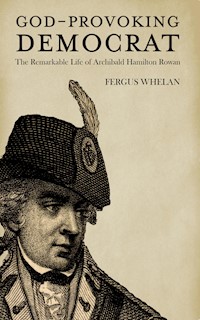
Born into the Anglo-Irish landowning class of Co. Down, Archibald Hamilton Rowan (1751–1832) led a colourful life. Heavily influenced by the celebrated radical John Jebb at Cambridge, and the revolutionary thinker Mary Wollstonecraft, he made waves throughout his career, weathering the wrath of his own class as he championed the causes of the poor and oppressed. Of a passionate disposition, he was involved in several duels, denounced the military for shooting dead tradesmen in Dublin for bull-baiting, and as a young man was liable to getting into 'scrapes with married women'. He was a founding member of the United Irish Society, and imprisoned in 1794, but he managed to escape in a fishing vessel. He then endured eleven years of hardship in France, Germany and America before his tenacious wife, Sarah Dawson, managed to secure him a pardon and he returned to Ireland in 1806. His revolutionary activities, treasonable plots, jail break and fugitive status make Rowan's remarkable life as a 'god-provoking democrat' an astounding and gripping adventure.
Das E-Book können Sie in Legimi-Apps oder einer beliebigen App lesen, die das folgende Format unterstützen:
Veröffentlichungsjahr: 2015
Ähnliche




















GOD-PROVOKINGDEMOCRAT
GOD-PROVOKING
DEMOCRAT
The Remarkable Life of Archibald Hamilton Rowan
By Fergus Whelan
GOD-PROVOKING DEMOCRAT First published in 2015 by New Island Books 16 Priory Office Park Stillorgan County Dublin Republic of Ireland.
www.newisland.ie
Copyright © Fergus Whelan, 2015. Fergus Whelan has asserted his moral rights.
PRINT ISBN: 978-1-84840-460-1 EPUB ISBN: 978-1-84840-461-8 MOBI ISBN: 978-1-84840-462-5
All rights reserved. The material in this publication is protected by copyright law. Except as may be permitted by law, no part of the material may be reproduced (including by storage in a retrieval system) or transmitted in any form or by any means; adapted; rented or lent without the written permission of the copyright owner.
British Library Cataloguing Data. A CIP catalogue record for this book is available from the British Library.
New Island received financial assistance from The Arts Council (An Chomhairle Ealaíon), 70 Merrion Square, Dublin 2, Ireland.
For my wife, Sheila.
In memory of Eamon Smullen, 1924–1990
Acknowledgements
Special thanks to Andy Pollock, Padraig Yeates, Theresa Moriarity and Vincent Morley.
Contents
1. Conception at Killyleagh
2. Youth Among the Radicals
3. Brown Bess on his Shoulder
4. Ruffian Force and Cowardly Calumny
5. From Volunteer to United Irishman
6. The Government Crackdown
7. Banquets Amidst Starvation
8. Challenge at Edinburgh
9. From Trial to Newgate
10. Dr Viper Comes to Town
11. The Glorious First of June
12. Rowan and Mary Wollstonecraft
13. Party Rage in the Land of Liberty
14. The Needle of Peter Porcupine
15. The Prospect of Union
16. The Londonderry Lordling
17. Return to Killyleagh
18. New Light on Presbyterian Loyalty
19. Conclusion
Primary sources
Bibliography
Index
‘I have seen many, very many United Irishmen, and with a few exceptions they are … the most God-provoking Democrats on this side of Hell.’
– A New England Federalist Senator describing his visit to Pennsylvania
1.
Conception at Killyleagh
Says he, ‘If ye’ve laid the pike on the shelf,
Ye’d best go home hot-fut by yerself,
An’ once more take it down.’
So by Comber road I trotted the grey
An never cut corn until Killyleagh
Stood plain on the risin’ groun’.1
Archibald Hamilton Rowan (1751–1834) was born and raised in England. He first saw the light of day at his grandfather’s house in Rathbone Place, London, on 12 May 1751. He was educated among the elite of upper-class society at Westminster School and Cambridge University. Arthur Wellesley, the Duke of Wellington, is reputed to have remarked when commenting on his Irish origins, ‘If a gentleman happens to be born in a stable, it does not follow that he should be called a horse’.2 Despite his birth and upbringing, Archibald Hamilton Rowan was not an Englishman; his heart was always in Ireland.3
Rowan did not perceive himself as Anglo-Irish, the term sometimes applied to a caste of landed Irish Protestants by those who have imbibed the attitude that to be truly Irish is to be Roman Catholic. Rowan was of Scottish ancestry, but he like his Irish Protestant contemporaries such as Wolfe Tone, William Drennan and Henry Grattan, ‘never doubted that they were Irishmen without any qualification’.4
Rowan was conceived by his Irish mother at his father’s ancestral home, Killyleagh Castle in County Down. This elegant, whimsical castle is still in the possession of the Hamilton Rowan family. Killyleagh’s windswept turrets stand perched on a rocky outcrop, dominating the surrounding countryside. To the east lie Strangford Lough and the Ards Peninsula, and yet farther east is the north channel of the Irish Sea. On a clear day the hills of Scotland can be seen on the horizon. The villages of Killyleagh and nearby Comber, Saintfield, Kilkeel, Newtownards and Cloghy feature in Florence Wilson’s poem, ‘The Man From God Knows Where’, which concerns the 1798 rebellion of the United Irishmen and the attempted rebellion of 1803. Although Rowan would take no direct part in the 1798 rebellion, many of the local people of the hinterland of Killyleagh fought at the battles of Saintfield and Ballynahinch. Archibald Hamilton Rowan was conceived in the heartland of enlightened, radical, Presbyterian Ulster.
Rowan was born in London because his mother, Jane Hamilton, had gone there when she knew she was pregnant. Her wish was that her son would have no contact with Ireland during his youth and early manhood.5 She hoped that Rowan would grow to be a ‘cool, foppish’ English aristocrat, loyal to his class and kind, unconcerned about the oppression, poverty and religious divisions of his native country. His mother’s stratagems were to no avail. Ironically, it was she who asked Rowan to settle with his family in Ireland many years later. By that time her circumstances, if not her negative attitude towards Ireland, had altered.
Rowan’s most illustrious paternal ancestor was James Hamilton, who arrived in Ireland circa 1600. James Hamilton’s father was a clergyman, and therefore James was, as they say in Ulster and Scottish parlance, ‘a son of the manse’. He graduated from Glasgow University and became a schoolteacher. He came to Ireland as an emissary for James VI of Scotland to serve his interests before the death of Queen Elizabeth I. James Hamilton is said to have negotiated a pardon for the Gaelic chief Conn O’Neill on a charge of treason, and to have conned the feckless Conn out of one third of his property in County Down as a reward for his services,6 thus becoming a major landowner in east Ulster in the early seventeenth century. He also became a fellow of Trinity College, Dublin. On the death of Queen Elizabeth, James VI of Scotland became James I of England, and James Hamilton was immediately appointed to the Irish Privy Council. He was made Viscount Claneboye in 1622, and was given possession of Killyleagh Castle.
King James had no time for Presbyterianism, which he regarded as incompatible with monarchy, and it is not clear whether he was aware of the new viscount’s religious sympathies.7 While the viscount’s ‘education and conversation inclined him to be episcopal … he was in practice Presbyterian’.8Viscount Claneboye is known to have been the patron of at least seven Scottish non-conformist clergymen who settled in Down and Connor, including his own nephew, another James Hamilton.9 In times of persecution he was willing to shelter non-conformist clergy in his own home.10
Hamilton succeeded in wooing Robert Blair, a former teacher of philosophy at Glasgow and one of the most gifted ministers in the contemporary Presbyterian Church of Scotland, to minister at Bangor.11 Claneboye opened a philosophy school in Killyleagh, which seems an extraordinary project to embark on in a small fishing village in early seventeenth-century Ulster. By the time Archibald Hamilton Rowan penned an account of his ancestry in the late 1790s this school had fallen into decay, but not before it produced at least two world-class scholars: Hans Sloane (1660–1753), founder of the British Museum and inventor of drinking chocolate, as was the great Francis Hutcheson (1694–1746), the father of the Scottish Enlightenment.
Rowan’s maternal great-grandfather, William Rowan, had raised a company of men who fought with the Williamite forces at the Boyne in 1690. A letter sent by Queen Anne to the Duke of Ormond on 18 April 1710 suggested that Captain Rowan be rewarded for his many services to ‘our late dearest brother and sister, King William and Queen Mary’. Among these services was ‘raising a troop of horse in the north of Ireland and arming and subsisting them at his own charge’. Captain Rowan had successfully ‘held a pass near Londonderry against the enemy and there lost his lieutenant and many of his men’. He saw military service in Scotland, and when ordered back to Ireland he continued ‘his exertions in favour of the [Glorious] Revolution’ until the final Williamite victory.12
Captain Rowan married Mildred Thompson, who was connected to the Synge family, which had produced a number of bishops and eminent churchmen in the late seventeenth and early eighteenth centuries. The captain hoped that his son, William, would become a clergyman, and with this in mind he sent him to Trinity College, Dublin. However, politics rather than theology seems to have engaged young William Rowan’s interest at college. He befriended a fellow student by the name of Markham. Both young men ‘were resolute and uncompromising Whigs’. They had adopted a minority, and perhaps unpopular, position in Tory-dominated Trinity. ‘Party spirit was so high in those days’ that the two chums were ‘frequently obliged to appeal to their fists to enforce the reasoning of their heads’.13
William Rowan excelled at Trinity, and after graduating he was elected to a fellowship at the college. Such fellowships were reserved for ordained clergymen of the Established Church. As William Rowan ‘refused to take the oaths necessary for ordination’, the election was declared void. William Rowan must have known the rules before contesting the election, so perhaps the election was a Whig campaign to unsettle the Tory establishment. If it was a campaign to change the rules, it appears to have worked and the rules were soon changed. Having successfully studied law, William became one of the first lay fellows of, as well as legal advisor to, the college.
He prospered at the law, married Elizabeth Eyre of Galway and bought an estate in Donegal. Elizabeth, like so many of the Irish landed gentry of her era, preferred life in the fashionable bustle of London to the remote, rural quietude of Donegal, and hence the move to Rathbone Place.
The Rowans had only one child, a daughter, Jane. She grew to be ‘a woman possessed of every amiable quality and perfection of mind and body’.14 She married Tichborne Aston, a member of the Irish House of Commons for Drogheda in 1746. Aston died two years later, leaving Jane a childless, eligible young widow with ‘a good fortune’. She married Gawin Hamilton of Killyleagh in 1750, and the pair moved to Rathbone Place in time for the birth of their son, Archibald Hamilton, the following year.
Rowan spent time living with his grandfather, who planned his education with care, sending him first to a famous school at Marylebone in preparation for entering the upper school at Westminster. The old man would summon the boy every Saturday and assess his progress at school. This was always an ordeal for Rowan, who by his own admission was giddy and negligent, while his grandfather was, to say the least, a hard taskmaster. Rowan said that his grandfather was ‘of a choleric habit’.15 If the old man was pushy about the boy’s education, he was more laid back about religion. Mrs Rowan would squabble with her husband about the grandfather’s failure to enforce religious principles on his grandson. Although they attended the services of the Established Church, the old man never urged any religious doctrine on the young Rowan. Rowan believed that his grandfather’s reason for refusing ordination at Trinity College was that he was, by early manhood, a Unitarian. Unitarians were Protestant Dissenters who rejected the doctrine of the Trinity and the deity of Jesus. Rowan and his father, Gawin (and indeed many of the Presbyterians in Dublin and Ulster who were later leading United Irishmen) espoused Unitarianism. Rowan believed that his grandfather was never shaken from his religious opinions.16
The old man’s will began with the phrase ‘in the name of the One and only self-existent Being’, an implicit expression of a Unitarian theology. Unitarianism in the eighteenth century, however, was not solely a matter of theology. Most, if not all, Unitarians in England and Ireland were radical Whigs and enemies of what they viewed as arbitrary power and the corruptions of government, which they believed denied citizens civil and religious liberty. The old man’s will concluded as follows:
From personal affection, and that in the hope that he shall become a learned, sober, honest man, live un-bribed and unpensioned, zealous for the rights of his country, loyal to his King and a true Protestant without bigotry to any sect, I give my property to Archibald Hamilton.17
‘Un-bribed’ and ‘unpensioned’ referred to the governmental practice of buying support. As Dr Johnson declared, ‘In England it is generally understood to mean pay given to a state hireling for treason to his country’.18 Old Rowan was clearly anxious that the boy should not become a place-chaser or a government hack. Being ‘a true Protestant without bigotry to any sect’ is a hallmark of Unitarianism.
Archibald Hamilton Rowan lived up to almost all of his grandfather’s wishes and Whig principles. He was ever after zealous when it came to the rights of his country, and remained a true Protestant and an enemy of religious bigotry. He did not, however, remain loyal to his king. Many radical Whigs of his generation, including the Founding Fathers of the United States of America, found that they could not be loyal both to their Whig principles and to King George III.
When William Rowan died in 1767 his grandson was 16 years old. The terms of the will required the young Archibald to add ‘Rowan’ to his surname, and thereafter he was known as Archibald Hamilton Rowan. He inherited his grandfather’s considerable fortune, receiving an annuity of £584 immediately, a capital sum of £20,000 at the age of 25, and a further annuity of £8,000 upon his mother’s death.19 The will stipulated that he must get his degree at an English university (he choose Cambridge) and not visit Ireland until he was 25 years old.
There is no evidence of antipathy towards Ireland on the part of his grandfather, and it is likely that this condition was the result of pressure from his mother. She apparently blamed the influence of Ireland for turning her husband, Gawin, into ‘a muddle-headed raffish sort of a man possessing a taste for low company’,20 and was anxious that her son should be a more polished and urbane aristocrat.
Rowan tells us, however, that ‘notwithstanding the injunctions of my grandfather’s will I made more than one trip across the channel to see Ireland during my minority’.21
1. Wilson (1918), ‘The Man From God Knows Where’.
2. He did not say it; Daniel O’Connell later said it of the duke.
3. Campbell (1991), p. 37.
4. Beckett (1976), p. 10.
5. Nicolson (1943), p. 26.
6. Hanna (2000), p. 22.
7. Holmes (1999), p. 11.
8. Herlihy (1996), p. 20.
9. Ibid., p. 19.
10. Ibid., p. 20.
11. Holmes, p. 15.
12. Drummond (1840), p. 13.
13. Rowan manuscript, p. 53.
14. Drummond, p. 15.
15. Ibid.
16. Ibid.
17. Ibid.
18. Kronenberger (1974), p. 29.
19. Nicolson, p. 27.
20. Ibid., p. 22.
21. Drummond, p. 50.
2.
Youth Among the Radicals
The time Rowan spent living with his grandfather ‘passed heavily enough’, but better days were on the way. After his grandfather’s death Rowan went to live with his father, Gawin Hamilton, in Cowley Street, London. According to Harold Nicolson, a descendant of the Hamiltons of Killyleagh, Gawin Hamilton ‘was more than a Whig, he was a radical’.22
Nicolson’s comment suggests that Gawin would have been staunchly opposed to aristocracy and court influence on the government, and believed that the Tories were the enemies of civil and religious liberty. Radical Whigs regarded Parliament as corrupt and under the control of the aristocratic landed elite. They supported political reform and opposed the Test Act, which sought to exclude Protestant Dissenters from political and public office. Rowan loved and admired his father, and quickly came to share his father’s political outlook. They were to stand by each other through the struggles and vicissitudes of later life.23
Their Cowley Street home, which they rented from Bonnell Thorton, a well-known wit and an established political writer, was ‘a favourite meeting place for English [and Irish] radicals’.24 Harold Nicolson published a critical biography of Rowan in 1943 in which he displayed vitriolic hostility to his great-great-great-grandfather, Gawin Hamilton, to whom he refers throughout his work as ‘Old Baldie’. Despite this disapprobation, Nicolson gives a vivid account of the meetings at Gawin Hamilton’s home, which must have made a big impact on the 16-year-old Archibald.
Nicolson writes:
Gawen [sic] Hamilton was known for his advanced opinions, and when the House of Commons rose at night some of the radical members would walk around to Cowley Street, drink large quantities of Mr Hamilton’s port and discourse upon the dangers of the ‘new monarchy’ of young George III and on the iniquities of Bute and Grenville. The poet Churchill would be present at these meetings and speak with passion about his dear friend Wilkes, about corruption in high places, about the coming dawn of English liberties. And there was Dr Charles Lucas, the ‘first of Irish patriots’, who also modelled himself, even in his manner of conversation, on the genius of the ‘North Briton’ [John Wilkes]. Dr Lucas [who] was crippled with gout, would be wheeled into the dining room and would shake his silver locks in fury at the ruthlessness of the English administration in Ireland.25
Nicolson’s amusing account of a group of port-swilling, bombastic and gout-ridden malcontents portrays a distorted picture of the goings on at Cowley Street. It is clear, even through Nicolson’s hyperbole, that Gawin Hamilton’s friends were men of intellect – not a few of them were famous for their wit, and some were accomplished politicians and well-known radical personalities. Churchill was a highly intelligent man and one of the most celebrated poets of his time.26 Wilkes was possessed of a biting wit. The Earl of Sandwich, who was involved in prosecuting Wilkes, once said to him, ‘Sir, I do not know whether you will die on the gallows or of the pox’. Wilkes is reported to have replied, ‘That depends, my lord, on whether I embrace your lordship’s principles or your mistress’.
Yet neither John Wilkes nor Dr Charles Lucas was a figure of fun; they were serious and able radicals who had fought against their respective governments during dangerous times in the cause of democratic reform. Wilkes had been imprisoned more than once. Lucas was outlawed, and might have faced the gallows had he not fled Ireland for the safety of Leiden in 1749. Both men were heroes to their constituents.
The people of Middlesex re-elected Wilkes each time the government deprived him of his seat. The government had sent him to prison and could then deprive him of his Commons seat on the basis that he was a felon. Dr Charles Lucas was alleged by his enemies in Dublin to have risen to prominence by ‘cajoling the very scum of the people’.27 By this they meant the decent common working folk of Dublin, who revered Lucas. Although often referred to as ‘the Wilkes of Ireland’, and ridiculed by Nicolson for modelling himself on Wilkes’s manner and conversation, Lucas was twelve years older than Wilkes, and had more claim to be the model than the imitator.
Dr Lucas began his campaign to democratize the governance of Dublin City in 1749. His ‘crime’ had been to express the opinion that the British Privy Council and the Westminster Parliament had no right to legislate for Ireland. Wilkes’s ‘crime’ twenty years later was to upset the grandson of George II, George III, by using his newspaper, TheNorthBriton, to deride the King’s ministers, Grenville and Bute, and to attack some of the King’s own speeches.
The only way in which it can fairly be said that Wilkes was a model for Lucas was that Wilkes founded TheNorth Briton the year before Lucas founded his Freeman’sJournal in Dublin in 1763. Although TheNorthBriton did not survive for long after Wilkes’s release from prison, the Freeman’sJournal was one of Ireland’s leading newspapers for more than 160 years, finally closing down in 1924.
Wilkes was the best known and most highly regarded radical in mid-eighteenth-century Britain, and the same can be said of Charles Lucas in relation to Ireland. The fame of these men was not confined to their native countries: both men had substantial international reputations and were admired by some of those who would later be the Founding Fathers of American democracy. If Grenville was a subject of criticism in the discussions at Gawin Hamilton’s soirées, it was likely in part the result of his imposition of the Stamp Acts on the American colonists on behalf of George III.
Within a few short years the King declared his American subjects to be in rebellion, and Wilkes became a venerable friend of the American Revolution. Benjamin Franklin visited Dublin to meet with Lucas shortly before the good doctor’s death in 1771,28 and it is said that Thomas Jefferson took inspiration from Lucas as he penned the Declaration of Independence.29
Rowan, as a 16-year-old youth who shared his father’s radical views, must have been exhilarated by the company of his father’s famous and charismatic friends. In masterful understatement, Rowan records that Wilkes and Lucas had ‘an influence on my early sentiments’.30
It could be said that Rowan was later to benefit from ‘the lively lower-class political culture that Lucas developed among the Dublin workers’.31 The children and grandchildren of those who took to the streets of Dublin in support of Lucas as he fled for his life in 1749, and welcomed his triumphant return from exile in 1760, often cheered Archibald Hamilton Rowan through the same streets in the early 1790s. It would not have been in Rowan’s interest to be cheered through Dublin on his return from his own exile in 1805, but the Dublin people showed their support and affection at least once again on a famous occasion in 1829, when their hero was 78 years of age.
Cambridge and John Jebb
In the year 1768 the time had come for Rowan to go to Cambridge. We know little of how he spent his time there, but he did carry on with the boisterous behaviour for which he had become known at Westminster School. One commentator, a Mr Topham, had described Hamilton as ‘wasting himself at Westminster’, and observed that expecting Rowan to flourish there was like expecting an alpine plant to live in aquatic conditions. Topham had his tongue very firmly in his cheek when he said:
With more than boyish aptitudes and abilities, he should not thus have been lost amongst boys. His incessant intrepidity, his restless curiosity, his undertaking spirit, all indicated early maturity – all should have led to pursuits, if not better at least of more spirit and moment than the mere mechanism of a dead language … His evenings were set upon … with pranks and gunpowder, [and] in leaping from unusual heights into the Thames.32
This ‘early maturity’ must have manifested itself again at Cambridge. He is alleged to have thrown some furniture out of a high window onto a passing coach, and to have thrown the coachman into the River Cam.33 He was rusticated for this or some other misbehaviour and was sent down from Cambridge for a year.
He spent that year, possibly 1770, at Warrington Academy, whose guiding spirit was the famous Unitarian clergyman, scientist and political radical Dr Joseph Priestley. In spite of the fact that Rowan and Priestley were friends in later life, the pair are unlikely to have met at Warrington as Priestley had moved on from there three years earlier in 1767.
Rowan met the first love of his life at Warrington. This was Lætitia Aikin, who later became famous as Anna Barbauld. Her father, John Aikin, was teaching at Warrington at this time. This young woman is said to have been ‘possessed of great beauty, with dark blue eyes that beamed with wit and fancy’.34 She would later emerge as a successful and highly regarded writer at a time when very few women had managed to break into a profession that was, at the time, male- dominated.
The young Miss Aikin was seven years older than Rowan, and we do not know if his affections were requited. We do know that in the long years ahead Anna Barbauld wielded her considerable talents in favour of many of the liberal and progressive causes that were close to Rowan’s heart. She welcomed the American and French Revolutions, she supported her old friend Dr Priestley when he was persecuted and hounded out of England, and she denounced the slave trade, advocated democratic reform and campaigned against the Corporation and Tests. She was the author of several highly regarded hymns, and her ‘Hymn for Harvest Time’ is sung to this day by Protestant congregations in England and Ireland.
Anna Barbauld had a remarkable public career as a writer and intellectual. We have no way, however, of knowing if Rowan’s relationship with her was in any way meaningful or merely a schoolboy crush.
Gawin Hamilton placed his son in the care of the Reverend John Jebb, a Fellow of Peterhouse College, Cambridge. Jebb was a minister of the Church of England who possessed no less than two Established Church ‘livings’ nearby. It might seem strange for a radical Whig like Gawin Hamilton to place his son in the care of an Anglican clergyman; John Jebb, however, was no ordinary priest. Indeed, within a few years he was to resign his comfortable ‘livings’ and leave the Church of England. Thereafter he was pressured into leaving Cambridge, a pressure he resisted for some considerable time. Eventually he was forced out, and in order to make a living he qualified as a doctor of medicine and practised medicine for the rest of his life.
Back in 1774 Jebb had been in close correspondence with Theophilus Lindsey, a fellow Anglican clergyman, who had found it necessary to resign his post in the Church because of his rejection of the doctrine of the Trinity. Jebb, who shared Lindsey’s views, would eventually follow suit. Theological disputes, however, are rarely just about theological matters.35 Even before Rowan arrived in Cambridge, Jebb had been somewhat isolated there due to his reputation as a radical. In 1754 he had infuriated the Earl of Sandwich when he successfully opposed his court-backed bid for the office of High Steward of the University. Sandwich never forgave Jebb, and used all his influence, both in and out of government, in the years that followed to harm Jebb in every way he could.
A decade later, during the ‘Wilkes and Liberty’ controversy, Jebb refused to sign an address of loyalty to the King. The address read:
We your majesty’s most dutiful and loyal subjects … the scholars of Cambridge we [sic] cannot but see with concern and abhorrence the evil designs of bad men who are labouring to seduce the ignorant and unwary from their duty. We will instil in the rising generation true principles of religion and loyalty. We shall add an unfeigned prayer to God to preserve your majesty the beloved sovereign of a united loyal and affectionate people.36
It took courage for Jebb to refuse to sign. As he was to say later, ‘I know I shall feel the vengeance of the Tories as this place [Cambridge] swarms with them’.37 He was dismayed when many of his colleagues succumbed to the pressure.
Jebb was noted for his ‘zealous and active … exertions to improve the system of education at the university’.38 Many of Jebb’s suggestions for educational reform, for instance his proposals for the yearly public examination of undergraduates, were opposed, not on the merits of the case but on account of Jebb’s unpopular religious and political opinions.
Jebb stood his ground for many years, and Rowan would have been conscious that during his time at Cambridge he was under the ‘care and patronage’ of a Unitarian radical reformer who was unpopular not only with the government and the university establishment, but with most of his fellow scholars as well.
Jebb endured the hostility of Cambridge for twenty-two years, but in 1775, two years after Rowan’s graduation, he could stand it no longer, and resigned. He was now without an occupation. Theophilus Lindsey had opened a new Unitarian chapel at Essex Street in London the previous year, and asked Jebb to be his coadjutor there.39 Jebb, however, had no wish to continue preaching, and instead pursued the study of medicine.
If John Wilkes was the best known reformer of the mid eighteenth century in England, by the 1780s Jebb was the most thoughtful, consistent, radical and democratic of the reformers. In fact, although he was opposed to violence, he was a revolutionary. Other reformers humbly petitioned the Commons for their liberties. Jebb was an early advocate of universal suffrage and suggested that people should not ask for this right; they should take it for themselves. He took the old Whig slogan of ‘no taxation without representation’ to its logical conclusion when he said:
The people must put themselves in possession of the right [universal suffrage] in the same way as they would abate a nuisance or demolish an enclosure made on a common without legal right. Those who have no representation should tell the government that they will withhold taxes.40
Rowan was proud to say that he retained Jebb’s friendship and correspondence to the last year of his tutor’s life.41 The two men exchanged letters when Rowan was in Paris at the close of the American war. When Jebb heard that Rowan had met Benjamin Franklin there, he declared:
I rejoice that you saw that truly great man Dr Franklin. I beg that you will make my acknowledgements to him for his kind enquiries on my health and assure him that for the sake of America, the sake of England, the sake of mankind, I do most cordially congratulate him on the close of the America war. The American cause is the cause of justice and freedom.42
In August 1783 Jebb was asked by the Volunteers of Ireland for his advice on their reform programme. He strongly advised them against a petition for reform being submitted to Parliament, feeling that this might all too easily be rejected by the House. A petition, in Jebb’s view, ‘transfers authority from the senders to the sent. […] It calls upon them to reform themselves, which a corrupt body of men never did, nor can do’.43 Instead, he suggested that they should outline their demands and set a date for their full consideration and implementation by Parliament. They should then adjourn their present assembly to a reasonable time beyond that date, and when the Volunteers reassembled they would know what to do depending on how Parliament had responded. In a second letter of the same month he expanded on why the Volunteers should try to keep the initiative and not rely on the House:
A new Parliament may contain a greater number of real friends of freedom, but an incurable vice is inherent in its constitution. If it be left to Parliament to form a plan the scheme will inevitably be defeated. The aristocratic interest united with the regal, like a blight from the East, will assuredly blast every hope of harvest. While you retain the matter in your own hands, you cannot fail of effecting, under Providence, the permanent salvation of your country.
When Rowan came to Ireland in 1784, and threw himself enthusiastically into the Volunteer movement, he corresponded with his mentor seeking advice on how he should behave and what stance he should adopt in relation to the question that was causing turmoil within the once great but now declining movement: what were the possibilities of making good citizens of Irish Roman Catholics?
In a letter to Rowan dated 5 March 1785, after expressing his delight that Rowan was settled in Ireland and making a positive contribution to public affairs, Jebb advised him to:
Explore with the utmost exercises political truth and having found it avow it with firmness and perseverance. Temporising expedients are always injurious when contrary to natural right and natural feelings. […] I am of the opinion that there should be one law for Papist and Protestant.
I must declare, I think the Priesthood has ever been the cause of civil dissentions … The Protestants of the north I much wonder that they should be alarmed with respect to the Roman Catholics much more have they to fear from the intolerant spirit of the Established Church.’44
In a follow-up letter in September of that same year he identified the two main issues to be addressed as the rights of Roman Catholics and universal suffrage. Jebb was anticipating Theobald Wolfe Tone and the United Irishmen by more than five years when he wrote, ‘No reform can be justly founded that does not admit Roman Catholics and does not restore to the people their full power’.45
Jebb was ill when he wrote this final letter to Rowan, and he breathed his last just a few months later on 2 March 1786. Jebb was 50 years old when he died. Rowan was nearly 35 at the time. Jebb had been a friend and mentor for half the younger man’s lifetime.
Reverend John Jebb did not live to see just how much Rowan avowed the political principles he had bequeathed. Rowan’s firmness of purpose almost brought him to the gallows, and though he avoided paying the ultimate price, he was forced to persevere through a long, lonely and painful exile. Rowan never could temporize, nor did he ever repudiate the truths or principles he had inherited from John Jebb.
William Drummond and Harold Nicolson, Rowan’s previous biographers, utterly failed to understand their subject. They seem bemused by his sometimes rash, risky and courageous actions during the 1790s. Drummond suggested that Rowan had an excess of political testosterone, which resulted in both his youthful pranks and his later actions. A phrenologist who posthumously examined Rowan’s skull at Drummond’s request concluded that his major characteristic was a ‘love of approbation’.46 Nicolson grasped this theme enthusiastically, giving his work the title The Desire to Please. One of the recurring themes of the latter’s utterly unpleasant book is that Rowan was mad and/or bad, and that was why he risked his life, family and fortune in a series of pointless escapades, to no serious purpose.
Rowan’s youthful hooliganism was on a par with many of his peers, and there is a more convincing explanation for his career as a revolutionary reformer than an infantile desire to please. He once told his wife that he had allowed himself to be led into a more active life than he would have wished, but that his sentiments had nearly always been the same: from education and principle he was led to support the reform of Parliament and equal liberty to all religious sects.47
Rowan in early manhood had come under the influence of Jebb, a principled, thoughtful and revolutionary radical. His advice to Rowan to ‘explore with the utmost exercises political truth and having found it avow it with firmness and perseverance’ had been taken to heart by the younger man.
After Cambridge
From Rowan’s memoir, written for his children while in exile in 1796, we get some details of his travels to Holland, South Carolina and Portugal. He spent the summer after Cambridge in South Carolina. He later visited Portugal in a vain attempt to enlist in the Portuguese Army. Such was his personal and family wealth on leaving Cambridge in 1773, however, that he seems to have had little need to pursue a livelihood, and it is hard to fathom if he had any plan to make a living, start a family or do anything other than travel and enjoy the pleasures of easy wealth.
He went to France in 1773 when he was 22 years old, where he stayed for eleven years. He was by this time a very tall, good-looking man. Flann Campbell writes:
Not much is known about these years in France except that he met some descendants of the Wild Geese, the exiled soldiers who had emigrated from Ireland after the Treaty of Limerick in 1691, and he was apparently influenced by Jean-Jacques Rousseau and the French philosophes. He was admired by Marie Antoinette who saw him rowing on the Seine and was so taken by his appearance that she sent him a ring.48
Rowan tells of the French queen noticing him on the Seine, but makes no mention of the ring. Rather, he tells us that she remarked to her party that rowing a boat was no proper activity for an English gentleman.49
In 1777, at the height of the American war, Rowan had the first of several meetings with Benjamin Franklin in Paris. They would have known a number of people in common since at an earlier period Franklin had spent time in England, much of it in the company of the ‘Real Whigs’ such as John Jebb, Revd Richard Price and Joseph Priestley, all of whom, like Rowan himself, were Unitarians, and enthusiastic in the American cause.
Rowan petitioned Franklin on behalf of two British officers who wished to get commissions in the Continental Army. Franklin had no authority to issue such commissions, and he suggested that the men concerned should go to America and apply for their commission there. The men in question were not prepared to take that chance, and nothing came of this petition. Rowan recalled, ‘I regretted I was not an American but I was determined, if ever I was able, to play the same role in Ireland’.50
At around this time, Rowan, against his better judgement, became involved with George Robert Fitzgerald, a ‘high player’ and notorious Irish duellist. Fitzgerald convinced Rowan to act as his second in a duel with a Major Bragg. Fitzgerald behaved dishonourably in that, having wounded Bragg, he discharged a second shot in an attempt to kill his wounded enemy. His second shot missed, and Bragg succeeded in inflicting a flesh wound on Fitzgerald.
The duel took place at Valenciennes, which was in Austrian territory, and Rowan might have been in serious trouble had not the governor, when he summoned Rowan, noticed that he was wearing a masonic symbol, which he had from the time he was master of the Cambridge Masonic Lodge.
His brother mason allowed him to travel back to Paris unmolested. Fitzgerald continued his high living, and survived many duels. He almost survived a visit to the gallows in Mayo, Ireland, in 1786: the first two attempts to hang him failed, however it was then a case of third time unlucky.




