


11,49 €
Mehr erfahren.
- Herausgeber: Atlantic Books
- Kategorie: Fachliteratur
- Sprache: Englisch
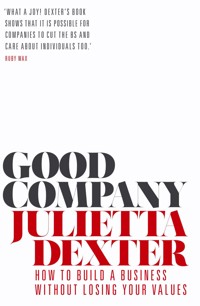
In a highly competitive world, many think business success means being ruthless: maximising short-term return for shareholders, cutting overheads, crushing competition, and expanding at an exponential pace. Nothing says this more than Silicon Valley with its macho mantras like 'Move fast and break things' (Facebook) or 'We're a team not a family' (Netflix). But this model is looking increasingly flawed. What if there were another more compassionate way? Julietta Dexter believes there is. In this powerful and hopeful book, the award-winning CEO of The Communications Store explains how she built one of the world's most respected PR & communications companies without compromising her morals and without screwing over her staff or her clients. Highlighting a new paradigm for business, she explains why profit should be just one consideration among several, and why honesty, reliability and diversity are the best foundations for long-term success.
Das E-Book können Sie in Legimi-Apps oder einer beliebigen App lesen, die das folgende Format unterstützen:
Veröffentlichungsjahr: 2020
Ähnliche



















Julietta Dexter founded The Communications Store in 1995 with £600 and two clients. TCS would go onto become the premier strategic brand development, communications and PR company for some of the world’s best brands in fashion, beauty and lifestyle, with offices in London and New York. In 2017 it was named as one of the Sunday Times Top 100 Small Companies to Work For. In 2020, The Communications Store became ScienceMagic.Inc.
First published in hardback and trade paperback in Great Britain in 2020 by Atlantic Books, an imprint of Atlantic Books Ltd.
This paperback edition published in 2021.
Copyright © Julietta Dexter, 2020
The moral right of Julietta Dexter to be identified as the author of this work has been asserted by her in accordance with the Copyright, Designs and Patents Act of 1988.
All rights reserved. No part of this publication may be reproduced, stored in a retrieval system, or transmitted in any form or by any means, electronic, mechanical, photocopying, recording, or otherwise, without the prior permission of both the copyright owner and the above publisher of this book.
Every effort has been made to trace or contact all copyright holders. The publishers will be pleased to make good any omissions or rectify any mistakes brought to their attention at the earliest opportunity.
10 9 8 7 6 5 4 3 2 1
A CIP catalogue record for this book is available from the British Library.
Paperback ISBN: 978 1 78649 722 2
E-book ISBN: 978 1 78649 721 5
Printed in Great Britain
Atlantic Books
An imprint of Atlantic Books Ltd
Ormond House
26–27 Boswell Street
London
WC1N 3JZ
www.atlantic-books.co.uk
Contents
Preface to the Paperback Edition
Introduction The Future Is Friendly
Chapter 1 Leadership
Chapter 2 Culture
Chapter 3 Communication
Chapter 4 Service
Chapter 5 Money
Chapter 6 Recruitment
Chapter 7 Start-Ups
Chapter 8 Crisis Management
Chapter 9 Responsibility
Conclusion Success
Endnotes
Acknowledgements
Index
For my father,
John Dartnall Dexter CBE
Preface to thePaperback Edition
Good Company was originally published at the height of the first Covid-19 lockdown in the UK. Initially, it was difficult to know if this was good or bad timing. Perhaps people would be reading more at home. Perhaps people would be too preoccupied with the chilling medical realities of the pandemic to think about anything else. Perhaps business leaders would be too busy working out how to approach the many uncertainties their firms faced.
What a difference a year makes. With hindsight, I believe that Good Company was the right book for the moment. Yes, we have felt anxious, frightened, and unsure – unable to plan for the next week, let alone our futures. But a period of crisis is an excellent opportunity for evaluation. If one is lucky enough to have one’s health, then one has a personal duty to protect others as best one can, and to use a moment like this, to listen, learn and search for improvement and self-awareness. This is especially true for anyone with responsibilities for others’ careers and wellbeing. It’s been immensely challenging.
Businesses, including The Communications Store (TCS), have had to make tough decisions. At times during 2020 we lost up to 35% of our revenue. Some of the brands we represented quite simply haven’t made it – they could not ‘pivot’, to use a much overused word, quickly enough. It’s been hideous. As a business leader, in a situation like this, you need to save as many jobs as you can. We’ve done all we can – no doubt making mistakes along the way – and we have lost exceptional talent, but we’ve sought to treat one another in the most respectful, dignified way possible. Putting people first.
On Friday 13 March 2020, we tested a day of remote working prior to the UK Government putting the country into lockdown. As I write this almost a year later, we’re still not back in the office. Our work environment has evolved at an unprecedented pace and it is increasingly clear that the positive, and less positive, consequences of our new digital tools continue to need analysis, consideration and legal questioning. We’ve all embraced remote working by necessity and we’re only just beginning to understand the longer-term implications, but, however we communicate, it is strong relationships and values that bind institutions and companies together.
In the middle of the Covid-19 crisis, another crisis exploded. The Black Lives Matter (BLM) movement erupted across the world, fuelled by footage of the killing of George Floyd in Minneapolis that shocked and horrified an already broken world. The movement opened our eyes to ongoing injustice, racism and inequality. It was another huge moment to pause, listen and learn. The swift and performative responses of many irked. But the truth is, this is going to take a long, long time to fix. In the past, the fact that we’d built a business that was 88% female was a statement of equality in itself. Not so anymore. Real diversity in the workplace has taken on a whole new meaning.
As a business, we were fortunate to already have an Inclusivity Committee, a group of people with minority lived experiences who had created a safe space to share, challenge and envision a better future. When the BLM movement rose up again, this committee set to work slowly, thoughtfully and with the mantra of not wanting to rush, but to create a plan that would last for years to come. We did make a donation to BLM but that was just a start. We must truly understand the inclusion of every single person and we must champion the power of real diversity. We have also just been accredited as B Corp and we are excited to join a community of like-minded businesses.
For many industries, but especially public relations and business development, 2020 felt like the end of an era. Consumer behaviour and the media landscape have changed more in the past year than in the past few decades. I was already concerned about these trends before the pandemic hit. We’d assembled a global advisory board in the Autumn of 2019 to interrogate the future of our business. How long could it continue as it was? As print media continued to dwindle and consumers spent ever more time on their mobile phones, I felt we needed to question our business model. Our global advisors had world-leading knowledge in tech, data science, the future of conscious consumerism, and the future of media. We gathered in our West London offices on 9 December 2019. When I left that meeting, I knew that it was time to rethink our business for new challenges.
And that’s exactly what we’ve done. Never waste a crisis, they say. We’ve taken this time to shore up our existing business and be truthful about the parts that weren’t working, that weren’t innovative enough. And then we built a business model that brings together the best approach to using digital tools, data-driven power and an understanding of where the consumer will enjoy consuming (responsibly) in the future. On 18 October 2020 The Communications Store became ScienceMagic.Inc. It’s a brave thing to do, and it certainly feels like a new beginning. TCS has been an independent company that has thrived for 25 years. It has been built on exceptional talent, hard graft, and shared values and business ethics – culture over strategy every, single, time. But we are evolving our talent to include different skills. I’ve partnered not only with Daniel, my existing business partner of 18 years, but also David Pemsel who was Chief Executive of the Guardian Media Group. He led the digital transformation of one of our most purpose-driven newspapers and brought it back to break-even after huge losses. He understands responsible digital transformation. It is a very exciting new chapter, but our values will remain at the centre of all we do.
What won’t change is the core belief that business should be a force for good. Our ethics, our culture, and our values are paramount. We will remain a company where profit alone is not the only goal. And we will continue to strive for a world where businesses are more transparent, more open, more communicative, and greater contributors to wider society. I’ve learnt so much this far, but I am committed to a life of learning. There’s never just one way to do things. I want to keep challenging myself, learning new things, from new people around me.
In 1995 when I spoke of kindness, values and ethics in the workplace, many patronised and belittled me. Focus on your bottom line to be successful, they said. But today we live in a world where organisations can no longer ignore their environmental, social and wider economic impact. Such discussions should be at the top of the agenda in C-suite meetings. This is why I’ve taken the role of Chief Growth & Purpose Officer at ScienceMagic.Inc. so I can focus on what really matters. I hope this book reveals why doing so is the best avenue to long-term success.
Julietta Dexter
January 2021
Introduction
The Future Is Friendly
I’ve always been interested in business. I remember being very small, less than ten years old, and watching my father, the owner of an insurance company, come home with his briefcase and put his papers down on his desk; words, numbers, calculations, letters, documents and neat, meticulous, to-do lists. My father was always getting things done. He would read the newspaper in the evenings in the sitting room. I always thought it looked clever and was such a good use of time, finding out what was going on in the world, what was happening in the business community. I wanted to be like him and make intelligent use of my time, too.
My father died quite shockingly in 1991 at the age of fifty-eight while I was in my final year at the University of Cambridge. He went to sleep one night and just didn’t wake up in the morning. At his funeral, hundreds of people showed up to pay their respects – not only friends, family and neighbours, but all of his eighty or so employees, lots of people he’d met through his business and all the other extraordinary things he did outside of work, too. He contributed a lot. It was humbling to see just how many lives he’d touched in his lifetime. I am now fifty and have had more years without my father than with him. But losing him so suddenly was a personal trauma that has shaped my life, my behaviour and my thinking every day, as both a human being and as a business person.
In the year after his death, I watched my friends from university go into banking, management consultancy and graduate trainee programmes with law firms and accountancy practices – Oxbridge cream-of-the-crop graduates for tomorrow’s job market. My route into the job market wasn’t quite such a straight line. First, I went back to our family’s home in Italy to help my mother with my late father’s affairs. Then I returned to London, applied for endless jobs and received forty rejections. I was pretty low and lost, to be honest.
A family friend, Charlotte de Vita (who went on to be hugely successful in the charitable field), helped me land my first job at The English-Speaking Union, a philanthropic organization that fostered good relationships between the UK and the US in the fields of art, literature, music and education, and where I had the privilege of working with a small group of great, hard-working people. From the charity sector, I went into the world of fashion and beauty communications. Those two worlds – charity and PR – could not have been more different. One was well-meaning, humble and under-funded. The other was insincere, vainglorious and under-handed. My early jobs as an account associate taught me everything I needed to know about how not to run a business.
I lasted a few years at what was, to me, a miserable office until I quit in protest when my boss instructed me to increase our clients’ fees by 30 per cent for no reason at all. Unemployed and with no idea what to do next, I got a call from a former client who wanted to know why I’d left my previous job. I shared the story and confided to him that I liked being an accounts person in the communications field, but the corporate culture I’d seen so far had left me demoralized. Maybe I was naïve, but I’d worked hard throughout my education and did my honest best for a boss who tore down my confidence on a daily basis. Was this really all the job market had to offer? Was this what I’d worked so hard for?
The ex-client said, ‘Start your own business and do it your way.’
My initial reaction was to laugh. I was only twenty-five and lacked the skills and experience to start my own company. When I was a girl, my father would sometimes joke about me taking over his business someday, but I thought that was more fatherly flattery than a serious possibility. And yet, I was intrigued by the idea nonetheless, certainly enough to talk about it over dinner with that client and my then-husband. Both men were supportive and encouraging. They believed in me and felt I could actually make a go of it. So, the next day, I started jotting down some thoughts which ultimately turned into a business plan.
In retrospect, it was all a bit rash. I didn’t have a lot else going on then, so there was no harm in scribbling down ideas. Doing my on-paper conceptualizing, I see now, was a brave act. A lot of dreamers with great ideas don’t get that far. They just flow from one notion to the next, one dissatisfying job to the next, and never write down what they’d do on their own if they could. Fear and self-doubt are the biggest roadblocks to success. Writing a one-page, broad-strokes description of a future company is not like signing a legal contract. It’s little more than doodling on a cocktail napkin. But unless someone takes that step, they’ll never move forward.
Oh, I had plenty of doubts. Even as I worked on my plan, I kept asking myself, ‘Can I really start a business?’ and had to stop myself from crumpling my papers into a ball and throwing them over my shoulder. What kept me going was a hunger to prove myself and defy the industry standard by founding a company that would and could break the mould of the old-fashioned business model I’d seen so far, defined by short-term profit-taking, bosses who ruled by fear and intimidation, hierarchies that turned colleagues against each other and an aggressive ‘winner-takes-all’ approach that encouraged unhappy workplaces. In my future company, I’d change all of that, and create a safe place to take risks, with compassion guiding all aspects of the business. A part of my character works on ‘competitive rebellion’ (according to my business coach). Proving to myself that I could do things differently was the motivation that kept me going.
During this uncertain time, I felt my father’s absence keenly. It’d been several years since he’d died, and I wished he could give me guidance and weigh in on countless issues that came up. My plan from the start was to mirror his ‘no-bullshit’ style of doing business. Memories of how he ran his company were my main inspiration. While clearing out his home office, my sisters and I found drawers and boxes full of my father’s paperwork. He wrote multiple drafts of letters, beautifully handwritten, with courtesy and gratitude on every page. He had been a careful, considered and considerate man in all of his correspondences, a far cry from how we communicate now. (I wonder what he would make of Twitter attacks and Facebook trolling. In fact, I wonder a lot about how he would handle just about everything related to business today.) My father closed his office every Friday at lunchtime, not just during the summer, but year-round, so his staff was free to see the dentist, have a kid’s birthday party, get an early start on a weekend trip or keep a plumber’s appointment. According to a document I discovered in a drawer, he gave options to eight of his employees so that they could share in the sale profits, too. He didn’t have to, but he did. He’d made plenty of money while taking good care of his people and had a great life while staying true to his values.
From what I’d experienced so far, these qualities seemed to be outside the corporate norm at the time. The stressed-out, anxious people I’d met from other agencies in the same field had similar complaints. Instead of being guided or nurtured by their managers, they were often patronized and belittled. The business model for PR – and most other industries – appeared to be to ‘get as much as you can and give the very least’ on every front, from the unfair and unkind treatment by bosses, to the deliverables for journalists and clients. At least in one of my previous jobs, my colleagues and I were all very much united in loathing our boss and in support of each other. But at most bullshit offices, there’s an ‘everyone for himself’ mindset, making them a well-dressed version of The Hunger Games.
As I understood it then, making money was a traditional business model’s justification for unethical behaviours – cooking the books, overcharging clients, underpaying staff. The companies where I’d seen such practices were profitable and successful. I had to wonder whether it was even possible to build a human-friendly company and also make money. Were honesty, kindness and compassion profitable commodities? My father had done it, but was he an anomaly or a throwback? Was his wise alternative to short-termism no longer possible in the mid-1990s business world? I was resolved to try to live my life and operate my business with his old-school morals nonetheless, and to just see what happened.
I initially wanted to incorporate my new company as ‘NO. BS. PR’ but eventually chose a name that was a bit less confrontational but no less transparent. I called it The Communications Store (TCS). My one-woman operation launched in 1995 from a windowless shared office. I didn’t have a lot going for me – just youthful enthusiasm, £600 in seed money, two clients and a vision of what a compassionate business could be. One phone call at a time, I built my reputation as being steady and honest, a far cry from the ‘Fabulous, darling!’ Ab Fab fashion PR stereotype of saying everything and doing nothing.
In 1996, I brought in a former colleague from my Devil Wears Prada days to become my first partner. Tom Konig-Oppenheimer and I worked together to build TCS, and the company grew quickly. In 2002, we were joined by Daniel Marks, still my business partner today. Before long, we had a team of five, then fifteen, all the way up to our current 200 employees in London and New York. Our client roster increased from two to five, ultimately to scores of the world’s top luxury brands. Some of our clients, in no particular order, have included Versace, Glossier, MaxMara, Molton Brown, Moët & Chandon, Diptyque, Ferragamo, Chantecaille, Orlebar Brown, Rocco Forte Hotels, Christopher Kane, House of Holland, NET-A-PORTER, Allbirds, BaByliss, Burberry Beauty, ESPA, John Frieda and Rolls-Royce. Our annual billing is in the tens of millions of pounds.
Along with attracting and retaining this calibre of client, we’ve been recognized within our industry with numerous awards and honours and have become known as one of the top strategic brand development, PR and communications companies in the fashion, lifestyle and beauty arena. We help brands communicate, grow and, above all, be aspirational and desirable to consumers the world over. In 2019, we were named the number one fashion, beauty and luxury communications agency by PRWeek UK. In 2018, we made the list in the Sunday Times 100 Best Small Companies, based on our employee feedback score in eight key areas: leadership, management, engagement, personal growth, peer relationships, well-being, salaries and social responsibility – confirmation that we are achieving our goal of doing well by being good to each other.
We’ve established a successful, widely admired company by upholding compassionate principles that have long been unheard of in business. By being unwilling to compromise on our ‘no-BS’ culture, we’ve thrived in every sense of the word. Of all our accomplishments, I feel most strongly about the longevity of our relationships with many of our staff and our clients, some of whom have been with us since the beginning. We’ve stuck to our promises and principles, and they’ve stuck with us. They wouldn’t have stayed with us, for decades in some cases, if we hadn’t made plenty of money for them – this is a business after all – but also if we hadn’t stuck to our human-friendly values.
I don’t want to give you the impression that the road from that windowless shared office to our present locations at the WestWorks campus in White City, London, and Spring Street in Manhattan’s Soho neighbourhood was strewn with rose petals (although it was often slathered with Dr. Hauschka’s Rose Day Cream). We’ve had lean and really tough years. I’ve faltered, made big mistakes, made an idiot of myself and doubted myself all along the way. But during the down cycles, no matter how bleak our prospects, we were motivated by our strong relationships. We cared about each other too much to fail. When you put people first, you learn exactly how determined and resilient you can be.
I know talking about caring and feelings isn’t something a stereotypical CEO would do. I wonder if forced-to-resign former WPP CEO Martin Sorrell comforts himself during his dark nights of the soul by reflecting on how well he’s treated others. Is being ruthless the answer? Maybe for some, but it’s just not for me. When people ask me what skills I bring to work as a leader, I often say my ‘maternal’ skills; encouragement and support, patience and nurturing. At home – with my daughters and my (second and, God help me, last) husband – we practise care, respect and consideration. My colleagues, staff and clients are my work family, and we treat each other the same way. It’s our company policy to take care of each other.
I’d rather make less money than hurt or use anyone. In fact, we sometimes have made a little less by choice so that we wouldn’t have to work with brands that were in conflict with our core values. We ask ourselves if we believe in the people behind the product and the product itself. If we don’t, we don’t work with them. Perhaps, in the short-term, we would have a bigger bank balance if we’d taken on certain dubious clients. But it would have been a bad ‘return on ethics’ in the long-term, reflecting negatively on us and damaging our reputation. Besides that, I wouldn’t have been able to sleep at night.
Looking back at all the relationships we’ve built, at employees I’ve hired for their first jobs and seen grow up, at the clients and small brands we’ve grown into global stars, I know that I’ve done well by my father’s memory and stayed true to his inspiration. With the hard work of my brilliant partners – Tom for nineteen years and then fashion business legend Daniel Marks – and our entire international team, we’ve built a company I hope my father would be proud of.
It’s been twenty-five years since I founded TCS. But in many ways, times haven’t changed. BS corporate culture is still very much in place. You see evidence of it in pay gaps and income inequality. Maximizing short-term returns to shareholders and making money matters more than improving the quality of life for the majority of a company’s workers. The financial crisis in 2008 was a perfect example of the smash-and-grab tactics that made some bankers rich in the short-term and proved catastrophically ineffective in the long-term, ruining lives and wiping out the savings of millions. Although the global economy has recovered, corporate greed and mistreatment of staffers by tyrannical bosses continue to be front-page news.
Even the biggest, seemingly impervious leaders and companies are being held accountable for their bad behaviour and lack of ethics. In 2018, The New York Times and The Observer exposed the machinations of British political consultancy Cambridge Analytica’s duplicity in acquiring private data from Facebook users and exploiting that information to influence the 2016 US presidential election and many others. The British government issued a warrant to investigate the firm’s crimes, and Cambridge Analytica has since closed operations.1 An affiliate tech firm, Canada’s AggregateIQ, went through a similar comeuppance when a whistle-blower revealed its role in manipulating voters in making their Brexit decision. As a result, AggregateIQ was suspended from Facebook and served a notice by the UK Information Commissioner’s Office for breaking European privacy laws. And look at Sir Philip Green, the former chairman of the retail company Arcadia Group (whose brands include Topshop, Topman and Miss Selfridge). He once owned the home retailer BHS, a brand that lost 11,000 jobs, owed £1.2 billion and ran a pension deficit of £571 million when it went out of business. Meanwhile, Green and his family collected £586 million during his fifteen years of mismanaging the retailer.2 Winner takes all, regardless of the consequences. In 2019, Green’s reputation took another blow when The Telegraph reported on his racist, sexist misbehaviour at Arcadia. At the time of writing, his empire is near collapse.3
All of these and so many more offensive examples of BS business only make a stronger case for the emergence of companies with the long-term, relationship-based values that have traditionally been seen as soft and feminine, but are anything but. We need more companies to shift towards a no-BS culture of compassion. Given the divisive political climate of late, we could all use more fairness, kindness and collaboration in our lives. There is as much uncertainty now, thanks to Brexit, as there was during the Great Recession. No one knows what the landscape of business is going to look like over the next decade. Being inclusive and kind as a strategy for forging new partnerships seems like a smart idea.
The public learned from the recession to no longer tolerate corporate tricks. Unethical companies and CEOs are being found out and held accountable. According to a report on CEO succession at 2500 of the world’s largest companies, top bosses in the UK are removed, on average, after just 4.8 years, due in part to public and shareholder scrutiny and criticism of unethical behaviours such as fraud, sexual harassment and mismanagement, down from 8.3 years in 2010.4 What’s more, at the largest of those companies, the CEO is almost twice as likely to be forced out due to ethical lapses.
People are clueing in to the fact that lack of compassion in the workplace isn’t sustainable. Workplace stress, aka burnout, is at epic proportions. According to a 2018 study by the UK government’s Health and Safety Executive, 595,000 British workers suffer anxiety and depression related to their work; British employers lost 15.4 million working days due to employee stress during the study period.5 Stress stats are climbing year on year. A study by the American Psychological Association found that the US economy loses $500 billion due to workplace stress every year, with 550 million missed workdays.6 Stress caused between 60 and 80 per cent of all workplace accidents.
Workaholism undermines bosses as well. In 2018, Tesla founder Elon Musk’s workaholic lifestyle was exposed in a New York Times article, describing a tumultuous year in his business.7 He worked 120 hours per week, never took time off, used AMBIEN to sleep if he slept at all (sometimes under his desk at the office) and had no time for his kids or anything but work, all to satisfy the unyielding demands of ‘short-seller’ shareholders. A month after that article appeared, he was forced to resign as chairman of the company’s board. That same year, as further evidence of his unravelling, Musk had a front-page spat with the brave men and women trying to rescue a team of trapped young footballers in a cave in Thailand, calling one of his critics a paedophile. His ego and ambition seemed to come before all else: his family, his friends, and his physical and emotional health.
Trying the opposite of BS profit-over-people – putting people first – is actually profitable in and of itself. According to a 2017 report in Forbes magazine, the ‘Just 100’ – the 100 most fair and ethically responsible companies in the US – generated, on average, a 3.5 per cent higher 5-year return on invested capital, paid employees better, had more female board members, created more jobs, paid eight times fewer corporate fines and donated twice as much to charity than their off-the-list competitors.8 According to a 2017 McKinsey study, a company is more likely to be successful if its culture is ethical, empathetic and diverse in terms of gender, ethnicity, ability and age.9 Employees who work for a friendly, forward-thinking organization are more likely to excel at their job, and less likely to develop cardiovascular disease later in life.10 A healthy, happy – no-BS – workplace is essential to the well-being of a company’s employees and to its profitability. In my humble opinion, you can’t and shouldn’t have one without the other.
For companies to attract new talent, they must be socially responsible in a local or global sense. By 2025, Millennials will make up 75 per cent of the global workforce.11 According to a recent study of 1000 college-educated Americans born since 1981, 86 per cent enthusiastically agreed with the statement, ‘Knowing I am helping to make a positive difference in the world is more important to me than professional recognition.’12 Seventy-nine per cent concurred with the statement, ‘My work environment will be more important than the paycheck.’ Job seekers of my daughters’ generation are just not interested in working insane hours in a cubicle to make their boss or the company’s shareholders rich. They want to do fulfilling work that’s positive for themselves and their communities. Traditional companies that put quarterly profits above all else should be worried. To attract the best, most creative young talent, they will need to change their big-picture objectives to be inspiring and benevolent. There has to be a positive vision.
It restores one’s faith in our future to know that leaders of the next generation care more about social responsibility than grabbing what they can for themselves. My husband often says that the people who will be remembered long into the future will be those who make a positive impact, and I totally agree. Will the guy who worked all hours and made more money than anyone else at the expense of those around him be the one we laud and celebrate twenty, fifty or 100 years from now? Or will we honour those who changed the world for the better? It’s the same for companies. I’ve already mentioned some companies with questionable ethics that have been undone by their scandals. To survive into the next decade, the winner-takes-all, uncaring, competitive, BS, stereotypically ‘male’ style can and should be replaced with an inclusive, caring, collaborative, no-BS, stereotypically ‘female’ one.
When you internalize and exhibit kindness and consideration at work, people return the favour. Some people call this ‘paying it forward’. And, frankly, TCS’s reputation for common decency has driven the business all along. The tone of any company starts at the top. It’s up to leadership to uphold values and behaviours, and to spread the message to others in the industry, and beyond. Every time a person or a company behaves in an upstanding integral manner, it has a positive ripple effect. My main objective as CEO is bigger than promoting brands. I’m promoting transparency and compassion, in-house and with our clients’ products, which are valued and appreciated by people all over the world. It’s possible that one ethical office in the UK will inspire another and another, and soon creative and corporate workers will be happier and healthier everywhere. That’s the big idea anyway: start small and expand compassionate culture around the world.
You can see the shift happening already, when a grossly unethical firm goes out of business, a CEO resigns in disgrace, a company is fined billions of dollars for wrongdoing (as Facebook was in April 2019 for privacy violations), or a female or ethnic minority worker ascends to a high-level job. It should certainly happen more often. There are too few leaders who really put their working community out front, and far too many who will prioritize short-term profit above the very people that make the work happen in the first place.
One of the main reasons I’m writing this book is to call attention to the need for positive change in the world of business, and to inspire leaders to drive that change and workers to rally for it. When thousands or millions of workers stand up and demand that their companies do more to improve the quality of life for employees, save the environment and balance inequalities, the company will benefit. But that’s only the beginning. Although, to cynical ears, this might sound like BS (it’s not), I truly believe that the good work of just one person can help people far and wide. Positive change has to start somewhere, so why not here and now? The ‘how’ is in this book.
To be honest, I struggled with climbing up on this soapbox, right from the outset. It’s not natural for me to put myself forward. However, I have been leading a company that has succeeded in creating a friendly and compassionate corporate culture, and I have learned a lot over the last twenty-five years about how to do it. I have some wisdom to impart that might be of use to people who hope to start a no-BS business one day or foster a human-friendly change in the place they are currently working.
It all goes back to my long-ago decision to quit that job and start a company based on my father’s principles. My life changed for the better when I fixated on that one tiny phrase – ‘no BS’ – as a guideline for how I wanted to live and lead. Anyone with dreams of a compassionate, ethical corporate future would do well to keep that phrase in mind, too. It’s the central philosophy of this book, and my life.
On these pages, you’ll discover stories, research, advice and ideals about no-BS values and leadership style. You’ll also find stories and examples about the opposite – the toxic, BS culture that still dominates too much of the corporate world today. I want to be clear that friendly doesn’t mean lazy. Ethical, compassionate people still need to work very hard. At TCS, it’s not a winner-takes-all battlefield, but it’s no walk in the park either. As long as you are ambitious and understand the rigorous demands of success, you can make it in business without lying, cheating or harming others. It’s possible, and preferable, to fulfil your professional dreams in a softer, kinder manner. No BS allowed, no bloodshed required.




