


Erhalten Sie Zugang zu diesem und mehr als 300000 Büchern ab EUR 5,99 monatlich.
- Herausgeber: The Lilliput Press
- Kategorie: Geisteswissenschaft
- Sprache: Englisch
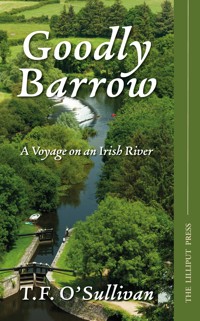
Goodly Barrow is a long-unavailable classic that charts the history and character of Ireland's second-longest river, from the Slieve Bloom Mountains to the sea in Waterford. T.F. O'Sullivan's riverine narrative embraces legend and song, literature and anecdote, viewing Irish history through the prism of the waterway: from the early tribal kingdoms of the Celts, to the Vikings and Normans who made passage up the estuary, leaving a legacy of castles, abbeys, monasteries and towns; from the Tudor and Cromwellian settlements on the fertile plains of Carlow and Kildare, to Quaker bridge-builders and Huguenot refugees. It opens up a little-known part of Ireland's countryside and heritage, and is an invaluable guide for boaters and armchair travellers alike.
Sie lesen das E-Book in den Legimi-Apps auf:
Seitenzahl: 530
Veröffentlichungsjahr: 2001
Das E-Book (TTS) können Sie hören im Abo „Legimi Premium” in Legimi-Apps auf:
Ähnliche




















TrialltarBearbhaanbhuirdealaigh
óntíriothmhairúirmhealaigh,
óDhionnRíoghgoMaisdinmhir,
dodhíolmh ’aistiróan-uaislibh.
Giolla-na-naomh Ó hUidhrín. ob. 1420: TuilleadhfeasaarÉirinnóigh
… agoodlyryvercalledthebarro
fleeteththroughthewholecountrie
andthissoserveththecountrie
thatuponittheydoconveighe
alltheircomodytiesandmarchaundyscs
fromtheseas …
John Hooker to Sir Peter Carew, 26th May, 1568
… thegoodlyBarrow,whichdothhoord
Greatheapesofsalmonsinhisdeepebosome …
Edmund Spenser: TheFaerieQueene. Book IV, Canto xi, 1596
ST. MOLING AND ST. FIACHRA ModernstainedglassbyPatrickPollenina13th-centurywindowintheeastgableofDuiskeAbbey. Photographbytheauthor.
GOODLY BARROW
A Voyage on an Irish River
T.F. O’SULLIVAN
THE LILLIPUT PRESS
Do Bhríd, ag an bhfoinse agus i mbéal inbhir.
Contents
List of Illustrations
St. Moling and St. Fiachra
The Upper Barrow Valley (16th century map)
Lea Castle
Moore Abbey
Athy
White Castle
Canal fly-boat
Kilkea Castle
Castledermot Abbey
Carlow
The Barony of Idrone (16th century map)
Leighlinbridge
Cloghrenan Castle
Borris House
Duiske Abbey, Graignamanagh
Looking down on Clashganny Lock
Medieval tiles, Graignamanagh
New Ross
Dunbrody Abbey
Duncannon Fort
Hook Tower
The Upper Barrow valley (outline map)
The Barrow Estuary (outline map)
Foreword
High summer, rain pouring down unendingly, the Grand Canal behind us as we nosed into the Barrow for the first time, our minds opening to who knows what kinds of adventure. Curlew, our forty-foot narrowboat, is a veteran of the canals, solid, comfortable, reassuringly built of steel; we had, we thought, mastered her handling, even her idiosyncratic way of going astern in the most unexpected directions.
We slid out of the murky green depths of the first lateral cut at Ardreigh Lock and I knew straight away we were in trouble. The lateral canals on the Barrow are designed to take boats around weirs; what I should have known, of course, is that exiting the lateral cuts means re-entering the river as it gathers speed downstream of the weir. Bad enough as that might be in normal conditions, I should have known that the brown roiling whitecaps of the river in flood would smack into us like a train. That first day, in our flat-bottomed Curlew, was helter-skelter white-knuckle stuff, literally, as my hand on the tiller gradually froze into a death grip. Placid and calm as she always is when on or in or just near water, Paula sat on the foredeck like a riverine Bodhisattva, sipping tea, gazing mildly at the world as it shot by, oblivious to the Conradian heroics of the steersman.
‘You look a bit tense,’ she said, as we tied up that first night. ‘Is everything all right?’
‘Ah fine, fine. Not a bother. I think I might have a drink now.’ (Once I get my heart out of my mouth.)
As I prised my fingers open enough to cup the brandy glass, I thought dark and bitter thoughts about Colin Morrison and Tadhg O’Sullivan. A veteran riverman, Colin had bestowed GoodlyBarrow on us when we acquired Curlew, an act of immense generosity, as I came to realize when I discovered that this classic work had been long out of print and was eagerly sought after by boat people. Morrison and O’Sullivan, I reflected darkly, might have mentioned, even in passing, that the stately and placid Barrow is no place to be in a narrowboat when it’s in bloody flood. Comparisons might usefully have been drawn, I felt, between navigating in such conditions and steering an articulated lorry, with its brakes locked, down an ice-sheeted hill. Barrelling sideways into a stone arched bridge at full tilt might have been mentioned, I thought. The elegant observations on history and architecture might have made way occasionally, I felt, for some pertinent advice on survival in extreme conditions.
I was being unfair, of course; several brandies later, in the glow of the oil-lamp, in the mellow heat from the stove, as we took turns to muse over The Book, it was borne in on me that we were on the Barrow in the first place because a winter spent poring over O’Sullivan’s words and pictures had enmeshed us in a dream of history and humanity strung out along no mean river. We had ventured out to put concrete experience in the balance with dreams and pictures, to see for ourselves the castles and keeps, the steep valley sections, the broad cornfields and the historic towns which O’Sullivan had brought so authoritatively to life. Damn the weather, I thought, falling over into sleep, and the flood and the dodginess of it all, we’ll just have to see faster as we’re borne down.
And we did, we did.
We saw more than we’d ever expected to, as The Book and the river came to life for us through that week.
Let the reader discover, as we discovered, the riches of this book for herself and himself; it is no business of mine here to prefigure or paraphrase the author. But, having read this book, preferably at some physical remove from the river, let book and river take hold of you in your dreaming. Let O’Sullivan’s history animate your winter with tales of undying Gael and Norman, of the men and women who lived and worked and died in this valley, who worked this river, built tower and keep and town along its life-giving way. And when you’ve dreamed enough, when your head is full of it, then beg, borrow or hire a boat and do as we did, launch yourself out on the welcoming flood. The Barrow may be as we found it, heavy with rain, swirling and turbulent, in which case O’Sullivan will flesh out and deepen for you, before and after, each stretch of the river as it flashes by; or the river may be calm and broad and somnolent, in which case you will move in your mind’s eye at O’Sullivan’s depth and pace while the eyes in your head are seduced and steadied by the leafy majesty of it all. In any case, armed with this book and abroad on the river, you will have a sense of yourself doubled with history, companioned by a wise and reflective mind even as your spirit opens to the spirit of the river.
At the end of that week we swept into Graiguenamanagh in a wide and perfect curve to settle with a rustle of fenders against the cut-stone wall, perfectly balanced against the current, casual as veterans, old river hands.
‘Ye came in nicely,’ said Seán Hoare, our instant friend, last of the Barrow boys, stepping forward to take a line.
‘Ah sure,’ a jut of the chin, ‘you’d get a feel for the river.’ Pure wickedness in Paula’s eyes as she looked up at this bit of bravado, but she didn’t say a word.
‘Tell me,’ said Seán some time later, a whiskey in one hand, mug of tea in the other, perched on the low wall alongside: ‘did ye ever read GoodlyBarrow? A mighty book.’
‘Oh a mighty book, a mighty book indeed.’ And gazing around us at this charming town, the ghosts of Normans and ’98 men crowding the bridge above the weir, the steep-roofed Abbey behind us, we drank to the immortal soul of Tadhg O’Sullivan.
TheoDorgan,August2001
Preface
In the following pages we embark not so much on a voyage in the physical or navigational sense as on an excursion through history, literature and a number of other subjects; an exploration of the tributaries and sidestreams of local lore, traditions, stories and songs. Although a trip down the river Barrow is the framework of the narrative, this is no manual for the enthusiastic boatman, for a great deal of time is spent ashore, in search of anything of interest to be found on the banks of the river. Nor is it a guidebook: there will be many places and subjects left untreated – ports at which we will not call in the course of our inland voyage. And when the mood so dictates we may even wander far from our river: for it has always been the custom of the Irish inland navigator, as many an old canal ballad testifies, to let his fancy go sailing to regions which no ship could reach.
The treatment of history should be either chronological or thematic. In this book it is linear, which is not a method to be recommended to the serious student. It is also, on the whole – one hopes – lighthearted. But the debt to scholarly workers in the historical and various other fields touched on will be obvious, and is hereby gratefully acknowledged. Many people have helped in the making of this book, if only by drawing the author’s attention to his errors; and it is not their fault if errors nevertheless persist. The greatest pleasure of my inland voyage was the making of new friends. Among the friends, old and new, to whom I am most indebted, are that great-hearted man, Donal Foley, at whose suggestion many of the following chapters were published in their original drafts in the IrishTimes, and whose passing bereaved not merely that progressive newspaper, but all Ireland; Alf Mac Lochlainn and the hard-pressed staff of that battered but splendid institution, the National Library of Ireland; Mrs. Olive Goodbody, Librarian, Society of Friends; Commandant Con Costello of the Co. Kildare Archaeological Society; Rev. Douglas Graham, who has been unfailing in his encouragement and his useful criticism; the late Bertie Shirley and his friend Bill Duggan – the latter happily very much with us – whose names are to the Barrow what those of Rice and Delany are to the Shannon; Andrew and Tina Kavanagh of Borris, Co. Carlow, who have been as hospitable as they have been informative; Bonnie Hughes-Quinn of Graignamanagh and her late husband, Captain Padraig Quinn, who among many other kindnesses introduced me to the works of Patrick O’Leary; Edward W. Hughes, to whom I am indebted for a wealth of information on life in old Graig; Donal Brennan and Dr. Máire de Paor who read the typescript and supplied advice, assistance and above all, encouragement; Dr. Wolfgang Meid of Innsbruck University who gave advice on the poems attributed to Mo Ling; Oberrat Dr. Egger of the Kriegsarchiv, Vienna, a fine researcher on Kavanagh Wild Geese; Dr. Micheline Walsh of University College, Dublin whose published researches on Irishmen in the Imperial Service proved invaluable and Dr. John Andrews of Trinity College, Dublin, who supplied information on early Irish maps. My thanks also to Cormac Ó Cuilleanáin for his sensitive editing.
Acknowledgment is also due to Seán O’Faoláin for permission to quote from ATaleofaTown, to Patrick Pollen for permission to reproduce his beautiful windows in Duiske Abbey, to Breandán Ó Cíobháin for permission to use material from his radio programme “These Were the Bargemen”, while for kind permission to reprint copyright material, acknowledgement is due to the authors and Faber & Faber Ltd for lines from TheAscentofF.6 by W.H. Auden and Christopher Isherwood and lines from “The Waste Land” by T. S. Eliot; to Mrs Katherine Kavanagh for lines from “Lines written on a Seat on the Grand Canal, Dublin, ‘Erected to the Memory of Mrs Dermot O’Brien’” by Patrick Kavanagh; to the Estate of the late Flann O’Brien, Granada Publishing Ltd and Walker & Co. for lines from AtSwim-Two-Birds by Flann O’Brien; to AD Peters & Co Ltd for lines from IrishMiles by Frank O’Connor, to Michael B. Yeats, Anne Yeats and Macmillan London Ltd for lines from “The Stolen Child” and “The Tower” from CollectedPoems by W.B. Yeats.
Finally, a debt is owed to my wife and family, who put up with this particular idiosyncracy for so many years, and to the companions of my voyages, in fair weather and foul: the skipper of the mpv MauriceChevalier and the crew of Moling, including one whose humanity and imagination contributed much to what is in these pages, and who is not here to sail with us again.
This book was undertaken with no other object in mind than the pleasure of writing it, and perhaps the hope of conveying something of the same to the reader. But as the voyage progressed and its story took shape, a certain more serious purpose developed along with it: to focus attention on one of the least known but most civilized regions of Ireland, and on the priceless treasure which we possess in the simple things of the Irish countryside, but are in danger of losing through neglect, ignorance and the effects of development. The Barrow is already a sadly polluted river, its navigation semi-derelict, its channel so choked with weeds that often in summer no boat can pass. Thousands of trout and salmon are poisoned every year by factory effluent and untreated town sewage. The problem is a general one and many Irish rivers are in as sad a case: some, such as the Boyne and Black water, are in greater danger. This book is no environmentalist tract, but it will have served a useful purpose if it encourages interest in preserving the beauty of the river Barrow – of all our rivers, and of the as yet green and unspoiled countryside through which they run.
1
The Well of Enchantment
In the Slieve Bloom Mountains, on a heathery summit called Barna, there is a well with an interesting legend. It lies in a swampy hollow filled with rushes and watched over by a solitary mountain ash. If you disturb its waters, or even if you stare too rudely into its depths, this well will overflow, sending a torrent down the mountainside to flood all the wide plain beneath. From this enchanted spring flows one of the great rivers of Ireland, the Barrow, second only to the Shannon and first of the three rivers which water most of the south-eastern quarter of the country and are known as the Three Sisters.
The great hogsback of the Slieve Blooms sprawls across the southern Irish midlands; a part of that upland chain that cuts off the deep turf bogs of the Shannon basin from the fertile plains of south Leinster. Here, in some Palaeozoic upheaval, the underlying slate and sandstone burst through the limestone floor of the central plain, raising a mountain barrier from what is now the Shannon estuary to Kildare and beyond. In the flat country at the foot of the Slieve Blooms people will tell you that Arderin, the highest summit, was once the tallest mountain in Ireland. That is what its name means – Ireland’s Height – and who is to say that the claim is unjustified? Arderin’s present modest elevation of 533 metres follows countless aeons of erosion, and for all you or I know it might once have ranked with the highest peaks in Ireland.
But that, of course, is to beg the question, for the belief that the Slieve Blooms are the highest mountains in Ireland is a recent folk tradition. The simple people who inhabited this midland plain in the past knew of no other world than that plain and those mountains. If you were born and grew up here, your horizon was that distant blue ridge. It did not occur to you that there might be higher mountains, or indeed any other mountains at all. And when you grew big enough to climb the ridge, on a warm Sunday at the end of July when the fraocháns were ripe, and you stood on that high summit and gazed far and wide over the boundless plain, you had no doubt at all that the whole of Ireland lay at your feet.
Today’s motorist, speeding down the Limerick road, sees the Slieve Blooms on his right between Portlaoise and Roscrea. Should the mood take him, there are quieter roads that wander away towards that blue ridge, and up and over it: narrow winding grey roads sunk between tall hedges of ash and elder and thorn, overshadowed by even taller trees that meet overhead – beech and elm and chestnut – turning the highway into a green tunnel. One traverses a hidden, deceptively empty countryside, where houses and farms are concealed in the lush greenery, save where a farm gate disgorges a sheepdog to hurtle for a few seconds, barking furiously, almost under the wheels. Not too much has changed along these roads in a generation, except for the mode of transport. Thirty years ago this was pony-and-trap country: clip-clop of hooves in the white dust, trotting to Sunday Mass; or bicycles coming down the hills with a whirr and a rattle; or on market days the clockel-tockel of farm carts, painted red-lead and blue. Now even bicycles are rare and the hard macadam roads are given over, as we all are, to the internal combustion engine in its many manifestations.
Higher up the hills the hedges are thinner: sparse growths of furze, birch and rowan begin to replace the hawthorn thickets and the lush green of the lowland trees retreats before dark ranks of pines – Sitka spruce, to be more accurate – marshalled between road and valley as though to cut off the view. Higher still, and there are no hedges or trees at all: just the road and the empty moorland on either side, and the sky. Up here the sky dominates all. On most days it is a grey Irish sky: any of forty shades of grey, from the pearly film that filters the light like a ground-glass to that low, malevolent sky that presses down like a lid, so oppressive that it is a relief when it rains. It rains a lot in the Slieve Blooms. Nothing is quite as wet as a wet day in these mountains. But there are other, precious Slieve Bloom days when the sky is a deep blue and towering white clouds sail over the mountain top like ships putting out to sea. And I have known one rare, rare day when there was no cloud at all in the sky and only the faintest of warm breezes stirred heather and bracken. The vast plain shimmered in the heat and the mountain lay across it, bringing to mind some immense, slumbering giant. It was an enchanted day – a day of faerie – like that day when the giant Blomius met the fair nymph Rheusa, in Spenser’s poetic account of the birth of the three rivers:
Andtherethethreerenowmedbrethrenwere,
WhichthatgreatGyantBlomiusbegot
OfthefaireNimphRheusawandringthere.
Oneday,asshetoshunnetheseasonwhot
UnderSlewbioomeinshadygrovewasgot,
ThisGyantfoundherandbyforcedeflowr’d;
Whereofconceiving,sheintimeforthbrought
Thesethreefairesons,whichbeingthenceforthpowrd
Inthreegreatriversran,andmanycountreisscowrd.
In imagining these “three faire sons” Spenser followed the Roman classical tradition, in which riverine gods were usually male. But in Irish mythology rivers are women. To a primitive, pastoral people they symbolized life – its source and renewal, the fertility of the soil, the life-blood of men and beasts, the birth of kings and heroes. Our Celtic ancestors also believed that all the great rivers of Ireland had their source in one sacred spring, the fountain of all wisdom, around which grew nine hazel trees bearing nuts of a bright crimson colour that contained all that was worth knowing of history, literature and the arts. When the nuts fell into the spring they were eaten by a salmon that lived there; and to catch and eat this salmon of knowledge, the EoFis, was to procure for oneself the sum of human wisdom.
This fountain of all wisdom was known as Conle’s Well. Conle the Red-haired was the son of ConnCétchathach, Conn of the Hundred Battles, the legendary king of Connacht who founded the line of the High Kings of Ireland. Seven secret streams of knowledge flowed from Conle’s well, among them the Three Sisters – Barrow, Nore and Suir – which began to flow on the night that Conn of the Hundred Battles was born, if we are to believe the old Irish annalists. Present-day geologists will tell you, of course, that the major rivers of Ireland were created when the great Chalk Sea drained away, about sixty million years ago. And that, to be sure, is disputed by other geologists, who claim that our rivers are not a day older than twenty million years. But either birthday would mean quite a long life-span for King Conn, for we find him still active in the Annals about the year 200 A.D.
There is no inconsistency in that, for Conn of the Hundred Battles was no mere mortal king. In the dim beginnings of our race, where legend fills the role of history and the limits of time and space and form are blurred, Conn seems to have exercized an Otherworld function, as a kind of Irish Pluto. His son Conle – he of the fiery locks – was lured away by a fairy maiden to a land of eternal youth, as was Oisin, son of Fionn, in a better-known story. Conle’s Well and the Land of Youth are both expressions of the Otherworld and Conle himself was, like his father – with whom he is sometimes identified – an Otherworld personage.
The cult of sacred wells and springs is not, of course, confined to the Irish. Wherever water bubbles mysteriously from the earth, man has invested it with attributes of wisdom, fertility and healing. One thinks of the Pierian springs; the two fountains of Aganippe and Hippocrene which sprang from the holy mountain of the Muses. The ancient Greeks peopled their rivers and lakes with female spirits – the Naiades – many of whom presided over springs that were supposed to inspire those who drank from them. In another continent and another culture, the Mayas of Yucatan despatched messengers to the gods by hurling the fairest maidens of their tribe into the pool of Chichén Itzá. In today’s Africa the bushmen of the Kalahari desert observe the cult of the tree with the fruit of knowledge growing beside a sacred spring, and the Ibo of Eastern Nigeria make ritual offerings at the sources of streams and rivers at the season of the planting of the yams. Throughout Europe there are ancient well-sanctuaries, usually dedicated to female divinities, from the triple goddess who presides over the source of the Marne to the nymph, Coventina, at Hadrian’s Wall. There are holy wells all over Britain and upwards of three thousand have been recorded in Ireland. The custom of hanging strips of cloth from bushes beside certain of these walls survived until recently in parts of Scotland, Wales and Ireland. An example of this is to be found near Clonmel, where there is a rag-well at which the mountain farmers used to hang rag-offerings during the lambing and calving seasons. The well-dressing ceremonies of Derbyshire are a relic of similar customs, and the Patterns that still take place at Irish holy wells on the feast-days of local patron saints, or on dates coinciding with the midsummer or harvest festivals, are another survival of pagan rituals.
The gift of knowledge hidden in the depths of Conle’s well was denied to women – and this despite the fact that in ancient Ireland the six gifts of womanhood included wisdom, along with beauty, music, sweetness of voice, chastity and skill at needlework. Any woman possessed of such gifts might count herself fortunate indeed; but one such woman was greatly irked at being denied access to the sacred fountain. She was Sinann, daughter of Lodan, son of Ler, sea-lord of the people of Danu, the TuathaDéDanann. Sinann was the most high-born, the most accomplished and the most beautiful of the women of Erin, but not content with this she longed for the forbidden gift of knowledge hidden in the well. No sooner, however, did she approach its brink than the well erupted violently and its waters swept her away in a great torrent which continues to bear her name: the river Shannon.
Sinann is, of course, an eponymous river goddess, and the theme of woman craving the forbidden fruit of knowledge is recognizable as one of the oldest legends of mankind. Many Irish river names originated in this way. Thus Boand, whose lover was the Dagda, father of the gods, gave her name to the Boyne when the waters of a forbidden well rose and swept her away. The Bann is named after the goddess Banna, and the Inny from Eithne, daughter of Eochai Féileach. Among the Celts of Gaul rivers also had their eponymous goddesses, such as Sequana (the Seine), Souconna (the Saône) and the trinity of earthmothers – the Matronae – who guarded the source of the Marne. The rivers Brent in England, Braint in Wales and Bride in Ireland all bear the name of the goddess Brigantia or Brigid.
We are less sure of the origin of the Barrow’s name. In the Irish language it is AnBhearbha, or in Old Irish Berba. It may be identical with the Birgos mentioned in Ptolemy’s geography, but T.F. O’Rahilly has pointed out that to connect the two names one must assume “an extraordinary corruption” in Ptolemy’s text. Other scholars suggest derivations from berbaim (to boil), bearg (a stream) or bir (water). In the Dinnshenchas of the Book of Leinster there is a reference to Berba, a queen or female deity of the TuathaDéDanann, whose son, Mechi, had three serpents in his heart. Diancecht, the medicine god or physician of the TuathaDé, killed the serpents, burned them and threw their ashes in the river, causing it to boil. This story has the conventional symbols of Celtic ritual, including the Threefold Death by wounding, burning and drowning.
There is another reference to the goddess Berba in the TimnaCathaírMáir, the testament of Cathaír Már, divine ancestor of the Leinstermen, who describes his youngest son, Fiachu ba hAiccid, as the “lucky offspringof ardent Berba”. Fiachu was to be the progenitor of the great Leinster dynasties, and Berba – goddess or river – is thus the mother figure of all Leinstermen. Another Fiachu, the progenitor of the Eoghanacht dynasties of Munster, was born on a rock in the middle of the river Suir at Knockgraffon; he was also killed while bathing in the Suir. These are clearly survivals of ancient beliefs in the role of river spirits in the birth and death of kings. We can never be sure of course, for there is little consistency about mythology – particularly Celtic mythology – but if other rivers have their presiding goddesses, Sinann and Boand and Eithne and Brigid, it is fair to speculate that the source of the Barrow, with its enchanted well, its reputation as one of the seven secret streams of knowledge and its connections with the goddess Berba, must be inhabited by a similar spirit – no doubt the ardent Berba herself.
To trace a river to its source is a romantic notion that must have occurred to most of us at one time or another. Not many people translate such ideas into reality, and fewer still, having done so, find the experience as satisfying as anticipated. I myself have been twice in search of that enchanted spring at the Barrow’s source, and have not found it. But if you, too, are prone to entertain such fantasies, you can reach the headwaters of the Barrow by taking the road that skirts the northern flank of the Slieve Blooms, between Mountmellick and Roscrea. Just before you come to the village of Clonaslee, which means the meadow by the roadside, turn up into the hills by the valley of the Gorragh river. The road climbs for four miles through the pine-clad river valley until it crosses the Slieve Bloom ridge through a rocky defile called the Cut. Barna Mountain is eastward of this Cut and the source of the Barrow is a mile away over the heather.
This last mile is only for the dedicated: it is wet, heavy going through hummocks of spongy peat and sphagnum mosses that hold water even in a dry summer. A new forest road has been built from the Cut Road leading in the direction of the sources of the Glenlahan and Barrow rivers. This ought to make access rather easier, but it is not yet marked on the Ordnance Survey maps and did not exist at all when I first set off on my exploration. It was a day in March: a raw grey day with a hint of snow in the air. The attraction of the magic spring and its presiding goddess diminished considerably as I stepped off the road and my foot sank to the ankle in icy bog-water. But I carried on, treading carefully on what looked like the drier hummocks, along the bleak windswept flank of the mountain, bare but for its cover of moss and heather and bent-grass, with now and then a scraggy rowan punctuating the solitude. Within seconds I was out of sight of the road, moving through a world that showed no trace of the hand of man: a landscape of grey and brown that could hardly have changed in a thousand years. Once a startled snipe rocketted away ahead of me; otherwise I could have been the only living thing on that desolate mountainside.
The chatter of a mountain stream brought relief to this wild solitude. If I could believe my map, it was the infant Barrow. So I traced it up the mountain to where it emerged from the heather; but search as I might, I could find no well – not one visible to mortal eyes, at any rate. For the stream simply oozed from a thousand places in the spongy ground and trickled in hidden rills between thick clumps of rushes until finally it ran down a sloping yellow sandstone slab, tumbled into a deep pool and sang its first song. Call this pool a magic well if you like, but it seemed to me as if there was as much water coming into it as there was leaving it; and though I stared into it, stirred it with the toe of my boot and generally behaved in a rude and provocative manner, it failed to visit a deluge upon my head. Such retribution is reserved for princesses of the TuathaDé, the people of the gods. For the enchanted spring exists only in the Otherworld of Celtic mythology, where it is concealed from the prying eyes of mortal man.
By the pool stood a mountain ash, its thin bare branches swaying in the wind. In a few weeks these naked twigs would veil themselves in a green lacework; in summer they would be handsomely decked out in creamy blossoms and in early autumn they would bend under the weight of clumps of shiny red berries, bringing brightness to these grey slopes. The mountain ash, also called the rowan (sorbusaucuparia), is a fairy tree, like the hawthorn, the holly and the hazel. The Druids used it in their rites, particularly in the ordeal by fire. Country people tied sprigs of it to the door jamb, hung it in the cowshed and wrapped it round the churn as a protection against witches. Rowan berries and hazel nuts were used for medicines and food in ancient times, and the nuts of knowledge that fell into Conle’s enchanted well were of a bright crimson colour, like the berries of the rowan. The tradition of the nuts of knowledge is closely linked with the Barrow: the king and bishop of Cashel, Cormac Mac Cuilennáin, whose youthful studies took place not far from its banks at DísertDhiarmada, present-day Castledermot, records that: “I found my nut of knowledge on the waters of the Barrow.”
As I stood gazing into the pool and wondering if it could reasonably be called an enchanted well, a snowflake drifted down and lit on the surface of the water. It dissolved instantly, but it was followed by another and another; and by the time I lifted my head the air was full of a feathery whiteness. All horizons were blotted out, and as I made my way back in what I hoped was the direction of the road I reflected that this was probably the first time I had ever been quite alone, in a true wilderness, with not a track nor a landmark to guide my steps. The thought was incongruous, for I was within a mile of a public road; but there was no less of an incongruity in such a person as myself, a town-dwelling creature of sedentary habit, stumbling about all alone on a wild mountainside in a snowstorm. How circumscribed is the daily ritual of our lives, and how ill-equipped we are for the most timid step outside our tamed environment. In my case, of course, the step was indeed a short one, and the snow which blotted out my view became my guide and compass: for by keeping it blowing in the same direction from right to left across my face I was able to steer a fairly straight course back to the road, which I reached not far from the point at which I had left it.
Nevertheless I was glad I had no more than a mile to walk across country in that sudden blizzard. The Slieve Blooms are not the highest nor the most precipitous of mountains: they are heathery hills of little more than a thousand feet. But they are sufficiently inhospitable in bad weather to challenge the most intrepid. Of such a stamp was Robert Lloyd Praeger, the pioneering naturalist who left us one of the best of all books about Ireland: TheWaythatIWent. “Mention of the Slieve Blooms brings back to my memory one of the longest and wettest walks that I have ever had,” wrote Praeger. The way that he went that day took him from Mountrath to Arderin, the highest point on the ridge, in the forlorn hope of finding something of botanical interest. Heavy rain set in, with a high wind, so he retreated to the western base of the range and worked northward through Kinnity; but the weather never cleared and he finally recrossed the hills in mists and sheets of rain by a more northerly route back to Mountrath. “It was nothing much in the way of long-distance walking,” he modestly observed: “thirty-seven miles in all, but with a lot of head wind and 2500 feet of climbing thrown in.” Praeger was a pragmatic Northerner, son of a Dutch linen merchant, who would have had no time for nonsense about magic wells and river sprites. But no Irishman loved his country so well, nor left us such a store of knowledge about the land we live in: for which God be good to him.
I had no better luck in my search for that elusive spring when I went back to the Slieve Blooms in midsummer. But there was another kind of enchantment to be found in the view from the top of the ridge on that clear day. The great central plain stretched away to the north, a sea of blue and purple from which rose like islands the limestone outcrops of the Hill of Allen and the Chair of Kildare. To the south-west lay the Silvermines, and a long way off on the southern horizon were the blue summits of Slievenamon and the Galtees. The Slieve Blooms are a link in that chain of anticlines that stretches south-westwards across the central plain from the Chair of Kildare to Keeper Hill on the lower Shannon. The next link is the Devil’s Bit, whose gap-toothed summit I could see to the south-west. It is related that the devil bit a chunk out of this mountain one day, but not finding its taste to his liking, the fastidious fiend spat it delicately twenty miles farther into County Tipperary, where it forms the Rock of Cashel. It is true that the famous rock is of limestone, while the summit of the Devil’s Bit is of old red sandstone; but stranger things than that have happened to rocks and stones, and to men and women too, when the devil has been at them.
The Three Sisters all rise in this area: the Barrow in the Slieve Blooms, the Suir on the Devil’s Bit and the Nore on both mountains. The official source of the Nore is the Devil’s Bit, but it draws much of its headwaters from the Slieve Blooms: so much so that some people regard the latter range as its true source. “They spring from the breast of one parent mountain,” wrote Ferguson of the Nore and the Barrow, “and after wandering each her own way, unite again in the same valley and descend into the sea together.” The great tract of territory encompassed by the three rivers in their meandering courses is the ancient kingdom of Ossory, of which the eastern and western boundaries are watered by the Barrow and the Suir, while the Nore runs across its centre, all of them on the way to their meeting place in Waterford Harbour. Ossory is a rich and fair land, sung by poets and fought over by princes. “From the Barrow westward to the Suir,” wrote Seán Ó Dubhagáin, “lies the sunny land of Ossory; and from soft Slieve Bloom to the sea: a part of Ireland most beautiful and well watered:”
OBhearbhacoSiúirsiaruinn
fonnosruigheArd-ghrianaigh
óBhladhmabhuigcosáile
cuiddo’nbhanbaasbraonáille.
Back on Barna Mountain I watched the newly-born Barrow leave the deep pool through a channel that I could almost span with my thumb and fingers. It tumbled light-heartedly down the mountainside, between rushes and bracken and bent-grass, cascading over shelves of crumbling purple sandstone and grey slate covered with algae and moss and layers of peat, with rusty deposits of yellow ochre in the eddies. Fed by a hundred singing rills, the young river gathered strength and carved a deep gully in the peat. I followed it down, between two ridges and around the shoulder of the mountain to the north-east. As it descended towards the lowlands heather and bent-grass gave way to gorse and bracken, and the last guardian mountain ash was left behind. I paused by the streamside to have a look at my map. A mile and a half to the west the Glenlahan river kept pace with the Barrow, which it would join at the foot of the mountain. Further west again, beside the road to Clonaslee, the Gorragh ran amongst its pine trees. The Gorragh would flow northwards to join the Clodiagh, which would join the Brosna, which would join the Great Shannon. So too might the Barrow have done, but for an accident of the ground that deflected it eastward on its own course.
I put the map away and stood looking out over the valley. I could not make out the distant river, but far away to the east a faint silver gleam seemed to beckon. If one were to follow the river, where would it lead? To the sea, of course: but what of the country through which it ran, and the people who lived along its banks? What kind were they? What were their stories and songs? What secrets had the river learned since that night when Conn of the Hundred Battles was born?
“Rivers are highways,” wrote Pascal in one of his Pensées, “moving highways that carry us where we wish to go.” Where was it, then, that I wished to go? Or did it matter? Robert Louis Stevenson, who knew many a highway, maintained that travel for travel’s sake was enough. “For my part, I travel not to go anywhere, but to go,” he declared in TravelswithaDonkey. “The great affair is to move.” And indeed there is a singular freedom and exhilaration about the open road. But few of us would embark on a journey for the pure pleasure of locomotion. There is usually some destination, some reason for going from here to there, even if it is only the green of far-off hills. The great affair is not so much to move as to be elsewhere.
Mobility is a phenomenon of our times. Whether for business or for pleasure, to broaden the mind or to relax the nerves or simply for a temporary change of environment, enormous numbers of people have themselves transported from one place to another, and back again, at least once a year. No holiday is regarded as complete unless it includes this element of displacement. People willingly abandon their familiar surroundings and subsist for a time elsewhere, often in conditions of purgatorial discomfort, in the belief that they are enjoying themselves. It is not exclusively a twentieth-century phenomenon. Chaucer’s pilgrims suffered from the same urge: “so priketh hem nature in hir corages, than longon folk to goon on pilgrimages.” But by the time Auden and Isherwood came to write TheAscentofF.6, it was very much a part of twentieth-century behaviour:
… thefortnightinAugustorearlySeptember,
Theboardinghousefood,theboardinghousefaces,
Therain-spoiltpicnicsinthewindsweptplaces;
Thecameralost,andthesuspicion,
Thefailureintheputtingcompetition …
That was in the 1930’s. Nowadays it would be the package tour to Benidorm or Torremolinos, or Greek tummy or rapacious Brussels taxi-drivers or getting bilked by a Vienna tax-free shop. Affluence and the jet engine have created a more peripatetic flagellation, but the constant factor is that one’s penance is inflicted at some distance from home. Such is the need of urbanized man for a change of scene that people annually return in droves to submit themselves to further tortures, heedless of what happened to them the year before. We all have our dreamlands and our fantasies, and they are indestructible.
Dream and fantasy are the stuff of the romantic imagination, something we share with the great poets. It matters little whether one travels in the physical sense or not: one can set forth on a voyage around one’s room; one can go sailing to Byzantium. Even the most prosaic of us preserves a certain balance between reality and illusion, if only in self-defence. “No man can drink of the whole wine” was how Yeats put it. He himself lived in the restless borderland between reality and dream, and it was his struggle to resolve the conflict between the two that produced his greatest work. He believed in the occult; as a young man he practised magic and learned some quite peculiar lore from people like MacGregor Mathers and that strange Russian lady, Madame Blavatsky. In later life he invented an elaborate and esoteric metaphysical system which it would be easy to dismiss as absurd had it not nourished some of the noblest poetry of our age. He explored many dream countries, one of which was Ireland, an enchanted land peopled by invisible deities. His deep love for the Irish countryside – lake and mountain, stream and strand, yellow pool and old brown thorn tree – was accompanied by a belief, which he shared with the ancient tribal Irish, in the identity of the race with the soil, expressed for instance in Autobiographies when he asks: “Have not all races their first unity from a polytheism which marries them to rock and hill?”
Yeats has no connection with the Barrow valley, as far as I am aware; yet he would have joined enthusiastically in the search for the enchanted spring on Barna Mountain. In one of the strange rituals that he conducted with his group of Celtic visionaries in London in the late 1890’s, those present were magically transported to “a mountainous district where in the midst of the hills we found ourselves before an ancient well. Leaning over the well on our left grew a mountain-ash tree laden with red berries that kept dropping, dropping into the water, so ripe that they seemed like drops of blood reddening the pool as they sank.” Had Yeats come to the source of the Barrow, he would not only have found the well but would, one feels, have chatted familiarly with the river spirit! And the whole mountain would have come sympathetically alive; and the sound of the stream and the wind among the ferns and rushes on its banks would have changed to the laughter and whispers of a hidden people, as happens in the poetry he wrote about the places he knew and loved in his youth:
Wherethewanderingwatergushes
FromthehillsaboveGlen-Car,
Inpoolsamongtherushes
Thatscarcecouldbatheastar,
Weseekforslumberingtrout
Andwhisperingintheirears
Givethemunquietdreams;
Leaningsoftlyout
Fromfernsthatdroptheirtears
Overtheyoungstreams
As a boy Yeats absorbed the romantic eremiticism of Thoreau’s Walden and dreamed up his own fanciful hermitage, that famous lake isle with its wattle cabin, its nine bean rows and its hive for the honeybee. Later he entertained the notion of buying the Castle Island at Rockingham on Lough Key and making it the seat of one of his mystical Orders. Neither of these day-dreams was realized, which was just as well, for nothing is so destructive of the delicate fabric of fantasy as any attempt at its realization. Thoreau, in his hut beside Walden Pond, actually did grow beans. But from all one has learned about Yeats, such agronomic achievement would have been unlikely. One row of beans seems too much, let alone nine of them.
But in later years, when he had transcended mere fantasies – and when he had come into a little money – he did acquire a hermitage of a kind by buying the old Norman tower-house at Ballylee, near Coole, and converting it into a summer residence “with old mill boards and sea-green slates, and smithy work from the Gort forge.” Here at Thoor Ballylee, or at any rate during the period when his imagination focussed on this place, he wrote his most powerful poems. I confess to a weakness for the earlier Yeats, but that is a personal foible, not a critical judgment. “The early poems”, writes Robert Graves, “fall short of the pathetic only by their genuine feeling for Ireland and their irreproachable anvil-craft.” The ring of the hammer on the anvil is also heard all through the Tower poems, but here too are strength, nobility, a lyrical intensity which he had rarely attained previously and, most important of all, the sheer authority of his assertion of the power of the human imagination.
Yeats’s imagery of place, his geniusloci, resided in his tower. As his candle burned late into the night, or as he “paced upon the battlements” (why should I be perversely reminded of those rows of beans?), he commandedimages and memories to come to him; and come they did, often from unlikely places – the ruin of a nearby house, the blackened stump of an old tree – crowding in to be woven into the fabric of his poetry, his great song about man. You and I have no such authority. We may know how to grow beans, but if we want a stimulus for the imagination, we must go out and search for it, and without too much assurance of finding anything. Why should one bother? Why should I, for instance, want to explore this river? I might find nothing but a weedy stream; a string of nondescript towns full of nondescript people. Did I not fail to find that enchanted spring on the mountain top?
But the enchanted spring is the fountain of the imagination. In its depths a rich treasure is hidden: the unseen value of simple things, the nobility of ordinary people, the beauty of the countryside around us – the joy of life. There is no reason at all why you and I should not search for it; why we should not do as the poet did:
– sendimaginationforth
Undertheday’sdecliningbeam,andcall
Imagesandmemories
Fromruinorfromancienttrees,
ForIwouldaskaquestionofthemall.
2
Quaker Country
The Barrow came down from Barna Mountain, chattering in its stony bed. It scoured its way through the blanket bog, stripping off the layers of peat down to the underlying sandstone flags. Even these were worn and cracked and flung about in great boulders, as though to display the awesome power which this mountain torrent could deploy when it had a mind to. White water foamed and bubbled around the rocks and spilled into pools where a relative stillness reigned, disturbed only by ripples constantly fanning out over the surface from the point at which the water entered. The depths of these pools were a dark brown colour, infused with the hues of peat and sandstone; but occasional shafts of sunlight reached down into the water, turning it a rich gold, like a fine old whiskey. At the bottom lay deposits of an ochreish muddy grit, showing how the flagstones were being ground down by the merciless action of the stream into the sand and mud out of which they had been formed countless millions of years ago.
I can spend hours on the bank of such a stream as this, just listening to the babble of the water and watching the moving bands of light projected by the ripples onto the bottom. I once had a stream of my own – long, long ago – at the bottom of a rocky field below my grandmother’s house in Connemara. It, too, rose in a bog and had mellow brown water, trickling over a granite bed. It was no more than a rivulet where it passed our house, but by the time it reached the sea at Ballyconneely it was deep and dark and dignified, almost grand enough to be called a river. Even in our section there were deep pools under sally bushes where you could swim, or go navigating in a tub – it usually amounted to the same thing. But my favourite place was where a spur of granite projected across the stream-bed, making it narrow enough to build a dam of stones and sods. Here you could fish for pinkeens with a shrimp net, or try to capture young eels with a notched stick in the shallow water below your dam. I bridged the pool above it with an old sleeper from the railway that once served the Marconi wireless station; and here, in those long warm summer days that came so often then and that never come at all now, I lay on my bridge and gazed into the depths of my pool. What was there to see? It wasn’t some wonderful underwater garden, like Peterkin’s pool in TheCoralIsland. But what lacked of the exotic was more than supplied by the youthful imagination. A tiddler darting among the weeds became a strange beast lurking in a deep forest. And if you looked long enough you saw roads winding through the forest, and mighty armies on the march, with banners and trumpets and drums, making their way to distant cities: a world of fantasy in six inches of water.
Many years older and no whit wiser, I was tramping the bank of this other stream. Down the mountain it coursed, between thick clumps of rushes and ferns, with occasional coppices of small trees sheltering under low gravelly bluffs. I wondered why no heather grew on the banks for some yards on either side of the water. Perhaps the banks were too well drained or too low in acidity to support this plant, or was it the power of the winter floods that kept it at a respectful distance? Farther off on the right bank the heather and bracken gave way to patches of open grassland, where cowpaddies showed that these uplands were still used for grazing. At one time much of the mountainside on that bank of the river was populated. This was the country of the O’Dunnes of Hy Regan, and there are still some families of Dunnes living on the lower slopes; but up here near the Barrow’s source, in the townland known as The Cones, as many as twenty families once grazed their cattle and tilled the soil. There were Hogans, Clears, Conroys, Lalors, Sullivans, Fitzpatricks, Gallaghers. Through the binoculars I could see a cluster of ruined stone houses where some of them had lived. In that end house, they say, lived a man called Sullivan who was hanged from the shafts of a cart for stealing sheep from the local landlords, the Pigotts of Capard House. In the thatch of another cabin was found a French musket, with bayonet, no doubt intended for the Pigotts, should the opportunity offer. What was a poor devil of a Sullivan doing here on this mountain, so far from his Cork or Kerry home?
It must have been a harsh life here in the Cones, especially in winter, for the Slieve Blooms are high enough to catch the snow when the lowlands merely have rain. Access was on donkey-back over primitive tracks – one hears stories of old and ill people being brought out on stretchers in the snow; of children who died before medical help could reach them. As elsewhere the population was decimated by the famines of the 1840’s, though it is remembered that many people survived on oats, grown in the fields down by the river. The Gallaghers kept a watermill there to grind it and the sacks of oatmeal were brought out on donkey-back. The ruin of the mill, with a millstone, is still there.
Famine, evictions and the hardship of the mountain life drove the people from the Cones. The last family to leave were the Clears, who held out until the second world war. The encroaching heather has almost obliterated their patchwork of fields: soon all will be engulfed by the man-made forests spreading down the slopes.
Now I left the moorland and came to one of these forestry plantations, where ranks of dark conifers marched to the bank of the stream. On the left bank the ground climbed steeply upwards to high cliffs of exposed sand and gravel drift. Between cliff and forest ran the river, digging ever more deeply into the mountain. The going got tougher, with the banks so obstructed with young trees and shrubs of hazel and blackthorn that it was easier to seek a passage down the stream bed. Here I traversed a small gorge with the trees high above me on both sides. This place was a geologist’s paradise, and I tried to bring to mind what little I had learned of that science. Here among the sandstones and conglomerates were outcrops of Silurian shales, prompting all sorts of speculations about how this rugged landscape was originally formed. Here were faults in the rock strata – or were they faults? – creating a number of splendid waterfalls where the young river leaped joyfully over the edge of a sandstone shelf, landing with a roar on another shelf several feet below. Looming above all was that great cliff of glacial drift, like a mine tip, menacing stream and forest with its million tons of gravel and boulder clay.
Presently I came to another waterfall – not one, but a series of cascades where the river spilled over three sandstone ledges, one below the other, as though it were descending a stairway, to fall at last into a wide shallow pool overhung by trees. This was a scene of rare beauty: one of those situations in which nature is the artist and there is nothing for man to do but confess his limitations and sit back and enjoy himself. So I sat on a broad shelf of rock above the falls and watched a little rainbow form and fade and form again where sunlight intermittently pierced the thin prism of mist that hung above the tumbling water. The roar of the river as it plunged from ledge to ledge had a musical note. It was a joyful sound, this song of the young river; a song such as all things of creation sing that are young and free and have the whole wonder of life before them.
From the waterfall a forest path led along the river bank. This eased the going: it was no longer necessary to fight one’s way through the briers and thorn bushes. This forest was a half-grown plantation of spruce trees, such as one meets more and more often in the Irish countryside these days. The Sitka spruce comes from Canada and the western United States, where conditions for its growth are similar to those in Ireland. It is a fast-growing and commercially useful tree which is being planted widely throughout the country. Ireland’s almost treeless landscape still manages to supply a quarter of our timber needs, and at the present rate of planting our forests should supply two-thirds of our needs by the end of the century. Lonely places like the Slieve Blooms which have hardly changed in a thousand years now echo to the sound of heavy machinery as roads are driven across the uplands and the ground is prepared for the forests that will clothe these naked hills over the next half-century.
I like trees, even the sombre spruce. I am not one of those who deplore the impending disappearance of Ireland’s desolately beautiful moorlands. But I do wish it were possible to grow deciduous forests, rather than wrap the whole country in this dark uniform of conifers. What do these black woods know of the glory of autumn, of the rebirth of spring? As a people the Irish adopt at best an unsentimental attitude to trees. We were never arborophiles, which may explain why our ancestors hacked down our forests to make way for agriculture, to smelt iron and to make pipe-staves for the export trade. There was one poet who lamented the destruction of the forests – “Oh what shall we do without timber? The end of the woods is at hand” – but his was a lonely voice. To be sure, we can blame it, like a lot else, on the foreign exploiter, though it was the same exploiter who left us any mature woods we have at present. To grow trees is not a particularly Irish thing to do. Is it our jansenistic nature – justly notorious – or some deficiency in the visual aesthetic sense – often postulated – that causes us to be suspicious of things whose first claim to existence is their beauty? A tree is a thing of beauty. A thing of beauty appeals to the senses. That which arouses the senses is dangerous. Is that why there are so few trees in Ireland?




