


9,99 €
Mehr erfahren.
- Herausgeber: The History Press
- Kategorie: Geisteswissenschaft
- Sprache: Englisch
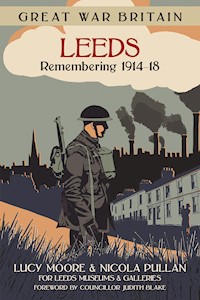
The First World War claimed over 995,000 British lives, and its legacy continues to be remembered today.Great War Britain Leeds offers an intimate portrayal of the city and its people living in the shadow of the 'war to end all wars'. It describes the local reaction to the outbreak of war, the experience of individuals who enlisted, the changing face of industry and related unrest, the work of the many hospitals in the area, the effect of the conflict on children, the women who defied convention to play a vital role on the home front, and how the city and its people coped with the transition to life in peacetime once more. The Great War story of Leeds is told through the voices of those who were there and is vividly illustrated with images from the archives of Leeds Museums & Galleries
Das E-Book können Sie in Legimi-Apps oder einer beliebigen App lesen, die das folgende Format unterstützen:
Veröffentlichungsjahr: 2015
Ähnliche

















To Walter Barnsdale,
First World War veteran and the most wonderful great-grandfather anyone could have.
– Lucy Moore
To those who helped make this possible –you know who you are.
– Nicola Pullan
ACKNOWLEDGEMENTS
We would like to thank the staff at the Leeds Local and Family History Library for all their hard work and support throughout the research process. Throughout our work on this book we’ve met a huge number of people who have allowed us to share their histories or have given hints and advice. We would also like to thank the staff at the Leeds office of the West Yorkshire Archives Service for their help, colleagues working under the Legacies of War programme at the University of Leeds, the Halifax Estate, the Fierce Babe Network, Bob and Jacki Lawrence of the East Leeds History and Archaeology Society, Malcolm Ryder, Michael Hassell, Camilla Nichol, Helen Langwick, Liz Mylod, Tim Lynch, Hannah Kemp, Amanda Walters, Jon Finch, Robert Finnigan, Daniel Martin, Dave Stowe, Andrea Hetherington, Geoffrey umble, Helen Webb, Alison Fell, Ann Fell, Kitty Ross, Yvonne Hardman, Richard Wilcocks, Tom Kipling, Jane Luxton, Peter Taylor, Ann Lightman and many others for sharing their knowledge and passion with us. We would also like to thank Jen Newby and John Roles for their heroic proofreading and all our colleagues across Leeds Museums & Galleries and our friends and families for providing cake and good humour throughout the process.
All images are from Leeds Museums & Galleries collections unless otherwise stated.
CONTENTS
Title
Dedication
Acknowledgements
Timeline
Foreword by Councillor Judith Blake
Introduction
1 Outbreak of War
2 Preparations at Home
3 Patients and Prisoners
4 Industry in the City
5 News from the Front
6 Keep the Home Fires Burning
7 Coming Home
Postscript: Legacy
Appendix: Regiments on the Leeds Roll of Honour
About the Authors
Resources
Copyright
TIMELINE
FOREWORD
The First World War changed the world, altered society and had an impact that reverberates even today. Leeds’s place as a large industrial city meant that it played a huge part in preparing the nation for war. Our factories and workshops across the city produced military equipment, armaments and industrial materials.
This affected the lives of all our citizens. Many left their jobs and families to serve in the armed forces. Many more, especially women, took new jobs in the highly productive war industries. Leeds was forward thinking in the development of its armaments industry. The industrial strength of Leeds was recognised as a clear threat by German authorities, who attempted to destroy it with an (unsuccessful) Zeppelin raid in November 1916.
Leeds had an important role in welcoming refugees displaced by the war, including 1,500 men, women and children from Belgium. Nationally, Leeds was an important centre for the care of the sick and wounded, and by 1918, over 57,000 patients had been treated in the city. To support the families of those who left to fight, many informal support networks were founded across the city.
Wooden cross of remembrance, produced by wounded soldiers, 1919. (Leeds Museums & Galleries, photographed by Sara Porter)
Ten thousand people from Leeds lost their lives serving during the First World War. In this book we want to remember those who, like them, made the ultimate sacrifice, but also to explore the vital role Leeds played and its global context.
Councillor Judith Blake
Leader of Leeds City Council
2015
INTRODUCTION
In 1927 the Leeds Corporation (now Leeds City Council) published an account of the city during the First World War. This was produced through the library with the War Memorial Committee. The author William H. Scott sought to set out what happened during the conflict, its impact on the city and the effect on the population. This book draws on that text, but has been written by curators from Leeds Museums & Galleries. This book will focus on sites and collections belonging to Leeds Museums & Galleries, showcase new research and draw out some of the fascinating wartime stories of the city. The publication of this new work is part of Leeds City Council’s commemorations of the First World War.
In 1914 Leeds was geographically smaller than it is today. Morley, Pudsey, Rothwell, Aireborough, Otley and other areas of the city today all sat outside the 1914 boundaries. Within this book we’ve tried to reflect the surrounding communities Leeds Museums & Galleries serve today, as well as those within the 1914 limits.
The newspapers circulating in Leeds throughout 1914 suggest a feeling of inevitability about a forthcoming war. Imperialist rivalries over naval strength and overseas territories had characterised the first decade of the twentieth century. Great Britain participated by building up its naval capacity in response to increases in German military capacity. The late nineteenth century had seen Europe divide into complex alliances between countries. By 1914 these could be expressed as:
ENTENTE v. ALLIANCE?
An alliance is a formal declaration of mutual support; an entente is a less formal arrangement or understanding.
The Triple Alliance: Germany, Austro-Hungarian Empire, Italy
The Triple Entente: British Empire, Russian Empire, French Republic
The European political situation was growing increasingly tense and the assassination of the Austro-Hungarian Archduke Franz Ferdinand on 28 June 1914 triggered a chain of reactions that opened the way for full-blown conflict to develop. The alliance system has been described as a ‘domino effect’ – when Serbian nationalist Gavrilo Princip assassinated the archduke, Austro-Hungary saw this as a reason to try to annex Serbia. Germany expressed military support for Austro-Hungary, whilst Serbia turned to Russia for protection. A war between Russia and the Triple Alliance would inevitably become a war with France. It was the German declaration of war with France and their invasion of Belgium that ultimately led to a British declaration of war on 4 August 1914.
Detail from a map of Europe, produced on a tablecloth, 1914.
View of Thrift Street, Bramley, showing typical terraced housing.
Leeds had grown into a major industrial urban centre throughout the nineteenth century, but economic growth had stabilised by the 1910s. Leeds was a city of terraced houses, mills and impressive Victorian architecture. In 1914 there were indications that the boom was coming to an end. In January 1914 a rent strike began in Harold Grove, Burley, which soon spread across the city and lasted until March.
The summer of 1914 was hot and thundery. Newspaper reports looked forward to galas and shows. The Yorkshire Evening Post offered its readers the chance to take rides in a Leeds-built Blackburn aircraft at the Yorkshire Show in July. Meadows in Wetherby and other rural places around Leeds were burnt up and farmers had no grazing for their cattle. Crops were stunted due to a lack of rain. As political tensions increased on the Continent, Leeds waited phlegmatically for the storm clouds to break.
This is not a comprehensive history of the city during the war but we hope that this book will inspire you to seek out your own stories around the First World War, whether you discover something about your street, a business, or your great-grandmother. The aspect of the war that will fascinate you might not be within pages of this book – for every large city like Leeds, there are thousands of other towns and cities around the world affected by the First World War and affected by ongoing wars today.
Lucy Moore and Nicola Pullan, 2015
1
OUTBREAK OF WAR
The first shock of war almost dazed our people, but by no means to inertness. Leeds was very much on the alert. It could not belie its motto ‘Pro Rege et Lege’ – ‘For King and the Law’ – had now a profounder meaning than ever.
– W.H. Scott, Leeds & the Great War, 1923
Civic crest of the Leeds Corporation.
The newspapers published in Leeds on 4 August 1914, like those sold in towns and cities around the country, suggested that war was inevitable for Great Britain. Amongst articles on the latest shows and performances, the Yorkshire Evening Post reassured its readers that, ‘as during previous Wars’, its readers would receive the ‘First and Fullest Information of the progress of events, military and political’ through an exclusive arrangement with various international correspondents including Reuters News Agency. The paper also questioned whether Lord Kitchener would take over from Herbert Asquith as Secretary of State for War. A student at the University of Leeds sent in an article from Paris ‘on the eve of war’ in which he discussed the difficulties involved in changing money, the disarray French transport was in and how he had seen ‘old men in tears because they cannot fight’. The University of Leeds had looked to emulate German universities in the 1900s and had fostered close links with continental institutions. Academics travelled to Germany looking to model Leeds on German institutions.
In Leeds, despite the fact that no official declaration of war had yet been announced, appeals and preparations were being made in advance through the papers. The Leeds Rifles (then the 7th and 8th battalions of the West Yorkshire Regiment) had returned from summer training camp in Scarborough to their barracks in Carlton Hill and had been told to mobilise as soon as the order was given. Crowds in Scarborough had cheered the soldiers out of the town on their way back to Leeds, and they were met in turn with cheers as they marched through their home city. The Army Service Corps had also returned from camp in Whitby to Harewood Barracks, where they were making active preparations for mobilisation. A similar situation was ongoing at the Royal Engineers’ barracks in Claypit Lane.
Horses in West Yorkshire were in short supply and 500 were now needed by the Royal Field Artillery, the Yorkshire Hussars and the Army Service Corps. In the event of war being declared, every available horse would be requisitioned by the military.
Aside from military preparations, one concern for the city authorities on the eve of war was the consequences for the German citizens of Leeds. Many of the staff in the city’s hotels were German. One hotel waiter, who had an English wife, discussed the choices facing him. He could return to his country of birth, leaving his family behind without an income. In Germany he would have to fight against England, the country that had given him a good life. Alternatively he could remain, but be held in an internment camp, close to his family but not able to support them. For those who had not yet been naturalised and therefore did not have a British passport, the problem was often that while their personal allegiances lay with England, they were technically classed as ‘enemy aliens’. The Queen’s Hotel lost two German waiters, four French cooks and a Swiss waiter, all of whom had been called up by their home countries during August 1914. One German waiter reportedly cried and explained that he had no wish to fight England and no belief in the coming war: ‘I am a married man, married to an Englishwoman – and can anyone expect me to fight against my own family? … I am for all purposes an Englishman, earning my bread here, and I shall stay here to look after my family.’
Russian soldier featured on a biscuit tin produced by Huntley & Palmers, 1914.
Some fifty Germans were arrested and put under military guard in Leeds Town Hall according to a report in the Yorkshire Evening News published on 8 August. Although keen to stress that the men were being treated well, the arrests happened very quickly and some did not even have time to inform their families. The report included little information as to what would happen next: ‘The fate of the unhappy foreigners at present hangs in the balance. Instructions are being awaited from headquarters, but it is possible that the men will be taken to York.’
A few days later a piece announced that a large number of the men had been released, having proved their credentials. Many signed paperwork to formalise their naturalisation to England.
Other articles in the local press familiarised the reader with the Russian soldier’s uniform and army service, the likelihood of sugar shortages, the important role minesweeping trawlers would play in the coming conflict and the hope that the would settle the banking crisis the country had been facing. Tellingly one column of political commentary discussed the ‘triviality of the reasons for which wars are often waged’, using examples such as a 900-year-old conflict between Modena and Bologna beginning as a dispute over a well bucket and a Chinese emperor going to war over a broken teapot. Perhaps there was a feeling that the reasons for going to war were more substantial now than those found in our distant past?
Great Britain declared war on Germany at 11 p.m. on Tuesday, 4 August 1914. Edward Grey, the Foreign Secretary, was allegedly quoted as saying ‘the lamps are going out all over Europe’. War had finally arrived and would affect the city hugely over the coming years. Yet precisely how Leeds would be affected was not immediately clear.
On 5 August the Yorkshire Evening Post reported the war as an ‘inevitable corollary’ of Germany’s invasion of Belgium.
Earthenware bottle for ginger beer, 1914.
Earl Grey’s writing table, on which the declaration may have been signed, currently held at Temple Newsam House.
The first few days of war
As soon as war was declared, the city swung into action. An air of ‘tremendous excitement’ immediately arose due to the ensuing military preparations, with people thronging Briggate to see members of the regular army returning from their summer training. Newspapers reported that Briggate was ‘impassable’ at times due to crowds. The Leeds City Police was greatly affected as many officers were reservists and so had been called up to barracks away from duties. Practicalities were important and the local press helped to identify people who might need relief and organise labour lists to ensure that vacancies left by men signing up would be filled quickly. Film screenings of war news were shown at the Empire and Hippodrome and were ‘received with enthusiasm’. At the Empire, the national anthems of Russia and France, as well as ‘God Save the King’ and ‘Rule Britannia’, were played at the end of performances with ‘the audiences standing’. This surge in energetic patriotism appealed to the consciences of some. An army deserter, Matthew Burrows of Elland Road, was ‘struck with remorse on reading the news … [of] the great European war … [and] gave himself up’.
Banks had closed on 4 August. Although they opened again on 8 August, there was still a shortage of change to pay workers. Firms were encouraged to only withdraw banknotes rather than gold – this was to keep the banks financially stable. During the summer of 1914 increased European political instability had meant that overseas creditors of the London Stock Exchange were more likely to default on their debts in the event of war. The Stock Exchange closed on 31 July 1914. Subsequently the guarantee of the Stock Exchange’s loans by the Bank of England was seen as a sign by some tradesmen that they should remove their wealth from the control of the banks. In Leeds, as in other cities, the authorities urged caution which helped to avert a national financial crisis.
Daily life posed challenges for local people. Drastic increases in food prices led to fears that supplies would run out – partly due to a reliance on imports, and partly as people were rushing out to panic buy. On 5 August, the Yorkshire Evening News reported that sugar prices had risen by 50 per cent: ‘We hear of one woman, who in normal times buys 2lb of bacon a week, rushing into a shop and actually purchasing two sides. It is this kind of thing that is doing so much harm and the poor are the ones who are suffering.’
Food prices had risen quickly in response to the declaration of war. According to the papers, wealthier people were trying to stockpile staples, which drove prices up and severely affected poorer members of society. Flour became a particular issue. Not only was its wholesale price increased, but this price in turn pushed up the price of bread at the bakers. Relief came when the Co-operative Society began to sell half-stone quantities of flour at slightly below the current inflated price. This reassured people that there were still remaining supplies of flour and that the price inflation had been artificial. Pork products such as bacon and ham, also increased in price. This was due to a reduction in supplies of Danish pork due to the closure of North Sea trading routes. Trade was very slack at Kirkgate Market because traders had received the last consignment of imports from Holland, Germany or France for some time.
Coffee bag produced for the ninety-eight branches of Leeds Industrial Co-operative Society.
Special meetings were organised in the city by the Lord Mayor to discuss issues such as price inflation and how to assuage labour shortages. Newspaper reports reveal that Leeds’ industrialists were keeping firms open for longer than was prudent, to avoid putting lots of men out of work. However, the overall feeling at the time was that, because Leeds had so many industries, it was spared the worst of these initial privations. Nevertheless, factories were seriously affected if they could not export their products and relied on overseas markets. Fowler’s, which produced heavy engineering for global markets, immediately laid off 1,700 workers, anticipating that they would only receive a reduced number of home orders. Clothing manufacturers went to short-time working and there were long queues outside the Labour Exchange. By the end of August 1914 the Yorkshire Evening Post reported that 8,000 trade unionists were out of work, and with members of trade unions making up approximately 25 per cent of the workforce, unemployment was startling. There was the hope amongst textile manufacturers, such as Bentley & Tempest at Armley Mills, that orders for the armed forces would be forthcoming for uniforms and blankets. The unstable employment situation in the city must have been an important factor as to why so many men signed up in the first few weeks of war.




