


Erhalten Sie Zugang zu diesem und mehr als 300000 Büchern ab EUR 5,99 monatlich.
- Herausgeber: The History Press
- Kategorie: Geisteswissenschaft
- Sprache: Englisch
Imagine stepping into someone else's shoes. Walking back in time a century ago, which shoes would they be? A pair of silk sensations costing thousands of pounds designed by Yanturni of Paris, or wooden clogs with metal cleats that spark on the cobbles of a factory yard? Would your shoes be heavy with mud from trudging along duckboards between the tents of a front-line hospital or stuck with tufts of turf from a football pitch? Would you be cloaked in green and purple, brandishing a 'Votes for Women' banner, or would you be respectably dressed, restricted by your thigh-length corset? Great War Fashion opens the wardrobe of women in the years before the outbreak of war to explore the real woman behind the stiff, mono-bosomed ideal of Edwardian society, and closes it on a new breed of women who have donned trousers and overalls to feed the nation and work in munitions factories and who, clad in mourning, have loved and lost a whole generation of men. The journey through Great War Fashion is not just about the changing clothes and fashions of the war years – it is a journey into the lives of the women who lived under the shadow of war and were irrevocably changed by it. Using material from her own extensive collection, renowned costume expert Lucy Adlington brings an inspiring generation of women to life with rare and stunning images alongside a narrative that is both deeply poignant and laugh-out-loud funny.
Sie lesen das E-Book in den Legimi-Apps auf:
Seitenzahl: 403
Veröffentlichungsjahr: 2013
Das E-Book (TTS) können Sie hören im Abo „Legimi Premium” in Legimi-Apps auf:
Ähnliche




















For Mrs Elsie Walton – family historian, fashion researcher and friend
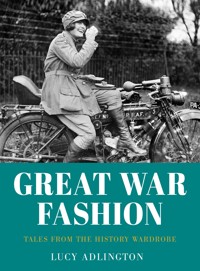
Front Cover Image: A despatch rider in the Women’s Royal Air Force enjoying a tea break while seated on her motorcycle, 1918. ©IWM (Q 12260Q)
Every effort has been made to trace copyright holders and to obtain permission to reproduce illustrated material. In case of any omission, please contact the author care of the publishers.
First published 2013
This paperback edition first published 2022
The History Press
97 St George’s Place, Cheltenham,
Gloucestershire, GL50 3QB
www.thehistorypress.co.uk
© Lucy Adlington, 2013, 2022
The right of Lucy Adlington to be identified as the Author of this work has been asserted in accordance with the Copyright, Designs and Patents Act 1988.
All rights reserved. No part of this book may be reprinted or reproduced or utilised in any form or by any electronic, mechanical or other means, now known or hereafter invented, including photocopying and recording, or in any information storage or retrieval system, without the permission in writing from the Publishers.
British Library Cataloguing in Publication Data.
A catalogue record for this book is available from the British Library.
ISBN 978 0 7509 5677 2
Typesetting and origination by The History Press
Design by Katie Beard
Printed in Turkey by Imak
eBook converted by Geethik Technologies
CONTENTS
Acknowledgements
A Word About Money
Prelude
1. On the Brink
2. Fashion for the Few
3. Keeping up Appearances
4. Shopping for Clothes
5. Maid of all Work
6. War Paint
7. Crowning Glory
8. The Fully Fashionable Figure
9. Knitting by the Ton
10. Making the Best of Things
11. Monday is Washing Day
12. Angels in Hell
13. Mother’s a Munitionette
14. Furs and Feathers
15. Wedding Belles
16. In an Interesting Condition
17. Widow’s Weeds
18. As Smart as the Chaps
19. Emergency Fashion
20. A League of Their Own
21. Cross-Dressing and Undressing
22. A Land Fit for Heroines
Bibliography
About the Author
ACKNOWLEDGEMENTS
Thank you in general to all History Wardrobe ‘fans’ who have contributed photographs, anecdotes, costume donations and good all-round enthusiasm.
Thank you in particular to the following individuals and institutions:
Dee Curran for the fabulous studio photographs – www.denisecurran.com
Meridith Towne for modelling costumes and for ongoing performances with History Wardrobe – www.meridithtowne.co.uk
Mrs Elsie Walton, indefatigable comrade-in-costume
Ben and Lorna Adlington, for feeding my passion for women’s history … and for feeding me cake when required
Mrs Melanie Towne, for knitting the fantastic khaki wool socks
Grace Evans, costume curator at Chertsey Museum – www.chertseymuseum.org
Platt Hall Museum of Costume, Manchester – www.manchestergalleries.org
Kay-Shuttleworth Textile Collection, Gawthorpe Hall – www.nationaltrust.org.uk/gawthorpe-hall
Jo deVries and Katie Beard at The History Press for their creative enthusiasm and hard work
Kate Shaw, Agent Extraordinaire
Picture Credits
All images are from the author’s personal collection, with the following exceptions:
p. 26 – Jane Wharton – Museum of London collection
p. 28 – Dora Thewliss postcard – courtesy of Jill Liddington, author of Rebel Girls, Their Fight for the Vote (Virago Press, 2006)
p. 30 – Prison wardress courtesy of Margaret Bennett
p. 59 – Green wool suit courtesy of Meridith Towne
p. 128 – Nurses Steele & Stead courtesy of Vicky Warwick
p. 129 – Edith Appleton portrait, courtesy of Dick Robinson, Edie’s great nephew
p. 140 – Engine cleaners at the Shilden works courtesy of Darlington Head of Steam Museum
p. 140 – Jessie Harding courtesy of Millicent Harrison
pp. 158–9 – Annie Colley images courtesy of Raymond Colley
p. 164 – courtesy of Maureen Marshall
pp. 176–7 – Bus conductress and Annie Cragg courtesy of Norman Ellis
p. 182 – WRN Imperial War Museum collection
p. 209 – Dick, Kerr Ladies team photo courtesy of Gail Newsham, author of A League of Their Own (Pride of Place Publishing, 1994)
Quote from Laurence Attwell p. 108 from Letters from the Front, Pen & Sword Publications www.pen-and-sword.com
PRELUDE
It is 1910. The first year of a new decade. In a nice mid-terrace house ‘Mrs Average’, a nice middle-aged, middle-class woman, is getting dressed for the day.
This will take some time.
To the modern eye, Edwardian-era fashions evoke awe and admiration. Viewing photographs and fashion prints we might remark on how stylish the women look, how feminine. A closer look at the layers that make up a basic daytime ensemble gives an idea of the way in which women were physically hampered by their clothes as well as socially constrained by the need to look respectable.
Unmentionables
We begin with underwear … and there’s plenty of it.
Ladies who could afford high-end lingerie from fashion houses indulged in luxurious confections of silk crêpe de Chine, light georgette or lace. For warmth and hygiene, wool next to the skin was recommended; for economy, flannelette. Undergarments in white cotton were by far the most common, perhaps with pretty touches of ribbon or broderie anglaise. For the first layer, there was a choice of chemise and drawers, or combinations.
The chemise – also known as a shift or a ‘shimmy’ – was the forerunner of today’s vest. It was considered rather outmoded in the pre-war years, although for many centuries it had been obligatory wear for women, corresponding to the shirt for men. The humbler chemise was made of plain homespun linen or sturdy cotton. Fancier versions were of a light cotton lawn with lace trimmings at the throat. Shaped like a generous T-shirt reaching the knees, the main purpose of the chemise was to protect the subsequent layers of clothes and to soak up perspiration – highly necessary in an age before commercial deodorants. Sturdy French seams enabled the chemise to survive repeated and vigorous washing. Inked or embroidered initials meant undies didn’t get lost at the laundry.
Drawers were shaped like feminine knee breeches. They were usually split at the crotch to enable the wearer to use the toilet with the least fuss possible, although modern women who attempt this may find it a rather hit-and-miss affair, even on a fitted WC. Hovering over a chamber pot required quite a knack with fabric management, as well as strong thighs. Even more awkward to cope with was an Edwardian innovation in drawers … new models stitched at the crotch. This was said to signify greater dignity for women, but surely it meant also a greater inconvenience. These drawers, whether flimsy silk affairs with embroidery and lace, or racy-coloured ‘tango’ pants for flamboyant dancing, were the direct ancestors of modern knickers. They fastened with a neat button at the waist or alarmingly weak elastic.
Far more common than chemise or drawers in 1910 were wool or cotton combinations. These generally unbuttoned down the front and were either straight-legged or delightfully gathered and frilled and scattered with embellishments. Most had a split at the crotch, or a back flap. Combinations with a fully closed crotch required complete removal for lavatory visits.
There is more to come.
Conditions of a living death
In the privacy of her bedroom our nice middle-class lady next laces herself into a corset, also known as a pair of stays.
Corset designs changed to suit whatever shape fashion demanded, and a woman’s body changed shape with it. When the silhouette required was of a graceful Grecian curve, the ‘S’ bend corset distorted the spine, thrusting out the bosom and the posterior. In the years just preceding the war, the new Directoire line called for a column effect. This corset confined the thighs more and dropped lower under the bust, eventually requiring the invention of the brassiere.
Made of sturdy coutil cotton, which kept its shape well, or satin, or even denim, corsets were stiffened with sprung steels, designed to give better movement than old-fashioned whalebone. The steels sometimes stopped short of the lower hem, generously enabling the wearer to sit or bend with care.
Discomfort aside, very few women chose to abandon their stays and those who did could be ridiculed as frumpy or unwomanly. Corsets ensured that closely cut clothes hung well. They smoothed contours and corrected bad posture. All in all, corsets controlled wobble, supported the stockings via suspenders and satisfied anxious hypochondriacs by keeping the kidneys warm.
The Lady Cyclist magazine – a popular publication reflecting the relative acceptance of women being active on pedal bikes and tricycles – was scathing about corsetry, suggesting that the excessive demands of fashion could be harmful as well as uncomfortable; even giving rise to ‘conditions of a living death’ such as ‘fainting, hysteria, indigestion, anorexia, lassitude, diminished vitality and a host of other sufferings’. Not surprisingly, corset manufacturers did not take this line. They were superlatively confident about the benefit of their wares. Adverts for the Superb Magneto corset, at only 5s 11d, boasted that the wearer would ‘begin to feel a ceaseless stream of Magnetic Power permeating the whole body from head to heel. The joy of New Life, of New Health, and New Vigour thrills through every nerve.’
The Jenyns patent ‘reducing and supporting’ corset claimed to give support ‘without the slightest compression’ while ‘moulding your figure into graceful curves, at the same time imparting a delightful sense of ease’. Anyone who has actually worn a historical corset can vouch for the fact that nothing compares to the far more delightful sense of relief when removing such a garment after long wear. In Period Piece, Charles Darwin’s granddaughter, artist Gwen Raverat, complained that, ‘Except for the most small-waisted, naturally dumb-bell shaped females, the ladies never seemed at ease, or even quite as if they were wearing their own clothes’.
FAR LEFT: A 1914 magazine advert for combinations and drawers – made for comfort not seduction.
LEFT: Elegant, refined and ladylike … that’s the idealised image of corsetry at least. The reality is far more nuanced.
An alarming variety of support garments, advertised in The Lady’s Companion 1912.
From 1906 the famous Liberty bodice was available for young girls. Itchy when warm and unbearable when hot, the bodice came complete with steels, as a miniature version of adult stays. Girls were therefore trained to confinement from an early age.
Poise and balance
The layers continue for our middle-class lady getting dressed.
A cotton corset cover was required to hide the bust and keep the steels from showing under outer garments; also, the skirt had to be given shape by several petticoats, which were fluted to follow fashionable lines and made of flannel, wool, cotton or silk.
In theatre historian Walter MacQueen-Pope’s memoirs of the pre-war period, he reminisces, ‘Women wore many petticoats and the better off they were the more they wore of them. They gave her poise and balance.’ He approved of the fact that ‘skirts were long, mostly they swept the ground’. Not entirely dismissive of practicality he admired the way that, on rainy days, a woman ‘by a knack and a feminine form of hitch would manage to bring her skirts just off the mud and wet’. Apparently, if she lifted them too high, ‘rude men stared, bus conductors cheered and the woman herself beat a hasty, humiliated retreat’.
The women themselves were not so pleasantly nostalgic. Gwen Raverat’s memoirs crackle with anger at the time wasted by needing to brush mud off long-hemmed walking skirts – ‘there can be no more futile job imposed by an idiotic convention, than that of perpetual skirt-brushing’ – not to mention the mending required when hems become torn or worn. Cunning metal skirt lifters were one ingenious answer to the problems of long skirts, since it would take a world war before shorter hems could be considered.
This satirical cartoon barely exaggerates the distorted shape of fashion c. 1911, with giant hats and dresses that strain at the seams.
The final layer was a one-piece dress or two-piece suit. The jacket was always worn over a blouse that could have a variety of fussy details such as lace inserts, pin-tucks, ruffles and embroidery, unless a more masculine style was being adopted – popular from the 1890s onwards – in which case a shirt and tie replaced the blouse, and the tailoring of the suit would be more severe. Colours, fabric and cut depended on the season, on personal taste and on fashion’s whim. These outer garments were often heavy to wear, certain to stain and difficult to clean.
For added awkwardness, the truly fashionable lady could adopt a peculiar trend known as the ‘hobble’, either with a narrow ribbon binding the outside of an exaggeratedly narrow sheath skirt, or with a ‘hobble garter’ buckled around the top of the calves to ensure the wearer could only take dainty half-steps. Lampooned in the popular press, the fact that hobble skirts were so popular illustrates how contrary fashion can be – promoting extreme styles over practicality. At a time when the fight for female emancipation was becoming so prominent, fashionable ladies deliberately chose skirts that narrowed their stride, as if hankering for the bound feet of traditional Chinese women, or the dainty pitter-patter of the Japanese Geisha girl. As ever, this sort of hobbling could only be worn by women whose chief purpose was to be decorative, so it served to show distinction from those unable to afford such leisurely luxury, or unwilling to be bound by it.
The dressing doesn’t stop here.
A hat was essential and, in 1910, often of vast dimensions – a veritable cartwheel size – loaded with feathers and flowers, then skewed onto rolled and padded hair with a monstrous hat pin.
A charming Art Nouveau ‘skirt lifter’. The ribbon loops around a waist belt and the clip seizes the skirt fabric to raise the hemline.
This beautiful pre-war hobble dress is created from cotton lace and delicate China silk. A ribbon is wrapped around the ankles to ensure the wearer doesn’t stride out too boldly and split the fabric. It is matched with a glorious silk damask and swansdown cape, silk stockings, lace gloves and satin shoes.
Spring fashions 1914 – two rather conservatively dressed models from the high-class Bradford tailors, Mosley & Smith.
Gloves were a social and practical necessity, keeping the hands clean and the wearer free from criticism about slovenly dressing. Crocheted short gloves for summer; gauntlets for driving; kid leather for evening wear … the etiquette for gloves was complex and expensive. Yet one more thing to occupy the female mind and divert it from weightier issues.
Footwear, at least, was practical for daytime walking, if one overlooked the time-consuming task of hooking the buttons on calf-length boots, or the danger of stockings getting dirty when worn with low-fronted shoes.
In cold weather, women wore thick coats and the best quality furs they could afford, wrapped as stoles or carried as muffs. Furs were also a sign of conspicuous consumption, with mink and ermine clearly superior to modest coney or squirrel. In summer, a veil and parasol protected a genteel complexion from sunburn. Since women’s clothes were often lamentably short of practical pockets, handbags enjoyed great popularity.
And so our nice middle-class lady surveys herself in the full-length looking glass. In all, the total weight of her clothes and accessories might amount to, at minimum, 10lb (4kg) – at least twice as much as that of a modern woman’s outfit. This then is the basic feminine ideal for the pre-war years.
Real women wore the clothes sketched in fashion magazines. Here, a fur edged suit from Bon Ton magazine in 1913.
Thus Mrs Average – a rather simple stereotype – begins the decade in 1910, perhaps going out to visit friends, or to do a spot of shopping. Her responsibilities were, as a generalisation, expected to focus on household management and care of children and relatives. Servants were not a luxury for Mrs Average, they were an essential part of life. Her entertainments might be limited to fashion, reading, gardening, light music or the occasional theatre trip and church or chapel on Sunday. If adventurous, the railway could take her to bigger cities, or across the continents even, with one of Thomas Cook’s tours. By the end of the decade there will be truly astonishing changes both in her clothes and in her capabilities.
For this history of women’s costume in the Great War, we will go beyond the confines of the stereotype of Mrs Average to explore the varied lives of British women of all classes, ages and occupations. Clothes and fashion offer fascinating insights into the often overlooked domestic details that make up an ordinary life. They also bear evidence of extraordinary political events, technological innovations and social revolutions. They are symbolic of so much – and yet so utterly, recognisably human that even a century later we can admire a shoe – and wonder who wore it, and where to. We can appreciate the colour of a dress … and imagine who cut and stitched it. We can see a wartime uniform and speculate what it would be like to march in it across a parade ground. The couturier Lady Lucy Duff Gordon, known as ‘Lucile’, recognised the special connection between women’s lives and clothes, writing in her memoirs, ‘All dressmakers know that women are in many ways an expression of their clothes. Put a woman into a certain type of dress and she will instinctively find a pose to wear it.’
Great War Fashion is an account of textiles and fashion styles, and it is also a textured collection of stories – tales of the women of the war years, told in their own words, or through their own clothes. The sources include diaries, letters, oral histories, shop catalogues, magazines, photographs, account books, fashion plates and, of course, original garments and accessories, all woven together to give as full a picture as possible of what women wore, why they wore it, and what it meant to them to dress a certain way.
Most of the original clothes and accessories are from the author’s own collection. They are not haute couture. They are not ‘special occasion’ pieces. They are everyday items – the sort of clothes we might have worn 100 years ago …
A more liberating fashion? Cartoonists enjoyed poking fun at daring ‘harem’ trousers, supposedly of Arabian influence. They hardly sit well with the typical Englishwoman’s fashionable accessories.
1
ON THE BRIN
RESPECTABILITY AND REBELLION IN SUFFRAGETTE FASHION
Men cannot imagine a woman, dressed as women have seen fit to dress for the last few years, being competent to take any serious or worthy part in the work of the world. He cannot believe in a woman being capable of efficient, vigorous, or independent action when hampered by the skirt of the period. A man knows that if for a year he were to submit himself to the restraints which a woman puts upon herself, he would mentally, morally, and physically degenerate.
London Times Weekly, 17 April 1914
The period before the Great War is often referred to as a time of peace. Some historians even call it the ‘Golden Summer’ when privileged members of society enjoyed the pleasures of Henley, Ascot and the London Season. In many ways, pre-war clothes reflected this affluence and confidence. But images of complacent women in couture clothes are far from being the complete picture of life before the guns of August 1914.
‘How do you like this?’ asks the sender of this 1911 postcard depicting ‘La Jupe Culotte’ – the French term for the short-lived fad for fancy trousers, rarely worn by any but dedicated fashionistas.
Our average middle-class lady, once dressed for the day, may well have added a few rather radical accessories to her ensemble before leaving the house. Perhaps she took up a parasol with an extra stout handle – perfect for beating off Bobbies. Perhaps she filled her embroidered handbag with stones for window-breaking, chalk for writing slogans on paving slabs and a length of metal chain with a padlock, so she will have time to say her piece at the railings of 10 Downing Street before men come with bolt cutters. As for the leather bag she collected from its hiding place in the wardrobe – it could have contained a hissing and spluttering time bomb engineered by an ingenious chemist.
In case of arrest and detention at His Majesty’s pleasure, she could also carry a toothbrush, for this is the age of the suffragette – and her buttoned-up boots have joined the march for emancipation.
Screaming with rage
Letter-box firings, large-scale arson, general vandalism, infantry marches, infiltration operations and subversive propaganda … it’s clear that long before shots are fired in Sarajevo to precipitate the great battles of the First World War, the women of Britain were already at war, all in the name of freedom.
Before the twentieth century, the fight had been relatively bloodless and rather one-sided. The first petition advocating women’s suffrage was presented to Parliament in 1832, without response. This was added to, year on year, by the campaigning of non-militant suffrage societies, with some rather brilliant legal challenges (unsuccessful) as well as repeated, rational appeals for government support (equally impressive and unsuccessful).
What was new as the Edwardian era unfolded was the sheer escalation of rebellion, and the outrageous destructive force of some suffrage factions. The year 1903 saw the founding of Emmeline Pankhurst’s Women’s Social Political Union (WSPU). This ushered in an age of militant agitators, dubbed ‘suffragettes’ by the popular press. The fight for any kind of legal, political or sartorial freedom was slow, and usually greeted with derision or suspicion. Clothes and appearance, far from being a frivolous topic, were of great significance to all women attempting to edge their way into the political arena.
Conflict over clothing limitations began to show in fashion in the nineteenth century, corresponding with a rise in women’s demand for fewer political disadvantages. In the 1850s, the American Amelia Bloomer had famously popularised a smart suit of matching bodice, skirt and trousers. Her outfit raised many eyebrows, but no sustained show of striding about without petticoats. It was simply too radical an idea. Later in the century, inspired by Pre-Raphaelite art, reformists introduced picturesque but impractical gowns, which at least rejected the worst offences of corset constriction and steel caging. By the 1880s, a craze for bicycling created a need for a costume that could cope with legs, chains and wheels. Sporty women became enthusiastic about divided skirts or even – how daring! – knickerbockers with boots and gaiters.
How women reacted to their limitations varied. An anecdote from Charles Darwin’s granddaughter Gwen Raverat illustrates both the noisy and the quiet protest. In her memoirs she recalls, without fondness, the day that she and her adolescent sister Margaret were compelled to put on full adult corsets to signify their passage into puberty. Margaret ‘ran round and around the nursery screaming with rage. I did not do that, I simply went away and took them off.’
Gwen’s silent rebellion was shared by many other women who resorted to the compromise of unlacing their stays when the day’s work was done, while feeling a seething undercurrent of discontent. Margaret’s outrage is more symbolic of the energetic and increasingly violent protests women undertook when it became clear that peaceful deputations to Parliament were having no significant effect.
Gwen concludes, ‘The thought of the discomfort, restraint and pain, which we had to endure from our clothes makes me even angrier now than it did then; for in those days nearly everyone accepted their inconveniences as inevitable.’ At 18 years old she decided never to fuss about clothes, and she made no overt fuss about politics either. In contrast, suffragist and journalist Evelyn Sharp was critical of all restrictions, commenting quietly in her 1928 memoirs, ‘No woman of to-day would go back if she could to the conditions which her grandmother endured.’
Just as it was considered natural for women’s bodies to be shaped by their corsets, so a domestic, subordinate role was also considered natural for females, regardless of whatever capabilities they might possess beyond the scope of wife and mother. Daily Mail writer Lilian Bell gave voice to the feelings of many in a 1906 article: ‘An unhappy married woman is a freak. So is a woman with a career. Both are outside of what God and nature intended them to be.’
For many women, stepping out from a sheltered home life or a respectable job was a tremendous risk. No wonder they make note of how they dressed for the part. The youngest Pankhurst daughter, Adela, reveals a touching combination of vulnerability and excitement as she describes the outfit she wore to make the brave move from Manchester to London, to undertake a bolder suffragist role:
I, in a home-made coat and skirt, home-trimmed hat, with a month’s salary in my Dorothy bag, had set forth to regenerate mankind. I was rushing into it and the express train, tear along at what speed it would, was too slow for me.
(Quoted in Rebel Girls by Jill Liddington)
Travelling alone, gathering in large groups, speaking in public – these were not normal activities for decent females. Somehow women had to manage to fight for new freedoms while hampered by their clothes. However, in their quest for new rights, the suffragettes most certainly did not storm the Houses of Parliament in breeches or knickerbockers, much as they might have appreciated the liberty of movement. The arsonists, bombers and window-breakers did not dress for warfare in conventional khaki uniforms, nor did they carry out covert operations in camouflage gear.
This elegant pre-war two-piece costume is rich with textures – lace, gauze, velvet and damask silk. The skirt trails the ground, and the hem is protected by a balayeuse, or ‘sweeper’ ruffle. What might the beautiful beaded bag contain?
Their stealth wear was conventional street wear. They quite deliberately decided to dress as ladies.
Her hat’s never on straight
It took a great deal of effort, energy and expenditure to be correctly dressed at this time. Success met with social approval. Proper clothes suggested proper behaviour, and the suffragettes did not wish to be derided as ‘unwomanly’.
It was far easier to mock the suffragettes and their cause than to take their ideas seriously, such was their threat to traditional notions of gender roles in Edwardian Society.
Cartoonists had a marvellous time lampooning the ‘shrieking sisterhood’ of suffragists, as they became known. Echoing the prejudices of men like Sir Almroth Wright, who considered such women to be unattractive to men, and therefore sexually embittered, the satirical image of the suffragette was of a badly dressed, bespectacled and rather hairy female with large feet.
Feisty campaigner Ada Nield Chew, notoriously haphazard in her clothes, regretted this stereotype. In a letter to the Common Cause magazine in 1913 she quoted an anonymous chap who’d quipped, ‘You can always tell Suffragists by the way they are dressed. There’s Mrs Chew, for instance – her hat’s never on straight!’ Ada’s daughter Doris, interviewed many years later, wisely commented in a book about her mother’s life, ‘How much easier it would have been today when she would not have needed to wear a hat!’
All suffrage societies were aware of the need to make strenuous efforts to soften the negative stereotypical image. In The Cause, suffragette historian Ray Strachey, an active member of the National Union of Women’s Suffrage Societies (NUWSS), recorded the opinions of many of her contemporaries on pioneering women, as when Dr Elizabeth Garrett Anderson deplored the fact that one of her female medical students ‘looks so awfully strong-minded in walking dress … she has short petticoats and a close round hat and several dreadfully ugly arrangements … It is abominable, and most damaging to the cause’. Ray Strachey herself wrote candidly of fellow suffragettes in The Cause: ‘Some of them were young and beautiful, and others were rather less young and much less beautiful … It cannot be denied that among these brave and devoted women there were a few who were not only plain, but positively uncouth to the outward eye.’
At political meetings where the press were present, these ‘uncouth’ women were discretely placed so as not to catch attention. It is sad to think that matters of looks and dress couldn’t be set aside when fighting for such important issues, and that intelligent arguments wouldn’t be taken seriously if, as Strachey writes, ‘presented by a lady in thick boots, untidy hair, and a crumpled dress’.
One woman uncomfortable with fashion dictates was Cicely Hamilton, a hard-working actress, author and playwright, whose suffrage works include the play How the Vote was Won and the does-what-it-says-in-the-title book Marriage as a Trade. Her passion for emancipation was dampened by the need to toe the party line regarding clothes, so that the press couldn’t dismiss suffragists as unwomanly or eccentric. Hamilton prefered to wear tailored jackets and skirts but tried to appear in public dressed in a softer style. Time & Tide magazine in January 1923 reported that she ‘sacrificed her individualism to the extent of adopting the conventionally feminine form of dress’. She disagreed with the dictatorship style of the WSPU, particularly in matters of appearance.
In Hamilton’s unpublished one-act play, The Pot and The Kettle, an anti-suffrage character speaks of the frustration of not knowing how to spot those beastly suffragettes: ‘she had on a fawn coat and a black hat with daisies on it; but she was really a suffragette – though I didn’t know it – she looked just like everyone else’.
As for Emmeline Pankhurst, she followed her own criteria for a ladylike appearance. It was said of her that she dressed with ‘the elegance of a Frenchwoman and the neatness of a nun’.
The oldest Pankhurst daughter, Christabel, despite private misgivings that putting too great an emphasis on grace and charm would disguise the fundamentally radical nature of their cause, followed the general suffragist tactic of looking ladylike. Being qualified as a barrister – though not permitted to practise law because of her gender – Christabel managed to use an appearance before magistrates in order to call cabinet minister Lloyd George to the witness stand. To disarm initial hostility she wore a fresh white muslin dress with a coloured sash. Lloyd George was, however, soon under attack from Christabel’s decisive arguments and biting sarcasm.
And the sash? This one note of colour in her pretty white outfit? It was a striking belt of three colours that were to become synonymous with the suffrage cause: green, white and purple.
Green for hope
The WSPU meant business. They deliberately chose an insignia that would unite their members with a strong sense of identity and common purpose. The tricolour designs became instantly recognisable as a ‘brand’, which was hugely important as women fought to get media coverage from journalists reluctant to devote newspaper inches to what was, at first, a minority cause.
White was the predominant colour. This was common to the WSPU and to another major suffrage group often overshadowed by WSPU notoriety – the non-militant NUWSS. White was to represent purity. It was also a classic choice for a true lady, since white clothes signified leisure … and enough income for regular washing. At pageants, exhibitions and demonstrations women were encouraged to wear white gowns. It must have been a superb sight, and wonderful proof that women were actually capable of effective organisation. A demonstration at Hyde Park was described as looking ‘like a great bed of flowers because of the thousands and thousands of women all dressed in the lightest and daintiest of summer garments’.
This front-page illustration from the Daily Graphic in 1909 shows a surprisingly positive portrait of Christabel Pankhurst, as she here grills Lloyd George. Her tricolour sash is visible, representing the WSPU colours.
While the NUWSS added red and green to their palette, the WSPU chose purple to signify loyalty to the king, and green for hope. Loyalty was important, as they didn’t wish to be branded unpatriotic. As for hope, this was very much a requirement, because the first decade of the twentieth century saw a frustrating ebb-and-flow of promises and indifference from the government on the subject of the female franchise.
One further advantage of suffragette colours to the WSPU: they could raise much-needed sums of money for the ‘war coffer’, as it was known, through the sale of the tricolour items – sashes, badges, dolls and jewellery.
Wearing purple, green and white quickly caught on with WSPU supporters, who wore suits in these colours, a flash of purple stockings, or lovely velvet hat flowers. In 1913, as Emily Wilding Davison made her fatal approach to the king’s horse at the Epsom Derby, she had sewed green, white and purple into her coat so there could be no mistake about her motive.
Those who didn’t dare flash their allegiance so prominently could copy the actions of working girls who knew that their fathers would clip them round the ear if they were caught displaying radical tendencies: they hid their WSPU badges under their coat lapels.
Once window-breaking became a regular feature of WSPU tactics – Mrs Pankhurst’s most famous saying was, ‘The argument of the broken window pane is the most valuable argument in modern politics’ – shops and department stores defended themselves against costly damage by setting out window displays with the suffragette colours. Some store owners, such as Mr Selfridge, were proud to show their support for the suffragist movement.
Anti-suffragist strongholds would have no such defence.
I disguised myself
With public opinion often viciously against the cause, dressing as ladies was also a crucial tactic to obtain access. At party political meetings any woman not neatly making tea came to be regarded as a potentially dangerous interloper, out to disrupt the masculine gathering with impertinent demands for answers to the inflammatory question, Will you give votes to women? As militant violence escalated, many meetings clamped down on open entry for women. Galleries, theatres and concert halls might have police cordons, watching for any woman who looked troublesome. Fashionable dress became a disguise for infiltration … in more ways than one.
Even His Majesty King George V was accosted during a night at the opera in 1914. A group of ladies in evening gowns and diamonds were naturally allowed unquestioned access to a theatre box, but they promptly barricaded themselves in their box and used a megaphone to address the royal audience before showering everyone with pro-suffrage leaflets. The opera was Jeanne d’Arc – an appropriate role model for the suffragettes, and this martial heroine often appeared at fancy-dress pageants for the cause.
Class snobbery was always an issue, with lower-class women generally forfeiting the deference usually shown to their ‘betters’. Working-class suffragettes Annie Kenney and Hannah Mitchell took advantage of this by donning good-quality clothes and furs to escape police scrutiny while infiltrating a meeting of male politicians. Annie did not seem to enjoy the privilege of dressing well – she complained of being too hot.
Lady Constance Lytton, decidedly upper class, had a contradictory problem. She wanted to be arrested to gain publicity but was too well connected. She found a compromise, confessing in her book Prisons and Prisoners, ‘I disguised myself by doing my hair in an early Victorian way, so that the police, if on the look-out for me, should not recognise me and so be tempted not to arrest me; for people whose relatives might make a fuss effectively are considered awkward customers.’ Next she describes how she dressed as a working-class seamstress to protest the way that lower-class women were being abused in prison:– ‘A tweed hat, a long green cloth coat, which I purchased for eight shillings sixpence, a woollen scarf and woollen gloves, a white silk neck-kerchief, a pair of pince-nez spectacles, a purse, a note-bag to contain some of my papers, and my costume was complete.’
Clothes were used to trick the police sent to arrest the WSPU leader. In one escapade Mrs Pankhurst gave her speech from an upper storey, wearing a smart hat and veil. She then challenged the police to catch her. They promptly crowded onto her as she appeared at ground level and bore her off to the police station … only to discover that they had captured a decoy veiled woman. On another occasion, six women who were identically dressed rushed away from a meeting, leaving the police baffled as to which one was the ringleader – a fine example of how readily an observer sees a person’s clothes rather than their person.
Pushing clothing transgression to the limit, one enterprising lady disguised herself as a telegram boy in order to deliver a message in person at 10 Downing Street; there are at least two occasions when suffragettes evaded arrest by disguising themselves as errand boys to baffle police.
Lady Constance Lytton in ‘disguise’ as the fictitious Jane Wharton. As an aristocrat she received preferential treatment in prison, quickly being released when doctors discovered her heart condition. Dressed as a working woman there was no such consideration. She suffered from severe health problems following force-feeding episodes.
Constables were quick to stop and search women loitering with large furs muffs, in case these concealed weapons. ‘Why,’ a policeman asked one lady, ‘do you have a pocket in your muff?’ She calmly replied, ‘I must have somewhere to put my handkerchief and my gloves and keys.’ How reasonable since, naturally, fashionable women rarely had decent pockets in their clothes. The lady in question was, however, Edith Garrud, a professional martial-arts practitioner and trainer of the elite WSPU protection corps called The Bodyguard; the anecdote above formed part of an article for the Votes for Women newspaper in March 1910. Garrud frequently hid wooden clubs in her muff for use in self defence, and she did indeed carry handkerchiefs … so that she could drop one on the ground, bend to pick it up and catch constables with a sharp martial-arts move. Contemporary film footage shows her wearing a smart, full-length coat and shoulder-wide hat to demonstrate effective jujitsu techniques. In her article – entitled The World We Live In: Self-Defence – she recommended using a sash or veil to tie up a defeated mugger, a twist on popular fashion accessories.
As for Mary ‘Slasher’ Richardson, her most notorious outrage was to protest at the prison mistreatment of suffragette leader Mrs Pankhurst by taking a hatchet to a Velázquez masterpiece, The Rokeby Venus, in the National Gallery in London – hence her evocative nickname. For her, fashionable clothing became a mere hiding place for a weapon: she concealed her art-wrecking axe up a jacket sleeve, held in position by a chain of safety pins.
The gloves come off
The association with espionage tricks and military tactics is no coincidence in the WSPU. The Pankhurst campaign was a dictatorship, run on quasi-military lines. There were infantry assaults on Westminster, cavalry parades, coded messages and even ‘bombs’ of propaganda pamphlets dropped from a dirigible airship. The WSPU band had terribly smart military-style uniforms, and mass demonstrations were organised by a uniformed ‘General’ Flora Drummond on horseback, like a genuine army officer. It all prefigured the war to come, during which women’s military contribution would not be welcomed.
Martial arts expert Edith Garrud. The Punch cartoonist here is amused at the idea of one little lady holding big Bobbies at bay. Satirists joked that some ‘fair damsel’ would make the Prime Minister kneel for mercy, or that Winston Churchill ‘will unexpectedly find himself turning a somersault in the air’.
By 1913 suffragette violence was widespread. Pankhurst felt sure that the actions of her ‘guerrillists’ was justified, as long as human life was never threatened. To some extent, the women were goaded into physical action not least by one of the arguments used to justify withholding the vote from them, made by the opinionated doctor Sir Almroth Wright in his anti-suffragist book, The Unexpurgated Case against Women’s Suffrage: ‘The woman voter would be pernicious to the State not only because she could not back her vote by physical force, but also by reason of her intellectual defects.’ Lord Cromer backed him up, telling the National League for Opposing Women’s Suffrage that only those who possess the physical force to uphold the law should have the right to make the law – an attribute he did not concede to women.
Pankhurt’s guerrillists certainly proved that some women did have the physical capabilities to fight for their political rights. However, such energy and perseverance was not widely admired by anti-suffragists.
Rising MP Winston Churchill was disgusted by suffragette aims, stating in 1906, ‘They come here asking us to treat them like men. That is what I particularly want to avoid. We must observe courtesy and chivalry to the weaker sex dependent on us.’
Chivalry is the key word. A lady must be treated as a lady, not as an equal. The unwritten chivalric covenant between the genders at this time can best be summed up by MacQueen-Pope in his rosy-tinted review of pre-war society: ‘It was a man’s job – and pleasure – to revere, respect and protect his woman from the dirt and dangers of the world. And to his credit he mostly did.’ This ideal suited many men and women, but it took no account of the realities of life in which women could be left without male protection, or could want to feel independent and able to stand on their own two feet.
ABOVE: A smartly dressed demonstrator is knocked down during the infamous clashes between police and suffragettes on 18 November 1910 – a day known afterwards as ‘Black Friday’.
LEFT: 16-year-old Dora Thewliss is arrested by policemen, with her skirt torn open at the waist.
Chivalry breaks down very quickly once the woman breaks her side of the bargain and behaves in a way that is considered unacceptable and unfeminine. Her status, shown by her clothes, offers her no protection once she has transgressed. This is when the gloves well and truly come off.
Descriptions of assaults on suffrage deputations and speakers make for sober reading, and journalist Evelyn Sharp’s memoirs, Unfinished Adventure, highlights the particular insult that women felt when their clothes were damaged: ‘Little details, like the tearing of a lace cuff or the rending of gathers in a skirt seemed often to matter more than real injuries, which in most cases were not discovered until later.’ Since clothes are so personal and so intimate, any damage to them is an affront to the wearer. The destructibility of clothes also highlights how vulnerable the woman beneath is too.
Women were conscious of their vulnerability but still dignified: for example, a well-respected doctor during a ‘rush’ on constables at Westminster stopped to pause, with a timeless gesture, to adjust her silk scarf before re-entering the fray.
Clothes could sometimes offer limited protection, as in the case of the large cartwheel hats. In Margaret Nevison’s memoir Life’s Fitful Fever, she notes, ‘The filth and garbage thrown at us, was most destructive to the limited wardrobe we took on tour – Fortunately, we kept the sight of our eyes, largely by the big hats then in fashion; a strong, coarse straw, tipped well over the face, was a great protection and saved us from hard missiles and the cayenne pepper blown at us from bellows.’
One of the most iconic images of the suffragette movement shows 16-year-old mill-worker Dora Thewlis being escorted by two burly policemen, with the front placket of her skirt yanked open in the struggle. Later, in court, the magistrate implied she had been lured to London to ‘walk the streets’ – an unsubtle innuendo of sexual immorality.
In addition to the humiliation of looking dishevelled or indecently dressed in public, there is a darker undertone of sexual violence to all of these physical attacks. The ultimate assault is described in a sworn oath given by Mrs Mary Earl in December 1910 after a terrible conflict between police and suffragettes in November of that year, and which came to be known as Black Friday:
In the struggle the police were brutal and indecent. They deliberately tore my undergarments, using the most foul language – such language as I could not repeat. They seized me by the hair and forced me up the steps on my knees, refusing to allow me to regain my footing … My skirt was lifted up as high as possible, and the constable attempted to lift me off the ground. This he could not do, so he threw me into the crowd and incited the men to treat me as they wished.
The long journey to the cells
Prison clothing for convicted suffragettes represented the final embodiment of social contempt for the women who dared to tear rips in the idealised image of womanhood. In prison, suffragettes were refused the right to be treated as political prisoners and were classed as common criminals – a significant distinction that devalued their cause. As such, they were not allowed to keep their own clothing. Any sense of identity and femininity was deliberately stripped from them, along with whatever clothes they had carefully and laboriously dressed in on the day of their arrest.
Clothes offer literal protection against the elements and prying eyes. They also offer a more symbolic sense of protection, one that prisoners were not allowed to keep. Women of this era were almost universally accustomed to hiding their bodies. Long skirts and stockings covered the legs, long sleeves hid the arms; no bosoms were bare before the hour of dinner, and they were soon covered up at bedtime; even necks were swathed in high collars supported by spirals of wire. To have all of this taken away must have been traumatic enough. To undergo a perfunctory medical examination barefoot and dressed only in a short, cotton shift must have been a devastating experience. As a final affront, the women were felt all over to ensure they had nothing concealed.
A formal portrait of an Edwardian prison wardress. Elizabeth Sanderson’s uniform is immaculate. She has a dainty lace collar and fashionable hair, but the long chain signifies a pouch full of keys, and a brass ‘alarm’ whistle hangs from her belt.




