


39,99 €
Mehr erfahren.
- Herausgeber: John Wiley & Sons
- Kategorie: Geisteswissenschaft
- Sprache: Englisch
This is a unique introduction to Greek tragedy that explores the plays as dramatic artifacts intended for performance and pays special attention to construction, design, staging, and musical composition. * Written by a scholar who combines his academic understanding of Greek tragedy with his singular theatrical experience of producing these ancient dramas for the modern stage * Discusses the masters of the genre--Aeschylus, Sophocles, and Euripides--including similarities, differences, the hybrid nature of Greek tragedy, the significance that each poet attaches to familiar myths and his distinctive approach as a dramatic artist * Examines 10 plays in detail, focusing on performances by the chorus and the 3 actors, the need to captivate audiences attending a major civic and religious festival, and the importance of the lyric sections for emotional effect * Provides extended dramatic analysis of important Greek tragedies at an appropriate level for introductory students * Contains a companion website, available upon publication at www.wiley.com/go/raeburn, with 136 audio recordings of Greek tragedy that illustrate the beauty of the Greek language and the powerful rhythms of the songs
Sie lesen das E-Book in den Legimi-Apps auf:
Seitenzahl: 520
Veröffentlichungsjahr: 2016
Ähnliche




















Table of Contents
Cover
Title Page
Preface
About the Companion Website
1 Introduction
Greek Tragedy as a Genre
The Social Context
The Theatrical Space
The Audience
Actors, Chorus and Others
Properties, Costumes and Masks
Acting Style and Characterization
The Sound and Rhythm of Greek Tragedy
Music
Choreography
Summary on Performance
What is a Tragedy?
Form, Content and Meaning
Play Analyses
Structural Terminology
Recordings
References
Further Reading
2 Aeschylus
The Plays
Life and Times
Achievement as Dramatist
Thought and Outlook
Dramatic Technique
Characterization
Style
Spectacle
Summary
Further Reading
3
Persae
Introduction
Historical Background
Synopsis
Interpretation
The Dramaturgy in General
Original Production
Dramatic Analysis
Parodos (1–139)
Transitional Anapaests (140–54)
First Episode (155–531)
First Stasimon (532–97)
Second Episode (598–622)
Second Stasimon (623–80)
Third Episode (681–851)
Third Stasimon (852–907)
Exodus (908–1077)
Conclusion
References
Commentaries
4 The
Oresteia
General Introduction
Synopsis of the Trilogy
Historical Background
Other Themes in the Trilogy
Dramaturgy
AGAMEMNON
Synopsis
Interpretation
Dramaturgy
Dramatic Analysis
Prologue (1–39)
Parodos (40–257)
First Episode (258–354)
First Stasimon (355–487)
Second Episode (489–680)
Transitional Anapaests (782–801)
Third Episode (810–974)
Third Stasimon (975–1033)
Fourth Episode including
Kommos
(1035–330)
Choral Anapaests (1331–42)
Fifth Episode (1343–576) including
Epirrhema
(1407–576)
Exodos (1577–673)
CHOEPHORI (Libation Bearers)
Synopsis
Interpretation
Dramaturgy
Dramatic Analysis
Prologue (1–21)
Parodos (22–83)
First Episode (84–584), Including
Kommos
(306–478)
First Stasimon (585–652)
Second Episode (653–782)
Second Stasimon (783–837)
Third Episode (838–934)
Third Stasimon (935–71)
Exodos (973–1076)
EUMENIDES
Synopsis
Interpretation
Dramaturgy
Dramatic Analysis
The Delphi Scene (1–234)
Orestes’ Trial at Athens (235–777)
Closing Scene (778–1047)
References
Commentaries
Agamemnon
Choephori
Eumenides
Further Reading
5 Sophocles
The Plays
Life and Times
Achievement as Dramatist
Thought and Outlook
Dramatic Technique
Characterization
Style
Summary
References
Further Reading
6
Antigone
General Introduction
Synopsis
Historical Background
Interpretation
Dramaturgy
Dramatic Analysis
Prologue (1–99)
Parodos (100–54)
Transitional Anapaests (155–61)
First Episode (162–331)
First Stasimon (332–78)
Transitional Anapaests (376–83)
Second Episode (384–581)
Second Stasimon (582–625)
Transitional Anapaests (626–30)
Third Episode (631–780)
Third Stasimon (781–800)
Transitional Anapaests (801–5)
Kommos
(806–82)
Fourth Episode (883–943)
Fourth Stasimon (944–87)
Fifth Episode (988–1114)
Fifth Stasimon (1115–52)
Exodus (1155–353) including
Amoibaion
(1261–346)
Conclusion
References
Commentaries
7
Oedipus Tyrannus
Introduction
Synopsis
Interpretation
Dramaturgy
Dramatic Analysis
Prologue (1–150)
Parodos (151–215)
First Episode (216–462)
First Stasimon (463–511)
Second Episode (513–862)
Second Stasimon (863–910)
Third Episode (911–1085)
Third Stasimon (1086–109)
Fourth Episode (1110–85)
Fourth Stasimon (1186–222)
Exodos (1223–530)
Some Concluding Thoughts
References
Commentaries
8
Electra
(Sophocles)
Introduction
Synopsis
Interpretation
Dramaturgy
Dramatic Analysis
Prologue (1–85)
Electra’s Monody (86–120)
Parodos (121–250)
First Episode (251–471)
First Stasimon (472–515)
Second Episode (516–822)
Lament for Electra and Chorus (823–70)
Third Episode (871–1057)
Second Stasimon (1058–97)
Fourth Episode (1098–383), Including
Amoibaion
for Electra and Orestes (1232–87)
Fourth Stasimon (1384–97)
Exodos (1398–510)
Conclusion
References
Commentaries
Further Reading
9 Euripides
The Plays
Life and Times
Dramatic Achievement
Thought and Outlook
Dramatic Technique
Characterization
Language and Style
Summary
References
Further Reading
10
Medea
Introduction
The Myth
Synopsis
Interpretation
Dramaturgy
Dramatic Analysis
Prologue (1–130)
Parodos (131–212)
First Episode (214–409)
First Stasimon (410–45)
Second Episode (446–626)
Second Stasimon (629–62)
Third Episode (663–823)
Third Stasimon (824–65)
Fourth Episode (866–975)
Fourth Stasimon (976–1001)
Fifth Episode (1002–250)
Fourth Stasimon, Incorporating the Death of Medea’s Children (1251–91)
Exodos (1293–419)
Conclusion
References
Commentaries
11
Electra
(Euripides)
Introduction
Synopsis
Interpretation
Dramaturgy
Dramatic Analysis
Prologue (1–111)
Electra’s Monody (112–66) and Parodos (167–212)
First Episode (213–431)
First Stasimon (432–86)
Second Episode (487–698) The Recognition Scene
Second Stasimon (699–746)
Third Episode (747–858)
Choral Victory Song with Electra (860–79)
Fourth Episode (880–1146)
Third Stasimon (1147–64) and Murder Scene (1165–76)
Kommos
(1177–232) for Orestes, Electra and Chorus
Exodos (1233–359)
Conclusion
References
Commentary
12
Bacchae
Synopsis
Interpretation
Dramaturgy
Dramatic Analysis
Prologue (1–63)
Parodos (64–167)
First Episode (170–369)
First Stasimon (370–431)
Second Episode (434–518)
Second Stasimon (519–70)
Third Episode (576–861)
Third Stasimon (862–912)
Fourth Episode (912–76)
Fourth Stasimon (977–1023)
Fifth Episode (1024–152)
Fifth Stasimon (1153–64) and Entrance of Agave (1165–7)
Exodus (1168–392), Including
Amoibaion
(1168–99)
Conclusion
References
Commentaries
Further Reading
Appendix A: Glossary of Greek Tragic Terms
The Performance Area
The Performers
Organization
Dramatic Structure
The Language of Poetics
Appendix B: Rhythm and Meter
Iambic Trimeter
Trochaic Tetrameter Catalectic
Anapaests
Lyric Meters
Index
End User License Agreement
List of Illustrations
Dedication
Figure 0.1
Bacchae
, Cloisters, New College, Oxford 2013.
Chapter 04
Figure 4.1
Agamemnon
, Greek Theatre, Bradfield College, England 1958.
Figure 4.2
Agamemnon
, Greek Theatre, Bradfield College, England 1958.
Figure 4.3
Choephori
, Greek Theatre, Bryanston School, England 1987.
Chapter 06
Figure 6.1
Antigone
, Whitgift School, Croydon, England 1977.
Figure 6.2
Antigone
, Whitgift School, Croydon, England 1977.
Chapter 07
Figure 7.1
Oedipus Tyrannus
, Cloisters, New College, Oxford 2015.
Figure 7.2
Oedipus Tyrannus
, Cloisters, New College, Oxford 2015.
Chapter 11
Figure 11.1 Euripides
Electra
, Cambridge Greek Play 1980.
Figure 11.2 Euripides
Electra
, Cambridge Greek Play 1980.
Chapter 12
Figure 12.1
Bacchae
, Cloisters, New College, Oxford 2013.
Figure 12.2
Bacchae
, Cloisters, New College, Oxford 2013.
Guide
Cover
Table of Contents
Begin Reading
Pages
iii
iv
v
ix
x
xi
1
2
3
4
5
6
7
8
9
10
11
12
13
14
15
16
17
18
19
20
21
22
23
24
25
26
27
28
29
30
31
32
33
34
35
36
37
38
39
40
41
42
43
44
45
46
47
48
49
50
51
52
53
54
55
56
57
58
59
60
61
62
63
64
65
66
67
68
69
70
71
72
73
74
75
76
78
79
77
81
82
83
84
85
86
87
88
89
90
91
92
93
94
95
96
97
98
99
100
101
102
103
105
106
107
108
109
110
111
112
113
114
115
116
117
118
119
120
121
123
124
125
126
127
128
129
130
131
132
133
134
135
137
138
139
140
141
143
144
145
146
147
148
149
150
151
152
153
154
155
156
157
158
159
160
161
162
163
164
165
166
167
168
169
170
172
171
173
174
175
176
177
178
179
180
181
182
183
184
185
186
188
187
189
190
191
192
193
194
195
196
197
198
199
Greek Tragedies as Plays for Performance
David Raeburn
This edition first published 2017© 2017 John Wiley & Sons, Inc.
Registered OfficeJohn Wiley & Sons, Ltd, The Atrium, Southern Gate, Chichester, West Sussex, PO19 8SQ, UK
Editorial Offices350 Main Street, Malden, MA 02148‐5020, USA9600 Garsington Road, Oxford, OX4 2DQ, UKThe Atrium, Southern Gate, Chichester, West Sussex, PO19 8SQ, UK
For details of our global editorial offices, for customer services, and for information about how to apply for permission to reuse the copyright material in this book please see our website at www.wiley.com/wiley‐blackwell.
The right of David Raeburn to be identified as the author of this work has been asserted in accordance with the UK Copyright, Designs and Patents Act 1988.
All rights reserved. No part of this publication may be reproduced, stored in a retrieval system, or transmitted, in any form or by any means, electronic, mechanical, photocopying, recording or otherwise, except as permitted by the UK Copyright, Designs and Patents Act 1988, without the prior permission of the publisher.
Wiley also publishes its books in a variety of electronic formats. Some content that appears in print may not be available in electronic books.
Designations used by companies to distinguish their products are often claimed as trademarks. All brand names and product names used in this book are trade names, service marks, trademarks or registered trademarks of their respective owners. The publisher is not associated with any product or vendor mentioned in this book.
Limit of Liability/Disclaimer of Warranty: While the publisher and author have used their best efforts in preparing this book, they make no representations or warranties with respect to the accuracy or completeness of the contents of this book and specifically disclaim any implied warranties of merchantability or fitness for a particular purpose. It is sold on the understanding that the publisher is not engaged in rendering professional services and neither the publisher nor the author shall be liable for damages arising herefrom. If professional advice or other expert assistance is required, the services of a competent professional should be sought.
Library of Congress Cataloging‐in‐Publication Data
Names: Raeburn, D. A., author.Title: Greek tragedies as plays for performance / David Raeburn.Description: Chicester, West Sussex; Malden, MA: John Wiley & Sons, Inc., 2016. | Includes bibliographical references and index.Identifiers: LCCN 2016032959 (print) | LCCN 2016036064 (ebook) | ISBN 9781119089858 (cloth) | ISBN 9781119089896 (paperback) | ISBN 9781119089889 (pdf) | ISBN 9781119089933 (epub)Subjects: LCSH: Greek drama (Tragedy)–History and criticism. | Theater–Greece–History–To 500.Classification: LCC PA3131 .R28 2016 (print) | LCC PA3131 (ebook) | DDC 882/.0109–dc23LC record available at https://lccn.loc.gov/2016032959
A catalogue record for this book is available from the British Library.
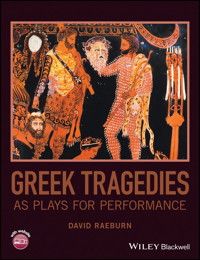
Cover image: Red-figure volute krater with an actor holding his mask, from Ruvo, c.410 BC (ceramic), Pronomos Painter (c.420-390 BC) / Museo Archeologico Nazionale, Naples, Italy / Bridgeman Images
Figure 0.1Bacchae, Cloisters, New College, Oxford 2013.
Source: Reproduced by permission of the Archive of Performances of Greek & Roman Drama.
Preface
It is a remarkable fact that many of the tragedies which have survived from ancient Athens still have the power to move an audience in the theater today nearly two thousand millennia after their original performance. This is true although they were composed in a form and under conditions largely alien to the modern theater and entirely so if compared with our experience of drama in the cinema or on the television screen. One important reason for this strange phenomenon must be the universality of their themes which makes them relevant today as they were in the fifth‐century BC. These plays are also powerful dramatic constructs and it greatly aids our appreciation to explore how the three great Attic tragedians set about the task of engaging and sustaining their own audience’s attention, exciting emotion and stimulating thought.
For its proper understanding an ancient Greek vase demands to be viewed not only as an artefact in its own right but also as an object of its own time. Similarly, a Greek tragedy should be regarded as a play for performance, with account also taken of the medium in which it was composed, the resources that the dramatist had at his disposal, the social and historical context in which it was first produced, the subject matter on which the poet drew and the ideas which may have inspired him as an individual artist.
In this book I attempt to give an account of 10 of the 33 extant tragedies that have survived from ancient Athens in more or less complete form. My aim is to demonstrate how these plays were contrived and operated as pieces essentially composed for theatrical performance. The ten – four by Aeschylus and three by each of Sophocles and Euripides – have been chosen as they are generally considered among the very finest Greek tragedies and, in almost all cases, frequently revived today. In particular, the Oresteia and the two Electra plays complement one another in being based on the same myth and so well illustrate the differences in artistic approach between the three dramatists. As a classical scholar I have studied all these plays from various academic standpoints and have taught them to students in the original Greek. I have also engaged with them in the many live productions that I have directed with students in schools and universities, whether in the original or in translation. Some of them have been mounted in open‐air spaces in which it has been possible roughly to reproduce the spatial relationships between actors, chorus and audience which would have characterized a play’s performance in the ancient theatre. These productions have never aspired to reconstruct a play’s original performance. Too little is known of many aspects, such as music and choreography, to make that conceivable. Nevertheless, I believe that some features of the form and style of ancient tragedy are essential to the effective communication of a classical text in the modern theater.
I hope, therefore to blend some of the insights of scholarship into Greek tragedy with the practical artistry of the theater. The aim of bridging the study and the stage in this kind of way inspired the influential Prefaces to Shakespeare, published between 1927 and 1944, by Harley Granville Barker, an actor, playwright and director who broke new ground in the presentation of Shakespeare’s plays for the audiences of his time. It is in a similar spirit that I have approached my task in the exploration of my chosen Greek tragedies.
My book is intended first of all for students who may be reading these plays, whether in the original or in translation. I would encourage them to view the texts as the script for a continuous and highly structured theatrical performance and to visualise them in action, as far as possible, as they might have been performed in the theater for which they were composed. In this latter regard, I have occasionally suggested stage directions of my own, where this has posed a major problem to scholars.
I also hope that my detailed discussions of individual plays will prove of interest to a wider readership. The last fifty years or so have seen a remarkable revival in the live performance of Greek tragedy not only in schools and universities but also in the professional theater, on the cinema screen and even on television. New translations have abounded and also “acting versions” or adaptations by distinguished poets which can be regarded as new plays in their own right. The unfamiliar form of the ancient texts, however, is often baffling to new audiences or readers. My book hopes to guide this broader group of aficionados towards an understanding and fuller appreciation of this kind of drama.
If my accounts of the plays can be of value to actors and directors, as Granville Barker’s Prefaces have been, then so much the better. Actors may be particularly interested in the ancient tragedians’ approach to characterization, while directors may find it useful to consider how intimately content and form are interconnected in these challenging dramas. If the question that concerns them is, “How do I use this text to create my own original piece of bold and exciting theatre?” they will probably not find this book very helpful. The approach needs to be more in the spirit of an orchestral conductor studying a score prior to rehearsal, such as: “How can I best engage with the creative mind that gave birth to this ancient text, in the light of the form in which he composed it, the conditions under which it was first performed and (maybe) its own political and historical background – in order to bring it to life for a modern audience in a clear, interesting and vibrant realization?” That question, indeed, is the one with which this book is primarily concerned.
There are several whom I need to thank for their help in this enterprise. Andreas Knab attended some lectures I gave on the subject matter of this book and encouraged me to write it by transcribing my notes. Ryan Kourakis Beadle and Kresimir Vukovic between them typed up my manuscript drafts. Ben Cartlidge, Lucy Jackson, Philomen Probert and Guy Westwood joined me in doing the readings for the recordings, expertly engineered by Jamie McIntyre and financed by the New College Ludwig Fund for Humanities Research. I am also indebted to my colleagues at New College, Oxford, Jane Lightfoot and Robin Lane Fox, especially for their encouragement of the productions I have mounted with their talented students in the College Cloisters during recent years. Several of the illustrations in this book are photographs taken by Jane Lightfoot.
I dedicate the book to the memory of my late wife, Mary Faith, and to the innumerable students in schools and universities and at the Greek Summer Schools sponsored by the Joint Association of Classical Teachers, who have taken part in the many productions of Greek tragedies that I have directed. It is thanks to them that I have been able to develop the approach that I have adopted in these pages.
About the Companion Website
The recordings can be accessed on the book’s companion website at:www.wiley.com/go/raeburn
1Introduction
Greek tragedy was an art form initiated in ancient Athens towards the end of the sixth century BC and developed during the fifth century BC. Although tragedies continued to be acted and composed during the fourth century and later, all that survives to us in more or less complete, as opposed to fragmentary, form consists of 33 plays, said to date from 472 to 406 BC and traditionally attributed to Aeschylus, Sophocles and Euripides.1
These plays have been studied and valued in later times for a variety of reasons. Most of them survived in the first place because they were selected in late antiquity or the Middle Ages as ‘set books” in schools for the purpose of teaching the grammar and syntax of the ancient Greek language. Although there were occasional performances from the Renaissance onwards, they were primarily regarded as materials for pedagogic purposes or textual criticism until the early twentieth century, when interest in them as major works of drama became established among a wider public. In due course this inspired a plethora of new translations or original plays based on them. Scholars have explored their stagecraft as well as their literary qualities. Much recent work has examined the plays as socio‐historic documents which help to illuminate the period in which they were composed on general issues such as group identity, gender and class. Finally, the last century has seen an unprecedented rise of public interest in those ancient texts as plays for performance on stage by professional or amateur actors.
The aim of this book is to focus on four tragedies of Aeschylus, three of Sophocles and three of Euripides, exploring each play on its own in terms of its original status as a theatrical artefact. I try to show how these ten texts “work” as drama and, more specifically, how the three great poets used the characteristic form of the Greek tragic genre to create dramatic sequences that would engage and hold their audiences’ attention and stir their emotions in the theater, while at the same time encouraging them to reflect on matters of profound importance. This introductory chapter attempts to define the ancient poet’s task in terms of this form, the social context in which the plays were composed to be presented, and the human and other resources that were available at the time. All these factors dictated their composition and are important to their consideration as works of art.
Greek Tragedy as a Genre
“Greek tragedy is a hybrid form, and the different parts of the drama are differentiated in form and style” (Rutherford 2012, 29). All our surviving plays follow a standard pattern, a sequence of discrete sections akin to the “movements” of a classical symphony or the “numbers” of an eighteenth century oratorio and in modern music theater. Put as its simplest, these movements alternate between spoken “episodes” (scenes) for one to three solo actors and “odes” (songs) performed by a chorus. The normal meter for the former is the iambic trimeter, while the latter are delivered in a variety of so‐called lyric meters. Variations on this pattern are mentioned later but it is enough at this point to note the hybrid character of Greek tragedy and the particular challenge that it presented to the ancient dramatist in creating a continuity in unfolding his story on stage to his audience in a compelling and satisfying way. To understand how these plays “work” as drama, we need to analyse the “structure of feeling,” the controlled sequence of emotional responses implicit in this basic alternation of movements for chorus and solo actors and to observe how these two disparate elements are united in the individual texts.
This peculiar form calls for some explanation. Here we have European drama in its infancy and we need to ask how it came about. Unfortunately, the detailed evidence for the origins of Greek tragedy is difficult and obscure; we can never be entirely sure how or when it began, and this book is not the place to argue a problematic issue.2 Tragedies were certainly being performed at Athens by the end of the sixth century and we have the firm date of 472 BC for our first surviving example of the genre, Aeschylus’ Persae. An answer to the question, “How did Greek tragedy take the hybrid form that it did?” may be more easily sought if we briefly examine the performance genres which existed in Greece earlier in the sixth century.
The ancestor of the tragic chorus is surely to be found in the so‐called genre of “choral lyric,” that is the performance of cult poetry sung and danced by a choir to the accompaniment of the lyre or other musical instrument. These performances were originally “sacral,” religious acts offered in honour of gods or heroes in the hope of blessings for the local community. Examples would include the “paean” performed in honour of Apollo, or the “dithyramb” which was associated particularly with Dionysus, the god of wine and (later) of the dramatic festivals at Athens. Subsequently, choral lyric could be essentially secular, as in the epinikion, a hymn celebrating the victory of an athlete in one of the great inter‐state festivals like the Olympics, an art perfected in the fifth century by the poet Pindar. The whole genre evidently goes back to the seventh century and was mainly developed in the southern part of Greece, the Peloponnese, not so much in Athens itself, though an Attic vase dated to 560–50 BC3 offers evidence for pre‐dramatic performances by a chorus of satyrs, who were always associated with the worship of Dionysus. It is significant that the choral songs of Attic tragedy adopt certain features of the Doric dialect which was spoken in some cities of the Peloponnese.
The other performance art from which Greek tragedy fairly obviously derives was the public recitation of epic verse by professionals known as “rhapsodes.” By 514 at the latest, and very possibly earlier, competitions in the recitation of Homeric verse were held in Athens at the Great Panathenaea, the quadrennial festival in honour of the city’s patron goddess Athena, alongside contests in athletic and equestrian events. The Iliad and Odyssey themselves derive from a tradition of oral recitation in a preliterate culture and make perfect performance poetry in their combination of third‐person narrative and speeches, often quite long, that are put into the mouths of the various characters. Epic poetry would doubtless have demanded the kind of projection of voice and personality that was associated with acting or any form of public speaking; it must also have included an element of impersonation in the delivery of the speeches. The rhapsodic contests can thus be seen as leading naturally into tragedy, in which a story was presented by masked actors individually impersonating a variety of characters, with the narrative element covered by more nondescript “messengers,” through whom the audience could learn, by ear, of such events in the story as could not convincingly be enacted before their eyes.
If tragedy starts with a chorus and a messenger, it is not difficult to regard the tragic contests at Athens as entailing a marriage between two pre‐existing art forms, choral lyric and epic recitation. These contests were an important feature of the City Dionysia, the annual festival in honour of Dionysus, which may have been inaugurated in its earliest form by the tyrant Pisistratus in about 534 – though scholars debate the dating of the various additions which led to the festival as it became in the Periclean age, during the second half of the fifth century, when the art of tragedy had grown to maturity. There was a tradition in ancient times that credited a certain Thespis with the idea of introducing a solo actor (himself), perhaps by detaching the leader of a lyric chorus and getting him to deliver long speeches in response to questions put to him by the chorus. This would fit the Greek word for an actor, hypocrites, usually understood as meaning “answerer.” Thespis is also supposed to have disguised himself, a crucial innovation which leads to drama as we understand it, and to have worn stylized makeup or a linen mask.
For all these uncertainties, when it comes to our first surviving tragedy, the Persae of Aeschylus, we find a sequence of long movements for the Chorus of Persian Elders, punctuated by other movements, including a central Messenger scene, which involve one or two solo actors who make their entrances and exits at various points in the drama. That the chorus was initially thought of as the primary element is suggested by the term epeisodion, meaning “insertion,” which was later used as the formal description of the intervening scenes for solo actors and gives us our own word “episode.”
The Social Context
Before we can fully understand how the individual plays work as drama, it is important to consider the various external factors which will have shaped the poet’s composition. First of all is the social context in which the plays were first performed at Athens.
Tragedies during the fifth century were designed for presentation at the City Dionysia, the festival of Dionysus at Athens, which was held over five or six days in late March when the seas were navigable and the city full of visitors after the winter.4 A preliminary procession brought the image of Dionysus to his theater, which was situated on the south slope of the Acropolis; and this was followed on the next day by another, very grand, procession to the sacred precinct adjacent to the theater, where animals were sacrificed and bloodless offerings made. During the Peloponnesian war, at some point before the performance of tragedies, the sons of citizens killed in battle were paraded in full armor in the theater, as was the tribute brought by Athens’ subject allies. Tragedies were also performed at another festival, the Lenaea, of which we know much less.
The dramatic performances took place over the next three or four days. Three tragedians competed, each with three tragedies and a satyr play, an altogether lighter affair, which involved a chorus of equine satyrs and so brought the poet’s entry to a more specifically “Dionysiac” climax. Contests in comedy were added in about 486 and room in the program was found for five of these plays too. From the late sixth century each of the ten tribes had contributed choruses, one of men and another of boys, for contests in the dithyramb, a choral song in honour of Dionysus. With all this fitted into such a short spell of time, the days must have been extremely long and the demands on the audience’s concentration phenomenal.
The three poets chosen to compete in the tragic contests were selected by a leading state official, the eponymous archon. Each poet was his own director, composer and choreographer; he could also be the leading actor. Central to the festival organization was the chorêgia, a form of service performed for the city‐state by a wealthy citizen. The chorêgos funded the chorus and was like a modern “producer” in that he was responsible for recruitment, training, maintenance and costuming of a chorus for one of the various competitions. Just as prizes were awarded to the competing poets and, later on, to the leading actors, the chorêgos stood to win an ivory crown and high prestige for what the judges decided had been the most successful production. The actors themselves were funded by the state.
We need to remember two important implications of this account. First, tragedies were, in principle, composed for a single performance at a festival that included elements of religious and civic activity besides work in other genres. There was no question of “taking tickets” for a convenient date during a run. Second, for many people, tragedy was art very much for glory’s sake.
The Theatrical Space
When studying Greek tragedies it is important to visualize them as they might originally have been performed. A certain amount can be validly inferred from the text, though much of the detail is speculative.
Scholars debate the precise details of the theatrical space for which our surviving plays were composed. The Theater of Dionysus, which can be visited today, with its stone seating, reflects a late fourth‐century reconstruction. However, we may fairly assume that earlier spectators sat on wooden benches rising up in a tiered horseshoe over the hillside at the foot of the Acropolis. This audience area, the theatron, surrounded a central performance area, probably circular,5 of about 24 meters in diameter and known as the orchêstra or dancing‐floor. Entrances and exits for the chorus and actors were initially down passages at each side of the theatron, called eisodoi and these could be used to suggest two different offstage locations (e.g. city and shore).
At some point a wooden stage‐building, the skênê, was introduced, to back the orchêstra along the side that was unoccupied by the spectators. I believe that this was probably fronted by a slightly raised platform with perhaps three steps leading down from it, though some scholars dispute its existence.6 The structure, once introduced, certainly provided a central upstage entrance through a double doorway and was normally used to represent a house, palace or other building, though other locations came to be indicated by painted panels applied to the building’s façade.
We know of two stage devices: a low trolley on wheels, the ekkyklêma, which could be rolled out of the central doorway with a tableau usually understood to represent what was going on indoors; and some kind of crane, the mêchanê, which allowed actors, usually playing gods (the deus ex machina), to appear above the skênê roof.
Such was the spacious open‐air setting, with a distance of over 100 meters from the central doorway to the furthest spectator, for which our tragedies were planned. It was very different from our smaller‐scale indoor theaters with their proscenium arches, curtains and artificial lighting which can be skillfully used for emphasis and atmosphere.
The Audience
The Theater of Dionysus was able to accommodate an audience of perhaps 15,000, a size that reflected the character of the occasion and, in principle, involved the whole male citizen body of Athens. Whether women attended is another matter of scholarly debate. Some think they did, but in a separate area. Many roles and choruses in the plays were female, but all the performers were male and the plays themselves seem to be essentially oriented towards men, even where they suggest some sympathy with women’s feelings and points of view. Men could well have attended the theater in a spirit of democratic participation, much as they attended political assemblies. Certainly there will have been a degree of partisanship in the audience in favor or otherwise of the poets, actors and chorêgoi involved. Given the festival context and the large theater, the atmosphere could well have been more akin to that of a modern football match than to an ordinary theater visit today.
Actors, Chorus and Others
We now move on to the human resources that the dramatist had at his disposal. By the middle of the fifth century, the single “actor,” often the poet himself, had grown to three professionals who divided all the roles in the play between them. This was achieved by changes to the actors’ costumes and masks, which could easily be effected inside the stage building. Actors were supplemented by an unlimited number of non‐speaking extras, “dumb masks” as they were called.
The chorus in Aeschylus’ time numbered twelve and Sophocles raised this to fifteen (Vit. Soph. 4) – why we can only guess. Perhaps the larger number offered greater choreographic possibilities; the poet was his own composer and choreographer as well as the script‐writer. In the fifth century members of the chorus were representatives of the citizen body who needed to be trained, except, probably, for their leader, the koryphaios (“head man”) who delivered short speeches of his own during the episodes and could engage in dialogue with a soloist.
Modern drama has no equivalent for the chorus and it is often seen by directors as a “problem” when it comes to revivals of Greek tragedy. The choral songs, however, are as integral to the tragic composition as the Hallelujah Chorus is to Handel’s Messiah. Literary study of the ancient genre naturally encourages a wish to advance theories about the chorus as representing the “ideal spectator” or “the common man,” but these are of limited value. The chorus in each play has its own collective identity as elders, local maidens or whatever, which comes in and out of focus as they are involved in the play’s main action or detached from it. It is probably better to see the chorus as one instrument or resource which the playwrights used in different ways in the dramatic continuum. All one might usefully say in generalization is that the chorus, through its collective nature and its proximity to the audience in the orchêstra, serves as a kind of intermediary between actors and spectators. Often, though not always, it operates as a guide to the audience’s responses and sympathies as the action proceeds. This applies not only to the choral songs but also to the iambic interventions of the coryphaeus during the episodes.
Properties, Costumes and Masks
Props abounded in Athenian comedy but in tragedy the texts suggest that they were used very economically, unless they were in effect part of a costume, such as staves carried by old men. They normally have a particular significance in the dramaturgy which goes beyond their immediate function (Taplin 1978, 77). Avoidance of the purely adventitious seems to be an important aspect of the Greek tragic aesthetic.
The iconography of costumes in vase painting suggests that the actors wore very richly decorated dresses with fitted sleeves in a stylization and formality appropriate to a grand occasion.7 Euripides may have gone in for greater realism, to judge from a scene in Aristophanes’ Acharnians. The high‐heeled boots, kothurnoi or buskins, which are sometimes associated with Greek tragedy, did not come in till a great deal later.
Masks and their implications demand slightly longer discussion. They were essentially the device which allowed multiple impersonation and clearly defined the face of a character within the large theatrical space. With the attachment of wigs, they enabled an actor to combine male and female, old and young, characters within a single performance. In the fifth century they do not seem to have used the standardized tragic mask with downturned mouth that featured in later theater. It looks rather as if they were essentially designed to identify the actor’s character and, if made of linen, to fit the outline of his face.
How far the mask had, beyond this, a kind of religious mystique and whether the actor developed a kind of “relationship” with his mask that affected his performance are matters of speculation. It is clear that nothing like our modern notion of “casting” can have applied. Whatever illusions may be open to today’s actor through makeup, we still take account of facial type along with other factors such as age, sex, height, physical build or other less definable personality traits in the allocation of roles.
Acting Style and Characterization
Masking obviously requires the actor to use his hands and body expressively. It is unlikely, however, that the acting style in the Greek theater involved the kind of sign language characteristic of Japanese classical acting. Greek poetry and art, despite the formal features that distinguish the different genres, retain a compelling naturalness, which suggests that actors, though performing expansively in a large public space, will not have followed a stereotyped body language, except in ritual actions like supplication or gestures of prayer. More likely, they will have taken their inspiration from the immediate requirements of impersonation within the specific dramatic context. Paramount for the actor would have been his skill in vocal projection and expressive delivery of the verses composed for him by the poet.
An actor attempting to interpret a Greek tragic role today will need to forget all he or she has learned about Stanislavsky and subtexts or Freud and the subconscious. That said, it is possible to overemphasize the “alienness” of Greek tragedy, as exemplified particularly in the mask convention. Some modern scholars have argued that the ancient poets were not interested in characterization as such. But stylization does not imply the absence or distortion of human truth. Homeric epic is highly stylized in its language and poetic rhythm, but what makes the Odyssey and the Iliad immortal is their basic humanity. Similarly the dramatis personae of Greek tragedy can still be seen as real people acting recognizably in recognizable human situations. I aim to show how the poets, while not attempting fully rounded portraits of their characters, did point up those details of characterization that were relevant to their specific artistic purposes.
The Sound and Rhythm of Greek Tragedy
Nothing differentiates the two elements of the hybrid art form more than the meters that give them their characteristic pulse and musical movement. The solo actors in the episodes spoke expressively, for the most part either in formal, often very long, speeches termed rheseis or in the line‐for‐line dialogue known as stichomythia. These were composed from the outset largely in iambic trimeters, less commonly in trochaic tetrameters, rather than the dactylic hexameter of the epic poems.8 Iambs and trochees involve the separation of long syllables by single shorts, where dactyls consist essentially of one long followed by two shorts. The iambic meter had been used earlier, in the seventh century, by the Ionic poet Archilochus of Paros for verse of a satirical character and had been taken up in Athens in the sixth century by the statesman Solon for the poetic expression of more serious moral or political ideas. Aristotle (Poetics 1449a) considered it the meter best suited to normal speech. It is thus ideal for the colloquial verse found in Aristophanes’ comedies, but the tragic poets also found it an excellent medium for more formal speeches and dialogue.
Choral passages, on the other hand, were sung to “lyric” meters and composed in more complex rhythmical phrases called cola (limbs) which involved the separation of long syllables by either one or two short syllables. Cola were formed into stanzas or strophes (turns) corresponding in principle to complete choreographic sequences. Strophes often end in cadences and it was normal for them to be replicated in antistrophes which repeated the syllable patterns of the different cola precisely or almost precisely. This symmetry was sometimes crowned in a triadic structure by a freestanding epode consisting usually of similar, but occasionally of contrasting, metrical phrases.
Apart from these two main types of delivery, in moments of particular pathos or excitement, solo actors could be called upon to sing either in exchange with the chorus in what was known as an amoibaion or kommos, lament, or else in freestanding monodies. The movements for soloist and chorus together were a special feature and are often high spots in the drama when performed. Another interesting exchange is also found, the epirrhema in which choral singing is contrasted with solo speaking or vice versa. It seems that the evidence is not there to describe what the vocal delivery of all the various sung sections was like; but the importance of singing in ancient Greek culture and the training which actors underwent (see Hall 2002, 22–3) suggest that it might have been a little like modern opera singing.
Common to both chorus and soloists was the use of the anapaestic meter, which serves as a kind of halfway house between the more heightened language and emotional registers of lyric and the less lofty one of iambic. Anapaests are often used to cover transitions, but Aeschylus used them importantly for choral entrance marches and other significant moments.
Music played a crucial part in the differentiation between these three “modes of utterance.” The sung lyrics were accompanied onstage not, as originally, by the lyre but the aulos, an instrument described in the next section, which sounded rather like an oboe. Iambics were not accompanied, but anapaests probably were. The delivery of the latter was probably closer to speech than to song9 as a rule, with the rhythm more sharply defined than in the more fluid spoken iambic verse. Sometimes, though, anapaests contain a patina of Doric vowels, like the choral lyrics, which suggest that such passages would have been sung in carefully defined rhythm.10
We can thus see an art form emerging in the hybrid which offered considerable scope for variety and contrast in the sound of its performance. The comparison with the classical symphony or eighteenth century opera or oratorio is useful; but the movements of Greek tragedy are more obviously discrete because of the three distinctive vocal and musical registers. (For access to an oral demonstration of these, see section “Recordings”.) It was the dramatist’s task to weld these disparate elements in their plays into a calculated and unified sequence and with a continuity which gave a good shape to their drama and so to its impact on the audience in the theater.
Music
Music was an essential ingredient in the tragic recipe and I have already indicated its importance in describing the three “modes of utterance.” It is difficult to assess the part it would have played by itself in the drama’s total impact. It would appear that, when it came to selecting poets to be allotted choruses for the tragic festivals, skill in music was a less important criterion than poetic, rhetorical and dramatic talent (West 1992, 351).
The chorus and the soloists in their lyric movements sang to the accompaniment of the aulos, an instrument consisting of a pair of pipes with finger holes and a double‐reed mouthpiece strapped to the player’s face. The performer, known as the aulêtês, was an important member of the artistic team, who is thought to have led the chorus into the orchêstra on its first entrance and out of it at the end of the play. He would have been important in conducting the chorus through their odes, probably providing introductions to get them into position and short interludes between the strophes. He would have helped the all‐important leader in holding the weaker brethren together (Wilson 2002, 39–55).
The sound of the aulos was a penetrating one, more like that of an oboe than the flute with which it used to be commonly identified. It was widely used in a variety of other, non‐theatrical contexts and noted for its ability to express and arouse a range of different emotions, from calmness to orgiastic frenzy, through the use of different “modes” or scales with a characteristic series of intervals. That instrument will certainly have contributed to the effect of the sung lyrics and spoken anapaests; and the audience will have expected it much, I imagine, as a modern church congregation expects hymns to be accompanied by an organ. Given the importance and poetic quality of the words in Greek tragic odes, one must suppose that it would have part of the aulete’s art to ensure that his accompaniment reinforced rather than detracted from the audience’s concentration on the poet’s text and its meaning.
Though the aulos was tragedy’s primary instrument, other instruments were evidently used for incidental purposes. Some kind of drum certainly features in Euripides Bacchae.
With regard to the singing itself, the melodic score, presumably replicated by the aulos, for the tragedies we possess is virtually lost to us.11 It was evidently based on the “enharmonic” scale which had only a small range of notes (West 1992, 351). It seems likely, though far from certain, that the melodies sung by the chorus and solo singers were influenced by the natural pitch of the words as they were sounded with the “tonic” accents, which itself provides a kind of tune of its own.12 If this was the case, we should have to assume that the strophic pairs corresponded metrically but melodically only within the limited range of notes in the adopted musical scale or “mode.”13
We are able, however, by metrical analysis, to recover or at least to offer a reasonable interpretation of the rhythmical score of the lyrics in Greek tragedy. It is indeed its complexity and excitement that leads me to believe that rhythm counted for more than melody in the musical impact of the odes. When these are delivered aloud in the original Greek, there can be no questioning their emotive value. An important, very possibly, the chief dimension of Greek tragedy’s music does survive in the lyric meters, and the poet’s deployment of these is an essential aspect to consider in the examination of individual tragedies as plays. The recordings accompanying this volume attempt to illustrate the effect of these rhythms as deployed in particular dramatic contexts (see also Appendix B).
Choreography
We are even more in the dark when it comes to the “dancing” element in Greek tragedy. Dance was, of course, pervasive in ancient Greek culture, and there is some general evidence that the choreography of tragedy involved stylized mime in the form of rhythmical gestures and derived some inspiration from the poses adopted in sculpture (Pickard‐Cambridge 1968, 246–7). Can we go further than this in determining what the movement and gesture of the tragic chorus was like and also how crucial it was?
There have been a number of theoretical attempts to describe “Greek Dancing” (Ley 2007, 150–65), but none seem to accommodate the variety of identities among the tragic choruses. We should surely expect the Elders of Argos with their staves in the Agamemnon to move in a very different way from the Furies in the Eumenides. This might be confirmed by the contrast between two vase‐paintings which show groups standing with an aulete and so demonstrably members of a chorus: the one of bearded men in a stationary position, the other of dancing girls.14 It certainly seems a reasonable supposition that dancing in the Greek theater was not always what we understand by ballet but could sometimes have simply amounted to stately, processional movement.
There are other questions to which we should like answers. Did choruses move and gesticulate throughout an ode, or could some (or even all) of a song be essentially static? Did the choreography of strophe and antistrophe always mirror one another, even when there was a marked change in the context or argument of the latter? We can only guess at the answers to these questions on the basis of a priori aesthetic assumptions. One criterion must surely be whether movement would have enhanced or detracted from the audience’s attention to the poetic content of the text.
I base my own intuition on many attempts to realize the choruses of Greek tragedy in live production for modern audience in ancient‐type spaces. This experience, for what it is worth, suggests to me the following: the Attic poets did not choreograph their plays to set rules or formulae but used movement, significant gesture and also stillness as was appropriate to the corporate identity of the chorus of a particular play, the function and mood of individual odes in the dramatic sequence and the content or imagery of the words being sung. I doubt whether particular steps were entailed in the different meters, but it would obviously be natural for conventional ritual gestures to be used in prayers, lamentations and so on, as they were normally formalized in non‐theatrical contexts. My own view is that choreography, like the musical accompaniment, was essentially subordinate to the text, not dancing for dancing’s sake.
Summary on Performance
What is certain is that the ancient experience of drama could not be more different from our own experience of it before our television screens today. In Greek tragedy we find plays composed in a strange form and a complex verse medium, designed for performance by daylight in a very large space and in a very public context, and acted by professionals whose faces were visible only in the single expression on their masks. By contrast we are regularly presented today with drama scripted in naturalistic prose dialogue, watched in the privacy of our homes with the aid of electricity. We are invited to observe and identify with fictitious people who are very highly characterized in appearance, personality and motivation, seen within the limited space of a screen, often in close‐up, which allows the slightest movement of the actor’s face to speak volumes.
What is a Tragedy?
Did the ancient tragedies entertain a clear concept of “the tragic”? The term “tragedy” is dear to literary theorists and great play is made with it. The Greek word tragoidia simply means a “goat‐song,” which may have originally meant a song sung in a competition where a goat is the prize, though nobody really knows. At Athens “tragedy” was distinguished from “comedy” as representing any play which qualified for performance in a tragic contest. Where comedy in the fifth century amounted to contemporary political or social satire of a boisterous and bawdy kind, tragedy was usually more solemn in its narration of exciting stories based on the heroic past. But this story did not have to end unhappily or even to inspire tears rather than laughter. Euripides’ Ion, for example, though classified as a tragedy, is much closer to what we understand as comedy.
Aristotle’s famous doctrine of katharsis, whether understood as “purgation” or “purification,” is an important early attempt to explain tragedy’s emotional impact and to consider why the spectacle of suffering should give pleasure. The doctrine must be, at least in part, a response to Plato’s puritanical view of poetry as wicked and bad because it was removed from reality and encouraged people, particularly actors, to be hysterical and uncontrolled. As regards the subject matter of tragedy Aristotle simply says that it is a “representation of an action that is serious,” and that for a definition fits most of the surviving dramas. The notion of the “tragic hero” who comes to grief through a “tragic flaw” of character is based on a misunderstanding of Aristotle and is not applicable to many Greek tragedies. It may, however, be useful to think of tragedy as involving a pathos, some kind of identifiable suffering, whether of individuals or humanity generally. The emotions which this is said to arouse are, typically, “pity” and “fear;” and these correspond well with our own notions of identification with the characters and sympathy with them in the thought that “this could happen to me.” Even so, theory is not always helpful and it may be better, in the first instance, to examine and interpret the plays individually in their own terms.
Form, Content and Meaning
With these perspectives on the form of tragedy and the theatrical medium within which the ancient dramatist operated, we can briefly explore the subject matter of Greek tragedy and the general question of “meaning” or “artistic purpose,” beyond mere entertainment, which lay behind the craftsmanship of the individual plays which we shall be examining.
Like the Homeric rhapsodes, the tragic poets based their plots on myths drawn from the heroic past. These myths would have been familiar in broad outline to their audiences, either from the Iliad and Odyssey, the so‐called “epic cycle” or other sources such as choral lyric. The details, though, were never constant and the dramatist was free to elaborate or vary them as he wished, to accord with the line he was taking on the story and its meaning as he perceived it. The Greek mind liked to see the particular in relation to the general, a respect in which the tragedian would be following the tradition of choral lyric, which often included an appropriate myth and also contained a “gnomic” element, the statement of moral truth by way of warning or instruction. Similarly, the tragic poet was not simply a scriptwriter for popular entertainment. In the context of the religious and civic festival he was there to teach his fellow citizens and communicate some kind of “message,” whether of contemporary or universal relevance. Aristophanes in his Frogs makes Dionysus bring back Aeschylus from the underworld as the best poet to save the city in a time of crisis. Though a flight of comic fancy, this must be based on the way in which poets, both tragic and comic, were conceived as existing to benefit society.
Some plays reinforce the values of the Athenian polis, the city‐state, others may challenge them.15 Others again may be felt to affirm the famous Delphic maxims of “Know yourself” and “Nothing in excess.” In the development of empire and the flowering of civilized art of different kinds which characterized fifth century Athens, there was always the temptation for some to forget their limitations as human beings and to fly too high.
At this point we come to another dimension, essential to the context and understanding of Greek tragedy: the part played by the gods. Greek religion had no “church” or dogma enshrined in sacred texts, and so each of the three tragic poets with whom we are concerned approached and interpreted the gods in a different way. But the gods are always there in the plays, just as they were worshipped in the fifth century and later in the rituals that attended all the festivals and other events in the state or inter‐state calendar and innumerable aspects of everyday life. The significance of the gods and their relationship with men in the plays become clearer in the dramatic analyses that are the main substance of this book.
Tragedy therefore contains a great deal of profound human, political, philosophical and even theological interest and it is proper to ask what the poets were trying to “say” or “put across” in their particular plays. “Authorial intention,” though, is problematic for some who take the view that what an author first “meant” is neither recoverable or of any importance. I would myself maintain that the inherited text of a Greek tragedy remains a constant, as is the musical score of an opera or a symphony. Despite many centuries of transmission, it is still possible to feel that most of the tragic texts are coherent, satisfying and original unities which communicate a powerful impression of a clear artistic purpose. If we can locate them in the context of their historical period and of what we know about the society and poetic traditions in which they were composed, a reasonable stab can be made at establishing the preoccupations which inspired their authors. Modern performances may fairly be compared for their fidelity to those original preoccupations as for their theatrical effectiveness.
Play Analyses
The method followed, therefore, with the individual plays explored in this book is first to set the texts in the context of their own time and then to suggest a possible “meaning” which underlies the analysis of the drama’s shaping in an effective sequence. I then attempt a blow‐by‐blow account of what “happens” in the play in terms of Greek tragedy’s characteristic form and the resources at each poet’s disposal. This is done poet by poet and in chronological order, as far as dates can be established. I aim to show the function of each movement within the dramatic sequence as a whole and would strongly encourage the reader to follow the play in the Greek text or a translation as the analysis proceeds. A brief synopsis of each play is given rather than a fully detailed account and the dramatic analysis is also preceded by notes on historical background, where needed, and on the play’s dramaturgy generally. Analyses may include some discussion of problems relating to the staging of the plays in the ancient theater, but we can never reconstruct the original staging of any play in full detail. That said, I would re‐emphasize the importance of visualising a play’s action in imagination as far as it is possible. This will greatly enhance our understanding and appreciation of a text for what it is: the notes or “score” for a sequence of significant sounds and bodily movements which constitute the essential substance of a play.
The main substance of my discussions is very closely tied to the text of the plays and the best value will be obtained if they can be read in conjunction with a full text, whether in the original or in a translation. Line references are to the Loeb edition which prints the original Greek with a sound English translation in parallel. With the wide readership I have outlined in mind, all quotations are in English, usually my own. In the spelling of Greek names I have, as a rule, preferred the conventional latinized forms to direct transliterations, for example, Aegisthus and Bacchae rather than Aigisthos and Bakkhai.
Structural Terminology
The analysis of most plays in this book follows the traditional terminology derived from Aristotle (Poetics 1452b) in establishing a template for all tragedy. It has the merit of drawing attention to the primacy of the Chorus and applies well to most tragedies. Some modern scholars (e.g. Taplin), prefer to divide the plays into acts and act‐dividing songs.
Aristotle called the opening scene a prologos, “before‐word,” that is what is said before the entry of the chorus, whose entrance song is termed parodos. The action after that consists essentially of scenes for solo actors alternating in regular succession with choral songs. We call the former “episodes,” from the Greek epeisodion, meaning “insertion”, that is. a movement which falls between two choral songs or stasima. A stasimon is understood as a movement for the chorus when they are in stasis




