


78,99 €
Mehr erfahren.
- Herausgeber: John Wiley & Sons
- Kategorie: Geisteswissenschaft
- Sprache: Englisch
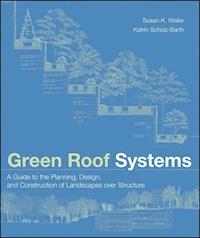
Green Roof Systems goes beyond the fashionable green roof movement and provides solid information on building accessible space, often as important public space, over structure. It offers brief coverage of the entire process, including planning and collaboration, and focuses on the technical aspects of these roof systems, their components, and their applications.
Sie lesen das E-Book in den Legimi-Apps auf:
Seitenzahl: 420
Veröffentlichungsjahr: 2011
Ähnliche




















This book is printed on acid-free paper.
Copyright © 2009 by John Wiley & Sons, Inc. All rights reserved
Published by John Wiley & Sons, Inc., Hoboken, New Jersey
Published simultaneously in Canada
No part of this publication may be reproduced, stored in a retrieval system, or transmitted in any form or by any means, electronic, mechanical, photocopying, recording, scanning, or otherwise, except as permitted under Section 107 or 108 of the 1976 United States Copyright Act, without either the prior written permission of the Publisher, or authorization through payment of the appropriate per-copy fee to the Copyright Clearance Center, 222 Rosewood Drive, Danvers, MA 01923, (978) 750-8400, fax (978) 646-8600, or on the web at www.copyright.com. Requests to the Publisher for permission should be addressed to the Permissions Department, John Wiley & Sons, Inc., 111 River Street, Hoboken, NJ 07030, (201) 748-6011, fax (201) 748-6008, or online at www.wiley.com/go/permissions.
Limit of Liability/Disclaimer of Warranty: While the publisher and the author have used their best efforts in preparing this book, they make no representations or warranties with respect to the accuracy or completeness of the contents of this book and specifically disclaim any implied warranties of merchantability or fitness for a particular purpose. No warranty may be created or extended by sales representatives or written sales materials. The advice and strategies contained herein may not be suitable for your situation. You should consult with a professional where appropriate. Neither the publisher nor the author shall be liable for any loss of profit or any other commercial damages, including but not limited to special, incidental, consequential, or other damages.
For general information about our other products and services, please contact our Customer Care Department within the United States at (800) 762-2974, outside the United States at (317) 572-3993 or fax (317) 572-4002.
Wiley also publishes its books in a variety of electronic formats. Some content that appears in print may not be available in electronic books. For more information about Wiley products, visit our web site at www.wiley.com.
Library of Congress Cataloging-in-Publication Data
Weiler, Susan K., 1955-
Green roof systems : a guide to the planning, design and construction of landscapes over structure / Susan K. Weiler, Katrin Scholz-Barth.
p. cm.
Includes index.
ISBN 978-0-471-67495-5 (cloth)
1. Green roofs (Gardening) 2. Green roofs (Gardening)—Design and construction.
I. Scholz-Barth, Katrin, 1967- II. Title.
SB419.5.W45 2009
635.9'671—dc22
2008027942
The following images are used with permission from OLIN Partnership, Ltd.: 1-4, 1-8, 1-13, 1-14, 1-15, 1-17b, 3-1a-c, 3-2b, 3- 3a-b, 3-4, 3-5, 3-6, 3-7, 3-8, 3-9, 3-10, 3-11, 3-12, 3-13a-c, 3-14, 3-15, 3-16, 3-17, 4-5a-b, 4-6, 4-7, 4- 8, 4-9a-b, 4- 10, 4-11, 4-12, 4-13, 4-14a-b, 4- 15a-b, 4-18, 4-19, 4-20, 421, 4-22, 4-23a-c, 4-24, 4-25a-b, 4-26, 4-27, 4-28, 5-2, 5-3, 5-4, 5-6, 5-7, 5-8a-b, 5-9, 5-10a-c, 511, 5-12, 5-20a-b, 5-21a-b, 5-22, 6-2, 6-3, 6-8, 6-9, 6-28, 6-29, 6-30, 6-34, 6-35, 6-36, 7-1, 7-2a-c, 7- 3a-d, 7-4, 7-5, 7-9, 7-10a-c, 7-12, 7-16a, 8-1, 8-2, 8-3, 8-4, 8-5, 8-6a-b, 8-7, 8-9, 8-10, 8-11, 8-12, 8- 13, 8-14, 8-15, 8-16, 8-17, 8-18 a-b, 8-19 a-b, 8-23, 8-25a-b, 8-26, 8-27, 8-28, 8-29, 8-30, 8-31, 8-32, 8-33, 8-34, 8-36a-b, 8-37, 8-41, 8-42, 8-44, 8-46, 8-47, 8-48, 8-50, 8- 57, 8-58, 8-59, 8-60, 861, 8-62(S. Benz), 8-63, 8-64, 8-65, 8-66, 8-67, 8-69, 8-70, 8-72, 8-73, 8-74, 8-75, 8-76, 8-77, 8-82, 8-83, 8-84a-b, 8-85, 8-86, 10-2a, and 10-9.
Title Page
Copyright
Dedication
Chapter 1: Replenishing Our Diminishing Resources: Integrating Landscape and Architecture
Defining and Redefining the Roof: Traditional Roofs and Green Roof Systems
Designing with Nature
Roof as Floor
Coming to Terms with a Green Roof
Application of Living Green Roofs
Application of Landscapes over Structure
Maintaining Healthy Cities
Summary
Endnotes
Chapter 2: Beyond the Property Line: Ecological, Economic, Spatial, and Social Benefits of Green Roof Systems
From Green to Gray: The Effects of Urbanization
Stormwater and the Hydrological Cycle
The Special Problems of Cities and Decentralized Stormwater Management Practices
Summary
Endnotes
Chapter 3: Envisioning Green Roof Systems: From City Scale to Project Scale
Collaborators and Their Role: Initiating and Realizing the Vision
Planning and Design Process
Summary
Chapter 4: Green Roof Systems at the Project Scale: Site and Architectural Considerations
Merging Landscape and Architecture
Enhancing the Integration of Transit and Parking
Surface, Structured, and Underground Parking
Early Planning and Design Considerations for Green Roof Systems
Summary
Chapter 5: Considerations in Developing Structural Systems for Green Roof Systems
Early Planning and Design Considerations
Basic Structural Principles and Considerations in Design, Documentation, and Building of a Landscape over Structure
Defining Key Structural Considerations: Loads and Basic Structural Principles
Summary
Endnotes
Chapter 6: Component Parts: Inert and Dynamic
Understanding System Components
Inert Components
Dynamic Components: Soils, Soil Mixes, Growing Media, Plants, and Irrigation
Summary
Endnotes
Chapter 7: Putting the Parts Together: The Design and Documentation Process
Early Project Phases
Putting the Parts Together
Summary
Chapter 8: The Bidding and Construction Process
Bidding, Negotiation, and Award of Contract
Value Engineering
Construction and Administration of the Construction Contract
Summary
Chapter 9: Minimizing, Managing, and Insuring Risk
Assessing and Spreading the Risk
Managing Risk: Avoiding Fundamental Problems
Summary
Endnotes
Chapter 10: Maintenance Requirements and Performance Evaluation
Project Conditions and Specific Maintenance Requirements
Responsibility for Maintenance During Construction
General Maintenance and Care of Green Roof Systems
Maintenance Requirements for Green Roof Systems
Summary
Wiley Books on Sustainable Design
Index
I dedicate this book to my partners Laurie Olin, Dennis McGlade, Lucinda Sanders, Robert Bedell, and David Rubin for their extraordinary contribution of knowledge and experience reflected in this book—and for their support in my undertaking this publication.
Many thanks to Rob Schaeffer, Nathan Charlton, Michael Nairn, Jacob Weiler, Jeff Bruce, Sue Campbell, Rick Mitchell, Daneil Mazone, Sahar Coston, Jeremy Jordan, Julia Schmidt, Andrew Tetrault, and most of all, Katrin Scholz-Barth.
Susan K. Weiler
Thanks to Paul Schwedtke, Jorg Baumhauer, Scott Wallace, Curtis Sparks, Daniel Howell, Paul Watson, Stew Comstock, Bill Hunt, Nathan Hultman, Sandy Mendler, Bill Odell, Chip Crawford, Stephanie Tanner, Margaret Cummins, and Amy Zarkos. I also thank Louise Liu, Pamela Sams, Diane Holdorf, Chris Morrison, Margot Curran, and Sigi Koko.
Writing this book would not have been possible without the support of my family. I thank my husband Kai-Henrik for his support and my most amazing son Per-Niklas for his patience with his mommy. My parents are simply the best! Finally, I owe deep gratitude to my co-author Susan K. Weiler whose relentless energy, commitment and perseverance I greatly admire. Susan became a dear friend in the process. Thanks, Susie, for sticking this out with me.
Katrin Scholz Barth
Chapter 1
Replenishing Our Diminishing Resources: Integrating Landscape and Architecture
The world is a glorious bounty.
—Ian L. McHarg, Design with Nature
The technology and materials for vegetating roofs and creating usable open spaces over structure have been known for centuries. Since 4000 BC, practitioners of building and agriculture have utilized the knowledge and materials of their time to construct sacred places such as ziggurats, simple vegetated roofs, and remarkable gardens over elevated surfaces.
The building green movement is not new, nor is the practice of using natural resources responsibly to sustain life and encourage the regeneration of natural resources.
In the last five years, the term green roof has taken on ecological and social significance beyond its seemingly simplistic description. As commonly understood, the term has become an epithet for the reduction of pollution and urban heat islands, for large-scale mitigation of stormwater runoff, and for maximum utilization of urban land.
Justifiably, the concept of the green roof as a way to add pervious surface and usable open space without taking up additional land is easy to understand and should be equally easy to implement. Consequently, many clients, municipalities, architects, landscape architects, and planners have come to consider them as an integral element of sustainable building practice.
More recently, many European municipalities have mandated the incorporation of green roof systems as standard building practice. Even without legislative mandate, landscape architects and architects have, with the personal will and mandate of their clients, successfully built numerous green roofs as stormwater management systems and as comfortable, accessible, open spaces over structure. This has happened without fanfare, perhaps because many of these spaces have been imperceptibly integrated with the architecture and surrounding urban fabric, and perhaps because much of what sustains green roof functionality is invisible to the user.
Most roofs as we know them, however, are not invisible, and as cities grow so do the number and sizes of rooftops. So too does the amount of land used for roads, parking lots, and pavement. At issue is the fact that conventional rooftops and paved surfaces are impermeable, which in turn affects the quality of our water and air. The use of more and more land for building affects the way we live. As our cities grow we need to be thoughtful about how we use our limited natural assets.
FIGURE 1-1 Gardens at the United Nations, viewed from the East River, illustrate extensive portions built over the FDR Drive.
One of many strategies for replenishing our diminishing resources and integrating landscape and architecture is the green roof, and its wide-scale utilization is the focus of this book.
FIGURE 1-2 Outside Geneva, Switzerland, where vast meadows grow over the roof of a reservoir, a rich palette of plants provide a diversity of habitats for insects and small animals, as well as nesting places for birds.
FIGURE 1-3 Even a small individual effort can help ameliorate the negative impacts of unplanned development and urban growth in the Netherlands. (Photo: Joyce Lee)
This book aims to provide a comprehensive, systems-based approach to understanding, designing, and constructing green roof systems in an urban environment. The following chapters will:
Lesen Sie weiter in der vollständigen Ausgabe!
Lesen Sie weiter in der vollständigen Ausgabe!
Lesen Sie weiter in der vollständigen Ausgabe!
Lesen Sie weiter in der vollständigen Ausgabe!
Lesen Sie weiter in der vollständigen Ausgabe!
Lesen Sie weiter in der vollständigen Ausgabe!
Lesen Sie weiter in der vollständigen Ausgabe!
Lesen Sie weiter in der vollständigen Ausgabe!
Lesen Sie weiter in der vollständigen Ausgabe!
Lesen Sie weiter in der vollständigen Ausgabe!
Lesen Sie weiter in der vollständigen Ausgabe!




