


33,99 €
Mehr erfahren.
- Herausgeber: John Wiley & Sons
- Kategorie: Geisteswissenschaft
- Serie: AD Reader
- Sprache: Englisch
Delve deep into the complex issues surrounding humanitarian design
Ground Rules in Humanitarian Design establishes essential foundations for thinking about humanitarian design and its role in global change. Outlining a vital framework for designing for impoverished and disaster-stricken communities, this informative guide explores the integration of culture, art, architecture, economy, ecology, health, and education. Experts on land, health, water, housing, education, and planning weigh in with best practices and critical considerations during the design process, and discussion of the environmental considerations and local materials/skills will broaden your understanding of this nuanced specialty. Richly illustrated, this guide combines graphic documentation of projects, maps, and data-tracking developments from Asia, Africa, and the Americas to underscore the complexities of this emerging and evolving field.
The ambition to provide humanitarian architecture for areas in acute need is driving design innovation worldwide among both practitioners and educators. This book provides an indispensable resource for those engaged in the search for the sustainable inclusion of cultural code and compassion as a technology for design innovation.
- Learn how to approach the problem of humanitarian design
- Understand the cultural factors that play into development
- Develop a new framework for planning post-disaster design
- See how humanitarian design is pushing the industry forward
While still in college, students are being given the opportunity to directly participate in programmes that provide vital facilities for communities abroad. While these international initiatives remain largely ad hoc, this book provides parameters for engagement and establishes best practices for approaching these projects with a global perspective. With expert insight and practical strategies on the ground, Ground Rules in Humanitarian Design is an essential resource for architects at any level.
Sie lesen das E-Book in den Legimi-Apps auf:
Seitenzahl: 398
Veröffentlichungsjahr: 2015
Ähnliche




















Ground Rules forHumanitarian Design
Edited by
Alice Min Soo Chun and Irene E Brisson
The editor and the publisher gratefully acknowledge the people who gave their permission to reproduce material in this book. While every effort has been made to contact copyright holders for their permission to reprint material, the publishers would be grateful to hear from any copyright holder who is not acknowledged here and will undertake to rectify any errors or omissions in future editions.
© 2015 John Wiley & Sons Ltd
Registered office John Wiley & Sons Ltd, The Atrium, Southern Gate, Chichester, West Sussex, PO19 8SQ, United Kingdom
For details of our global editorial offices, for customer services and for information about how to apply for permission to reuse the copyright material in this book please see our website at www.wiley.com.
This is a collective work. The copyright ownership of individual extracts is indicated in a copyright notice at the end of each extract.
All rights reserved. No part of this publication may be reproduced, stored in a retrieval system or transmitted, in any form or by any means, electronic, mechanical, photocopying, recording or otherwise, except as permitted by the UK Copyright, Designs and Patents Act 1988, without the prior permission of the publisher.
Wiley publishes in a variety of print and electronic formats and by print-on-demand. Some material included with standard print versions of this book may not be included in e-books or in print-on-demand. If this book refers to media, such as a CD or DVD that is not included in the version you purchased, you may download this material at http://booksupport.wiley.com. For more information about Wiley products, visit www.wiley.com.
Designations used by companies to distinguish their products are often claimed as trademarks. All brand names and product names used in this book are trade names, service marks, trademarks or registered trademarks of their respective owners. The publisher is not associated with any product or vendor mentioned in this book.
Limit of Liability/Disclaimer of Warranty: While the publisher and author have used their best efforts in preparing this book, they make no representations or warranties with respect to the accuracy or completeness of the contents of this book and specifically disclaim any implied warranties of merchantability or fitness for a particular purpose. It is sold on the understanding that the publisher is not engaged in rendering professional services and neither the publisher nor the author shall be liable for damages arising herefrom. If professional advice or other expert assistance is required, the services of a competent professional should be sought.
Wherever possible URLs were checked previous to publication. URLs, however, may be subject to changes by owners of websites and digital platforms.
ISBN 978-1-118-36159-7 (paperback) ISBN 978-1-118-36144-3 (ebk) ISBN 978-1-118-36143-6 (ebk)
Executive Commissioning Editor: Helen Castle Project Editor: David Sassian Assistant Editor: Calver Lezama
Design by Artmedia, London
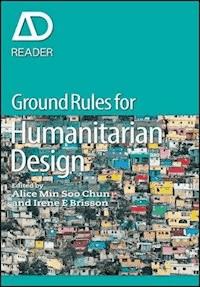
Front cover image: Port-au-Prince, Haiti, 2013. Rebuilt and remaining structures in informal settlements three years after the earthquake. © Damian Fitzsimmons.
Acknowledgements
Ground Rules for Humanitarian Design began as a discussion with students and faculty at Columbia University and became a much larger dialogue with students and faculty at Parsons The New School for Design. The global disasters caused by the 2010 earthquake in Haiti, the 2012 Kamaishi earthquake and tsunami in Japan and the 2013 Typhoon Haiyan in the Philippines had struck a cord in all of us. We could no longer stand by and watch what was happening to the environment, we had to take action. The tides, rifts and storms that had moved oceans and earth had also motivated in us a desire to create ways of deciphering such a complex and multifaceted problem.
We would like to thank Brian McGrath for his mentorship and support for this book and for proposing it on our behalf. He is dedicated to new research in urban ecosystems and is a leader in this field. Many thanks to Cameron Sinclair for the discussion we had about the lessons he had learned while at Architecture for Humanity. Kenneth Frampton was also a great inspiration, and we thank him for taking the time to be interviewed. We are indebted to the authors who contributed to this book and thank them not only for their essays but also for the many hours of work spent writing each essay. This project has taken two years to complete; we are very grateful to Helen Castle and Calver Lezama for their perseverance and patience over the past two years and their commitment to this publication.
Editorial Note
With the exception of one essay (pp 142–4), this book is an anthology of texts created specifically for this publication.
CONTENTS
Introduction
Rules of Measure
What Matters
Parameters of Engagement
Notes
PART 1 HISTORIES OF HUMANITARIAN DESIGN AND AID
Humanitarian Design
Appropriate Technology and Design for the Other 90 Per Cent
Design and Participatory Citizenship
Humanitarian Design as
Good Design
Notes
Fifty Years of the Community-Led Incremental Development
Part 1 Rediscovering Incremental Housing Development
Part 2 The Implementation of Incremental Housing Strategies
7
Part 3 Challenges and Opportunities
Notes
PART 2 LAND
Real Estate and Property Rights in Humanitarian Design
The Humanitarian Designer as Critical Actor
Property Systems
Logistics and Practical Considerations
Professionalisation
Notes
Remediating Ecocide
Notes
PART 3 CRISIS IN HEALTH AND CULTURE
Crisis Architecture
Conflict and Crisis Culture
Conflict and Crisis-Forms
Marginal Spaces of Displacement
Appropriated Crisis-Forms and Economic Displacement
Self-Organised, Mass-Appropriated Crisis-Forms
Temporary Crisis-Forms and Conflict Displacement
Complete and Incomplete Crisis-Forms
Conclusion
Notes
Emergency Medical Structures
Establishing Activities in an Existing Structure
Establishing Activities in an Independent Structure
Temporary Structures
Semipermanent Structures
The Expanding Role of Architects
Notes
PART 4 WATER AND SANITATION
Fluid Matters
How Water Guides Us
How We Guide Water
Issues to Consider When Designing for Water
Notes
Water, Sanitation and Hygiene Interventions
Efficacy Research Conducted in Controlled Conditions
Effective Use in Field Implementations
References
PART 5 ECOLOGY AND HUMANITARIAN DESIGN
Architectures of Eco-Literacy
Eco-Literacy
Eco-Bling
Circling Research with Design
The School as Prototype
Notes
PART 6 LOCAL MATERIALS AND LOCAL SKILLS
Intelligent Materials and Technology
Natural Materials
Hybridisation of Bamboo and Concrete
Natural Products and Zero Waste
Agricultural Waste to Alternative Energy
Recycling
Notes
One City
The Intelligence Unit (IU)
An Example of Our Research: ‘One City'
A Policy for the Development of Neighbourhoods
A Policy for the Continuity of the Urban Fabric – Including Nature
A Policy of Collectivity and Shared Identity
A Policy for Natural Infrastructure
A Policy to Create a Region of Health
A Policy to Harness Intelligence and Creativity
PART 7 SHELTER AND HOUSING
Missing Scales
Note
reCOVER
reCOVER Coursework
reCOVER: Applied Design Research
PART 8 EDUCATION AND PRACTICE
Humanitarian Architecture Is Hip. Now What?
Create Jobs
Stimulate Local Economies
Leverage Local Capacities, Don't Overshadow Them.
Notes
Reading Codes Is a Whole New World
PART 9 ARCHITECTURE, PLANNING AND POLITICS
Delmas 32
Introduction and Background
Post-Disaster Recovery and Reconstruction Plan Objectives for the Urban Zone of Delmas 32
Methodology for Elaborating the Conceptual Post-Disaster Recovery and Reconstruction Plan for Delmas 32
Community Participatory Planning Workshop with the Community of Delmas 32: Principles, Methods and Results
Conclusion
Building On, Over, With
Postcolonialism and Humanitarian Design
Humanitarian Design – Troubled by Postcolonialism
Aid as Neocolonialism via Authority versus Power or Aid as Authority
Notes
Select Bibliography
Index
Advert
EULA
List of Illustrations
Introduction
Charcoal seller in Haiti. Because of extensive poverty and the cultural tradition of using charcoal for cooking, trees have been cut down to make charcoal. The effect this has had is extreme land degradation. © Damian Fitzsimmons.
The hillsides of Port-au-Prince, Haiti, are a collage of shelters. The colours act as a codification for the nongovernmental organisations that built them. These plywood structures are called ‘transitional' homes, although none have running water, sanitation or electricity. © Damian Fitzsimmons.
Lesen Sie weiter in der vollständigen Ausgabe!
Lesen Sie weiter in der vollständigen Ausgabe!
Lesen Sie weiter in der vollständigen Ausgabe!
Lesen Sie weiter in der vollständigen Ausgabe!
Lesen Sie weiter in der vollständigen Ausgabe!
Lesen Sie weiter in der vollständigen Ausgabe!
Lesen Sie weiter in der vollständigen Ausgabe!
Lesen Sie weiter in der vollständigen Ausgabe!
Lesen Sie weiter in der vollständigen Ausgabe!
Lesen Sie weiter in der vollständigen Ausgabe!
Lesen Sie weiter in der vollständigen Ausgabe!
Lesen Sie weiter in der vollständigen Ausgabe!
Lesen Sie weiter in der vollständigen Ausgabe!
Lesen Sie weiter in der vollständigen Ausgabe!
Lesen Sie weiter in der vollständigen Ausgabe!
Lesen Sie weiter in der vollständigen Ausgabe!
Lesen Sie weiter in der vollständigen Ausgabe!
Lesen Sie weiter in der vollständigen Ausgabe!
Lesen Sie weiter in der vollständigen Ausgabe!
Lesen Sie weiter in der vollständigen Ausgabe!
Lesen Sie weiter in der vollständigen Ausgabe!
Lesen Sie weiter in der vollständigen Ausgabe!
Lesen Sie weiter in der vollständigen Ausgabe!
Lesen Sie weiter in der vollständigen Ausgabe!
Lesen Sie weiter in der vollständigen Ausgabe!
Lesen Sie weiter in der vollständigen Ausgabe!
Lesen Sie weiter in der vollständigen Ausgabe!
Lesen Sie weiter in der vollständigen Ausgabe!
Lesen Sie weiter in der vollständigen Ausgabe!
Lesen Sie weiter in der vollständigen Ausgabe!
Lesen Sie weiter in der vollständigen Ausgabe!
Lesen Sie weiter in der vollständigen Ausgabe!




