


7,19 €
Mehr erfahren.
- Herausgeber: Clink Street Publishing
- Kategorie: Fachliteratur
- Sprache: Englisch
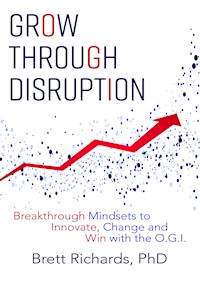
In today's market, where speed and performance are critical to success, CEOs and executives face an unprecedented number of challenges to continue differentiating themselves from competitors. At the same time, current methods of understanding and assessing an organization's true ability to grow through innovation and transformation are outdated. In Grow Through Disruption: Breakthrough Mindsets to Innovate, Change and Win with the O.G.I. Dr. Brett Richards, PhD, a seasoned practitioner and researcher with over 20 years of experience in the area of individual and organizational effectiveness, offers a new, comprehensive system for 21st century companies to measure growth and adapt to the changing business landscape. Some of the most important data to an organization's success is invisible and intangible, making it very difficult for leaders to make decisions based on what is really happening. In response, Dr. Richards developed the Organizational Growth Indicator (O.G.I.), a system of quantifable metrics to shed light on these previously hidden factors. The OGI enables leaders to make even more intelligent strategic decisions and, ultimately, strengthen their businesses by codifying: 4 Principal Mindsets that uncover previously hidden people and culture dynamics, The Transformation Wheel, consisting of 8 Orientations that both support and constrain an organization's ability to grow through disruption, and The organization's capacity to achieve growth through innovation and adaptive change. Harnessing decades of experience and system development, Grow Through Disruption is an essential read for heads of global corporations to leaders of small and midsize businesses to develop more vibrant, fulflling and lasting organizations.
Das E-Book können Sie in Legimi-Apps oder einer beliebigen App lesen, die das folgende Format unterstützen:
Veröffentlichungsjahr: 2017
Ähnliche



















GROW THROUGH DISRUPTION
Breakthrough Mindsets to Innovate, Change and Win with the OGI
Brett Richards
CONTENTS
ACKNOWLEDGEMENTS
The ideas proposed in this book have sprung from my interactions and learnings with so many great minds in academia and business over the years to whom I am deeply indebted. This book is an evolution of my doctoral dissertation, so I would be remiss not to thank my committee. Dr. Bob Silverman, enriched my thinking in so many ways, notably through hours of dialogue pertaining to the nature of organizations, and their quadratic structure. Drs. Fred Steier, Rich Appelbaum and Carina Fiedeldey-Van Dijk each offered rich perspectives related to systems theory, organizational effectiveness and the development of statistically sound assessments.
Many thanks go to Jerry Rhodes and his remarkable system of Effective Intelligence which has shaped my thinking beyond measure over the last twenty years, particularly related to cognitive styles and his unique conceptualization of thinking-intentions. Thanks also to Bob Wiele, a great, early mentor of mine whose intellect and creativity left an indelible impression on me and my approach to learning and development. I was fortunate to study with the late Sensei Miguel Palavecino, a master martial artist in the truest sense of the word, who introduced me to Tai Chi, the practice of mindfulness, intentional action and the important integration of mind-body-spirit. My deep gratitude goes to the late Bishop Henry Hill who embodied what it means to be a truly spiritual being. He had a deep intellect with an even deeper faith in God and the goodness that rests within all of us.
Related to the nitty-gritty task of getting the book done I would like to thank Daina Astwood-George for her fresh thinking and pragmatic sensibility. A dear colleague of mine, author Martin Rutte, founder of Project Heaven on Earth once said to me: “No David, no book, no kidding.” He was right. I’m grateful to David Christel for the many hours he committed to this book. I would not have accomplished it without him. Most of all, I appreciated David’s sharp mind blended with a gentle spirit which offers a rare mix indeed.
My team at Connective Intelligence must be thanked as I’d never get any project completed, book or otherwise, without their commitment and support.
I dedicate this book to my children, Courtney, Kyle and James who never cease to amaze, and to Lois, my wife and greatest inspiration of all. Thank you for blessing my life with yours.
The following are some Inconvenient Truths I’ve uncovered related to innovation within organizations. They are inconvenient because they are things that require attention and acknowledgment even though they may be difficult to do or accept. We may even choose to ignore or deny their existence, however, doing so may lessen the impact of our efforts at accelerating organizational growth through innovation and adaptive change.
You will see them pop up throughout the book. Any look familiar? There are likely more.
Inconvenient Truths
Leaders of organizations need better ways to measure, quantify, and demystify innovation so that it can be tangibly addressed in a systematic way.Innovation is a leading indicator of an organization’s ability to sustain future success.The majority of organizations still view innovation as a “nice to have” not a “need to have,” and they eventually pay the price. Those that do value and see the need for innovation struggle with how to do it well, or better.The goals of organizations and the goals of innovation are most often the same and yet the two are experienced by organizational members as enemies, not allies.Creativity is absolutely essential, but it’s not the whole story.An inability to break the bonds of short-term thinking at the leadership level will kill innovation.Organizations are most often adept at short-term, incremental innovation, but are typically much less effective at long-term, transformative, or radical forms of innovation.Failing to understand the full ramifications of the fact that organizations are complex systems, rather than a collection of complicated processes, will severely constrain an organization’s transformational potential — their ability to initiate and sustain innovation. There is no innovation without leadership support.There is a dramatic need to better understand the relationship between organizational thinking and organizational innovation.Effective organizations are most likely to be successful with innovation and yet it’s the ineffective organizations that need it most and who often experience numerous failed innovation attempts, a.k.a. the vicious cycle.Engagement surveys are useful, but not substantive enough to fully grasp, describe, and enable how to improve organizational innovation and transformation.Innovation and transformation are every bit as emotional as intellectual for every member of an organization.CHAPTER 1
SEEING THE INVISIBLE
“The seeds of decline are usually in place long before decline becomes visible — like a disease where you look strong on the outside, but you’re already ill on the inside.”
Getting a Grip on Reality
For millennia, philosophers have searched to understand the nature of reality. How is reality described, how is it known and how does it influence the happiness and success we experience in our lives? We hear and make references to “reality” all the time using phrases like: “the reality is…”; or “wow, what planet are they on?”; or “man, are they out of touch…”; and more recently the notion of “fake news,” which is, of course, another way of saying that what you are reading is false and out of touch with “reality.”
Reality is not just something that is tangible, that we can visibly see with our eyes; it is also something we or . In other words, the stuff of reality — facts — takes on two primary forms: they can be drawn from the tangible, objective, external world; or they can be drawn from the intangible realm of hidden, subjective impressions and opinions.
Lesen Sie weiter in der vollständigen Ausgabe!
Lesen Sie weiter in der vollständigen Ausgabe!
Lesen Sie weiter in der vollständigen Ausgabe!
Lesen Sie weiter in der vollständigen Ausgabe!
Lesen Sie weiter in der vollständigen Ausgabe!
Lesen Sie weiter in der vollständigen Ausgabe!
Lesen Sie weiter in der vollständigen Ausgabe!
Lesen Sie weiter in der vollständigen Ausgabe!
Lesen Sie weiter in der vollständigen Ausgabe!
Lesen Sie weiter in der vollständigen Ausgabe!
Lesen Sie weiter in der vollständigen Ausgabe!
Lesen Sie weiter in der vollständigen Ausgabe!
Lesen Sie weiter in der vollständigen Ausgabe!
Lesen Sie weiter in der vollständigen Ausgabe!
Lesen Sie weiter in der vollständigen Ausgabe!
Lesen Sie weiter in der vollständigen Ausgabe!
Lesen Sie weiter in der vollständigen Ausgabe!
Lesen Sie weiter in der vollständigen Ausgabe!
Lesen Sie weiter in der vollständigen Ausgabe!
Lesen Sie weiter in der vollständigen Ausgabe!
Lesen Sie weiter in der vollständigen Ausgabe!
Lesen Sie weiter in der vollständigen Ausgabe!
Lesen Sie weiter in der vollständigen Ausgabe!
Lesen Sie weiter in der vollständigen Ausgabe!
Lesen Sie weiter in der vollständigen Ausgabe!
Lesen Sie weiter in der vollständigen Ausgabe!
Lesen Sie weiter in der vollständigen Ausgabe!
Lesen Sie weiter in der vollständigen Ausgabe!
Lesen Sie weiter in der vollständigen Ausgabe!
Lesen Sie weiter in der vollständigen Ausgabe!
Lesen Sie weiter in der vollständigen Ausgabe!
Lesen Sie weiter in der vollständigen Ausgabe!
Lesen Sie weiter in der vollständigen Ausgabe!
Lesen Sie weiter in der vollständigen Ausgabe!
Lesen Sie weiter in der vollständigen Ausgabe!
Lesen Sie weiter in der vollständigen Ausgabe!




