


9,99 €
Mehr erfahren.
- Herausgeber: 50Minutes.com
- Kategorie: Geisteswissenschaft
- Serie: Art & Literature
- Sprache: Englisch
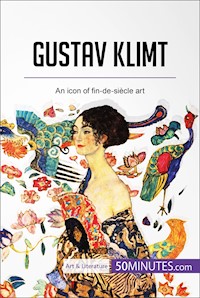
Keen to learn but short on time? Find out everything you need to know about the life and work of Gustav Klimt in just 50 minutes with this straightforward and engaging guide!
Gustav Klimt was one of the most influential artists of the late 19th and early 20th centuries, and helped to revolutionise art in his native Austria through his leading role in the Viennese Secession movement. Works such as
The Kiss are instantly recognisable due to their use of gold leaf; along with elements such as the use of mosaics, the incorporation of allegory into his work and the overt sensuality of his female figures, this helped to inaugurate a new, less conventional style of art in Europe. Although some of Klimt’s work caused a scandal and was dismissed as “pornographic” when it was first produced, his paintings were lauded abroad, and a number of them are now widely recognised as masterpieces.
In this book, you will learn about:
• The artistic landscape of 19th-century Austria and the emergence of the Vienna Secession
• Klimt’s main works, including his iconic painting
The Kiss, and the reception they received
• His influence on later artists, including Egon Schiele and Friedensreich Hundertwasser
ABOUT 50MINUTES.COM | Art & Literature
The Art & Literature series from the 50Minutes collection aims to introduce readers to the figures and movements that have shaped our culture over the centuries. Our guides are written by experts in their field and each feature a full biography, an introduction to the relevant social, political and historical context, and a thorough discussion and analysis of the key works of each artist, writer or movement, making them the ideal starting point for busy readers looking for a quick way to broaden their cultural horizons.
Das E-Book können Sie in Legimi-Apps oder einer beliebigen App lesen, die das folgende Format unterstützen:
Seitenzahl: 27
Veröffentlichungsjahr: 2018
Ähnliche













GUSTAV KLIMT
Born: 14 July 1862 in Baumgarten (Austria).Died: 6 February 1918 in Vienna.Context: the Art Nouveau and Symbolist movements in Vienna at the turn of the 20th century.Notable works:Pallas Athene (1898), paintingBeethoven Frieze (1902), paintingPhilosophy (1907), paintingThe Kiss (1907-1908), paintingDanaë (1907-1908), paintingGustav Klimt was one of the leading members of the Vienna Secession, a movement closely associated with Art Nouveau that flourished in Vienna at the turn of the 20th century and revitalised Austrian art.
At the beginning of his career, Klimt was known for his neoclassical wall paintings, before turning away from the conventional style that had brought him success and recognition to become one of the founding members of the Vienna Secession. His vast body of work includes oil paintings, murals, sketches and objets d’art, as well as architectural decorations, cartoons for tapestries and mosaics, ceramic works and lithographs. His most frequent subject was the female body, which he depicted with frank eroticism, and he often incorporated sensual and exotic elements into his work. His output was modern and innovative, and featured a wide range of characters, allegorical subjects, nudes, portraits and landscapes.
However, even when the sexual symbolism and eroticism of his work were veiled by allegory, they proved too much for the Viennese middle classes. Klimt was at the forefront of modern Austrian art, but although his work was admired by a new generation of avant-garde artists, it shocked conservatives and inspired heated debate. In spite of this initial controversy, many of his works are now considered to be key landmarks in art history.
CONTEXT
VIENNA IN 1900
Klimt’s work was shaped by the thriving metropolis where he lived, namely Vienna, which, along with Paris, Brussels and London, was one of the great European cities at the start of the 20th century. At this time, the capital of the Austro-Hungarian Empire was in the midst of a period of continual economic and demographic growth, spurred by urban expansion and immigration. By 1900, Vienna was home to two million people, and Austria-Hungary as a whole had 50 million inhabitants.
From 1848 to 1916, the country was ruled by Emperor Franz Joseph I (1830-1916), who modernised and centralised its administration in Vienna, ordered the destruction of the city’s ramparts, reduced customs tariffs, unified the tax system, played a key role in the foundation of the University of Vienna and implemented a number of other policies that cemented the city’s status as the country’s economic, scientific and artistic centre.
This transformation went hand in hand with a profound shift in the composition and customs of Viennese society. Immigrants from all over the Empire and beyond flocked to this cosmopolitan metropolis, which became a melting pot of different religions and customs. This cultural mixing led to the emergence of new social classes, and the first trade unions and political parties appeared. Although he was opposed to universal suffrage on principle, Franz Joseph eventually granted it under pressure from his subjects. As the middle class expanded and became an essential part of the economy, the aristocracy and the monarchy found their power under threat.




