


7,19 €
Mehr erfahren.
- Herausgeber: Unicorn
- Kategorie: Geisteswissenschaft
- Sprache: Englisch
The Battle of Hamel is arguably, the most important battle of the First World War yet it is still relatively unknown. It was turning point of the Great War and saw American troops fighting alongside Australian troops in their first taste of war on foreign soil, making the reputation of the man who led the troops, General Monash of the Australian Army. In the summer of 1918 the war was in the balance but the battle plan was beautifully conceived and executed, and without the Allies' victory, Amiens would not have been possible. It is special for three reasons, firstly it lasted only ninety minutes with very few casualties. Secondly it was the battle that set up the troops for Amiens after which the Germans were rolled back to Berlin. Finally and most importantly it is the first time American troops fought on foreign soil and really entered international politics. Formerly on the course at Sandhurst it has now been replaced by more modern examples but Hamel is still the perfect battle a century on, superbly prepared. When most battles are fought the original plans go out of the window, not so with Hamel.
Das E-Book können Sie in Legimi-Apps oder einer beliebigen App lesen, die das folgende Format unterstützen:
Veröffentlichungsjahr: 2018
Ähnliche



















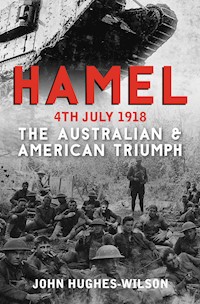
HAMEL4TH JULY 1918
The Australian & American Victory
John Hughes-Wilson
This book is dedicated to the memory of Professor and Brigadier Richard Holmes, CBE; gentleman, scholar and soldier; first Patron of the International Guild of Battlefield Guides.
Contents
Introduction
‘World War I was the most colossal, murderous, mismanaged butchery that has ever taken place on earth. Any writer who said otherwise lied. So the writers either wrote propaganda, shut up, or fought.’
Ernest Hemingway
THE Battle of le Hamel on 4 July 1918 was a dramatic turning point in the First World War. It may have been a very small battle in terms of overall numbers but its legacy resonates to this day. From this limited experimental offensive by British, Australian and American troops has come the whole modern war-fighting concept of combining all arms in the attack; infantry, artillery; airpower; tanks; deception and, above all, surprise. To say Hamel was the ‘first Blitzkrieg’ is to overstate the case: but only just. Hamel’s success and its subsequent impact paved the way for all future Blitzkriegs. Hamel showed how the muddy stalemate of trench warfare could be broken, with devastating results.
Hamel had other consequences too. Its crushing defeat demonstrated the growing weakness of the German Army after Ludendorff’s failed mass onslaught of spring 1918; it showed the Australian Corps at its ferocious fighting best; and it was one of the first bloodings of the newly-arrived American Expeditionary Force in France. The lessons of Hamel unleashed a military phenomenon, ‘Blitzkrieg,’ or ‘Lightning War,’ that still casts a long shadow: from France’s humiliating defeat in 1940 to Zhukov’s devastating onslaught into Japanese Manchuria in July 1945; and from Israel’s ruthless destruction of Egypt in 1967 to Norman Schwarzkopf’s text-book annihilation of Saddam Hussein’s Iraqi Army in 1991 – all were based on the principles tried and tested at the little village of le Hamel, outside the northern French city of Amiens in mid-summer 1918.
This tiny test tube of a battle paved the way for Allied victory and the final defeat of Kaiser Wilhelm’s Second Reich in the war they had begun four years earlier. It also gave a blueprint for modern warfare. It is therefore a matter of curiosity that Hamel has been widely ignored in histories of the First World War, even by such highly regarded military historians as Hew Strachan and the late Sir John Keegan. This book serves to correct that omission.
Because, small scale or not, Hamel stands as one of the defining battles of the Western World. It deserves to be remembered, if only for the fact that it started the chain of events that ended the First World War.
CHAPTER 1
Background to WWI
‘It would seem that events in the earlier part of the war made greater impression than later adventures…’
British Official History, 1918
WE ALL tend to think about the First World War through the distorting prism of its first two years, 1914 to 1916. The Great War on the Western Front has become synonymous with futility, mud, blood and senseless slaughter. Even the memory of Gallipoli is that of military incompetence, pointless casualties, death and misery.
This is a very narrow take on the true history of the ‘Great European Civil War’ that changed the world forever. The final two years, 1917 and 1918, reveal a much more dynamic war and a conflict that was very different to the first static years of Ypres, Notre Dame de Lorette, the Champagne, Loos, Verdun and the Somme, let again the pointless stalemate of Gallipoli. After 1916 everything changes. By the end of 1916 all the original strategic options – for both sides – had been exhausted and shown up as impossible goals. Germany was never going to be able to negotiate an end to the fighting and a favourable peace treaty; the Entente Allies were now grimly determined on a fight to the finish and drive the invading Germans back out of France and Belgium.
So it was that 1917 began as the year of hope and the year that would bring victory. Germany was intent on strangling Britain’s maritime supply line by unrestricted submarine warfare, which effectively meant sinking merchant ships on sight and without warning in UK waters. Berlin was even prepared to risk America joining the war in order to bring its principal enemy to its knees as quickly as possible.
France, under its new Commander in Chief, General Robert Nivelle, believed it had found the way to a major breakthrough in the west on the Chemin des Dames in the Champagne, boastfully claiming after his 1916 victories at the forts of Verdun, ‘We have the method.’ Britain was planning major new offensives at Arras, Messines and increasing its blockade of the Kaiser’s Reich to starve Germany out. Italy was planning yet another series of attacks across the River Isonzo to drive the Austrians out of their stronghold in the mountains in the north. Russia was beginning to realise that unless the Czar’s armies could win a major victory in the east, then a revolution was on the cards. For all sides, 1917 promised to be a decisive year.
It was: but not as the planners hoped.
By the fourth Christmas of the war the Great War was going badly – for everyone. The failure of the much vaunted French spring offensive on the Champagne had led to strikes, mutinies and a widespread collapse of French soldiers’ morale. Red revolution was in the air. From May onwards the Poilus (literally translated as ‘the hairy ones’) of the French Army, sick of pointless attacks, was effectively working to rule and would remain firmly in the military convalescent ward for at least another year. The arrival of America into the war in April was welcome news to a Britain within six weeks of running out of food, thanks to the depredations of the German U Boats. But real relief on the ground was still far away. America could not field an army in France before 1918.
Despite the British Expeditionary Force (BEF) summer’s success at Messines, PM Lloyd George and the politicians had dithered for nearly two months before allowing Haig to launch his long-cherished offensive against Ypres and strike north to try and cut off the German submarine bases on the Belgian north-east coast. The delay proved fatal; by November ‘3rd Ypres’ had deteriorated into the mud and bloodletting of Passchendaele, with its catastrophic losses of British manpower. Historian AJP Taylor called it, ‘the blindest slaughter of a blind war,’ a view shared by subsequent historians. Those who were actually present confirm this. In early 1918 Private R.A. Colwell, wrote of Passchendaele:
‘There was not a sign of life of any sort. Not a tree, save for a few dead stumps which looked strange in the moonlight. Not a bird, not even a rat or a blade of grass. Nature was as dead as those Canadians whose bodies remained where they had fallen the previous autumn. Death was written large everywhere.’
But the slaughter at Passchendaele cut both ways. The blood-letting was matched by the German High Command’s dismay at the way the long muddy battle had bled the Kaiser’s army dry as well, as the German Official History makes clear:
‘The [British] offensive had protected the French against fresh German attacks, and thereby procured them time to re-consolidate their badly shattered troops. It compelled OHL to exercise the strongest control over and limit the engagement of forces in other theatres of war; two divisions on their way from the east to Italy [Caporetto] had to be diverted from Italy to Flanders. But above all the battle had led to an excessive expenditure of German forces. The casualties were so great that they could no longer be covered, and the already reduced battle strength of battalions sank significantly lower.’
Although the casualty figures have long been the subject of hot debate, Professor Richard Holmes’ calculation that both sides suffered 260,000 casualties is now accepted as the best estimate. As a horrified German High Command counted the cost of Haig’s stubborn offensive, it proved that, if nothing else, ‘Passchendaele’ had demonstrated attrition’s inexorable, if logical, impact for all sides.
Even the success of Haig’s large-scale tank raid at Cambrai in December, which had caused church bells to be rung in Britain, had been stopped by a determined German counter-attack amid scenes of panic in the BEF. Horace Walpole’s stinging eighteenth-century judgement best sums up the disappointment of Cambrai: ‘They are ringing their bells to-day; very soon they will be wringing their hands.’
Elsewhere, the news from Britain’s Allies as 1917 drew to its gloomy close was everywhere of failure. In Italy a massive German-Austrian autumn breakthrough at Caporetto had routed the Italians and was only halted by the attackers’ overextended logistic and supply lines, and rivers in flood. Further north Czarist Russia had collapsed politically and militarily and, after their successful coup, Lenin’s Bolsheviks were busy preparing to construct their Marxist Paradise and begging Berlin for a peace deal at any price. Ominously, Russia’s final collapse and capitulation at Brest-Litovsk now meant that eighty divisions could be transferred from the Eastern Front to Germany’s army in the west.
The only ray of hope for the Entente Allies was Allenby’s capture of far off Jerusalem in December, amid growing signs of weakness in the Ottoman Turkish Army. 1917 – the year of hope – had turned out to be a bed of ashes, despair and desperation. All sides were beginning to realise that the war could not continue like this. Time – never mind manpower – was fast running out. War-weary and exhausted, the combattants faced up to what they were beginning to realise would really be the year of decision – 1918.




