


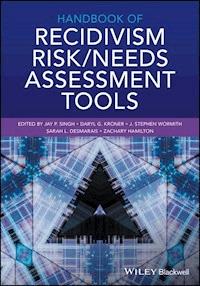
Handbook of Recidivism Risk / Needs Assessment Tools E-Book
44,99 €
Mehr erfahren.
- Herausgeber: John Wiley & Sons
- Kategorie: Fachliteratur
- Sprache: Englisch
Provides comprehensive coverage on recidivism risk/needs assessment tools
Correctional and healthcare professionals around the world utilize structured instruments referred to as risk/needs assessment tools to predict the likelihood that an offender will recidivate. Such tools have been found to provide accurate and reliable evaluations and are widely used to assess, manage, and monitor offenders both institutionally as well as in the community. By identifying offenders in need of different levels of intervention, examining causal risk factors, and individualizing case management plans, risk/needs assessment tools have proven invaluable in addressing the public health issue of recidivism. Recidivism Risk/Needs Assessment Tools brings together the developers of the most commonly-used risk/needs assessment tools to provide a comprehensive overview of their development, peer-reviewed research literature, and practical application.
Written by the leading professionals in the field of risk/needs assessment, the book provides chapters on: Recidivism Risk Assessment in the 21st Century; Performance of Recidivism Risk Assessment Instruments in Correctional Settings; Correctional Offender Management Profiles for Alternative Sanctions (COMPAS); the Federal Post-Conviction Risk Assessment Instrument; the Inventory of Offender Risks, Needs, and Strengths (IORNS); the Level of Service (LS) Instruments; the Ohio Risk Assessment System (ORAS); the Self-Appraisal Questionnaire (SAQ); the Service Planning Instrument (SPIn); the Static Risk Offender Needs Guide-Revised (STRONG-R); the Offender Group Reconviction Scale (OGRS); the Forensic Operationalized Therapy/Risk Evaluation System (FOTRES); the RisCanvi; and more.
- Systematically identifies currently-validated recidivism risk/needs assessment tools
- Reviews research on recidivism risk/needs assessment tools used internationally
- Each chapter presents sufficient detail to decide whether a given recidivism risk/needs assessment tool is right for your practice
Recidivism Risk/Needs Assessment Tools is ideal for correctional, probation and parole, and behavioral health professionals.
Sie lesen das E-Book in den Legimi-Apps auf:
Seitenzahl: 723
Veröffentlichungsjahr: 2017
Ähnliche




















Handbook of Recidivism Risk/Needs Assessment Tools
Edited by Jay P. Singh, Daryl G. Kroner, J. Stephen Wormith, Sarah L. Desmarais, and Zachary Hamilton
This edition first published 2018© 2018 John Wiley & Sons, Ltd
All rights reserved. No part of this publication may be reproduced, stored in a retrieval system, or transmitted, in any form or by any means, electronic, mechanical, photocopying, recording or otherwise, except as permitted by law. Advice on how to obtain permission to reuse material from this title is available at http://www.wiley.com/go/permissions.
The right of Jay P. Singh, Daryl G. Kroner, J. Stephen Wormith, Sarah L. Desmarais, and Zachary Hamilton to be identified as the authors of editorial material in this work has been asserted in accordance with law.
Registered Office(s)John Wiley & Sons, Inc., 111 River Street, Hoboken, NJ 07030, USAJohn Wiley & Sons Ltd, The Atrium, Southern Gate, Chichester, West Sussex, PO19 8SQ, UK
Editorial OfficeThe Atrium, Southern Gate, Chichester, West Sussex, PO19 8SQ, UK
For details of our global editorial offices, customer services, and more information about Wiley products visit us at www.wiley.com.
Wiley also publishes its books in a variety of electronic formats and by print‐on‐demand. Some content that appears in standard print versions of this book may not be available in other formats.
Limit of Liability/Disclaimer of WarrantyWhile the publisher and authors have used their best efforts in preparing this work, they make no representations or warranties with respect to the accuracy or completeness of the contents of this work and specifically disclaim all warranties, including without limitation any implied warranties of merchantability or fitness for a particular purpose. No warranty may be created or extended by sales representatives, written sales materials or promotional statements for this work. The fact that an organization, website, or product is referred to in this work as a citation and/or potential source of further information does not mean that the publisher and authors endorse the information or services the organization, website, or product may provide or recommendations it may make. This work is sold with the understanding that the publisher is not engaged in rendering professional services. The advice and strategies contained herein may not be suitable for your situation. You should consult with a specialist where appropriate. Further, readers should be aware that websites listed in this work may have changed or disappeared between when this work was written and when it is read. Neither the publisher nor authors shall be liable for any loss of profit or any other commercial damages, including but not limited to special, incidental, consequential, or other damages.
Library of Congress Cataloging‐in‐Publication Data Is Available
ISBN 9781119184287 (cloth)ISBN 9781119184294 (paper)ISBN 9781119184263 (ePUB)ISBN 9781119184270 (ePDF)
Cover Design by WileyCover Image: © Koron/Gettyimages
To Mom, Dad, Anj, Josh, and Erik for sticking out a long journey
To Norma Raycraft
To Amelita Bayani and Donnie Wormith
To my husband, Richard, and our girls, Grace and Mireille
To Robert ‘Barney’ Barnoski, Tim Brennan, and my wife, Sarah
Notes on Contributors
Antonio Andrés‐Pueyo, PhD, is Professor and Chair of the Clinical Psychology and Psychobiology at the University of Barcelona (Spain). He is a member of the Advanced Studies of Violence Group (GEAV) and co‐author of the RisCanvi. His research interests include violence risk assessment and management in correctional settings.
Karin Arbach‐Lucioni, PhD, is Professor at the School of Psychology of National University of Cordoba (Argentina) and Researcher at the National Council of Scientific and Technological Research of Argentina. She has co‐authored the RisCanvi. She is an expert in violence risk assessment and management in psychiatric and correctional facilities.
Christopher Baird is currently Chairman of the Board of Directors of the National Council on Crime and Delinquency (NCCD). Before retiring in 2012, he spent 28 years with NCCD, serving as Research Director, Vice President, and President. He authored dozens of research articles and reports and received several national awards for his work.
James Bonta received his PhD in Clinical Psychology from the University of Ottawa in 1979. Upon graduating, Dr Bonta was the Chief Psychologist at the Ottawa‐Carleton Detention Centre, a maximum security remand centre for adults and young offenders. During his 14 years at the Detention Centre he established the only full‐time psychology department in a jail setting in Canada. In 1990 Dr Bonta joined Public Safety Canada where he was Director of Corrections Research until his retirement in 2015. Throughout his career, Dr Bonta has held various academic appointments, professional posts, and he was a member of the Editorial Advisory Boards for the Canadian Journal of Criminology and Criminal Justice and Behavior. He is a Fellow of the Canadian Psychological Association, a recipient of the Criminal Justice Section's Career Contribution Award for 2009, the Queen Elizabeth II Diamond Jubilee Medal, 2012, the Maud Booth Correctional Services Award (2015), and the 2015 Community Corrections Award, International Corrections and Prisons Association. Dr Bonta has published extensively in the areas of risk assessment and offender rehabilitation. His latest publications include a book co‐authored with the late D. A. Andrews entitled The Psychology of Criminal Conduct now in its sixth edition (with translations in French and Chinese). He is also a co‐author of the Level of Service offender risk‐need classification instruments which have been translated into six languages and are used by correctional systems throughout the world.
Tim Brennan is Chief Scientist at Northpointe Institute. His work has appeared in the Journal of Quantitative Criminology, Criminology and Public Policy, Criminal Justice and Behavior, and others. His research interests are in quantitative methods for offender classification, machine learning, risk assessment, sentencing decision‐making, and open dynamic systems modeling. He was recipient of the Warren‐Palmer award from the Corrections and Sentencing Division of the American Society of Criminology.
Thomas H. Cohen is a social science analyst at the Administrative Office of the United States Courts (AOUSC), Probation and Pretrial Services Office. His work includes analyzing risk assessment at the post‐conviction and pretrial levels and authoring reports on how the AOUSC integrates the risk principle into its operational practices. His recent research has appeared in Criminology and Public Policy, Criminal Justice Policy Review, Federal Probation, Law and Human Behavior, and Psychological Services. Moreover, he has authored several technical reports on criminal court case processing at the state and federal levels through his prior work at the Bureau of Justice Statistics.
Sarah L. Desmarais, PhD is an Associate Professor and Coordinator of the Applied Social and Community Psychology Program at North Carolina State University. Her current research focuses on the assessment and treatment of justice‐involved adolescents and adults and the assessment of risk for terrorism. She has more than 100 peer‐reviewed publications on topics including violence and mental illness, behavioral health and risk assessment strategies, and domestic violence. Dr. Desmarais is co‐author of the Short‐Term Assessment of Risk and Treatability (START) and the Short‐Term Assessment of Risk and Treatability: Adolescent Version (START:AV). She has conducted trainings worldwide on risk assessment and serves on local, state, and federal behavioral health and criminal justice policy taskforces.
William Dieterich is Director of Research at Northpointe Institute. His work has appeared in Prevention Science, Journal of Quantitative Criminology, Criminal Justice and Behavior, and others. His interests focus on risk model development and validation, survival modeling, and related methods.
Jérôme Endrass studied psychology, psychopathology, and philosophy at the University of Zurich. He received his habilitation at the University of Zurich in 2008. Since 2011, he has been an APL professor at the University of Constance and is currently head of the forensic psychology research group. Since October 2013, he has served as deputy head of the Department of Mental Health Services, and prior to that, between 2003 and September 2013, he led the Research Department.
Leonel C. Gonçalves studied forensic psychology at the University of Minho, School of Psychology, Portugal, where he completed his Master (2008) and PhD degrees (2014). Since November 2014, he has been working as a researcher at the Department of Mental Health Services of the Zurich Office of Corrections, in the Research and Development Division. His research interests include inmate adjustment to prison life and the assessment of offenders.
Zachary Hamilton, PhD, is currently an Associate Professor of Criminal Justice and Criminology at Washington State University, the Director of the Washington State Institute of Criminal Justice (WSICJ). He is the primary developer of the Static Risk Offender Needs Guide – Revised (STRONG‐R), the Modified Positive Achievement Change Tool (M‐PACT) for juveniles, the Spokane Assessment for Evaluation of Risk (SAFER) for pretrial defendants, and the Nebraska Department of Correctional Services Infractions Risk and Prison Classification Instrument. His current work focuses on risk and needs assessment and identifying responsive populations for treatment matching. Recent publications have appeared in Criminology and Public Policy, Experimental Criminology, Justice Quarterly, Journal of Substance Abuse Treatment, Criminal Justice & Behavior, Sex Abuse, Victims and Violence, and Offender Rehabilitation.
Philip Howard, PhD, is a Principal Research Officer in the Analytical Services Directorate of the United Kingdom's Ministry of Justice. His current research interests include modeling recidivism and prison safety risks, and the integration of risk assessment into prison and probation operational practice. His recent research has been published in journals including Criminal Justice and Behavior, Law and Human Behavior, and Sexual Abuse, and he frequently contributes to guidance issued to prison and probation officers.
Kiersten L. Johnson, PhD received her doctorate in psychology from North Carolina State University. She currently works at the RAND Corporation.
Natalie J. Jones holds a PhD and an MA in Psychology from Carleton University in Ottawa, Canada, both with a forensic specialization. In 2011, she was awarded the Canadian Psychological Association Certificate of Academic Excellence for Best Doctoral Dissertation. Upon completing her doctoral work, Dr Jones joined Orbis Partners as Director of Research. In this capacity, she is responsible for managing justice‐related research projects including the validation of risk assessment tools, program evaluations, and the provision of research services to clients across the United States and Canada. Her specific research interests lie in the development of strengths‐based and gender‐informed risk assessment and intervention strategies for justice‐involved populations. In addition, Dr Jones has several peer‐reviewed publications in investigative psychology spanning the areas of offender profiling, linkage analysis, indicators of suicide note authenticity, and diagnostic decision‐making in policing contexts.
Daryl G. Kroner, PhD, is a Professor at the Department of Criminology and Criminal Justice at Southern Illinois University (SIU). He has more than 20 years of experience in the field as a correctional psychologist. During this time, he worked at maximum, medium, and minimum facilities delivering intervention services to incarcerated men. Dr Kroner has consulted on prison management and release issues, including with the Council of State Governments Justice Center and the UK's National Offender Management System. Dr Kroner is the past‐chair of Criminal Justice Psychology of the Canadian Psychological Association and past‐chair of the Corrections Committee for the American Psychology and Law Society. He is also a fellow of the Canadian Psychological Association. In collaboration with Dr Jeremy Mills he has developed several instruments, including the Measures of Criminal Attitudes and Associates (MCAA); Depression, Hopelessness and Suicide Scale (DHS); Criminal Attribution Inventory (CRAI); Transition Inventory (TI); and the Measures of Criminal and Antisocial Desistance (MCAD). In 2008, Dr Kroner joined the Department of Criminology and Criminal Justice at SlU. Current research interests include risk assessment, measurement of intervention outcomes, interventions among offenders with mental illness, and criminal desistance.
Edward J. Latessa received his PhD from Ohio State University and is Director and Professor of the School of Criminal Justice at the University of Cincinnati. Dr Latessa has published over 170 works in the area of criminal justice, corrections, and juvenile justice. He is co‐author of eight books including What Works (and Doesn't) in Reducing Recidivism, Corrections in the Community, and Corrections in America. Professor Latessa has directed over 195 funded research projects including studies of day reporting centers, juvenile justice programs, drug courts, prison programs, intensive supervision programs, halfway houses, and drug programs. He and his staff have also assessed over 1,000 correctional programs throughout the United States, and he has provided assistance and workshops in 48 states. Dr Latessa served as President of the Academy of Criminal Justice Sciences (1989–90). He has also received several awards including: Marguerite Q. Warren and Ted B. Palmer Differential Intervention Award presented by the Division of Corrections and Sentencing of the American Society of Criminology (2010), Outstanding Community Partner Award from the Arizona Department of Juvenile Corrections (2010), Maud Booth Correctional Services Award in recognition of dedicated service and leadership presented by the Volunteers of America (2010), Community Hero Award presented by Community Resources for Justice, (2010), the Bruce Smith Award for outstanding contributions to criminal justice by the Academy of Criminal Justice Sciences (2010), the George Beto Scholar, College of Criminal Justice, Sam Houston State University, (2009), the Mark Hatfield Award for contributions in public policy research by The Hatfield School of Government at Portland State University (2008), the Outstanding Achievement Award by the National Juvenile Justice Court Services Association (2007), the August Vollmer Award from the American Society of Criminology (2004), the Simon Dinitz Criminal Justice Research Award from the Ohio Department of Rehabilitation and Correction (2002), the Margaret Mead Award for dedicated service to the causes of social justice and humanitarian advancement by the International Community Corrections Association (2001), the Peter P. Lejins Award for Research from the American Correctional Association (1999); ACJS Fellow Award (1998); ACJS Founders Award (1992); and the Simon Dinitz award by the Ohio Community Corrections Organization. In 2013 he was identified as one of the most innovative people in criminal justice by a national survey conducted by the Center for Court Innovation in partnership with the Bureau of Justice Assistance and the U.S. Department of Justice.
Brian K. Lovins is the Assistant Director for Harris County Community Supervision and Corrections Department. He earned his PhD in Criminology from the University of Cincinnati, School of Criminal Justice. Prior to coming to Houston, his work at the School of Criminal Justice included developing a state‐wide juvenile risk assessment (Ohio Youth Assessment System, OYAS) and adult risk assessment (Ohio Risk Assessment System, ORAS), as well as redesigning juvenile and adult correctional programs to meet evidence‐based standards. Dr Lovins has been invited to present to over 150 agencies and routinely trains agencies in the principles of effective intervention, risk assessment, and the delivery of cognitive‐behavioral interventions. In addition, he has published articles on risk assessment, sexual offenders, effective interventions, and cognitive‐behavioral interventions.
Christopher T. Lowenkamp received his PhD in Criminal Justice from the University of Cincinnati (UC). He has served as the director of the Center for Criminal Justice Research and the associate director of The Corrections Institute at UC. He has also served as a probation officer and jail emergency release coordinator in Summit County Ohio and as a probation administrator with the Office of U.S. Probation and Pretrial Services. Dr Lowenkamp is currently a social science analyst at the Administrative Office of the United States Courts (AOUSC), Probation and Pretrial Services Office. He has co‐authored over 75 articles and book chapters. In an effort to close the knowing‐doing gap, Dr Lowenkamp has been involved in training thousands of correctional staff in effective practices and risk assessment.
Wagdy Loza is a licensed psychologist in Ontario. He was the Chief Psychologist at Kingston Penitentiary before he retired from the Correctional Service of Canada after 30 years of service. He is currently a member of the Ontario Review Board which is responsible for determining whether criminals who were found “not criminally responsible due to mental illness” were well enough to be released into the community. Dr Loza has developed two widely used psychological tests. The first is used to predict whether criminals will reoffend violently or non‐violently. The second is designed to measure Middle‐Eastern extremism and terrorism. Dr Loza is also an Adjunct Assistant Professor (Psychiatry, Queen's University) and ex. Adjunct Professor (Psychology, Carleton University). He has over 40 publications and offers training, workshops, and presentations in several countries around the world.
Jennifer L. Lux is a Research Associate at the University of Cincinnati Corrections Institute (UCCI). She earned her PhD in Criminal Justice from the University of Cincinnati, School of Criminal Justice in 2016. Her research interests include the assessment of correctional programs, the science of implementation and knowledge transfer, and more generally correctional treatment and rehabilitation. She has co‐authored publications and served as a project director on several correctional projects. Specific topics of research and service include an evaluation study of juvenile programs in the state of Ohio and the implementation and rollout of the Texas Risk Assessment System in partnership with the Texas Department of Criminal Justice. For the last five years, the majority of Dr Lux's experience has been with risk assessment instruments, from training to coaching to ensure agencies are using the tools with fidelity and integrity, to working with the University of Cincinnati Information Technology Solutions Center to develop and maintain various correctional agencies' automated risk assessment systems.
Xiaohan Mei is a PhD candidate in criminal justice and criminology at Washington State University and senior research associate of the Washington State Institute for Criminal Justice (WSICJ). His most recent publications on validation of measurement instruments appeared in the Prison Journal. His research interests include the study of deviance and criminology, risk‐needs assessment instrument validation, core correctional practices and program fidelity, management in corrections and organizational studies, quantitative methodology, and psychometric analytic approaches. His work has also appeared in Journal of Offender Rehabilitation and International Journal of Offender Therapy and Comparative Criminology.
Holly A. Miller holds a PhD in Clinical Psychology from Florida State University and currently is the Associate Dean and a Professor in the College of Criminal Justice at Sam Houston State University. She is the author of the Miller Forensic Assessment of Symptoms Test (M‐FAST) and the Inventory of Offender Risk, Needs, and Strengths (IORNS). Dr. Miller’s teaching, research, and practice interests include forensic assessment and working with individuals who have sexually offended. She is a licensed clinical psychologist and sex offender treatment provider who consults with various agencies providing expertise on evaluation, treatment, and research.
John Monahan, a psychologist, holds the John S. Shannon Distinguished Chair in Law at the University of Virginia, where he is also Professor of Psychology, and Professor of Psychiatry and Neurobehavioral Sciences. He is a member of the National Academy of Medicine and serves on the National Research Council. In 2016, Monahan was elected a Fellow of the American Academy of Arts and Sciences.
Santiago Redondo, PhD, is Professor and Chair of the Advanced Studies of Violence Group at the University of Barcelona. He has co‐authored the RisCanvi. Dr Redondo has a long experience in applied research with sexual and violent offenders and is an expert in criminology.
Charles Robinson has nearly 20 years of experience in community supervision. He currently works for the United States Probation Office in the District of New Hampshire and previously served as the Travis County Community Supervision and Corrections Department (adult probation) chief probation officer. He has co‐authored publications, served as a trainer, and developed programs for criminal justice clients.
David Robinson holds a PhD in psychology from Carleton University and has engaged in the development, validation, and implementation of criminal justice assessments for more than 30 years. From 1988 to 1997, he was a senior research manager with Correctional Service Canada. After his tenure in government, he began consulting work and became a founding member of Orbis Partners in 2001. He has directed program evaluations on correctional interventions including cognitive skills, substance abuse, drug courts, boot camps, programs for women/girls, case management models, and juvenile diversion. Dr Robinson conducted validation studies on numerous assessment devices and worked on early validation efforts with the LSI and YLS. Over the past 20 years, he managed 12 state‐wide implementations of assessment and case management tools, along with work in numerous county and non‐government organizations. His current research focuses on measurement and validation of strengths in risk/need assessments.
Astrid Rossegger studied psychology and criminology at the University of Constance. Since 2000, she has worked as a researcher for the Department of Mental Health Services of the Canton of Zurich and has served as head of the Research Department since October 2013. She is a member of the executive board of the Department of Mental Health Services and since 2007 has taught at the University of Zurich and the University of Constance.
Douglas Routh is a PhD candidate in criminal justice and criminology at Washington State University and senior research associate of the Washington State Institute for Criminal Justice (WSICJ). His most recent publications on offender typologies, offender reentry, and offender rights have appeared in Justice Quarterly, Journal of Offender Rehabilitation, and International Journal of Offender Therapy and Comparative Criminology. His research interests include corrections, risk assessment, evidence‐based practices, problem‐solving courts, and quantitative methodology.
Jay P. Singh, PhD, PhD, is a Fulbright Scholar and the internationally award‐winning Founder and Chairman of the Global Institute of Forensic Research. Former Senior Clinical Researcher in Forensic Psychiatry and Psychology for the Department of Justice of Switzerland and fellow of the Mental Health Law and Policy Department at the University of South Florida, he completed his graduate studies in psychiatry at the University of Oxford and clinical Psychology at Universitat Konstanz. He was promoted to Full Professor at Molde University College in Norway in 2014 and is currently affiliated with the Department of Psychiatry and the Wharton School of Business at UPenn. Dr. Singh has been the recipient of awards from organizations including the prestigious 2015 Saleem Shah Early Career Excellence Award from the American Board of Forensic Psychology and 2015 Early Career Professional Award from APA Division 52. Additional bodies of recognition have included the American Psychology‐Law Society, the Royal College of Psychiatrists, the European Congress on Violence in Clinical Psychiatry, the Society for Research in Child Development, and the Society for Research in Adolescence.
Faye S. Taxman, PhD, is a University Professor in the Criminology, Law and Society Department and Director of the Center for Advancing Correctional Excellence at George Mason University. She is recognized for her work in the development of systems‐of‐care models that link the criminal justice system with other service delivery systems, as well as her work in reengineering probation and parole supervision services and in organizational change models. She developed the RNR Simulation Tool (www.gmuace.org/tools) to assist agencies to advance practice. Dr. Taxman has published more than 190 articles and several books including “Tools of the Trade: A Guide to Incorporating Science into Practice.” and “Implementing Evidence‐Based Community Corrections and Addiction Treatment” (Springer, 2012 with Steven Belenko). She is co‐Editor of the Health & Justice. The American Society of Criminology’s Division of Sentencing and Corrections has recognized her as Distinguished Scholar twice as well as the Rita Warren and Ted Palmer Differential Intervention Treatment award. She received the Joan McCord Award in 2017 from the Division of Experimental Criminology. She has a Ph.D. from Rutgers University’s School of Criminal Justice.
J. Stephen Wormith received his PhD from the University of Ottawa in 1977. Since then he has worked as a psychologist, researcher, and administrator at various correctional facilities in the Correctional Service of Canada and as Psychologist‐in‐Chief for the Ontario Ministry of Community Safety and Correctional Services. Currently, he is a professor in the Psychology Department at the University of Saskatchewan, where he is also the Director of the Centre of Forensic Behavioural Science and Justice Studies. Dr Wormith's research activities have concentrated on the assessment, treatment, and therapeutic processes of offenders. He co‐authored the Level of Service/Case Management Inventory (2004) with D. A. Andrews and J. Bonta, and participates internationally in research and training on risk assessment. He consults with the corrections departments in federal and provincial governments across Canada and serves in court as an expert witness on matters of offender assessment and treatment. He is on the editorial board of a number of criminal justice and psychology journals. Dr Wormith is a Fellow of the Canadian Psychological Association (CPA) and represents CPA on the National Associations Active in Criminal Justice. He is a recipient of the International Association of Correctional and Forensic Psychology's Edwin I. Megargee Distinguished Contribution Award and the American Psychological Association's Division 18 Leadership in Education Award.
Preface: Recidivism Risk Assessment in the 21st Century
John Monahan
The Handbook of Recidivism Risk Assessment could not be appearing at a more propitious time. Sentencing and parole authorities around the world are turning to behavioral science for guidance in triaging offenders into those who require rehabilitative interventions in institutional settings and those who can more effectively be treated in the community. Drs Singh, Kroner, Wormith, Desmarais, and Hamilton have gathered together an A‐list of leading international scholars and practitioners to portray and probe the field of recidivism risk assessment. The possibilities occasioned by this book for cross‐fertilization across instruments and across jurisdictions are difficult to exaggerate.
I will not attempt to summarize the myriad insights found between the covers of this remarkable book. Instead, let me briefly put three issues addressed in these chapters into the larger context of criminal sentencing: the theory of sentencing that animates or proscribes recourse to recidivism risk assessment, the diverse roles that recidivism risk assessment may play in sentencing, and conundrums that recur whenever recidivism risk informs sentencing (Monahan & Skeem, 2016).
The Role of Recidivism Risk Assessment in Hybrid Systems of Sentencing
Almost all jurisprudential scholars of sentencing distinguish between two broad and polar opposite approaches to the allocation of criminal punishment. One of these approaches is usually termed retributive and the other utilitarian. Adherents of the retributive approach believe that an offender's moral culpability for crime committed in the past should be the sole consideration in determining his or her punishment. In the best‐known retributive theory, known as “just deserts,” offenders should be punished “because they deserve it, and the severity of their punishment should be proportional to their degree of blameworthiness” (Frase, 2013, p. 8) for the crime they have committed in the past, and to nothing else.
In stark contrast, advocates of the utilitarian approach believe that punishment is justified solely by its ability to decrease future criminal acts by the offender or by deterring other would‐be offenders from committing—or continuing to commit—crime.
Many legal scholars have argued that any workable theory of sentencing must address both retributive and utilitarian concerns, rather than just one of them. The most influential hybrid theory of sentencing is that developed by Norval Morris (1974) which he called “limiting retributivism.” In Morris's theory, retributive principles can only set an upper (and perhaps also a lower) limit on the severity of punishment, and within this range of what he called “not undeserved” punishment, utilitarian concerns—such as the offender's risk of recidivism—can be taken into account.
The risk of recidivism has a central function in utilitarian theories of punishment, an important function (along with perceptions of blameworthiness) in hybrid theories of punishment, and no function (or a very limited one) in retributive theories of punishment.
The Roles of Recidivism Risk Assessment
Within the theoretical constraints described above lie three important roles for risk assessment in sentencing:
Informing Decisions Regarding the Imprisonment of Higher Risk Offenders
Risk assessment can provide an empirical estimate of whether an offender has a sufficiently high likelihood of again committing crime to justify a larger “dose” of incapacitation. That is, within a range of severity set by moral concerns about the criminal act of which the offender has been convicted, risk assessment can assist in determining whether, on utilitarian crime‐control grounds, an offender should be sentenced to the upper bound of that range.
Informing Decisions Regarding the Supervised Release of Lower Risk Offenders
Risk assessment can provide an empirical estimate of whether an offender has a sufficiently low likelihood of again committing crime to justify an abbreviated period of incapacitation, supervised release (probation/parole), or no incapacitation at all. Within a range of severity set by moral concerns about the criminal act of which the offender has been convicted, risk assessment can assist in determining whether, on utilitarian crime‐control grounds, an offender should be sentenced to the lower bound of that range.
Informing Decisions Designed to Reduce the Risk Posed by Offenders
Risk assessment can also inform correctional strategies to reduce an offender's level of risk, even if the length of a sentence is set by purely retributive concerns. Any valid tool can be used to identify higher risk offenders for more intensive interventions, placing others at appropriately lower levels of intervention. Programs that match the intensity of correctional interventions to offenders' risk level have been shown to reduce recidivism (Cohen, Lowenkamp, & VanBenschoten, 2016).
Risk assessment instruments differ in the sentencing goal(s) they are meant to fulfill: some are designed exclusively to predict recidivism (assess “risk” to fulfill Roles 1 and 2 above), whereas others are meant to inform risk reduction (assess “needs” to fulfill Role 3 above).
Recurring Conundrums When Recidivism Risk Informs Sentencing
Four difficult problems frequently accompany the introduction of recidivism risk assessment into the criminal sentencing process.
Conflating Risk and Blame
The task of assigning blame for an offender's past crime and the task of assessing an offender's risk for future crime are orthogonal aspects of sentencing. Dealing simultaneously with the independent concerns of blame and risk in sentencing is not unduly problematic when a given variable bears on both concerns to similar effect, e.g., when both concerns point in the direction of raising or both point in the direction of lowering the severity of a sentence otherwise imposed. But dealing with the separate concerns of blame for past crime and risk for future crime at the same time becomes problematic when a given variable bears importantly on one of the two concerns, but is irrelevant to the other. And dealing simultaneously with the orthogonal concerns of blame and risk becomes highly contested when a given variable bears on each of the two concerns, but to opposite effect.
First, consider variables that affect perceptions of blame and assessments of recidivism risk in similar ways. The clearest example of a variable that has comparable effects on perceptions of blame and on assessments of risk is involvement in crime. It has long been axiomatic in the field of risk assessment that past crime is the best predictor of future crime. All recidivism risk assessment instruments described in this book reflect this empirical truism.
Second, consider variables that affect either perceptions of blame or assessments of recidivism risk, but not both. Demographic and life history variables that characterize an offender may have significant predictive validity in assessing his or her likelihood of recidivism, but no bearing on the ascription of blame for the crime of which he or she was convicted. In terms of demography, race (Skeem & Lowenkamp, 2016), gender (Skeem, Monahan, & Lowenkamp, 2016), and (adult) age (Monahan, Skeem, & Lowenkamp, 2017) all correlate significantly with criminal recidivism. However, neither race nor gender nor (adult) age bear on an offender's blameworthiness for having committed crime in the past—as a class, offenders who are of one race are no more (and no less) blameworthy than offenders who are of another race, offenders who are women are no more (and no less) blameworthy than offenders who are men, and (adult) offenders of one age are no more (and no less) blameworthy than (adult) offenders who are of another age. The same is true of life history variables: educational attainment and employment status do not bear on an offender's blameworthiness for having committed crime. A high school drop‐out is no more (and no less) blameworthy than a high school graduate when he or she decides to commit a crime. The same can be said of people with and without a job.
Finally, consider variables that affect perceptions of blame and assessments of risk in contrary ways. The clearest example of a variable that has contrary effects on perceptions of blame and on assessments of recidivism risk is combat‐induced trauma. Numerous studies have found that combat‐induced post‐traumatic stress disorder (PTSD) is a significant risk factor for a soldier's future commission of serious violence to others in civilian life (e.g., Elbogen et al., 2014), and thus could serve as a valid risk factor for recidivism among offenders with combat‐induced PTSD. According to the United States Supreme Court, however, such trauma could also function to mitigate the offender's blameworthiness for the commission of crime, and therefore could serve to reduce the severity of a criminal sentence otherwise given. In Porter v. McCollum (2009), the Court stated: “Our Nation as a long tradition of according leniency to veterans in recognition of their service. [T]he relevance of [the defendant's] extensive combat experience is [t]hat the jury might find mitigating the intense stress and mental and emotional toll that combat took on [the defendant]” (p. 44).
Group Data and Individual Inferences
One issue that has generated much controversy in the field of risk assessment in recent years is whether accurate inferences about an individual person—in this case, the recidivism risk of a convicted offender—can be drawn from data derived from groups of people (in this case, the recidivism risk that characterizes groups of convicted offenders). Some scholars have taken the position that “on the basis of empirical findings, statistical theory, and logic, it is clear that predictions of future offending cannot be achieved, with any degree of confidence, in the individual case” (Cooke & Michie, 2010, p. 259).
This view has been vigorously contested. For example, Hanson and Howard (2010) state that Cooke and Michie's (2010) argument that individual inferences cannot be derived from group data “if true, . . . would be a serious challenge to the applicability of any empirically based risk procedure to any individual for anything” (p. 277). Mossman (2015, p. 99) offers a medical analogy: “Suppose a 50‐year‐old man learns that half of people with his diagnosis die in five years. He would find this information very useful in deciding whether to purchase an annuity that would begin payouts only after he reached his 65th birthday.”
The debate among scientists on the legitimacy of making individual inferences from group data appears to be subsiding. In the recent words of two eminent statisticians (Imrey & Dawid, 2015, p. 40):
If groups of individuals with high and low propensities for violence recidivism can be distinguished, and courts act upon such distinctions, recidivism will decline to the extent that groups most prone to violence are incapacitated, and infringements upon those least so prone are minimized.
Assessing Risk or Reducing Risk?
Although, as the chapters of this book amply illustrate, a wealth of empirical guidance is available for assessing adult offenders' risk of recidivism, far less guidance is available for reducing that risk. Validated “causal” risk factors—i.e., variable risk factors that, when changed through intervention, can be shown to change recidivism risk—are in short supply. High quality adult correctional services, in the United States at least, are even more rare. Based on a cohort of California prisoners, Petersilia and Weisberg (2010) found that substance abuse treatment (of any sort) was offered to 10% of those with substance abuse problems, and basic anger control treatment was offered to one‐quarter‐of‐one‐percent of those with anger problems. “Evidence‐based” treatment programs and principles are even more scarcely implemented in adult correctional settings. As Lipsey and Cullen (2007, p. 315) state: “The greatest obstacle to using rehabilitation treatment effectively to reduce criminal behavior is . . . a correctional system that does not use the research available and has no history of doing so.”
Risk Assessment and Racial Disparity
In the United States, according to data from the Bureau of Justice Statistics (Carson, 2014), young (i.e., 18–19‐year‐old) black males are over nine times more likely than young white males to be imprisoned. As Frase (2013) has stated:
Even when such disparity results from the application of seemingly appropriate, race‐neutral sentencing criteria, it is still seen by many citizens as evidence of societal and criminal justice unfairness; such negative perceptions undermine the legitimacy of criminal laws and institutions of justice, making citizens less likely to obey the law and cooperate with law enforcement. (p. 210)
Does the use of recidivism risk assessment in sentencing affect racial disparities in imprisonment. Former U.S. Attorney General Eric Holder (2014) believes that it does: Although risk assessments “were crafted with the best of intentions, I am concerned that they may inadvertently undermine our efforts to ensure individualized and equal justice.”
Whether risk assessment affects racial disparities in sentencing is an important empirical question. Risk assessment could exacerbate racial disparities in sentencing, as Holder hypothesizes. But risk assessment could also reduce or have no effect on disparities. Disparities associated with the use of risk assessment may vary as a function of both the baseline sentencing context and the risk assessment instrument chosen.
First, in terms of the baseline sentencing context, the question is “risk assessment compared to what?” The effect of risk assessment on disparities depends on what practices risk assessment is replacing. Common denominators include (a) judges' unstructured and informal consideration of offenders' likelihood of recidivism, which is less transparent, less consistent, and less accurate than evidence‐based risk assessment, and (b) sentencing guidelines that heavily rely on criminal history and therefore heavily contribute to racial disparities.
Second, the effect of risk assessment on disparities may depend on the specific risk assessment instrument chosen. Any instrument used to inform sentencing must be shown to predict recidivism with similar accuracy across groups, i.e., the instrument must be free of predictive bias. However, given a pool of instruments that are free of predictive bias, some instruments will yield greater mean score differences between groups than others (Skeem & Lowenkamp, 2016). Much more research is needed to define the conditions under which risk assessment affects sentencing disparities. Studies are needed to determine, for example, how strongly different instruments correlate with race, which risk factors drive that correlation, and what (if anything) can be done to reduce that correlation without compromising predictive utility. If policymakers blindly eradicate risk factors from a tool because they are contentious, they risk reducing predictive utility and exacerbating the very racial disparities they seek to ameliorate.
Recidivism Risk Assessment in the 21st Century
Developments in sentencing theory that justify reliance upon recidivism risk assessment, changes in sentencing policy that emphasize identifying offenders at high risk or at low risk of recidivism or that emphasize how to reduce offenders' recidivism risk, and the resolution of several persistent conundrums will determine the degree of progress that can be expected in incorporating recidivism risk into criminal sentencing. The Handbook of Recidivism Risk Assessment will be an essential source in guiding these developments.
References
Carson, E. (2014).
Prisoners in 2013
. Washington, DC: Bureau of Justice Statistics. Retrieved from
https://www.bjs.gov/content/pub/pdf/p13.pdf
Cohen, T., Lowenkamp, C., & VanBenschoten, S. (2016). Does change in risk matter? Examining whether changes in offender risk characteristics influence recidivism outcomes.
Criminology and Public Policy, 15
, 263–296. doi:10.1111/1745‐9133.12190
Cooke, D. J., & Michie C. (2010). Limitations of diagnostic precision and predictive utility in the individual case: A challenge for forensic practice.
Law and Human Behavior, 34
, 259–264. doi:10.1007/s10979‐009‐9176‐x
Elbogen, E., Johnson, S., Wagner, H., Sullivan, C., Taft, C., & Beckham, J. (2014). Violent behaviour and post‐traumatic stress disorder in US Iraq and Afghanistan veterans.
British Journal of Psychiatry, 204
, 368–375. doi:10.1192/bjp.bp.113.134627
Frase, R. S. (2013).
Just sentencing: Principles and procedures for a workable system
. New York, NY: Oxford University Press.
Hanson, K. R., & Howard, P. D. (2010). Individual confidence intervals do not inform decision‐makers about the accuracy of risk assessment evaluations.
Law and Human Behavior, 34
, 275–281. doi:10.1007/s10979‐010‐9227‐3
Holder, E. (2014). Attorney General Eric Holder Speaks at the National Association of Criminal Defense Lawyers 57th Annual Meeting. Retrieved from
http://www.justice.gov/opa/speech/attorney‐general‐eric‐holder‐speaks‐national‐association‐criminal‐defense‐lawyers‐57th
Imrey, P., & Dawid, P. (2015). A commentary on statistical assessment of violence recidivism risk.
Statistics and Public Policy, 2
, 25–42. doi:10.1080/2330443X.2015.1029338
Lipsey, M., & Cullen, F. (2007). The effectiveness of correctional rehabilitation: A review of systematic reviews.
Annual Review of Law and Social Science, 3
, 97–320. doi:10.1146/annurev.lawsocsci.3.081806.112833
Monahan, J., & Skeem, J. L. (2016). Risk assessment in criminal sentencing.
Annual Review of Clinical Psychology, 12
, 489–513. doi:10.1146/annurev‐clinpsy‐021815‐092945
Monahan, J., Skeem, J., & Lowenkamp, C. (2017). Age, risk assessment, and sanctioning: Overestimating the old, underestimating the young.
Law and Human Behavior. Advance online publication.
doi:10.1037/lhb0000233
Morris, N. (1974).
The future of imprisonment
. Chicago, IL: University of Chicago Press.
Mossman, D. (2015). From group data to useful probabilities: The relevance of actuarial risk assessment in individual instances.
Journal of the American Academy of Psychiatry and the Law, 43
, 93–102.
Petersilia, J., & Weisberg, R. (2010). The dangers of pyrrhic victories against mass incarceration.
Daedelus, 130
, 124–133. doi:10.1162/DAED_a_00028
Porter
v.
McCollum, 558 U.S. 30 (2009).
Skeem, J. L., & Lowenkamp, C. (2016). Risk, race, and recidivism: Predictive bias and disparate impact.
Criminology, 54
, 680–712. doi:10.1111/1745‐9125.12123
Skeem, J., Monahan, J., & Lowenkamp, C. (2016). Gender, risk assessment, and sanctioning: The cost of treating women like men.
Law and Human Behavior, 40
, 580–593. doi:10.1037/lhb0000206
Part IIntroduction
1Performance of Recidivism Risk Assessment Instruments in U.S. Correctional Settings*
Sarah L. Desmarais, Kiersten L. Johnson, and Jay P. Singh




