


21,99 €
Mehr erfahren.
- Herausgeber: John Wiley & Sons
- Kategorie: Geisteswissenschaft
- Sprache: Englisch
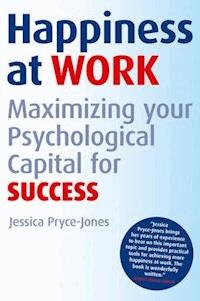
Sharing the results of her four-year research journey in simple, jargon-free language, Pryce-Jones exposes the secrets of being happy at work.
- Focuses on what happiness really means in a work context and why it matters to individuals and organisations in both human and financial terms
- Equips readers with the information, knowledge and skills to make the most of the nearly 100,000 hours that they'll spend at work over a lifetime
- Demystifies psychological research through a fascinating array of anecdotes, case studies, and interviews from people in the trenches of the working world, including business world-leaders, politicians, particle physicists, and philosophers, sheep farmers, waitresses, journalists, teachers, and lawyers, to name just a few
Sie lesen das E-Book in den Legimi-Apps auf:
Seitenzahl: 482
Veröffentlichungsjahr: 2011
Ähnliche



















Contents
Prologue
In the Beginning was the H Word
Who’s This Book For?
What’s Its Underlying Approach?
What Was My Aim?
What’s It All About?
What Are the Case Studies?
Who Are the Interviewees?
And Finally … How Happy Are You?
Acknowledgments
1: Why Happiness at Work? Why Now?
It Started for Me When …
Why Happiness at Work Matters
What Is Happiness at Work?
Happiness at Work: A Definition
Now’s the Time for a New Approach
Understanding Real Value
Myth 1: Financial Capital Is All That Counts
Myth 2: Happiness is Job Satisfaction or Engagement in Another Guise
Myth 3: You’re Born Happy or Sad and There’s Nothing You Can Do
Are You Leading the Life You Choose or Managing the One You’ve Got?
2: The Research Journey
The Initial Seeds
First of All, Focus Groups …
… Then One-to-One Interviews
And Hey Presto, the First Set of Findings
The Cold Hard Truth
Lose It or Use It
Building the Next Steps
Developing Outcome Measures
Launching the First iOpener People and Performance Questionnaire: The iPPQ
The 5Cs
And the Happiness–Productivity Link
Ten Top Findings That Really Matter
Concluding the End of the Beginning
3: Contribution from the Inside-Out
Introduction to Contribution
Contribution: Inside-Out and Outside-In
Achieving Your Goals
Having Clear Objectives
Raising Issues That Are Important to You
Feeling Secure in Your Job
Conclusion to the Four Inside-Out Elements
4: Contribution from the Outside-In
Introduction
Being Listened To
Receiving Positive Feedback
Feeling Appreciated at Work
Being Respected by Your Boss
Concluding the Outside-In Elements
Concluding Contribution
5: Conviction
Introduction to Conviction
Being Motivated
Believing You’re Efficient and Effective
Feeling Resilient When Times Are Tough
Perceiving That Your Work Has a Positive Impact on the World
Concluding Conviction
6: Culture
Introduction to Culture
Identifying Culture
Understanding Cultural Preference
Understanding the Elements of Culture
Relishing Your Job
Liking Your Colleagues
Appreciating the Values Your Organization Stands For
Having a Fair Ethos at Work
Being in Control of Your Daily Activities
Concluding Culture
7: Commitment
Introduction to Commitment
The Elements of Commitment
Doing Something Worthwhile
Being Interested in Your Job
Believing in the Vision of Your Organization
Feeling Strong Bursts of Positive Emotion
Concluding Commitment
8: Confidence
Introduction to Confidence
What Does Confidence Consist Of?
The Effects of Lack of Confidence …
… and Excessive Confidence
Getting Things Done
Having High Self-Belief
Understanding Your Role Backwards and Forwards
Concluding Confidence
9: Pride, Trust, and Recognition
Introduction to Pride, Trust, and Recognition
How Pride and Trust Work Together But Recognition is Separate
What is Pride?
Trust in Your Organization
Recognition for Your Achievements
Concluding Pride, Trust, and Recognition
10: Achieving Your Potential
Introduction to Achieving Your Potential
Feeling Energized
Using Your Strengths
Using Your Skills
Learning New Skills
Overcoming Challenges at Work
Concluding Achieving Your Potential
Happiness at Work A Conclusion
What Next?
References
1 Why Happiness at Work? Why Now?
2 The Research Journey
3 Contribution from the Inside-Out
4 Contribution from the Outside-In
5 Conviction
6 Culture
7 Commitment
8 Confidence
9 Pride, Trust, and Recognition
10 Achieving Your Potential
Happiness at Work: A Conclusion
Dramatis Personae
Index
Praise for Happiness at Work
“Jessica Pryce-Jones establishes happiness as more than a fleeting feeling; she argues that it is a critical resource for successful work and a good life. She brings her years of experience to bear on this important topic and provides practical tools for achieving more happiness at work. The book is wonderfully written.”
Robert Biswas-Diener, author of Positive Psychology Coaching
“We all want to be happy in every area of our lives, including work. This book offers the secret of finding happiness at work for us all, which in turn helps us to experience a more meaningful and healthy life.”
Lynne Franks, businesswoman and author of The Seed Handbook
“Illustrated with fascinating and diverse interviews, this book is understandable and easy to read. Jess Pryce-Jones has definitely created a great guide for anyone who wants to improve their working life.”
Cathy L. Greenberg, PhD, New York Times Best Selling author of What Happy Working Mothers Know, and Managing Partner of h2c Happy Companies Healthy People
For David, Jack, Harry, and Kitty – with love and thanks
This edition first published 2010
© 2010 Jessica Pryce-Jones
Wiley-Blackwell is an imprint of John Wiley & Sons, formed by the merger of Wiley’s global Scientific, Technical, and Medical business with Blackwell Publishing.
Registered Office
John Wiley & Sons Ltd, The Atrium, Southern Gate, Chichester, West Sussex, PO19 8SQ, UK
Editorial Offices
The Atrium, Southern Gate, Chichester, West Sussex, PO19 8SQ, UK
9600 Garsington Road, Oxford, OX4 2DQ, UK
350 Main Street, Malden, MA 02148-5020, USA
For details of our global editorial offices, for customer services, and for information about how to apply for permission to reuse the copyright material in this book please see our website at http://www.wiley.com/wiley-blackwell.
The right of Jessica Pryce-Jones to be identified as the author of this work has been asserted in accordance with the UK Copyright, Designs and Patents Act 1988.
All rights reserved. No part of this publication may be reproduced, stored in a retrieval system, or transmitted, in any form or by any means, electronic, mechanical, photocopying, recording or otherwise, except as permitted by the UK Copyright, Designs and Patents Act 1988, without the prior permission of the publisher.
Wiley also publishes its books in a variety of electronic formats. Some content that appears in print may not be available in electronic books.
Designations used by companies to distinguish their products are often claimed as trademarks. All brand names and product names used in this book are trade names, service marks, trademarks or registered trademarks of their respective owners. The publisher is not associated with any product or vendor mentioned in this book. This publication is designed to provide accurate and authoritative information in regard to the subject matter covered. It is sold on the understanding that the publisher is not engaged in rendering professional services. If professional advice or other expert assistance is required, the services of a competent professional should be sought.
Library of Congress Cataloging-in-Publication Data is available for this title
HB: 978-0-470-68942-4
PB: 978-0-470-74946-3
Prologue
In the Beginning was the H Word
I am in a wood-paneled boardroom of a large multinational waiting to make a pitch. The coffee’s delicious but I can’t swallow a single mouthful: I’m too nervous. I’m waiting for the Chief Executive Officer and his acolytes to appear. They’re late. My stomach lurches as I anticipate having to use the “H” word. It just feels too New-Agey to associate with the hardnumbered world of business.
Right now I know that the easier option facing me would be to talk about morale. But I also know both from my experience and our research that morale is not the right word for the issue we’re there to address.
My mind flashes back to lots of conversations with executives, friends, and acquaintances, several of whom had roared with laughter when we’d talked about what we were doing. I’ll never forget one Senior Vice-President putting his arm around my shoulder in a bar and saying condescendingly, “It will never catch on – don’t waste your time, sweetie. It’s a joke, an idea without a future.”
Across the polished table the executives are now waiting. I take a deep breath and, going with it, I say, “We’re here today to talk about happiness. Happiness at work.” The words sound so flaky: “happy clappy” and “happy hippy” ping into my mind even though the numbers tell their own powerful story. I explain how people who are really happy at work are nearly twice as productive as those who are not, and what that might mean for this organization.
I glance at one of my colleagues nodding with encouragement. No-one else is. Everyone is polite but non-committal as I end my pitch. And then the CEO asks everyone to leave but indicates that I should stay behind. The palms of my hands start to sweat gently and I’m expecting an ear-bashing for wasting his time. I try to breathe deeply and marshal my thoughts. I think to myself, “I’ll just be polite and pretend to scribble down some comments he makes.”
The heavy mahogany door shuts behind the last person and I am completely gobsmacked as he says, “When you said that word, ‘happiness,’ it really resonated with me. I’m so unhappy in my job, I hate what I do and I can barely bring myself to come in every day. Every time I see my Chairman I think about resigning. I really need to talk to you about all this.”
This was the first sign that happiness mattered as a concept to be talked about in boardrooms, even when times were good. If he got it, offices, institutions, and businesses everywhere would too.
That was the start of the journey. You are the next part.
Who’s This Book For?
This book is for you. If you’ve picked it up, maybe you’d like things to be better in some way at work. Perhaps you’re looking for a starting point. Or wondering about a change of direction. It’s written for you whatever kind of job you’re in, and whatever level of seniority you’re at. And it will help you if you are supporting other people who are not happy at work.
Reading this will tell you what happiness at work is, why it matters, and how you go about getting more of it. Plus it will explain what that means in terms of what we call psychological capital.
What’s Its Underlying Approach?
The fundamental point of being happy at work is to enable you to achieve your full potential and to make the most of the highs and manage the lows on the way. There are some basic principles on which this book is based:
You are responsible for your own levels of happiness.You have much more room for maneuver than you think.There is always a choice.Self-awareness is an essential first step.What Was My Aim?
I wanted to write something based in recent research but that’s practical and accessible too. Often research psychology takes 10–20 years to become mainstream, by which time things have changed and it’s not as useful as it could have been. This book is based on up-to-the-minute findings, including ours.
It’s written in a way that should work for any reader, whether you like to dip in and out, read end-to-end, or want to flick through for the stories and case studies. If you like lots of facts and references, you’ll find the sources all in the back.
What’s It All About?
Chapter 1 sets the scene with some key research findings; Chapter 2 outlines what we set out to do and explains the research journey; Chapters 3–8 tell you about the core of happiness at work – what we call the five components, or 5Cs: Contribution, Conviction, Culture, Commitment, and Confidence. Pride, Trust, and Recognition underpin all the 5Cs and you’ll read about them in Chapter 9. Chapter 10 investigates achieving your potential.
You’ll have noticed already that I’m using capital letters to describe, for example, each of the 5Cs. This is to highlight the fact that when I use these terms I’m using them not in a lay sense but specifically in the context of happiness at work interpreted through our research. So if you read them and think, “That’s not precisely what I understand that word to mean,” I’d agree with you. Meanwhile, in terms of happiness at work, I hope you’ll agree with me.
What Are the Case Studies?
Chapters 3–8 contain mini-case studies to illustrate issues and how they play out in the real world. These case studies are real, come from our consulting and coaching practice, and, although identities are altered and businesses changed, they illustrate issues that we have helped others work through.
Who Are the Interviewees?
Over 80 people were interviewed for this book; from lawyers through to lamas their stories, observations, and experience will give you deeper insights than I ever could. For a little more about them take a look at the dramatis personae at the end.
And Finally … How Happy Are You?
If you would like to find out exactly how happy you are at work before you start reading this book, complete our questionnaire by going to www.iopener.com/ippqreport. Within 24 hours you’ll have received your free report.
I hope you enjoy what you read and, most importantly, that it enables you to be happier at work.
Jessica Pryce-Jones Oxford, October 2009
Acknowledgments
First I owe a huge debt of gratitude to my interviewees. It was a real privilege and a delight talking to all of them. Diane Scott, Barbara Fölscher, Kalpana Morris, Gulrez and Sarah Arshad, Nathaniel de Rothschild, Zvi Limon, and Boaz Keysar and Linda Ginzel variously opened their homes, contact books, and many doors for me: this book would have been very different without their help.
Stephan Chambers at Oxford (Saïd) Business School helped me move the project from an idea into a proposal; Claire Andrews’s patient and supportive guidance saw it to fruition. Antony Read at Jaine J Brent Personal Management and Casting as well as Andy Peart, my agent and publisher, need a particular mention for taking me on; so does Brigitle Lee Messenger for holding my hand through the production process.
Meanwhile at iOpener, Julia Lindsay and David Solomon were wonderful listeners, thought clarifiers, and debaters. Dr. Laurel Edmunds, Simon Lutterbie, and Lucia Nyiriova crunched the numbers and helped me stay on track; Philippa Chapman, Melissa Sharp, Diane Lytollis, Ben Woodgates and Ian Hitchcock found time to offer invaluable input and help.
Nisha Pillai and Andrew Robshaw gave me really useful feedback especially in the early stages; Michael Gilson helped with reference checking at the end. I am also immensely grateful to Ciaron Murphy and Alan Kemp, both of whom sharpened up my thinking at exactly the right moments.
I’d also like to thank friends and colleagues at London Business School over many years, especially Michael Hay, Lynn Hoffman, JoEllyn Prouty McLaren, Mike Nowlis, and Lorraine Vaun Davis. Test-driving ideas on participants and students has been more helpful than they’ll ever know.
I do want to make one thing plain: although this book was a big collaborative effort, any mistakes are of course mine and mine alone.
Finally, I’d like to dedicate this to my husband David and children Jack, Harry, and Kitty: without your love, teasing, cooking, and back-up I’d still be stuck in the prologue.
1
Why Happiness at Work? Why Now?
It Started for Me When …
I was in my early twenties and I’d landed what I thought was a dream job. An interesting financial institution, well-paid and in a prestigious location.
I hated every minute of it.
As I walked up the marble staircase on the first day, I knew I should have been excited. Thrilled to be there, expecting to grab the world and launch a successful career. But my head, heart, and guts were all screaming that I was doing the wrong thing.
Every day my stomach lurched with the dread of going into work. My office was located in a small basement with no windows. My boss didn’t know what he wanted and would tell me to do something only to contradict himself a few hours later. One day his boss sent us all a memo which said, “When I come out of my office I expect to see your heads bent. When your heads are bent you’re working and when they are not, you’re not. This is not a holiday camp.” For the 11 months that I lasted in that role, I was miserable.
My unhappiness at work spilt over into my personal life too. I was permanently exhausted and moody. One day trying to keep a cool head, I went for a run at lunchtime. As I pounded round the square under the lime trees, this thought popped into my head. “I wonder if I could get a little bit run over by a bus? Because if I could get a little bit run over, I could take three weeks out and not have to be here.” Once I’d had that revelation I knew I had no option. I had to find something else to do.
Hunting for the next job, reality set in. I wondered if it was ever possible to achieve happiness at work. I’d had an education I hadn’t much enjoyed, so didn’t really see why a job should be any different. Then I thought about what it might be like to hate most of my daytime hours for the next 45 years of my life. It was too ghastly to contemplate.
But were my expectations unreasonable? Was it possible to be happy at work?
Why Happiness at Work Matters
If you’re not concerned about happiness at work, you should be. Because there are huge downsides when you don’t have it and upsides when you do: you know that without me telling you. If you’ve ever hated your job I’d put hot money that you knew what the negative effects were in terms of your effort, energy, and enthusiasm. But what about the upsides of being happy?
Lesen Sie weiter in der vollständigen Ausgabe!
Lesen Sie weiter in der vollständigen Ausgabe!
Lesen Sie weiter in der vollständigen Ausgabe!
Lesen Sie weiter in der vollständigen Ausgabe!
Lesen Sie weiter in der vollständigen Ausgabe!
Lesen Sie weiter in der vollständigen Ausgabe!
Lesen Sie weiter in der vollständigen Ausgabe!
Lesen Sie weiter in der vollständigen Ausgabe!
Lesen Sie weiter in der vollständigen Ausgabe!
Lesen Sie weiter in der vollständigen Ausgabe!
Lesen Sie weiter in der vollständigen Ausgabe!
Lesen Sie weiter in der vollständigen Ausgabe!
Lesen Sie weiter in der vollständigen Ausgabe!
Lesen Sie weiter in der vollständigen Ausgabe!




