


17,99 €
Mehr erfahren.
- Herausgeber: John Wiley & Sons
- Kategorie: Geisteswissenschaft
- Serie: Key Contemporary Thinkers
- Sprache: Englisch
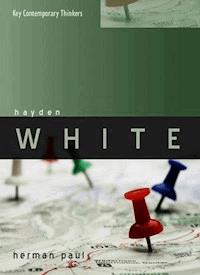
This new book offers a clear and accessible exposition of Hayden White's thought. In an engaging and wide-ranging analysis, Herman Paul discusses White's core ideas and traces the development of these ideas from the mid-1950s to the present. Starting with White's medievalist research and youthful fascination for French existentialism, Paul shows how White became increasingly convinced that historical writing is a moral activity. He goes on to argue that the critical concepts that have secured White's fame – trope, plot, discourse, figural realism – all stem from his desire to explicate the moral claims and perceptions underlying historical writing. White emerges as a passionate thinker, a restless rebel against scientism, and a defender of existentialist humanist values.
This innovative introduction will appeal to students and scholars across the humanities, and help develop a critical understanding of an increasingly important thinker.
Sie lesen das E-Book in den Legimi-Apps auf:
Seitenzahl: 392
Veröffentlichungsjahr: 2013
Ähnliche




















Table of Contents
Cover
Series page
Title page
Copyright page
Acknowledgments
Introduction: How to Read Hayden White
1 Humanist Historicism: The Italian White
The papal schism of 1130
White’s covering law model
“Ideology” or “value orientation”
The disenchantment of the world
From historicism to sociology
A Croce partisan
Questions in/about history
2 Liberation Historiography: The Politics of History
Why history?
Choosing a past
Strong humanist father figures
Social conditions of freedom
In defense of metahistory
A philosophy of liberation
3 The Historical Imagination: Four Modes of Realism
An inverted disciplinary history
Escaping the ironist’s cage
Imagination: thinking and dreaming
A manual of tropology
Structuralist linguistics
The freedom of imagination
White’s linguistic turn
4 The Power of Discourse: White’s Structuralist Adventure
Three modes of comprehension
Figurative language
Fictions of factual representation
Objectivism and relativism
The prison-house of language
Getting out of history
5 Masks of Meaning: Facing the Sublime
The content of the form
Stories are not lived but told
Sublime historical reality
The specter of fascism
Modernist anti-narrativism
6 Figuring History: The Modernist White
Modernist events
Intransitive writing
A turning point?
Figural realism
The practical past
Epilogue
Bibliography
Index
Published:
Jeremy Ahearne, Michel de Certeau
Peter Burke, The French Historical Revolution: The Annales School 1929–1989
Michael Caesar, Umberto Eco
M. J. Cain, Fodor
Filipe Carreira da Silva, G. H. Mead
Rosemary Cowan, Cornel West
George Crowder, Isaiah Berlin
Gareth Dale, Karl Polanyi
Oliver Davis, Rancière
Maximilian de Gaynesford, John McDowell
Reidar Andreas Due, Deleuze
Eric Dunning, Norbert Elias
Matthew Elton, Daniel Dennett
Chris Fleming, Rene Girard
Edward Fullbrook and Kate Fullbrook, Simone de Beauvoir
Andrew Gamble, Hayek
Neil Gascoigne, Richard Rorty
Nigel Gibson, Fanon
Graeme Gilloch, Walter Benjamin
Karen Green, Dummett
Espen Hammer, Stanley Cavell
Christina Howells, Derrida
Fred Inglis, Clifford Geertz
Simon Jarvis, Adorno
Sarah Kay, Žižek
S. K. Keltner, Kristeva
Valerie Kennedy, Edward Said
Chandran Kukathas and Philip Pettit, Rawls
Moya Lloyd, Judith Butler
James McGilvray, Chomsky
Lois McNay, Foucault
Dermot Moran, Edmund Husserl
Michael Moriarty, Roland Barthes
Stephen Morton, Gayatri Spivak
Harold W. Noonan, Frege
James O’Shea, Wilfrid Sellars
William Outhwaite, Habermas, 2nd Edition
Kari Palonen, Quentin Skinner
Ed Pluth, Badiou
John Preston, Feyerabend
Chris Rojek, Stuart Hall
William Scheuerman, Morgenthau
Severin Schroeder, Wittgenstein
Susan Sellers, Hélène Cixous
Wes Sharrock and Rupert Read, Kuhn
David Silverman, Harvey Sacks
Dennis Smith, Zygmunt Bauman
James Smith, Terry Eagleton
Nicholas H. Smith, Charles Taylor
Felix Stalder, Manuel Castells
Geoffrey Stokes, Popper
Georgia Warnke, Gadamer
James Williams, Lyotard
Jonathan Wolff, Robert Nozick
Copyright © Herman Paul 2011
The right of Herman Paul to be identified as Author of this Work has been asserted in accordance with the UK Copyright, Designs and Patents Act 1988.
First published in 2011 by Polity Press
Polity Press
65 Bridge Street
Cambridge CB2 1UR, UK
Polity Press
350 Main Street
Malden, MA 02148, USA
All rights reserved. Except for the quotation of short passages for the purpose of criticism and review, no part of this publication may be reproduced, stored in a retrieval system, or transmitted, in any form or by any means, electronic, mechanical, photocopying, recording or otherwise, without the prior permission of the publisher.
ISBN-13: 978-0-7456-5013-5
ISBN-13: 978-0-7456-5014-2(pb)
ISBN-13: 978-0-7456-3766-2(Single-user ebook)
ISBN-13: 978-0-7456-3765-5(Multi-user ebook)
A catalogue record for this book is available from the British Library.
The publisher has used its best endeavours to ensure that the URLs for external websites referred to in this book are correct and active at the time of going to press. However, the publisher has no responsibility for the websites and can make no guarantee that a site will remain live or that the content is or will remain appropriate.
Every effort has been made to trace all copyright holders, but if any have been inadvertently overlooked the publisher will be pleased to include any necessary credits in any subsequent reprint or edition.
For further information on Polity, visit our website: www.politybooks.com
Acknowledgments
It is hard to say whether this is my first or second book on Hayden White. Originally, I planned this study to be a reworked version of my 2006 Ph.D. dissertation, which traced how White’s philosophy of history was shaped by existentialist concerns about human dignity and moral responsibility in a world believed to be meaningless in itself. However, the revisions to the thesis gradually became so thorough that the outcome is an almost entirely new book. In marked contrast to its unpublished predecessor, the present book is first and foremost an introduction to White. Written for an audience unfamiliar with his work, it explains White’s views as clearly as possible, while offering an interpretation that I claim to be more accurate than the sort of Wikipedia wisdom (“history is a form of fiction”) that many seem to associate with his name. What has not changed, though, is my historicizing approach, as evidenced, among other things, by the chronological organization of this study and the use of past tense forms throughout the book. This is not to suggest that White’s interventions belonged to an age now long gone – even though Metahistory appeared well before I was born – but to show how his (often changing) views on history were rooted in specific historical situations, social structures, political realities, and generational sensitivities.
The greatest debt I have incurred in the course of writing this book is to Hayden White himself, who immediately took me out for coffee and pizza when I reluctantly knocked on his office door at Stanford University in the Fall of 2002. Ever since, he has been a stimulating conversation partner, generous with his time and ideas, always prepared to answer my questions or to recommend a new historical novel, but fierce in his insistence that I should write “with” rather than “about” his work. Although this was not precisely what I had in mind with the current book, I trust my other work in the field of historical theory testifies that my ideas are often shaped in conversation with White’s. Also, I am most grateful to my former doctoral advisors, Frank Ankersmit and Chris Lorenz, for their support and many helpful suggestions. I cannot imagine how I would have entered the historical profession without the encouragement and scholarly example of especially Frank Ankersmit.
Furthermore, I owe a word of thanks to Peter Novick, who read my Ph.D. thesis in 2006 and responded with a nine-page letter that was as friendly as it was useful in preparing the present book. In addition, I have benefited from stimulating conversations with Mark Bevir, Ewa Domaska, Brian Fay, Thomas L. Haskell, Martin Jay, Hans Kellner, Dominick LaCapra, Raymond Martin, Allan Megill, Annie van den Oever, Rik Peters, Paul A. Roth, Eelco Runia, Richard T. Vann, John H. Zammito, Eugen Zeleák, and other colleagues near and abroad.
My editors at Polity Press, Emma Hutchinson and David Winters, have been wonderful to work with. At home, my wife Esther gave me invaluable support and encouragement to finish this project. Thanks so much, my dear! Finally, I should like to dedicate this book to my parents, Mart-Jan and Nelleke Paul, as a sign of my gratitude and love towards them.
Parts of Chapter 1 appeared previously in “A Weberian Medievalist: Hayden White in the 1950s,” Rethinking History, 12, no. 1 (2008), pp. 75–102. This material is reprinted here by kind permission of the publisher, Taylor & Francis Ltd. Chapter 3 quotes heavily from Hayden White, Metahistory: The Historical Imagination in Nineteenth-Century Europe, pp. ix, x, xi, xii, 2, 5, 7, 15, 22–3, 29, 31, 33, 37, 42, 50, 52, 66–7, 69, 167, 173, 176, 177, 179, 186, 222, 226–7, 276–7, 283, 334, 346, 355–6, 372–3, 402, 415, 427–8, 431, 433–4. © 1973 The Johns Hopkins University Press. These quotations are reprinted with permission of The Johns Hopkins University Press. The same press also granted me permission to quote brief passages from White’s essay collections, Tropics of Discourse, The Content of the Form, and The Fiction of Narrative.
Introduction: How to Read Hayden White
“No one writing in this country at the present time has done more to wake historians from their dogmatic slumber than has Hayden White,” wrote Dominick LaCapra.1 In a sense, these words aptly describe how White, the American scholar best classified as a philosopher of history, spent a good part of his career explaining why historians are unjustified in thinking they have privileged access to the past. Over the years, in both his writing and teaching, White invested considerable energy in challenging the conventional wisdom that archival research and historical analysis enable historians to offer “better” accounts of the past than, say, historical novels or films. In expressive and often ironic prose, he fired volleys of questions: Who is to decide what counts as better? Better for what purposes? By whose standards? In whose interest? The word “history,” in particular, often aroused White’s critical attention. What does it mean to write history, to classify an event as historical, or to say that a phenomenon must be explained historically? What is it that historians and the general public in the West take as “history?” And what reasons could one possibly have for preferring this way of looking at history, this view of what counts as history, over alternatives proposed in other times and places? Like David Hume, the Scottish philosopher whom Immanuel Kant famously declared had awakened him from his “dogmatic slumber,” White raised a number of difficult questions disturbing the peaceful sleep of those assuming that the only way of doing history was taking notes in an archive and “getting the facts straight.”
Yet, in so far as LaCapra, in the words just quoted, implied that White’s wake-up calls were heard or answered by these note-taking historians, there was no small amount of wishful thinking in his claim. Who was White after all? Presumably, by the time LaCapra wrote his favorable review, in 1976, few American historians had ever tried to read White. They might have recognized his name as the director of Wesleyan’s Center for the Humanities or as a history professor who had taught at Wayne State, Rochester, and UCLA. But it is unlikely that more than a few historians ever reached the last page of White’s often long and difficult essays, published in such high-brow journals as History and Theory and New Literary History. Admittedly, by 1976, the leading historical journal in the United States had welcomed White’s path-breaking study, Metahistory: The Historical Imagination in Nineteenth-Century Europe (1973), as “a daring, ingenious, and sometimes bewildering tour de force.”2 But nor does that count as an indicator of the sort of influence that LaCapra seems to detect. Only by the 1980s did begin to acquire fame and notoriety. LaCapra’s statement is therefore best understood as a friendly encouragement, or as the enthusiastic endorsement of a program that LaCapra – himself a soon-to-be-famous theorist – considered healthy for historians still suffering from faith in truth and objectivity.
Lesen Sie weiter in der vollständigen Ausgabe!
Lesen Sie weiter in der vollständigen Ausgabe!
Lesen Sie weiter in der vollständigen Ausgabe!
Lesen Sie weiter in der vollständigen Ausgabe!
Lesen Sie weiter in der vollständigen Ausgabe!
Lesen Sie weiter in der vollständigen Ausgabe!
Lesen Sie weiter in der vollständigen Ausgabe!
Lesen Sie weiter in der vollständigen Ausgabe!
Lesen Sie weiter in der vollständigen Ausgabe!




