


1,49 €
Mehr erfahren.
- Herausgeber: Edizioni del Faro
- Kategorie: Geisteswissenschaft
- Sprache: Englisch
Forswears, murders, irrational decrees. Over the two millennium-long history of the Papacy, many, too many, mistakes and questionable and odd exploits have been carried out. In the present work, the author, far from attacking a single Pope, but rather with the clear intent of demolishing the dogma of Papal infallibility, lists all the barbaric acts of the Popes from the first century up to the present times. The work is marked by an innovative writing technique, one that has never been used before, characterized by extreme conciseness and a painstakingly precise bibliography of almost two-hundred works in order to provide quotes of the most relevant parts. The author wishes to push the reader to question the value of modern religious teaching with respect to the original teaching of Jesus, as well as to ask the reader what factors have caused Christianity to split into a variety of religious streams. He reminds us that the Catholic Church is the only one, among the three great doctrinal schisms, that has imposed celibacy upon its clergy. Could that be the reason?
Das E-Book können Sie in Legimi-Apps oder einer beliebigen App lesen, die das folgende Format unterstützen:
Veröffentlichungsjahr: 2013
Ähnliche




















Giacomo Bajamonte, He’s Just a Man
Copyright© 2013 Edizioni del Faro
Gruppo Editoriale Tangram Srl
Via Verdi, 9/A – 38122 Trento
www.edizionidelfaro.it – [email protected]
Prima edizione: aprile 2013 – Printed in Italy
ISBN 978-88-6537-172-5 (Print)
ISBN 978-88-6537-965-3 (ePub)
ISBN 978-88-6537-966-0 (mobi)
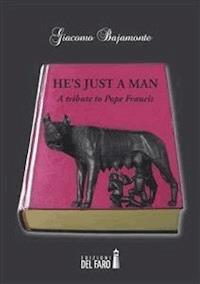
Cover: La Bibbia di Roma, Giacomo Bajamonte
Follow us: Facebook, Twitter, Linkedin
Dedicated to Pope Francis, who has succeeded in converting me
to Catholicism after years of Protestantism.
In reality, he is the Holy Father the world
has been waiting for for two thousand years.
Do we not have the right to be accompanied by a believing wife, as do the other apostles and the brothers of the Lord and Cephas?
New Revised Standard Bible, 1 Corinthians 9:5
[…] it is better to marry than to be aflame with passion.
New Revised Standard Bible, 1 Corinthians 7:9
Dedicated to Pope Francis, who has succeeded in converting me to Catholicism after years of Protestantism. In reality, he is the Holy Father the world has been waiting for for two thousand years.
Do we not have the right to be accompanied by a believing wife, as do the other apostles and the brothers of the Lord and Cephas?
New Revised Standard Bible, 1 Corinthians 9:5
[…] it is better to marry than to be aflame with passion.
New Revised Standard Bible, 1 Corinthians 7:9
Preface
I grew up Catholic. I went through the normal procedures for 90% of Italians: baptism, confirmation, communion and matrimony. Moreover, my middle school and part of my secondary school education took place in Catholic institutions, with parish priests and nuns respectively. In particular, for all three years of middle school and two years of secondary school, the priests would reserve an hour for mass every Saturday.
At around 25, having not attended mass, nor taken communion nor gone to confession (the one exception being for my marriage) for at least seven years, I began to ask myself some questions and a few doubts emerged. It seems incredible to admit it now, but until the age of 25 I had no idea that Christianity was divided into several branches. For me, “Christianity” was equivalent to “Catholicism”.
Faced with doubts and questions, I began to study both the alternative branches to Catholicism (Protestantism in particular) and other religions (Islam in particular). Something about Catholicism didn’t convince me, in fact several things didn’t: ritual upon ritual, phrases learnt by heart and always the same passages of the Gospel repeated in church. Is that really what Jesus would have wanted for me today? Phrases by rote, confession with a stranger who, unlike me, the Apostles and even the first Pope, embraces chastity? Who or what had diminished the belief in a Superior Being that had sent His Son, a man capable of performing miracles, here to earth? The church, perhaps? Doubtless, the church had its faults, but it couldn’t have done anything without the backing of its supreme head, the Pope.
Studying the popes, I was immediately struck by the theory of their infallibility ex cathedra, that is, when they speak on matters of faith. How strange, I thought, that a human being can believe himself to be infallible, even more so when discussing something theoretical that only God can know about. I was also intrigued by the concept of ex cathedra, which implicitly admits not only that the pope can make mistakes when not talking about faith, but that he in fact does. Ex cathedra or not, I decided to see which pope had made mistakes and when and what effects their errors had on our present days.
At the time I didn’t think there would be enough material to write a book, but before I’d even finished wading through the first-century the errors were already coming thick and fast. Well, I said to myself, why not keep note of them all in a few pages, with absolutely no biographical information not relating exclusively to the errors and curious or questionable actions, with a rich and carefully selected bibliography that no Catholic could argue with?
Thanks to Google Books I had an abundance of titles, allowing me to satisfy my curiosity and to find out who had got up to what and when. I liked the idea. But I could never have imagined the anger and the laughter that would result from it. Not even remotely.
I almost forgot to mention that my entire share of the profits from this book will be given away to charity. If anyone is wondering why, it’s not because I’m rich but because I laughed for at least fifteen minutes straight every day while writing it. I don’t think it is right to make money from something amusingly enjoyable, especially if it concerns religious issues and rituals that should have nothing to do with profit.
But that is the past, Pope Francis is now the vicar of Christ and it is his guidance that I want.
Liège (Belgium), Saint Jaques’s Church: Statue from Saint James the Just (1691) by Jean Del Cour, Flamenc, Wikimedia project
The Intransigents
Pope Anacletus I (1st Century)
Forced priests who to sport a ridiculous hair cut (known as tonsure), worn by those who celebrated mass in apostolic times1.
Pope Sixtus I (115-117/125-129)
Established that several ornaments of the altar (the chalice and paten) could no longer be touched by the laity but only by the clergy23.
Pope Telesphorus (125-136)
Established that no layperson could contradict the clergy4.
Pope Anicetus (155-166)
His only decretal in the eleven years of his pontificate was that no clergyman could have long hair; he also reinstated the use of tonsure. This decretal took it origins from the writings of Saint Paul567.
Pope Stephen I (254-257)
Ordered that the laity could no longer wear the vestments used by the clergy, introduced the blessing thereof and forbade their use outside of church8.
Pope Leo IX (1048-1054)
Decreed in a synod that the women who prostituted themselves to clergy in Rome were to become slaves serving the Lateran Palace910.
Pope Gregory VII (1073-1085)
Reaffirmed the celibacy of the clergy, declaring that he preferred them to engage in sodomy or sexual relations with family members over a legitimate marital tie .
Lesen Sie weiter in der vollständigen Ausgabe!
Lesen Sie weiter in der vollständigen Ausgabe!
Lesen Sie weiter in der vollständigen Ausgabe!
Lesen Sie weiter in der vollständigen Ausgabe!
Lesen Sie weiter in der vollständigen Ausgabe!
Lesen Sie weiter in der vollständigen Ausgabe!
Lesen Sie weiter in der vollständigen Ausgabe!
Lesen Sie weiter in der vollständigen Ausgabe!
Lesen Sie weiter in der vollständigen Ausgabe!
Lesen Sie weiter in der vollständigen Ausgabe!
Lesen Sie weiter in der vollständigen Ausgabe!




