


10,00 €
Mehr erfahren.
- Herausgeber: Garnet Publishing
- Kategorie: Geisteswissenschaft
- Sprache: Englisch
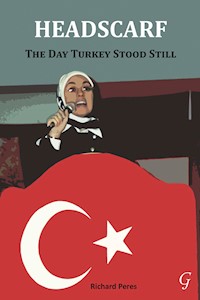
"Headscarved women are here, they are not going away, and they are maybe growing in number and they want to participate in public life," Merve Kavakci, 2010. Can the wearing of an Islamic headscarf ever be reconciled with a policy of complete secularism? Is it a symbol of freedom of choice for women, or one of religious dominance? The Headscarf is a unique behind-the-scenes story of the first headscarved woman to be elected into the Turkish Parliament, and the harsh reaction against her election. It deconstructs her vilification by the government, military, media and political parties. Nowhere is the issue of the wearing of the hijab more contentious than in Turkey, whose constitutional principle of secularism has lead to the Turkish government banning women who wear headscarves from working in the public sector. But the majority of women who wear the headscarf in Turkey think that to do so is very important and reflects their dignity and personality, as well as their religious beliefs. In May 1999, this conflict hit the headlines when Merve Kavakci walked into the Turkish Grand National Assembly to take her oath of office as a member of Turkish Parliament, wearing her Islamic headscarf. A near riot ensued, and the Prime Minister famously told the crowd to 'put this woman in her place'. Since then, Kavakci has become an outspoken critic of Turkey's secularization policy, travelling the globe in support of Muslim women's rights, especially regarding the hijab, which she promotes as a symbol of female empowerment. Richard Peres uses this fascinating true story to promote greater understanding of contemporary Turkish politics, and to illustrate the ongoing tension between Turkey's military-secular bloc and its predominantly Islamic population. This highly accessible book will resonate with Western readers who want to know more about this fundamental issue and gain a greater understanding of women's issues, religious conflicts, political Islam, human rights and the struggle for democracy in the Middle East.
Das E-Book können Sie in Legimi-Apps oder einer beliebigen App lesen, die das folgende Format unterstützen:
Veröffentlichungsjahr: 2014
Ähnliche
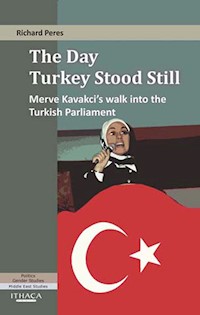



















HEADSCARF THE DAY TURKEY STOOD STILL
RICHARD PERES
HEADSCARF
Published by
Garnet Publishing
8 Southern Court
South Street
Reading
RG1 4QS
UK
www.garnetpublishing.co.uk
www.twitter.com/Garnetpub
www.facebook.com/Garnetpub
blog.garnetpublishing.co.uk
Copyright © Richard Peres, 2012
This book was formerly published as The Day Turkey Stood Still by Ithaca Press
All rights reserved.
No part of this book may be reproduced in any form or by
any electronic or mechanical means, including information
storage and retrieval systems, without permission in writing
from the publisher, except by a reviewer who may quote
brief passages in a review.
First Paperback Edition 2013
ISBN: 9781859644256
British Library Cataloguing-in-Publication Data
A catalogue record for this book is available from the British Library
Jacket design byGarnet Publishing
Typeset byJM InfoTech INDIA
Cover photo provided courtesy of the Kavakci family
TO UMIT CIZRE
For your mind
And your love
My gratitude
Will always be
As constant as
The Marmara Sea
Contents
Preface
Acknowledgements
1 Introduction: The Turkish Context
2 Islamic Mobilization and Its Response
3 A Covered Candidate Runs For Parliament
4 The Election
5 2 May 1999
6 The Bright Future Darkens
7 The Criminalization of Merve Kavakci
8 Persecuted and Prosecuted
Afterword
Glossary
Preface
Our meeting was pure happenstance, a serendipitous alignment of stars.
Umit Cizre, my wife and well-known Turkish political scientist, returned home after her first day at the Woodrow Wilson Center for International Scholars in Washington (USA) and told me that her assistant, Fatima, was the daughter of a well-known person in Turkey, a woman who had entered Parliament after her election wearing a headscarf. ‘We all watched her on television,’ she said. ‘The whole country was riveted. It was incredible. And the country has never recovered from it.’
Fatima’s mother is Merve Kavakci.
I searched for her name in YouTube and found ninety videos of a headscarved woman walking into the Turkish Parliament to non-stop jeers and clamouring. At one point a moustached man appeared and shouted his speech with a scowl on his face. It was a chaotic and perplexing scene. I found out that Merve Kavakci had been elected to the Turkish Parliament but was prevented from taking her oath of office that day and subsequently forced to leave Turkey.
I thought that what happened was strange in a country where practically the whole population considered themselves to be Muslim; it would be difficult to sleep anywhere in Turkey without hearing a local mosque broadcast the call to prayer five times a day. Like most Americans, at the time, I was not well informed about Islam having only generalized views in the post-9/11 world of terrorist attacks and threats that have dominated the media and the way Americans view the world.
We found out that Merve Kavakci was teaching Political Science courses at George Washington University. After leaving Turkey she earned a master’s degree from Harvard and her PhD from Howard University.
My curiosity about her grew. Who was this woman who seemed to cause so much havoc in Turkey? Weeks later Merve invited us, through her daughter, to meet for dinner in Georgetown.
As we approached the restaurant, I saw two smiling women in headscarves wave to us from inside. By the time we walked in, they were standing at the entrance to greet us, courteous and polite in the extreme. Merve Kavakci was wearing a funky big red plastic watch that I immediately noticed, and stylish jeans. Their bright eyes seemed to flash in the darkened restaurant. They greeted us with what I would discover is typically friendly Turkish hospitality.
Although they would be breaking the month-long fast of Ramadan with us, they seemed in no hurry to order. There was a rush of conversation and we stayed there for three hours; subsequent dinners and meetings would be the same. We talked and talked as I began a journey of discovery that would result in my living in Turkey and interviewing participants of what was known as the ‘Merve Kavakci Affair’.
Merve had published a personal commentary in Turkish, under the title of ‘Headscarfless Democracy’; some academic articles had appeared about the incident; and the bedlam in Parliament that day was cited in numerous books about modern Turkish history. Yet her story had never been accurately told to the Western world. In addition, her book had not been widely distributed in Turkey, nor did it provide the background information needed for people in the West to make sense of it. (She later had her dissertation published – Headscarf Politics in Turkey: A Postcolonial Reading – for a limited audience.) Merve was looking for a writer to translate her original work, or help get the story out, but to no avail. Despite all the reporting in Turkey and elsewhere, it somehow got missed by an untold number of potential authors and commentators before I embarked on this endeavour.
Thus a couple of dinners in Georgetown progressed to my interviewing Merve for hours at a time in her university office. In perfect and deliberate English, she recalled many details and her feelings. In the meantime, I began my own research, reading all the key works on Turkey and anything written about the incident in Parliament. The person depicted by these writers, most of whom had never interviewed or met Merve, described a different persona, a fictitious one, the ‘agent provocateur’ image labelled by the then President Suleyman Demirel, or a puppet manipulated by Islamic leader and ex-Prime Minister Necmettin Erbakan, and a vilification that was and remains in stark contrast to the reality of what happened and her true character. My own personal litmus test for gauging the polarization in Turkey was to tell an unsuspecting person about the subject I was writing. For most so-called ‘white’ Turks the response was shock, dismay and a look of incredulity. They included my students at Bilkent University who were children at the time of the incident in Parliament and only knew what they had read and what their parents had told them about Merve Kavakci.
Over time I began to understand the quiet, steadfast presence in this person who became the pivotal actor of a resolute notion of representative democracy and human rights in the history of Turkey. Ten years had passed, but her spirit seemed neither diluted nor mellowed. As her sister, Ravza, once told me, ‘They didn’t realize she would hold out this long; they didn’t realize she was so strong.’ The more we talked, the more I realized that inner and consistent strength.
In an earlier life I had spent several years investigating civil rights violations for the State of New Jersey and even wrote a book on the subject, Dealing with Employment Discrimination. I recognized in Merve the characteristics of many of the people whose cases I handled; I was well versed in civil rights law, lived through the civil rights movement in the USA, and personally investigated hundreds of discrimination cases. For these reasons, I felt comfortable telling this compelling story in a factually sound yet personal way.
Of course, the headscarf issue in Turkey, as well as France, Germany and other countries, is drenched in intense political overtones. In Turkey, it is especially a complex and volatile issue that is viewed within the context of modern Turkish history and adherence to a secularism that came in the new Republic after six hundred years of Ottoman rule closely integrated with Islam. One cannot fully understand the issue without understanding the Turkish revolution in the 1920s headed by Mustafa Kemal (Ataturk) whose picture adorns practically every building, office and store in Turkey today.
Turkey is a wonderful country, rich in culture and history, yet fractured as much as the earthquake-prone fault lines that run deep below the earth’s surface in most of Anatolia. Half of Turkey thinks that Merve Kavakci had a ‘hidden political agenda’ directed by others, and is a threat to the Turkish state. The other half sees her as its democratic salvation and hero for all the headscarved women who are denied rights in that country. The intense feeling Merve Kavakci evokes cannot be understood without considering the fact that even the headscarved wives of Turkey’s President and Prime Minister, whom Merve still communicates with, are generally not be taken to state events.
Headscarf: The Day Turkey Stood Stillis foremost a human rights story, notwithstanding its historical and political context. Understanding the travails of human rights issues starts, and ends, with humans, with people, not politics. Until we dig deep into the human context we will neither understand the full story of any so-called ‘conflict of civilizations’, nor develop the kind of transformative empathy that enables political change and the establishment of a peaceful and just society.
Beginning on 2 May 1999, Merve Kavakci endured the wrath of a nation for all to see, but her burden of being treated differently began much earlier and is emblematic of all the millions of headscarved women in Turkey who do not enjoy their right to express and live their religion in terms of dressing in the way they believe their religion requires in the public sphere – including education, teaching, working for the state and public professions. Knowing the tight bond of family, the perspective of past events, and the nature of her religious beliefs will help the reader to understand, I hope, the personal story of Merve Kavakci, as a baby step to understanding the billion personal stories that comprise a world that defies clichés, generalizations and simple bias.
When asked why she had refused on 1 December 1955 to give up her seat to a white person, the way she had on so many other occasions, Rosa Parks, who was in fact a seamstress in Montgomery, Alabama at the time, said that she was simply ‘tired of giving in’ and she ‘wanted to know for once and for all what rights she had as a human being and a citizen’. She left the leadership roles of the civil rights movements to others. Years later she recalled, ‘When that white driver stepped back toward us, when he waved his hand and ordered us up and out of our seats, I felt a determination cover my body like a quilt on a winter night.’ After reading Headscarf: The Day Turkey Stood Still I hope that you will have some understanding of how one headscarved woman suffered a basic violation of human dignity and respect, and can thus better appreciate the quiet but constant nature of her determination and that of others to effect change.
In addition to human rights, there is the political rights aspect of this story. As an elected Member of Parliament, Merve Kavakci also wanted to represent her constituents – in particular the women who talked to her repeatedly before the oath-taking ceremony and expected her to walk into Parliament wearing the same headscarf as they wore, and resist pressure to take it off. The night before, they called her, imploring, ’You’re going to walk in, aren’t you? You’re going to do it, right?’ This is democracy at its core, the baseline person-to-person contact between people and their representatives. Unfortunately, this core principle of political representation clashed with the tenets of Turkish nationalism and secularism, causing a harsh response and a torrent of actions that are documented in this book.
Third, this is also a story of women’s rights. Prime Minister Ecevit, after all, yelled in Parliament on that fateful day, ‘Put this woman in her place.’ And it was a wall of secular, uncovered women deputies in Parliament who were supposed to prevent Merve from ultimately taking her oath, at least that was the initial plan, so as not to make the issue seem like one of men treating women unfairly. Part of this story’s character as a women’s issue also relates to religious women who endure another layer of smothering patriarchy and unfair treatment because they are women in Turkey. Millions of women in Turkey are affected by this phenomenon to this day. Turkey has the worse record of women’s employment in Europe and ranks low on all scales of gender equality. Discrimination against women in employment is rampant, there is a lack of facilities for protecting battered women and honour killings persist particularly in rural areas.
This book describes, for the first time, the story of Merve Kavakci’s run for Parliament, told with her cooperation and within the context of Turkish politics, historical events and characters. It presents a far more revealing and objective picture than the one presented to the Turkish people by the newspaper cartels at the time, or as described by even Western journalists and cited in academic papers. I hope that this book on one level helps readers to understand the conflicts that lie at the foundation of Turkey, a country that has the potential of setting new standards of democracy in the Middle East, and that it provides commentators, policy makers and academics with an understanding of people’s democratic aspirations regardless of culture, religion and nationality.
The struggle for human, political and women’s rights that underscores the wearing of headscarves by eighteen million women will undoubtedly affect the course of the twenty-first century in Turkey and beyond. The underlying political movements related to these issues may intensify. There is certainly a need for the West to better understand the Islamic world generally and issues of human rights individually. The explosion of prejudice in August 2010 regarding the building of an Islamic community centre in New York City is the latest example of the gap that exists between some Americans and an understanding of Islamic people. Meanwhile in the Middle East, a wave of revolutionary sentiment is sweeping the region in defiance of authoritarian and repressive regimes. The fault lines may be redrawn and the parties change, but the issues remain. It’s my wish that Headscarf: The Day Turkey Stood Still adds to the general body of knowledge that derives from all these issues, that it helps our understanding of them and promotes empathy towards the universal, human need for freedom. And, of course, I hope that it benefits in some way the covered women of Turkey.
A note on terms
I have generally refrained throughout the book from using two popular terms that refer to political Islam – namely, ‘Islamism’ and ‘Islamist’ – although others using these terms may be quoted. The reason for this is that these terms are rife with negative connotations for many readers; they also actually have a wide variety of meanings and are subject to various definitions by both scholars and political actors. Thus I have tried to avoid their use.
On the other hand, I have used the term ‘Islamic’ to characterize those people who are devout practitioners of Islam. In Turkey today approximately 60 per cent of the population fall into this category, people who try to pray five times a day, avoid drinking alcohol and eating certain foods, and who fast during Ramadan. The point is that the political views of Islamic people are as diverse as the parties they join. The Western press in particular often refer to Islamic-friendly political parties as ‘Islamist’, including the current ruling AK (Justice and Development) Party in Turkey. This practice is confusing and misleading and should be avoided. We should not make assumptions regarding the political views of Islamic people and the parties they support, because they do, in fact, vary significantly.
Richard Peres
October 2011
Istanbul, Turkey
Acknowledgements
A book of this nature is not written without a great deal of assistance from others. First and foremost, Dr Merve Kavakci Islam deserves my heartfelt thanks. She granted every interview request, answered all questions, provided photographs and documentation, reviewed the manuscript and facilitated my contacting key players in this story. I appreciate not only her cooperation but also her trust in my deconstructing what happened from both historical and personal perspectives and coming to my own conclusions about the extraordinary events recorded in this book.
Dr Umit Cizre, my wife, partner and well-known scholar of Turkish politics and civil–military relations, made it possible for me to live in Turkey, carry out research and access her invaluable intellect, guidance and knowledge throughout the writing of this book. During the course of two years I quickly became one of her lucky students as she helped me figure out the black art of Turkish politics and a country not easily understood by Americans.
I am indebted to Marie Hanson and her colleagues at Garnet Publishing and Ithaca Press for recognizing the value of this work and their assistance in book preparation.
Special thanks to Susan Littauer for her honest editing, moral support and confidence in me.
My thanks to the Kavakci family for their constant cooperation, interviews and access to photographs: Yusuf and Gulhan Kavakci, Ahmet and Ayten Gungen, Turan Gungen, Ravza Kavakci Kan, Elif Kavakci Tanriover, Fatima Kavakci and Mariam Kavakci. I am also greatly appreciative to those who granted me interviews – namely, Nazli Ilicak, Abdurrahman Dilipak, Sibel Eraslan, Temel Karamollaoglu, Recai Kutan, Kim Shively, Esra Arsan, Mustafa Kamalak, Yildiz Ramazanoglu, Saim and Nuran Altunbas, Aslan and Bahar Polat, Osman Ulusoy, Fatma Benli, Zeynep Erdim and Mehmet Silay.
I also greatly appreciate the invaluable assistance of Ozlem Cosan who provided instant translations and assistance during numerous interviews in Ankara and Istanbul. Many thanks also to Dayla Rogers for her eye-opening paper and translations. Additionally, I thank Esra Elmas for her translation work and sharing her research on Merve Kavakci.
Notwithstanding all of those whose assistance I have thanked, I take full responsibility for this book’s content.
Richard Peres
1
Introduction: The Turkish Context
On 2 May 1999, Merve Safa Kavakci,1newly elected Member of Parliament, entered Turkey’s Grand National Assembly in Ankara to take her oath of office. She was wearing a multi-shaded blue headscarf, which matched her well-fitted, dark blue suit. The scarf was wrapped tightly around her head, covering all her hair and pinned beneath her chin – the style of a religious Islamic woman. As soon as she entered and began her walk calmly and steadily to a seat in the second row in the centre of the Turkish Parliament, accompanied by Nazli Ilicak, an uncovered woman deputy of the same party, the jeers of about one hundred Parliamentarians began, letting out a long chorus of ‘get out get out get out’, clapping in unison and protest, banging their hands on their desks, while millions of Turkish citizens watched on television transfixed by the spectacle.
Although many Turks believed the opposite, for Merve Kavakci her walk into Parliament was a simple act of democracy, representing the headscarved women from the first electoral district in Istanbul who had voted for her, as well as the rest of her constituents – many of whom were secular men and women not as devout in their religious practices. But it was headscarved women who had been calling her all day, encouraging her to take her rightful seat in Parliament after her election and maintain the symbol of her religious faith, something that no other woman had ever done in the history of Turkey. Merve Kavakci would be the first covered woman, as well as the youngest deputy in the history of the Republic, to take her oath of office.
However, for the pro-secular, Kemalist bloc in Turkey, her stroll down the aisle was a virtual act of war, a provocation in defiance of the loosely defined but powerful Kemalist ideology that formed the foundation of the Turkish Republic beginning in 1923, as established by Mustafa Kemal, now called Ataturk, or father of Turkey. Perhaps like no other act in the history of Turkey, it revealed a complicated fracture that splits this country – Islamic people on one side, secularists on the other. The division, however, was not (and even today is not) a simple story of secular, modern, Westernist elites fighting against reactionary, anti-secular, traditional and anti-Western people. Rather, it has been used as a convenient vehicle for reducing many political battles into a single polarity.
Prime Minister Bulent Ecevit, leader of the DSP (Democratic Leftist Party) stood up and went to the podium without the permission of the eighty-six-year-old ceremonial President of the Parliament, Ali Rıza Septioglu. From his pocket he withdrew a prepared speech on what looked like a scrap of paper. He silenced the cacophonous crowd with his loud and stinging remarks:
This is not a place to challenge the state, no one may interfere with the private life of individuals, but this is not a private space. This is the supreme foundation of the state. Those who work here have to abide with the rules and customs of the state. It is not a place in which to challenge the state. Please put this woman in her place.
It was a defining moment. The state had spoken. Merve Kavakci had always worn her headscarf, including when she applied for an election permit as the Fazilet (Virtue) Party nominee, during the campaign, and when she received official papers indicating her election to Parliament two days earlier. She picked up those papers in front of what seemed like the entire Turkish press corp wearing her headscarf. When asked throughout the campaign, before and after her election, about her intentions, she had always stated clearly that she would continue to wear it as part of her beliefs, that there was no law banning the headscarf in Parliament, and that she would not remove it when taking her oath of office. She was not about to remove it now.
Merve Kavakci was fully focused on trying to remain composed in the face of the riotous atmosphere, although she sat visibly unmoved by the harsh words of the Prime Minister, which were received with applause and support by the members of the DSP, while the majority of the rest of the deputies in Parliament sat in silence. As Stephen Kinzer wrote the next day for the New York Times:
Last week, almost no one in Turkey had heard of Merve Kavakci. Today she stands accused of nothing less than trying to destroy the nation, and Turks are talking of little else. Prime Minister Bulent Ecevit has begun assembling a new Government, but few seem to care. Even the figure of Abdullah Ocalan, the captured Kurdish revolutionary, who is intensely hated, has suddenly faded from the public consciousness. Front pages of today’s newspapers were dominated by photos of Ms Kavacki in Parliament, where her appearance with a headscarf on Sunday sparked pandemonium. Television stations endlessly rebroadcast tape showing legislators shouting insults at her.2
The display of rejection in Parliament continued for forty-five minutes until a recess was called. The scene was chaotic and disorganized. At this point, against her better judgement, Merve Kavakci left her seat with the other deputies. Her father was desperately calling to her cell phone to tell her to remain seated, but her phone was turned off. Denied her seat in the Turkish Parliament, harangued by the government, not supported by her party and her citizenship taken away, she would not be allowed to return. A day after the event, Turkey’s leading paper asked, ‘So who is forcing her to take such an uncompromising stance and thus creating political turmoil?’3
The other Turkey: what does Merve Kavakci represent?
The headscarf worn by Merve Kavakci on 2 May 1999 may have ended up being exhibited in the US Capitol as representative of the struggle for democracy and religious freedom, but in Turkey her actions were viewed by the Kemalist bloc as an intolerable threat to Turkey’s very existence. Is Merve Kavakci nothing more than a symbol of Islamic fundamentalism and an affront to Ataturk’s philosophy of modernism and secularism that is embedded in the Turkish Constitution and the psyche of Turkey’s people? The concept of religious freedom may seem to be a simple one for Americans, who approved the first amendment to its Constitution (and the Bill of Rights) in 1791, a logical outgrowth of the many people who settled in America in the seventeenth and eighteenth centuries to avoid religious persecution. But many, if not most, Turks do not see religious freedom from that perspective and have a dramatically different view of democracy based on the particular history and underpinnings of the Turkish Republic. Religion is to be controlled; religion impairs democracy. And thus her short and almost serene walk into the Turkish Parliament met with an explosion of conflict and outrage.
In spite of the fact that most women in Turkey4 wear a headscarf as part of their religious beliefs, they are subject to life-changing barriers and prohibitions in public, barriers that are not found in other countries in the Middle East or elsewhere, even in France. Headscarved women have been excluded from attending universities and high schools in Turkey for most of the last thirty years, both public and private, denied work in the public sector and consistently discriminated against in white-collar jobs. This is particularly the case since the military coup of 1980, which resulted in the 1982 Constitution created by the coup government and the establishment of Constitutional courts, and since the resurgent crackdown that ensued after the ‘post-modern coup’ of 28 February 1997.5 Even the daughter of the President of Turkey, Abdullah Gul, graduated from Bilkent University by attending classes wearing a wig and did not receive her diploma in public so as not to embarrass Bilkent’s administration. Neither his wife, nor the wife of Prime Minister Tayyip Erdogan, attended official state functions because of their headscarves. When President Gul broke from that tradition in 2010 on Republic Day the entire general staff of the Turkish Armed Forces boycotted the event.
Turkey’s secularism, based on French laicism, which was the foundation of the Turkish Republic, supports the view of the headscarf as a political symbol and specific threat against the Turkish Republic. Laicism, unlike the American view of secularism, subordinates religion to the state and, in Turkey, is controlled by the state. The fear on the part of secularists is that Islamic people want to impose an Islamic state in Turkey similar to nearby Iran. On the other hand, repeated surveys and polls show that devout Turkish people are not interested in establishing an Islamic state and that Turkish women who wear headscarves simply do so mainly for their own personal religious reasons.6 Put another way, the foundation of the Turkish Republic was based on the repression and control of Islam, along with the suppression of non-Turkish cultures (for example, the Kurds). That repression exists today, even with an Islamic-friendly ruling party, affecting the behaviour of Islamic people who deal with its constrictions in various ways, and continues to result in an incomplete democracy, at least the way the West defines it.
The ‘other’ Turkey is not just defined as headscarved women. A key example is how vocational school graduates are openly discriminated against. From 1974 to 1997 all students from vocational schools, like other high school students, gained entrance into one of Turkey’s universities by taking a national entrance examination. But after the 28 February 1997 military intervention a ‘coefficient’ system was put into place, administered by the Directorate of Higher Education, YOK, that downgraded the scores of students coming from vocational schools and religious high schools, called Imam Hatip, with a negative multiplier. The rules imposed by the coup leaders were an attempt to lessen the opportunities for ‘Islamists’ to rise up the career ladder and gain influential positions. In 1997, 49 per cent of students went to vocational and religious schools, but that number has plummeted because of the discriminatory rules in effect since then.7 Moreover, students of these schools cannot transfer back into regular high schools to remedy their situation. Merve Ozsoy, a twelfth-grader at the Hikmet Nazi Kursunluoglu Vocational High School, in response to a court decision to continue the coefficient system, said she views the situation as a nightmare from which she cannot awake and it ‘pushes the limits of disappointed young people’.8 The coefficient system has been upheld by the Constitutional Court, though the ruling, Islamic-friendly AK Party continues to push reforms to remedy the situation.
Much has been written about the fault lines that beset Turkey. Obviously, there is much to fight over: a modern and developed nation rich in resources, culture and history that sits at the crossroads of Europe and the Middle East with eight countries on its borders. Indeed, its geo-political position has likely contributed to the origin of many conflicts including the modern/secular versus the traditional/religious. The political and cultural revolution led by Mustafa Kemal beginning in 1923 leaned towards the West, adopting a pro-secular and Western ideology of modernism. This was in response to nineteenth- and twentieth-century Ottoman failures, and after the capitulation to foreign powers that marred its six-hundred-year history of rule over a vast empire that reached to the walls of Vienna.
Turkey’s secular establishment or bloc – which includes many Turkish institutions, sectors including the military, civil bureaucracy, higher echelons of the judiciary, business sectors and some educational elite – are protective of the status quo in Turkey and take a pro-West, anti-Islamist position. In particular they cite Turkey’s foreign policies under the current AK Party government as examples of a non-Western and Islamic-friendly orientation, which to them explains a similar pro-Islamic domestic policy as a result. However, in reality Turkey’s imitation of the West, which started in the formative years of the Turkish Republic, is not rejected by a large part of the population. Nor has Turkey’s so-called ‘Islamic’ government done much Islamizing since it came to power in 2002. The tutelage role of the military and its lack of strong civilian control are legitimized on the grounds of unsecular threats to the secular and modern character of the state. Similarly, Turkey’s qualification of individual rights and abrogation of religious freedoms may be admissible in terms of Turkey’s own view of democracy, but it is decidedly not democratic in the Western sense. So the paradox is that even the ‘West’ as a set of values is defined differently in Turkey.
It is a complex conflict, difficult for Westerners to grasp without knowing the context of modern Turkish history. The Kavakci Affair was obviously an internal issue for Turkey, difficult for the West to get involved in. Therefore it is possible to understand why the US ambassador did not voice any opposition against Merve Kavakci being denied her seat, for example, although on other occasions there were statements of concern on other issues and only Islamic countries registered a protest. In the post-Merve Kavakci Affair period, Westerners do not readily understand the deeply embedded fears of Turkey’s elite and aggressive form of secularism, but tend to go along with it because it complements fears of Islam after 9/11 and the perception of Islam as supporting terrorism.
Moreover, applying a Western feminist perspective does not help to explain matters more clearly either, in spite of Kemal Ataturk’s advances for women’s equality. Modern, secular Turkish women have also opposed lifting the headscarf ban and are not sympathetic to the plight of these ‘other’ women. In fact, many have organized to support women’s rights, but specifically not the rights of Islamic women, whom they see as being anti-feminist and a threat to Turkey.9 They too view Islamic women with disdain, as having a political agenda, as being paid to wear their headscarves or forced to do so by political parties and family members. This disdain can be seen in the stares of modern women at the headscarved girls who shop at Kanyon, the ultra-modern mall on the European side of Istanbul north of the old city, as relayed to me by covered women. And it can be seen in the photographs of women protesting against Merve Kavakci in May 1999. Some of these non-sympathetic women are also academics, even sociologists who research and write about Islamic women for their academic articles. Their feminism and empathy stop with the headscarf.
Secular women have also voiced the fear that they will be pressured by Islamic women to cover their heads if such bans are lifted. There is no evidence to support their fear, which does not discredit their having such feelings, but this fear is often expressed as one of the reasons for perpetuating prohibitions.
One crucial question that occupied Turkey’s popular and official agenda was how this woman could possibly be acting on her own? This lack of agency attributed to Islamic women seems to be one endemic barrier placed in front of women who want a voice, or a seat in Parliament, or to teach at a university in Turkey or work for the state. It runs counter not only to Western notions of liberal democracy and human rights, but also to the unique attributes of all humans, of our magnificent individualities. Ms Kavakci, now Merve Kavakci Islam, addressed this issue of a lack of women’s agency and Orientalism in Headscarf Politics in Turkey: A Postcolonial Reading (Palgrave Macmillan, 2010). She argues in this book that although Turkey is itself in the Middle East, Orientalist assumptions were at the core of the founding of modern Turkey in 1923.
Sympathetic Westerners are often told that applying democratic principles to Turkey does not always make sense because Turkey is different, Turkey is ‘unique’ and therefore human rights standards do not similarly apply. I have also been told this directly by Islamic men, even by some who are sympathetic to the political struggles of Islamic women and Merve Kavakci specifically: ‘Feminism is a Western concept. In Islam it is replaced by the family.’ In fact women leaders of the AK Party, including its sole female minister, speak against ‘feminism,’ which they view as a Western concept, yet advocate the interests of women. And for others, including the military and political parties, the headscarf issue reduces itself to a power struggle against the ‘other’ Turkey. Turkish nationalism and its definition also make the waters separating the two sides murky, for it is an attribute shared by all sides.
Yet for me clarity comes through living in Turkey and talking with religious people, who seem not unlike religious people elsewhere, anywhere. They want to be part of the middle class, get a good job, raise a family and prosper. Yet they are, also, simply unfortunate. In Turkey they have been politicized as the enemy of the secular state, a by-product of a revolution led by one man with a modernizing vision beginning in 1923, ‘modern’ for the 1920s, which turned into a forced revolution supported over the years by the Western countries it sought to emulate. Second, religious people are unfairly characterized in a pejorative way as ‘fundamentalists’ intent on bringing an Islamic state to Turkey, regardless of polls showing that this view is rare among religious Turks. The rise of restrictive laws against minarets and headscarves by European counties and the objection by France and Germany to Turkey entering the European Union come to mind, as well as many instances of Islamophobia in the West, including laws against Shariah in many US states. These views stem from a one-dimensional view of Islam that does not reflect reality, a view amplified by the idea that a ‘stable’ Turkey with an influential military is better than one that is less-than-stable yet more democratic, led by an Islamic-friendly political party.
As I write these words the midday call to prayer echoes among the apartment complexes where I live, on the Asian side of Istanbul, overlooking the Marmara. It is an almost transparent part of the fabric of this country, like the church bells heard on Sundays in the West, ones I heard every morning where I lived in the USA, calling Catholic parishioners to morning Mass. I am not Catholic, but I got used to it and didn’t mind. Practically every neighbourhood in Turkey hears the ezan five times a day. The Directorate of Religious Affairs replaced the ezan with a Turkish version, which was objected to by religious Turks, but was restored to its original Arabic in 1950 by a new government led by Adnan Menderes. The name ezan appears in the Turkish national anthem as well.
Turkey is almost 100 per cent Muslim today; the majority of its citizens are devout and practise its tenets in several variations, including the majority Sunni, as well as Alevis and Sufis. The perception of headscarved women during Ataturk’s time has little relevance today. At the time of Turkey’s War of Independence they were often rural, impoverished and focused on working in their family’s business or in the countryside, raising children and taking care of the home. It was a war that headscarved women also fought. That headscarf, worn loosely around the head and not fastened with a pin, often not tightly covering the hair, was a traditional female custom of the time. But then, ‘In the 1990s, a new generation of young women, assertive and liberated but still religiously conservative, began pursuing opportunities that had never been available to their mothers and grandmothers but that, thanks, ironically, to women’s liberation provisions of Kemalism, were available to them.’10 They tied their headscarves differently, competed with secularists in universities and the public and private spheres, and thus infringed upon the secular establishment.
Mustafa Kemal did indeed bring equality to Turkish women (albeit with some qualifiers). He wished to be seen and photographed with them, in their modern Western dress without the hijab (headscarf) and carsaf (black cloak, like a chador in Iran), women who would take part in modern Turkish society alongside men, get educated, drive cars and join the modern world. The fact that they looked modern was important. In the Turkish Republic’s view of modernity, appearances mattered. This was certainly for the time a highly modern view of women, not only for the Middle East but elsewhere in the world. This attribute of Ataturk’s revolution is often revered today. For example, a large photograph of Ataturk and women in modern dresses is the backdrop at the front desk of the Marmara Hotel in Taksim Square, Istanbul. However, when he died in 1938 he could not have envisioned the ‘modern Turkish Islamic woman’ who wanted to do almost everything that a secular woman would do except cover her hair, like the headscarved women I saw recently at a Tarkan (a Turkish pop star) concert in Istanbul, singing along with their secular counterparts in the crowd of cheering young people.
There is a class issue here as well in which educated Islamic women do not have an easy time crossing the line to modernity. For some Turks wearing a headscarf is fine for the women who commute to their homes to provide cleaning and cooking services, or who work in offices at night or who clean the streets. But for women doctors, lawyers, computer programmers and professors, wearing a headscarf represents a social and cultural threat. These women are smart, they know what they are doing and thus are perceived as knowingly challenging the secular public sphere. Certainly there are a lot of elements at work in this fear: real insecurities, cultural differences, political power, prejudice and isolation, to name a few. The point is that there is a generation of Turkish Islamic women (as well as men) seeking entry into the middle class whose self-development is stymied by discriminatory laws and practices. Ironically, Merve Kavakci’s education level, her elitist family background, income level and her fluency in English did not help her cross the bridge to a new definition of non-secular modernity but rather exacerbated her provocateur label. It is a surprising but key fact to remember.
Today, more than ten years later, the most aggressive secularists in Turkey marginalize Merve by referring to her, as did MHP (Nationalist Movement Party) deputy Osman Durmus in the Turkish Parliament in 2010, as that ‘American citizen Merve Kavakci’.11 But Merve Kavakci is Turkish. She was born in Turkey, as were her parents. Her grandfather fought in the War of Independence, was wounded and served for twenty-seven years. And like thousands of other Turks, as we shall see, she held dual citizenship, which enabled her to obtain a university education and to enjoy religious freedom in America.
There are eighteen million covered women12 in Turkey today, from a vast socio-economic spectrum, including rural and urban women, illiterate and educated, some of whom stylishly cover their heads with the latest Islamic fashions, drive cars, have profiles on Facebook, and want to become lawyers, doctors, professors and other professions, and join the growing Turkish middle class. Despite some studies that have shown that not all Islamic women embrace a full work-life because of their conservative family values,13 religious Islamic women have expressed, through their street demonstrations and new human rights organizations, that they want to participate in the modern world alongside their not-so-religious ‘sisters’.
While the idea of ‘modern Islamic women’ may be bothersome or an oxymoron to both secularist women (and men) and some religious Islamic men as well, its increasing presence is a fact. Understanding their struggles and issues of identity is important to bringing the West closer to an understanding of the highly multi-dimensional nature of the Islamic world and Turkey in particular.
Moreover, that understanding is critical for Turkey if it is ever to resolve a chronic and polarizing conflict. The fault lines in Turkey resemble, in some ways, America’s up to the early 1960s before the civil rights movement gained cohesiveness and a dynamic leadership. Discrimination in housing was the rule and not unlawful in most states, and if unlawful, those laws were rarely enforced administratively or in the courts. Neighbourhoods were not integrated throughout the USA and there were entrenched, segregated enclaves in the suburbs, north and south, and in the cities were the ‘ghettos’ that many white Americans managed to avoid. After hundreds of years of separate cultures, there was certainly fear in the air in the suburbs and white neighbourhoods of America, and that fear and friction took decades more to assuage as African Americans progressed slowly into the middle class, discrimination laws were passed, and one by one minorities made inroads in housing, employment and public accommodation. It was a long, arduous, often violent and political struggle. One should not expect Turkey to quickly resolve its similarly deeply entrenched conflicts.
In addition to separate neighbourhoods, gated communities and shopping areas, as well as the sharp difference between major cities and rural areas, consider this: most secular Turks have not attended high schools and universities with headscarved women for much of the last thirty years. Moreover, headscarved women were absent in many professions (lawyers, doctors, engineers) due to educational barriers or discrimination, and the white-collar employment environment was similarly disconnected from the world of covered women, especially in the front offices, managerial positions and jobs that interact with customers (like Turkish Airlines flight attendants). This lack of interaction with an entire group of ‘modern’ Islamic women who labour at workarounds to advance themselves, whether from lower socio-economic classes or from the up-and-coming middle class, naturally engenders fear and enmity at worst, and lack of empathy at least. This lack of contact in Turkey is enveloped by a level of polemical political discourse that is also severe in the extreme.
A decade after the Merve Kavakci Affair, the explosive issue of the headscarf continues to rage. Merve’s name may have left the front pages of the New York Times, and her headscarf is long gone from the halls of the US Capitol, but the conflict continues in Turkey unabated. And her name is not only well known and remembered; according to one of Turkey’s leading journalists it ‘hangs over the heads’ of Turkey’s ruling AK Party, to this day.14
In my first meeting with Merve Kavakci I asked about how she seemed so placid in contrast to the shouting and conflict around her. ‘I was determined not to let them see my suffering on the inside and not give them that pleasure,’ she said. ‘I was elected to represent the people from my district, my constituents, many of whom wore a headscarf. They called me earlier in the day and expected me to represent them and that is what I was intent on doing.’ Merve Kavakci became emblematic of this conflict and achieved a dual meaning for Turks. For some she is a provocateur; for others, particularly Islamic women, she is a heroine. Untold numbers of them have named their daughters after her.
The early Republic
Turkey’s long and rich history, plus its relatively recent establishment as a republic, provides an overpowering context that hovers just below the surface in the consciousness of its politicians and citizenry. It fuels nationalistic fervour and supports the notion of Turkey’s ‘uniqueness’. In that sense, Turkey is no different from any other country. Pride in Turkey is fuelled by its history as a great nation.
Merve Kavakci’s mother grew up in Istanbul within walking distance of the Haghia Sophia, one of the ‘world’s greatest architectural achievements’,15 built by Emperor Justinian in 537 and the greatest cathedral of Eastern Christianity. More than a quarter of a millennium before the British established a colony in the Americas, in September 1396, a massive European army of 250,000 men, led by John of Nevers and King Sigismund of Hungary, battled and lost to Bayezid I, the head of the Ottoman Empire, who had a smaller and less equipped army, at Nicopolis in Turkish territory near the Danube. It was the last battle of the Crusades. The Europeans lost more than 150,000 men trying to defeat the Turks, whose empire at that time stretched to the Euphrates.
Then in May 1453, the Ottoman Sultan Mehmet II and his army defeated Constantine after a seven-week siege of Constantinople (today’s Istanbul) and after spending a year at the Castle of Rumeli-Hasari that has guarded the Bosphorus since 1452, which can be visited today. After the victory, Mehmet II raced on his white horse through the ruined city to protect the Haghia Sophia from looters and convert it immediately into a mosque16 (one of Istanbul’s major tourist attractions).
A hundred years later, people in Istanbul were observed lowering buckets through their basements to collect water and even fish. It was only then that a massive underground cistern, built by Justinian a thousand years earlier, was discovered. It is still there today, one of the more unusual tourist attractions in this historic city, just a short walk from the Haghia Sophia.
The Ottomans ruled for six centuries, their empire stretching at one time from the gates of Vienna to today’s Balkans and Greece, across Anatolia to Mesopotamia, Syria, Egypt and North Africa. Europeans over the years were terrified of them and their bad reputations live on today in the works of Shakespeare and more contemporary commentators who do not want them in the European Union.17
Ataturk established Ankara as its capital in 1923. Situated in a valley on a plateau (2,700 feet) 250 miles east of Istanbul, Ankara had become the headquarters of Kemal’s forces during the War of Independence because it was far from the Ottoman, British, Greek and Italian armies that sought to claim their share of Turkey after the Treaty of Sevres in 1920. But its selection also symbolized the changes that were taking place in Turkey after almost five centuries of rule from historic Istanbul18 and its location as an imperial capital for 1,593 years.19
Although Ankara’s population was only about 50,000 at the time, the new capital grew to one million by 1968, the year of Merve Kavakci’s birth in that city, and is about five million today. It is an overtly modern city, with sleek and immaculate shopping malls, and apartment complexes have seemingly sprung up everywhere, spread out and organized without a centre, as if planning could not keep up with its rapid growth and economic development. It hardly appears historical, compared to the ancient mosques and spires that characterize Istanbul. Yet overlooking the city of Ankara, mostly hidden from public view, is the Citadel, whose walls date from the mid-seventh century. Near those walls is a building that houses an amazing collection of artefacts, the Museum of Old Anatolian Civilizations. It was founded by Ataturk himself as the Hittite Museum while his troops were still fighting the War of Independence. Photographs of the great man visiting the museum in the 1930s adorn the main area on the ground floor.
Ankara’s history, and Anatolia, can be traced back 4,000 years to the Hittites, followed ‘in the tenth century bc by the Phrygians, and later by the Lydians, Persians, Macedonians, Galatians, Romans, Byzantines, Seljuks and finally the Ottomans’.20 And just about anyone of significance passed through, from Genghis Khan to Alexander the Great. In summary, Turkey’s long-time place in the world is at the centre of civilization – not as a colony but as a colonizer, a major player on the world stage for 1,500 years.
However, by the twentieth century the empire was almost at an end and its grandeur gone. Picking the Germans as allies in 1914 was a disaster, the only bright spot being the Ottoman’s victory at the Battle of Gallipoli led by a young colonel named Mustafa Kemal. But by 1918 the country was essentially under the control of foreign powers and the sultan was an ‘irrelevant puppet’.21 In 1920 the Sultan agreed, at Sevres, to allow the allies to cut up Turkey, including the Greek and Italian infiltrations in Anatolia, a section of the country for the French, and independent territories in the east for the Kurds and Armenians.
Three years later, those plans would be all but forgotten. Mustafa Kemal did the impossible, leading an impoverished nation against not only a weak government but also foreign powers, including the invading Greeks, to establish the Turkish Republic. Mustafa Kemal, officially called ‘Ataturk’ since 1934 (‘father of the Turks’) was one of the greatest military and political leaders of the twentieth century, in the same category as Mao Tse-tung, who also led his country in a successful war of independence against foreign powers and who had an immeasurable impact on generations of people. It is no wonder that his countenance is everywhere in Turkey today – on all currency, in every business, office and public place, on the side of buildings, on key chains, mugs and blankets, as statues in town squares and in front of important buildings – the list is endless. He was indispensable in making Turkey into a modern state, resembling the West, which was his goal, breaking away from the backwardness and weaknesses of the Ottomans and the religious domination of the Caliphate. When a young Bernard Lewis came to Turkey in 1938 he was mesmerized by how modern Turkey had become, and his landmark book on the history of Turkey that appeared in 1961,The Emergence of Modern Turkey, resonates with admiration.
Ataturk’s military accomplishments are far outweighed by the one-man Cultural Revolution he led after the Ottoman army and foreign powers were defeated. Seeing a backward country of twelve million mostly illiterate and impoverished people, he set forth on a modernization campaign unlike any other. Early on, he abolished the Ottoman monarchy and shortly thereafter even the Islamic Caliphate, the leader of the Islamic world represented by the monarch, who was put on a train and sent to Switzerland. Although Ataturk appealed to the religious beliefs of the peasants to fight off Turkey’s foreign invaders, after the war he took steps to control religion along the lines of the French laicite model. Certainly part of his motivation was that the Caliphate was a great source of political power, not simply head of a religion.
The changes implemented by Ataturk were top-down and had no basis in democratic principles. On the other hand, they were not expansionist, totalitarian; nor were they based on a powerful leader. A semblance of democracy – a Parliament and elections – was left in place. But from the founding of the Republic in 1923 until 1945 the Republican People’s Party was the only party, and Turkey was an authoritarian state, directed by Kemal Ataturk until his death in 1938, and then by his successor, Ismet Pasha Inonu. Opposition parties were allowed to form on two occasions, but when they began to criticize the government they were shut down.
Ataturk focused his years as leader of Turkey in establishing a secular and national state22 in three areas.
Secularization of the state, education and the law: this was a continuation of a process started by Sultan Mahmut. The Swiss civil code was adopted to replace the institutionalized Islamic law of the ulema, the religious schools were abolished, and a Directorate of Religious Affairs was created in 1924 to impose control by the state over religion. (This is far different from separation of Church and state, as found in US law.)Cultural change: the religious fez was replaced by the hat in 1925, religious attire was limited to mosques, and Sunday was made the official day of rest instead of Friday. The Western clock and calendar were also adopted. Women were not only given the right to vote, but also encouraged to take part in Western-type occupations, from professional jobs, to pilots, opera singers and beauty queens – a liberation that had obvious non-religious connotations. More importantly, in one decree in 1928, Ataturk replaced Ottoman Turkish script, a version of the Arabic/Persian alphabet, with Latin letters, and went around the country instructing adults and children in the new form of writing. These ideas were not new, and were first proposed as early as 1862, but the recommendations never stuck. Ataturk squashed opposition and gave the entire country just two months to learn the new way of writing. Illiteracy was, in a sense, eliminated as a problem: now everyone was illiterate, including university professors and lawyers, and all would start from the same place. The use of family names was introduced in 1934, at which time Mustafa Kemal Pasha became Ataturk, exclusive to him and his descendants (he had none). During this time Ataturk also took steps to ‘construct a new national identity and strong national cohesion’.23 These steps included altering history to indicate that Anatolia had been a Turkish country for thousands of years; that Turks had helped to create major civilizations in China, Europe and the Middle East; and the adoption of a uniquely Turkish identity separate from the Middle East, without recognition of Turkey’s minorities, such as the Kurds.Secularization of social life: the most important act here was the elimination of religious schools and courts, and suppression of the orders (tarikats) in 1925 along with their related mystical brotherhoods, which touched upon many areas of popular religion, including ‘dress, amulets, soothsayers, holy sheikhs, saints’ shrines, pilgrimages and festivals’.24 Resentment by these and other religious movements caused them to go underground. With the increasingly unpopular regime in the 1940s ‘the Kemalists politicized Islam and turned it into a vehicle for opposition. One could say that, in turning against popular religion, they cut the ties which bound them to the mass of population.’25Ataturk’s reforms were aggressively implemented from the top down without debate in a relatively short period of time, compared to the previous six hundred years of Ottoman-Islamic culture. With fascism and Nazism already rising in nearby Europe, and often-viewed as contemporary models, democracy was not in the equation, and if it were those reforms would likely have not taken place and Turkey might very well be a different place than it is today. On the other hand, as the coming years would illustrate, the old culture would not be easily repressed. Turkey was and still is a Muslim country. The politicization of Islam would take other forms, as would the rise of modernism among Turkey’s religious Muslim population, hardly the perception of rural ignorant religious people so abhorrent to Kemalists.
A tenuous democracy emerges
The Kemalist regime was built on and supported by officers, bureaucrats and local Muslim notables and traders, yet the vast majority of the population, peasants and workers, were not happy by 1945 and, in fact, lacked basic standards of living. Only one-quarter of 1 per cent of Turkey’s 40,000 villages had electricity 26 at the time, for example.
Although President Inonu is often given credit for supporting Turkey’s first modern, free, two-party elections in May 1950, several factors in the previous five years gave rise to that effort. Turkey was a founding member of the United Nations in 1945, which was committed to democratic ideals. The USA gained preeminent influence at the end of the Second World War, which was a victory for Western democracies. In a speech in 1945 Inonu promised to make the regime more democratic and criticism of the government began openly in Parliament for the first time. Later that year he allowed for a choice among candidates within the Republican Peoples’ Party (CHP). New political parties were then created in this relaxed atmosphere, notably the Democratic Party (DP) in January 1946. As the DP gained in popularity, elections were quickly called and the CHP won overwhelmingly, gaining all but 62 of 465 seats in the assembly. But massive vote-rigging and lack of secrecy in the voting led to more complaints by the DP. The DP pressed for democratic reforms after its first convention in 1947 and by 1950 an election law was passed that required the judiciary, not the administration, to monitor elections.
During the time following the Second World War, tension with the Soviet Union emerged. The Truman Doctrine in 1947 brought military and financial aid to Turkey (and Greece) as part of the USA’s defence of anti-communist regimes and the start of the Cold War. These factors also supported the move towards democratic reforms, the relaxation of the political climate, and the start of independent newspapers. Both the CHP and DP wanted the religious vote; the CHP even moved to allow religious education in schools.
Inonu, to his credit, allowed for the formation of other political parties and, despite ideas to the contrary by the Turkish military, supported Turkey’s first free election on 14 May 1950. To everyone’s shock, the Republican People’s Party garnered only 39.8 per cent of the vote; the winner was the Democratic Party. Celal Bayar became President and Adnan Menderes became Prime Minister. A fragile democracy had begun. The military volunteered to take control but Inonu, again to his credit, called them off. It was an important first step towards democracy.




