


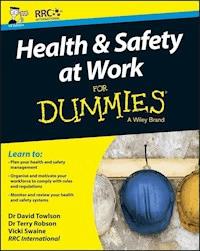
Health and Safety at Work For Dummies, UK Edition E-Book
18,99 €
Mehr erfahren.
- Herausgeber: John Wiley & Sons
- Kategorie: Fachliteratur
- Sprache: Englisch
Are you complying with health and safety regulations in the workplace?
Making mistakes in many areas of health and safety can be both incredibly dangerous and hugely costly. So what can you do to avoid hazards and expensive, time-consuming legal battles? That's where Health & Safety at Work For Dummies comes in. Cutting through the clutter, it provides you with the practical, must-know information you need to ensure your workplace is a suitably safe environment that complies with government health and safety rules and regulations.
Did you know that in 2014, 1.2 million working people suffered from work-related illnesses, 2,535 mesothelioma deaths occurred due to past asbestos exposure and 133 workers were killed on the job? The list goes on – and the statistics are staggering. Health & Safety at Work For Dummies shows you how to keep your employees safe from becoming another statistic in this frightening data. Arming you with critical information needed to adhere to health and safety regulations, it offers expert guidance on managing and implementing health and safety in your business, controlling workplace risks, going the extra mile in following orders and much more.
- Offers an easy-to-follow overview for getting started with health and safety
- Provides tips and advice for planning your health and safety management
- Includes guidance on monitoring and reviewing your health and safety systems
- Clearly demonstrates how to organize and motivate your workforce to comply with rules and regulations
You can't afford to run a business that doesn't provide a safe work environment. Be smart, safe and proactive with the help of this essential guide.
Sie lesen das E-Book in den Legimi-Apps auf:
Seitenzahl: 711
Veröffentlichungsjahr: 2016
Ähnliche




















Health & Safety at Work For Dummies®
Published by: John Wiley & Sons, Ltd., The Atrium, Southern Gate, Chichester,www.wiley.com
This edition first published 2016
© 2016 by John Wiley & Sons, Ltd., Chichester, West Sussex
Registered Office
John Wiley & Sons, Ltd., The Atrium, Southern Gate, Chichester, West Sussex, PO19 8SQ, United Kingdom
For details of our global editorial offices, for customer services and for information about how to apply for permission to reuse the copyright material in this book, please see our website at www.wiley.com.
All rights reserved. No part of this publication may be reproduced, stored in a retrieval system or transmitted in any form or by any means, electronic, mechanical, photocopying, recording, scanning or otherwise, except as permitted by the UK Copyright, Designs and Patents Act 1988, without the permission of this publisher.
LIMIT OF LIABILITY/DISCLAIMER OF WARRANTY: WHILE THE PUBLISHER AND AUTHOR HAVE USED THEIR BEST EFFORTS IN PREPARING THIS BOOK, THEY MAKE NO REPRESENTATIONS OR WARRANTIES WITH RESPECT TO THE ACCURACY OR COMPLETENESS OF THE CONTENTS OF THIS BOOK AND SPECIFICALLY DISCLAIM ANY IMPLIED WARRANTIES OF MERCHANTABILITY OR FITNESS FOR A PARTICULAR PURPOSE. IT IS SOLD ON THE UNDERSTANDING THAT THE PUBLISHER IS NOT ENGAGED IN RENDERING PROFESSIONAL SERVICES AND NEITHER THE PUBLISHER NOR THE AUTHOR SHALL BE LIABLE FOR DAMAGES ARISING HEREFROM. IF PROFESSIONAL ADVICE OR OTHER EXPERT ASSISTANCE IS REQUIRED, THE SERVICES OF A COMPETENT PROFESSIONAL SHOULD BE SOUGHT.
For general information on our other products and services, please contact our Customer Care Department within the U.S. at 877-762-2974, outside the U.S. at 317-572-3993, or fax 317-572-4002. For technical support, please visit www.wiley.com/techsupport.
Wiley publishes in a variety of print and electronic formats and by print-on-demand. Some material included with standard print versions of this book may not be included in e-books or in print-on-demand. If this book refers to media such as a CD or DVD that is not included in the version you purchased, you may download this material at http://booksupport.wiley.com. For more information about Wiley products, visit www.wiley.com.
A catalogue record for this book is available from the British Library.
ISBN 978-1-119-21093-1 (pbk); ISBN 978-1-119-28724-7 (ebk); ISBN 978-1-119-28725-4 (ebk)
Health & Safety at Work For Dummies®
Visit www.dummies.com/cheatsheet/healthandsafetyuk to view this book's cheat sheet.
Table of Contents
Cover
Introduction
About This Book
Foolish Assumptions
Icons Used in This Book
Beyond the Book
Where to Go from Here
Part I: Getting Started with Health and Safety at Work
Chapter 1: Making Sense of Health and Safety in the Workplace
Putting Health and Safety into Context
Benefitting Your Business
Speaking the Language Like a Pro
Chapter 2: Setting Your Health and Safety Policy
Deciding Whether to Go It Alone or Seek Assistance
Navigating the Maze of Official Guidance
Preparing Your Health and Safety Policy
Implementing Your Statement of General Policy
Chapter 3: Engaging Your Workforce with Health and Safety
Developing a Positive Safety Culture in Your Workplace
Taking Control
Co-operating with Health and Safety
Talking the Talk: Communicating about Health and Safety
Investing in Your People
Chapter 4: Assessing Health and Safety Risks in the Workplace
Thinking about Risk
Conducting Your Risk Assessment
Controlling Your Risk Level
Transferring Financial Risk with Insurance
Chapter 5: Getting Your House in Order
Working Up a Healthy Sweat
Staying Safe and on the Move
Considering Employee Welfare
Part II: Managing and Implementing Health and Safety in Your Business
Chapter 6: Moving to a Recognised Safety Management System
Discovering Why Safety Doesn’t Manage Itself
Choosing a Recognised Safety Management System
Looking at Safety Management System Elements
Implementing a Recognised Safety Management System
Chapter 7: Developing Safe Systems and Procedures
Developing Safe Systems of Work
Preparing Emergency Procedures
Contracting Procedures
Chapter 8: Monitoring and Reviewing Health and Safety in the Workplace
Monitoring Your Safety Management System
Using KPIs and Targets
Conducting Inspections and Audits
Learning from Accidents
Improving Health and Safety Performance
Part III: Controlling Workplace Risks
Chapter 9: Tackling Behaviour-Based Issues: Workplace Woes
Lifting the Lid on Violence
Stressing Out
Wising Up to Drugs and Alcohol
Chapter 10: Harnessing Gravity and Managing Workplace Transport
Working at Height
Controlling Workplace Transport
Chapter 11: Unpacking Manual Handling and Other Ergonomic Risks
Introducing the Problem
Taking Practical Steps to Handle Loads Safely
Getting Comfortable with Workstations
Chapter 12: Working Safely with Machinery
Getting to Know Your Machinery’s Hazards
Controlling Machinery Risk
Making Safeguards Count
Using Your Machinery
Chapter 13: Shocking Truths: Electrical Safety
Keeping Current on Electrical Hazards
Preventing Danger: Controlling Your Electricity Risk
Chapter 14: Fanning the Flames: Fire Risk
Playing with Fire
Assessing Fire Risk
Selecting Options for Fire Prevention and Protection
Chapter 15: Getting the Chemistry Right: Controlling Hazardous Substances
Assessing the Risks to Health from Chemical Substances
Keeping Chemicals under Wraps
Getting to Know Asbestos
Chapter 16: Making Waves: Tackling Noise, Vibration and Radiation
Dealing with Noise and Vibration in the Workplace
Addressing Radiation Concerns in the Workplace
Part IV: Going the Extra Mile
Chapter 17: Wrestling with Health and Safety Law
Judging What’s Right: The UK Legal System
Drawing Out the Health and Safety at Work etc Act 1974
Breaking into the Management Regulations
Chapter 18: Developing a Positive Safety Culture: Factoring in Human Behaviour
Evolving Your Organisation’s Safety Culture
Anticipating the Impact of Human Factors
Chapter 19: Cracking Process Safety
Approaching Safety Differently
Breaking Down Process Safety Management
Stacking Up Some Process Safety Management System Elements
Part V: The Part of Tens
Chapter 20: Ten Ways to Get Risk Assessment Wrong
Using a Risk Assessment to Justify Decisions You’ve Already Made
Making Your Risk Assessment Too Generic
Overcomplicating Your Risk Assessment
Ignoring Industry Standards and Good Practice
Using the Wrong Guidance
Knowing Nothing about the Activity You’re Assessing
Leaving Consultants to the Task without Getting Involved Yourself
Getting Bogged Down in Trivia
Treating Your Risk Assessment as a Paper Exercise
Assuming That Nothing Ever Changes
Chapter 21: Ten Neat Tools to Help You Assess Risks and Choose Controls
Office Risk Assessment Tool
Risk Assessment Routefinder
COSHH Essentials
Manual Handling Assessment Charts (MAC) Tool
Assessment of Repetitive Tasks (ART) Tool
Noise Exposure and Hearing Protection Calculators
Hand-Arm Vibration Exposure Calculator
Work at Height Access Equipment Information Toolkit
Asbestos Essentials Task Sheets
Stress Management Tools
Chapter 22: Ten Great Health and Safety Websites
Health and Safety Executive
Health and Safety Executive Northern Ireland
Public Health England
Fire Safety in the Workplace
Legislation
Institution of Occupational Safety and Health
Occupational Safety and Health Consultants Register
European Agency for Safety and Health at Work
World Health Organization
International Labour Organization’s Encyclopaedia of Occupational Health and Safety
About the Author
Cheat Sheet
Advertisement Page
Connect with Dummies
End User License Agreement
Guide
Cover
Table of Contents
Begin Reading
Pages
iii
iv
vii
viii
ix
x
xi
xii
xiii
xiv
1
2
3
4
5
6
7
8
9
10
11
12
13
14
15
16
17
18
19
20
21
23
24
25
26
27
28
29
30
31
32
33
34
35
36
37
38
39
40
41
42
43
44
45
47
48
49
50
51
52
53
54
55
56
57
58
59
60
61
62
63
64
65
66
67
69
70
71
72
73
74
75
76
77
78
79
80
81
82
83
84
85
86
87
89
90
91
92
93
94
95
96
97
98
99
100
101
102
103
104
105
107
108
109
110
111
112
113
114
115
116
117
118
119
121
122
123
124
125
126
127
128
129
130
131
132
133
134
135
136
137
138
139
140
141
142
143
144
145
146
147
148
149
150
151
152
153
154
155
156
157
158
159
160
161
162
163
164
165
166
167
168
169
170
171
172
173
174
175
176
177
178
179
180
181
182
183
184
185
186
187
188
189
190
191
192
193
194
195
196
197
198
199
200
201
202
203
204
205
206
207
208
209
210
211
212
213
215
216
217
218
219
220
221
222
223
224
225
226
227
228
229
230
231
233
234
235
236
237
238
239
240
241
242
243
244
245
246
247
248
249
251
252
253
254
255
256
257
258
259
260
261
262
263
264
265
266
267
268
269
271
272
273
274
275
276
277
278
279
280
281
282
283
284
285
286
287
288
289
290
291
292
293
294
295
296
297
298
299
300
301
302
303
304
305
306
307
308
309
310
311
312
313
314
315
316
317
318
319
320
321
322
323
324
325
326
327
328
329
330
331
332
333
334
335
336
337
338
339
340
341
342
343
344
345
346
347
349
350
351
352
353
354
355
356
357
358
359
360
361
362
363
364
365
366
367
368
369
370
371
372
373
375
376
377
378
379
380
381
382
383
385
386
387
388
389
390
411
412
413
414
415
416
417
418
Introduction
Health and safety is a surprisingly interesting topic. It combines bits of science, engineering, management, psychology, ergonomics, law and economics, giving them a safety and health spin. So, if you’ve ever studied anything or had a job of any kind, you may find that much of the information in this book is familiar and accessible (though it certainly has its techy bits).
We wrote this book because a lot of people are still a bit confused or mystified by health and safety – and we don’t want that confusion to continue! It’s partly because health and safety is surrounded by more mythology than an ancient Greek epic, and partly because it can be hard to find the information you need unless you know exactly what you’re looking for (or you’re just plain lucky).
At one extreme, you may think that health and safety is just common sense (so why all the fuss?), and at the other, you may think that it’s just too complicated. We have sympathy with both extremes because we’ve all been there. None of us started out as safety professionals (though we’ve always been professional …). We’re ordinary folk (with what we like to think of as a healthy interest in fires, explosions, drugs and alcohol).
To start you off on your health and safety journey, here are a few interesting things we, as authors, have picked up along the way that you may find useful:
Risk assessment is a core tool for health and safety. It helps you to make decisions and is a springboard for action; it isn’t supposed to be an end in itself.
Safety management systems are much easier to set up than to maintain, review and improve – people can lack the motivation for these repeat visits/checks/audits.
Using consultants can be an efficient and effective use of resources, especially when you’re dealing with something technical. But make sure that you’re clear about what you want from your consultant (in terms of end-result deliverables). A good consultant can help you work out the specifications around your needs, but this process can be tricky if you yourself have no clear idea of what you want in the first place.
Consultant fees seem only to come in units of one day, regardless of how little work is done.
No two safety experts will ever agree on the detail. Don’t let that worry you too much – health and safety work relies on professional judgement, and in reality you can find many ways to achieve the same end result. Take a holistic view.
You get better at safety the more you do it!
About This Book
Businesses have lots of things they need to do to be successful – and making sure that the money is coming in is obviously right up there. But health and safety is also an important part of managing a business. It isn’t something separate or an optional add-on – it needs to be integrated into your business’s operations, but it often isn’t.
In terms of health and safety, you and your business at least need to:
Navigate the apparently complex laws and guidance.
Discover what your priorities are – the things you must do, like write a safety policy, complete risk assessments, consult with your employees and report accidents.
Work out what you can do yourself and when you may need help – and where this help may come from (for example, from consultants).
Work out how to improve performance.
Be sensible, proportionate and realistic (rather than striving for perfection or overreacting).
This book can help you to do all these things, using the experience, wit and humour of three safety professionals (us, your authors). We can help to make health and safety real – so you can see how it can be put into practice in everyday terms. We also introduce you (in Parts III and IV) to the wider scope of safety and health. Not all of these areas will apply to you and your business, but health and safety crosses industries, sectors and continents. It’s relevant in any industry that’s interested in protecting its people, so we aim to deliver comprehensive coverage of the major topics.
You may notice a few icons in the margins as you work your way through the book – these icons help you to identify the key points, take note of some useful advice and they also indicate the stuff that’s just nice to know. You may prefer to skip some of the sidebars and ‘Technical Stuff’ icons if you’re in a hurry and need the basics fast.
Within this book, you may notice that some web addresses break across two lines of text. If you’re reading this book in print and want to visit one of these web pages, simply key in the web address exactly as it’s noted in the text, pretending as though the line break doesn’t exist. If you’re reading this as an e-book, you’ve got it easy – just click the web address to be taken directly to the web page.
Foolish Assumptions
We assume that you’re either very interested in health and safety or at least need to know the basics. However, we don’t assume that you know very much about health and safety, apart from what you may have read in the newspapers. You may be a business owner, a manager or anyone who needs to get health and safety sorted in your workplace.
Icons Used in This Book
To help you sort out the important information, we use icons in the text. Here’s a quick summary of what these icons mean:
This icon indicates practical advice that we’ve discovered along the way that can make life easier for you.
This icon points out some things that are important enough for you to take note of. You may even want to write these key points down somewhere.
This icon warns you of traps that you can fall into if you’re not careful.
This icon provides you with a realistic example (sometimes from your authors’ chequered pasts) that can help you to see how things work in practice.
This icon highlights technical terms. Did you really think you’d get away with avoiding the jargon? Every topic has some subject-specific terms that need a bit more explanation, so we take the time to point them out, especially when they’re common words that have a special meaning in a health and safety context.
This icon notes specialised health and safety facts that go deeper into a topic than you may need to go. But you can skip these if you’re in a rush and still get the point.
Beyond the Book
As you navigate your way through Health and Safety at Work For Dummies, you can supplement our sublime text with some extra online goodies. You can find the book’s e-cheat sheet at www.dummies.com/cheatsheet/healthandsafetyuk. And, by going to www.dummies.com/extras/healthandsafetyuk you can find some bonus articles with detail that we just couldn’t fit in the book.
Where to Go from Here
This book isn’t a novel; it’s a reference book. As such, you can start anywhere you like. But, if you have little or no safety knowledge or experience, we suggest that you start at the beginning, because the chapters in the first part provide a gentle introduction to the subject and focus on the key things you must do in a business to cover health and safety – the absolute basics.
Other than that, take a quick look at the table of contents or index and choose a topic that makes you smile – and get started!
Part I
Getting Started with Health and Safety at Work
Visit www.dummies.com for great (and free!) For Dummies content online.
In this part …
Understand what health and safety is and its benefits to you and your business.
Decide whether you need professional help or can go it alone, and take a look at your safety policy.
Set the right culture – lead from the front, consult with your employees, communicate effectively with your team and train your employees to do their jobs properly.
Assess your business risks using pragmatic and sensible approaches that are proportional to the risk.
Create a healthy and safe physical workplace environment and give attention to your employees’ welfare – that means toilets, temperature and housekeeping.
Chapter 1
Making Sense of Health and Safety in the Workplace
In This Chapter
Understanding what health and safety is
Establishing how health and safety can benefit your business
Navigating health and safety terminology
Health and safety at work isn’t a new thing. In past times, making work safer has sometimes been a by-product of not wanting to run out of a limited supply of skilled labourers. For example, gravity has always been difficult to defeat for us humans, so even the ancient civilisations (like the Greeks and Romans) thought of scaffolding and cranes (which also introduce some additional risks – choices, choices).
Things have moved on since then. Modern times bring their comforts and benefits but also new health and safety challenges for every business owner and manager. Safety standards are considerably higher today, and society won’t tolerate a business that recklessly fails to protect its employees from unnecessary risks. With modern knowledge, tools and technologies, you’re more capable than ever of managing these risks – but you may at times feel that you need to embrace a seemingly bewildering range of legislation and advice along the way. But not to worry – we’re here to help you figure out how to rise to the health and safety challenge.
In this chapter, we look at what workplace health and safety really is, why it’s important, and how good health and safety practices can help your business flourish. We also introduce you to some of the key terminology you’ll see again and again as you discover more about the wonderful world of health and safety. More than anything, we want to give you the confidence to tackle health and safety issues yourself in your own organisation.
Putting Health and Safety into Context
Health and safety can be an emotive subject. It gets a lot of bad press in the UK. Every week you hear about some nonsense or other that reinforces that health and safety is out to spoil everyone’s fun, ridiculously disproportionate or just plain silly. Or you hear lots of stories about how not enough was done, how someone or other must be held to account, and how on earth this can be happening again. It’s enough to make you want to write a strongly worded letter to The Times!
But, believe it or not, health and safety professionals get just as frustrated with this as you do – and they’re not out there to spoil your fun or to surround you with red tape. In fact, many rather like having fun themselves.
Lesen Sie weiter in der vollständigen Ausgabe!
Lesen Sie weiter in der vollständigen Ausgabe!
Lesen Sie weiter in der vollständigen Ausgabe!
Lesen Sie weiter in der vollständigen Ausgabe!
Lesen Sie weiter in der vollständigen Ausgabe!
Lesen Sie weiter in der vollständigen Ausgabe!
Lesen Sie weiter in der vollständigen Ausgabe!
Lesen Sie weiter in der vollständigen Ausgabe!
Lesen Sie weiter in der vollständigen Ausgabe!
Lesen Sie weiter in der vollständigen Ausgabe!
Lesen Sie weiter in der vollständigen Ausgabe!
Lesen Sie weiter in der vollständigen Ausgabe!
Lesen Sie weiter in der vollständigen Ausgabe!
Lesen Sie weiter in der vollständigen Ausgabe!
Lesen Sie weiter in der vollständigen Ausgabe!
Lesen Sie weiter in der vollständigen Ausgabe!
Lesen Sie weiter in der vollständigen Ausgabe!
Lesen Sie weiter in der vollständigen Ausgabe!
Lesen Sie weiter in der vollständigen Ausgabe!
Lesen Sie weiter in der vollständigen Ausgabe!
Lesen Sie weiter in der vollständigen Ausgabe!
Lesen Sie weiter in der vollständigen Ausgabe!
Lesen Sie weiter in der vollständigen Ausgabe!
Lesen Sie weiter in der vollständigen Ausgabe!
Lesen Sie weiter in der vollständigen Ausgabe!
Lesen Sie weiter in der vollständigen Ausgabe!
Lesen Sie weiter in der vollständigen Ausgabe!
Lesen Sie weiter in der vollständigen Ausgabe!
Lesen Sie weiter in der vollständigen Ausgabe!
Lesen Sie weiter in der vollständigen Ausgabe!




