


0,49 €
Mehr erfahren.
- Herausgeber: Quickie Classics
- Kategorie: Krimi
- Sprache: Englisch
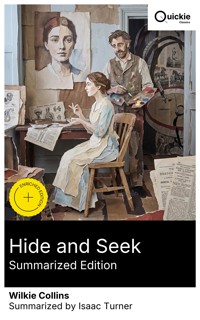
Hide and Seek interweaves lost identity with a tender study of disability. At its center stands the deaf heroine, Madonna, adopted by the idealistic painter Valentine Blyth; their orbit spans the London studio and the traveling circus from which she was rescued, as a buried scandal surfaces. Collins blends domestic realism with investigative plotting and theatrical set pieces, moving from comic bustle to menace. An early 1850s work, it anticipates sensation fiction by using secrets, misrecognition, and social surveillance to interrogate Victorian norms. Collins, son of Royal Academician William Collins, writes with an eye trained by the gallery and the greenroom. His association with Dickens and Household Words sharpened his interest in urban margins, while humane curiosity about law, medicine, and pedagogy shapes the respectful portrayal of deafness and sign. Early in his career, he tests techniques—shifting focalization, documentary detail, ethical suspense—that he would later perfect in The Woman in White and The Moonstone. Readers of Victorian fiction, disability studies, and arts culture will find this novel richly rewarding. It offers narrative pleasure, historical insight, and a humane intelligence that still feels modern, making it an ideal introduction to Collins and a cornerstone of early sensation. Quickie Classics summarizes timeless works with precision, preserving the author's voice and keeping the prose clear, fast, and readable—distilled, never diluted. Enriched Edition extras: Introduction · Synopsis · Historical Context · Author Biography · Brief Analysis · 4 Reflection Q&As · Editorial Footnotes.
Das E-Book können Sie in Legimi-Apps oder einer beliebigen App lesen, die das folgende Format unterstützen:
Veröffentlichungsjahr: 2026
Ähnliche
















Hide and Seek (Summarized Edition)
Table of Contents
Introduction
In a world where appearances police affection, institutions reward silence, and the past refuses to stay buried, Wilkie Collins’s Hide and Seek stages a relentless pursuit in which love, curiosity, and conscience test the barriers erected by class, propriety, and fear, turning the quiet spaces of home and studio, the bright dazzle of public entertainments, and the shadowed edges of the city into a map of concealed injuries and hard-won recognitions, while a young woman’s enforced muteness becomes the novel’s most eloquent challenge to how society hears pain, measures worth, and decides which stories deserve to be brought into the light.
First published in the mid-1850s, during the high Victorian moment, the novel blends domestic realism with an emerging mystery framework that anticipates the sensation fiction Collins would perfect in later works. Its settings range across urban and provincial England, from studios and parlors to the itinerant spaces of popular entertainment. The narrative proceeds in the third person with a confident, conversational narrator who guides, teases, and occasionally admonishes. Readers encounter bustling social textures, sharp comic turns, and careful attention to material detail, all harnessed to the question of how a hidden history might surface without shattering the fragile bonds that sustain everyday life.
The story’s initial movement is simple and affecting: a child, rendered deaf and mute by early misfortune, is rescued from a precarious life in public exhibition and taken into a compassionate household where art offers shelter and meaning. As she grows, her grace and intelligence anchor a small community that spans bohemian and respectable worlds, yet the puzzle of her birth and abandonment persists. A second arc follows a fiery young man struggling against paternal rigidity, whose rebellious energy draws him toward this household. Clues and coincidences begin to accumulate, not as melodramatic shocks but as patient beckonings toward a past that demands recognition.
Collins engineers the reading experience with a steady alternation of warmth and unease, building character through lively dialogue, painterly description, and a humane curiosity about work, leisure, and taste. Chapters often close on a hinge—less a cliff than a doorway—encouraging the reader onward while preserving the dignity of everyday rhythms. The prose is lucid, lightly ironic, and rich in visual cues, confident without pomposity. The author’s guiding presence never feels evasive; rather, it frames uncertainty as a moral and aesthetic problem, asking how we come to know one another and what it costs to press beyond the boundaries politeness would impose.
At the novel’s center stands the tension between secrecy and disclosure, a dynamic that structures households as surely as it animates courts, charities, and amusements. Collins treats disability not as a spectacle but as a social fact that reshapes communication, trust, and protection, casting the ethics of guardianship into stark relief. He is equally attentive to performance—in the studio, on the fairground, and within drawing-room rituals—probing the fragile line between artifice and sincerity. Sandwiched between pastoral longings and urban pressures, characters negotiate class attribution and moral reputation, showing how compassion can flourish inside constricting conventions yet also be warped by fear and shame.
For contemporary readers, the book’s most arresting contribution may be its insistence that care is an active, interpretive labor: listening across silence, making space for difference, and resisting the crude shortcuts of gossip or officialdom. Questions that animate current debates—about accessibility, the policing of respectability, and the right to narrate another’s life—are present here in nascent form, sifted through plot rather than podium. The novel also offers a study in restorative imagination: it searches not merely for culprits but for conditions under which injured lives can be repaired. That humane emphasis keeps the suspense meaningful, tethering discovery to responsibility.
As an early landmark in Collins’s career, Hide and Seek shows how a novelist associated with sensational revelations could craft suspense from ordinary kindness and domestic courage, laying groundwork for the psychological intricacy of his later triumphs. It invites readers to relish craft—the careful dovetailing of subplots, the painterly tableaux, the steady moral pressure—while entering a world recognizably ours in its anxieties about identity and belonging. The book still matters because it proposes that truth, however unsettling, is a communal achievement. Read patiently and without foreknowledge, it rewards with a revelation that feels earned, necessary, and ethically proportionate to the pain it uncovers.
Synopsis
Wilkie Collins’s Hide and Seek, first published in the mid-nineteenth century, traces a gently suspenseful mystery woven through everyday life rather than crime alone. The novel opens in and around London, where the generous artist Valentine Blyth and his devoted wife preside over a hospitable household. Into their world comes a young girl rescued after an accident connected with a traveling show. Unable to hear or speak, she is cherished and renamed “Madonna” for her serenity and grace. Collins establishes a mood of domestic warmth and curiosity, suggesting that the child’s obscure past, though tenderly guarded, may yet cast a longer shadow.
The Blyths’ home becomes a haven defined by art, kindness, and careful attentiveness to Madonna’s needs. Valentine’s studio, full of half-finished canvases and hopeful plans, frames the girl’s presence as both inspiration and responsibility. Her gestures, expressions, and quick perceptions allow Collins to explore communication beyond words, while maintaining a respectful distance from medicalized detail. The household’s quiet routines occasionally widen to include neighbors and friends, and the painter’s affection for his ward hints at complexities he chooses not to probe. The narrative’s central question—who Madonna was before she was found—remains suspended, inviting patient observation.
Contrasting with this tranquility is the restless energy of young Zack Thorpe, who chafes under the austere moral discipline of his father. Seeking escape, Zack gravitates toward livelier company and the free-spirited hospitality of the Blyths. He admires Valentine’s independence, longs for experience, and stumbles into nocturnal urban adventures that test his judgment. Collins uses this strand to stage a generational conflict: strict principle versus flexible sympathy. As Zack’s mischief grows bolder, he becomes a conduit through which disparate parts of London society meet—respectable parlors, artists’ studios, and rougher haunts that shelter people with histories harder to confess.
From these rougher quarters emerges Mat, a weathered wanderer whose taciturn manner conceals fierce loyalty. He returns to England with a single purpose: to uncover the truth about a grievous wrong suffered by his sister. Mat’s past is sketched through hints of far travels and hard experience, equipping him with patience, a talent for reading people, and an unshakable sense of justice. Collins shapes Mat’s quest as a dogged pursuit of fragments—names half-remembered, places altered by time, and witnesses reluctant to speak—setting a second mystery in motion alongside the quiet enigma of Madonna’s origin.
As the two narrative lines begin to interlace, Zack’s impulsive friendliness draws him toward Mat, while the Blyths’ generosity keeps their home open to unexpected visitors. The novel’s title underscores a pattern of appearance and concealment: people hide facts out of shame, fear, or misplaced protection; seekers follow traces that lead them closer to painful truths. Madonna’s past exerts a gravitational pull even on those determined to shield her. Collins orchestrates meetings and coincidences without breaking plausibility, allowing small tokens, casual remarks, and stray memories to accumulate into suggestive but incomplete revelations.
The investigation relies less on official channels than on social pathways and the geography of everyday life. Mat listens in public houses, searches among itinerant entertainers, and follows faint leads across humble neighborhoods. Collins balances the mechanics of detection with humane portraiture, pausing for vivid sketches of showfolk, artisans, and caretakers whose livelihoods carry their own codes of honor. This ground-level approach keeps the mystery rooted in ordinary experience. The reader moves through workshops and back rooms rather than courtrooms, sensing that truth in this world is more likely to be pieced together at a kitchen table than exposed by formal authority.
Meanwhile, tension inside the Thorpe household sharpens the novel’s moral inquiry. Zack’s father, rigid in conviction, doubles down on surveillance and reprimand, convinced he protects his son’s soul. Zack, pulled between duty and self-definition, finds solace in the Blyths’ tolerant counsel. The contrast between punitive zeal and compassionate guidance echoes broader Victorian debates about conscience, respectability, and the proper means of reform. Madonna’s serene presence complicates every judgment: her vulnerability invites care, but her dignity unsettles the impulse to decide for her. Collins sketches these conflicts without melodrama, letting habits and small choices reveal each character’s stance.
As Mat closes in on the older wrong he has sworn to remedy, various threads tighten around questions of identity and accountability. The search produces credible clues but also moral quandaries: how much disclosure helps the innocent, what restitution looks like after years have passed, and whether zeal for justice can shade into harm. The Blyths’ kindness, Zack’s volatility, and Mat’s resolve converge near the truth, yet the novel withholds definitive answers long enough to emphasize consequences over shock. Collins presses the idea that revelations can heal or wound depending on the care with which they are managed.
Hide and Seek ultimately affirms the value of patient sympathy, resisting the notion that righteousness alone clarifies a tangled past. By pairing a domestic idyll with a determined inquiry, Collins anticipates later sensation fiction while grounding suspense in everyday ethics. The novel’s enduring significance lies in its humane attention to disability, its critique of harsh moralism, and its belief that art, friendship, and persistence can illuminate what secrecy distorts. Without disclosing its final turns, the book suggests that truth matters most when it serves compassion, and that the hardest puzzles are solved as much by kindness as by cleverness.
Historical Context
Hide and Seek, published in 1854, belongs to Wilkie Collins’s early, pre-sensation phase, written as he was consolidating his reputation within mid-Victorian literary culture. By the early 1850s Collins was contributing to Charles Dickens’s weekly Household Words, and the two formed a close professional relationship that encouraged experiment with socially observant, plot-driven fiction. British publishing at mid-century was shaped by steam-powered presses, expanding literacy fostered by earlier schooling initiatives, and a growing market for multi-volume novels and serials. These conditions favored narratives that moved between domestic interiors and public institutions, and that tested the boundaries between entertainment and social inquiry—an approach Collins would refine.
The novel’s milieu is recognizably mid-century London and its environs, a city transformed by railways, new suburbs, and a swelling middle class. The 1851 Great Exhibition at the Crystal Palace had recently displayed British industrial prowess and consumer goods, symbolizing aspirations toward order, progress, and tasteful domesticity. Amid this prosperity, street entertainments, theatres, and pleasure gardens flourished, even as moralists scrutinized them. Voluntary associations, benevolent societies, and hospitals multiplied, while the press reported urban curiosities and scandals to an ever-wider readership. This mixture of spectacle, bureaucracy, and reform provides the social texture against which Collins stages lives that cross class and institutional boundaries.
Victorian religious culture remained powerful in shaping daily conduct. Evangelical Anglicanism and Nonconformist Protestantism promoted self-discipline, Sabbath observance, and suspicion of frivolous amusements, while also inspiring philanthropy and missions to the urban poor. Debates about theatre-going, temperance, and “worldliness” animated households and pulpits alike. At the same time, the Oxford Movement within the Church of England (from the 1830s) provoked controversy over ritual and authority. Such currents created sharp contrasts between public piety and private feeling, and between youthful sociability and paternal severity. Collins’s narrative registers these tensions, observing how rigid moral codes can narrow sympathies, and how affection seeks humane accommodations within them.
Legal and administrative frameworks strongly conditioned reputation and kinship. The Poor Law Amendment Act of 1834 centralized relief through workhouses and, under its original bastardy clauses, limited paternal liability for children born out of wedlock; revisions in the 1840s partially restored affiliation orders. Parish registers, coroner’s inquests, and settlement examinations left paper trails that could both illuminate and obscure identities. Married women remained under coverture, constraining property and guardianship rights until reforms later in the century. Charitable asylums and voluntary hospitals operated alongside magistrates’ courts, mediating cases of poverty and dependency. Collins engages these structures, revealing how bureaucracy and moral judgment intertwine in the making—or effacing—of a life.
Deafness and disability were prominent topics in nineteenth‑century Britain’s philanthropic and educational discourse. The Asylum for the Support and Education of the Deaf and Dumb Children of the Poor (founded 1792, London) exemplified institutional provision, where sign language and manual methods were widely used. Ear trumpets and finger‑spelling circulated alongside moral narratives about perseverance. Public figures who were deaf or hard of hearing—such as Harriet Martineau—and writers like John Kitto, author of The Lost Senses (1845), shaped contemporary understanding. Collins draws on this milieu to depict communication across sensory difference, probing how compassion, habit, and visual attentiveness can substitute for speech within affectionate domestic circles.
Visual art inflects the novel’s world. Collins grew up in an artistic household: his father, William Collins, R.A. (1788–1847), was a celebrated landscape and genre painter connected to the Royal Academy. Mid‑century London sustained a market for portraits and genre scenes, with exhibition culture centered on the Royal Academy and debated by critics such as John Ruskin. The Pre‑Raphaelite Brotherhood, founded in 1848, had stirred controversy by 1851 over truth to nature and moral seriousness in art. Studio practices, patronage networks, and the symbolic language of pictures were familiar to readers. Collins harnesses this backdrop to explore seeing, interpretation, and the ethics of representing character.
Institutional detection was also modernizing. London’s Metropolitan Police had been established in 1829, and a Detective Department was created at Scotland Yard in 1842, reflecting new confidence in systematic inquiry. Newspapers relayed trials and inquests, popularizing a culture of evidence, witness testimony, and documentary proof. Mid‑century fiction began to absorb these habits, experimenting with clues, embedded documents, and retrospective reconstruction long before the fully formalized detective novel. Collins, who would later help define sensation fiction, adapts these investigative rhythms to domestic settings, letting ordinary ephemera—letters, registers, and portraits—carry narrative weight and reflect a society fascinated by the recoverability of hidden facts.
The book reached readers shaped by circulating libraries such as Mudie’s (founded 1842), which favored decorous multi‑volume novels while tolerating carefully framed social critique. In the 1850s, authors explored secrets, inheritance, and identity against respectable backdrops, anticipating the explosive “sensation” vogue of the 1860s, in which Collins became a central figure with The Woman in White (1860). Hide and Seek belongs to this transitional moment: it entertains through mystery while scrutinizing the institutions—family, church, asylum, and law—that regulate belonging. Its humane focus on disability and its skepticism toward punitive moralism locate the novel within a broader mid‑Victorian debate about sympathy, oversight, and justice.




