


30,99 €
Mehr erfahren.
- Herausgeber: John Wiley & Sons
- Kategorie: Fachliteratur
- Sprache: Englisch
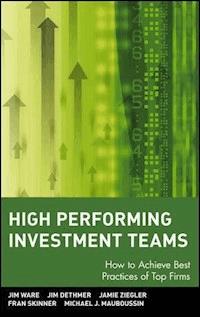
High Performing Investment Teams "Although most leaders agree teamwork is important, few businesses effectively build collaborative, synchronized teams. High Performing Investment Teams is an excellent guidepost for any manager striving to create a winning team and develop bench strength for the future." --John W. Rogers Jr., Chairman and Chief Executive Officer, Ariel Capital Management, LLC "Turning individual talent into team performance is the ultimate challenge for an investment organization, but also the key to building a sustainable investment franchise. Focus Consulting has captured the essence of how to leverage your intellectual capital for maximum and enduring success." --Michelle R. Seitz, CFA, Principal, Head of Investment Management, Executive Committee Member, William Blair & Company, LLC "Focus Consulting's work on behaviors of top teams is clear, effective, and practical. We recommend it highly for investment firms that are serious about world-class collaboration." --Terry Toth, President, Northern Trust Global Investments "Focus Consulting really understands that attracting and motivating talented people makes all the difference for asset managers. Their work is based on years of experience helping investment firms build strong cultures with productive behaviors." --Scott Powers, Chief Executive Officer, Old Mutual Asset Management "Focus Consulting understands the people aspect of the investment business. They know the investment business and how to make collaboration work." --Harin de Silva, PhD, CFA, President, Analytic Investors
Sie lesen das E-Book in den Legimi-Apps auf:
Seitenzahl: 348
Veröffentlichungsjahr: 2006
Ähnliche


















Contents
Foreword
Preface
Acknowledgments
About the Authors
Introduction
Chapter 1: Investment Leadership
The Culture Thing
Culture Success Factor 1: Clarity of Values and Vision
Culture Success Factor 2: Consistency of Values and Vision
Culture Success Factor 3: Alignment with Values and Vision
Culture Success Factor 4: Strong Culture
Culture Success Factor 5: Cultural Indoctrination
Culture Success Factor 6: Succession of Leadership
Culture for Competitive Advantage
Practical Applications
Conclusion
Chapter 2: Curiosity
Do you know if you’re Defensive?
Above or Below the Line?
The Acid Test: Untying the Gordian Knot in Canada
Real-Time Use of the Defensiveness Scale
Summary
Next Steps
Chapter 3: Accountability Part 1
What is Accountability?
Radical Responsibility
Radical Responsibility in Real Life
Slicing the 100 Percent Pie
Blaming Versus Claiming
The Rule of Three
Committing to Radical Responsibility
Stepping into Commitment
What if Everyone isn’t Playing?
Conclusion
Summary
Next Steps
Chapter 4: Accountability Part 2
What’s the Issue?
What is an Agreement?
Making Good Agreements
Keep Your Agreements
Renegotiating Agreements
Cleaning up Broken Agreements
Clarity Worksheet
Committing to Impeccable Agreements
Conclusion
Summary
Next Steps
Chapter 5: Candor
Separating Fact from Opinion
Reducing Drama in the Workplace
Exposing the Elephants in the Room
A Common Language Encourages Candor
Candor in the Investment Process
Summary
Next Steps
Chapter 6: Authenticity
Personas: A Personal Example
The Conflict Triangle: Villain, Victim, Hero
Getting out of the Triangle
Benefits of Eliminating Corporate Drama
Summary
Next Steps
Chapter 7: Awareness
Self-Awareness
Self-Management
Social Awareness
Relationship (Social) Management
Feelings in the Workplace
Intuition: The Equal Partner of Logic
Summary
Next Steps
Chapter 8: Genius
Why Job Descriptions Fail
Genius: Your Place to Shine
Keys to Finding Genius
The Success Key
The Delight Key
The Creativity Key
The Ease Key
The Feedback Key
Moving into Genius
Personal Alignment
Team Alignment
Conclusion
Summary
Next Steps
Chapter 9: Appreciation
Entitlement
What is Appreciation?
Two Circles of Life
Appreciation and Teams
Appreciation and Candor
Why do we Resist Appreciation?
Harder to Receive than to Give
The Voice of the Inner Critic
Committing to Appreciation
Appreciation is Contagious
Summary
Next Steps
Chapter 10: Fit
Extroversion Versus Introversion: “Out There” Versus “In Here”
Sensing Versus Intuiting: Bottom-Up or Top-Down?
Thinking Deciders Versus Feeling Deciders: Reading Annual Reports or Reading People
Organized (Judging) Versus Flexible (Perceiving): Felix and Oscar (The Odd Couple)
Types and Cultures in the Investment World
The Tough Behaviors for Rationalists: Curiosity, Responsibility, Appreciation
Chapter 11: Decision Rights
A Lesson for Joe
The Rungs of the Ladder
The Ladder in Action
Conclusion
Summary
Concluding Thoughts
Afterword
Index
Copyright © 2006 by Focus Consulting Group. All rights reserved.
Published by John Wiley & Sons, Inc., Hoboken, New Jersey. Published simultaneously in Canada.
No part of this publication may be reproduced, stored in a retrieval system, or transmitted in any form or by any means, electronic, mechanical, photocopying, recording, scanning, or otherwise, except as permitted under Section 107 or 108 of the 1976 United States Copyright Act, without either the prior written permission of the Publisher, or authorization through payment of the appropriate per-copy fee to the Copyright Clearance Center, Inc., 222 Rosewood Drive, Danvers, MA 01923, (978) 750-8400, fax (978) 646-8600, or on the web at www.copyright.com. Requests to the Publisher for permission should be addressed to the Permissions Department, John Wiley & Sons, Inc., 111 River Street, Hoboken, NJ 07030, (201) 748-6011, fax (201) 748-6008, or online at http://www.wiley.com/go/permissions.
Limit of Liability/Disclaimer of Warranty: While the publisher and author have used their best efforts in preparing this book, they make no representations or warranties with respect to the accuracy or completeness of the contents of this book and specifically disclaim any implied warranties of merchantability or fitness for a particular purpose. No warranty may be created or extended by sales representatives or written sales materials. The advice and strategies contained herein may not be suitable for your situation. You should consult with a professional where appropriate. Neither the publisher nor author shall be liable for any loss of profit or any other commercial damages, including but not limited to special, incidental, consequential, or other damages. For general information on our other products and services or for technical support, please contact our Customer Care Department within the United States at (800) 762-2974, outside the United States at (317) 572-3993 or fax (317) 572-4002.
Wiley also publishes its books in a variety of electronic formats. Some content that appears in print may not be available in electronic books. For more information about Wiley products, visit our web site at www.wiley.com.
Library of Congress Cataloging-in-Publication Data
Ware, Jim, 1954-
High performing investment teams : how to achieve best practices of top firms / by Jim Ware and Jim Dethmer With Jamie Ziegler and Fran Skinner ; foreword by Michael J. Mauboussin ; afterword by Kate Ludeman and Eddie Erlandson.
p. cm.
Includes bibliographical references.
ISBN-13 978-0-471-77078-7 (cloth)
ISBN-10 0-471-77078-7 (cloth)
1. Investment advisors. 2. Teams in the workplace. 3. Leadership. I. Dethmer, Jim. II. Title.
HG4621.W36 2006
658.15'2—dc22
2005029718
Foreword
Michael J. Mauboussin
Shortly after his retirement, Jack Welch, the legendary CEO of General Electric, spoke to a group of 5,000 human resources (HR) executives and delivered a message he was sure they would appreciate: The head of HR should be the second most important person in any organization. Anticipating some audience adulation, he was surprised when a strange hush filled the room. Prodding, he asked how many of the participants worked for firms where the CEO treated the head of HR and the CFO with equal respect. Only 50 hands went up.
Welch was astounded. Ninety-nine percent of these companies emphasized finance over people! “If you managed a baseball team,” he asked, “would you listen more closely to the team accountant or the director of player personnel?” Put this way, the lack of focus on people and their behavior seems absurd, yet this is how most executives manage their companies today.
If the only lesson you learn from High Performing Investment Teams is that people are crucial to long-term success, you will be ahead of the game and your competition. Still, this book offers much more than that seemingly simple lesson. The Focus team deftly guides you through both the theory and the practice of what makes investment firms thrive, and provides you with concrete cases and tools to improve individual and team behavior.
Psychologists find that people tend to attribute actions more to an individual’s character than to the social context, or the situation, in which the individual operates. Studies show, though, that social context has an extremely powerful influence on behavior. Researchers have consistently noted that when good people discover themselves in bad situations, their behavior changes for the worse. Thus, even if the need is not obvious or intuitive, creating a favorable social context is vital to any investment organization that wants to sustain above-average performance.
Even as star money managers (including my esteemed colleague Bill Miller) adorn investment magazine covers, academic research shows that a substantial majority of fund results are attributable to the investment firm, not a particular individual. No doubt there are super-talented money managers out there, but performance starts and stops with them unless they create an enduring, high-performing organization.
Mastering the seven behaviors of high-performing teams is a challenge for any business. Investment professionals may have an even more difficult time adopting these behaviors than people in most industries, aside from the personality issues the Focus team correctly considers. Specifically, investment managers face three hurdles to organizational development. The best firms work hard to clear all three.
The first challenge is the probabilistic nature of markets. Like a coin toss, you never know for sure what’s going to happen next. As a result, the link between process (how an organization makes a decision) and outcome (the result of that decision) is weak in the short to medium term. This is crucial because an investment firm may employ a poor process and still enjoy favorable short- to medium-term outcomes by sheer chance. These results invariably lead executives to overlook process and leave well enough alone. Only after the performance wheels come off (which is inevitable) will a firm reassess its process and people. By then, it’s often too late.
Saying it somewhat differently, the feedback loop is not very tight in financial markets. As a result, investment results do not always provide management with an accurate picture of investment team performance. This means that organizational problems can fester undetected for longer than they should, and the efforts and methods of high-performing teams may not appear fruitful for uncomfortably long stretches of time.
This leads to the second challenge: Markets evolve. Investors frequently look to the past when trying to divine the future, hoping that past patterns will repeat themselves. The hard truth is that the past applies only when the conditions (for example, interest rates, inflation, tax policy) have not changed much. When lots of change occurs, all bets are off.
Market evolution argues strongly for the significance of continuous learning, but it also exacts a toll. Investors often exhaust their energy sorting through a torrent of external information instead of allocating attention inside the investment organization to cultivate the behaviors that help detect and cope with change.
The final, and perhaps the greatest, hurdle is the substantial agency costs in the investment industry today. Within most firms, there is a tension between the investment profession—delivering superior results to investors over time—and the investment business—maximizing assets and fees. Increasingly, the incentives of agents (the investment managers) to maximize their own welfare take precedence over maximizing wealth for the principals (investors). When an investment firm focuses more on marketing than on markets, the day-to-day activities of front-line investment professionals do not align with their ostensible goal. This loss of congruence undermines the behaviors associated with high-performing teams. Incentives are a powerful force in the investment industry, and aligning incentives with behaviors is a crucial task.
In my two decades in the investment business, I have had the opportunity to visit hundreds of investment firms around the world. In those meetings I have watched people, listened to their frustrations, and observed how teams interact. This is an industry full of talented, dedicated, smart, hard-working people. Nevertheless, either wittingly or unwittingly, many organizations have adopted behaviors that constrain their long-term performance.
Take stock of where your organization is now. If you decide there is room for organizational improvement, embrace the behaviors that will take you to the next level. High Performing Investment Teams presents a comprehensive framework to help you do just that. I look forward to applying these principles within my own organization.
Preface
This book is the logical sequel to our first book, Investment Leadership, which discusses the steps in creating a vision and building a winning investment culture. That book identifies the specific elements of leadership that contribute to an investment firm’s sustainable success, and covers the importance of clearly defining the vision and values. (The first chapter of the present book reviews the major concepts of Investment Leadership.)
High Performing Investment Teams investigates the specific behaviors that are implied by values such as “accountability” or “lifelong learning” or “teamwork.” What does it mean to be accountable? Or to be a great team player? “It turns out your high-school coach was right: Teamwork matters,” wrote Scott Thurm in The Wall Street Journal.1 “Research from a variety of settings, from hospital operating rooms to Wall Street, suggests that the way people work together is important for an endeavor’s success—even in fields thought of as dominated by individual ‘stars.’ The studies may offer lessons for executives on boosting productivity and innovation.”
We present an overview of all this material in the introduction, and then dedicate the chapters to in-depth investigation of these seven specific behaviors. Along with the discussion and tools for making your own progress, we provide research support and reports of hands-on experience to support all our contentions and conclusions.
Before we move into the behaviors themselves, a word on the writing of this book. We chose to make this a collaborative effort, which is no surprise given our bias and business. Although Jim Dethmer, Jack Skeen, and Jim Ware wrote the chapters, each of our team members contributed significantly to the ideas, examples, and editing of this book. Thus, the author credit at the beginning of each chapter is primarily for convenient reference when we use first-person examples in our writing (for example, “I,” “me,” “my early experience,” or “my wife and our kids”).
Notes
1. Scott Thurm, “Teamwork Raises Everyone’s Game,” Wall Street Journal, November 7, 2005, B8.)
Acknowledgments
We view ourselves as chemists who bring together different elements to create new applications. Investment Leadership merged the work of Jim Collins and Jerry Porras in Built to Last (1994) and Good to Great (2001) and Richard Barrett’s Liberating the Corporate Soul (1998) with the world of investments to explain how investment leaders can most effectively leverage their cultures for long-term success. In High Performing Investment Teams, we bring the work of Gay and Katie Hendricks and Kate Ludeman and Eddie Erlandson to the world of asset management. The behaviors described in this book are taken directly from the work of the Hendricks, Ludeman, and Erlandson. These behaviors have changed our lives—both the way we work and the way we live. Quite frankly, we teach these behaviors to investment professionals because they have made such a difference to us and we see them making a huge difference to people who run money for a living.
So, Gay and Katie and Kate and Eddie: thank you! We appreciate you for modeling and mentoring a radical way of being in the world. Here’s to “smuggling donkeys!”
Our sincere appreciation also goes to Jeff Diermeier, Rebecca Fender, Julie Hammond, and our many friends at the CFA Institute for their ongoing invitations to present our new material at their conferences, at their workshops, on their webcasts, in their management newsletter, and at their member societies around the world.
We thank David Tittsworth at the Investment Adviser Association for inviting us to present at his Board of Governors events and for hosting our teambuilding workshops. Similarly, we thank Fred Bleakley for his invitation to join the Institutional Investors’ Senior Delegates Roundtable.
A long list of clients and friends graciously shared with us many stories about their successes—as well as their challenges—with teamwork at their organizations. We deeply appreciate them for their candor and insights, and for their permission to include or reflect these stories throughout this book. In addition, many of them reviewed this manuscript and gave us valuable feedback. Our thanks to them all:
Marie Arlt, Ted Aronson, Jim Bary, Peter Bernstein, Gary Brinson, Deb Brown, Jeff Brown, Erick Busay, Glenn Carlson, Bob Chapelle, Gary Clemons, Harin Da Silva, Nate Dalton, Michael Daubs, Beth Ann Day, Stephen Dunn, Sheldon Dyck, Richard Ennis, Don Ferris, Gordon Fines, David Fisher, Roger Fox, Mike Gasior, Larry Gibson, Dana Hall, Brit Harris, Bud Haslett Jr., Mellody Hobson, Marilyn Holt-Smith, Steve Holwerda, Jennifer Hom, Jon Hunt, Steve Joyce, Steve Kneeley, Bill Koehler, Isadora Lagos, Richard Lannamann, Bill Lyons, Michael Mauboussin, Marc Mayer, Chris McConnell, Will McLean, Donna Merchant, Jennifer Murphy, Bill Nutt, Raymond Orr, Lisa Parisi, Art Patten, Barry Paul, Wendell Perkins, Scott Powers, Al Prentice, Bill Quinn, Bill Raver, Sam Reda, Kim Redding, John Rogers, Alison Rogers-McCoy, Richard Rooney, Jim Rudd, Michael Sapir, Derek Sasveld, Dr. Andreas Sauer, Michelle Seitz, Craig Senyk, Kim Shannon, Brian Singer, Alvin Specter, Richard Steiny, Andy Stephens, Mike Steppe, Peggi Sturm, Nick Tannura, David Tittsworth, Terry Toth, Ted Truscott, Liz Uihlein, Tom Weary, Beth Whalen, Thurman White, Michael Yoshikami, John Zerr, and Jim Zils.
We are fortunate to have the wonderful support of our administrative partner, Beth Tuttle, particularly as we pulled this book together, experimenting with different forms of composition and style. With the precision of a professional lab technician, Beth skillfully orchestrated all the logistics in the compilation of the manuscript, without missing a beat in her day-to-day administrative responsibilities.
Of course, our heartfelt gratitude goes to our families, particularly our spouses—Jane, Debbie, Linda, Stuart, and Chuck—who lent their support and encouragement during every phase of this project.
About the Authors
Jim Ware, CFA, is the founder of the Focus Consulting Group, a specialized firm dedicated to helping investment leaders understand, articulate, and shape their firm’s investment culture so it can be leveraged for investment success. Jim is also a highly acclaimed industry author and international speaker on the subjects of investment leadership, culture, and building of high-performing investment teams. He is the lead author of Investment Leadership: Building a Winning Culture for Long-Term Success (Hoboken, N.J.: John Wiley & Sons, 2004). Jim’s quarterly newsletter, “Managing the Firm,” is featured on the CFA Institute web site. Jim has 20 years’ experience as a director of buy-side investment operations, a research analyst, and a portfolio manager. He holds an MBA from the University of Chicago and a BA in philosophy from Williams College.
Jim Dethmer, a principal with the Focus Consulting Group, is a world-class coach, speaker, and team-builder. He has lectured before more than 250,000 people worldwide and has worked with teams and executives from leading investment organizations, strengthening their effectiveness through customized coaching and consulting interventions. His keen insights and straightforward delivery of powerful and practical principles enable individuals, teams, and organizations to achieve breakthrough results in personal growth and profitability. Additionally, Jim has been featured on webcasts for the CFA Institute, covering the topics of world-class decision making and the essential behaviors of high-performing investment teams. Jim holds a BS in business management from Texas Christian University.
Jamie Ziegler is a principal with the Focus Consulting Group, responsible for client relations and marketing. Jamie’s expertise in branding and marketing communications is drawn from more than 20 years of investment experience, working with investment firms of all sizes. Jamie previously served as senior vice president of global marketing for Northern Trust Global Investments and as director of marketing/product management for Stein Roe & Farnham, Inc. Jamie began her career as a mutual fund analyst and has co-authored books and other publications on mutual fund investing. She holds a BA in English from the University of Notre Dame and an MBA in finance from DePaul University.
Fran Skinner, CFA, CPA, has 19 years of experience in the financial services industry with Mellon Bank, Allstate Investments, and the Focus Consulting Group. In addition to managing the back- and middle-office functions for various investment asset types, Fran has worked extensively with senior management on strategic planning, cash management, competitive compensation, succession planning, and design and monitoring of investment performance goals. Drawing on her creativity and extensive experience in the investment industry, she also specializes in designing and delivering customized training for investment firms, such as hiring for cultural fit and other special topics, and leading special projects for senior investment management. Fran has an MBA in Marketing and Finance from the University of Illinois–Chicago.
Jack Skeen, PhD, author of Chapter 8, has been studying and working in the area of human potential and coaching for the past 35 years. He has served as mentor and coach for many CEOs and senior executives of Fortune 500 companies. He is exceptionally talented at identifying obstacles that create a “ceiling effect” to success for individuals, relationships, and teams. Before entering the world of coaching, Jack founded a private psychotherapy practice, where he worked for 10 years. He holds advanced degrees in theology from Westminster Theological Seminary and a PhD in psychology from Biola University.
Introduction
The Elements of Greatness
Jim Ware
Greatness, it turns out, is largely a matter of conscious choice.
—Jim Collins
Seated next to the CEO of a large real estate investment company, I listened to him describe the history of his firm as our flight took off from the Jacksonville airport. He talked about the difficult years in the early 1990s and the success his firm had achieved by the turn of the century. This CEO had heard me present at the conference we had both attended and knew that my firm specializes in leadership, culture, and team-building in the investment world. He used the opportunity on the plane to ask my advice about an incident at a recent offsite meeting he had held with his senior staff. He described it this way: “There were 10 of us at the table, and we were discussing strategies for the following year. After about an hour, one partner looks across the table at another team member and announces to the group, ‘You know, I just don’t like you.’” At this point, the CEO put his cup on the tray table, looked at me, and said, “So, Mr. Culture Expert, what do you do with that situation?”
Lesen Sie weiter in der vollständigen Ausgabe!
Lesen Sie weiter in der vollständigen Ausgabe!
Lesen Sie weiter in der vollständigen Ausgabe!
Lesen Sie weiter in der vollständigen Ausgabe!
Lesen Sie weiter in der vollständigen Ausgabe!
Lesen Sie weiter in der vollständigen Ausgabe!
Lesen Sie weiter in der vollständigen Ausgabe!
Lesen Sie weiter in der vollständigen Ausgabe!
Lesen Sie weiter in der vollständigen Ausgabe!
Lesen Sie weiter in der vollständigen Ausgabe!
Lesen Sie weiter in der vollständigen Ausgabe!
Lesen Sie weiter in der vollständigen Ausgabe!
Lesen Sie weiter in der vollständigen Ausgabe!
Lesen Sie weiter in der vollständigen Ausgabe!




