


9,99 €
Mehr erfahren.
- Herausgeber: 50Minutes.com
- Kategorie: Bildung
- Serie: History
- Sprache: Englisch
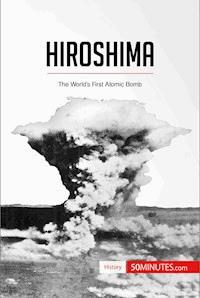
Keen to learn but short on time? Get to grips with the events surrounding the bombing of Hiroshima in next to no time with this concise guide.
50Minutes.com provides a clear and engaging analysis of the bombing of Hiroshima. In August 1945, the Second World War was over in Europe, but in the East the Japanese army refused to surrender. Fearing a bloody battle if they invaded Japan, the US military and political leaders decided to use their recently developed nuclear weapons to force Japan’s hand. These bombs proved more devastating than anyone could have imagined, and their use played a significant part in the development of the Cold War.
In just 50 minutes you will:
• Learn about the battles fought as part of the Pacific Campaign from 1941 to 1945
• Analyse the events leading up to the bombings of Hiroshima and Nagasaki and the factors that motivated this decision
• Understand the devastating effects of these bombings and their human and material consequences
ABOUT 50MINUTES.COM | History & Culture
50MINUTES.COM will enable you to quickly understand the main events, people, conflicts and discoveries from world history that have shaped the world we live in today. Our publications present the key information on a wide variety of topics in a quick and accessible way that is guaranteed to save you time on your journey of discovery.
Das E-Book können Sie in Legimi-Apps oder einer beliebigen App lesen, die das folgende Format unterstützen:
Seitenzahl: 33
Veröffentlichungsjahr: 2017
Ähnliche

















Hiroshima and the beginning of the nuclear age
Key information
When: 6 August (atomic bomb dropped on Hiroshima) and 9 August 1945 (atomic bomb dropped on Nagasaki).Where: Hiroshima and Nagasaki (Japan).Context: the Pacific Campaign (1941-1945) during the Second World War (1939-1945).Key protagonists:Harry Truman (1884-1972), President of the United States from 1945 to 1953.Leslie Groves (1896-1970), military director of the Manhattan Project.J. Robert Oppenheimer (1904-1967), scientific director of the Manhattan Project.Kantarō Suzuki (1868-1948), Prime Minister of Japan from 7 April to 17 August 1945. Hirohito (1901-1989), Emperor of Japan from 1926 to his death.Impact:The complete destruction of two large Japanese cities.The surrender of Japan and the end of the Second World War. The start of the Cold War and the development of nuclear arsenals.Introduction
In 1945, after four years of brutal fighting in the Pacific Ocean, American forces reached Japan. Worn down and isolated, the Empire of the Rising Sun could no longer avoid defeat. However, its troops fought on and refused to surrender: if the Allies were going to invade Japan, a bloodbath was the price they would pay for peace. The Americans then decided to force Tokyo to capitulate by using a new weapon that had been developed only recently: the atomic bomb.
The first bomb was dropped on Hiroshima on 6 August 1945, then another was dropped on Nagasaki three days later. It was a resounding success: the two cities were razed to the ground by explosions that were unprecedented in their power and the Japanese authorities finally decided to surrender, thus bringing the Second World War to a close. However, the victory came at a high price in terms of human life: tens of thousands of people were killed by blast injuries and fires, and many others would die as a result of radiation in the following weeks. The entire world was stunned by the scope of the destruction and realised that the USA had acquired a formidable weapon by mastering the atom. Soon, the United States would be drawn into a gruelling technological competition with the USSR, which also wanted to become a nuclear power. As such, by showing the destructive force of the atom, the bombings of Hiroshima and Nagasaki gave rise to the development of nuclear arsenals and led to the Cold War (1945-1990), whose consequences are still felt today.
Context
Japanese expansion in East Asia (1931-1941)
In the late 19th century, Imperial Japan took advantage of the provision of western technologies to modernise, develop its economy and increase its military power. By defeating China and Russia, it annexed new territories (Taiwan in 1895 and Korea in 1910) and asserted itself as a leading regional power in East Asia.




