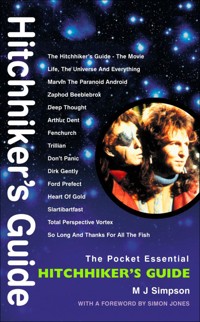
Don't panic! Everything you need to know about cult author Douglas Adams and his most famous creation, The Hitchhiker's Guide to the Galaxy, is in here.
From its unlikely start as a BBC radio serial in 1978, Hitchhiker's Guide developed into five bestselling novels, a BAFTA-winning television series, spoken word LPs that made the pop charts, dozens of extraordinary stage productions around the world, a computer game which topped the charts for a whole year - and now a Hollywood feature film.
The Pocket Essential Hitchhiker's Guide is the only book in the galaxy to document and explain all the contradictory variants of the story, packed with bizarre trivia and illuminating quotes from many of those directly involved in Hitchhiker's Guide, including Douglas Adams himself. Also included is information on Douglas Adams' other work: the Dirk Gently novels, The Meaning of Liff, Last Chance to See, Starship Titanic and his contributions to Doctor Who, Monty Python and Comic Relief.
This new edition is fully revised and updated to include the Hitchhiker's Guide movie and the brand new radio series.
M J Simpson is the author of the award-winning biography Hitchhiker and is universally acknowledged as the world's leading authority on Douglas Adams and The Hitchhiker's Guide to the Galaxy. A freelance journalist and broadcaster, he co-founded SFX magazine and has helped Touchstone Pictures to turn Hitchhiker's Guide into a movie.
A Completely and Utterly Unauthorised
Hitchhiker's Guide
M.J. Simpson
POCKET ESSENTIALS
In memory of Peter Jones, Douglas Adams and Dr Harry Porter
Acknowledgements
In preparing this book, I have been assisted by many people, to whom my thanks are extended: Will Adams, Sophie Astin, Martin Benson, Rayner Bourton, Simon Brett, Jonathan Cecil, Mike Cule, Kevin Jon Davies, Paul Duncan, the late Jim Francis, Neil Gaiman, Dave Golder, Stephen Grief, Richard Hollis, Roy Hudd, the late Peter Jones, Simon Jones, Lizzy Kremer, Geoff McGivern, Dirk Maggs, Joe Melia, Ion Mills, Stephen Moore, Stan Nicholls, Geoffrey Perkins, Andrew Pixley, Terry Platt, Liam Proven, Dave Prowse, Susan Sheridan, Michael Marshall Smith, Aubrey Woods, Matt Zimmerman and – without whom, etc. – Douglas Adams. Apologies if I have missed anyone out.
This book would also not have been possible without the long-term support and encouragement of my parents, without the forbearance and understanding of my wife Hillary, or without the assistance of a small, furry creature from Alpha Centauri.
Some of the links no longer work due to the age of the subject matter. We have retained them so fans can see what internet information was available when this book was first published. More information is now available by the usual methods.
Contents
Acknowledgements
Foreword by Simon Jones
Foreword to the 2005 edition
1.Introduction
2.The Radio Series
The Primary Phase
The Secondary Phase
Sheila’s Ear
The Tertiary Phase
3.The Stage Productions
The Science Fiction Theatre of Liverpool Production
The Rainbow Theatre Production
The Theatr Clwyd Productions
More Professional Productions
Amateur Productions
4.The Books
The Hitchhiker’s Guide to the Galaxy
The Restaurant at the End of the Universe
Life, the Universe and Everything
So Long, and Thanks for All the Fish
Young Zaphod Plays It Safe
5.The Recordings
The Hitchhiker’s Guide to the Galaxy
The Hitchhiker’s Guide to the Galaxy Part Two - The Restaurant at the End of the Universe
The Theme Single
The Marvin Singles
The Radio Series
Douglas Adams at the BBC
The Tertiary, Quandary and Quintessential Phases
6.The Television Series
The BBC TV Series
The Making of The Hitchhiker's Guide to the Galaxy
The Second Television Series
The DVD
The Big Read
7. Other Versions of The Hitchhiker’s Guide to the Galaxy
The Computer Game
The Other Computer Game
The Illustrated Hitchhiker’s Guide to the Galaxy
The Comics
8. Documenting The Hitchhiker’s Guide to the Galaxy
Don’t Panic
9.The Hitchhiker’s Guide to the Galaxy Overseas
USA
Germany
France
Finland
Elsewhere
10.The Film
11. Dirk Gently
Dirk Gently’s Holistic Detective Agency
The Long Dark Teatime of the Soul
Dirk Gently on Tape
Dirk Gently on Screen
Dirk Gently on Stage
The Salmon of Doubt
12. Other Work by Douglas Adams
Footlights
Monty Python/Graham Chapman
Doctor Who
The Pirate Planet
City of Death
Shada
Doctor Who and the Krikkitmen
The Meaning of Liff
Last Chance to See
Doctor Snuggles
Other Radio and Television Work
13.The Digital Village
Starship Titanic – The Game
Starship Titanic – The Novel
h2g2
14.The Hitchhiker’s Guide to the Galaxy on the Web
Douglas Adams – A Select Bibliography
Copyright
Foreword by Simon Jones
It's always been a bit of a mystery to me. My old friend Douglas Adams has always maintained that he wrote the character of Arthur Dent, hero/victim of The Hitchhiker'sGuide to the Galaxy, with me in mind. Personally I've never seen the resemblance.To be brutally frank, he didn't seem anything like me. I mean, Arthur is a man who spends much of his time touring the universe in a dressing gown, in a state of bewilderment bordering on irritability, complaining much of the time about the absence of a really good cup of tea.The irritability stems not just from his state of physical dislocation, but also from a vague sense of unease that nothing is quite what it seems, and never has been. He's easily distracted by trivia, and he keeps thinking it's Thursday.
Actually I think it was a Thursday when I heard from this fellow Mike Simpson. He was in England, and I was in New York, so for me it was a good bit earlier in the morning than it was for him. In fact, I'd just got out of bed and put the kettle on.
He came straight to the point."How would you like to write a foreword to my book about The Hitchhiker'sGuide?"
Of course, my suspicions were immediately aroused.
"What book? What's it about?"
He replied that it was a complete chronology of all the versions in the media of Douglas' classic work. He added, "You know – all the details of your life as Arthur Dent."
I gave it some thought. Put that way, it sounded really quite interesting, but nonetheless I felt it my duty to wonder aloud,"Is this really something the world needs?"
His reply struck me as a bit sharp in tone."Yes, it is, or I wouldn't have written it."
"Oh ho!" I thought, "Someone got out of bed the wrong side – and it wasn't me." Actually I can't get out of bed the wrong side, because my wife sleeps on the other – unless I've been on the wrong side all this time and never known it …
I leave him on hold because the kettle has boiled by now, and I have to warm the pot before letting the tea infuse or it'll be undrinkable. As I pour the water on the leaves – while it's boiling, or it's a waste of time – I think about his proposition. He has a point. The world does need this book. I need this book. Once and for all I could prove to people that the radio series came before the books – something a surprising number of people don't know and wilfully won't believe when I tell them. A definitive where-and-when sort of book would settle all sorts of pointless and time-wasting debates. It astonishes me what far-fetched theories are floating out there in the ether. Someone once told me that The Who had planned a rock opera with Roger Daltry as Arthur and Pete Townsend as The Book – crazy of course, but sort of intriguing. Who was it who came up with the idea that there was a nine-hour experimental German film directed by a disciple of Rainer Werner Fassbinder that's lying forgotten in a deserted cellar in Leipzig? Or did I dream that one?
While I was waiting for the tea to steep, I heard a squawking from the telephone. Mike Simpson was becoming impatient."Well?" he said,"Will you do it?" He seemed to be in rather a hurry. "Look – I can e-mail you the book if you want to look at it first."
"No, no, don't trouble … or well, maybe, yes, do."
Oh, the Information Superhighway! I've no idea how it works but it still gives me a thrill.
I waited – not very long – and there it was, available to download. Of course that was easier said than done – but after a struggle during which I became convinced that I'd consigned the whole file to oblivion, I had it on the screen and, soon after that, printed out. So I read it – and found it very comprehensive, accurate and intriguing. My name's mentioned a lot,and for some reason I find that comforting, although I'm not very thrilled to read that I'm too old to play Arthur in the Hollywood movie version. Not enough of a box-office name, I suspect. But if I am too old, it's because I've had to wait too long for it.The eventual cast, if you want my opinion, hasn't even been born yet …
Anyway, I called him back. I congratulated him on his scholarship, and told him I'd be delighted, nay, honoured, to write some sort of foreword – though I wasn't at all sure what I could think of to say. I'd just put down the receiver when I remembered the tea. It had stewed to the colour and consistency of prune juice – a complete waste of prime second flush Assam, which isn't at all easy to come by.
Oh, this book? It's great. Read and enjoy. (Now, where have I heard that before?)
Simon Jones New York, November 2000
Foreword to the 2005 edition
Oh dear. Reading over my foreword to the first edition is like looking at a photograph taken at Ascot in the balmy summer of 1914. Those top-hatted men and elegantly stayed ladies had no idea what was about to befall them, just as I had no inkling of what lay ahead for me, for Arthur Dent, and for Douglas.We couldn't be expected to guess how the cards might fall – but we weren't prepared for what did take place even in our wildest imaginings.
2001 was a year that changed everything, with brutal suddenness. But for those of us connected in our various ways to The Hitchhiker's Guide to the Galaxy, from fans to cast, the real disaster took place in May, well before the general cataclysm of 11 September, when Douglas succumbed to a massive and entirely unexpected heart attack during a routine session of weightlifting at his local gym in Santa Barbara.
We were all devastated, though none so much as his family, his wife Jane and daughter Polly. The reaction on the Internet was remarkable; there was an enormous outpouring of grief from all the corners of the Earth – a phenomenon that would surely have astonished Douglas himself. It was apparently a coincidence, but it seemed wonderfully apt that, at his funeral in California, we were able to announce that the official entity that does such things had just named a distant astral body after Arthur Dent. It also seemed inevitable that, when I sadly glanced at my boarding card on the flight back to New York after the ceremony, I found I was flying on Delta Flight 42. (I'm not making this up. I still have the card.)
I was not in New York on 9:11; I was in London for Douglas' Memorial at Saint Martin-in-the-Fields, but I couldn't forget the time nearly 18 years before when we dined at Windows on the World, the restaurant at the top of the World Trade Center. Douglas had announced that he was driving from the West Coast and he wanted to have dinner there. Would we book? It turned out that Terry Gilliam was flying in from Canada that same day, and so we arranged to meet there at the tower's top floor. It seemed to me that the moment was sufficiently auspi cious for me to take my courage in both hands and propose to my girlfriend, Nancy Lewis, the American manager of Monty Python, who had been a friend of Douglas before she and I had met each other. So I dropped to my knee on the floor of one of the last spacious checker cabs in Manhattan, and she graciously accepted. We arrived in exultant mood at the restaurant, only to be greeted by the maitre d' who was most apolo getic, explaining that the fire alarm had been accidentally triggered, causing the kitchen to be covered in green foam. Appalled, we explained to him the significance of the occasion, and with further apologies he gave us a bottle of champagne and directed us to the neighbouring sushi bar. In due course the others arrived, and their disap pointment at the loss of a gourmet evening was, we hoped, mitigated by our celebration. There in London, I reflected on the horrifying destruction and loss of life, and, as a passing thought, pondered that not only would Douglas now never dine there, but nor would anyone else.
But there at Saint Martin-in-the-Fields, the radio producer, Dirk Maggs, met with Bruce Hyman, whose company, Above the Title, had been responsible for a string of distinguished programmes for the BBC. Back in 1994, there had nearly been another series following on from the Secondary Phase. Dirk had actually booked us all to reprise our characters, but the effort foundered because Douglas was unhappy with the scripts.We were all paid – but we would rather have made the programmes. As it was, by the time of Douglas' death, the prospect, as far as I could see, of recording the remaining three books had entirely disappeared. Peter Jones, David Tate and Richard Vernon had all left us – it seemed hardly worth the effort. But Bruce and Dirk were determined to see it through, as a tribute to Douglas.
So it was that in November 2003 the surviving original cast assembled at the Sound House Recording Studios to compare hairlines – I lost – and to slip back into the old roles, which we found fitted like old comfy gloves. That was Life, the Universe and Everything aka The Tertiary Phase. Now, in January 2005, we've laid down So Long, and Thanksfor All the Fish and Mostly Harmless. I'll admit that finishing the job was strangely important to me, but the sense of a completed mission is tempered by a reluctant admission that I may have said my last lines as Arthur Dent. He and I have been joined at the hip for more than twenty-five years, and I suppose we'll always be inextricably linked.
In the week following the last studio session, I had three other engagements – all of which bore the traces of Douglas. On the Monday and Tuesday, I recorded an audio book of Noel Coward short stories for Harper Audio at Motivation Studios, near Finchley Road Tube Station. I had barely been there a few minutes before I learnt that it was there that Douglas had recorded all the Hitchhiker books. On the Wednesday, I appeared in a BBC Radio drama – Episode Four of The League of Queer Trades by GK Chesterton.Who should be in the cast (apart from Geoff McGivern, through whose good offices I was there) but Martin Freeman, who has assumed the role of Arthur Dent in the Touchstone movie? The chances of our meeting so soon had to be rather remote, but I can report that we chatted amiably enough, and while I'm not passing on any torches or batons, I wish him the best of luck. On Thursday, I was interviewed by an outfit called Objective TV for a programme about landmark shows of the eighties, to discuss Hitchhiker's and Brideshead Revisited. Douglas, it seems, is not going to leave me alone, and I'm delighted to do all I can to promote his witty work.
Mike Simpson, it's fair to say, has done more than anyone to keep the flame of H2G2 alive over the years with his enthusiasm and unflagging support. As I said of his excellent biography of Douglas, Hitchhiker: 'It was generally remarked, even by his subject, that Simpson knew more about Adams than Adams himself.' It remains true to this day and for any enthusiast of the Adams oeuvre, this little guide is not only entertaining, but impeccably comprehensive and most certainly 'essential'.
Simon Jones London, January 2005
1. Introduction
Where to begin?
The Hitchhiker's Guide to the Galaxy does not follow any sort of pattern. It does not, for example, have any preferred medium. It has been equally successful on radio, on television, on record, as novels, as talking books, on stage, as a computer game and most recently as a feature film. All these different versions tell roughly the same story, but not necessarily in the same way. And on numerous occasions they flatly contradict each other.
This does not make it an easy subject to write a book about. Far from it.
There is no logical progression to be had here: no episode guide, no filmography, not even a clearly defined chronological progression. What there is instead is a genuine multimedia phenomenon – a global success without precedent or parallel. Or, unfortunately, order. I have done my best to make sense of it.
Surprisingly, there has been relatively little attempt to document this phenomenon (with the obvious exception of Neil Gaiman's book Don't Panic, which I had the honour of revising and updating for its third edition in 2002), although two biographies of the Hitchhiker's Guide's creator Douglas Adams have been published since his death in 2001. It is hoped that this book will go some way to explaining and charting this incredible story, and the incredible story behind it.
So where to begin?
Half past ten on Wednesday 8 March 1978 is as good a place as any to begin the story of The Hitchhiker's Guide tothe Galaxy. In those days, the BBC still made a lot of radio comedy, almost invariably written and performed by Oxbridge graduates (the 'alternative comedy' scene was still struggling to find its own identity in a London strip club). Regular listeners to Radio 4 knew to check the Radio Times each week, examining certain broadcast slots – 12.27pm, 6.30pm, 10.30pm – for the latest offerings from the Light Entertainment Department at Broadcasting House.
That initial listing for The Hitchhiker's Guide to the Galaxy gave no indication that it was to be any different from any of the series before, after, or running concurrently. There was a recognisable name in the cast – Peter Jones, rather mysteriously credited as 'The Book' – and radio comedy obsessives may have recognised writer Douglas Adams' name from occasional credits on The News Huddlines. The episode title, 'Fit the First', would have seemed a mere whim to most, although fans of Lewis Carroll may have recognised a reference to The Hunting of the Snark. (The Milliways restaurant slogan 'If you've believed six impossible things before breakfast this morning …' was another Carroll reference, although the existence of a 'rule 42' in Through the Looking Glass was mere coincidence, according to Adams.) Nevertheless, there was no clue as to quite how different this new series was going to be.
For one thing, it did not have an audience. Radio 4 policy was clear: if you were a comedy series, whether sitcom, revue or variety, you had to have an audience. Yet the listeners on that March evening, in their bedsits and their baths, found themselves laughing aloud and alone – which, given the solitary nature of the typical late-night Radio 4 listener, was not as embarrassing as it might have been.
The show was an instant hit, on a scale unseen since the golden age of radio in the 1950s. It very rapidly established itself as worthy of being mentioned in the same breath as radio classics like Hancock's Half Hour, The GoonShow and I'm Sorry, I'll Read That Again.
Real, hardcore, purist Hitchhiker's Guide fans still consider the original six-part radio series to be the definitive version of the story. But The Hitchhiker's Guide to theGalaxy has a popularity that extends way beyond its hard core fans, and its numerous incarnations mean that it is something different to different people.
To some it is a cult radio series, to others an early 1980s TV comedy, to others a series of best-selling science fiction novels – and to some people it is now a Hollywood movie. Ironically, Douglas Adams never set out to be either a science fiction writer or a novelist.
If one is to trace the origins of Hitchhiker's Guide, one has to look at the Footlights Society, that elitist yet prolific group of ever-changing Cambridge undergraduates which has been producing great names in comedy for over a century. The casts of Monty Python's Flying Circus,The Goodies and Beyond the Fringe were wholly or partly composed of Footlights alumni, and the Footlights influence is as strong in Hitchhiker's as in any of those other shows. Douglas Adams attended Cambridge University in the early 1970s and there met Simon Jones, Mark Wing Davey and Geoffrey McGivern, who were to be the inspirations rations for the characters they were later to play.
Pinning down just why The Hitchhiker's Guide to theGalaxy