


Erhalten Sie Zugang zu diesem und mehr als 300000 Büchern ab EUR 5,99 monatlich.
- Herausgeber: G2 Rights
- Kategorie: Geisteswissenschaft
- Sprache: Englisch
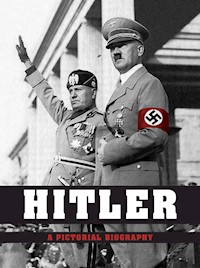
An extraordinary collection of contemporary photographs of Adolf Hitler.
Das E-Book Hitler - A Pictorial Biography wird angeboten von G2 Rights und wurde mit folgenden Begriffen kategorisiert:
Hitler, Nazi, Germany, dictator
Sie lesen das E-Book in den Legimi-Apps auf:
Seitenzahl: 65
Veröffentlichungsjahr: 2015
Das E-Book (TTS) können Sie hören im Abo „Legimi Premium” in Legimi-Apps auf:
Ähnliche




















© G2 Rights 2014. All rights reserved.
Publishers: Jules Gammond & Edward Adams for G2 Rights.
This book is sold subject to the condition that it shall not, by way of trade or otherwise, be lent,resold, hired out, or otherwise circulated without the publisher’s prior consent in any form ofbinding or cover other than that in which it is published and without a similar condition, includingthis condition, being imposed on the subsequent purchaser.
All rights reserved. No part of this work may be reproduced or utilised in any
form or by any means, electronic or mechanical, including photocopying, recording or by anyinformation storage and retrieval system, without prior written permission of the publisher.
ISBN: 978-1-782811-19-0
The views in this book are those of the author but they are general views only and readers are urgedto consult the relevant and qualified specialist for individual advice in particular situations.
G2 Rights hereby exclude all liability to the extent permitted by law of any errors oromissions in this book and for any loss, damage or expense (whether direct or indirect) suffered by athird party relying on any information contained in this book.
All our best endeavours have been made to secure copyright clearance for every photograph usedbut in the event of any copyright owner being overlooked please address correspondence to G2Rights, Unit 7-8, Whiffens Farm, Clement Street, Hextable, Kent BR8 7PQ.
CONTENTS
INTRODUCTION
EARLY YEARS
THE FIRST WORLD WAR
HITLER’S RISE TO POWER
1933-39
THE SECOND WORLD WAR
INTRODUCTION
Adolf Hitler was the Führer and absolute ruler of the German nation from 1933 to 1945. He established a brutal totalitarian regime, endorsing his ideas on elitism and racism, under the ideological banner of Nazism. The hatred that he had for Jews, Communists, Slavs, gypsies and homosexuals resulted in the systematic murder of millions of innocent men, women and children. His insatiable desire for an empire resulted in the Second World War, the costliest war in history, culminating in Germany’s defeat and the re-ordering of world power relationships.
THE EARLY YEARS
ADOLF HITLER was born at 6.30 p.m. on the evening of April 20, 1889, in the small Austrian village of Braunau Am Inn, just across the border from German Bavaria.
One day Hitler would lead a movement that placed supreme importance on a person’s family tree, making it a matter of great consequence. However, his own family tree was tainted by deformity, mental illness and was incomplete. Not knowing the identity of his paternal grandfather, Hitler would have been unable to produce the certificate of origin that he later required from every German citizen on pain of death.
His life long embarrassment and concern about his own family background, it is thought, led him to obliterate Dollersheim, his father’s birthplace and grandmother burial place, turning it into an army training area. Hitler continually wished to cover up his past, being very paranoid about it.
HITLER’S FATHER
Hitler’s father, Alois, born in Dollersheim, Austria, was the illegitimate son of Maria Anna Schicklgruber. The father, being unknown, has led to much speculation. He may have been someone from the neighbourhood such as the poor millworker, Johann Georg Hiedler, or indeed the son of a wealthy Jewish family named Frankenberger. Maria had been employed by this family as a cook, before her pregnancy, and it was rumoured she was sent money by the son after Alois’s birth.
When he was five years old his mother married Johann Georg Hiedler. Five years later following her death, Alois went to live on a small farm with his uncle. Young Alois did not like farm life and aged thirteen set out for the city of Vienna, in order to make something of himself. He enlisted in the Austrian civil service becoming a customs officer and rising to the highest possible rank of Senior Assistant Inspector, a huge accomplishment for a man with little formal education.
It was at this time that Alois Schicklgruber, aged 39, decided to change his name, an event that would have implications for the future. This was not due to the stigma of being illegitimate, since it was common in rural Austria, but to appease his proud uncle by continuing with the family name Hiedler. However, the name was misspelt in the record books as Hitler. It is doubtful that thousands of Germans shouting ‘Heil Schicklgruber’ would have resounded as far as ‘Heil Hitler’ in the years to come.
In 1885, after two marriages and numerous affairs, Alois married the pregnant 25 year-old Klara Pölzl, the granddaughter of Uncle Hiedler. A Vatican dispensation had to be obtained firstly as, because of the name change, Klara was technically his niece.
Alois was a strict, traditional minded, authoritarian father and there were many arguments between him and his son, Adolf. Temperamentally he was headstrong, impatient, intolerant and manipulative. Alois died aged 65 from a lung haemorrhage.
HITLER AS A CHILD
In early childhood young Hitler had been sickly and was spoilt by his adoring mother. According to some, it was suggested that his lifelong addiction to cakes, puddings and sweet things may have developed from his mother’s over-indulgence in feeding him sugary treats at home.
Young Hitler moved home several times when young due to his father’s promotions as a custom officer, most of the time living in Austria close to the German border.
When he started primary school, aged six, it coincided with his father’s retirement. The Hitlers were then living on a small farm outside of Linz. The Hitler household consisted of Adolf, little brother Edmund, little sister Paula and older half brother Alois and half sister Angela, hunchbacked aunt, Johanna Pölzl and two parents. It was a crowded, noisy and unhappy home. His father, a man used to giving orders and having them obeyed at work, expected this from his children. He was restless in his retirement and spent much of his spare time drinking at the local tavern. The oldest boy Alois, 13, often bore the brunt of his father’s bad temper with his harsh words and occasional beatings. When he left home, never to return, it became Adolf’s turn.
He took solace by immersing himself in a fantasy world by reading adventure stories and then re-enacting them. His great favourites were tales of the America West by German writer, Karl May. In trying to emulate the hero ‘Old Shatterhand’ young Hitler said that he did not let out a sound when he was beaten. (He continued to read these books when Führer and ordered his officers to carry May’s books when fighting the Russians.)
Although attending many different schools, Hitler progressed well in the local village schools. However, when attending the technical secondary school in the city of Linz he was socially and academically out of his depth. He fell behind and managed to complete only three years, repeating two of the years twice.
Because of Linz’s proximity to the German border, boys were divided into two fractions throughout the school - one showing loyalty to the Austrian Hapsburg Monarchy, the other to Germany and its Kaiser. Hitler identified with the latter, considering himself to be German. In defiance of the Austrian Monarchy (and his father) Hitler and his young friends liked to use the German greeting ‘Heil’ and sing the German anthem “Deutschland Uber Alles,” instead of the Austrian Imperial anthem. Later Hitler attributed his political awakening to a history teacher, Dr. Leopold Pötsch, who touched Hitler’s imagination with tales of the glory of German figures such as Bismarck and Frederick the Great. Quite early on in Hitler’s life German Nationalism became an obsession.
Hitler left school at 16 without taking the final exam for his diploma. From that time on he would be self-taught, reading numerous books with dreams of becoming an artist.




