


Erhalten Sie Zugang zu diesem und mehr als 300000 Büchern ab EUR 5,99 monatlich.
- Herausgeber: New Island
- Kategorie: Geisteswissenschaft
- Sprache: Englisch
Hitler's Irish Slaves tells the shocking story of 32 merchant seamen from Ireland who were held in conditions of great hardship in an SS slave labour camp from 1943 to 1945. Mercilessly punished for their refusal to join the German war effort, and ignored by their own government, they became part of a slave workforce that was used to construct an immense bunker. The Nazis believed that they could build a 'miracle boat' in this bunker: a new type of U-boat that could win the war for Germany. To achieve that goal, many thousands of slaves were worked to their deaths.Despite the savage regime to which they were subjected, and unlike some other Irishmen, they steadfastly refused all attempts by the SS to turn them into collaborators with the Third Reich. In this engrossing and dramatic book, David Blake Knox explores the fascinating and tragic story of the hardship endured by these men, as well as the reasons why that narrative, like the men themselves, has been unjustly neglected. Previously published as Suddenly While Abroad .
Sie lesen das E-Book in den Legimi-Apps auf:
Seitenzahl: 451
Veröffentlichungsjahr: 2017
Das E-Book (TTS) können Sie hören im Abo „Legimi Premium” in Legimi-Apps auf:
Ähnliche




















Hitler’s Irish Slaves
Hitler’s Irish Slaves
David Blake Knox
HITLER’S IRISH SLAVES
First published in 2012 as SUDDENLY, WHILE ABROAD
This edition published in 2017 and reprinted 2021
by New Island Books
Glenshesk House
10 Richview Office Park
Clonskeagh
Dublin D14 V8C4
Republic of Ireland
www.newisland.ie
Copyright © David Blake Knox, 2017
The author has asserted his moral rights in accordance with the provisions of the Copyright and Related Rights Act, 2000.
PRINT ISBN: 978-1-84840-596-7
EPUB ISBN: 978-1-84840-622-3
All rights reserved. The material in this publication is protected by copyright law. Except as may be permitted by law, no part of the material may be reproduced (including by storage in a retrieval system) or transmitted in any form or by any means; adapted; rented or lent without the written permission of the copyright owner.
British Library Cataloguing Data. A CIP catalogue record for this book is available from the British Library
New Island Books is a member of Publishing Ireland.
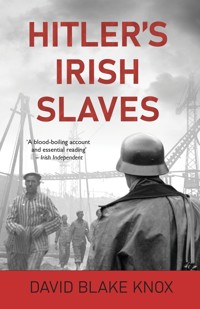
Front cover image of Bremen-Farge, showing construction of the U-boat bunker ‘Valentin’ (Bundesarchiv).
For my mother and my father.
About The Author
Dr David Blake Knox has worked as a TV producer and executive for RTÉ in Dublin, the BBC in London and HBO in New York. He established Blueprint Pictures, an independent production company, in 2002, which specialises in arts and entertainment series. He is the author of Ireland and the Eurovision, published by New Island in 2015, and The Curious History of Irish Dogs, published by New Island in 2017. David lives in Dublin.
Contents
Acknowledgements
Introduction
1. Suddenly, While Abroad
2. The German Raider
3. The Irish Legation
4. With a Pop Gun
5. The Mining Town
6. The Abwehr’s Irish Friends
7. The SS and Co.
8. Speer’s Lethal Fantasy
9. Heart of Darkness
10. Endgame
11. Aftermath
12. A State of Denial
13. A State of Neutrality
14. Radio Waves
15. What War?
16. Farge
Appendix
Notes
Acknowledgements
Whatever faults or errors this book contains are, of course, my own responsibility, but there are a number of people who have greatly helped me to write it. I should like to thank Maurice Earls, the editor of the Dublin Review of Books, who first suggested to me that I write an article for that journal about the thirty-two Irish merchant seamen who were imprisoned in the Farge camp. Maurice also provided an extremely helpful critique of some of the chapters in this book. I want to thank Tom Inglis, of University College Dublin, who also read several chapters, and gave his usual perceptive commentary on them. I am grateful to my friend Robert Seidman, the writer and film producer, who brought an invaluable perspective to his reading of the book. I would like to thank both my daughters, Kirsty and Sarah, for the original research that they contributed—as well as their critical comments. I am sure that I tested the patience of their mother, Deborah Spillane, in talking to her about this book while it was being written, and I am deeply grateful for her tolerance and understanding of my preoccupation. My son, Dr Jamie Blake Knox, was the first to read a complete draft of this book, and I am most appreciative of the many late-night discussions that we had about its contents, and for the shrewd historian’s eye that be brought to bear on the final text. Jamie travelled with me when I visited the main concentration camp at Neuengamme, and the Valentin Bunker at Farge. Dr Caoimhe Gallagher also travelled with us to Germany: her fluency in German is much superior to my own, and helped me to obtain some key documents, as well as (literally) opening doors for us. I should like to thank our guide at the Valentin Bunker, Ms Sandra Kern, who went to some trouble to facilitate our visit, and who was also most helpful in making archive photographs of the bunker available to me. I am indebted to Dr Reimer Möller, of the KZ-Gedenkstatte Neuengamme, for providing so much useful information about the trial of SS personnel in Hamburg in 1947. I am also grateful to Susan Hill, the Collection Access Officer with Southampton City Council, for her assistance in obtaining the records of some of the Irish merchant seamen who were held captive in the Farge Camp. I would also like to thank Harry Callan, the last Irish survivor of the Farge camp, for his hospitality and openness in talking to me about his experiences as a prisoner of the SS. I am very grateful to those relatives of the other prisoners who survived their incarceration in the labour camp who shared with me some of their family memories. In particular, I should like to thank Sophie O’Mahony, Christine Foley and Susan McKeon for the valuable information they provided. Finally, I should like to thank Edwin Higel for his encouragement and advice, and also my editors at New Island, Eoin Purcell, Justin Corfield and Dan Bolger. Eoin first approached me about the possibility of writing this book, and their comments and suggestions, as well as their encouragement, have been of great assistance.
Introduction
‘Why do people have memories? It would be easier to die—anything to stop remembering.’
These words come from Vasily Grossman, a Soviet Russian author and front-line war journalist who visited Nazi concentration camps in the immediate aftermath of the Second World War. His comments reflect a response that was not uncommon among those who had been caught up in the horrors of that war. Others might argue that it is also time for the rest of us to forget. After all, the Second World War happened a long time ago, and since the vast majority of those who took part in it are now dead, perhaps it would be better to let them rest in peace.
I am more inclined to the view of Elie Wiesel, who survived Auschwitz, and thought that to forget all that had happened there and in similar Nazi camps was simply ‘to kill the victims twice’. I believe that we must continue to listen to the voices that emerged from that terrible conflict. The Second World War has cast far too long a shadow to be forgotten. It is a shadow that continues to fall beyond the children and grandchildren of those who fought in the war. Even if we wanted to forget the men and women who died or suffered in its cataclysm, their voices would still rise up and insist on being heard.
Benedetto Croce once wrote that ‘all history is contemporary history,’ and his comment seems especially apt as far as Ireland is concerned. Ireland’s role in the Second World War is still able to generate heated controversy and division, and it is not hard to see why. On the one hand, Ireland was one of just five European states who were able to remain neutral throughout the duration of the war. On the other hand, tens of thousands of Irish men and women volunteered to join the Allied armed forces, and to engage in the struggle against fascism. That apparent contradiction can still inform, or cloud, Irish perceptions of the war.
This book tells the story of thirty-two merchant seamen from Ireland who were held in conditions of great hardship in an SS slave labour camp from 1943–1945. As the prosecuting counsel argued before a military tribunal after the war, ‘The whole camp was illegal. Those workers were conscripted and brought to the camp [against their will], and that in itself [was] illegal.’ I believe that the imprisonment of these Irish seamen was not only unlawful, but could have been avoided. The Irishmen who were imprisoned in this labour camp near the village of Farge in north-west Germany may seem unlikely heroes of any story about the Second World War. They were all non-combatants, and none of them had volunteered for active service. The ships they served upon were not modern battleships, armed to the teeth with heavy guns, but were, for the most part, ageing freighters: slow, cumbersome, and without any adequate means of defence. Some of the Irish seamen were already in advanced middle age when they were taken prisoner. Regardless of their age, they were sent to a labour camp by the Gestapo, where they were subjected to years of a brutal and degrading regime. Despite that, and unlike some other Irishmen, they steadfastly resisted all attempts by the SS to turn them into collaborators with the Third Reich.
When the camp at Farge was finally liberated in 1945, and twenty-seven of the Irish seamen who had been imprisoned there were able to return to Ireland, they were largely ignored by the press, and soon disappeared from public view. Ironically, they are now acknowledged in Germany as a distinct group of victims of the Nazis. However, their suffering is still not properly recognised in their native country, even though the principal reason that they ended up working as slaves for the Nazis was their Irish nationality.
It is not only because of their suffering and endurance, or because they refused to collaborate with the Nazis, that I believe these men deserve to be remembered. It is also because a number of them chose to return to Germany after the war to give evidence in the trial for war crimes of some of their SS guards. Some survivors were too ill to travel to Germany, but still provided testimony about their ordeal. It required considerable nerve and commitment to give evidence before a court whose judgments were based on a presumption of innocence, and who expected witnesses to undergo rigorous cross-examination. Such trials were actively opposed by the Irish government of the time. As we shall see, this was not out of concern for the witnesses—no Irish representative was sent to provide practical or moral support for them. Those who gave evidence before similar courts have spoken of the trauma that it caused them to relive their years of callous and inhuman treatment in the Nazi camps. As a result of the determination of these Irishmen to see justice done, a number of SS personnel from their labour camp were punished for their crimes, and sentenced to periods of imprisonment. But what was perhaps even more important was that the testimony of these Irish seamen asserted the fundamental principle that, even in a time of global hostilities, there remain certain boundaries to the ways in which any war should be conducted.
In a small but significant way, these Irishmen contributed to the proposition that war criminals, whether they operate in Germany or Rwanda, Bosnia or Syria, should continue to be held responsible and liable to be punished for any acts that deliberately victimise innocent civilians or defenceless prisoners. For that alone I believe that we continue to owe some debt of gratitude to the Irish seamen who were held in the slave labour camp at Bremen-Farge.
1.
Suddenly, While Abroad
My father began to plan his funeral about ten years before he died. He told me that he had already bought a plot in Dean’s Grange Cemetery, in south County Dublin, close to his mother’s grave. He said that he had intended to commit suicide some years previously and thought it would make sense to choose his final destination before he killed himself. To anyone who knew my father, this story was simultaneously highly implausible and all too likely to be true. He gave me a slip of paper on which he had scrawled all the relevant details, adding that he would not mind if I chose instead to put his body in a bin bag and sling it in a rubbish tip.
My father’s motives for telling me this weren’t entirely clear: certainly not to me, and probably not to him either—perhaps especially not to him. I was pretty sure that, at some level, it was bound up with the emotional mayhem that had been caused by his wartime experiences. Nonetheless, a few weeks later I was driving past Dean’s Grange, with his slip of paper in my pocket, and I decided to pull in to see if I could find his plot. It didn’t take long, although it turned out that the resting place my father had chosen for himself was a considerable distance from where his mother was buried. His choices may have been limited: the family vault was crammed full with an assortment of close and distant relatives. Pride of place on its weathered stone obelisk was given to my great-great-grandfather, Francis Blake Knox—the founder of this particular branch of the family. Although his name was carved on the grey stone, Francis was not buried in this cemetery, but in County Mayo in the west of Ireland, where he was born and where he had died.
As I turned away from the vault, I stumbled upon another, slightly smaller, grave just a few yards away. Once again, the tombstone—which, this time, took the form of a large Celtic cross—bore the name of Francis Blake Knox. That didn’t surprise me unduly: the name has been popular in my family for several generations, and was now attached to one of my own nephews. I was more perplexed by another of the inscriptions on this grave. It referred to ‘Billie’, who had apparently died in Bremen in 1945. I had never heard of this relative, and there was no reference to the circumstances of his death.
When I next saw my father, I asked him who this person might be. Judging from the spelling on the tombstone, I had thought that ‘Billie’ might be a female relative, but my father told me that it referred to ‘William Hutchinson Knox’, his cousin. ‘What happened to him?’ I asked. ‘He was killed in Germany just before the war in Europe ended.’ I was curious to know why he wasn’t called ‘Blake Knox’, but my father only muttered something about there being ‘enough of us’ in the world already. I knew from the tone of his voice that this was a subject he did not wish to discuss further. I also knew, from long experience, that the more I questioned him, the less I was likely to learn. It was only after my father’s death that I learned what had happened to our lost cousin.
I had imagined that my father’s unwillingness to talk about William was connected to his general reluctance to talk about the war in which he had fought. As a young man, my father had crossed the border from the state that was then known as ‘Eire’ into Northern Ireland soon after hostilities were declared in 1939, and enlisted in the British Army. Once again, his motives in doing so were not entirely clear to me—and probably not to him either. My father was not greatly interested in politics, but he often expressed a visceral dislike of Hitler, and he connected, with some reason, the extreme Nationalists of Nazi Germany to their contemporary equivalents in Ireland. We were not Jews, but my father held the Jewish people in high regard, and was revolted by their persecution. When he was young, Irish Jews had usually been sent to Protestant schools, and some of his classmates and friends were Jewish. Perhaps, as a member of one religious minority, in his case the Church of Ireland, he also felt some sense of identification with another.
No doubt there were other factors in the mix besides his dislike of National Socialism, such as his simple desire for excitement, and there may also have been a sort of historical reflex that led him, his two brothers and half-a-dozen cousins to volunteer for active service. His family had a tradition of serving in Irish regiments of the British Army—for the most part, in the Connaught Rangers. They were by no means the only Irish family with that custom: from the time of the Peninsular Campaign at the start of the nineteenth century, soldiers from Ireland had helped to form the backbone of Britain’s infantry divisions. The Irish government did not go to great lengths to prevent such voluntary enlistment continuing during this war; they may even have welcomed its easing of the problem of chronic unemployment at home. One memorandum from the Ministry of Justice stated succinctly that, given the ‘present economic circumstances,’ it was better for young Irish men to be in the British Army ‘than in our gaols’.
The government proved to be much less tolerant, to say the least, of the 5,000 or so Irishmen who were already serving in the Irish Army, and chose to desert to join the Allied armed forces. General Dan McKenna, the Irish chief of staff, explained these desertions in what may seem like sympathetic terms: ‘Those who have a natural taste for military life are more inclined to join the British Services,’ he wrote, ‘where a more exciting career is expected.’ The Irish government did not share his understanding. In fact, they would later deny those soldiers who had deserted the Irish Army any access to public jobs and to state pensions when they returned home. This issue would fester for many years, and would generate much ill feeling and deep resentment.
My father ended up in Burma in 1942, with the First Battalion of the Royal Inniskilling Fusiliers. He arrived outside Rangoon just a few days before the decision was taken to evacuate and burn down that city. Rangoon was already in flames when my father joined the longest forced retreat in British military history. It lasted for more than three months, and covered over 1,000 miles of unforgiving terrain. The retreating army was under constant and ferocious attack from elite Japanese divisions as it fought its way to the Indian frontier. It suffered more than 10,000 casualties, one of whom was my father. He was hit by shrapnel from mortar fire, and his wounds turned gangrenous. Fortunately, an American missionary doctor had set up a field hospital under canvas. He operated on my father and saved his life.
General Slim described the men who limped out of Burma as ‘utterly exhausted, and riddled with malaria and dysentery.’ However, Slim could also recognise that ‘they still carried their arms, and kept their ranks.’ They may have ‘looked like scarecrows’, but Slim was proud that ‘they looked like soldiers too’. It had taken a beating, but the Fourteenth Army was still an army, and a few years later my father was lucky enough to be alive, and able to take part in the counteroffensive that drove the Japanese forces out of Burma.
He came back to live in Ireland in 1946, to a country that had remained politically neutral for the duration of the war. There were sound pragmatic reasons for the Irish government to follow that policy: apart from the human casualties it would have involved, Irish participation in the war could have exacerbated serious internal divisions in a country that was still recovering from both a bitter civil war and a deep economic depression. As a result of its neutrality, the Irish State had little direct involvement in the global conflict, and its resident citizens were even restricted in their knowledge of what had taken place. Martin Quigley, an agent in the OSS, the forerunner of the CIA, had visited Dublin for six months in 1943, and reported that for most Irish people the war in Burma and the Pacific ‘seems as remote as if it were being fought on Mars.’
Stringent censorship had accompanied political neutrality—in what was officially known in Ireland as ‘The Emergency’. In 1935 the Irish government had set up an interdepartmental committee ‘to prepare and submit proposals for the operation of censorship in time of war.’ The report it had submitted was put into effect in August of 1939. Frank Aiken, who was appointed as Minister for the Coordination of Defensive Measures at the outbreak of hostilities, claimed that part of its purpose was simply to prevent ‘our people being oppressed by a barrage of propaganda.’ However, as Clair Wills has noted, stripping reportage of the war of all editorial commentary produced ‘its own kind of falsehood.’
This was perhaps most evident in Irish cinemas, where Joseph Connolly, the new Controller of Censorship, outlined what could, and what could not, be shown to Irish audiences. His first principle was that that ‘all news films’ shown in Ireland ‘must be free of war news’. He also insisted that there must be no sight or mention of ‘war preparations, parades, troop movements, naval and aircraft movements, defence preparations, pictures of shelters [or] sandbagging.’ In addition, no comments, positive or negative, were to be permitted about ‘any of the countries engaged as belligerents.’ This was still a pre-television era, and newsreels were a primary source of information for audiences across Europe. The extraordinary constraints imposed by the Irish government created immediate problems for Gaumont Pictures, who produced weekly newsreels for both Irish and British markets. They responded to the new situation by using quite different material for the two countries.
On 16 May 1940, for example, the British version of the Gaumont newsreel covered the bombing of Rottterdam and the arrival in London of the entire Dutch government, which had fled the German blitzkrieg. The Irish version featured the Pope proclaiming a new saint in Rome and a festive carnival in Zurich. The next week, the British newsreel included the German bombing of Belgian towns and dramatic footage of terrified refugees sheltering from machine-gun fire. The Irish version featured the King of Italy being received by Pope Pius XII and the Kentucky Derby. In the years that followed, the newsreels shown in Ireland continued scrupulously to avoid screening any disturbing images of bloodshed and destruction. Instead, the patrons of Irish cinemas were kept well informed about international horse races, new arrivals in Dublin’s Zoological Gardens, and of course the Pope’s latest round of engagements. Eventually, in 1943, no further Irish editions of these newsreels were made or screened—apparently, to the great relief of Irish audiences.
Feature films were also subject to official censorship. Film distributors in Ireland were used to this, and apart from the objections to movies that featured the war, some of the other restrictions were based on traditional moralistic grounds. There was a puritanical antipathy to what the Gaelic Athletic Association termed ‘pictures extolling idleness, extravagance, superficiality and depravity of all kinds.’ Such movies, it was claimed, carried a ‘deadly, creeping poison’ that threatened the spiritual health of the Irish nation. A similar attitude led the official censor to insist that the title of the Hollywood film I Want a Divorce, described in its publicity as ‘a wise-cracking comedy’, be changed in Ireland to The Tragedy of Divorce. Some of the cuts demanded by the film censor defied any obvious explanation. In a report sent to the OSS in Washington, Martin Quigley cited the case of the RKO movie Bombardier, in which an instructor tells new recruits: ‘There are three things a bombardier must remember: hit the target, hit the target, hit the target.’ The censor insisted that the last two ‘hit the targets’ be cut. Quigley commented: ‘Don’t ask me why.’
Newspaper censorship may not have been quite as comprehensive, but the press was also strictly regulated by the government. The details of Irish soldiers who had died while serving with Allied forces could not be reported directly in Irish papers: instead, those who were killed in action had died ‘suddenly, while abroad’. When the British battleship the Prince of Wales was sunk by Japanese torpedo planes in October 1942, with the loss of 327 lives, it was referred to in one Irish newspaper as a ‘boating accident’. Even the word ‘Nazi’ was not allowed to appear in print because the use of the word outside Germany was deemed to have ‘an adverse connotation’. When Belfast was bombed in April and May of 1941, with the loss of almost 1,000 lives in one night alone, the Irish press was instructed to avoid publishing any of the ‘harrowing details’. All in all, the years of the Emergency saw what Ian Wood has described as ‘an expanding bureaucracy’ working diligently to ‘cocoon Irish people from the unsettling realities of a world at war.’
Meanwhile, the members of a ladies’ knitting circle in Killarney were questioned by the Gardaí, who suspected them of making socks and gloves for Allied troops. Small wonder that Samuel Beckett later told Israel Shenker, with his usual mordant irony, that he preferred to live in ‘France, at war, than Ireland, at peace.’
Censorship relaxed a little as the war entered its closing stages, but the most serious omission from Ireland’s press coverage obtained until the very end. This related to its atrocities, and in particular to the systematic genocide being perpetrated against Europe’s Jews. The position of the Censorship Board was stated clearly by T. J. Coyne, its deputy controller: ‘The publication of atrocity stories,’ he wrote, ‘whether true or false, can do this country no good.’ In 1942, Coyne and Aiken informed the press censors that details of specific war crimes were not to be published in Irish newspapers. In December of the same year, the Allies issued a strongly worded resolution regarding the persecution of Jews, which gave accurate details of the mass deportations that had begun in Poland, and in other occupied countries. In April of 1943, the Bermuda Conference also drew world attention to what was happening to the Jews of Europe.
Many years later, the Irish cabinet minister with special responsibility for censorship, Frank Aiken, admitted that ‘what was going on in the camps was pretty well known to us early on.’ Despite that, there were no explicit references in the Irish press to the Holocaust until after the war was over. Even after Auschwitz, Belsen and Buchenwald had been liberated, and their horrors had been exposed, no recognition of the genocide came from official Irish sources. In that context, it is hardly surprising that the first newsreels to feature footage from the death camps were greeted with considerable scepticism by Irish audiences when they were shown in Irish cinemas. Indeed, one Irish newspaper even suggested that the British had used starving Indians to play the roles of concentration camp victims. The implication was that, whatever atrocities might have occurred, they were being cynically used to mask the real culprit, and that was the old enemy: British colonialism.
I remember, towards the end of his life, my father passing my son, Jamie, a faded photograph. It had been taken outside the Red Fort in New Delhi in 1941, and it showed eight young men. Six of them were sitting in a row of chairs. Two men stood directly behind them. I recognised one of these as my father. ‘Who are they?’ my son asked.
‘My brothers,’ my father answered. Seven of the men were second lieutenants in my father’s battalion; the eighth was their commanding officer. They had all recently arrived in India after several months cooped up on a transport ship. My father looked like one of the eldest in the group, and he was just twenty-three when the picture was taken. Under the feet of four of the men who were sitting down, he had marked a cross. Another cross had been drawn above the head of the man standing beside him in the back row. My father pointed to a good-looking young man with fair hair, who was seated in front of him: ‘My best friend, Pat Kelly. He was the first we lost.’ He took the photo from my son and held it close to his eyes. ‘We lost him the week after his birthday,’ he said. ‘We had given him a bit of a party to celebrate. The next week he didn’t come back from a night patrol. I found him two days later.’ Kelly had been stripped, tied to a tree and disemboweled. My father managed to send a letter to my mother: ‘I have seen a terrible thing,’ he wrote, ‘and I don’t think I will ever be the same again.’
Much later, I found out that Patrick William Kelly was the son of a Church of Ireland clergyman. He had been educated at Mountjoy School in Dublin (the school became Mount Temple Comprehensive in 1972, and its future pupils would include Bono and the rest of U2). Pat Kelly graduated from Trinity College, Dublin, shortly before the war broke out. He travelled north with my father, and they enlisted and were commissioned in the same Irish regiment. They trained together in the military academy at Sandhurst, and travelled to India on the same troop ship. Pat Kelly was killed less than a month after they arrived in Burma: he had just turned twenty-four. ‘After that,’ my father told me, ‘I never minded killing Japs.’
The men and women who had spent the war years in Ireland might be forgiven for failing to understand the sort of lasting trauma, both physical and emotional, that Irishmen like my father had endured in Burma, and in the other operational theatres. And the lack of understanding could work in both directions. The Emergency had promoted a sense of national solidarity within Ireland, and generated a political consensus that had helped to heal some of the wounds left by a vicious civil war. There was considerable national pride in the skill and determination with which the policy of neutrality had been pursued by the Irish government, as well as great relief that the country had managed to avoid the appalling damage and loss of life that had been inflicted throughout most of Europe. The Emergency had established many areas of shared experience, both ephemeral and profound, with little relevance to those who had served overseas in armed forces. Like many Irishmen who fought for the Allies, my father was broadly in favour of Irish neutrality, only bridling when any defence of that policy was couched in what he considered to be self-righteous terms. Nonetheless, I think it was sometimes hard for him to accept that the lives of those who had remained in Ireland during the war had been, in their own way, equally meaningful.
When my father died in 2008, he left a mass of papers. Sorting through them, I came across some old press cuttings. One of these, from The Irish Times, was dated 17 May 1945. It described the homecoming of a small group of Irish merchant seamen who had just been liberated from a Nazi concentration camp, where they had been part of a slave labour force. From the little that my father told me, I had assumed that our cousin, William Hutchinson Knox, was an Allied soldier killed during the invasion of Germany—like my uncle Lesley, who had survived the D-Day landings, but was shot dead by a German sniper just a few weeks before the war in Europe ended. I now discovered that William had been in the Merchant Navy, and that the conditions of his death were much darker than I had imagined.
By that time I had learned a bit more about William and his place in our family. He was not my father’s first cousin, as I had thought, but my grandfather’s. In fact, William was over thirty years older than my father, and, while my father had been brought up in the west of Ireland, William had been raised in Dun Laoghaire on the eastern coast. Their paths had seldom crossed, and I believed that my father did not like to admit how little he knew about his relative. William also remained an elusive character to me, and there were aspects of his life that I found puzzling. Although a few members of my family had served in the Royal Navy, I knew of none, apart from him, who had joined the merchant marine. After more than thirty years of service, William Hutchinson Knox still held the relatively modest rank of able-bodied seaman. That was an honourable post, but it might be considered unusual at that time for someone like William, who came from a fairly privileged social background.
I did, however, discover in due course the reason why William was called ‘Hutchinson’. Shortly before he was born, his paternal grandmother had died (my own great-great-grandmother), and William had been named after her father. Lieutenant William Hutchinson came from Kildare, a land-locked county, but had joined the Royal Navy as a midshipman, and saw action in the Napoleonic wars while he was still a boy. He ended up as a lieutenant on HMS Pandora, but in 1816, at the age of just twenty-three, he was appointed as the first master of the new harbour in the port of Dun Laoghaire. It took several decades to complete the construction of the two huge arms of that harbour, and William Hutchinson was the master at Kingstown, as the port was renamed in 1821, for the next fifty-eight years. By all accounts he was a commanding individual who liked to take an active role in every aspect of the harbour’s operations. That included supervising the quarrying of stone and taking part in hazardous rescue operations. In 1838 he lost an eye while trying to bring a foundering ship, by coincidence also called Pandora, ashore in heavy seas. Throughout the nineteenth century, Kingstown boasted the biggest artificial harbour in the world, and my cousin had grown up in a large and elegant Regency house that overlooked its sweeping granite piers.
Perhaps it was this family connection with the harbour that had first led William to consider a life at sea. That background provided one explanation for his choice of career, but I wondered if there were others. William’s surname, for example, was both the same as his parents, his brothers, and other relatives, and yet also somewhat different. My father had explained this by saying there were ‘enough of us’ when William was born. Did that suggest in some way that he was not one of ‘us’? Perhaps that also explained the differing path he had taken in life.
Many of the records of Irishmen in the British merchant fleet are kept in an extensive archive in the English port of Southampton. The RS2 identity books that were issued to each seaman normally included a mugshot photograph. William’s photo is not dated, but was taken at some point in the inter-war years. I have looked intently at his image, trying to find some clues to his character. In his picture William is staring straight ahead, but his expression seems downcast and cautious: his eyes are widened, as if he had been startled, or were afraid of something that the camera might reveal. His ears protrude to an alarming extent. His hair is combed neatly across the top of his head. There are certain physical similarities to photographs of his first cousin, my grandfather, but William seems to lack any of the latter’s palpable self-confidence. When I showed the mugshot to my son, he thought William looked like Nosferatu in Murnau’s vampire movie. There is also a form attached to the RS2 book that each seaman was supposed to complete. William did not fill in about half of the queries—there is no information, for example, about his height, his weight, or the colour of his eyes, and the space for details of his next-of-kin has also been left blank.
I understood that William had spent more than three decades working on long-distance sea routes: to North and South America, India, China, Australia and New Zealand. He clearly liked to keep on the move, which may explain, in part, why he never married. According to The Irish Times, he did not attend the funeral of his father—that may have been because he was thousands of miles away, or it may have been a deliberate absence. Perhaps William was attracted by the democratic credentials of the merchant fleet. When he grew up in Kingstown, it was regarded as one of Dublin’s most genteel and affluent suburbs: for James Joyce, it seemed to epitomise the stifling respectability of Ireland’s bourgeoisie. But Kingstown was also a bustling port and a popular seaside resort where young couples went for romantic walks along its leafy promenades.
The Merchant Navy may have offered William a somewhat similar duality: on board ship there was a hierarchy of command very similar to the Royal Navy, but the authority of merchant officers ended as soon as they stepped ashore. Unlike the Royal Navy, merchant seamen did not sign on for years of service, but only for individual voyages. The age restrictions were also a good deal looser: boys as young as thirteen could serve in the merchant marine, and so could men who were well into their seventies. The merchant crews on long-haul voyages may have seemed rather exotic to someone like William, who had been raised in the strict conventions of late-Victorian Ireland. British merchant ships were not the prototypes of liberal multi-culturalism, but they usually contained considerable ethnic diversity, and were often of mixed race. Once again, this was in marked contrast to the tight little world of Kingstown, where William’s father, as a well-known surgeon, had played a prominent role.
Whatever the reasons, when war broke out in 1939, William was working above deck for the Anglo-Persian Oil Company. Anglo-Persian owned ninety-two merchant ships—almost twice the size, and with a great deal more tonnage, than the entire Irish merchant fleet. As soon as war was declared, the British government requisitioned all of Anglo-Persian’s ships. Their crews stayed in place, and their everyday work remained much the same. The only notable additions were the small guns installed on each of their sterns, which allowed the tankers to be classified as DEMS—‘Defensively Equipped Merchant Ships’. It was considered unsafe to allow these low-angle weapons to be manned by untrained merchant seamen, so a few additional members of crew were usually recruited, mainly from retired military personnel.
William’s job may not have changed, but the context in which he worked certainly had. Instead of transporting cargo that was intended for domestic or industrial use, the Anglo-Persian tankers were now carrying oil to fuel the Allied armed forces. As such, they had become obvious—and soft—targets for German surface and submarine raiders. The Anglo-Persian fleet was to pay a high price for that change in its status: by the end of the war almost half of its tankers had been sunk, and the lives of more than 600 of its crewmen had been lost.
From another of my father’s newspaper cuttings, this one from The Times of London, I learned that William was on board one of Anglo-Persian’s ships, the SS British Commander, in August 1940. The entry of Italy into the war as one of the Axis powers had effectively closed the Mediterranean to Allied shipping, compelling them to round the Cape of Good Hope on their way to Asia and Australia. William’s ship was carrying oil to India when it was intercepted 300 miles south-west of the coast of Madagascar by a German surface raider called the Pinguin. The course of William’s life as a merchant seaman had seemed fixed and irreversible, but then a world war intervened, and he was swept away in its bloody wake. William could not have known, but his future would become linked to that of a German naval officer called Ernst-Felix Krüder.
2.
The German Raider
On a bright summer morning in June 1940, a nondescript ship, identified only by the code name ‘HK 33’, sailed out of the port of Gotenhafen. Nowadays, Gotenhafen is known as Gdynia, and is part of Poland. Following the German invasion of September 1939, it had been incorporated into the Third Reich. More than 50,000 ethnic Poles were forcibly expelled, and Gotenhafen was developed as an important German naval base. In appearance, HK 33 seemed like a standard transport ship, painted a dull grey and without any obvious armaments. In reality she was one of the first wave of surface raiders whose purpose was to use deception and subterfuge in order to sink, capture or disrupt Allied merchant shipping. HK 33 had originally been a freighter, the Kandelfeis, but had been requisitioned by the Kriegsmarine, the German Navy, in 1939, converted into a Hilfskreuzer, an armed auxiliary cruiser, and given a new identity. Conversion of the ship entailed the installation of weapons, ammunition stores and accommodation for a large crew and a small number of prisoners.
The Hilfskreuzers wrought havoc on Allied ships in the early years of the war. Although there were fewer than a dozen of them, they sank almost a million tons of shipping. They did not attack merchant convoys that were escorted by warships, but there were not enough Allied escorts to protect every merchant vessel, and the raiders preyed on those that were alone and vulnerable. The Hilfskreuzers operated primarily in the southern hemisphere: the South Atlantic, the Indian Ocean and the Pacific. These waters were, as Stephen Morrison has noted, ‘crucial to the British war effort,’ since huge quantities of raw materials from Asia, Africa and Australia crossed them. Attacks in these regions also forced the Royal Navy to divert ships that were urgently needed in the North Atlantic theatre. An officer on one of these auxiliary cruisers noted their strategic importance to the German war effort. ‘For every ship sunk by a single raider,’ he wrote, ‘others may be re-routed or harbour bound for weeks, and the decisions of armies battling from Libya to the Volga [could] be governed by the fortunes of humble merchantmen.’
The German raiders used elaborate disguises to approach their targets, and usually revealed their true identity, as they were obliged to do under the Geneva Conventions, by raising their battle flags just before they opened fire on their victims. They used the cargos of their captured prizes to fuel and feed themselves before they moved on to the next kill. At first, British naval command had no idea who these raiders might be or where they were operating. They were classified as ‘mystery ships’ and designated by letters of the alphabet.
When HK 33 left Gotenhafen that June morning, she was escorted by the minesweeper Nautilus and the Wolf- class torpedo boat Falke. HK 33 was under the command of Fregattenkapitän Ernst-Felix Krüder, an extremely capable, experienced and single-minded officer. He had joined the Imperial German Navy, the Kaiserliche Marine, when he was fifteen, and had worked his way up from the ranks. Krüder was commissioned as an officer in 1917. In the First World War he took part in the naval engagement at Jutland, and also saw action off Sebastopol during the Gallipoli campaign. For his services he had been awarded the Iron Cross, both 1st and 2nd Classes. Soon after the First World War ended, he led a naval assault brigade against Socialist revolutionaries in Berlin and Munich. His subsequent career had prospered under both the Weimar and Nazi regimes, and he was steadily promoted.
Großadmiral Erich Raeder, the commander-in-chief of the German Navy when war broke out, recognised the superiority of the British Navy, which had many more ships than Germany. However, Raeder also recognised that the sheer size of the British merchant fleet made it vulnerable to guerilla attacks since even the British Navy could not protect all of its merchant ships. As an island, Britain was clearly dependent on those ships for its basic provisions, and Raeder realised that could damage Britain’s capacity to wage war. For that reason he had ordered the Kriegsmarine to commandeer civilian vessels and convert them into warships. Raeder understood the importance of choosing suitable captains for these raiders. He believed that they needed to have ‘all-round knowledge in every aspect of seamanship.’ But he also wanted men ‘of intelligence and initiative as well as exceptional fighting spirit.’ In every respect, Ernst-Felix Krüder seemed an ideal candidate for this mission.
In the summer of 1940, Krüder was forty-two years old and at the height of his powers. According to those who served with him, he was imbued with unshakable self-belief, seemed utterly fearless, and possessed a steely determination to succeed. In all of this he seemed to exemplify the so-called Führerprinzip—the Leader Principle beloved by the Nazis. According to the Führerprinzip, any problem could be resolved by bold and decisive leadership of the sort supposedly provided at a national level by Hitler. In subsequent months Krüder would become just the type of charismatic commander whose men were prepared to follow him anywhere. Tall, lean and athletic, he embodied the physical qualities that National Socialism revered, but which most of its leaders conspicuously lacked. He would achieve exceptional success and public acclaim, which was all the more remarkable because HK 33’s crew was largely composed of untested naval reservists. But eventually the same characteristics that brought Krüder to triumph would also lead to his demise.
As the small convoy which he led moved into the North Sea on that summer day in 1940, it was supplied with Luftwaffe air cover and reinforced by two more minesweepers. Together, they headed up the coast of occupied Norway, passing Bergen on 20 June. On the same day, the Falke peeled off to make her way back to Germany while the remaining ships carried on northwards. Two days later they pulled into the inlet of Sognefjord, the longest and deepest fjord in Norway. In its seclusion and safety, HK 33 changed identity: her grey hull was painted black, her guns remained camouflaged, and hammer and sickle markings were added. When HK 33 emerged from the Norwegian fjord, it was as the Soviet cargo ship the Petschura. German naval intelligence knew that there was a real Soviet ship of that name, and they also knew that she would be laid up in the port of Murmansk for the forseeable future.
Krüder’s ultimate destination was the Indian Ocean and Australian waters, but first his ship had to rendezvous with and replenish a German submarine off Cape Verde in the North Atlantic. HK 33 and her escorts continued to head north into Arctic waters, but she soon ran into heavy weather. The two minesweepers had turned back when Krüder spotted a British submarine that had surfaced close to his position. He headed farther north to give the impression that HK 33 was a Soviet cargo freighter bound for Murmansk. However, the submarine gave chase, and fired three torpedoes at the German ship. All of them missed, and after an hour so the submarine disappeared beneath the waves. A few days later, on 28 June, Krüder changed tack again and turned south, passing through the Denmark Strait into the choppy waters of the Atlantic on 1 July. The following week, HK 33 assumed a new identity, this time as a Greek merchant ship, the Kassos. On 20 July, the first part of her mission was fulfilled when she resupplied a German U-boat 700 miles south-west of Cape Verde.
In order to save fuel, Krüder towed the submarine south until she had reached the shipping lanes off Sierra Leone, at which point the U-boat went on her own mission and Krüder continued on his journey south. By now he had decided to give his ship a proper name. He had been reading a book about whale fishing, and had liked its descriptions of Antarctic wildlife. He suggested a name to Seekriegsleitung, German Naval Command, and it was approved. From then on, HK 33 would be known as the Pinguin. On 31 July, 300 miles north-west of Ascension Island, she sighted a British freighter. It was the 5,000-ton Domingo de Larrinaga on its way from Bahia Blanca, Argentina, to Newcastle in the north-east of England, carrying 7,000 tons of grain and a crew of thirty-six. The freighter had also spotted the Pinguin, and, fearing the worst, had turned sharply away while sending a distress signal. The Pinguin gave chase, dropping its assumed identity, running up its battle flag and opening fire with its heavy guns.
The bridge of the Domingo de Larrinaga received several direct hits. The ship caught fire and slowed to a halt. A German boarding party found eight dead crewmen. Scuttling charges were placed in the freighter’s engine room, but they failed to explode, and the Domingo de Larrinaga was finally dispatched with a torpedo. Meanwhile, the surviving crew had been taken aboard the German ship, where those who had been wounded received medical attention. This was the first ‘blood’ for the Pinguin, and the first prisoners she had taken. However, it would not be long before the crew of the Domingo de Larrinaga were joined by many other merchant seamen, and more Allied ships lay at the bottom of the ocean.
The day before the Pinguin sank the Domingo, the British Commander had left the Cornish port of Falmouth with a crew that included my cousin, William Hutchinson Knox. The Commander was an aging freighter that had seen better days, and could now only manage, at best, a sluggish speed of around 10 knots—about half the speed of the Pinguin. She had been equipped with two small guns, both of which were located on her stern, which meant that they were only of practical use when the ship was in retreat. These weapons were supposed to be manned by the merchant crew, but their training in gunnery had only amounted to a rushed one-day course. The Commander left Falmouth as part of an escorted convoy that was bound for Gibraltar. For the first five days of her voyage she risked attack from the German U-boats and bombers that were based in occupied France, but there were no such incursions, and at the Straits of Gibraltar she separated from the other ships and headed south alone.
The captain of the Commander, John Thornton, had been warned that there was still a danger of attack from German raiders, but his ship reached Cape Town without incident. She arrived there on 19 August, and the crew spent that night on shore leave. According to Bernard Edwards, the effects of the war had yet to reach Cape Town, where ‘the lights still burned brightly, luxuries filled the shops, restaurants still served steaks and lobster, and the drink flowed freely.’ I hope the Commander’s crew were able to take advantage of the opportunities on offer, because for some of them it would be their last chance to enjoy such freedom. The next morning the Commander left port early on a southerly course heading for the Cape of Good Hope, which she rounded twelve or so hours later. The ship then passed into the tranquil waters of the Indian Ocean, where the trade routes were still considered to be relatively safe. However, the Royal Navy’s presence there was very limited: the Indian Ocean covered more than 20m square miles, and there were fewer than a dozen cruisers and destroyers in the entire India squadron of ships. As a result, most of the hundreds of Allied merchant tankers and freighters that crossed the ocean were without any protection. For German raiders such as the Pinguin, this meant that there were rich pickings to be had.
The Pinguin rounded the Cape of Good Hope on the same evening as the Commander. Six days later, Krüder launched one of his ship’s seaplanes with fake RAF roundel markings. It soon located an Allied tanker, the Filefjell, a 7,000-ton Norwegian merchant ship on her way to Cape Town, carrying 500 tons of oil and 10,000 tons of aviation fuel. The German pilot dropped a weighted package with a message written in English onto the deck of the Filefjell. It purported to warn the ship of the presence of a German warship, and was signed by ‘Hopkins’, the commander of HMS Cumberland. The pilot was thoughtful enough to suggest a detailed escape route for the tanker—one that would lead her straight to the waiting Pinguin. However, the Filefjell’s captain, Josef Norby, was suspicious: the English used in the message was stilted, and he declined to follow this advice. Instead, he sent out a SOS signal. That proved to be an unfortunate response: his ship and the Pinguin were set on divergent courses, but Norby’s signal allowed the German wireless operators to take bearings on the tanker’s position and alter their direction to intercept. When the German seaplane returned, its pilot ripped out the Filefjell’s aerial with a grapnel and strafed the Norwegian ship with machine-gun fire. Captain Norby was left with little option but to surrender: there were no guns on his ship, and he and his crew were aboard what was virtually a floating bomb. Two hours later, a boarding party from the Pinguin took control of the tanker. It was decided to take her to a quiet stretch of water so that the cargo of oil could be transferred to the Pinguin. The two ships then sailed together farther into the Indian Ocean.
Meanwhile, Thornton had set the British Commander on a course to the south of Madagascar. The shortest route to India lay through the Mozambique Channel, between Madagascar and the African mainland, but since that narrow channel could easily be used for a naval ambush, all Allied ships had been instructed to take the longer outside route. On 26 August the Commander was off Cape St. Mary, the southernmost point of Madagascar, when she picked up a distress signal from a Norwegian freighter that she was being stopped by a ‘suspicious vessel’. No doubt Captain Thornton was greatly relieved when the distress call proved to be a false alarm: the suspicious vessel was a British warship. At around one in the morning of 27 August, the Commander was clear of Madagascar, and Thornton altered his course to pass west of the French island of Réunion. Once that had been done, he went to his cabin to catch up on some sleep.
A few hours after Thornton went below deck, his ship was spotted by the Pinguin. As a precaution, the Commander was sailing in the dark without any lights, and for that very reason Krüder suspected that she was an Allied tanker. After an hour of shadowing the tanker, Krüder was satisfied: he signalled the Commander




