


13,99 €
Mehr erfahren.
- Herausgeber: The History Press
- Kategorie: Geisteswissenschaft
- Sprache: Englisch
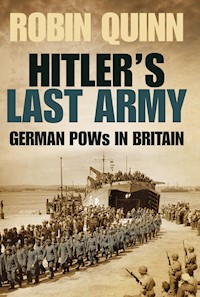
After the Second World War, 400,000 German servicemen were imprisoned on British soil, some remaining until 1948. These defeated men in their tattered uniforms were, in every sense, Hitler's Last Army. Britain used the prisoners as an essential labour force, especially in agriculture, and in the devastating winter of 1947 the Germans helped avert a national disaster by clearing snow and stemming floods, working shoulder to shoulder with Allied troops. Slowly, friendships were forged between former enemies. Some POWs fell in love with British women, though such relationships were often frowned upon: 'Falling pregnant outside marriage was bad enough – but with a German POW …!' Using exclusive interviews with former prisoners, as well as extensive archive material, this book looks at the Second World War from a fresh perspective – that of Britain's German prisoners, from the shock of being captured to their final release long after the war had ended.
Das E-Book können Sie in Legimi-Apps oder einer beliebigen App lesen, die das folgende Format unterstützen:
Veröffentlichungsjahr: 2015
Ähnliche



















For my grandson, Louis
Acknowledgements
I was sure from the very beginning that this book had to be based on the first-hand testimony of the former prisoners of war themselves. I’m therefore grateful to those who kindly allowed me to interview them – often at some considerable length. They have not only provided the information which forms the backbone of this book, but have also extended their hospitality, friendship and encouragement to me over the last two years. So I must begin by thanking them, together with their spouses and partners, as follows: Karl-Heinz Decker and Dorothy Masterman; Theo Dengel and his late wife, Joan; Bruno Liebich; Peter Roth; Werner and Iris Völkner; and Eberhard and Kathleen Wendler. I feel honoured to have met them all and to have been allowed to share their memories.
The following individuals have provided me with indispensable information, help and advice: John Andrews; Raymond Blackman; Arno Christiansen; Keith Ennis; Phil Fairclough; John Glanfield; Harry Grenville; Ingeborg Hellen; Mark Hickman; Mary Ingham; David Martin; Andrew Mitchell; Peter Osborne; Veronica Parker; Winston G. Ramsey; Maureen Small; Anne Smith; Sven Urbanski; Peter Venner; Malcolm Whitaker.
I am deeply indebted to the writers whose works I have consulted: the background information in their books has provided a solid foundation for this present volume.
Special thanks go to Stephen Walton (Senior Curator, Documents and Sound Section, The Imperial War Museum), whose help has been above and beyond the call of duty; likewise the kind assistance provided by his colleagues at the IWM’s London Research Room. I am also grateful to the courteous and ever-resourceful staff at the British Library; the London Metropolitan Archives; the National Archives and the former Newspaper Library at Colindale; and to those at the many local libraries and archives I have contacted around the country.
Mark Beynon, my editor at The History Press, has been attentive and helpful throughout the whole process; I have had no hesitation in entrusting this work to him and his team of colleagues to work their magic on it before it finally makes its public debut.
Last but not least, a very big thank you to Jacqui, without whose love and support I could not even have considered embarking on this project.
Contents
Title
Dedication
Acknowledgements
Prologue
1. ‘Let’s Go, Let’s Go!’
2. In the Land of the Enemy
3. The Darkest Day
4. The Ones That Got Away
5. All Walks of Life
6. Nazis Rule the Roost
7. The Final Battle
8. An Eternal Yesterday
9. The POWs Are Guarding the Camp
10. Sold Like Slaves
11. Shilling a Day
12. Britain Switched Off
13. An Affair of the Heart
14. Brush Up Your English
15. ‘What Are You Doing with a German?’
16. Home in Time for Christmas
17. Please Come Back!
18. Next Stop Germany
19. ‘The Germans Were All Right’
20. Britain’s Last POW
Postscript
References
Plates
Copyright
Prologue
As the hop-pickers clambered into the back of the lorry none of them imagined that within minutes they would be fighting for their lives.
Every year the same families came down from London to the Sussex village of Bodiam for a working holiday, a good get-together, a breath of fresh air, and the chance to earn some welcome cash. It was mainly the women and children who went ‘hopping’: the men of the family could seldom get time off from their regular jobs, and only visited at weekends, if at all. During the war a hop-picking holiday had been especially prized as a respite from the bombing, a couple of weeks away from it all. But this was September 1947 – more than two years since VE Day – and people were slowly adapting to peacetime.
With thirty people on board, the lorry was hopelessly overloaded. Yet none of the passengers seem to have given a second thought to the short journey ahead. It was, after all, only a ten-minute ride and they’d soon be back in camp after a glorious summer’s day in the sunshine. Some of the older women used to bring wooden chairs from home, and sat on them whenever they took a quick break from hop-picking. Now they put the chairs in the back of the truck and perched on them in relative comfort while the younger ones sat on the floor, all squashed together, wherever they could find a space.
From year to year the routine seldom varied, peacetime, wartime, rain or shine. ‘There were about twenty in our group who went together with a family called the Moneys,’ says Maureen Blackman, who was just 7 years old at the time. ‘We all shared two wooden huts, numbers 51 and 52 – every year the same ones.’
George Middleton started the engine and drove off. Everyone knew George would take it nice and steady – his wife and their two young children were in the lorry. Minutes later they reached Bodiam village and approached the humpbacked bridge across the river. Back in 1940 a pillbox with a two-pounder gun had been installed close by to defend against the feared German invasion. Then the Home Guard found that the solid brick-built parapets on either side of the bridge blocked their line of fire: workmen had been sent to remove the masonry and some flimsy, makeshift railings were put in its place. And since the war no one had quite got around to putting the bridge back as it once was.
The hop-pickers are uncertain what happened next. There were some indistinct recollections of a car coming the other way at speed, but from the back of the lorry most of them simply couldn’t see.
‘One moment we were going along, all singing in the back,’ Raymond Blackman remembers, ‘then suddenly we were in the water.’ The lorry had crashed through the railings, falling 10ft into the river and turning on to its side. The passengers were all thrown into a heap. For a few moments everyone was stunned, immobile, confused. Some were unconscious, a few seriously injured or gasping for air, trapped by the lorry’s canvas cover.
Fifteen-year-old Donald Money had just left school and taken a job as a messenger with the Southern Railway. He’d recently taught himself to swim at the local pool. Freeing himself from the wreckage he spotted a small child whom he rescued from the water. But he knew he couldn’t save the rest of them, not on his own: instead he ran 200 yards to a small encampment of tents in a field by the river. He had passed this way many times before and remembered seeing the soldiers there. When he arrived, the camp was almost empty, but he found four men preparing dinner for their comrades.
Out of breath, Donald tried to explain to the cooks what had happened. There was something of a language barrier, for these were not British soldiers.
They were German prisoners of war.
Somehow Donald made them understand. One of the men seized a sharp cooking knife and they all rushed back to the scene of the accident. The Germans dived into the river and started to rescue the crash victims. One slashed the canvas cover at the rear of the truck with the knife he had brought from the camp, freeing those trapped inside.
‘They were brilliant,’ says Raymond Blackman. ‘They pulled us out and wrapped us in blankets. If it hadn’t been for them, people would definitely have died.’
Though several people were hurt, all seemed to be accounted for, at first. One of the injured was Ellen Blackman – mother of Maureen and Raymond – who had sustained a broken arm and ‘a terrible gash’ to the head. When she looked around, she realised that Maureen was missing. According to her son, the late Terry Blackman, Ellen was ‘a powerful, stocky woman, very strong.’ But the news that Maureen was nowhere to be seen was too much even for her to bear, and she passed out.
‘All the others were found close to where the accident happened,’ recalls Maureen, ‘but I was only 7 and small for my age. I was carried downstream, unconscious, and washed up against some reeds and rushes.’ One of the Germans must have realised what had happened: he immediately ran along the riverbank until he found Maureen, dived into the water and lifted her out. Despite her ordeal she was, incredibly, uninjured and soon regained consciousness.
An account of the accident found its way into most of the national newspapers: the Daily Herald quoted a witness who summed up the incident in four words, ‘The prisoners were wonderful.’
‘My Dad bought the German prisoner a silver lighter to say thank-you, but a big regret was that we never got his name,’ says Maureen. ‘I would have loved to have tracked him down to let him know how grateful I was that he saved my life.’ But it seems that the Germans were never publicly named.
Today – decades later – it seems extraordinary that German prisoners were still being held captive in Britain two years after the end of hostilities. Indeed, to quote Professor Terry Charman of the Imperial War Museum, ‘The entire POW experience for the British revolved around Colditz and the Great Escape. I think many young people would be surprised to learn there were German POWs living here at all.’
The fact is that as many as 400,000 Germans were detained as prisoners in the UK during and after the war – some until 1948.
This is their extraordinary story.
United Kingdom, showing camps and other locations referred to in the text.
Notes
‘a powerful, stocky woman, very strong’. General background on hop-picking and Bodiam. Heffernan, p.17
‘The prisoners were wonderful.’ Daily Herald, 13 September 1947, p. 1
‘The entire POW experience … here at all.’ Reuters
1
‘Let’s Go, Let’s Go!’
It was towards the end of 2011 when I decided to write this book. I knew I’d need to interview people who’d actually been there – eyewitnesses to an almost forgotten chapter in our history. But how do you go about finding a former enemy who fought in the Second World War and was taken prisoner and held captive in Britain?
The answer came sooner than expected. That same evening BBC television carried a short piece about German ex-POWs who had stayed on in this country after the war: one of them, Bruno Liebich, talked about his experiences. Next morning I was speaking with him on the phone.
‘I’d be glad to help,’ he says, ‘but I wouldn’t be able to see you for several months. I’m busy writing my life story.’ We chat for a few minutes. Bruno relents and I visit him at his home in St Albans soon afterwards. A framed oil painting of Field-Marshall Erwin Rommel stares down at us. ‘One of the ex-prisoners gave that to me,’ he says, almost apologetically. ‘It’s not a very good picture but it is a fair likeness, so I decided to keep it.
‘I met Rommel once, you know …’ In his thoughts Bruno is back in France, in Normandy, almost seventy years ago, standing to attention with his comrades as the great General-Feldmarschall inspects the troops. ‘I come from Weißfurt, Lower Silesia,’ Bruno says:
It’s a very small village with about thirty families, that’s all. I was born on the 21 July 1926 in a Gasthaus [inn] which my grandfather built in 1846. There was a farm with it as well. My father was one of ten children – five boys and five girls. He died very young and so my branch of the family didn’t inherit a share of the business. I attended Volksschule [people’s school] from the age of 6 and, shortly before my 14th birthday, I was taken on as an apprentice at a savings bank. After almost three years I became a full employee. I was called up for the army on my 17th birthday, which was normal at the time. I did a bit of training in Germany, and then we moved to France before Christmas 1943. I was 171/2.’
He was posted to Normandy. Very few of the soldiers there could be classed as ‘crack troops’. Bruno’s unit included many older men, some of whom had been wounded in Russia, and teenagers like Bruno himself. The average age was 37. They were stationed near the coast for three or four months at Vierville – listed in one pre-war guidebook as a station balnéaire – a sea-bathing resort with just 270 inhabitants. The main task of the German troops was to keep an eye on the French population, and after five years of occupation the two sides had settled down to a reasonably trouble-free coexistence.
We were told to treat the French with respect. As I was one of the youngest, the sergeant would send me to get butter from the farm. I took my rifle – we had to pretend to be armed, but I don’t remember whether we had any ammunition or not. I’d go alone, although we were supposed to go in pairs. And I’d say, ‘Avez-vous du beurre, si’l vous plait?’ And I’d pay for the butter – we always paid – and take it back.
One winter’s night in November 1943, just after they arrived, Bruno’s sergeant sent him out for kindling wood so that they could light a fire and keep warm. ‘We were living in the garage of a house, and the owner lived in the house itself. I went out and it was cold and dark, and I saw a fence outside and just broke off two of the wooden slats. We used it as kindling and the fire was going like mad and everybody was happy.’ He adds, ‘Next morning at 7.00 – “Everybody out!” and we all lined up outside. The commandant said, “Madame So-and-so has complained that two slats are missing from her fence. Who has taken them?” They all looked at one another. Bruno didn’t say a word. “We’ll soon find out who did it. Now, dismiss!”’
‘Just two bits of wood and I could have finished up on the Eastern Front! Specially if they’d found out later and I’d told a lie. But that’s how strict they were with us.’
Near the village, extending about 8km eastwards, was a sandy beach, which the writers of the Guide Michelin didn’t even consider worthy of a mention. Yet it would soon become one of the most talked-about beaches in the world and have a name of its own – Omaha Beach.
‘Rommel came up one day in March or maybe April 1944 and inspected the coast. He was my supreme commander, you see. Above him was only von Rundstedt for the whole of France. He said, “This is where they’re going to land. We’ll put some defences here to stop them.” He was right, of course, but he was too late.’ Soon after Rommel’s visit, Bruno’s unit was moved about 20km inland and they made camp in an orchard where apple trees were grown for the local tipple, Calvados. By this stage in the war the German army was overstretched and poorly equipped – fuel and spare parts were in short supply and soldiers frequently had to travel to their posts using farm carts or bicycles.
A few minutes before midnight on 5 June, sounds of gunfire reached Bruno and his comrades from the direction of the coast. ‘We didn’t take it seriously at first but when it didn’t stop we realised something was happening. At about 4 a.m. the commandant said, “Get ready to move”, so we left between five and six o’clock towards the coast.’
It was a cold, windy, overcast morning. They set off on the new black bicycles which had been delivered to them only a week or two earlier, with their personal belongings following on behind in a horse-drawn cart. Halfway to the coast they heard more intense gunfire as the first Allied troops landed on Omaha Beach. The largest combined sea, air and land operation of all time was just beginning.
Abandoning their cycles they cautiously moved forward on foot. At about midday they arrived at the coastal village of Colleville and looked toward the horizon. Before them an armada of almost 7,000 ships, landing craft and other vessels stretched as far as the horizon. One of the defenders later likened it to a ‘gigantic town on the sea’.
At Omaha Beach alone, 34,000 Allied troops had landed, or were about to land, on that first day. Bruno recalls:
It was something exceptional that we’d never seen before and we were simply lost for words. We could see hundreds of ships and balloons, lots of aeroplanes, guns firing, troops, tanks, machine guns, noise, landing craft. We said, ‘Oh, my God!’ We realised we’d never beat that lot; there was a massive superiority there. We’d been expecting the invasion, expecting it all the time, but nobody knew when and where. We carried on as long as we could. Later in the day we took an American prisoner so we realised it was the Americans against us and we were then driven back.
Next morning we were trying desperately to get out because we were surrounded, and our little unit was getting smaller and smaller. Some must have disappeared or gone their own way or whatever.
The American prisoner had also slipped away. Bruno and his comrades considered this to be a problem solved, for they had been wondering quite what to do with him.
There were only about fifty or sixty of us left now. We were lying in this ditch in the Normandy fields – they always have ditches and hedges to keep the cows in, not fences – and a small unit of ten or twelve men were coming towards us. We saw them but they couldn’t see us. Our sergeant said, ‘Don’t shoot, let them come a bit closer.’ So we waited till they were about 80m away, and he said ‘Shoot!’ After we’d fired one maybe two shots, he said, ‘Now, run! Get out of it!’
‘It was my one-shot, twenty-four-hour war.’
They ran this way and that. Bruno found himself at one end of the column – at its head or its tail, depending on their direction at any given moment. ‘I was in front when we ran over this little field path into the hedge on the other side. We jumped, we crawled, whatever. There was a hell of a noise behind us. They’d spotted us. All those behind us were shot to pieces, wounded or killed. There were five or six of us – not more – in this hedge looking out and we saw fifty men standing there with rifles ready and a tank behind them. Our sergeant said, “We can’t fight all this lot, we’re caught. We’ll have to give ourselves up.”’
From the moment he surrendered, Bruno’s future was to be irrevocably changed. And the same would be true for thousands of other soldiers as the invasion proceeded. ‘That moment was the first time I’d ever thought about being taken prisoner. It had never entered my mind. But for this one step … it could have been a completely different life.’
Was Bruno afraid? ‘Not really. Personally I was never frightened – I don’t know why, I should have been. We didn’t have time to think, just to look after yourself. I was hoping they were decent people like me.’ It was only later that reports surfaced of Allied troops killing prisoners in retaliation for their own losses. At Omaha Beach alone, some 2,000 American soldiers had already died under withering machine gun fire from German defensive positions overlooking the beach. The blood of the fallen invaders tinted the water red. Those who had witnessed the slaughter were often in no mood to take prisoners. According to one American officer, paratroopers in particular were ‘apt in going along the road with prisoners and seeing one of their own men killed, to turn around and shoot a prisoner to make up for it’. Some units, it is claimed, had actually been ordered to shoot any enemy soldiers they captured rather than be hindered by the burden of guarding them. ‘There was no way we could take prisoners because there was no place to put them,’ one Allied soldier explained.
Bruno and what was left of his unit came out of hiding and made a show of throwing their guns away, so that the enemy could plainly see they were unarmed. ‘We put our hands up – as high as they’ll go – and walked toward them very slowly and they told us to stop, then they searched us.’ The Americans took away their gas masks and any other surplus equipment, and frisked them for hidden weapons. They also took advantage of the situation to collect some spoils of war. Swastika emblems were highly prized as mementoes. Most of the prisoners lost theirs. Many had their watches stolen too – but not Bruno. ‘To have a wristwatch in the 1940s was something, not just an everyday thing. I’d managed to buy one in France with my soldier’s pay, and I was very proud of it.’ Somehow he managed to remove it from his wrist and slip it inside his sock. Rings, too, were ‘confiscated’. Aside from that, Bruno says, ‘They didn’t treat us roughly at all. No pushing or kicking, they just wanted souvenirs.’
Many conflicting thoughts swirled in his mind. ‘It wasn’t a good feeling to give up what we were here for. And you worry about what’s going to happen.’ His concerns were no longer for the bigger picture. ‘It was all over in such a short time and, being taken prisoner, you’ve got to worry about what’s happening next. So we just took one day at a time.’
Another German soldier, Josef Kox, captured later that year in Holland, told a researcher, ‘Being taken prisoner is quite traumatic. You don’t know what’s going to happen. There are a thousand thoughts going through your mind, all in a split second.’ Günther Mauff, on the other hand, had just a single preoccupation: ‘What’s going to happen to me? What will they do to me? That was all.’ Franz Kriesch took a philosophical view: ‘What you have to do to survive [is] you put up your hands. If you don’t you’re a hero – but a dead one.’
‘A strange new existence was about to begin,’ another German recalls. ‘[We were] in a kind of limbo, a vacuum between the old life and whatever the future held.’
Having frisked the prisoners, the Americans gestured with their rifles and yelled the words that tens of thousands of prisoners would hear repeated over the next weeks and months: ‘Let’s go, let’s go!’
Plucked from the highly structured world of army life into the unknown, the prisoners clutched at the smallest of straws. Minor details assumed massive proportions and stayed fixed in the memory like a photographic image. ‘The first building we passed there was a farmer standing at the gate with a big tub of cider,’ Bruno recalls. ‘We hadn’t had anything to eat or drink for a couple of days. He gave me a cup of cider – it was heavenly, lovely – and I remember that so clearly.
‘We were just herded together in a field. There was no barbed wire, and only a couple of guards. They knew we wouldn’t run away. We spent a couple of nights just lying on the grass. It was bitter cold during the night because we had no blankets – they’d been thrown away, left behind.’ Around this nucleus of a few men hundreds more captured German soldiers clustered as the hours went by.
Allied deception plans had led the German high command to believe that the attack in Normandy was only a feint: in other parts of France men were kept on standby for the time being, while their commanders waited to see where the real invasion would take place.
Just to the south of St Nazaire, 250km from Omaha Beach, a slightly-built 18-year-old soldier named Eberhard Wendler was on duty. From a fortified bunker near the shore he could look out on to the windswept Atlantic Ocean. By his own admission he was a reluctant participant in the war. Given the choice, he would much rather have stayed at home and begun a career as a precision engineer – a vocation for which he’d just completed an apprenticeship back home. But home was a long, long way to the east, close to Germany’s border with Czechoslovakia.
I lived in a little village in the Erzgebirge – the Ore Mountains. It was beautiful. We knew all the neighbours – it was like a big family. We had no cinema, nothing, but we were very happy. We weren’t well-off but my parents had work. I’d never been away from home – I must have been 16 before I went to the next town. I was always shy and retiring and never mixed much.
My father was called up first and my mother went to work spinning yarn to make cloth. Every night after she came home from work she cooked for me and my brother Gert, who was three or four years younger than me. And about 10 p.m. she would sit and write a letter to my Dad. Every night! And she’d go out in the dark and post it.
Before being called up into the army, Eberhard was conscripted to do compulsory duty in the Reichsarbeitsdienst – the National Labour Corps – a quasi-military organisation which served to prepare Hitler Youth members for the full-time military. ‘I had to go to Borkum, an island in the North Sea,’ he explains. ‘We were always marching and singing. When you got to the coast there was a promenade and the beach a long way below. We had to jump down. I was afraid but you counted for nothing in the German army – you just jumped. Then we had exercises on the beach – every morning.’
Eberhard returned home from his stint in the Labour Corps and awaited his call-up papers, which arrived in the post on 20 January 1944. He was so flustered that he inadvertently dropped them into a bucket of water. His mother went with him to the barracks. Within a few days he and his new comrades had been issued with their uniforms, gas mask, gas cape, Karabiner 98 rifle and sidearm. Strictly against all the rules, Eberhard had begun to keep a secret diary on scraps of paper, which he hid in his gas cape. The recruits boarded a train to their posting and as they passed through towns and cities he noted details of the journey – a gazetteer of exotic places he had scarcely even heard of before:
4 February 1944: left Plauen in goods wagons (40 men to each wagon). We went via Reichenbach, Zwickau, Glauchau, Leipzig, Marburg, Koblenz, Trier, Metz, Paris, Le Mans, Nantes, Pont Château – where it snowed for the first time.
Even at that stage in the war, the shops in France still offered luxury goods which would have been difficult or impossible to buy in Germany:
14 March 1944: sent two 1-kilogram packages to home. Contents: one silk scarf (350 francs), one pair stockings (160 francs), pudding, baking powder, one jar of soap, and one bottle of liqueur (160 francs).
News of the invasion seems to have momentarily disrupted the normal routine:
6 June 1944: alarm and move out. We had to take our vehicles and horses and everything and go under cover in the little wood by the château. At 14.00 hours we could go back to our quarters.
‘Everybody expected the Allies to come, but they didn’t come where we were,’ he says with a flicker of a smile. ‘When the Allies landed in Normandy it was apparent that was the place, and that Germany was being beaten, and so it was decided to move us. We’d heard that they’d landed, but we hadn’t a clue where we were being marched to. All that way, hundreds of miles we marched at night – only at night – [to avoid daytime aerial attack]. There were hundreds, thousands of men. They wouldn’t have told us where we were going and we wouldn’t have dared to ask.’ They avoided towns and used only country lanes:
The blisters! When you stopped, ah! That was a relief. But when you started again … we had jackboots on and in the army they said, ‘If they don’t fit it’s not the boots, it’s your feet.’ I was a little chap then, one of the smallest. The big tall ones marched in front, and when they make one step you make about two, and we marched like that. And we were absolutely worn out.
It was 20 July – six weeks after D-Day – when Eberhard’s unit arrived in the village of La Chapelle near St Lô. They were immediately given five days leave to recover from the long march, but had to move camp twice because of artillery fire and aerial attacks. Although the Allied forces had gained a foothold in France, they had failed from the beginning to achieve their objectives on schedule. General George S. Patton’s Third Army was given the objective of breaking out and advancing further inland. Patton (whose motto was ‘In case of doubt, attack’) arranged for the air force to drop thousands of bombs on the defending German troops before his men moved in to finish off the enemy. Eberhard wrote:
25 July 1944: in the morning the carpet-bombing of St Lô took place. I immediately left with Oberleutnant Spieß and others to look for new quarters. At 20.00 hours the order came to make ready and we advanced in an armoured personnel carrier. At 22.00 came the order to advance on foot. We suffered heavy artillery fire on the march. Houses were burning and on the streets stood blazing tanks in which the ammunition kept blowing up. Our group was attached to the first company and we lost contact in a little wood. We could go no further on the road because it was under artillery fire and there was a burning tank with exploding ammunition. I was sent forward alone to try to make contact and lost my way repeatedly. After I had joined the group we took up position in a trench on the front line and dug in.
26 July 1944: in the morning we were continually attacked by fighter-bombers and came under attack from heavy artillery, grenade-launchers and automatic weapons. I was slightly wounded by a piece of shrapnel in the upper left arm.
‘The noise was deafening,’ he adds, the scene as vivid to him today it was then. ‘The fighter planes came over so low they almost touched you. The worst was the trench mortars, you don’t see them come, you don’t hear them. And they hardly need touch a leaf and they explode.’ The ground shook ‘like an earthquake’ as the bombs fell, he remembers, and for weeks afterwards he could hear gunfire and explosions in his sleep. ‘It was hopeless to do anything, and in any case I was wounded. The Yanks shouted, “Come out, come out!” But you were afraid to come out. You don’t know if they’ll shoot you. Nobody wanted to move. Then they start firing again and so it goes on.’
Finally, around midday, Eberhard and his comrades emerged from their defences and surrendered. ‘They checked us all, and they were very keen to take our watches and everything, and handle you roughly. And they took some of our men to interrogate … and then one by one march them back, all the time hands-up.’ This initial interrogation served to identify the men’s unit and deal with any urgent matters, such as the number of troops remaining. The soldiers’ pay-books, together with any other documents they carried, including letters and photographs, were taken from them. These would provide useful intelligence and serve as the basis for a more detailed interrogation a few days later.
Eberhard and the others were forced to climb into a truck. ‘There were one or two Americans in the back with rifles ready,’ he remembers. What many POWs recall is that most of the drivers were black. In the racially segregated US Army, African-Americans were often employed in support roles such as transport: but for almost all the Germans it was the first time they had ever seen a black man except in pictures.
To prevent the prisoners from escaping, the drivers had been ordered not to slow down under any circumstances. ‘They drove like devils,’ says Henry Metelmann describing his own experiences a little later in the war. ‘One lorry overturned, and was lying at the bottom of an embankment. We could hear the shouts and the cries and saw the prisoners crawl out from underneath like eels – those who could still crawl. What a way to die, a day or so after having escaped the war alive!’
‘There were sixty to a hundred prisoners of war in each lorry,’ Heinz Matthias told a German TV interviewer. ‘We had to shout [a warning] whenever there was an overhanging apple tree with a low branch. The man standing in front of me was too slow to react and the branch hit him in the face at 60km an hour. He collapsed and slid down – he couldn’t fall over because the men were so tightly packed – and his head was between my legs and blood spurted out. His skull was smashed and he was finished.’
They were taken to a succession of temporary camps, none of which provided shelter of any kind for the captives. ‘We were just in the open, there was no accommodation and we didn’t know where we were,’ says Eberhard Wendler. For a long time they received no food or drink, then finally they were given American ration packs. ‘That was wonderful! One packet had got some stuff in it, we hadn’t a clue what it was.’ (It was in fact a mixture of powdered tea, artificial sweetener and powdered milk which, with the addition of boiling water, made an instant hot drink.)
Eberhard and his comrades ate it straight from the packet: ‘It was lovely. We were hungry. We’d have eaten anything.’
Notes
Vierville. Guide du Pneu Michelin, 1939
By this stage … carts or bicycles. ‘Sieg um Jeden Preis’, Der Spiegel, 29 May 2004, p. 61
The largest combined … just beginning. ‘Sieg um Jeden Preis’, Der Spiegel, 29 May 2004, p.53
Before them an armada … as far as the horizon. D-Day Museum
‘gigantic town on the sea’. Beevor, A., p. 92
‘apt in going along … make up for it’. TNA, FO 916/913 (quoted in Scheipers, p.119)
‘What’s going to happen to me? … That was all.’Soldaten Hinter Stacheldraht, episode 2
‘What you have to … but a dead one.’ Soldaten Hinter Stacheldraht, episode 2
‘A strange new existence … whatever the future held.’ Christiansen, p.17
‘They drove like devils … war alive!’ Metelmann p.187
‘There were sixty … he was finished.’ Soldaten Hinter Stacheldraht, episode 2
2
In the Land of the Enemy
Planning for D-Day had started months beforehand: 65,000 copies of the meticulously prepared operation manual – each one as thick as a phone directory – were printed. Every contingency was covered, including the procedure for dealing with POWs. The Geneva Convention required that prisoners should be removed from the battle zone to a place of safety as soon as possible. To this end, captured troops would be transported to England until conditions on the Continent were suitable for them to be kept in camps there.
A small fleet comprising sixteen LST (Landing Ships, Tank) was set aside to transport prisoners across the Channel, and operated a shuttle service between Normandy and the British Channel ports. In their usual role, these 400ft-long ships could carry twenty medium tanks; as POW-carriers they could take up to 800 prisoners at a time to English ports – a total of up to 2,000 a day. When this scheme was unveiled to the High Command before the invasion, the planners had admitted that they may have been somewhat optimistic in planning for so many prisoners: but, in the event, daily totals were occasionally twice as high as predicted.
The Channel crossing was estimated to take twenty-four hours: in bad weather, though, it might last for up to four days. The LSTs came right in to the Normandy beaches at right-angles to the shoreline, their bow doors open ‘like gigantic whales’. The German prisoners marched down the beach and into the surf until the water reached their knees, then up the ramp and into the landing ship.
For its size, Germany has relatively few kilometres of coastline and consequently the Germans as a whole are not a seafaring nation. Most of the prisoners had never been on a ship of any kind and some had never seen the sea. Bruno Liebich remembers being swallowed up in ‘a plain, empty hull, totally empty, and on the side were two huge ropes’. By lying on the deck around the outside of this vast space, they could rest their heads on these great hawsers and use them as a pillow. Beyond that, the craft offered no comfort: another POW describes the LST:
an enormous, square, iron box, with floors, walls and ceiling of steel. It had no windows, only very small round portholes very high up so that no one was able to see out of them, and they would only let in the minimal amount of fresh air. Slowly the boarding ramp was winched up and every vestige of daylight, and every sound faded from eye and ear … as the last crack of daylight disappeared from the top of the boarding ramp, a little rustle of panic rippled fitfully among [the POWs].
‘When the tanks come off the ship,’ Fritz Jeltsch explains, ‘the big ramp comes down and the tanks roll over it. The ships come as far up the beach as possible but water gets in. When we were on the high seas the ship was swinging and the deck was awash with rusty water. It sloshed about over our feet and soaked our uniforms.’
John Andrews was a crew member on board one of the LST’s smaller counterparts, the LCT (Landing Craft, Tank). These flat-bottomed craft were nicknamed ‘kipper boxes’ by all who sailed in them, and were notorious for the unreliability of their engines. On those occasions when they could be persuaded to function at all they had a maximum speed of 10 knots and carried eleven tanks.
In the latter part of D-Day, Andrews noticed ‘cruisers, destroyers, troopships, LSTs, LCTs as far as the eye could see’. They crossed in mid-Channel with other craft which had already unloaded their precious cargo of men, munitions and machines, and arrived at Gold Beach late at night. When a rope became entangled with their propeller, the beach-master ordered some of the waiting POWs to help free it.
While the ships would soon be leaving densely packed with prisoners, some of these earlier sailings were almost empty. ‘It wasn’t really crowded, so we could lie down and have a little rest,’ Bruno Liebich says. On each vessel twelve armed guards watched over the POWs. ‘They were standing at one end and bartering with chocolate for souvenirs – swastikas, rings and things like that – and they were having a lovely time, I think. We were cooped in there; we didn’t know whether it was day or night.’ Under such conditions, and having hidden his watch, Bruno quickly lost track of the time. But he believes the crossing took two days, and this is consistent with other prisoners’ accounts.
Many former POWs speak of a sense of helplessness, a complete inability to control their own destiny. ‘Every second a fresh decision was being taken [about us] which we ourselves couldn’t influence.’ Although they had no idea what lay in store for them, their fate for the next few years, possibly for the rest of their lives, was already determined – by as trivial a factor as the initial letter of their surname. Britain and the United States had agreed to share responsibility for the prisoners. From now on, the general rule was that those whose surnames began with a letter in the first half of the alphabet were to be imprisoned in the United States, and the remainder in Britain.* Prisoners chosen to stay in Britain generally made the ‘short sea crossing’, as it was known in official circles, to either Southampton or Gosport. Newhaven and, on occasion, other ports were also used.
Those bound for the United States were shipped to Portland in Dorset, then onwards to Le Marchant Camp at Devizes, Wiltshire, for further processing. They usually spent a week or two in Britain before being transported on troopships – usually via Liverpool – to America, where most would stay for many months.
At Portland harbour Bruno set foot in the land of the enemy for the first time. But the significance of this event affected him only slightly:
I can’t remember that I was overwhelmed by anything. I think at the time the five steps in front of you are important – the rest you can’t absorb. There’s a group of you – you’re among your own men, that’s reassuring. You listen for orders and you haven’t got time to absorb the situation, the fact that you’re now in England. It was just land – people, houses – very similar to the other side, really, so it wasn’t a momentous occasion. No, it was minute by minute, day by day. You don’t even tell yourself what to do – it’s automatic that you don’t make any mistakes, don’t say anything wrong.
On disembarkation from the landing ship, the POWs were marched a short distance to a railway platform. When they saw the train that would take them to their next destination, they were astonished. ‘[As soldiers] in Germany and France you were put in a cattle wagon. The doors shut, you may not see anything. But here we were sitting on seats, with a table. It was lovely, the difference, you know.’
Their destination was unknown to them; what would happen to them on arrival they couldn’t guess. But any apprehension that Bruno and his comrades felt was balanced by their relief at being out of the war. There was an unexpected sense of exhilaration, too. ‘Strange as it sounds, it was an exciting sort of experience.’ He smiles. ‘Yet it could have been deadly, couldn’t it? At the time, though, because we were young and innocent, perhaps, we didn’t perceive it in that way.’
On arrival in Devizes they were subdivided into still smaller groups.* After two or three days they travelled by rail to Haltwhistle, Northumberland, where they stayed for less than a week: then to Liverpool where they boarded an ocean-going troopship which had brought American soldiers to Europe for the invasion, and was now returning to the United States. During the crossing, the POWs were fed on porridge and nothing else. Stricken by acute hunger, Bruno bartered a ring for two bars of chocolate, and sustained himself by eating a small piece every morning and another at night. The ship docked at Boston, Massachusetts, where an American soldier searched Bruno and said, ‘What’s this?’ as he hurled the treasured chocolate into a rubbish bin. Even now, seventy years later, Bruno sighs at the memory. ‘I’ll never forget that. I think I’d have killed him if I could.’
Bruno and his fellow soldiers were to spend the next two years in the United States, but they had not yet seen the last of Britain.
For Eberhard Wendler it was different. He, and many others, would spend the rest of the war in Britain. They were hustled at gunpoint from the beach on to the landing ship. Seven weeks had passed since D-Day and the shuttle service was now operating at full capacity:
There was hardly room to sit. We were crammed in there and we sat on the rusty steel deck. We were there ages, not knowing what was going on. There were no facilities to relieve yourself, but they lowered a massive tub down with a crane and we had to take it in turns, and you sit and take your trousers off and do your job on there. There wasn’t anything to wipe yourself. But what a relief. And then, when the tub was full – running over – they took it up and they made sure it slopped about all over so you got wet, and tipped it out and lowered it down again.
Eberhard found it unsettling to be separated from his comrades. ‘We didn’t know anybody else, only one or two you’d been captured with. We were hungry. We were all mixed up, and we were fed up and we were frightened. At Southampton we were let out into a reception camp with big cages all in the open and we were left out there for a long time. We eventually got something to eat, pre-packed food. Then we were taken on the train with guards.’ Everywhere they were encircled by barbed wire. Now it was British soldiers, not American, who watched their every move. The POWs were ushered into a big hall – possibly part of an army barracks – and the Tommies brought out some stew.
‘We had once been told by an officer, “Be comrades, and help each other.”’ But of the eight Germans at his table four were sergeants: ‘These wretches who were supposed to look after us piled their plates to overflowing. I was the next to last, and I only got half a scoop and the last one got nothing. Honestly, it’s niggled me all these years how they scoffed the lot!’
After the meal, they passed along still more corridors of barbed wire, and boarded another train. Predicting that very large numbers of prisoners might be captured, the Allied forces had made elaborate plans to ‘process’ the POWs as efficiently as possible. A special camp was set up at Kempton Park racecourse for the purpose. A minimum of four trains arrived here every day, each carrying 500 POWs. The whole reception process was supposed to take no longer than a day: official orders stated that the prisoners must be ‘detrained, fed, received, searched, medically examined, their clothes disinfested, bathed, reclothed in their disinfested clothing, interrogated, accommodated for the night and entrained for base camps, all within the time stated’. It was a tall order, but the POWs would generally be on their way again within the allotted twenty-four hours.
As soon as the men had disembarked from the trains they were marched straight on to a flat area behind the grandstand which was nicknamed the ‘barrack square’. Now the British would show the prisoners who was in charge. Intelligence Officer Tony Hare describes the procedure with POWs fresh from the battlefields in France:
From previous information, we had some idea which German divisions were in the area, and by learning all the numbers of the regiments and special battalions by heart, it was possible to call them out and make them fall-in in the same sequence that they had been on the front line only some hours earlier. This gave them the impression we knew a great deal about them, and any questions during the preliminary negotiations that followed were frequently given freely and in a relaxed manner, particularly as they were simultaneously told about the hot shower and meal afterwards. The aroma of this meal was usually wafting across the interrogation huts at the time. The result of this was a very strange psychological experience. For ten days we lived as if we were in Normandy, talking to prisoners who had been there some hours before, having constant detailed maps before us.
Every German knew, if only vaguely, of the Gestapo’s reputation in Germany: assuming that things would be the same in Britain, the POWs doubtless found the prospect of being interrogated by the Secret Service especially chilling. They were led into ‘a long hall where there were about a dozen tables in a line’.
‘The interrogator was a Norwegian who spoke perfect German,’ says a German paratrooper captured in Brittany. During the interview he was asked if he would go on the radio and broadcast propaganda to the German troops. ‘I said, “Sir, when Hitler is dead, yes. While he’s alive, no – because if you’ve sworn your allegiance you must keep your word. You’re only released from that oath when the man you’ve sworn to is dead.’
‘One at a time we went in and the Secret Service were there and we were interrogated,’ Eberhard Wendler remembers. With the prisoner’s pay-book open in front of him, along with any other documents captured from the POW, the Intelligence Officer was at a distinct advantage. ‘They knew which town you came from and told me, “They’re making things for the war effort there, and we’ll make sure we bomb your town.” And they said that Russia needed a lot of people to work there and we were warned we’d all be taken to Russia to work in the mines.’
The prisoners found it unnerving to be questioned by someone with such a perfect grasp of the German language. In fact, a significant number of the interrogators were Germans – Jewish refugees who had fled to Britain before the war to escape persecution under the Nazi regime. The irony was that some had initially been interned as ‘enemy aliens’ right here at Kempton Park.
The tables were turned. Now it was the Jews who were asking the questions.
Twenty-two-year-old paratrooper, Bernhard (Bert) Trautmann, who later became a legendary footballer, claimed, ‘They knew more about us than we did ourselves.’ As ‘unimagined numbers’ of prisoners threatened to overwhelm the system, extra interpreters were drafted in to help. A staff-sergeant by the name of Deutsch was transferred from another depot, but was quickly sent back when it turned out that – in spite of his promising name – he spoke no German at all and was, in fact, an Italian interpreter.
After being on the battlefield for days or weeks without proper washing facilities, most of the Germans were infested with lice. ‘[They] used to gather in the crotch of our trousers and drive us mad,’ one German soldier explained. ‘When we had time we would remove our trousers, turn them inside out and hold the crotch over a lighted candle. This was a horrendous job but it killed most of the little blighters.’ As well as being a major irritant to the sufferer, lice could spread typhus. The major German chemical company, IG Farben, had begun during the war to manufacture a product called Lauseto containing DDT, but supplies were never adequate and seldom reached the front-line troops who needed them most.
As former interrogator Matthew Barry Sullivan describes, ‘The cavernous areas under the stands [at Kempton Park stadium] were ideal for the big delousing parades at which every prisoner was squirted with DDT.’
‘Our uniforms were all taken off and fumigated and we stood there naked.’ explains Eberhard Wendler.
‘A British soldier, with a syringe at least 2ft long, and full of DDT delousing powder, skilfully squirted everyone from top to bottom, fore and aft, making sure that the powder entered into every wrinkle and fold of skin,’ a POW remembers.
This process was followed by the promised ‘hot shower’ – in reality a pathetic trickle of icy water. ‘Our uniform came back again all wet and we had to put it on again.’
A somewhat different version of the procedure was sometimes adopted. The POWs were ordered to throw all of their clothes on to a huge pile prior to delousing. Afterwards, they went to a hut where, according to one man, ‘Trestle tables were piled high with assorted bits of German uniforms. Each prisoner had an item of clothing thrust towards them indiscriminately, with no attempt to check the size, until every man had one of everything available … some of them were so badly shrunk that it was doubtful if they would have fitted a child.’ He finished up with ‘a pair of green drill trousers, grey shirt, boots two sizes too large, and an infantry jacket that hung down well below the tips of [the] fingers … permission was given to swap around, and eventually everyone was dressed in something.’
Peter Roth was in his mid-20s. He’d already seen a lot more of army life than most of the teenage conscripts who stood in line with him waiting to shower. Long before the Canadians captured him he’d acquired a reputation as a bit of a rebel. In fact, it had all started in his early teens. ‘I lived in a staunchly Catholic village. All the other boys were in a Catholic youth organisation, and I didn’t think it was genuine. They were all good boys – but only when the priest was near. I like everything to be straight, you see. I was one of only seven or eight who went into the Hitler Youth. We went out on night exercises and so on. It was the best time I ever had, absolutely brilliant.’ He was glad when he received his call-up papers, but military life didn’t turn out entirely as he had expected. ‘The first thing they do when you start in the army is to make you like a machine. All you do is what you are ordered, no questions asked. They made you like a computer. I didn’t like that sort of thing; I wanted to do my own things. I got into a hell of a trouble about it. The thing was to outwit the authority. If I could outwit anyone who was in charge, that was my plan.’
As he stood in a long line of weary prisoners, it was not immediately apparent to Peter how he was going to outwit the British army, who seemed very much in control at that moment. But his chance would come, of that he was sure.
A posting to France had offered more scope to do as he pleased:
I had a very big position in the German army because I spoke fluent French. I was in charge of an army food depot in Mont de Marsan, south-western France. I loved France – I had a girlfriend whose mother owned a hotel in Biarritz. Her mother was lying on her deathbed and the last thing she ever said to me was, ‘Peter, when this war is over, and I hope it’s soon, if you still love each other this is all yours’ – a big hotel in Biarritz. She took to me, you see.
As he pondered these things, the queue of men shuffled forwards under the gaze of the guards. Those ahead of him were undressing. It was not a very dignified procedure. Peter felt an undercurrent of anxiety – not because he was embarrassed about taking off his clothes. The fact was that for some time he had – somewhat alarmingly – been swindling the German army out of large sums of money. And now he was worried that the British would get their hands on the wads of cash he’d stashed in his clothing.
After the good life in Biarritz he’d been transferred to northern France, to a village near Abbeville. ‘I was responsible for the soldiers’ accommodation and I made sure I got good quarters for myself. I was always on the winning side, you see. Later, I was interpreter for the whole area.’ Here he hit upon a scam with the potential to make him rich:
We expected an invasion, and I was in charge of French people who worked for me erecting telephone poles in the fields so your gliders wouldn’t be able to land. And I told my boss I would put them on piecework – they’ll do more work that way. I said, ‘You tell me how many poles you want there and you’ll get them.’ I gave each worker 10 francs, but I charged my boss 13 francs. So there was 3 francs for me, and I always had plenty of money. I wouldn’t ever cheat an ordinary man, but I’d cheat the system if I could make some money.
Finally, Peter’s turn came to strip off all his clothes and shower. ‘I’ve never had such a quick shower in all my life,’ he remembers. ‘We had to run through that shower; we hadn’t got ten drops of water on us. And when we got our things back, all the money and everything had gone.’
He accepted the forfeiture of the cash with stoicism, expecting to make up for it later, perhaps. But some things simply couldn’t be replaced:
If they just took the money I’d have understood, but the worst thing was when one of the guards took our photographs and burned them. There were men crying like babies. Some of them, their families had been bombed out and they only had one picture of their wife and children. Things like that make you bitter. If any of the guards had come in to where we were at night we would have killed them. It leaves a lump in your throat – you don’t forget it – I’m still bitter about it now.
Behaviour of this kind was not unknown, but it was not typical either: the POWs generally received humane, if somewhat dispassionate, treatment. ‘They looked after my injured arm, treated it with iodine,’ says Eberhard Wendler. ‘Then we went outside in the open again. Next morning we went on again by train. In every wagon there were English soldiers with guns. They couldn’t speak to us, and we couldn’t speak to them.’ The Germans were by no means an uncultured people, but under the Nazi regime schooling for most young men centred on learning a practical trade, with very little emphasis on languages and other ‘arts’ subjects. Any remaining time was mostly spent being force fed Nazi doctrine. ‘Our lessons comprised the history of the lives of Hitler, Göring, Goebbels and other famous Nazis. If we knew all the details we would pass any exams,’ claimed one POW. Even the few Germans who did know a little English were perplexed by the many regional accents of the Tommies and their Yankee allies. For their part, of course, the British were proud of their inability to learn other languages. The guards contented themselves with a handful of useful phrases – such as ‘Hände hoch!’, and ‘Schnell, schnell!’ (‘Hands up!’; ‘Quick, quick!’).
A long journey through the night via Newcastle and Edinburgh brought Eberhard Wendler and his companions to Camp 16, Gosford, East Lothian. From here, they could see the Forth Bridge in the distance. The camp was a former British army barracks which had been hastily laid out in the grounds of a mansion prior to D-Day. Afterwards it was converted for POW use, when it became evident that space would have to be found for significant numbers of German prisoners. That summer it had room for 3,000 men with fifty men crammed into each hut. Even so, some 400 had to sleep in tents until more permanent accommodation was erected late in the year.
‘It was an enormous camp, and lovely to be at last somewhere, but there were SS men, navy, air force and infantry like us,’ says Eberhard. A significant number of SS men, paratroopers, Luftwaffe aircrew, and submariners were strong adherents to Hitler’s National Socialist doctrine, and one of the first tasks to be undertaken by the British administration would be to identify the ardent Nazis and segregate them from the rest of the prisoners. ‘On a different day for each hut we were interrogated again in a large hall.’ It was here that each man was assigned an individual prisoner of war number. ‘I don’t remember my German army number, but I still know my POW number.’




