


7,99 €
Niedrigster Preis in 30 Tagen: 7,99 €
Niedrigster Preis in 30 Tagen: 7,99 €
Mehr erfahren.
- Herausgeber: WriteLife Publishing
- Kategorie: Geisteswissenschaft
- Sprache: Englisch
By homing in, we activate our inner compass for wayfinding and belonging.
An Amazing Story that inspires awe.
A Miraculous Adoption Story About Reunion and Divine Timing.
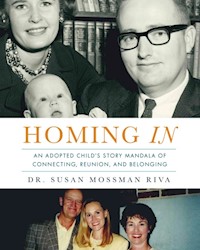
Dr. Susan Mossman Riva was adopted in Omaha, Nebraska in 1963. In 1995, she sought the help of the Nebraska Children's Home to find her birth mother, leading to the discovery of her birth family in 1996. Miraculously, her search and reunion coincided with her biological sister's search. The awe and joy of homecoming brought her to the realization that synchronicity acts as a guidepost, repairing relational brokenness. The divine timing of their reunion happened months before their biological, maternal grandmother died. Susan connects the phases of her life in an intricate story mandala.
As an adopted child, she innately understands all that can be lost through her experience of separation. This awareness became a driving force as she steadfastly worked for reconciliation in all her relations. With loving intent, she embarked upon a journey seeking to reunite and reconcile with all those she belonged to. By connecting and engaging in an intentional forgiveness process. Susan was ultimately able to forge a pathway homing in to wholeness.
Readers will discover the power of the homing in mechanism that can be activated and used as an inner compass for all pathfinders. Susan's social science background provides an explanatory framework, sharing knowledgeability about generative and transformative processes.
This incredible story has evolved into a teaching story through blog posts that document each book chapter and develop key concepts presented in the book.
Das E-Book können Sie in Legimi-Apps oder einer beliebigen App lesen, die das folgende Format unterstützen:
Veröffentlichungsjahr: 2020
Ähnliche




















Homing In: An Adopted Child’s Story Mandala of Connecting, Reunion, and Belonging © 2020 by Susan Kay Mossman Riva. All rights reserved.
No part of this book may be reproduced in any form or by any means, electronic, mechanical, or digital (including photocopying and recording) except for the inclusion in a review, without written permission from the publisher.
Because of the dynamic nature of the Internet, any web addresses or links contained in this book may have changed since publication and may no longer be valid. The views expressed in this work are solely those of the author and do not necessarily reflect the views of the publisher, and the publisher hereby disclaims any responsibility for them.
Limit of Liability/Disclaimer of Warranty: all effort has been done to ensure accuracy and ownership of all included information. While the publisher and author have used their best efforts in preparing this book, they make no representations or warranties with respect to the accuracy or completeness of this book and specifically disclaim any implied warranties or merchantability or fitness for a particular purpose. No warranty may be created by sales representatives or written promotional materials. The advice and strategies contained herein may not be suitable for your situation. The publisher is not engaged in rendering professional services, and you should consult a professional where appropriate. Neither the publisher nor the author shall be liable for any loss of profit or any other damages, including but not limited to special, incidental, consequential, or other damages incurred as a result of using the techniques contained in this book or any other source reference.
The personal experiences detailed in this book are those of the author and are told from that perspective.
Published in the United States by WriteLife Publishing
(An imprint of Boutique of Quality Books Publishing Company, Inc.)
www.writelife.com
Printed in the United States of America
978-1-60808-227-8 (p)
978-1-60808-228-5 (e)
Library of Congress Control Number 2019957781
Book design by Robin Krauss, www.bookformatters.com
Cover design by Rebecca Lown, www.rebeccalowndesign.com
First editor: Olivia Swenson
Second editor: Caleb Guard
PRAISE FOR SUSAN MOSSMAN RIVA AND HOMING IN
“In this beautifully written work, Susan Mossman Riva shares her fascinating journey to discover her family of origin, and her own identity. It is indeed a poignant journey into herself, as she explores her longings, her doubts, and her joys. The work is especially relevant to this era in which the seals on adoption cases are being removed. For us, it was an enthralling adventure on its own.”
— Mary and Kenneth Gergen,
founders of the TAOS Institute
“Homing In is an autoethnography of the highest quality that examines adoption and kinship through the holistic and comparative lens of anthropology, convincingly arguing that nature and nurture are inextricably intertwined, exemplified through the author’s personal story that is akin to a transformative journey and comparable to a spiritual pilgrimage.”
— Alexander Rödlach SVD PhD
Associate Professor of Medical Anthropology and Psychiatry Chair,
Department of Cultural and Social Studies
Creighton University
“Against the backdrop of the early 21st century, with its spiritual ennui and cyber (dis)connectedness, Susie Riva, in this remarkable book, deconstructs her sense of humanity. Her text is holistic and interconnected. She uses a three part structure to explore her life history from multiple temporal and conceptual vantage points. Writing from the present from Switzerland, she first explores her beginnings. In this section, she recreates and deconstructs the dialogue between her lived experiences and her family narratives, initially locating herself with the multi-generational narrative of the prominent adoptive Nebraska family in the Midwestern part of the US. She next describes the complex process of reconnection to her birth family, creating an awakening of unknown deep roots and shared meaning with a family she comes to know and love. Drawing from Native American spiritualism, she explores these two sides of herself not as a parallel or as lineal story lines, but rather as connected aspects of a personal mandala of life. The third part of the book moves to a higher level as she explores various cultural, spiritual, and personal dimensions of her circle life. Her book is not only the story of an amazing journey of life, it is also a scholarly autoethnography of one’s life.”
— Dr. Richard Sawyer, Professor of Education,
Washington State University,
Co-developer/author of duoethnography
“Homing In is a compelling and passionate must read for both adults with adoption histories seeking to better understand the fabric of their evolutionary and psychological DNA through the process of autoethnography, and seekers of a higher communicative pathway to integrated spiritual enlightenment. Through the captivating telling of her personal story of adoption, reunion and belonging, Dr. Riva provides a brilliant roadmap to healing and personal transformation using illuminating, poetic prose to reveal the therapeutic power of th personal story mandala, the importance of consciousness raising synchronicities, and the road to inner peace and a sense of anchored belonging. By embracing the oneness and synergistic connectivity of the human spirit at the level of family, community, and society, Dr. Riva masterfully communicates to the reader the importance of walking the road less traveled, consciously connecting to the tapestry of human life, and discovering and weaving one’s own story mandala along the way.
Through the sharing of our own transformation process we have the power to transform others. Homing In is the equivalent of life’s poetry and Dr. Riva’s beautifully narrated prose and deep dive into history, anthropology, and human behavior will leave the reader fully engaged, illuminated, and ultimately transformed.”
— Dr. Connie Morror, Psychologist,
Research Associate Professor of Pediatrics,
University of Miami Miller School of Medicine
This book is dedicated to my descendants.
“You’ve no idea how hard I’ve looked for a gift to bring you. Nothing seemed right. What’s the point of bringing gold to the gold mine, or water to the ocean. Everything I came up with was like taking spices to the Orient. It’s no good giving my heart and my soul because you already have these. So I’ve brought you a mirror. Look at yourself and remember me.”
—Rumi, translated from Coleman Barks
CONTENTS
Preface: A Story Mandala Connecting Adoption, Reunion, and Belonging
Acknowledgements
Relational Lexicon
Part 1—Adoption: Re-collecting and Re-membering My Life’s Beginnings
Chapter 1: The Giveaway Girl
Chapter 2: Intergenerativity
Chapter 3: Blackbird Bend Farm
Chapter 4: Seasons of Adventure
Chapter 5: Responding to the Call
Chapter 6: Faith and Community Service
Chapter 7: Concrescence: Wedding to Become One
Chapter 8: International Ski Tribes
Chapter 9: A Coat of Many Colors
Chapter 10: International Affairs
Chapter 11: The Tragic Break
Chapter 12: The Sundance Way of Life
Chapter 13: Kinning: Becoming a Child of Multiple Families
Part 2—Reunion: Finding My Birth Family
Chapter 14: Nature and Nurture within the Epigenetic Paradigm
Chapter 15: The Rebirthing Process
Chapter 16: The Love Letters
Chapter 17: Engaging in Polyphony and Dialogism
Chapter 18: Once in a Blue Moon
Chapter 19: Pictures in a New Family Album
Chapter 20: Welcoming Cathy into the Family Circle
Chapter 21: Embodying and Integrating Change
Chapter 22: Being Other
Chapter 23: Spinning the Family Tale
Chapter 24: The Dark Archetypical Forces
Chapter 25: Adieu
Chapter 26: Trying to Fit In
Chapter 27: Balancing Work and Family Relations
Chapter 28: The Eulogy
Chapter 29: Weaving a New Pattern
Chapter 30: Finding the Path Forward: Beyond Barriers of Belonging
Part 3—Belonging: Designing My Medicine Shield
Chapter 31: The Meaning-Making Process
Chapter 32: Mind-Body
Chapter 33: God’s Many Faces or “Showings”
Chapter 34: The Golden Pocket Watch
Chapter 35: Journeymanship: Encounters in Pursuit of Higher Knowledge
Chapter 36: Developing Moral Imagination
Chapter 37: Earthrise: Expanding Our Circle of Caring
Chapter 38: The Weighing of the Heart
Chapter 39: Stewardship
Chapter 40: From Kinship to Earthship
Chapter 41: Future Forming
Chapter 42: Liminal Space
Chapter 43: Making Mandalas of Wholeness on the Medicine Wheel of Life
Chapter 44: Engaging in Healing Conversations
Chapter 45: The File
Chapter 46: Pilgrimage as Process: Cultivating Radical Amazement
Chapter 47: The Anthropology of Becoming
Chapter 48: Knocking on Mercy’s Door
Chapter 49: Beholding the Sacred Vessel
Postscript
About the Author
Key Concepts
Bibliography
PREFACE
An Adopted Child’s Story Mandala of Connecting, Reunion, and Belonging
“Thus sprung, why should I fear to trace my birth? Nothing can make me other than I am.”
—Sofocle, Edipore1
This is a true story about lines of inheritance, interconnectivity, and belonging. I tell of how I found my birth family and discovered that I was the oldest of five children. My search for my birth parents coincided with my birth sister’s search for our parents. In the early 1960s, she was adopted the year following my own adoption. I didn’t know about her existence. We were united with our birth family before our maternal grandmother died of cancer. The miracle of our coming together from separate lifeworlds to be at our maternal grandmother’s side before she died is the seed for this work. This demonstration of interconnectivity made me wonder if heartstrings connected us. Our reunion story provides valuable insight into the human condition and our ability to home in.
Interweaving the relationship between lineage and inheritance, I address what we receive, what we keep, and what we decide to pass on to our line of descendants. My experience underscores the difficulty an adopted child has in balancing their rightful place in both their adopted family and their birth family. The intercultural dimension is an intricate part of my narrative—I grew up in Nebraska, married a Swiss national, and am currently raising my own five children in the Swiss Alps. My heritage as an American child born in the state of Nebraska grew to include Swiss heritage transmitted through marriage. My search for belonging traces multiple forms of kinship, mapping out relational connections.
Becoming ready to tell my story took developing professional experience and practicing as a mediator, a medical anthropologist, and a social psychologist. As my children grew up, I had more time to write. Over the years, daily contemplation kindled a desire that flared with words describing my self-realization process, suggesting that inherited family patterns might be transformed through writing and conscious dialogue.
This unique narrative of letters, poems, and creative writing pieces from my past show the construction of an adopted child’s identity throughout a lifetime. Motherhood, friendship, women’s sexuality, the challenges women face balancing motherhood and careers, as well as the complexity of international relations are social themes woven into the fabric of my book. I hope that my own search will inspire healing conversations in other families, especially those concerned by adoption. My personal quest allowed me to embark upon a healing path, facilitating self-discovery and leading me back to my birth family. My story resonates with the archetypical metaphor of the lost child searching for her roots.
As my story unfolded, I understood that an adopted child has strands of inheritance much like optical fiber, using photonic crystals. This transparent fiber functions as a “waveguide” transmitting forms of communication. The fibers of my identity came from my birth family and my adopted family. Though the fibers from my birth family were informing me all through my life, I was not consciously aware that they were transmitting information to me. A shared resonance with my birth family acted as a guiding force in our relational energy field.
Epigenetics is a growing field of study that explains how our DNA does not influence genetic expression alone. Our environment and perceptions have an important influence on our genetic expressions. Trans-generational memory passes on characteristics gained through our life experiences, influencing future generations. These discoveries force us to become aware of the incredible responsibility we have as we make lifestyle choices that will influence our offspring for generations to come. Epigenetics underscores the power of our perceptions as well as our environment to transform our life and give form to the future. We are the stewards of our genome.
Evaluating what we receive, what we keep, and what we pass on to future generations is essential, as we are also the Keepers of Life on Gaia. The Gaia principle describes how the complex self-regulating Earth environment maintains the conditions for life on the planet. We must pass on a tradition of sustainable development in the face of the Anthropocene, or the current epoch in which humans have a significant impact on the Earth’s geology and ecosystems.
As a social scientist and researcher, I am interested in understanding the mechanisms at work in my own identity construction process as an adopted child. Having asked “What could my story be telling me?” I proceeded to develop an explanatory model, inspired by psychiatrist and medical anthropologist Arthur Kleinman’s approach exemplified in his book, Illness Narratives. Engaging in “metalogues,” in reference to Gregory Bateson’s seminal book An Ecology of Mind, has involved engaging in problematic conversations using an interdisciplinary social science referential framework. By eliciting conversations with great thinkers, I searched for theories that might help to explain the ineffable dimension of our reunion process. I first became familiar with the concept of synchronicity through Swiss psychologist and psychiatrist Carl G. Jung’s analytic psychology. His writings expand upon theories including the individuation process, archetypes, collective consciousness, dreams, and mandalas. Pierre Teilhard de Chardin uses the term noosphere to describe an evolving sphere dominated by the mind, consciousness, and interpersonal relationships. My story illustrates how we are linked by the fundamental element of Akasha that Ervin Lazlo refers to as “fundamental underlying connectivity.” Another framework of understanding is Rupert Sheldrake’s morphogenic fields, which hypothesizes that memory is inherent in nature as observed in the emergence of organizing fields that give rise to different life forms. Possibly another theoretical explanation, from a social constructionist stance, is Kenneth Gergen’s ‘Relational Being’, highlighting the social construction of relatedness. Nassim Haramein’s work in quantum science has shown a similar idea: we live in a connected universe. More specifically, this story further investigates what La Vonne H. Stiffler referred to as the homing in mechanisms of children separated from their parents at birth.
In archaeology and anthropology, the term provenience is used to refer not only to the spot where an artifact was found (the “find spot”) but equally encompasses where it has been since it was found. Not only do I trace my beginnings to find out where I come from, but I also tell about where my life’s journey has taken me, illustrating the landscape of meaning tracking my own adventurous expedition through life. My own “find spot” is not just an outward, earthly landmark, but also an inner place of peace and relational balance.
My story begins in Part One by re-collecting my past, describing my childhood upbringing in Nebraska and the unfolding of my life as a young adult, studying at the University of Colorado in Boulder, and moving to Switzerland to start a family, all before searching for my birth family. While remembering my past, I give importance to the many synchronicities that occurred, contributing to my meaning-making process. I present the multiple families that I have come to belong to through adoption, my parents’ marriages and my own union, as well as my circle of family friends, who are truly a special clan. I explain how I met my Swiss husband and the founding of our own intercultural and international family. This “kinning” process is illustrated through ethnographic descriptions of how I became part of my adopted family and then later my biological family, entwining multiple threads of relatedness inherent in an evolving kinship.
In the second part, I tell the story of finding my birth parents and our reunion. I explain the process of searching for them and share the love letters we exchanged before we met. Following our initial meeting, my birth sister Cathy found our family. Her exchange of letters with my birth mother bears witness to the extraordinary episode in our lives when we were pulled back together before our maternal grandmother passed away. After we were all reunited, our relationships came full circle. My story goes on to explain the challenges I have faced maintaining my relations in my multiple family circles.
The third part of my narrative brings together my recollections of the past with the reception of my adopted grandfather’s golden pocket watch, which allows me to introduce the notion of divine timing in our lives. What was rightfully mine found me and served to reestablish my place in my adopted family, while offering a needed form of validation. I show how my Medicine Shield, a Native American symbol of personal vision, protected me with magical power, allowing me the space to transform my perceptions as well as my identity by weaving together the many strands of my Self. I ponder what is truly important to pass on to my children and future generations, analyzing different forms of transmission. My quest for my “true” identity was part of a transformational process possibly best understood in the words “Healer, heal thyself ” and “Healer, know thyself.”
My story generates a healing space that informs future generations by sharing my adoption and reunion story, my vision, as well as my meaning-making process. Belonging is revealed through possibilities to contribute, realizing potentiality in its fullest. In the end, I find what appears to be a sacred chalice and container of conflict and illness narratives: the Holy Grail, or rail-Way.
In a visit to Drammen, Norway, for a conference, I noticed a ship hanging from the ceiling in the center aisle of a Lutheran church. I used that metaphor to guide my group work at the conference. I was a chosen “dream weaver,” weaving together the conversations that took place between the participants from twenty-four different countries. The ship inspired me to guide my group with the phrase “setting our course.” I realized the word “ship” appeared in words like friendship, companion-ship, fellow-ship, and steward-ship. Indeed, divine guidance has a way of blowing into our ship’s sails, carrying us forward to new horizons. The Holy Spirit breathes the sacred life force into us, filling our human containers, and allowing us to stay buoyant as we set our life course. Just as the word suggests, we are not alone on the great waters—there are fellow-ships.
The recognition of the root word “ship” became a guiding force, taking me on a meaning voyage to other words and their significance. “Ship” as a suffix means to create form. It can also imply quality, condition, skill, power, number, or profession and rank. Though its meaning is not related to ship as a vessel, it does give form. Words, like ships, are containers, fashioning consciousness into expression and shaping form.
My family experienced a “convergence” that reset our life-courses. Our hardship became a new kind of companion-ship, catching the wind of destiny, and taking us full speed ahead. As I trace the trail of my roots, anchoring me in both my adopted family and my biological family, I analyze worship, or “worth-ship,” stemming from the Old English definition. The writing process brought out all that I truly revere, shedding light on how “worship” is living in a daily dialogue with the divine, revealing that which we treasure and value most in life. The vessel of authorship has transported me to a place of transformed relationships while searching for “the good life” (Nebraska’s slogan). This autoethnographic process metamorphosed into spiritual journey, accomplished through mediatorship, or faith in Jesus Christ, the incarnate Word of God, the Way to wholeness. The transformational process is ultimately crowned by Christ’s kingship.
The chapters of this book unravel the different fibers, separating them into the stories that have structured my life. Each chapter is a part of a story mandala, linked together in a story arc, cross-webbing three phases of my life quest. My mandala frames my life’s story in a meaning-making process seeking wholeness. It is a teaching tool allowing me to create sacred space to better understand and communicate my performance as an adopted child. In my three-part drama, I am the actor appearing with different masks, portraying my complex personage enacting a “performance pedagogy of radical democratic hope.”2
My narrative is a case study that seeks to show how the waveguide informed me through the many synchronicities that I was able to recognize. The synchronicities were like images traveling by way of photonic crystals in optical fiber. As I was searching for my Self, I was in fact linked to my birth family and guided by genes informing my beingness. The waveguide leads me back to my beginnings, activating a kind of relational resonance on the trail of human becomingness.
The unfolding events that are portrayed suggest there is a linkedness, a mysterious connectedness that actively configures our lives and the unfolding of destinies. I define mediation as linkedness. The chapters don’t follow linear, chronological time. Instead, they emanate from a flow of consciousness that represents the holographic matrix that connects space-time events with interlaced perceptions, linking emotions and insights with happenings in symbolic places. In this way, life-course is connected in a series of life-o-grams—something like story fractals. Lifescaping, the practice of transforming lifecourse trajectories, reconfigured chronological order with connected memories and meanings in a generative “storymind.” In flow, this relational mind emerged, harnessing the power to perceive patterns and make meaning with the purpose of sharing the miracle of our reunion.
This autoethnography seeks to give out “viriditas” or “greenness,” a terminology used by St. Hildegard von Bingen to describe how people give out viriditas through virtues. It was believed during her time that divine forces of nature and creative powers of life were transmitted into the plants, animals, and precious gems. When people ate the plants and animals and wore precious gems, they obtained their energy or viriditas. In the chain of being, humans give their own form of greenness through their virtues. She also used mandalas to express her sacred visions. My hope is that this story will transmit my own life’s “greenness” to the reader, offering its generative potential to other Seekers.
__________
1 Quotation, Family Matters: Portraits and Experiences of Family Today, Family Matters, CCC Strozzina Museum, Florence, Italy.
2 Norman K. Denzin, Interpretive Autoethnography. Second edition. (Los Angeles: SAGE, 2014) 80.
ACKNOWLEDGEMENTS
A special thanks goes out to Olivia Swenson whose editing and guidance has allowed the manuscript to become more coherent and whole. I would also like to thank Jeff Forker for helping me work on the story arc at the beginning of my writing process. Another thanks to Sheila McNamee, Gaia Del Negro, and Amy Milner for reading the manuscript and accompanying me through the creative and editing process. I will be forever thankful for my families who have supported my autoethnographic process, allowing me to share our story with the world.
RELATIONAL LEXICON
Susan, the author, was born on July 5, 1963, and adopted by Janice and David Mossman. She grew up with two younger sisters, Nancy and Leigh, both natural children of Janice and David. Janice and David raised their family in Omaha, Nebraska. David grew up in Omaha, Nebraska and Janice in South Sioux City, Nebraska.
David’s parents, Harland and Marion Mossman, grew up in Omaha, Nebraska. David was also raised in Omaha. He was an only child.
Janice’s parents, George and Marion Shrader, were from South Sioux City, where they also raised Janice. She was an only child.
After David and Janice divorced, David Mossman married Dorothy “Dody” Doane. Dorothy has one daughter, Angie. Janice married Robert Falk. Robert’s four children from a previous marriage are Carolyn, Nancy, Carl, and Kristine. Janice lived in Fort Calhoun with Robert until his death, whereupon she moved back to Omaha.
Susan’s birth parents are Michael and Ruth Ann Wylie, who lived all their lives in Lincoln, Nebraska. Their first two children, Susan and Cathy, were adopted by families in Nebraska. They raised Michelle, Ryan, and Kaitie.
Michael’s birth father was John Murphy, and he was raised by his mother Elisabeth and her husband Everett Wylie in Lincoln, Nebraska. Michael grew up without knowing his birth father’s existence. Ruth Ann’s parents, Katherine and Harland Wiest, raised five children in Lincoln, Nebraska.
Susan Mossman, the author, married Angelo Riva from Valais, Switzerland. After Susan’s graduation from the University of Colorado in Boulder, they moved to Switzerland and had five children: Katrina, Sven, Nils, Yann, and Jessica. As of this writing, they have one grandchild, Nevin Schyrr, son of Katrina and her husband Bastien. The Rivas and Schyrrs live in Switzerland. Angelo’s parents were Jean-Robert and Lily Riva, both Swiss nationals.
The Heartstrings mother-daughter group includes Sharon Marvin Igel and her daughter Melissa, Carolyn Hansen and her daughter Cathy, and the late Diane Westin and her daughter Karin. They all live in Omaha.
Timeline of important events in Susie’s life
Burke High School graduation: 1981
Exchange student in Switzerland: 1981
Susie and Angelo’s Wedding: March 15, 1986
Graduation from the University of Colorado, Boulder: Spring 1986
Grandpa George’s death: January 15, 1987
Katrina’s birth: May 5, 1987
Sven’s birth: July 22, 1990
Jan and Dave’s divorce: December 1991
Nils’s birth: October 26, 1992
Jan and Bob’s wedding: November 28, 1992
David and Dody’s wedding: April 1, 1994
First letter exchange with birth parents: 1995
Yann’s birth: October 18, 1995
First physical meeting with birth family: 1996
Father Bob Wiest’s death: January 3, 1997
Michelle’s wedding: May 1997
Great-grandma Kay’s death: December 18, 1997
Grandma Marion’s death: September 19, 1998
Harland or Poppy’s death: September 3, 1999
Great-grandma Betty’s death: October 15, 1999
Marion or Marnie’s death: May 14, 2002
Jessica’s birth: June 30, 2003
Dave’s death: July 23, 2007
Bob Falk’s death: February 20, 2014
Nevin Schyrr’s birth: April 29, 2018
ADOPTION
Re-collecting and Re-membering My Life’s Beginnings
The Image
Thunder comes resounding out of the earth:
The image of ENTHUSIASM.
Thus the ancient kings made music
In order to honor merit,
And offered it with splendor
To the Supreme Deity,
Inviting their ancestors to be present.
—Translation from Richard Wilhelm,
I CHING or book of changes3
__________
3 Richard Wilhelm, I Ching or Book of Changes, (London, England, The Penguin Group, 1989).
CHAPTER 1
THE GIVEAWAY GIRL
When searching for the words that would tell my story, I opened the I Ching to the image of Enthusiasm. The I Ching, or Book of Changes, is an ancient Chinese text used for divination using hieroglyphic symbols. The hexagram of Enthusiasm refers to leaders who are able to tap into a kind of electrical energy, bringing the group forward by guiding the positive energy to a favorable destination. Sacred reverence for the ancestors and the past establishes a bond between God and humankind—the invisible sound that moves all hearts, draws them together, uniting the heavenly and earthly world in mystical contact.
My adoption and reunion story elicited a kind of electrical energy as the events unfolded, altering life trajectories as the hearts of me and my biological family members responded to a sound that drew us together. We used our innate capacity to home in, following heartways. Even though I was given away, there were heartstrings that connected me to my biological line of inheritance. As my biological family let go of my tiny baby hand, another family grasped on, receiving me into their family circle and transmitting their own lines of inheritance through nurturance. This created two ancestral lines of transmission.
It all began in Nebraska. I’m the girl given away to adoption—the giveaway girl. In Native American culture, the Giveaway is a ceremony where beloved possessions are given to others with no strings attached and no regrets. It is believed that in sacrificing something important, personal growth will be attained in the future. In contrast, when a child is given up for adoption, there is a sense that their intrinsic value is diminished when unrecognized by their kin. When my young birth mother gave me up for adoption with no legal strings attached, I arrived like a ceremonial offering on a sacrificial altar.
After birth, I was taken directly to the children’s hospital for blood transfusions as I suffered from blood type incompatibility with my birth mother. I was placed in foster care for four months before my adopted parents, Dave and Jan, received a call from the Nebraska Children’s Home announcing my arrival on the day President Kennedy was assassinated. I made a grand entrance by arriving in my family at that historical moment of time. My arrival was a portal where adoption’s gift and human sacrifice joined in the politics and poetics of the moment.
Dave and Jan, my adopted parents, were unable to have children and were in their late twenties when my adoption was confirmed. When I arrived on Thanksgiving Day, they received a letter from the foster care parents explaining my routine and schedule. There were details about the food I ate and my bottles. I was a perfectly broken-in baby.
As a child, I wasn’t sensitive to what they had gone through before the adoption. They never spoke of that time as associated with any kind of sorrow or disappointment. Jan worked as a gym teacher and Dave was part of the family real-estate business, working alongside his father and uncle. Their friends were all having children and founding families. My first real insight came when, as a young mother myself, I read my mother’s handwritten words in my baby book saying how I had made her complete.
The first time I asked where I came from, they explained that I was special and that they had been able to choose me from all the other children at the adoption agency. That story made me feel loved and handpicked. A memory I hold to this day is sitting on someone’s lap in the velvet armchair in my paternal grandparents’ high-ceilinged living room. I was surrounded by my parents and grandparents, and each parent told part of the story about me coming to them. It seemed very normal as they explained that I was special and chosen. My way of coming into my family was sealed by their unified testimony.
My adopted parents also explained that my biological parents loved me very much. They were too young when I was born and had given me up for adoption at birth because they knew they couldn’t take care of me themselves. That perfect story was like a birthday present carefully wrapped and tied up with a bow. I must have been around two or three years old when they shared my adoption story. It took years before I was ready to unwrap the package and see what sort of present was waiting for me inside—before I was ready to experience the day of my rebirthing.
My adopted father, Dave, became a millionaire at a young age. He had developed apartments and commercial space in the western expanding suburbs of Omaha. He had a good eye for beautiful properties and Mossman Co., a three-generational real estate company, allowed him to benefit from generations of experience in the business. He had decided to go into the family business instead of going to law school.
His business success meant that my adopted mother, Janice Shrader Mossman, could stop working and take care of me. A portrait in my Grandmother Shrader’s house in South Sioux City showed my mother as a regal young woman in her University of Nebraska homecoming dress, an elegant, light-blue gown. As a mother, she loved to dress me up and scotch-tape a little bow to the little wisp of hair she was able to pull together. There are many baby pictures of me in pretty smock dresses with laced bloomers.
My mother had me take White Gloves and Party Manners as a little girl. I learned how to eat properly, to wave and clap in just the right way, and to pull off my white gloves one finger at a time before putting them into my purse. She also signed me up for cotillion, or dancing classes, at Brownelle Talbot, the local private school. There I met all the young boys that came from the established families in Omaha. We learned to dance and knew “who was who” at age seven.
My mother loved to bring me along for all her social events and show me off. She was very involved in the community, serving on many boards and in many organizations where she was a devoted member. She served on the board of the museum and symphony working for the arts in the greater Omaha area. Going to exhibits and concerts and developing a taste for the fine arts was possible because my mother believed that these were important ingredients in “the good life”—our Nebraskan way of living.
Several of her dearest friends had little girls the year I joined the Mossman family—1963—and we all became very close, sharing mother-daughter birthdays and celebrating our lives together with a form of loyalty only those from tight families know about. These friendships developed into our Heartstrings Group, a community of loving mothers and daughters. These strong women in my life have been the cornerstone of my confidence, strength, and happiness. We made up our own code of honor based on unconditional love and acceptance for all members of the group. We always saw the very best in each other and worked to bring out the unique qualities we each had.
Our mothers were models of community service and had all studied to be teachers at the university. They used their skills to bring us up. They portrayed a kind of friendship that we girls sought to emulate. Entertaining, dressing, and picking out just the right gift were all talents to be cultivated. One of my favorite pictures is of our future Heartstrings Group at age three in dresses with party purses; I am holding mine up high over my head!
My mother was particularly close with Sharon, my godmother, and my mother was godmother to Sharon’s daughter Missy. Missy and I were the best of friends. I have always referred to Missy as my god-sister. My godmother has been a guiding light. I remember when my godfather had a heart attack and underwent surgery. I found my godmother in the waiting room with a Bible on her lap, praying. Sharon rarely spoke of her worries or her challenges, facing hardship with faith and discipline. She has modeled a life of hard work and service. She has a warm smile and is always immaculately dressed. She has never once forgotten my birthday in all these years!
How lucky I was to have such strong women raising and supporting me. These ties have held us together regardless of the distance separating us. My mother and her friends created a circle of caring mother-daughter relationships. She brought me into that sisterhood, enjoying her role as mother and sharing those years raising me with her entourage. She was fulfilled and actively participating in Omaha’s social world. But the words she wrote into my baby book revealed that something was missing. Mothering me brought her contentedness.
Though my adoption filled that original emptiness my mother experienced waiting to conceive, eventually she was able to have the experience of giving birth, and she and my father pass on their unique biological lineage to my two sisters, Nancy and Leigh. Nancy is four years younger than me, and Leigh is ten and a half years younger. Two other close family friends had adopted their first child and then were able to become pregnant, which made it that much more normal for me as an adopted daughter in a family that also had biological children.
At that time, the Nebraska Children’s Home placed children in families that were matched with the baby’s background through an interview process tracing family history and commonalities. Thus, I looked like my parents and my sisters. We would always kid about who was the adopted child. I didn’t stand out in family pictures. Family portraits were common in the 1970s, and I remember the photographer coming to take our family picture down by the lake on which we lived. We posed with our dog, Brownie. Our portrait was hung with other Omaha families at the Clarkson Hospital where the Service League organized the yearly style show and exhibited the chosen family portraits. Our pictures were often in the Omaha World Herald, mostly due to my mother’s accomplishments as a volunteer for the hospital, the Junior League of Omaha, the Josyln Art Museum, and the Omaha Symphony Guild.
When Nancy was born, my grandparents took me to the hospital, but I couldn’t go in. From my seat in the car in the parking lot, I could see the shadows through the hospital window where my parents and little sister were together. They held her up to the window for me to see her.
My mother had received me when I was four months old with a list of all the food that I liked to eat. When Nancy came home, she had colic and cried a lot. My mother had a broken tailbone from the birth, and she was in pain as she sat on a special round inflated seat. I remember my mom calling the doctor in tears.
Nancy didn’t keep the little scotch-taped bows in her hair and she wouldn’t wear dresses. One day when my father was driving home from work, there was a traffic jam at the intersection near our house. He saw a little child on a tricycle blocking the cars during five o’clock traffic. What kind of parents would let their child ride in the street like that? he thought. As he got closer, he saw that it was Nancy. He rushed to get her off the road and out of harm’s way. When my mother had her first parent-teacher conference for Nancy, she came back in tears because the teacher explained how Nan would take other students’ crayons and interrupt their work. She had a hard time behaving in class. As both my mother and my grandmother were teachers, that was hard to hear. But as Nancy grew up, her strengths started coming out.
I remember walking on the sidewalk on the way home from school with Nan, who was on her tricycle. Most of our neighbors’ children attended St. Margaret Mary’s, a Catholic school, but we attended Dundee Elementary School and I felt that we were kind of outsiders. The neighbor boys stopped us and wouldn’t let us go beyond the crack in the sidewalk to our house. They were busy threatening me when Nan hopped off her tricycle and bit one of the brothers on the leg, opening up our path home!
A few years later, five-year-old Nancy set off to walk to school with a classmate during a snowstorm. School hadn’t been called off, despite high winds and drifting snow, and our mother wasn’t one to worry about the natural elements, having grown up in the harsh prairies of Nebraska. As they were walking across the large abandoned field on their way to school, Nancy’s friend couldn’t make it forward against the strong wind. Nancy must have instinctively known that if she left her friend there, she might die. She courageously carried her across the school grounds to safety. She saved her life. After that experience, the teachers looked at Nancy differently. She had an inner strength and natural assurance that impressed people—even though we couldn’t get her to stop sucking her thumb.
My life before Nancy was spent with the elders of the family who transmitted ways of being simply through their presence. What I received during those special times differentiated me from my sisters. I was greatly influenced by my relationship with my great grandfather. Our lives overlapped, allowing me to encounter not just my great grandfather, but an entire historical period that he was connected to and embedded in.
When I was adopted, my parents were living with my great-grandfather, Carl Wilson, whose house joined my paternal grandparents’ house and my father’s uncle’s yard. An orchard joined the three homes. They referred to this place where our joint properties met as the Hill. I can remember the gardens full of peonies and lilac bushes. The abundant flowers attracted butterflies, and trees were full of squirrels. The Hill was an enchanted garden for me to discover. Pretend playing in the garden, I was wonderstruck by the natural world where my imagination and fantasy world opened up doors where I was emboldened to explore. The freedom and love that surrounded me in those enchanted gardens allowed me to flourish. As I was developing a sense of self, the landscape was “scaping” me. The beauty and wonder was sculpting my perceptions as I began making “mental ‘maps’ of causal relations between things and people.”4
About a year before Nancy was born—I was three—we moved from Grandpa Carl’s house to a house on Farnam Street, and there is where many of my childhood memories take place. Some of my favorite playmates were my friends Missy and Scott, and of course my sister Nancy.
During one of our more memorable play dates at our house on Farnam Street, I decided to put Vaseline in Missy’s thick, curly, chestnut-colored hair. As I applied the gel to her beautiful locks, I realized that I had done something wrong and that we would probably end up getting punished. While our mothers were chatting over coffee, I escorted Missy to a secure hiding place, where we silently remained until our mothers must have realized that we weren’t making any noise.
They never found us in our perfect hiding place and amazingly enough, we stayed put without making a sound, listening to our frantic mothers as they searched for our whereabouts. After searching our house and the block, they decided to call the police. We finally came out of our hiding place to be scolded. I recall the embarrassment I felt watching my godmother’s horrified expression as she saw Missy’s hair. However, the fear our mothers had experienced thinking we were lost saved us from spankings. Poor Missy had to endure multiple intensive washings in the kitchen sink to get her locks free of the sticky gel. This and other incidents, like filling the basement with bubbles from the overflowing washing machine, gave me a reputation as an instigator of mischief.
At Missy’s house, we developed a more docile playtime tradition. We would sit on her entry steps and imagine that the bookcase facing us was a cinema screen. We would flip the light switch to turn on our movies, inventing films and commenting on the events we saw in our mind’s eye. It became a part of our play ritual. Only we could see the film reels played on our private movie screen.
One hot summer afternoon at the Farnam house when Nancy and I were upstairs resting, we heard a truck pull up. We watched from the upstairs window as my mother’s father—Grampy—delivered a playhouse for my birthday. We would play house together with our dish set like little sisters do, making soup from cut grass and mud. The playhouse became our special hideout where adults didn’t care to venture, as it was too small for them to enter or sit comfortably. It was our domain, especially in the summer because it shaded us from the hot sun.
Memorial Park was just across the street from our Farnam house. Its centerpiece is a large white memorial created in 1948 for all the men and women from Douglas County who served with the armed forces. I remember catching butterflies with butterfly nets in the park with my first love, Scott Barker. We were the same age and attended kindergarten together. We grew up in a time when there was a prevalence of monarch butterflies. His mother took us to the park one afternoon, and when we caught a butterfly, she would burn it with her cigarette so that we could conserve each one for our collection.
Looking back, butterfly catching was a sacred art. We chased after butterflies, lifting ourselves higher, reaching out our nets for the capture. We have both become “inspirational idea catchers,” looking to the sky to find inspiration as it flutters around us. He is now the Bishop of the Episcopal Diocese of Nebraska.
Scott and I used to plan out pretend wedding rituals with our other neighborhood friends using a makeshift veil and a plastic ring. Scott always enjoyed performing the wedding ceremonies. I am sure our childhood play of arranging wedding ceremonies was good practice for performing the church rituals. Of course, Scott always asked the bridegroom to kiss the bride, which added yet another emotional level to our childhood playing.
Kindergarten involved playing in the class’s playhouse and taking naps on floor mats. We were asked to bring things from home for show-and-tell, and together we’d sit on the floor and listen attentively to our schoolmates present their special object brought from home. Our mothers participated in our class activities by functioning as “room-mothers,” bringing cookies and preparing activities for the different holidays. At my mother’s first teacher-parent conference, my kindergarten teacher referred to me as being a “social butterfly.” She shared with my mother that I was a socially gifted child. My relational and transformational way of being in the world was expressed through my teacher’s metaphor. My social intelligence made me more aware of the social transformation that was occurring around me and how it was performed.
Dundee grade school was in a neighborhood close to the University of Nebraska at Omaha. I could see the university from the sidewalk as I walked to school in a neighborhood where families lived within the protected walls of brick homes. The student body at the university was resonating with a call for social transformation. Stripping down in protest, they waved their shirts like liberating flags. My sensitivity to the changing times was especially felt during the many manifestations happening on campus. I could feel the ripple of change running through the student body that was altering the course of history. When I was eight years old, it was the beginning of the 1970s and the hippie movement. The hippies and students from the university rioted for numerous reasons, including the new hours enforced at Memorial Park. The protestors and onlookers made their stand at the park, often overflowing across the street and into our yard.
My father sent me to stay with his parents, who lived in the western part of town. I returned home from my grandparents the last night of the riots. I remember seeing about twenty people, many wearing flowered shirts, just sitting in our front yard, like it was normal to be passive spectators on a warm night. Farther down the intersection, university students were lying down in the middle of Dodge Street in protest. I had seen the reports about the riots on the local news, but this first-hand experience was unsettling.
Just before sunset, the police came to break up the riot and started spraying tear gas. The onlookers began to run, and some of them hid in our playhouse to get away from the tear gas. As I saw the tiny flame of the intruders lighting up a joint inside our special place, my father ran out to defend our territory. When those fleeing started screaming for fear of being attacked by the police, the surreal scene suddenly became an uncomfortable form of realpolitik playing out on my neighborhood street right before my eyes.
I recall hearing screaming coming from the bottom of our front yard steps at nightfall. My mother opened the front door and saw a police officer beating a black man with a stick while the man pled to be left alone. At each blow, he cried out in pain. My mother intervened, ordering the officer to stop beating the man on our property. My parents pulled him to safety on our front steps and tried to get an ambulance to come, but the traffic was gridlocked. I can still see my mother on the phone, trying to indicate to the 911 operator where our house was. The whole evening seemed like a documentary film, minus the background music.
The difference between my world and the world of the onlookers in my front yard was apparent even to an eight-year-old. The protestors wore bell-bottoms and flowing, pirate-like shirts, and the men had long hair. My parents wore classic attire and didn’t smell of weed, and my father had short hair, like other adults in our social circle. The riots had been like a show, and these young revolutionary students who thought they had the right to invade our private property were disturbing my safe, orderly world. The riots brought unwanted chaos and police, who were capable of a form of violence that I had never before witnessed. The music on the radio sang the words of the social revolution in the making that I could feel, but the reality of drug-overdosed students dying in the park seemed more to me like a threat to my security than real social progress. But living on Farnam Street provided me with a lens giving insight in to the social milieu of Omaha’s Midtown.
When I was eight, we left behind the landmarks of the university and Memorial Park where many of the protests took place, going west—at least, to the western part of town on 120th and Pacific Street. We moved from our brick house on Farnam Street to Boardwalk Apartments while our house in the Candlewood Lake development was being built. Moving to the new house would mean going to a new school, and I felt saddened to leave my schoolmates. However, the excitement of building our new house made it all seem as if we would be moving up in the world, living in a prestigious new neighborhood that my own father was developing.
We lived on the third floor of the apartment building, right across from my grandparents, whom we called Marnie and Poppy, and adjacent to my father and grandfather’s real estate office. It was very convenient, and my grandparents watched Nan and me while my father and mother took a trip to Europe, visiting London and Paris. They brought back red patent leather jackets, an impressive lock and key with an old wine opener for my father’s wine cellar in the new house, a belt buckle collection, and, most importantly, a new life. They had conceived Leigh on their trip.
One afternoon when my mother had a meeting, Marnie was taking care of Nancy and me. We were swimming at the pool behind our building when suddenly Nan’s round inner tube started losing air. My grandmother, who could not swim, panicked and started throwing other inner tubes her way, but the wind was too strong. The other adults around the pool sat there, frozen. I knew I had to act quickly if I wanted to stop her from drowning, so I jumped in.
As soon as I got to her, she wrapped her arms around me, blocking my arms and legs from being able to swim. I was able to keep our heads above the water until a man jumped in to help us. I found out later he had been on his way to meeting with my father when he saw us. He stripped off his clothes and came through the pool gate while the sunbathers in their bathing suits just watched. That was a lesson for me—the courage to act isn’t given to all.
During that summer living in the apartment next to my father and grandfather’s office, I enjoyed dressing up and trying on different roles. I liked to read and was very fond of Little Women by Louisa May Alcott, particularly the character Jo, who was an aspiring author. I too wanted to be a writer, and I got my mother, who was a good seamstress, to make me a Jo costume. I started writing my first poems. My own family was growing, and we would soon have another sister, just like Jo’s. But Little Women was not the only book I checked out of my elementary school library. I also chose Rachel Carson’s book Silent Spring, written in 1962. How did my fingers know to pick that book out from all the others on the shelf? Somehow I was drawn to learn from an environmental science book documenting the adverse environmental effects caused by pesticides.
During the same period, John Denver came out with his best album. I enjoyed listening to “Poems, Prayers and Promises” and “Follow Me” and began making choices about the music I wanted to listen to and the books that I wanted to read.
While living in the apartments, I watched as my mother endured morning sickness and as her pregnancy began to show. The secrecy of the pregnancy was kept from Nancy and me, though I had read the prescription on the pills I saw my mother taking for nausea. I guessed she was expecting. There were great changes whirling around me as we prepared to receive a new baby and move from our apartment complex into our new home on Candlewood Lake.
Soon after the move, I wrote the poem “No More Shall I Live nor Die.” The strong emotions I felt as I left my best friends at Crestridge Elementary School are evident. I moved forward, through the pain of separation, hoping to make new friends at Thomas Edison Elementary School. The beauty of our new home on the lakeshore and the spaciousness of our surroundings were a comfort, as were my dogs. Still, leaving behind my dear grade school friends hurt deeply.
No more shall I live this morning,
No more shall I die.
No more shall I see my loved ones,
But just once more I’ll cry.
Baby’s lying by the bedside, not understanding why.
Father and sister don’t seem to care, but don’t really understand.
My best friend is losing life-remembering things we’ve done.
Now the shadow passes above me,
And now I shall die,
Remembering the love that once surrounded me,
And the new kind that shall come.
My first poem always takes me by surprise, especially considering I composed it around ten years of age. Why was I so taken by this image of death? What was I remembering? Now, as I recollect the pieces of my past, I see that my poetic expressions were helping me to give voice to the love I must have felt for my birth parents that I had known in the womb. Separating from them was a form of death. But the poem interestingly stresses the sure belief that new love shall come. My adoption brought new love and a wonderful childhood. Still, a part of me, deep in my subconscious, was “remembering a love that once surrounded me” when I was in my mother’s womb. That remembering would drive me to search for my biological family as an adult. Coming from a place of relational giving and receiving developed a memory talk that allowed me to see connections and describe what I was seeing in an evolving form of reciprocity. After experiencing a form of root shock at birth, I developed a homing in mechanism to repair the rift, tracking the memory prints.
__________
4 Caspar Henderson, A New Map of Wonders, A Journey in Search of Modern Marvels, (The University of Chicago Press, Chicago, 2017) 196.
CHAPTER 2
INTERGENERATIVITY
Often Europeans will try to tell me that we Americans don’t have any roots. Indeed, we do. Our roots go far back and can be traced to the continents that our ancestors came from. They can be traced through family recipes handed down from mother to daughter. Our traditions are kept alive through our practice of faith, the songs that we sing, and the children’s stories that we read. Our virtues are passed on through our culture and our relations, maintained over generations. When we aren’t sure, we look back—and we also look deeply into our children’s eyes to see where we should go.
Intergenerational relationships engender a form of generativity, enkindling interactions and concern for others. Relationships between grandchildren and grandparents permit a relational space for all that is symbolic and spiritual to exist. Grandparents don’t have the same direct, material responsibility for our development. I understood as a child that my time spent with my grandparents was limited and that they would most likely die during my lifetime. Yet, in subtle ways, we created ties that bound us beyond the material world. We passed on love through gestures, linking us through family rituals passed down from our ancestors. Each of my grandparents and great-grandparents created bonds with me that shaped who I am and, as I pass along their wisdom and traditions and values, who my children and grandchildren are.
One of my earliest experiences feeling bonded to my forebears happened when Grandpa Carl (my father’s mother’s father) gave me my first doll in the apple orchard. That moment was like a bookmark in my early childhood memory book. In that threshold moment in the first years of my life, symbolic connections were made through the lines of inheritance that tied me to my great-grandpa Carl. The gift that I received from my great-grandfather bound me to him in a family timeline, allowing me to take the doll like a relay stick with the intent of passing it on to the next generation of runners.
The archetypical meanings Grandpa Carl passed on to me were part of the collective consciousness of his time. I meshed with those shapes and forms that I wasn’t able to understand as a child. Still, I wore them like a cloak; I sensed their texture, their smell, and the feelings they evoked. Later, I followed their trail much like a child follows the smell of a fresh baked pie, leading to the kitchen table where the afternoon tea party is set out.
Perhaps the strongest pull inspired by my first doll was to become a mother. I developed an attachment to my “Koo-men-slag,” the strange name I gave my doll. My daughters later inherited my precious doll. She initiated me to a sense of motherliness, a seed of desire that was planted deep within me during the first years of my existence.
Living in Grandpa Carl’s house and playing in his gardens fostered a deep connection to an enchanted world. Grandpa Carl was a magician and had taught Johnny Carson his magic tricks before he left Omaha and became the famous host of the Tonight Show. He had hidden rooms in his house. I remember a secret room that was accessed by pushing on a hidden opening in the wallpapered hall. It was exciting living in a magical house surrounded by an enchanted family garden.
Grandpa Carl had an amazing library, and all his old books fascinated me. Though I don’t remember seeing them in our first house that we shared with him, they took on a great importance later when they were placed in my father’s study in the house he built on Candlewood Lake. I wanted so badly to know, as I imagined my great-grandfather knew from reading the Harvard Classics and the old leather-bound volumes of Don Quixote in Spanish that my sister Nancy retrieved and keeps on her own desk. The books called to me, inviting me to absorb what was written inside, the wisdom of the ages. The symbolic representation of books resonated in my young mind, associating with the pursuit of higher knowledge, another core theme in my life. During those first years, the encounter with my great-grandfather linked me to my adopted lineage as well as my psychic connection to archetypical information that I later believed to be hidden within the pages of his books.




