


Erhalten Sie Zugang zu diesem und mehr als 300000 Büchern ab EUR 5,99 monatlich.
- Herausgeber: The Emma Press
- Kategorie: Geisteswissenschaft
- Serie: The Emma Press Prose Pamphlets
- Sprache: Englisch
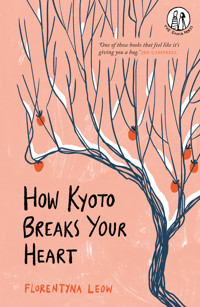
20-something and uncertain about her future, Florentyna Leow is exhilarated when an old acquaintance offers her an opportunity for work and cohabitation in a little house in the hills of Kyoto. Florentyna begins a new job as a tour guide, taking tourists on elaborate and expensive trips around Kyoto's cultural hotspots. Amidst the busy tourist traps and overrun temples, Florentyna develops her own personal map of the city: a favourite smoky jazz kissa; a top-shelf katsuobushi loving cat; an elderly lady named Yamaguchi-san, who shares her sweets and gives Florentyna a Japanese name. Meanwhile, her relationship with her new companion develops an intensity as they live and work together. Their little kitchen, the epicenter of their shared life, overlooks a community garden dominated by a fruitful persimmon tree. Their relationship burns bright, but seasons change, the persimmon tree out back loses its fruit, and things grow strange between the two women. How Kyoto Breaks Your Heart is a collection about the ways in which heartbreak can fill a place and make it impossible to stay.
Sie lesen das E-Book in den Legimi-Apps auf:
Seitenzahl: 148
Veröffentlichungsjahr: 2023
Das E-Book (TTS) können Sie hören im Abo „Legimi Premium” in Legimi-Apps auf:
Ähnliche




















HOW KYOTO BREAKS YOUR HEART
OTHER TITLES FROM THE EMMA PRESS
SHORTSTORIESANDESSAYS
Night-time Stories, edited by Yen-Yen-Lu
Hailman, by Leanne Radojkovich
Postcard Stories 2, by Jan Carson
Tiny Moons: A year of eating in Shanghai, by Nina Mingya Powles
POETRYCOLLECTIONS
Europe, Love Me Back, by Rakhshan Rizwan
POETRYANDARTSQUARES
The Strange Egg, by Kirstie Millar, illustrated by Hannah Mumby
The Fox's Wedding, by Rebecca Hurst, illustrated by Reena Makwana
Pilgrim, by Lisabelle Tay, illustrated by Reena Makwana
One day at the Taiwan Land Bank Dinosaur Museum, by Elīna Eihmane
POETRYPAMPHLETS
The Fabulanarchist Luxury Uprising, by Jack Houston
The Bell Tower, by Pamela Crowe
Ovarium, by Joanna Ingham
Milk Snake, by Toby Buckley
BOOKSFORCHILDREN
We Are A Circus, by Nasta, illustrated by Rosie Fencott
Oskar and the Things, by Andrus Kivirähk, illustrated by Anne Pikkov, translated from Estonian by Adam Cullen
Cloud Soup, by Kate Wakeling, illustrated by Elīna Brasliņa
My Sneezes Are Perfect, by Rakhshan Rizwan with Yusuf Samee, illustrated by Benjamin Phillips
The Bee Is Not Afraid of Me: A Book of Insect Poems, edited by Fran Long and Isabel Galleymore
For everyone who has ever lost a friend
■ ■
THEEMMAPRESS
First published in the UK in 2023 by The Emma Press Ltd.
Text © Florentyna Leow 2023.
Cover design © Elīna Brasliņa 2023.
Edited by Pema Monaghan.
All rights reserved.
The right of Florentyna Leow to be identified as the author of this work has been asserted in accordance with the Copyright, Designs and Patents Act 1988.
ISBN 978-1-915628-00-8
EPUBISBN 978-1-915628-01-5
A CIP catalogue record of this book is available from the British Library.
Printed and bound in the UKby TJ Books, Padstow.
The Emma Press
theemmapress.com
Birmingham, UK
Foreword
To belong is to be in a relationship. Relationships take time and exchange. Relationships are risks. – Zedeck Siew
Capturing a city in words is impossible, but everyone tries. Many books have been written about Kyoto over the years. Some offer wisdom and insight into its culture; others philosophise over its art. More than a few document its temples and gardens, and even more dispense travel recommendations backed by authoritative comments from local residents.
This is none of those books. I’m no expert on this city. What I can tell you is that no two people ever see it in quite the same way, although that’s probably true of all places. Your Kyoto will not be the same as mine. The very fact of who you are will shape your experience of it: the path you walk, the people you meet, the hall of memories you create in your dreams.
What does home mean when you emigrate? What does it mean to find home elsewhere? What if you keep leaving – what then? I’ve migrated twice and moved cities six times since I turned 19, and I’m still thinking about it. Specifically, how so many places can feel at once like home and not. How they slip under my skin in their own separate ways. I splinter and fracture, becoming different people in each place. Each city has been the stage for a life lived. A different cast, a new storyline. Meetings, departures, heartbreaks. Another notch, another scar on my heart.
The following pages are a brief record of trying to find a home in Kyoto; a series of sketches, vignettes, and attempts to make sense of all the ways you can love a place. Here’s what I’ve figured out so far: when you try to belong somewhere, your chosen home becomes a reminder of what you stand to lose. It will shape you, make you, break you. To love a place is to love its people, and to love a place is to let it break your heart.
Contents
Foreword
Persimmons
How Kyoto Breaks Your Heart (I)
How Kyoto Breaks Your Heart (II)
The Art of Tour-Guiding
Some Small Dive
How Kyoto Breaks Your Heart (III)
A Bowl of Tea
How Kyoto Breaks Your Heart (IV)
How Kyoto Breaks Your Heart (V)
Rainy Day in Kyoto
How Kyoto Breaks Your Heart (VI)
Egg Love
About the author
Acknowledgements
Also from The Emma Press
About The Emma Press
Persimmons
Persimmon blossoms emerge in June, petite and cream-coloured, as though clusters of buttery pursed lips have sprouted all over the tree – or so I’m told. I can’t recall the persimmon tree in this garden ever flowering. Bright green leaves one day, fruit the next – they seem to blink into being overnight as June’s rainy season subsides, oval lumps swelling over the summer months until blushing orange in autumn, like a thousand little suns festooning the tree. Visiting crows peck away at persimmons on the highest branches. Some ripen all too quickly, landing in fragrant, messy puddles in the undergrowth, a feast for wasps and songbirds alike.
It is early October now, a warm, sunny afternoon with a dreamlike cast, and we’re harvesting persimmons. The tree is still lush and green; in a few weeks it will be bare, scattering leaves in a brilliant carpet of mottled tangerine and vermillion. She shimmies up the ladder and snips away at the fruit-laden boughs with red shears. I catch them – mostly – and prise the persimmons from the branches by their calyxes. If I close my eyes I can still hear our peals of laughter, her yelps and curses as some fruit falls into the roof gutters. Oh fuck! I can feel myself shaking with laughter. I look up. Her hair glints in the sun.
When we have harvested close to three-quarters of the tree we call it a day. The persimmons spill out across the veranda by the hundreds, far more than we can reasonably eat by ourselves. We’ll pile them up in a corner, but for now we make persimmon angels: arms spread, surrounded by abundance. Autumn sunshine streams in through the glass of the sliding doors. My heart catches a little, as though there’s a glass splinter inside. I’m already weeping for the moment as it slips away. I’m happy. It hurts. I think this is where I’m supposed to be.
This is how I remember her still: luminous, laughing, haloed by sunlight and sunset-coloured fruit.
■ ■
I spent two years in Kyoto during my twenties, sharing a house with a friend I’d known from university in London. She contacted me a few months after I’d arrived in Japan to ask if I wanted to work remotely with her at her current job and also move in with her. She would be asking her housemate (whom she couldn’t stand) to leave. I didn’t know her particularly well, but I knew I enjoyed being around her, admired her relentless drive, her sardonic wit and colourful stories, her taste in ceramics, her depth of knowledge on traditional art and culture – and I would have jumped at any opportunity to leave my job in Tokyo. It made sense. I had a way out of the retail job I hated, and she would have a colleague to share her increasing workload with and a new housemate.
The job itself was mundane: customer services, consisting largely of emails to and from clients wanting to travel to Japan on guided tours. But I genuinely loved the products I sold, and for all their flaws the company management had a real knack for attracting good-hearted people with fascinating backgrounds, and creating an unusually tight-knit working culture where everyone could more or less understand the role they played and why it was essential. In other words, even though it was poorly paid and I was ultimately replaceable, I knew the work really meant something to the company, and it provided – at least initially – that sense of purpose I craved. It was the only full-time position I had actually ever wanted, so I was determined to make it work.
Adding to the novelty of the situation was the house I shared with her. It was a single-storey building ensconced in the northeastern suburbs below Mt. Hiei – more of a hill than a real mountain – and rented from a couple living in upstate New York. From the nearest station, you made your way through a shotengai1 and up a hill, through a few slender, unnamed lanes and turnings before arriving at a nondescript-looking house encircled by a modest garden space, which for the most part lay unused. The waist-high gate to the property tended to stay ajar, more there to mark a boundary than provide security.
Like many houses in Japan, it was poorly insulated, with thin walls that shook and rattled whenever an earthquake shuddered through the city. The floorboards creaked and complained, especially in the deafening silence of 3am when I stumbled my way to the toilet on the other side of the house. Summer invariably saw several cockroaches the size of golf balls scuttling across the kitchen floor, and winter had us huddling close to fume-spewing kerosene heaters which only ever warmed the room to a tepid temperature at best.
None of that mattered. I loved the house, and as far as I remember she did too. My bedroom window faced the front garden and its unruly carpet of weeds, and I could see Mt. Hiei most days, mist clinging to its silhouette in the mornings. At the other end of the house, the kitchen overlooked a spacious and endlessly abundant community garden, where local residents planted all manner of delicious things year-round – bitter gourd, cucumber, aubergine, daikon – and beyond the surrounding suburbs more mountains lay in the distance. I hadn’t realised I missed looking at the vast bowl of sky above until I left Tokyo and its tall buildings, and there were many days my heart would ache with pleasure just looking out of the kitchen window.
What I loved most about this house, though, was the persimmon tree.
At the heart of the house was a room lined with tatami mats, which my friend used as her bedroom. It was bordered by an engawa – a kind of veranda, an L-shaped, metre-wide corridor running along the edges of this room – and looked out into the central garden. A few pine trees and bushes dotted a space covered mostly with grasses. On the right, a Japanese maple extended its spidery branches over a petite nandina bush that had dark glossy leaves, and bright red berries in winter. To the left, the persimmon tree: relatively young and sprightly, a knobbly lichen- and moss-furred trunk stretching languorously towards the sky. It had rarely been pruned and it towered above the roof, ending in a spray of skinny branches at its crown, like a halo of flyaway baby hair.
Despite growing up in a tropical country, I thought I’d learned about seasons from my few years in the UK. But the persimmon tree showed me how little I understood. I’d never taken the time to observe how plants morph and shift over a year, how they can take on a dozen different faces and still delight you week after week. Spring begins with bright yellow-green leaves that darken as summer approaches and fruit forms. Autumn breathes shades of fire, rust, bronze into the leaves, which blanket the ground as the cold creeps in. Persimmons tend to remain long after the leaves have fallen, slender branches weighed down by clusters of fruit slowly rotting and shrivelling out of reach. You leave some behind for the birds, 木守り kimamori, as a way of ensuring good harvests and fortunes for the coming year. And winter, eventually, outlines its skeleton in inches of settled snow. So the cycle goes.
■ ■
How do you describe something you’ve never eaten before? I had no frame of reference for this fruit. A just-ripe persimmon off our tree was sweet, crisp, honey-like. When its flesh ripened even further, becoming soft and pulpy, it tasted like an autumn mango, hints of toasted brown sugar and dates and a dash of cinnamon. It tasted like the sound of a clarinet – silky, mellow and warm. I assumed all persimmons could be eaten straight off the tree. I didn’t know that hundreds of varieties existed, or that they fell broadly into astringent and non-astringent types. Later, I found out the hard way that an under-ripe astringent persimmon tastes like a thousand green bananas, and turns your tongue into a shag rug for half an hour.
It was the first time I had lived up close with an actual fruit tree. The autumn bounty felt miraculous and impossible, these mounds of beautiful imperfect fruits with their bruises and webs of blemishes, so different from perfectly square supermarket persimmons suffocating in their plastic prisons. Without any effort the tree simply grew, year after year, a gift unasked for. It felt a bit like my life: a job, a friend, a tree, a roof over my head, all of these things I hadn’t asked for but had received like a benediction. It took years to stop feeling guilty for all this good fortune.
■ ■
Things I’ve told myself over the years: She must have had her reasons. She may have outgrown you. You weren’t compatible with who she was becoming. You were a lot to handle as a friend. Okay, you kind of sucked. You never felt things by halves, and neither did she. She may have seen this as a toxic relationship. Her feelings are valid and so are yours. You have become different people. It’s okay to miss someone who isn’t in your life anymore.
■ ■
Life in the house revolved around the kitchen, where we answered emails and took phone calls across from each other at a rickety white IKEA table. In the kitchen we worked, cooked, listened to music, and got to know each other better. I wasn’t accustomed to sharing space so closely with someone who wasn’t family or, indeed, to tending to the logistics of a shared household, and I suspect she would have lived by herself if the rent had been tenable on our low salaries. In retrospect, it’s fair to say we were not the best match as housemates. Oh, who am I kidding – we were lousy for each other! I was a messy night-owl blundering through my twenties, a bungler with good intentions, a loud kitchen singer constantly trying to feed her. When I knew her, she was a tidy morning person, a furiously-focused bundle of dreams and ambitions and energy, who at times subsisted mostly on vegetable smoothies and chocolate. She introduced me to Oliver Sacks. She had a weakness for limited-edition Haagen-Dazs ice cream. She held herself to incredibly high standards in work and in life, and did not suffer fools gladly. I loved her. Fiercely and unstintingly, the way you love someone you think is going to be in your life forever.
I couldn’t bear to think of her or the house for many years, and have since excised so many memories I can’t remember whether we even ate together towards the end of her time there. But I know we shared many meals in that kitchen. I still have photos of things I cooked for us: crêpes with bacon and eggs, generously smeared with Dijon mustard; scrambled eggs and garlic chives; spaghetti con pangrattato crowned with a molten-yolked fried egg; kimchi-jjigae, a dish I cook for people I love.
After the persimmon harvest, I combed through blogs and recipe books jotting down ideas for using the fruit in notebooks and scraps of paper I’ve now lost or discarded. One of the first things I made was persimmon jam, attempting to use up the rapidly-spoiling fruit. In between answering emails, I deseeded the persimmons and tossed the pulp into my largest pot along with sugar and lemon or yuzu juice. It was a tremendously messy process. Sometimes it took hours to make a single batch, and starting after work hours meant I’d be stirring well past midnight. Several inches of pulp cooked right down to a scant few tiny jars of jam, all the more precious for the labour that went into them. Neither of us were really jam people to begin with, but I loved how meditative the whole process was. Eventually, I gave almost all of the jars away.
Another time, I invited Z up to the house so he could help us eat the persimmons, and he made us dinner. I’d made persimmon chutney and an experimental persimmon black pepper jam. He mixed the two together, along with reduced persimmon puree, then simmered several chicken thighs – after painstakingly removing the white, stringy tendons from each piece – in the resulting sauce. The finishing touch: blowtorching the chicken skins until crisp and charred. It was sweet and savoury, salty and fruity, begging for bread to drag through the sauce. I’d taken a stab at making persimmon pudding on her request – it was more like a sloppy persimmon custard, rich with nutmeg and clove – and Z blowtorched a layer of sugar on top for a brûlée. The caramel carapace was too thick, and instead of cracking elegantly it simply sank into the pudding below when she tapped it. Damn, she said, and it was so anticlimactic, so comical that we laughed until our sides ached.
■ ■
W




