


11,49 €
Mehr erfahren.
- Herausgeber: Atlantic Books
- Kategorie: Poesie und Drama
- Sprache: Englisch
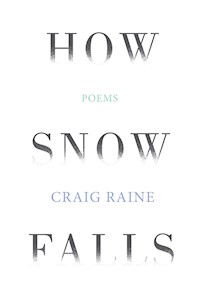
In his first poetry collection for a decade, Craig Raine addresses themes of transformation in human nature and the natural world and confronts the quiddities of death and sex, memory and desire, commemoration and love. At the core of How Snow Falls are four long poems that explore the possibilities of the form; there are two ardent elegies, one for the poet's mother and one for a dead lover; a sparkling reworking of Ryunosuke Akutagawa's story In a Grove; last a 'film-poem', High Table. These poems are sometimes joyous, often moving, and always turn an unflinching gaze on the world. Taken together, this collection reawakens us to forgotten worlds and gives voice to the hidden language of existence. As Raine writes in 'Night': 'don't give way to drowsiness, poet. / You are the pledge we give eternity / and so the slave of every second.'
Das E-Book können Sie in Legimi-Apps oder einer beliebigen App lesen, die das folgende Format unterstützen:
Veröffentlichungsjahr: 2010
Ähnliche














How Snow Falls
HOW
SNOW
FALLS
Craig Raine
Atlantic Books
LONDON
First published in Great Britain in hardback in 2011 by Atlantic Books, an imprint of Atlantic Books Ltd.
Copyright © Craig Raine, 2010
The moral right of Craig Raine to be identified as the author of this work has been asserted by him in accordance with the Copyright, Designs and Patents Act of 1988.
All rights reserved. No part of this publication may be reproduced, stored in a retrieval system or transmitted in any form or by any means, electronic, mechanical, photocopying, recording or otherwise, without the prior permission of both the copyright owner and the above publisher of this book.
10 9 8 7 6 5 4 3 2 1
A CIP catalogue record for this book is available from the British Library.
ISBN: 978 1 84887 285 1 eBook ISBN: 978 0 85789 250 8
Printed in Great Britain
Atlantic Books An imprint of Atlantic Books Ltd Ormond House 26–27 Boswell Street London WCIN 3JZ
www.atlantic-books.co.uk
Contents
How Snow Falls
I Remember My Mother Dying
Rashomon
In Hospital
Night
La Médica Harkevitch
Three Poems after Willem Van Toorn
Words Upon the Window Pane
A Festive Poem for Albie Marber
51 Ways to Lose a Balloon
Ars Poetica
Venice
Those No-Doubt-About-It Infidelity Blues
Davos Documentary B&W
L. F. Rosen: Three Poems
Marcel’s Fancy-Dress Party
High Table
For Pat Kavanagh
On the Slopes
A la recherche du temps perdu
Acknowledgements
How Snow Falls
Like the unshaven prickle
of a sharpened razor,
this new coldness in the air,
the pang
of something intangible.
Filling our eyes,
the sinusitis of perfume
without the perfume.
And then love’s vertigo,
love’s exactitude,
this snow, this transfiguration
we never quite get over.
I Remember My Mother Dying
I remember
we were driving to my father’s funeral. An overcast day.
A downcast day. Outside Darlington, eight miles away,
my ten-year-old son Vaska asked: Do you think
your brother will try to murder you? My cock shrank.
I remember
my father’s open coffin in the unlit dining room.
White nostril hairs, fog-lights in the gloom.
His face was the colour
of old glazed cheddar.
His right eyelid was straining open,
to see what was going to happen:
stitches stretched the parchment
like the flysheet of a tent.
It was the face of someone about to be shot,
about to flinch away from being hit,
apprehensive as those Hungarian security police,
all their body language a single plea,
snapped by that Life magazine photographer
John Sadovy, just as the trigger
was pulled in Budapest in 1956.
I felt faintly sick.
But I had to think about the speech
my brother had just asked me to make in church.
I remember
that my mother had found a phrase,
empty, sentimental, formulaic self-praise,
something to say, to explain why
my father’s corpse was on display.
She repeated it to everyone
as they offered their commiserations.
She was playing the indomitable wife:
‘I looked after him all his life
and I wasn’t going to let anyone else
look after him now.’ Pure pretence.
She went along with it, but the whole stupid idea
had my brother’s wonky, macabre steer.
I remember
the funeral congregation
paying wary attention
to my brother's affected upper-gloss voice
pledging to care for my mother. His solemn promise.
Three years later,
he turned up from god knows where
and terrorized the middle-aged female wardens,
issuing edicts, insults and orders,
a rip-tide of abuse by telephone
every night and all night long.
It was a little freehold flat in sheltered housing.
My mother began to lose her mind.
I remember
my brother, drunk, as usual,
announcing his 3.30 a.m. arrival
by leaning on my front doorbell.
And shouting through the letterbox as well.
‘I’ve brought you my mother’s ashes.’
The ineffectual, thirty-second thrashing
I gave him was a surprise to me.
I was hampered by my nudity,
my bare feet, my open dressing gown –
and he cycled shakily off to Summertown.
I don’t think he was expecting me to spurn
the sturdy screw-top bronze plastic urn.
I remember
seeing my brother on a bench,
sweaty, unshaven, intense,
his tight tie-knot shiny with dirt,
the morning after our mother died.
It was outside the Radcliffe Hospital.
He was talking to himself, spraying spittle
like a madman. I laughed out loud.
Because he’d been abusive, he wasn’t allowed
to see my mother’s body in the morgue.
He was reviewing the legal arguments,
taking legal advice,
raising his voice...
Undertakers, not one but two firms,
had already refused to deal with him.
In the end, though, he put her on display
just like my father, for a couple of days.
I remember
the first inkling of my mother’s mental decline
was a disagreement about the design
of plastic cocoa-butter containers,
which, against all evidence, she maintained
had a hidden pump, something recessed,
that would spring up when pressed.
I remember,
when she took out her top set of teeth
at Sunday lunch, facing the truth
that something was seriously wrong.
Her wincing delicacy was always so strong
she would berate
my father for removing his dental plate
to rinse out a painful raspberry pip,
‘in public’, under our kitchen tap.
Sometimes when criticized, he’d jut out
his bottom set,
his whole face a grotesque leer,
and ask for ‘a gottle of geer’,
like a ventriloquist’s dummy –
his routine routine, no longer funny.
I remember
at the same lunch, my mother said:
‘I’m dying’ and added:
‘At least there’s the flat.
You’ll make money on that.’
Just the two of us. The words were humble,
but her voice was slightly trembling.
It was a declaration of love, disguised
for her other difficult, distant son, as pure prose.
I remember
as I helped her into her black coat,
she asked me, ‘Am I all right?’
I remember
that I didn’t want to frighten her,
so I said, ‘Of course you are.’
And I straightened the turquoise brooch
on her right lapel and watched her fingers search
for the chipped gilt buttons, one by one,
as her blind eyes darkly searched for mine.
‘You’re my protector.’
Too late, I put my arms too late around her.
I remember
that every Sunday I made her her favourite drink,
lemonade and Advocaat, simple pub plonk.
When she became worried about her mind,
she stopped drinking the Snowballs. Another sign.
I remember
her trying to remember. After she died,
we found Post-it notes with names to memorize.
HAROLD PINTER. OLIVE WALKER.
Then 1 2 3 4. Then 1 2 3. Then 1 2 3 4.
I remember
asking questions to test her, and her strategies,
her desperate remedies:
‘How old was your father
when he got married?’ Answer:
‘My mother never wanted me.’
Question: ‘Was he 40? Was he 30?’
A favourite all-purpose answer:
‘When I had my operation for cancer
there was blood all over my back.’
Or a variant on ‘Jack Sprat’,
a nursery rhyme,
but also a feat in her private scheme:
Jack Sprat could eat no fat,
His wife could eat no lean,
But with a drop of HP Sauce
They licked the platter clean.
I remember
another scrap of verse
that represented Annapurna, F6, Everest:
Salvation Army, free from sin,
All go to heaven in a corned-beef tin.
I remember
that before she became ill
my mother had a dark-eyed, frail
wispy delicacy, a gracefulness
created by her partial sight loss.
She would stand,
smiling, unseeing, with folded hands.
When her brain began to struggle
and fail, she became ugly.
Her nose got bigger.
Everything was coarser.
Under her eyes, the bags
were great wax seals, swags
on a medieval document.
I felt an irresistible instinct:
I wanted to wash my hands when I left her flat,
as if I’d just been to the toilet.
I remember
my mother’s instincts were better
than mine. Her sense of etiquette
survived the indignity of being on the loo:
‘Excuse me.’ She said ‘thank you’
at the end of even the briefest visit.
Her manners went on being exquisite.
I remember
trying to get her to drink
a mouthful or two of milk.
I was worried in case she lost
her swallow reflex. She’d started to fast
and she was losing weight at speed.
Her: ‘Can I lie down?’ Me:
‘Yes, when you’ve drunk the milk.’
This is the small talk
we make when someone is dying.
She takes a sip, then lies back sighing
on her pillows. I stroke her hair.
She moans, continuously, lying there.
Her: ‘Can I lie down now?’ Pretending to scoff,
Me: ‘You are lying down.’ She laughs.
I remember
this resourceful viva voce between her
and Dr Duodo, the hospital doctor,
the afternoon she was admitted
to the Radcliffe Infirmary. He said,




