


39,99 €
Mehr erfahren.
- Herausgeber: John Wiley & Sons
- Kategorie: Fachliteratur
- Serie: Bloomberg Professional
- Sprache: Englisch
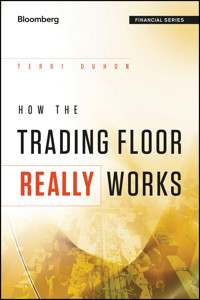
A detailed look at what really happens in the front office of an investment bank and why
Trading floors have always fascinated people, but few understand the role they play in the world of finance today. Though markets rise and fall every day, the drivers of those are rarely explored. Those who understand the dynamics of trading floors will better understand the dynamics of global financial markets. This book reveals the key players on the floor, their roles and responsibilities, how they serve their clients, and how it all impacts the markets. It also explains important terminology, explains the world of trading both cash and derivatives, and much more.
Includes a foreword by Gillian Tett, author of Fool's Gold: How Unrestrained Greed Corrupted a Dream, Shattered Global Markets and Unleashed a Catastrophe.
Terri Duhon (www.terriduhon.co) is a financial market expert who in 2004 founded B&B Structured Finance Ltd, which provides expert consulting and financial markets training . Her time on the trading floor has been documented in the book Fool's Gold as well as by PBS's Frontline.
Sie lesen das E-Book in den Legimi-Apps auf:
Seitenzahl: 628
Veröffentlichungsjahr: 2012
Ähnliche



















Contents
Foreword
Preface
Women on the Trading Floor . . . Really?
Chapter 1: What Are Financial Markets?
Debt Markets
Equity Markets
Other Asset Classes
Derivative Markets
Conclusion
Discussion Questions
Chapter 2: What Role Do Banks Play in Financial Markets?
What It Means to Provide Liquidity
Central Market Platforms
Who Are the Clients and What Are They Doing?
Conclusion
Discussion Questions
Chapter 3: Which Part of the Bank Are We Talking About?
Corporate Finance
Global Financial Markets
Where Are these Trading Floors?
The Trading Floor’s Relationship with Clients
The Loan Portfolio and the Funding Department
Conclusion
Discussion Questions
Chapter 4: What Does It Mean to Trade?
PACAM Treasury Trade
Supermart Interest Rate Swap Trade
A Structured Equity Product
Conclusion
Discussion Questions
Chapter 5: What Is the Market and Why Does It Move?
What Is the Market?
Price Fundamentals: Macroeconomics
Price Fundamentals: Company Specific News
Supply and Demand
Conclusion
Discussion Questions
Chapter 6: How Do Traders Make a Market?
PACAM Treasury Trade
Supermart Interest Rate Swap Trade
Equity Structured Product Trade
A Typical Trader Day
Conclusion
Discussion Questions
Chapter 7: How Is Proprietary Trading Different from Market Making?
Proprietary Trading Desk Overview
Proprietary Desk Liquidity
How Market Makers Are Similar to Proprietary Traders
Trading Book Accounting
Trader Capital Allocation
Conclusion
Discussion Questions
Chapter 8: What Is the Relationship Between Sales and Trading?
A Day in the Life
Know Your Client
Managing the Client Relationship
Sales Person Stereotypes
Conclusion
Discussion Questions
Chapter 9: What Role Does the Research Analyst Play?
The Role of a Credit or Equity Analyst
Conflict of Interest
The Economists and Strategists
Desk Analysts
Conclusion
Discussion Questions
Chapter 10: What’s So Special About Trading Derivatives?
Bond Intermediation
Derivative Intermediation
Counterparty Credit Risk
Illiquid Derivatives Intermediation
Conclusion
Discussion Questions
Chapter 11: Where Does Structuring Fit?
The Deal Origination
Deal Negotiation
Deal Closing
Conclusion
Discussion Questions
Chapter 12: Where Are the Quants?
Pricing Models and What They Do
Risk Management Models and What They Do
Financial Market Evolution
Quants’ Relationship with the Trading Floor
Conclusion
Discussion Questions
Chapter 13: What Are the Risks?
Market Risk
Credit Risk
Other Risk
Conclusion
Discussion Questions
Chapter 14: How Do We Manage These Risks?
New Product Approval Process
Market Risk Limits
Credit Risk Limits
Learn from Experience
Conclusion
Discussion Questions
Epilogue
Glossary
Index
This edition first published in 2012
Copyright © 2012 Terri Duhon
Registered office
John Wiley & Sons Ltd, The Atrium, Southern Gate, Chichester, West Sussex, PO19 8SQ, United Kingdom
For details of our global editorial offices, for customer services and for information about how to apply for permission to reuse the copyright material in this book please see our website at www.wiley.com.
The right of the author to be identified as the author of this work has been asserted in accordance with the Copyright, Designs and Patents Act 1988.
All rights reserved. No part of this publication may be reproduced, stored in a retrieval system, or transmitted, in any form or by any means, electronic, mechanical, photocopying, recording or otherwise, except as permitted by the UK Copyright, Designs and Patents Act 1988, without the prior permission of the publisher.
Wiley publishes in a variety of print and electronic formats and by print-on-demand. Some material included with standard print versions of this book may not be included in e-books or in print-on-demand. If this book refers to media such as a CD or DVD that is not included in the version you purchased, you may download this material at http://booksupport.wiley.com. For more information about Wiley products, visit www.wiley.com.
Designations used by companies to distinguish their products are often claimed as trademarks. All brand names and product names used in this book are trade names, service marks, trademarks or registered trademarks of their respective owners. The publisher is not associated with any product or vendor mentioned in this book.
Limit of Liability/Disclaimer of Warranty: While the publisher and author have used their best efforts in preparing this book, they make no representations or warranties with the respect to the accuracy or completeness of the contents of this book and specifically disclaim any implied warranties of merchantability or fitness for a particular purpose. It is sold on the understanding that the publisher is not engaged in rendering professional services and neither the publisher nor the author shall be liable for damages arising herefrom. If professional advice or other expert assistance is required, the services of a competent professional should be sought.
Library of Congress Cataloging-in-Publication Data
Duhon, Terri Lynn, 1972-
How the trading floor really works / Terri Lynn Duhon.
p. cm.
Includes index.
ISBN 978-1-119-96295-3 (cloth); ISBN 978-1-119-96601-2 (ebk);
ISBN 978-1-119-96603-6 (ebk); ISBN 978-1-119-96602-9 (ebk)
1. Trading rooms (Finance). 2. Stock exchanges. I. Title.
HG4551.D84 2012
332.64—dc23
2012029240
A catalogue record for this book is available from the British Library.
To my family and friends: I consider myself unbelievably lucky to have you all and ridiculously proud to be daughter, sister, wife, mommy and friend.
Foreword
By Gillian Tett
Many years ago, when I was a young financial reporter, I had a chance to walk onto a banking trading floor in London. It was an intense experience, which sparked a frisson of excitement and an insatiable sense of curiosity – and an odd sense of déjà vu. In an earlier part of my career, before becoming a journalist, I had worked as a social anthropologist, conducting fieldwork in places such as Tajikistan and Tibet. At first glance, those remote Himalayan communities might seem to have nothing in common with the young (and they are mostly young) men and women who work on the trading desks of the world’s banks; on the contrary, in terms of power, lifestyle, aspirations and earnings, the two environments are worlds apart.
And yet what the trading floor of any financial institution shares with the Tibetan and Tajik villages is that they operate as a community and an ecosystem; and, as such, they have their own set of rules, traditions and languages which defines the group, and sets them apart from others. Some of these rules and languages are formally stated and “obvious” (just look at in-house bank manuals on compliance for an example of that.) But many other cultural practices and rules are subtle and rarely discussed, either with outsiders or within the group (just take note of the gender differences that Duhon highlights near the start of the book to see this). But both sets of these overt and hidden codes of behaviour are profoundly powerful, and shape how societies are reproduced over time, how power structures develop – and how the participants see themselves and interact with the rest of the world. A bank trading desk, in other words, presents as much material for anthropologists as an exotic village; even, or especially, if the bankers who work there think of themselves as rational “modern” beings who work in a disembodied world of high-tech, cyber-finance.
Given this, Duhon’s book is not just illuminating, but valuable and timely for banker and non-banker alike. It sets out to offer a comprehensive picture of how a trading floor works, and how it interacts with the rest of the financial system. But – more importantly – it does this in a way, using real-life stories, that is comprehensible and easy to read; even for people who have never worked on a trading floor, or seen one. This matters. After all, during the past few decades, the operations of these trading floors have often seemed almost as mysterious to outsiders (and some insiders too) as a Tajik village. That is partly because of a widespread aversion among non-bankers towards grappling with technical and quantitative terms; to many non-bankers, complex finance seems so alienating that it is easier to label it as “geeky” and to simply ignore it. However, another reason for this lack of understanding is that the banking industry has long assumed it was in their interests to wrap finance with an air of mystery. This is not necessarily down to any deliberate “plot” or intentional criminality (although, on occasion, criminal acts do occur on a trading floor, as in almost any business sector). Instead, there was a more basic issue: bankers have often assumed that opacity and mystery produces more profit. Banks who have great trading ideas often want to hug them to themselves. Traders with fantastic teams do not want their competitors to steal their staff. And, most importantly of all, many banks have assumed cultivating an air of exclusivity would allow them to charge more for their services. After all, in finance, as in every business, it often pays to be seen as an “expert” who has sole command of some mysterious technology or product; if customers find it difficult to shop around for a service, or compare prices, the profits tend to be much higher.
But while this approach might have seemed to have served the industry well at some points in the past, these days, it is clear that this opacity and sense of mystery has also come at a huge cost. For one thing, the lack of understanding about how a trading floor really works has made it tough for society at large to exert effective oversight, and thus prevent crises before it is too late. Risks have built up within the financial system, and these have gone undetected for years, because journalists, politicians, regulators and central bankers – not to mention ordinary households – had almost no idea what was going on. The recent credit boom and bust is a case in point: if more regulators, politicians, journalists and other outsiders had understood, say, how banks were trading mortgage-linked securities before 2007, the financial crisis would never have spun so deeply out of control. Similarly, if there had been more external oversight of how banks were raising finance in the money markets, vulnerabilities in the system might have been spotted earlier, and possibly even fixed.
Worse still, because traders have been operating in quasi ghettoes, it has often been hard for them to retain that crucial trait: basic common sense. As they feverishly churned out products, or traded instruments, the temptation has been to keep staring at whatever lay beneath their noses (on their computer screens); any sense of wider context to trading has sometimes been lost. As a result, some crazy decisions and practices have emerged. Once again, the pattern of behaviour in the mortgage-backed securities is a case in point; if more traders had been forced to spend time explaining their operations to others, or even visiting some mortgage borrowers, they might have seen how dangerous the bubble was becoming. The lack of public understanding, in other words, did not simply make it tough for regulators to monitor the banks; it also made it harder for banks to engage in wise practices.
And there is a third key point: precisely because trading floors have been swathed in a sense of mystery, it has been difficult for banks to show the rest of the society why trading is a valuable and important endeavour to the wider economy. This is profoundly unfortunate. Since the financial crisis of 2008, there has been a welter of criticism among politicians and the wider public about the antics of bank traders; indeed, the word “speculator” has become the favourite bogeyman of many politicians. And that in turn has prompted calls to ban most forms of trading, and a wider regulatory crackdown. It has also damaged the reputation of the industry, in a manner that has not been seen since the last big financial crash of the 1930’s.
In some senses, this development is natural and understandable; some bankers and some traders have indeed done egregious things in recent years, and society has suffered as a result. But what has often been lost amid all this mud-slinging is that economies need financial systems to work; and the trading floors of banks are a crucial pillar of any modern financial system. When trading floors spiral out of control or engage in crazy antics, the consequences are certainly bad; however, if trading floors “freeze”, or disappear, this will be very damaging for the economy. That does not necessarily mean that these trading floors need to be as large as they have in the past; the size of these operations and their risk-taking appetites certainly became excessive during the credit bubble, and these need to be reined in and placed on a more ethical and sensible footing. But politicians, journalists, regulators and ordinary voters alike need to recognise that financial trading is a legitimate activity, which is needed to support growth. Sadly, though, it has been hard for banks to make that case – partly because the operations of those trading floors have been so opaque. In that respect, then, what Duhon is seeking to do with this book is crucial. If there was less ignorance about financial trading, and more common sense and transparency, we would have a better chance of building a healthier financial system. And that would not just be good for non-bankers, but bankers – and would-be bankers - too.
Preface
Why I Wrote this Book
Starting off as a 22-year-old analyst at JPMorgan on the interest rate swap trading desk with a math degree from MIT was one of the biggest challenges of my life. I had read a few books and had understood that the trading floor was a high-energy place. I also understood that trading derivatives would suit my analytical background. Yet, despite that and the intense JPMorgan training program, I had no idea what to do when I was told on one of my first days on the job to “trade the short end of the CAD dollar swap book and hedge using BAs and FRA switches.”
Later, as I interacted with the middle and back office at JPMorgan, I began to appreciate how little was even understood within the bank itself about the activities and the risk on the trading floor. Even interacting with the bankers from JPMorgan (who advised their clients about using the services of the trading floor) or the loan officers (who made credit risk decisions every day) was eye opening.
After 10 years of trading and structuring derivatives on the trading floor in New York and London, I started B&B Structured Finance with the original goal of training market participants in derivative products and markets. I quickly realized the demand for generic knowledge about the trading floor was our key to being successful trainers. Analysts, middle and back office professionals, bankers and even sales people on the trading floor needed to better understand some aspect of what was going on “on the trading floor” over and above learning about some specific derivative product. If my trainers could tell war stories about their time on the trading floor to put the derivative or risk analysis into context, then everyone in the room had an experience to remember and draw on. Our rule became “stories are sticky and facts are slippy.” Thus, in writing this book, I included several true stories that either I experienced directly or I was told by colleagues on the trading floor. These stories not only make the learning more entertaining but also give some context to the personalities that make financial markets go round.
With all the interest in sales and trading from graduates, the huge interest in moving from back and middle office to front office and the intense focus on financial markets and how they work today, there is a real need to teach people lessons they will be able not only to remember but also to utilize. Importantly, there is a real need to give people the perspective of someone who has done it all before.
What this Book Does and Does Not Do
What does it mean to make a market? What value do banks add to the financial markets? What risk do they take as a result? What really happens on the trading floor? What are the key roles and responsibilities on the bank trading floor? When does it all go wrong? These are the questions that this book answers. Because financial markets are continually evolving and there are so many unique financial products that are traded, this book does not attempt to burden the reader with too many technical details, nor does it try to address all the nuances of individual financial products. Instead, many financial products are simplified in order to use them as examples throughout the text. This book aims to establish a framework and some fundamental vocabulary for understanding how markets are made on trading floors and understanding the key roles and responsibilities of the individuals who work there.
Who this Book Is For
For the pending or recent graduate who is looking for a job in financial markets, this book is a must. It is not theoretical; it is practical and easy to read and follow. It clearly explains how the financial markets work and what the purpose of the bank and the bank trading floor is, using clear examples. Anyone looking for a job in financial markets will be able to identify roles and responsibilities which are most appealing and best suited to their skillset. This book starts with a foundation in basic financial products and participants then moves quickly into market making and risk taking. This book does not try to explain every product, nor does it try to teach financial math. It simplifies the financial market and makes it accessible to anyone who is interested. While the financial markets can be very technical, not every role on the trading floor requires a math degree. Most roles require an understanding of financial market dynamics and relationships between products, which this book provides.
For the financial market professional who is not sitting on the trading floor, this book is a crucial handbook. Many financial market professionals are familiar with financial products and financial market participants but still find the trading floor an opaque space. The people who work on trading floors often speak in shorthand and use a lot of vocabulary which is not easily decipherable. Even worse, people on the trading floor don’t have the time to help others really understand what’s going on. The current financial market professional may not need the first chapter of this book, which provides a financial market foundation, but instead might prefer to start at Chapter 2, “What role do banks play in financial markets?”
For everyone else, this book will put the bank’s role in the financial markets into context and explain what really happens on the fabled trading floor. Importantly, this book will help to decipher the conversations and the roles and responsibilities of the key players on the trading floor. The fact is that banks and their trading floors play a crucial role in the financial markets, but they don’t need to take as much risk as they have in the past. How to manage this without fundamentally changing or damaging the financial market dynamics is the key issue for everyone to consider.
Finally, Some Key People in the Process of Writing this Book
In alphabetical order they are: Vic Adams, Susan Fleming, Richard Gommo, Bianca Hart, Konstantina Kappou, Betsy Mettler, Marcus Miholich, Anu Munshi, Jannette Papastaikoudi, Megan Rutt and Neil Schofield. They all took time out of their busy schedules to answer some questions about their areas of expertise, give feedback on portions of the early drafts and/or share some of their experiences for inclusion in this book. Needless to say, they were invaluable. Last but not least is my husband, who has listened to me drone on about details I’m sure he didn’t want to become an expert on . . .
All Feedback Welcome!
Visit me on www.terriduhon.co with all questions and comments.
Women on the Trading Floor . . . Really?
The trading floor isn’t known for being the most balanced place in terms of gender. It has historically been very male-dominated. One female derivatives trader was surprised to hear her boss, on Bring Your Daughter to Work Day, say to his daughter, “Here are the boys. They’re here to make money. Here are the girls. They’re here to look good.” (Yes, that was me . . . the trader, not the daughter.)
Those were the bad old days and much has changed. However, for brevity’s sake, I refer to traders and others who work in the financial world as “he” and “him.” Conversely, probably because sales teams have more women in them than trading teams do, sales people are always referred to as that on the trading floor, and so they are in this book. So while I tacitly acknowledge the way things are, or are perceived to be, in the financial markets, I do so safe in the knowledge that women, even though they are in the minority, perform as well as men do on the trading floor.
CHAPTER 1
What Are Financial Markets?
Lesen Sie weiter in der vollständigen Ausgabe!
Lesen Sie weiter in der vollständigen Ausgabe!
Lesen Sie weiter in der vollständigen Ausgabe!
Lesen Sie weiter in der vollständigen Ausgabe!
Lesen Sie weiter in der vollständigen Ausgabe!
Lesen Sie weiter in der vollständigen Ausgabe!
Lesen Sie weiter in der vollständigen Ausgabe!
Lesen Sie weiter in der vollständigen Ausgabe!
Lesen Sie weiter in der vollständigen Ausgabe!
Lesen Sie weiter in der vollständigen Ausgabe!
Lesen Sie weiter in der vollständigen Ausgabe!
Lesen Sie weiter in der vollständigen Ausgabe!
Lesen Sie weiter in der vollständigen Ausgabe!
Lesen Sie weiter in der vollständigen Ausgabe!
Lesen Sie weiter in der vollständigen Ausgabe!
Lesen Sie weiter in der vollständigen Ausgabe!




