


13,99 €
Mehr erfahren.
- Herausgeber: John Wiley & Sons
- Kategorie: Fachliteratur
- Sprache: Englisch
Do you want to get to 'yes'?
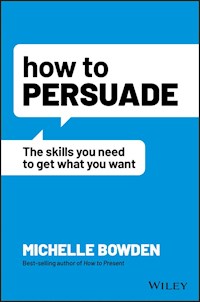
Every day we are faced with moments where we either win or lose. The question is: How persuasive are you? Could you be winning more of the time? In How to Persuade, best-selling author Michelle Bowden shows you the research-proven techniques to master the art of persuasion in any situation—whether it's securing that next big deal, convincing your manager to hit 'approve,' or even winning an argument with your friends.
Through real-world examples and engaging activities, this book shows you how to transform your weaknesses into strengths. You’ll build your own personalised plan to move people from 'no' to 'yes'—every time. Learn how to:
- Recognise and improve your persuasive strengths and weaknesses
- Build undeniable likeability and trust to compel people to action
- Arouse passion and enthusiasm for your ideas
- Win that next big pitch
- Persuade anyone, anywhere, anytime
In How to Persuade, you'll learn all the practical skills, tips and actions you need to get exactly what you want.
"Everything you want and need is on the other side of persuasion. This book takes you through the latest thinking on influence and persuasion and gives you all the completely achievable step-by-step actions to make yourself more instantly persuasive."
—Alec Gardner, Managing Partner, Australia & New Zealand, AlphaZetta
Sie lesen das E-Book in den Legimi-Apps auf:
Seitenzahl: 412
Veröffentlichungsjahr: 2022
Ähnliche


















Table of Contents
COVER
TITLE PAGE
COPYRIGHT
DEDICATION
ABOUT THE AUTHOR
Style and approach
THANK YOU!
INTRODUCTION: WELCOME TO THIS BOOK
Getting the best from this book
Embedding best-practice habits
PART I: How persuasive are you?
CHAPTER 1: Why be persuasive?
We all persuade all the time
How persuasive are you?
Welcome to
How to Persuade
CHAPTER 2: Are you turning people off?
We're unlikely to give feedback on poor persuasion
The 15 most common persuasion mistakes
CHAPTER 3: You cannot
not
influence!
Persuasion's position on the influence continuum
Why don't we develop our persuasive skills?
Using persuasion effectively
CHAPTER 4: Persuasion versus manipulation
What is manipulation?
Are you persuasive or just a common hustler?
CHAPTER 5: The four persuasive types
Understanding the key persuasion indicators
Introducing the four persuasion types
Type 1: The Wise Owl
Type 2: The Commanding Eagle
Type 3: The Friendly Budgie
Type 4: The Captivating Peacock
How the four types combine credibility and charisma
PART II: Understanding the types and working out which one to use when
CHAPTER 6: Type 1: The Wise Owl
The importance of message credibility
Structure your message so it resonates and sticks
Use external proof to strengthen your message
Use rhetorical questions to guide people
Eliminate fluffy language
Add power words to liven up your argument
Limit your options
Use numbered lists
Use visual aids to captivate and convince
Package your numbers
Rehearse until you can't get it wrong
A final word about message credibility
CHAPTER 7: Type 2: The Commanding Eagle
The importance of personal authority
Become an expert in your niche
Communicate your competence — let everyone know!
Raise your profile
Be trustworthy
Refine your elevator pitch
Calm your farm
Speak with elegance
Back yourself
Tell stories that impress
Always exceed expectations
A final word about personal credibility
CHAPTER 8: Type 3: The Friendly Budgie
Why you need goodwill in persuasion
Know and accept yourself
Accept others
Be likeable
Show warmth
Build rapport
Make people feel good
Find ways to help people
Connect
Listen actively
Don't use words that damage your goodwill
A final word about building goodwill
CHAPTER 9: Type 4: The Captivating Peacock
Why develop your inner Captivating Peacock?
Turn up your charisma
Be confident
Be passionate
Be expressive
Speed up your speech and be accurate
Use repetition
Engage the senses
Make a good first impression
Dress for success
Use clever delivery techniques
A final word about arousing enthusiasm and passion
PART III: Perfecting your pitch process and bringing it all together
CHAPTER 10: Perfecting your next bid or pitch
Increasing your chances of success
Resourcing
Boundary and role setting
Managing fear
Role modelling
CHAPTER 11: And now it's up to you
OTHER TITLES AND RESOURCES BY MICHELLE BOWDEN
How to Present
Free resources
APPENDIX: SUMMARY OF THE FOUR PERSUASIVE TYPES
INDEX
END USER LICENSE AGREEMENT
List of Tables
Chapter 5
Table 5.1 Key persuasion indicators broken into four sets
Table 5.2 The four persuasion types
Chapter 6
Table 6.1 Power words
Chapter 8
Table 8.1 Alternative words so you avoid using absolutes
List of Illustrations
Chapter 3
Figure 3.1 Influence continuum
Chapter 5
Figure 5.1 The impact of credibility, charisma and dominance within the four...
Guide
Cover
Table of Contents
Title Page
Copyright
Dedication
About the Author
Thank You!
Introduction: Welcome to this Book
Begin Reading
Other Titles and Resources by Michelle Bowden
Appendix: Summary of the Four Persuasive Types
Index
End User License Agreement
Pages
i
ii
v
vi
vii
xi
xii
xiii
xiv
xv
xvi
xvii
xviii
xix
xx
1
3
4
5
6
7
8
9
10
11
12
13
14
15
16
17
18
19
20
21
22
23
25
26
27
28
29
30
31
33
34
35
36
37
38
39
40
41
42
43
44
45
46
47
48
49
50
51
52
53
54
55
57
59
60
61
62
63
64
65
66
67
68
69
70
71
72
73
74
75
76
77
78
79
80
81
82
83
84
85
86
87
88
89
90
91
92
93
94
95
96
97
98
99
100
101
102
103
104
105
106
107
108
109
110
111
112
113
114
115
116
117
118
119
120
121
122
123
124
125
126
127
128
129
130
131
132
133
134
135
136
137
138
139
140
141
142
143
144
145
146
147
148
149
150
151
152
153
154
155
156
157
158
159
160
161
162
163
164
165
166
167
168
169
170
171
172
173
174
175
176
177
178
179
180
181
182
183
184
185
186
187
188
189
190
191
192
193
194
195
196
197
198
199
200
201
202
203
204
205
206
207
208
209
210
211
212
213
214
215
216
217
218
219
220
221
222
223
224
225
226
227
228
229
230
231
232
233
234
235
236
237
238
239
240
241
242
243
244
245
246
247
248
249
250
251
252
253
254
255
256
257
258
259
260
261
262
263
265
267
268
269
270
271
272
273
274
275
276
277
278
279
281
282
283
284
285
286
287
289
290
291
292
293
294
Praise for Michelle Bowden's Persuasion Smart Profile® and Persuasion Blueprint
Michelle Bowden is a legend! We unleashed Michelle and her boundless energy and winning formulas on our top performers and the results have been outstanding. This book is the detail from her winning keynote presentation and it will transform your persuasiveness and change your life for the better.
Tony BongiornoOwner and Director,Bongiorno Financial Services
Michelle is so special. She is incredibly passionate about each and every one of my team winning and she’ll stop at nothing to help us achieve our persuasive goals. Her life-changing formulas stay with you for the long term and can be used in all parts of your life. I highly recommend Michelle to you.
Gustav AriantoCEO, Pierlite ANZ
I loved it! Michelle's workshop on persuasion was very comprehensive and engaging! Lots of great structure and content that will help our people persuade more effectively. Michelle is an awesome facilitator!
Marika TetereMedical Director, Boehringer Ingelheim
Michelle helped each pitch member in our large bid team to refine their story, simplify their slide deck, enhance their delivery style and refine their answers to tough questions. Then she helped us in the rehearsal stage to ensure that there was a synergy between the presenters. Our Executive felt that all the presentations went extremely well, and the team did an excellent job. This was in large part due to Michelle's clever formulas, guidance and support.
Felicity Williams-LovegroveRegional Head of Bids — APAC
Michelle's pitch coaching sessions had a massive impact and influence on our presenters. I could see they worked hard to prepare and present diligently to their customers using the Persuasion Blueprint process.
Vijayakumar (Vijay) EkambaramSub ISU Head — Banking,Financial Services and Insurance,TATA Consultancy Services
Everyone needs Michelle’s wonderful models and formulas. My team and I have been working with Michelle for years to shape compelling presentations that achieve excellent results. Her approach is practical, memorable and builds incredible confidence — no matter your current persuasive skill level.
Professor Evonne MillerQUT Design Lab,Queensland University of Technology
Learning from Michelle was the first step toward running my own successful business! I have been using the skills Michelle teaches to present a persuasive argument, win business, and present training since I attended her workshop while working in the pharmaceutical industry in 2005 — decades ago! If you are serious about being more persuasive, I recommend How to Persuade. Michelle’s insights and teaching will have a huge impact on you, no matter your industry, current skill level or seniority.
Roz LindsayManaging Director, Engaging Potential
I worked with Michelle years ago and still use the tips and techniques she taught me to this day. Her clever formulas help me whenever I need to pitch an idea or persuade someone. Her work is highly recommended.
Marisa LariaMarketing & Communications Manager, Revlon
how to PERSUADE
The skills you need to get what you want
MICHELLE BOWDEN
Best-selling author of How to Present
First published in 2022 by John Wiley & Sons Australia, Ltd
42 McDougall St, Milton Qld 4064Office also in Melbourne
© John Wiley & Sons Australia, Ltd 2022
The moral rights of the author have been asserted.
ISBN: 978-1-119-89187-1
All rights reserved. Except as permitted under the Australian Copyright Act 1968 (for example, a fair dealing for the purposes of study, research, criticism or review), no part of this book may be reproduced, stored in a retrieval system, communicated or transmitted in any form or by any means without prior written permission. All inquiries should be made to the publisher at the address above.
Cover design by WileyAuthor photo: Tim Pascoe
DisclaimerThe material in this publication is of the nature of general comment only, and does not represent professional advice. It is not intended to provide specific guidance for particular circumstances and it should not be relied on as the basis for any decision to take action or not take action on any matter which it covers. Readers should obtain professional advice where appropriate, before making any such decision. To the maximum extent permitted by law, the author and publisher disclaim all responsibility and liability to any person, arising directly or indirectly from any person taking or not taking action based on the information in this publication.
I dedicate this book to my best human, Ian Bowden (the very Wise Owl), and to my three beautiful and clever daughters, who inspire me to keep opening my mind to the world and its opportunities.
ABOUT THE AUTHOR
Michelle Bowden is an authority on persuasive presenting in business. Michelle’s name is such a synonym in corporate Australia for presentation skills that people don’t say, ‘I’m going to persuasive presentation skills training’, they say, ‘I’m going to Michelle Bowden!’
She is the bestselling, internationally published author of:
How to Present: The ultimate guide to presenting your ideas and influencing people using techniques that actually work
(Wiley)
Don't Picture Me Naked
Exceptional Presentation Design
STOP! Your PowerPoint is killing me!
Confident Speaking Vocals
How to Present: Presentation Skills Tips from the Masters
Michelle is also:
multimillion-dollar pitch and capital-raising coach to executives across industry
editor of
How to Present
magazine and producer of Michelle Bowden TV
creator of the Persuasion Smart Profile
®
, a psychometric assessment that reports on your persuasive strengths and weaknesses in business
Certified Speaking Professional, the highest designation for speakers in the world; Michelle's keynote presentations educate her audiences on the theory and practice of persuasive communication at work and at home.
Michelle has delivered her two-day Persuasive Presentation Skills Masterclass more than 950 times for over 12 000 people over the past two decades.
Style and approach
Michelle conducts public and in-house Persuasive Presentation Skills Masterclasses for employees from all levels, across all industries. She is renowned for achieving results through learning and laughter. She is an expert, generous and passionate adult educator with the highest standards in relation to behavioural change. Her keynotes, workshops and courses are based on the idea that interaction, high energy and fun, combined with proven theory, create results for your business. Michelle's passion is to see people performing at their best. It's time you worked with Michelle so you can speak up and influence people!
THANK YOU!
In writing this book, I stood on the shoulders of giants. Influence gurus such as Robert Cialdini, Kevin Hogan, Kurt Mortensen, Bob Bodenhamer, Michael Hall and many others have paved the way for me to provide this highly practical, ‘how-to’ guide to make you an even more persuasive and successful person.
A heartfelt thank you to my wonderful mum (the Friendly Budgie/Commanding Eagle) and my brilliant and loving daughters Holly (Friendly Budgie/Wise Owl) and Madi (Commanding Eagle/Wise Owl), who diligently read my manuscript and provided countless improvements and insights to make this book better for you. Thank you Brady Dawson (Wise Owl/Commanding Eagle) for your helpful insights and fixes to the various linguistic challenges I faced. A fist-pump to my Annabelle (Commanding Eagle/Wise Owl) for your intelligent and thought-provoking conversations about communication. And a wholehearted thank you to my best human Ian — you are such a Wise Owl/Commanding Eagle, and the wind beneath my wings.
Thank you and hugs to Lucy Raymond (Friendly Budgie/Commanding Eagle), and Leigh McLennon (Captivating Peacock/Wise Owl) from Wiley. You have ensured that what's in my head is a helpful resource for others. Charlotte Duff (Commanding Eagle/Friendly Budgie), you are an editing LEGEND! Thank you Chris Shorten and the whole Wiley team for making this book the best it can be for my precious readers.
And, of course, thank you to all my wonderful, generous, supportive clients who have booked me to run masterclasses, speak for you at your conferences, and coach your bid or pitch teams. You have trusted me (in many cases for over 10 years, and sometimes for more than 20 years) with your most precious asset in your businesses — your people. Together we have learnt, embedded and refined the formulas and systems for persuasive presenting in business so that we won! Together we are most definitely stronger! Our shared experiences have made this book what it is, and you know it (because I say it all the time) — I love you for being an incredibly important part of my life. I love the joyful ring of the word ‘yes’! It's thanks to you that we now have a book that will help everyone be more persuasive and hear ‘yes’ more often too!
INTRODUCTIONWELCOME TO THIS BOOK
Hello and thanks for picking up this book! You know, I have lived a very blessed life. At the ripe age of 50 years, I can confidently say that I am a fortunate person. I have achieved my goals in my personal, work and spiritual life. If you look at me, you might think, Wow! She is lucky. She has it all — a loving husband, wonderful and successful kids, a beautiful home, a thriving business, a bestselling book, good health, and plenty of life-affirming adventures and notable experiences. I have clients who love me and describe my impact on them as ‘life changing’. I even have two good-looking, well-behaved dogs! (Okay, well-behaved most of the time.)
Yes, I am fortunate, and I am incredibly grateful for this wonderful fortune. But don't for one minute think that any of this came easily to me. I have made my life what it is. I have pitched and persuaded my way to where I am today. I have been studying the art of influence and persuasion since (at the age of eight years old) a mean girl said she didn't want to be my friend anymore because she didn't like my homemade skirt! (Mum, I loved that tiered green and navy skirt you lovingly sewed for me!)
Make no mistake — I'm not lucky. I have coaxed, convinced, motivated, argued, swayed, induced and persuaded my way through life. I have sought out opportunities from primary school through to high school, and through three degrees at university. I have talked my way into jobs that I wasn't perfectly qualified for but knew I could eventually ace. Along every part of my journey, I have studied and applied the actions of powerful persuaders to ensure life goes the way I want. I built my successful national training company off the back of an extraordinarily high sales conversion rate. I have made sure that my friends are people I really want to spend time with. I have crafted a lifestyle where I rest when I want to rest, and work when I want to work. I can afford to buy the things I want for myself and my family. I have grabbed every possible opportunity for growth wholeheartedly and am still always striving and putting my best foot forward to ensure that things turned out the way I want.
I am certain that luck has played no part in any of my fortune! Yes, I was often in the right place at the right time, but only because I made sure I was where I needed to be. I made my own luck by being persuasive.
The same can be true for you too — everything you want and need in life is on the other side of persuasion.
When it comes to genetics or ‘natural’ ability, I do have an incredibly high predisposition to persuade (or what I call ‘P2P’). In persuasion, your P2P is your care factor — your drive to persuade others to your point of view. My P2P score (tested in the Persuasion Smart Profile® I've developed, and which I explain in more detail through this book) is 96 per cent. This is unusually high, and has most definitely served me well. My very high P2P means I am frequently passionate about issues or challenges, and I trust my ability to persuade others, so I am more likely to be driven to persuade. I am unphased by conflict so I frequently feel confident in my ability to persuade others, and I am more likely than most people to attempt it. I am very good at reading the room and can sense when the other person's position is malleable, and I find it a challenge to use what I know about persuasion to change their mind — whether they are fixed in their opinions or not.
Of course, that's not to say you need a naturally high P2P to be persuasive. My husband's P2P is very low and he's one of the most persuasive people I know — when he wants to be! He's just not driven to change people's minds unless he really cares about the matter. This book is all about appreciating what's necessary if you want to persuade others, and then building the skills and approaches you need to get better and more comfortable when persuading others — regardless of how driven you are to change people's minds.
I wrote this book because I am passionate about both the art and science of persuasion. I am driven to make sure that you know what you need to do to make yourself undeniable when you have a great idea, product or solution. Life is too short to hear the word ‘no’! I have made it my mission to read and research every nook and cranny of advice, formulas, techniques and tips, and have been teaching what I've learnt to the beautiful learners in my Persuasive Presentation Skills Masterclasses for many decades. Delivering this training every week of my life (for more than half my life) has most definitely helped me refine my thinking on what you need to do if you want to improve your ability to communicate clearly and persuasively at work and at home. I'm just so delighted that I have finally distilled the important parts for you in this book so you can see the results in your life too!
Getting the best from this book
Becoming a persuasive person is not a series of soap box moments where you turn your persuasive skills on and off. While no doubt you will have soap box moments (such as a pitch or an important meeting), becoming persuasive is all about modifying the way that you interact with the world on a minute-by-minute basis. It's about how you are perceived by others ‘all the time’ not just when the stakes are high.
In this book, I outline the four persuasive approaches (introduced in part I of this book, and outlined in much more detail in part II). These approaches — or persuasive types — each have different strengths and benefits and can be used in different situations and with different types of people. Each has specific behaviours you can develop, build or cement. You will get the most out of this book — and become a more persuasive person — through striving to develop your strength in all four of the persuasive approaches.
I have written this book in a very similar style to the way I speak. You'll probably read my writing style quite quickly. My recommendation is to read part I (chapters 1 to 5) in one go. Once you have the context of persuasion under your belt and you understand the four persuasive types, you can then take your time as you explore the four types in part II (chapters 6 to 9).
Chapters 6 to 9 hold all the tips, techniques, formulas and methods that persuasive people use and follow. And — no pressure — you want to try to be strong in everything contained in these chapters. Yes, everything! Thankfully, you'll likely find you're already doing many actions in these chapters (consciously or unconsciously) and you should celebrate this fact — this minute! And then you'll also find you need to learn, develop and cement the rest of the actions that are not yet your current habits.
You might choose to read this book from cover to cover to ensure you're capturing everything contained in these fabulous and rich pages. Or you could read chapters 1 to 5 and then decide you really need to develop one or two persuasive types in particular. Chapters 6 to 9 have been written so you can dip in and out. You can always just jump to the persuasive type that most interests you and go from there. I've also provided lots of case studies and examples throughout, to help illustrate how the actions can be applied.
Wherever your focus leads you, as you are reading:
Take notes:
Find yourself a nice journal to jot things down as you learn to help the ideas stick.
Mark up the book:
Turn this book into your ‘go-to’ reference guide for persuasion. Use sticky notes or page markers to highlight the pages you either want to come back to, or that you think will help you better deal with people in your future.
Do the activities:
When you spot areas for growth, you can start implementing a development strategy. As you read a section, complete the included activities. They're a great way to start embedding the learning.
I want you to have the ability to move through your life more persuasively all the time, whether you realise you're in a persuasive moment or not. How do you do this? Through embedding the learning and habits from this book, and aiming to improve your persuasive reach by just 1 per cent every day — starting today!
Embedding best-practice habits
As you read through the book and complete the suggested activities, you might wonder how to go about changing your long-held habits, and lock new ones in place. I suggest a three-step process to help you embed best-practice habits:
Build knowledge:
Understand which habits help and which ones harm your persuasiveness.
Increase awareness:
Simply notice if you accidentally slip up. Once you know you're doing it, stopping it is easier.
Take action:
Make a conscious decision to aim for a 1 per cent improvement every day. Embed the positive habits that make you more persuasive and eliminate any negative habits that are holding you back. If you practise your new skills daily with the people at home who love you, implementing these tips when you must persuade at work will become much easier.
Why only 1 per cent?
Often when we know we need to develop a skill in something, doing so can seem like a massive, insurmountable task. Having so much to learn and implement can mean we either procrastinate or give up altogether. One way to tackle a seemingly insurmountable task is to choose to improve just 1 per cent every day. Aiming for a 1 per cent improvement in your persuasive skills is doable — you'll see instant results and, over time, you'll become a more persuasive person. Excellent!
You may think that ‘just a little bit’ each day is too slow or ineffective, and the good news is that this is how true personal transformation happens. This is how your new long-term behaviours or habits are formed — over time.
Implementing the 1 per cent
To start working on that 1 per cent improvement, simply pick something little from this book and start doing it. Start today. Then do it tomorrow and the next day, and the next. Keep doing it until that 1 per cent improvement becomes your habit and is easy and innate instead of feeling clunky and laborious.
When you think you've mastered that 1 per cent improvement, pick something else, and so on. These small, seemingly insignificant improvements will add up over the course of a year to create a meaningful improvement for you and build more success in your life.
Don't become someone you are not!
This book is not about turning you into a TV evangelist or anyone else who you think is impressively persuasive. This book is about helping you to be the most persuasive version of you that you can be. This book has been designed to give you all the 1 per cents — the small things you can do daily to develop your persuasiveness over time in a way that feels right for you.
I'm pumped for you — so let's get started!
PART IHow persuasive are you?
CHAPTER 1Why be persuasive?
Fred is a 70-year-old man who lives in Cairns, Far North Queensland. Cairns is on the east coast of Australia and is right up near the top, famous for its access to the Great Barrier Reef, funny-looking giant birds called cassowaries and big, juicy, delicious mangoes. Anyway, back to Fred.
It's a Thursday morning and Fred telephones his son, Josh, who lives in Melbourne, in southern Australia. He says, ‘Son, I'm sorry. I've got some bad news for you. Your mother and I are getting divorced — 45 years of misery is enough. We can't stand the sight of each other, and I can't stand talking about the separation. You'll have to telephone your sister and let her know what's happening. I'm sorry’. And Fred disconnects the call.
Josh is distraught! He is standing in his living room holding his mobile phone in his hand in amazement. What is his father saying? What should he do? He telephones his sister, Susie, who lives in Broome, Western Australia, and says, ‘Hi Sis, it's Josh. I've just spoken with Dad, and I'm so shaken up. Dad says that he and Mum are getting divorced!’
Susie is furious. She flies into a rage and replies, ‘Like heck they're getting divorced! You leave this to me’. And she disconnects the call so abruptly Josh is left once again holding the phone in his hand in disbelief.
Susie phones her father. When Fred answers, Susie cries, ‘Dad! ‘What are you thinking? You and Mum are not getting divorced. You love each other. There is nothing that a good functional conversation around the dinner table with a nice hot cup of tea can't resolve. Now listen here, don't do anything, Josh and I will be there tomorrow’. She pauses to gulp in some air and then continues, ‘We will be there very soon. Please don't make any firm decisions. Don't do anything until we get there. Do you hear me?’ And she disconnects the call immediately with the intent of booking two flights for herself and Josh to get to Cairns within the day.
Fred also puts down his mobile phone as he sits in his armchair looking out at his beautiful mango trees up in Cairns. He turns to his wife, Bev, and nods his head nice and slowly as he says, ‘Okay, Bev, they'll both be here tomorrow for Christmas. Now what will we tell them at Easter?’
Hilarious, right? Or maybe not?!
We all persuade all the time
From the common task of resolving conflict in our families (like with Fred, Josh and Susie), through to negotiating the terms of a deal or a project at work, we all employ a variety of communication strategies aimed at influencing the people around us. Just think about a normal day in your life. Think about all the people you meet, and all the things you need to ask them for to get what you want and need in a day.
Every day we are faced with opportunities to influence those around us. Some occasions, such as a business pitch, formal presentation, business case or sales meeting, are obvious opportunities to persuade. When the stakes are high, or we're pitching in a competitive environment, it's important that our stakeholder listens and takes the action that we require. In these ‘soap box’ situations, it is essential that we are persuasive. Other opportunities are less obvious, for example, unplanned meetings, impromptu presentations, an informal conversation, a lift ride with a possible referrer, an email, even a friend's BBQ that you decided to attend at the last minute. Whatever the stakes or the setting, your ability to persuade people throughout your day can be a game-changer.
Our unique persuasion style and personality traits ensure that some people are easier for us to persuade than others. Unfortunately, these same styles and traits can also mean our persuasiveness is limited in some situations, and often we don't take full advantage of the opportunities that present.
There's room for improvement
If you've ever felt unsure of the most effective way to persuade someone, and you want to hear the word ‘yes’ more often in your life, one thing is for sure: you need to develop your ability to persuade in any situation, not just the easy situations.
Based on a survey I completed with over 800 people:
75 per cent of people say they would gain greater respect for their knowledge and expertise if they were better communicators
only 28 per cent of people say that the most recent meeting they attended moved them to action — meaning 72 per cent went back to what they were doing and did nothing new.
Professor John Croucher AM from Macquarie Graduate School of Management in Sydney, Australia, found similar results in relation to the effectiveness of meetings in persuading people. Croucher reported his study findings that 89 per cent of executives admit to daydreaming during important meetings and conversations — and 33 per cent admit to sleeping during them! Dreadful, right?
These statistics tell us that there's room for improvement when we are persuading our colleagues, clients, employers, and friends and family members.
And the truth is that even if you're not in sales, you still want and need to get things from other people. You want people to trust you. You want people to support you. You want people to endorse your ideas or suggestions. And often this means getting people to do or think something very different to what they were thinking or doing just a minute ago. Indeed, your ability to persuade is the single most important skill you can develop to ensure you are competitive in the knowledge economy.
Persuasive people are made, not born
I know that a lack of confidence in asserting ideas holds many people back from achieving their potential in business. I know that it doesn't matter how good you are at your job, or how compelling your message is, if no-one is listening to you when you speak! And I also know that persuasive people are made, not born. I have seen with my own eyes that anyone can be persuasive — yes, especially you!
As a persuasive presentation skills expert, I have had the opportunity to work with thousands of people, and what I have learnt is that most people are unaware of the many tools and techniques that can transform them into a persuasive communicator. I have observed that once people know what to do to persuade their stakeholder and start doing it, they automatically increase their success at work and at home.
TIP
Michelle says,
‘I believe anyone can be persuasive — yes, especially you!’
How persuasive are you?
Here's a question for you. From one day to the next, how persuasive are you? I mean, seriously, how persuasive — are you? Do people listen when you speak? Do you often get your own way? What approach would you take to convince your family members to travel across the country for an important family event? For example:
Would you scheme like Fred in the story?
Would you demand and behave aggressively like Susie?
Would you sulk or guilt your family members into travelling?
Would you delegate like Josh?
Would you just ask nicely?
What's your natural persuasion style? And, possibly an even more important question to ask yourself, how persistent would you be? If your family member said ‘no’, would you leave it at that because no means no and trying to force things is pointless. Or would you keep asking them to visit with you? If you did keep asking, would you use the same method over and over until you wore them down? (My husband calls this approach the ‘dog at a fence approach’! He means you just keep barking and barking at the fence until the person can't stand it anymore and just gives in and does what you want.) Or would you be more likely to keep trying but use a variety of different methods until the other person was eventually convinced?
What do you think about persuasion?
When you think about the word ‘persuasion’, what words come into your mind? We've all got a very different perception of what persuasion really is. Do you think of words such as ‘charm’, ‘tempt’ and ‘cajole’? Or do you think of words such as ‘negotiate’, ‘manipulate’ and ‘mother-in-law’? These words are all value-laden descriptors that help you decide what you think is functional influence, and what you think is overstepping the mark into dysfunctional manipulation or misuse of your personal or positional power.
Ask yourself:
Do you think that persuasive people are born persuasive?
Is there a proven, best-practice approach for persuading?
Should we all persuade the same way?
Should we follow a specific model or formula no matter the communication scenario?
Or does the approach we use to persuade depend on the situation?
To what extent does your personality affect your approach and your success as a persuader?
These questions are all aimed at helping you reflect on whether you think we can all learn to be persuasive, and whether we should all be trying the same approach. Or should we be doing something different depending on the scenario, the stakeholder, or our own style?
Welcome to How to Persuade
Welcome to How to Persuade, where I answer all these questions and more. I believe that your ability to persuade — to move hearts and minds — is the single most important skill you can develop to ensure you are competitive in the knowledge economy. You'll learn in this book that we all need to master and demonstrate some simple, practical, and highly effective techniques and approaches on a daily basis if we want to be consistently persuasive. The great news is that anyone can be persuasive, especially you! It's just a matter of knowing what to do and doing it.
TOP TIPS
Why be persuasive?
We all persuade all the time!
Some persuasive moments are obvious; others are less so.
Some people are easier to persuade than others.
Developing your ability to persuade can help ensure you are competitive in the knowledge economy.
Persuasive people are made not born.
Anyone can be persuasive — yes, especially you!
CHAPTER 2Are you turning people off?
Before we get into the tips for being more persuasive, reflecting for a moment about whether you ever turn people off when you're persuading (without realising it or not) is important. Could you be turning people off? It's a blunt question, isn't it? The fact is, when it comes to persuasion you do plenty of things to attract people. Unfortunately, you also do a whole lot of things to repel your stakeholders and/or turn them off your big, important ideas. Most of us are completely unaware of the hundreds of little things we do daily that are both attracting and repelling people at different times.
If you've ever felt like someone rubbed you up the wrong way, that was you being turned off. Or maybe you've been in a situation where you got a ‘vibe’ that the other person just wasn't that into you. It happens all the time. And when it happens, most of us don't take the time to wonder what it is that we did or said that turned the other person off. We just get on with our life. We might even blame them! Perhaps we tell ourselves, ‘Well, that person is just rude!’ This means we are highly likely to repeat the turn-off behaviour over and over again without any awareness that we're damaging our persuasiveness.
We're unlikely to give feedback on poor persuasion
I've been teaching persuasion for over two decades. When I'm teaching my persuasive techniques, people are keen to tell me all about their experiences with people who were a ‘turn-off’ during the persuasion process — including managers, staff, clients, external consultants, and even family and friends. The common element in most people's stories is that they didn't give any feedback to the actual person who behaved poorly, which means the person will never know the impact of their behaviour. In fact, it's my experience that most of us think we're being nice to the persuader by not speaking up or giving feedback about the behaviour that bothered us. In general, we don't want to offend the person who turned us off or cause any unnecessary conflict — particularly if the person who offended us is more senior than we are at work. We definitely don't want to perform a ‘career-limiting move’ by calling out the boss's bad behaviour! Now, I'm not saying you should go around giving feedback to everyone you meet. I'm reflecting that most people simply won't give feedback when they have been turned off by someone.
So what does this mean when you are the persuader?
You may be moving through life turning people off, offending people and missing out on opportunities because no-one has given you feedback that your approach is offensive or ineffective.
The 15 most common persuasion mistakes
To help you avoid insulting, disappointing or upsetting people, let's look at the most important things not to do when persuading others. See if you can relate to any of the mistakes in the following list because, if you're doing these things, it's unlikely anyone will be frank enough to tell you — which means you'll never be consistently persuasive.
The 15 most common mistakes people make when attempting to persuade others are:
Displaying pessimism or a lack of enthusiasm and passion:
People generally need your enthusiasm to feel enrolled in your idea. Get appropriately excited about it and you'll be contagious.
Appearing judgemental or untrustworthy:
None of us like to feel judged, and we're also unlikely to be persuaded by someone we don't trust. I recall a powerful activity in a workshop where the facilitator got us to listen to a person in two ways. Firstly, we were asked to listen as though we thought the person was an idiot. Secondly, we listened as though they were a genius. This activity showed us that the frame of mind you take to your persuasive moment informs how you perceive the moment and, more interestingly, also transforms the ‘performance’ of the person you are listening to. When we were listening as though the speaker was fascinating, the person sensed this and brought their best self to the interaction. On the other hand, listening to them as though they were an idiot affected the person's confidence: their voice, their eye contact, their flow. What does this mean? When you are persuading someone, it's important that they don't ever feel judged by you. Rather, they need to feel accepted if they are going to trust you and listen to your point of view. If you are not sure about the person you are persuading, try hard to remain open-minded and find a way to accept them so you don't turn them off your plan.
Asking too many questions:
Who likes having so many questions thrown at them that it feels like an interrogation? Yes, no-one! Don't over-question your prospect or stakeholder. You have probably heard the saying (attributed to the Greek philosopher Epictetus) that we have two ears and one mouth and should use them in that proportion. Listening more than talking is a good rule to apply when persuading.
Offering one-sided facts:
To ensure people find your message credible, your facts should not be obviously biased or one-sided. Your facts being noticeably skewed is a turn-off. Instead, aim to be thorough, logical, robust and well prepared.
Denying, blaming, or justifying poor decisions:
Denying, blaming and justifying are known as victim behaviours. People who are known to consistently display victim behaviours are not persuasive — they are a turn-off! In general, people prefer that you take personal responsibility for your actions. Acknowledge the role you play in your own life — whether it's good or bad — and, importantly, own up to mistakes. That way, when you have something to persuade about, you'll be more trustworthy and believable.
Using pushy behaviour:
No-one likes a pushy salesperson! When it comes to persuading, be ‘others-focused’ so you can ‘read the room’ and best judge how strong to be without turning your prospect or stakeholder off. Commitment, rigour and passion are all fabulous qualities when used in the correct doses.
Offering too many stories to make your point:
Some people just love the sound of their own voice, and they tell way too many personal stories to make their point. Stories are a wonderful way to make your point when they are interesting and memorable, and told brilliantly. Just be careful not to hog the limelight too much.
Seeming desperate:
Desperation has a stink about it that is very easily sensed by your prospect or stakeholder — and it's a real turn-off. Coming across as desperate implies you are unsuccessful. Others infer that no-one else is buying what you're selling! Desperation opens you up to price and value negotiations that will leave you feeling used and unfulfilled. Do what you can to feel confident in yourself and your idea (or offer), and be sure you don't beg or plead!
Forgetting someone's name, or never knowing it in the first place:
Oh, this is one of my pet hates! I was recently involved in a big project where only two women and lots of men were involved. The senior executive called one of the women by the other woman's name. Let me repeat: there were only two women! It was not hard to know which woman was which. Please care enough about your prospect or stakeholder to know their name and get it right every time. And don't get it nearly right. I'm often called Melissa instead of Michelle. To the person getting it wrong, they might seem like similar names; to me, they didn't care enough to get my name right.
Allowing yourself to be distracted by something more ‘interesting’:
You're talking to someone and they look over your shoulder at something, and you find yourself turning your head to see what they are looking at. Has this ever happened to you? Don't do this! You'll come across as not caring enough to stay connected to the person and their idea.
Not using direct eye contact:
Indirect eye contact makes you appear insincere or uninterested. Direct eye contact is essential for rapport. Look right at the person you're talking to with short breaks. Don't stare intently. Relax your face. Relax your eyes. If possible, even smile with your eyes where appropriate.
Over-stating the facts:
Some people feel they should ‘never let the truth get in the way of a good story’! Some of us tend to exaggerate the importance or significance of certain events that are exciting to us. You may not even do this knowingly — rather, it's your way of making the other person sit up and listen. Sometimes, exaggeration can be funny and energising; often, it's just annoying. And exaggeration also comes with a big risk: if you're perceived to be embellishing, over-stating or distorting the facts, you may be seen as lacking in integrity. The point here is to choose your moment.
Forgetting to ask for what you want:
People can't read your mind. If you don't state what you want clearly and specifically, your stakeholder doesn't know what to do next. Always ask for the thing you want. As talk show host and powerhouse Oprah Winfrey wisely said, ‘You get in life what you have the courage to ask for’.
Talking about yourself too much:
Only talk about yourself to the extent that it builds rapport and establishes the necessary amount of credibility and connection. Then stop.
Using slick communication:
Slick communication is when you sound rehearsed or scripted and you come across as contrived and insincere. In other words, you are ‘too good to be true’. Aim to be as authentic as possible. It's counterintuitive, but you'll be your most authentic and persuasive self when you plan your message thoroughly, rehearse until you can't get it wrong, and then allow yourself to ad-lib and even add some humour in the moment. Thorough rehearsal is the key to being perceived as authentic.
So, there you have it. You want people to trust and respect you instinctively. You want to attract, not repel people. Once you make yourself aware of these common mistakes, the next step is to work out how to better manage your approach so that you don't end up unintentionally turning people off. If you recognise any of these mistakes are things you do, work out what you can do differently to stop right now.
These are just some ideas to help you stop turning people off. The rest of this book delves much more deeply into building trust and making your argument undeniable. I'll show you how to use different approaches for different situations so you can master persuasion. Everything you want in life is found on the other side of persuasion. So you need to do what you can to ensure you are as effective as possible at persuading in every area of your life.
TIP
Michelle says,
‘Everything you want in life is found on the other side of persuasion.’
TOP TIPS
Are you turning people off?
You're likely completely unaware of the hundreds of little things you do daily that both attract and repel people at different times.




