


47,99 €
Mehr erfahren.
- Herausgeber: John Wiley & Sons
- Kategorie: Fachliteratur
- Serie: Bloomberg Professional
- Sprache: Englisch
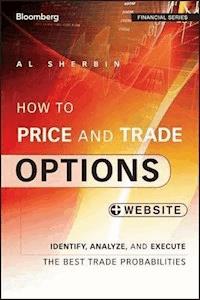
Select and execute the best trades--and reduce risk Rather than teaching options from a financial perspective, How to Price and Trade Options: Identify, Analyze, and Execute the Best Trade Probabilities goes back to the Nobel Prize-winning Black-Scholes model. Written by well-known options expert Al Sherbin, it looks at the basis for probability theory in option trading and explains how to put the odds in your favor when trading options. Inside, you'll discover how anyone can "operate their own casino" if they know how through proper option strategies. Plus, a supplemental website includes videos that walk you through various probability scenarios, pre-formatted spreadsheets, and code. All investors should have a portion of their portfolio set aside for option trades. Not only do options provide great opportunities for leveraged plays, they can also help you earn larger profits with a smaller amount of cash outlay. With the help of this book, traders, active investors, and self-directed investors of all stripes will learn how simple it can be to deploy probability-based trading strategies. * Teaches both defined and undefined risk strategies * Utilizes simple cost basis reduction strategies to enhance investment returns * Draws on unique research studies * Discusses volatility to include both historical (realized) and implied volatility: the interplay between the two is a key piece of information overlooked by option traders If you're a trader of any level and want to make the best trades possible, this book has you covered.
Sie lesen das E-Book in den Legimi-Apps auf:
Seitenzahl: 442
Veröffentlichungsjahr: 2015
Ähnliche



















Since 1996, Bloomberg Press has published books for financial professionals on investing, economics, and policy affecting investors. Titles are written by leading practitioners and authorities, and have been translated into more than 20 languages.
The Bloomberg Financial Series provides both core reference knowledge and actionable information for financial professionals. The books are written by experts familiar with the work flows, challenges, and demands of investment professionals who trade the markets, manage money, and analyze investments in their capacity of growing and protecting wealth, hedging risk, and generating revenue.
For a list of available titles, please visit our Web site at www.wiley.com/go/bloombergpress.
HOW TO PRICEANDTRADE OPTIONS
Identify, Analyze, andExecute the Best Trade Probabilities
Al Sherbin
Cover image: Bull Market Financial Data © iStock.com/Henrik5000; Orange Background © iStock.com/lovin-you Cover design: Wiley
Copyright © 2015 by Al Sherbin. All rights reserved.
Published by John Wiley & Sons, Inc., Hoboken, New Jersey. Published simultaneously in Canada.
No part of this publication may be reproduced, stored in a retrieval system, or transmitted in any form or by any means, electronic, mechanical, photocopying, recording, scanning, or otherwise, except as permitted under Section 107 or 108 of the 1976 United States Copyright Act, without either the prior written permission of the Publisher, or authorization through payment of the appropriate per-copy fee to the Copyright Clearance Center, Inc., 222 Rosewood Drive, Danvers, MA 01923, (978) 750-8400, fax (978) 646-8600, or on the Web at www.copyright.com. Requests to the Publisher for permission should be addressed to the Permissions Department, John Wiley & Sons, Inc., 111 River Street, Hoboken, NJ 07030, (201) 748-6011, fax (201) 748-6008, or online at www.wiley.com/go/permissions.
Limit of Liability/Disclaimer of Warranty: While the publisher and author have used their best efforts in preparing this book, they make no representations or warranties with respect to the accuracy or completeness of the contents of this book and specifically disclaim any implied warranties of merchantability or fitness for a particular purpose. No warranty may be created or extended by sales representatives or written sales materials. The advice and strategies contained herein may not be suitable for your situation. You should consult with a professional where appropriate. Neither the publisher nor author shall be liable for any loss of profit or any other commercial damages, including but not limited to special, incidental, consequential, or other damages.
For general information on our other products and services or for technical support, please contact our Customer Care Department within the United States at (800) 762-2974, outside the United States at (317) 572-3993 or fax (317) 572-4002.
Wiley publishes in a variety of print and electronic formats and by print-on-demand. Some material included with standard print versions of this book may not be included in e-books or in print-on-demand. If this book refers to media such as a CD or DVD that is not included in the version you purchased, you may download this material at http://booksupport.wiley.com. For more information about Wiley products, visit www.wiley.com.
Library of Congress Cataloging-in-Publication Data:
Sherbin, Al, 1956– How to price and trade options : identify, analyze, and execute the best trade probabilities / Al Sherbin. pages cm. — (Bloomberg financial series) Includes index. ISBN 978-1-118-87114-0 (paper/website); ISBN 978-1-118-87103-4 (ePDF); ISBN 978-1-118-87122-5 (ePub) 1. Options (Finance) 2. Investments. I. Title. HG6024.A3S5145 2015 332.63'2283—dc23
2014041593
As I always teach my children, any project worth doing is worth doing well. With respect to this book, if in the end it is judged to be done well, it is only through the efforts of many whose names do not appear on the cover.
First, I would like to thank my friend and fellow author, Larry Shover, for both encouraging and inspiring me to write this book and for introducing me to Pamela Van Giessen of John Wiley & Sons and Stephen Isaacs of Bloomberg Press. Pamela, Stephen, and I conceived this book over some good coffee and excellent pastries. Stephen continued on as my support system throughout the process of writing the book, fielding (too) many confused phone calls and setting me back on the right path.
Special thanks to Judy Howarth, my developmental editor, who always had a quick, concise answer to my questions and who took a rough, raw manuscript from me and somehow returned a book.
I am quite sure this book would not have come to be without the strong, even-handed guidance I received from Kathy Graham, founder of the HQ Companies Group. Kathy's influence far exceeded this project. She was, and continues to be, a light in the storm of my career. When I am unsure of my path, I turn to her for help. Thank you for bringing me to, and through, this project.
To my many friends, colleagues, fellow traders, and students, I thank you for teaching me my trade. I find that you often learn the most valuable lessons from the most unexpected people. Only some of you fall into this category, as I knew I would learn much from those close to me. Thank you for sharing your knowledge, support, and encouragement with me even when I continued to whine that I would never get this done.
Nothing I could say would do justice to what the love and support of my family have meant to me. To my beautiful wife, Kathleen, this is every bit as much your book as mine. As always, you went through every second of sweat, pain, fears, and turmoil as I did. Only, somehow, you managed not to complain! You encouraged me, prodded me, supported me, and loved me until it was complete. To my wonderful children, Mark, Emily, Kevin, Ted, and Kerry, I know for the past many months you could see me, but, at least mentally, I was not always there. Or as one of you so tactfully put it, “Dad, the lights are on, but nobody's home!” Thank you for the love and support and the thousands of “it will be great” e-mails, texts, phone calls, and discussions.
Contents
Introduction
CHAPTER 1 Why Trade Options?
Strategic without Being Directional
A Word about Leverage
Options Are a Decaying Asset
Insurer or Insured?
Probability of Making Money
Market Efficiency
Tired, Worn-Out Metaphors
CHAPTER 2 What to Look for in a Broker
Brokerages versus Banks
Depth of a Broker’s Pockets
Trading Risk Management
Learning from Recent Events
Account Types
Commissions
Interest Rates
Stock Borrow and Loan
Trading Platforms
Conclusion
CHAPTER 3 Building the Foundation
Option Pricing Models
Option Pricing Model Inputs
Historical Data as Input into the Implied Volatility of an Underlying
Implied Volatility as a Predictor of Stock Movement and Probabilities
The Distribution Curve
Breakout Stocks
Actual versus Historical Distribution Curves
CHAPTER 4 Trade Probabilities: What to Look For
The Results
How to Calculate Option Probabilities
CHAPTER 5 Choosing Your Trades
Choosing Your Underlying
Making an Assumption
CHAPTER 6 Choosing a Strategy
Defined Risk Trades
Credit Spreads
Debit Spreads
Butterfly
Iron Condor
Calendar Spreads
Undefined Risk Trades
The Straddle
The Strangle
Short Naked Puts
Ratio Spreads and Back Spreads
What Time to Expiration Should My Trades Have?
Trading Earnings Announcements
CHAPTER 7 Exiting Trades
The Variables
The Kelly Criterion
Morning Routine
To Log Your Trades or Not to Log Your Trades
CHAPTER 8 Executing Your Trades
Order Types
CHAPTER 9 Portfolio Management
Two Types of Risk
The Goal: Diversification—Minimizing Unique Risk
The Methods: Correlation and Number of Positions
Identifying and Mitigating Systematic Risk
Trade Sizing
Early Exercise
Conclusion
About the Website
About the Author
Index
EULA
List of Tables
Chapter 1
Table 1.1
Chapter 4
Table 4.1
Table 4.2
Table 4.3
Chapter 7
Table 7.1
Chapter 9
Table 9.1
Table 9.2
Table 9.3
List of Illustrations
Chapter 3
Figure 3.1
Normal Distribution
Figure 3.2
Lognormal Distribution
Figure 3.3
Skewed Lognormal Distribution
Figure 3.4
Kurtosis
Figure 3.5
QQQ Option Chain
Figure 3.6
QQQ Smirk
Figure 3.7
Smile
Figure 3.8
BXM versus SPX Chart
Figure 3.9
GME Option Chain
Figure 3.10
Volatility Smile
Figure 3.11
Smirk
Figure 3.12
Forward Skew
Figure 3.13
Stock Price Rising with IV Falling
Figure 3.14
Stock Price Rising with IV Rising
Figure 3.15
Option Chain with Normal Skew
Figure 3.16
Option Chain with Inverted Skew
Figure 3.17
Distribution Curve with Varying IV
Figure 3.18
SPX Five-Year Eztrade Graph
Figure 3.19
GMCR Eztrade Graph
Chapter 4
Figure 4.1
Normal Distribution Showing 90 Percent
Chapter 6
Figure 6.1
Effect of Volatility on the Butterfly
Figure 6.2
Calendar Profit and Loss
Figure 6.3
Distribution Curve
Figure 6.4
Decay Curve with Various Deltas
Figure 6.5
GMCR Chart of Calendar IVs One Month before Earnings
Figure 6.6
GMCR Chart of Calendar IVs Day before Earnings
Chapter 8
Figure 8.1
Apple Trade Grid
Chapter 9
Figure 9.1
Asymptotic Chart of Risk
Figure 9.2
KCJ versus SPX
Figure 9.3
SPY Options Chain Showing Early Exercise
Guide
Cover
Table of Contents
Chapter
Pages
xi
xii
xiii
1
2
3
4
5
6
7
8
9
10
11
12
13
14
15
16
17
18
19
20
21
22
23
24
25
26
27
28
29
30
31
32
34
35
37
38
40
41
42
43
44
45
46
47
48
50
51
52
53
54
55
56
57
58
59
60
61
62
63
64
65
67
68
69
70
71
72
73
74
75
76
77
78
79
80
81
83
84
85
86
87
88
89
90
91
92
93
94
95
96
97
98
99
100
101
102
103
104
105
106
107
108
109
110
111
112
113
114
115
116
117
118
119
120
121
123
124
125
126
127
128
129
130
131
132
133
134
135
136
137
138
139
140
141
142
143
144
145
146
147
148
149
150
151
152
153
154
155
156
157
158
159
160
161
163
164
165
166
167
168
169
170
171
172
173
174
175
176
177
178
179
180
181
182
183
184
185
187
189
190
191
193
194
195
196
197
198
199
200
201
202
203
204
205
206
207
208
Introduction
Options are one of the most powerful money making asset classes ever devised. Yet they were not devised as a money making tool. Rather, their “purpose for being” is to limit portfolio risk. Whether you are talking about a portfolio of one stock, a hundred stocks, stocks mixed with commodities, or a myriad of other combinations, options can be used to either enhance your portfolio’s return on capital, take advantage of leverage to enhance yield, or limit your risk by exchanging a bit of profit potential for the “insurance” a long option provides. But if you are looking to buy an option to limit your risk, someone has to be on the other side of the trade. In years past, the other side of the trade was usually taken by professional options traders. The professional options trader was a mythical creature who made thousands of dollars every day by “picking the pocket” of the poor individual investor. I want to emphasize the word mythical. The professional options trader was merely someone who understood that options trading is nothing more than an exercise in simple probability theory. And this probability theory is easy enough to learn; with a bit of time and effort, most people can master it and use it for their own benefit. Furthermore, today options markets are, for the most part, so efficient that you can trade either side of a narrowly quoted market. Thus, there is no one out there picking anyone’s pockets. Options provide the fairest, most level playing field one can hope for.
When most investors hear the words options trading, they think “too much risk,” they think “calculus … too complex,” they think “too time-consuming,” and they think “the professionals will clean my clock.” However, none of these thoughts are accurate. I am not purporting that options trading is easy and that anyone can do it. In fact, I am purporting only half of that statement! If you are a motivated learner, trading options is not that difficult to learn. Though it is not easy, virtually anyone can learn to trade options with a little effort. Let’s illustrate my point by addressing each of the foregoing excuses individually.
If options trading has a bad rap, it got it as a result of the Crash of 1987. In fact, that single event has, to date, changed the way people price options. (More on that in a later chapter.) During the crash, there were stories of traders losing everything as a result of being short “naked puts.” Does that mean there is truth to the statement that options are too risky? Let me answer that question with a question. Most people are comfortable owning stocks. Which trade carries more risk, owning 100 shares of XYZ stock or being short an XYZ put (which commands 100 shares of stock)? Would you be surprised to know that owning stock is actually riskier? And would you be surprised to know that you have better odds of making money being short an out of the money put than being long stock? The difference in the odds can be considerable and quite surprising to many.
Maybe you have done your homework and have discovered that option pricing models are generally based on either some form of the Black-Scholes model, which is a partial differential equation, or the binomial model, which is a decision tree–style model. Your eyes have glazed over already! Calculus! Complex math! Time to find another book to read? Well, hold on a minute. As a retail options trader, you have no need to understand the calculus behind the models. In fact, your (carefully chosen) broker should provide you with all the calculus-induced models you need to trade effectively and profitably! And some do so at no charge to you! Before you think, “No math? Awesome,” I need to burst your bubble. I did not claim there would be no math. I said there would be no complex math. For you to be effective at options trading, instead of the calculus behind the pricing models, you need to understand the odds, or probability theory, behind options. You do not need to become a statistician. You merely need to understand a few basics, which I will address in this book. In fact, it is the probability basis of options that makes trading so much fun (and profitable) for me. I am, and have always been, enamored of games. Games can keep me interested for many hours, days, weeks, and months on end. And when they put money in my pocket, all the better!
You may be thinking, “I do not have a lot of time to devote to this.” While it will take some time and effort to learn to trade options effectively, once you get the hang of it you can trade by devoting 10 minutes per day to it. As I write this book, I am teaching individuals and groups how to trade, I am teaching college finance classes, I am commentating on TV every week, I am speaking at conferences, I am preparing research, I am attempting to be a good father and husband, and, yes, I am trading around 10 minutes per day. My return on capital year-to-date far exceeds the market’s return, which is in turn having a nice year! In fact, my trading has been profitable for each and every one of the 26 years I have traded. I am certainly no trading savant. I have just learned how to effectively take advantage of the probabilities that options provide any investor. We will explore this in detail.
Is it worth the trouble to learn to trade options? Well, that is a personal decision. While there are some people who I believe should stay away from the options markets, they are few and far between. If you like games of chance (in which you have the odds in your favor) and you like to earn money, you might want to put a bit of time into learning to trade options. I believe you will find it fun and rewarding! But be prepared. In my experience, you cannot take the training wheels off until you have been trading for around 18 months, on average. Of course, some people catch on much quicker, and I have coached traders who had never made a trade before to be consistently profitable after only three months of effort. And I recall one person in that group who was simultaneously working 60 hours per week at their systems development job.
As for the fear that the professionals will “clean your clock,” know that options trading is a much less personal experience. It is not “us against them.” I find that retail traders often make money because of the professionals, and not despite the professionals. We talk more about that later.
With all this being said, there are a plethora of books written on the mathematics of options. And there are many people who trade options full-time who are struggling to make money. In this book, I will subscribe to the K.I.S.S. (keep it simple… ) method and stick to only the things you must know to trade effectively and profitably. I hope you will stay with me as we explore the world of options.
CHAPTER 1Why Trade Options?
I am frequently asked, “With so many places to invest and with the complexity of the markets, wouldn’t I be better off letting a professional manage my money rather than trying to trade options myself?” Couple that with money managers asking, “You wouldn’t do your own brain surgery, would you, so why manage your own money?” I understand one’s reluctance to enter the world of self-directed investing. But after 33 years in the business world and over 26 years in trading, I can assure you that no one cares for your money like you do. Many money managers go through a three- to six-month training program and they are off and running trading your hard-earned savings. Compound that with the fact few managers beat the S&P 500 returns (after fees and commissions) on a consistent basis, and you should begin to wonder why you have not been investing your own capital all along.
Lesen Sie weiter in der vollständigen Ausgabe!
Lesen Sie weiter in der vollständigen Ausgabe!
Lesen Sie weiter in der vollständigen Ausgabe!
Lesen Sie weiter in der vollständigen Ausgabe!
Lesen Sie weiter in der vollständigen Ausgabe!
Lesen Sie weiter in der vollständigen Ausgabe!
Lesen Sie weiter in der vollständigen Ausgabe!
Lesen Sie weiter in der vollständigen Ausgabe!
Lesen Sie weiter in der vollständigen Ausgabe!
Lesen Sie weiter in der vollständigen Ausgabe!
Lesen Sie weiter in der vollständigen Ausgabe!
Lesen Sie weiter in der vollständigen Ausgabe!
Lesen Sie weiter in der vollständigen Ausgabe!




