


Erhalten Sie Zugang zu diesem und mehr als 300000 Büchern ab EUR 5,99 monatlich.
- Herausgeber: Books on Demand
- Kategorie: Geisteswissenschaft
- Sprache: Englisch
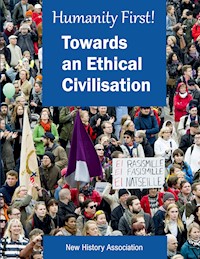
We are living in the era of the unification of humankind. Humanity will survive or perish together. So far, self-destruction seems more likely than survival. What is the reason for the self-destructiveness of the human species? This is the crucial question of our time. Finding an answer to this question is the most important ethical and intellectual challenge of our era. Humankind can survive only by building its internal relationships on the basis of self-knowledge. Only in this way we can live in harmony with nature. Our sole survival strategy is the knowledge of human history and human nature. This program pamphlet contains a new and original view of the world today: the change of era, the crisis of democracy, and how we can see features of the future global society already in the present. Humankind ought to come together to study and discuss the basic teachings of our history. To that end, this program provides some practical suggestions. The program relies on the lifework of the Finnish philosopher Matti Puolakka. It makes use of his text archive, notes and speeches, which he left to the New History Association for safekeeping, editing and publication. A short presentation of Puolakka's lifework and a summary of his view of the entire history, i.e. the 2.5-million-year journey of the Homo family, are attached. The program is available also on the web site of the New History Association: https://newhistory.fi.
Sie lesen das E-Book in den Legimi-Apps auf:
Seitenzahl: 83
Veröffentlichungsjahr: 2021
Das E-Book (TTS) können Sie hören im Abo „Legimi Premium” in Legimi-Apps auf:
Ähnliche



















Humanity is now facing an era more turbulent than ever before. For the first time in human history, social upheavals and turmoil will occur almost simultaneously in all continents, in all different circumstances and political systems. (2003)
How does humanity know itself? All information relevant to the existence of humans must be re-evaluated.
The time of reassessing all values, the great era of redefining all concepts has begun. (2016)
- Matti Puolakka
Preface
The 2.5-million-year journey of the Homo family is coming to an end. It can end in two ways: either humanity will destroy itself or find ways to unite on the basis of its self-knowledge. Then our new history will continue in a global society, that is, in an ethical civilisation.
In this program bulletin, we present the most common perspectives on how humanity has come to this day, as well as some suggestions for the way forward.
That is our view – what is yours?
Helsinki, 13 June 2021
New History Association
The program of the New History Association is a summary of our views, based on the lifework of the Finnish philosopher Matti Puolakka. It is edited by Heli Santavuori with the help of other members of the Editorial Team.
Contents
Part I In Which Era Are We Living?
The Crucial Question of Our Time,
The Past Era and the State of Ideological Debates,
The Change of the Era,
The State of the World Economy
Democracy in a Crisis
Cultural Globalisation
Basic Communities, Social Alienation, and Identity Politics
The Formation of a Global Society,
The Basics Elements of Global Society
Central Authority
States and Political Parties
Ethical Civil Society
New Institutions of Global Society,
A Truth and Reconciliation Commission as a Permanent Institution
Ethical Citizens’ University
Part II What Is to Be Done?
Principles of Discussion,
Ideologically Rational Debates
The Most Important Human Right: the Right to Get Paid for Speaking the Truth
Human Path Debating Encyclopedia (DE),
How to Organise the Debate
The Central Theme: The Human Path
Guidelines for a Fair Debate
Citizens’ Truth Forum,
The Themes of the Truth Forum
A Great Discussion on the World Economy and Economics,
Proposals for Banking Reform
Part III Why Do We Need a New History?
The Evolutionary Phases of Human History,
Introduction
Our Evolutionary Psychological Roots
Bands of the
Homo
Genus
Hunter-Gatherer Tribes
Stateless Civilisations
State Societies
Global Society
Decentralisation of Power, or Hierarchical Fractionalism,
Basic Human Communities
Appendices
About Matti Puolakka’s Lifework,
What Do We Mean by the Philosophy of History?
New History Association,
PART I
In Which Era Are We Living?
The Crucial Question of Our Time
The Past Era and the State of Ideological Debates
The Change of the Era
The Formation of a Global Society
New Institutions of Global Society
PHOTO: Graffiti on the remains of the Berlin wall. Pxfuel.
The Crucial Question of Our Time
What is the reason for the self-destructiveness of the human species? This is the crucial question of our time.
We are living in the era of the unification of humankind.
Humans, as a species, have become a unit of natural selection. It is a biological fact – no other animal species has the same quality. Humanity will survive or perish together.
Humanity is in danger of self-destruction. Nuclear weapons, climate change, and loss of biodiversity are all examples of the fact that humans are able to destroy the preconditions for human life on the planet. The threat of financial crises, recurrent pandemics, increasing inequality, and the everharshening social discourse are yet other problems for which we humans are to blame.
What is the reason for the self-destructiveness of the human species? This is the crucial question of our time. Finding an answer to this question is the most important ethical and intellectual challenge of our era. All other ideological speculations are subordinate to this problem. We should always go back to this question when we discuss current global problems.
The Swedish botanist and physician, Carl Linnaeus, placed our species in the genus Homo and named it Homo sapiens – wise humans. To his definition, Linnaeus added a remark: “Man, know thyself”. His comment was intended for the entire human species. Hegel said the same thing categorically: the Delphic maxim, “know thyself” is directed to humankind, not only to individuals. In other words, humans become wise only when they know themself as a species.
Our sole survival strategy is the knowledge of human history and human nature.
Humankind can survive only by building its internal relationships on the basis of self-knowledge. Only in this way we can live in harmony with nature.
The most important goal of our program is to bring all humankind together to discuss and debate the basic teachings of our history.
The Past Era and the State of Ideological Debates
No traditional ideology has tried to synthesise the world views born in the past era – let alone link it with the new, epoch -making scientific findings on human origins or differences between humans and animals.
The socialistic world order and the global communist movement came to a dead end and a total collapse at the end of the last century.
Fifty years ago, none of the supporters of socialism could see this coming. Something happened that even those who now protest against “capitalism” and want to replace it with “socialism” cannot explain. None of those who strive to overthrow “capitalism” have made attempts to form a synthesis that takes the indisputably viable characteristics of a capitalist economic system into consideration but neither has any opponent of socialism been able to explain, in scientific terms, the collapse of all forms of socialism.
The “end of history” view was an ideological and political conclusion drawn by the supporters of western democracy: liberal democracy had won for good, and it no longer had any inherent threats.
This conclusion implied that there was nothing positive to gain from the defeated ideology. The fact that millions of people all over the world once were ready to sacrifice their lives for socialist and communist ideals was not explained, or if it was, it was an anti-intellectual narrative of omnipotent leaders combined with a racist-style image of ordinary people as an easily manipulated mob.
The threat of humanity’s self-destruction, reflected in the deepening crisis of democracy, recurrent financial crises, and climate catastrophes, has proven the concept of the “end of history” wrong.
Historical events of the last decades have shown all, even opposing ideologies, to be inadequate.
The ideologies inherited from the past era all rely, knowingly or unknowingly, on some kind of overall view concerning human history as a whole, which is why the recorded history should also be reevaluated. As to prehistory, re-evaluation has become a necessity because of the new, epoch-making findings on human origins.
How do humans differ from animals? How does human society differ from flocks, herds or colonies of animals? What are the psychological reasons for wars? Is there something in common in the social development of prehistoric and historical times? When looking for answers to these questions, the basic views and concepts they are based on must be evaluated critically within every ideological current. 1
1 The terms socialism and capitalism are often used as if they were universally defined. However, this is not the case, hence the use of quotation marks. Defining these terms will be one of the central topics in the discussion on the past era.
The Change of the Era
The information technology revolution is a much more profound turning point in world history than the preceding industrial revolutions. The IT revolution and the globalisation sped up by it have caused irreversible changes in our economic and technical basis as well as interactions between states and individuals.
Industrial revolutions divided societies into two opposing classes, with the middle class dissolving. Conversely, the IT revolution has increased the number of small enterprises and brought about development of new social middle layers. A new kind of start-up culture has arisen; the market economy has expanded into new areas.
In the following, we discuss the change of the era. First, we look at it from the perspective of the world economy, then from the perspective of nationstates. The reason for this order is that it is precisely the economic globalisation that has brought new challenges to the whole world. Our focus, however, is on democratic countries, because, in our opinion, democracy and the rule of law are the only possible starting points.
The State of the World Economy
The most significant politico-economic consequence of the IT revolution and globalisation is that speculative financial capital has gained a leading position in the world economy. Back in the 1950s and 1960s, industrial capital still ruled over financial capital. Banks were nationally owned, and they financed the national economy.
Today banks operate globally, and the biggest of them concentrate on speculation instead of financing the real economy. In recent years, the financial sector has grown much faster than the real economy.
For major international banks, it is almost impossible to know if they are financially sound or not. It is difficult to estimate the value of various investment products or even the value of government bonds. A given value is also likely to change quickly according to the economic or political situation.
In short: banks do not know their balances, and supervisory authorities are as ignorant. Therefore, we can rightly ask if banking in today’s world is, as such, on an illegal basis.




