


9,49 €
Mehr erfahren.
- Herausgeber: BRASPORT
- Kategorie: Fachliteratur
- Sprache: Englisch
"Congratulations to all for your excellent efforts in writing this book. At this time of the crisis caused by the Covid-19 pandemic, whatever methodology we prefer to use, we must all come together to create better and kinder ways to work and live. We must also gather many different points of view and ways of thinking to solve the problems we are all now experiencing throughout the world. Once again, I would like to congratulate you and wish you all the best!" Karyn Ross Lean International Specialist & Consulting "One of the main challenges that we have to overcome these days is the dogmatic view based on methodologies and methods. Often so deeply ingrained in the professionals are the methods that they simply forget what really matters, and what needs to be done to turn the idea into a result. The transformation of ideas into results requires dedication, motivation, passion, and willpower. Indeed, these topics are not necessarily learned by using a specific method. Works like this book by Clovis Bergamo allow for a broader understanding of the different paths that can be taken to "Get Things Done"." Ricardo Viana Vargas Former Chairman, Project Management Institute Former Director, Infrastructure and Project Management at the United Nations (UNOPS) "The world is changing at a speed never seen before, and technology is undoubtedly the main element that has brought about this transformation. In this global and highly competitive environment, companies seek to deliver an experience that is increasingly attractive and of greater value to its customers, as well as slashing operating costs, transforming its operations with increasingly efficient and touchless processes. This work is of great value in this underlying scenario, as this work contributes to these two main objectives in a way that is practical, agile, customer-focused and profitable for companies. I hope you enjoy reading it!" Paulo Roberto Siqueira Pinto Junior Operations Director – Business Transformation Leader for Brazil and Latin America – Accenture "This book helps to break paradigms, leading us to more up-to-date and disruptive thoughts about differentiated organizations and professionals, within an increasingly demanding market, allowing clear vision of the integrated application of Lean Six Sigma, Agile and Design Thinking methodologies. This widens the vision in business, presenting extremely relevant content to this world beset with so much volatility, uncertainties, complexity, and ambiguities – this is VUCA. Don't miss the opportunity to browse the transformative pages of this book." Ricardo Cancela Chairman of LeaderX & BBX, entrepreneur and enthusiast of human revolutions "Currently, the need for companies to work with excellence in all their lines of business is getting stronger and more evident. The elimination of waste, thereby creating value for its customers, empowering employees, reducing procedure variability, slashing costs and solving problems from the root. This means that several philosophies and methodologies intertwine. This book brings a structured and disruptive reflection, stirring up thoughts about what is traditional, showing that the cohesion and coexistence of these philosophies and methodologies in favor of operational and organizational excellence is indeed possible." Danilo Vilar Teixeira Head of Continuous Improvement – Supply Chain Grupo Pão de Açúcar Group (GPA)
Das E-Book können Sie in Legimi-Apps oder einer beliebigen App lesen, die das folgende Format unterstützen:
Seitenzahl: 276
Veröffentlichungsjahr: 2022
Ähnliche



















Adélio Pereira de Souza Júnior
Clovis Bergamo Filho
Luís Carlos A. Oliveira
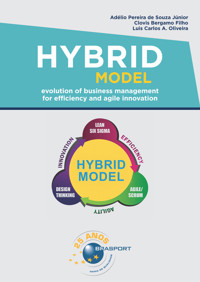
HYBRID MODEL
evolution of business management for efficiency and agile innovation
Rio de Janeiro
2022
Copyright© 2022 Brasport Livros e Multimídia Ltda.
Editor: Sergio Martins de Oliveira
E-book: Loope
Cover:
English Translation
Translator: Maria Hyeronides Lima
Technical analysis of translation: Khatchik
Translation reviewer: Paul Dixon
Final reviewer: Adélio Pereira
BRASPORT Livros e Multimídia Ltda.
Rua Washington Luís, 9, sobreloja – Centro
20230-900 Rio de Janeiro-RJ
Tel./Fax: (21)2568.1415
e-mails: [email protected]
www.brasport.com.br
Acknowledgments
Adélio Pereira de Souza Júnior
I would like to thank everyone who taught me, academic or otherwise, throughout my life, to everyone with whom I have interacted until today in my career, since all experiences bring learning opportunities. And, in particular, I dedicate to those who supported me in a unique way: my dear parents, Adelio (in memorian) and Maria Edite, and my beloved wife Viviana.
Clovis Bergamo Filho
I dedicate this book especially to my wife Patricia Sousa Gomes de Oliveira Bergamo, my daughter Sophia Oliveira Bergamo, my parents Clovis Bergamo and Carmen Duva Bergamo, my in-laws Sergio Gomes de Oliveira and Rute de Sousa Gomes de Oliveira and all my family, friends, and professionals who have always supported and encouraged me on this journey, and a special recognition to my father Clovis Bergamo who passed away in June 2021 and has always been by my side and will always be supporting me in everything.
Luis Carlos A. Oliveira
Every trajectory is built from commitment, resilience, study, but mainly from the learning that comes from those with whom we interact along the way - our teachers, our work partners, our customers, our professional references and, of course, our friends and family, who are always ready to support us in all challenges. My deep thanks to everyone and specially to my wife Cristiane and my daughter Thais, for inspiring me every day. You were instrumental in bringing this project to fruition.
The opinions of key market reference professionals
Amir Hamin – Head of Continuous Improvement and Digital Transformation - Master Black Belt of DPA Brazil (JV Fonterra & Nestlé)
“Professionals with operational excellence must instigate nonconformity and, more than that, instigate social, intellectual, personal, and professional growth by understanding people’s comfort zones and helping people to expand these zones. There are many stereotypes in this environment, Master Black Belt, Scrum Master, Agile Coach, PMO, among others, etc... but the professional person that every company yearns for is not a PhD in the use of a methodology or toolkit, but rather a professional who solves problems aligned with the vision of his or her external and internal customers. Migrating from a vertical and specialist view to the concept of complementarity is essential for catering to the business’s needs and providing the speed that it requires. In this case, no one size fits all, and corporations that remain shortsighted in this sense do not live in the reality of the VUCA world and are certainly doomed to failure.
The starting point could be the etymology of the word ‘method’ itself, which comes from the Greek “methodos”, in turn a combination of meta (goal) and hodos (route or path), that is, path to the goal. When we talk about a hybrid concept, we are reexploring the shortcut to reach the goal; and the shortcut does not lie in one single method, but in the power of extracting the best out of each of them.
Kelly Andrade
Entrepreneurship and Digital | Lean Six Sigma – EUROFARMA
“Currently, the need for companies to work with excellence in all their areas is getting stronger and more evident, thereby eliminating waste, creating value for its clients, empowering the employees, reducing process variability, and also solving problems and costs from the roots. This means that several philosophies and methodologies intertwine. This book provides a structured and disruptive reflection, moving away from the traditional, while also showing that the cohesion and coexistence of these philosophies and methodologies in favor of operational and organizational excellence is possible.”
Marcelo Barasini
Master Black Belt
“New organizational challenges in the context of VUCA world need new ways to deliver solutions and results. Project managers and business areas need to understand the type of challenge, the ecosystem of the project or product that will be created, and seek, in a simple, fast and assertive way, to maximize project and product performance, provide a balance between predictability and flexibility, reduce risks, and increase innovation, to deliver better business results and adding value to the customer. I believe that the Hybrid Model brings this aggregating possibility to organizations, casting borders aside and bringing synergy as a benefit of each framework, methodology and mindset, focusing efforts on innovative results and value added to the customer.”
Wanderson Felipe Walger
Master Black Belt
“In a constantly evolving and developing world in constant evolution, with online information and increasingly shorter time frames, we no longer have the possibility of handling treating VUCA World without knowing how to make better use of our toolbox. With this in mind, the Hybrid Model provides the choice of the appropriate tool, combining the agile factor and, enhancing results, keeping to deadlines and reducing executives’ anxiety about the results.”
Eunice Christina Rodrigues Silva
Master Black Belt – HEINEKEN
“While the importance of focusing on results is obvious, unfortunately a lot of energy has been used for lengthy discussions about choosing the most ideal methodology for project management. The worst happens when you believe that just a single methodology is capable of solving everything. This mistake generates frustration and waste. The best way to avoid this problem is to make smart choices, choosing the best tools and techniques for presenting the best solutions, bearing business goals and objectives in mind. Making the right choices is not trivial, but the Hybrid Model can surely help.”
Gustavo Lopes Furtado
Global Director, Management Systems & Transformation at Alpargatas S.A.
“Agile doesn’t solve all the problems of the world.” I heard this statement from Dr Jeff Sutherland, the great creator of Agile, in a conversation in 2018 in the United States. Throughout my 20 years of professional experience, having worked for through three large multinationals, I have firmly and fully believed that there is no single approach or methodological model that meets all the needs of the business, delivering the expected results.
Around 2014, before the world even started talking about VUCA and BANI among other concepts, many companies, especially the “Fast Moving Companies”, were already facing some dilemmas and understanding that the needs of a marketing and of an industrial area, for example, are quite different. With the rapid spread of digitalization, the generation of data in a way never seen before, and new generations of people arriving with a digital mindset, this transformation has been leveraged. The most structured companies began to evolve and create hybrid models, with a mix of the classic Lean Six Sigma with Design Thinking, Change Management and, more recently, the Agile approach. Nowadays, anyone who thinks that a methodology with good templates and tools shall suffice has got it wrong.
I have seen many companies that in the last five years decided to stick with their “methodological roots” and then failed. I have also seen many companies that have migrated from one model to another and have failed. On the other hand, I now see companies that have adapted and created a hybrid model with their own DNA thriving.
The world today is connected more than ever before, and the key to success is synchronizing people, processes, and systems. People are agents of transformation, therefore empowerment of people through a simple and comprehensive management model, thereby promoting the best tools for them to carry out their jobs, is key for transformation. This simple comprehensive model is the Hybrid Model.
Presentation
In an increasingly complex world, the signs that an old model was not keeping up with the needs of something new began to instigate people to try a radical, disruptive, innovative, transformational way with the use of new methodologies to eliminate the problems of agile way. This need ended up leaving aside the look at the famous lessons learned and at the efficiency of the processes, causing discomfort among continuous improvement professionals in relation to the non-acceptance of the Six Sigma methodology as something outdated. This discomfort is nothing more than an opportunity to transform and evolve the methodology of continuous improvement. I was able to follow this opportunity closely, not only through the Hybrid Model Manifesto launched at the XI International Six Sigma Congress in 2019, but also through a new need within the corporate world.
I would like to try to illustrate, in a simple way, how hybrid models are part of our daily life with an analogy between the area of continuous improvement and the medical area. In a natural and intrinsic way, the doctor, as well as the continuous improvement specialists, “D”efine an objective and a goal to solve the patient’s problem, “M”easuring and “A”nalyzing all possible causes and information. through the data from the exams requested from the patient, and after their analysis, an action plan is initiated, prescribing the appropriate drugs in the phase “I”mprove, and, provided that your patient is engaged in executing the established action plan according to your prescription. Finally, it still guides its patient through a “C”ontrol plan designed so that the disease does not return or is totally eliminated. Sometimes, in the middle of the treatment, the specialist is faced with the complexities of each case and system and needs to resort to other more invasive methods, or sometimes he does not have the knowledge in a particular specialty and needs the support of another specialist. In this analogy, we know that for simple cases, simple tools and methods will be used, and for more complex ones, disruptive and even innovative interventions will be made to solve the problem. The ease of diagnosing which tool/methodology to use for each opportunity found comes with experience, through project mentorship and training given, the perception of the need of people who are still at the beginning of the journey to have the “recipe” of which tool or methodology to use.
The Hybrid Model is not a new methodology, but it fits as an orientation guide so that we have a cycle of continuous improvement of the process and demonstrates that it is possible to coexist, to integrate “old” and “new” methodologies, not forgetting the origin and fundamentals of all of them. The Hybrid Model is the toolbox, to meet the triad of business balance: less time, high quality and low cost, where it is possible to navigate, for example, within a DMAIC project with actions that improve the process using an Agile mindset with deliveries of value in all stages and not only in the Improve stage. I perceive great changes and acceptances in relation to this mixture and adaptations of methodologies in practice within the continuous improvement projects that I have been working on. This evolution within the projects reflected a cultural change based on the needs of the market and, obviously, of the customers. Surely our experiences will still transform this model into something increasingly robust and mature. The great challenge is collaboration between specialties, and the corporate world needs to take advantage of and recognize each specialty, through a Hybrid Model, knowing how to use each tool/methodology wisely, efficiently and in an innovative way to solve increasingly complex problems.
Preface
The world changed.
I could say here that it was because of the pandemic, after all it is the “event of the year” globally speaking, but in fact the world has changed for a long time and the Coronavirus has only accelerated the process of change. The virus has made more noticeable what has been happening since at least when I was still in school studying globalization and later in college studying digitalization.
The continuity of world economic growth depends on companies that are increasingly effective, efficient, and faster in delivering value. Resilience has become a mantra and business agility a necessity, whether you like it or not. And I’m not talking about one method or the other, I’m talking about: adaptation, innovation, delivery, and value capture. It’s all fluid, whether you’re a small startup in a Palo Alto garage, or a large corporation on the fringes of the Berrini Avenue. While in the past you could (really?) take years of R&D to then manufacture and bring a product to market, today that must be reduced to months or weeks.
This brings us challenges like knowing “what” and “how” to do in times never seen before. We must learn to cross data, merge methods, put order in chaos and not only seek time to market, but time to value.
Yes, because our customers are increasingly demanding as well.
The generation of digital natives, those who were born with Internet access, are already consumers and were raised among banks that charge no fees, private drivers called by apps and retailers fighting to have their attention wherever they are, virtual or physically.
Wanting to put a new product or service on the market, and being successful with it, is no longer for amateurs. And again: the pandemic has only accentuated this.
Since Ford, and probably before him (don’t judge me, I’m one of the exact ones, not the human ones), methods, techniques, and ways to be effective and efficient in the production and execution of goods and services were already being sought. There were so many methods and techniques to conduct projects for new products, companies and businesses that it is impossible to make a list that supports you in a way that leaves no gaps, after all, “tomorrow” we will always have one more method to include, each one with its characteristics, its nuances, and with a problem-solution fit that made or still makes sense in certain circumstances. And this is where the “cat leap” is for project leaders.
Being attentive to details, observing and “always alert”, as the scouts would say, is precisely the first fundamental characteristic so that, then, it is possible to give the appropriate answer, choose the right tool, apply the most appropriate method and even anticipate new changes. Within agile methods, we call this posture pragmatic agility.
For a nail, a hammer. For a screw, a screwdriver.
Do you understand what I mean?
And what about if I have to build an entire house? Quite possibly I’ll need a very large toolbox, right?
And just like in the midst of the pandemic, we had to find, each country, each state and each municipality in the world, the way to contain the advance and “flatten the curve” of the spread of the virus. In the same way, every entrepreneur and intrapreneur has had and still has to find a way to deal with all this transformation that we are going through and that only tends to accelerate.
And if all you know is just how to handle a “hammer” it’s time to change to survive.
The purpose of this book that you have in your hands is daring: to convince the reader, possibly a project leader, that “your current truth” doesn’t stand on its own. That “traditional” is not the method of who came before you, but the thought that there is some “silver bullet” or “panacea” in terms of project management.
Through a pragmatic, inclusive and coherent approach, the authors bring not only reflections on the flawed modus operandi of most current project leaders, but also propose methods of combining techniques, practices and methodologies from different schools to achieve the real objective of working with projects: delivering value to our customers.
Because at the end of the day, it doesn’t matter what acronyms are in your email signature, the English title on your badge, or whether you work with spreadsheets versus Post-its. It only matters if you get results with the way you work. Result for you, your company and your customers.
The world changed. And it will keep changing.
And I’m very tempted to make one more pandemic analogy, as it’s all the media mentions these days, making it hard to think of anything else. As of the date I write this preface, we still don’t have a cure, people die every day from this terrible disease and the return to “normality” (is it?) is everyone’s wish.
The only certainty I have in the midst of this uncertain period is that we are not going to get through this using a single tool, a single remedy or a single way of thinking to solve the problems that arise every day.
And anyone who says otherwise, that there is a Holy Grail for project management in some book, on some street corner or in some method, is being a fool. Or is trying to sell you something.
Stay smart.
Hug and success.
Luiz Fernando Duarte Junior
Agile Coach & Software Specialist
DLZ Technology
Gravatai, RS, Brazil.
September 17, 2020
Contents
Introduction
1. The evolution of methodologies of excellence
1.1. Methodologies of Excellence
1.1.1. Quality & Productivity (Efficiency)
1.1.2. Innovation
1.1.3. Project management
1.2. Conclusion
2. The VUCA/BANI world and methodology selection
2.1. The VUCA/BANI World
2.2. The Project
2.2.1. “How” and “What” of a Project
2.2.2. The Selection of Methodologies
3. A hybrid model to attend the VUCA/BANI world
3.1 Worshipped Methodology x Adequate Methodology(ies)
3.2 Again, the VUCA/BANI World
3.3 Hybrid models of methodologies – the concept
3.4 Hybrid models of methodologies - examples and discussions
4. The hybrid model leveraging the Organizations Model
4.1 Vision, Mission etc.
4.2 Back to the VUCA/BANI World...
4.3 Agile Approaches
4.4 Ambidextrous Organizations
4.5 Ah... the Structures
4.6 The professional of the excellence or innovation areas
5. Hybrid DMAIC
5.1. Iterative Cycle – Hybrid DMAIC
5.1.1. Identify
5.1.2. Prioritize
5.1.3. Implement
5.2. Reflections about methodological efficiency
5.3. Iterative cycle dynamics
5.3.1. Identify
5.3.2. Prioritize
5.3.3. Implement
5.4. Role of the Hybrid Iterative Cycle
6. Hybrid Define
6.1. Hybrid model applied to Define
6.2. Composition of Methodologies and Tools
6.3. Hybrid Define Iterative Cycle
6.3.1. Identify
6.3.2. Prioritize
6.3.3. Implementation
7. Hybrid Measure
7.1. Hybrid Model applied to Measure
7.2. Reflections on Methodological Efficiency
7.3. Measure Iterative Cycle
7.3.1. Identify
7.3.2. Prioritize
7.3.3. Implement
8. Hybrid Analyze
8.1. Hybrid Model applied to Analyze
8.2. Analyze Hybrid Iterative Cycle
8.2.1. Identify
8.2.2. Prioritize
8.2.3. Implement
9. Hybrid Improve
9.1. The Hybrid Model applied to Improve
9.2. Improve Hybrid Iterative Cycle
9.2.1. Identify
9.2.2. Prioritize
9.2.3. Implement
10. Hybrid Control
10.1. Hybrid Model applied to Control
10.2.1. Identify
10.2.2. Prioritize
10.2.3. Implement
11. Case Study – Hybrid Model
11.1 Case Coolgel
11.1.1 The Coolgel company
11.1.2 Context and Challenges for the Company
11.1.3 Project Identification
11.2 Selection of Methodology
11.3 Case Resolution with the Hybrid Model
12. Evolution of the Hybrid Model
12.1 The current scenario: innovation renovation
12.2 Hybrid Model: adjusted to the world scenario
12.2.1 Flexibility, agility, and earnings
12.2.2 Current Experience
12.2.3 Re-skilling & Cultural Change (mindset)
12.2.4 Development and talent
12.3 Skills Acquisition in the Hybrid Model
12.3.1 Training
12.3.3 Internal and External Consultants
12.4 World and Organizational Evolution and the Hybrid Model
Introduction
In 2001, in Snowbird, Utah-USA, a group of 17 renowned people in the Information Technology field got together to discuss a new approach to managing software development projects. Their original objective was the practices for planning, developing, and delivering systems in a more agile model that was called at the time “methods”.
One of the results of this meeting was the creation of the Agile Manifesto that expressed the following vision:
Individuals and interactions over processes and tools
Working software over comprehensive documentation
Customer Collaboration over contract negotiation
Responding to change over following a plan
This new and innovative way of developing projects was named as Agile Methods, and brought a greater purpose tuned to the customer’s needs and focused on the continuous delivery of value during the development of a solution or resolution of a problem.
This new approach provided significant gains in productivity, quality, and cost reduction for the software development process.
In an environment of great transformations at an accelerated pace, agile methods offer an appropriate and shaped methodology for the survival challenges that are imposed on professionals and their organizations.
Concurrently, new methodologies emerged seeking to leverage the improvement of processes, products, and services in a disruptive and innovative model.
A good example is the Design Thinking used to solve complex problems in products, services, and processes in an innovative way, focusing on empathy and centrality on customer/people and supported by teamwork in a collaborative, interactive and creative format.
Agile Methods and Design Thinking provide a renewal in current management methodologies, continuous improvement, and innovation. They oxygenate current models of project development by incorporating a more flexible and adaptive dynamic to the changing demands of our time.
When Six Sigma emerged, initially there was some competition with Lean Manufacturing which was being widely used. The integration was consolidated supported by the robustness and synergy of the wide scope of tools provided by each methodology. Lean Six Sigma in recent decades has been used as a strategy for operational excellence in leading companies.
In this scenario, a need arises to formulate a model that integrates Agile Methods and Design Thinking with Lean Six Sigma. The potential synergy as a result from the complementarity of these approaches requires an integrative and catalyzing method that provides improvement programs with the possibility to obtain, simultaneously and broadly, the gains and benefits from each methodology.
Faced with this demand, we took on the challenge of structuring a differentiated model that would make it possible to effectively integrate the three methodologies. To guide the actions of this endeavor, we adopted the following premises to be followed throughout the development of the project: maintain the fundamentals of agile methods, promote and stimulate innovation, provide instruments for practical application, and allow flexibility to incorporate new emerging methodologies.
We also considered the mission of providing elements to help the construction of a culture based on the triad of efficiency, agility and innovation in the conception and management of improvement projects.
This journey allowed us to test and create concepts, methods, and integrative approaches, resulting in a Hybrid Model that harmonizes the use of Lean Six Sigma, Agile Methods, and Design Thinking, aiming to rationalize resources and maximize results when developing improvement projects.
We were able to improve concepts and foundations in this experience and even establish the following manifesto of the Hybrid Model:
The need for business results before the definition of methodologies to be implemented.
Individuals and iterations effectively accelerating and optimizing the use of methodologies and tools.
Continuously delivering improvements in project execution rather than following improvement plans.
Build continuous flow of value to customers rather than occasional improvements.
Adaptability to the effectiveness of improvement actions rather than following the sequencing of tools.
Our experience has shown that achieving and sustaining excellence in processes, products and services requires from the organizations the culture and practice of continuous improvement, time, a broad scope of effective methodologies, training, and people engagement.
We hope that the concepts of the Hybrid Model summarized in this book will contribute to the evolution of methodologies of excellence, as well as present paths, solutions and insights for professionals and organizations to gain skills and aptitudes to adapt to rapid changes and overcome the great challenges presented in this reality of great transformations.
Success for all and together we stay strong.
1. The evolution of methodologies of excellence
Over time, several methodologies have been established aiming at increased excellence within organizations. However, so great is the quantity and diversity of methodologies that it is difficult for leaders to understand the goal of each one and be able to select the most appropriate according to the situation.
So huge is the complexity is so huge that we could even write methodology in quotes: “methodologies”. Why is that? Because not all “methodologies” are in fact methodologies. Some are described as philosophies, others such as framework, scripts, standards, etc. This generates much philosophical discussion.
In addition, the term “excellence” also generates discussions. According to the understanding of those who use the term, it can be related to efficiency, industrial operations, the processes of an organization, quality, innovation, effectiveness (efficiency and efficacy, encompassing innovation) etc.
Thus, if the words “methodology” and “excellence” themselves already generate discussions, imagine what it would be like to seek understanding when these words are put together in the expression “methodologies of excellence”.
To help business leaders and all those involved with “methodologies of excellence”, this book provides information about the application, objective, description, history and evolution of “methodologies” of great relevance within organizations. In addition, we indicate a directed technique on how to select the most appropriate methodology (methodologies) to be used according to the situation.
In the previous paragraph we mentioned (methodologies) in brackets. What does that mean? This is because in several situations the most appropriate course of action is to use more than a single methodology. In a project, to achieve an effective result (efficiency and efficacy, which includes innovation), often the most appropriate way to proceed is the use of different methodologies: one that provides efficiency, one providing innovation and another for project management itself.
The use of several associated methodologies, to achieve effectiveness, is what we call the hybrid model of methodologies. This model supports projects to bring efficiency and innovation at the same time. But more than that, it empowers people to think much more about efficiency (or improvement) and also innovation, this being the basis for establishing ambidextrous organizations, the best prepared to take advantage of this current world called VUCA or BANI (we will comment in detail on what this means, its impact and how to act in this context), because they can successfully innovate while maintaining or increasing the efficiency of all their processes, even innovation itself.
In this book we will present details of the hybrid model related to efficiency, innovation, and agile management. Through a case study, we will see in detail just how this model can be applied in a project. We will also address the impact of this model on organizations in order to boost the organization’s ambidextrous capacity.
This hybrid model is an evolution of the way these methodologies are applied in a world of continuous changes and evolution; this is what is expected to occur with the methodologies that support the business. Therefore, in this chapter, we will see the evolution, application, and convergence of different methods of excellence that are related to improvement (efficiency), project management and innovation.
1.1. Methodologies of Excellence
There are several philosophies, methodologies, standards, and tools of excellence in use, most of these having different objectives and fields of application.
A methodology shows how something must be done to achieve a particular goal within a specific scenario. It therefore sets out the principles to be applied, the approaches to be used, how to select the most appropriate tools, roles, and responsibilities. This means that the selection of the methodology to be used is something fundamental, as the results will vary depending on the choice.
In this chapter and throughout this book, to facilitate reading, we will often use the term “methodologies” to mean the set of philosophies, methodologies, standards, and tools. Similarly, we will use the term “excellence” in reference to a very high level of effectiveness, that is, efficiency and efficacy, that also involves innovation. In a generic way, we can therefore use the term “methodology of excellence” for a philosophy, methodology, standard etc., related to efficiency, innovation, or project management.
Next, we will see a general consideration on “methodologies of excellence” of great relevance to the following fields of interest: quality and productivity (efficiency), project management and innovation.
This overview will also let us understand the main reason for using each of these methodologies.
1.1.1. Quality & Productivity (Efficiency)
When the objectives of a project are intrinsically related to quality and/or productivity (improved or increased efficiency), the most widely used methodologies are Lean, Six Sigma and Lean Six Sigma, as well as PDCA, which is often related to Lean. We shall now look at these methods in sequence.
1.1.1.1. PDCA (Plan, Do, Check, Act - Plan, Run, Check, Act)
The origin of PDCA lies in the Shewhart Cycle, proposed in the late 1930s, adapted and made popular by Deming, especially in Japan after 1950, when it gained the current format.
In the scope of Total Quality Management (TQM), PDCA has become a methodology for an activity management cycle and was later applied as a great ally of Lean, having become a natural basis for its implementation. In recent decades, this cycle has gained more details, or even steps, depending on the author. For example, it has typically consisted of eight phases within the main stages, encompassing the MASP (Method of Analysis and Problem Solving) and its tools.
Currently, PDCA is seen as an initial problem-solving methodology, serving an important basis for the journey of excellence, as it helps with the mental model of how to seek solutions and improvements.
1.1.1.2. Lean
Lean is currently seen as something that transcends a methodology and becomes a philosophy, because it permeates the mentality of not accepting waste in the processes. This spreads throughout the organization, having an impact on its culture.
The development of what is called Lean took place over a whole century and is a sequence of evolutions of concepts; methods, tools, and the use of them in searching, primarily, for productivity. In this concept, quality is certainly very important, however, it is seen as a leverage factor for productivity rather than the result or target to be achieved.
During the Industrial Revolution, production was made by hand, with low productivity. However, in the 1890s, Frederick W. Taylor developed the principles of The Time Study and Standardization of Work. This helped Henry Ford to develop the so-called Moving and Mechanized Assembly Line for car production in 1909, which greatly boosted productivity. However, the flexibility of the production line was too low to allow variability in the models of manufactured cars. To minimize this difficulty, Alfred Pritchard Sloan Jr. (president of General Motors from 1923 to 1937) developed batch production, which brought greater variety in car production lines with good productivity levels maintained.
In 1937, the Toyota Motor Company was founded, and Kiichiro Toyoda created the concept of Just-in-time, later improved by Taiichi Ono as from the 1940s. This allowed Toyota to start looking for concepts in producing even smaller batches with greater flexibility in its production lines, thereby reducing inventory and boosting productivity at the same time, with quality at the level of excellence.
In the 1980s, in collaboration with GM (General Motors Company) Toyota brought the Toyota Production System to the United States. Finally in the 1990s, authors James Womack and Daniel Jones published “The Machine that Changed the World”, a classic book that brought details of this whole track record, as well as of the concepts and practical applications of this philosophy, which they called “Lean Manufacturing” (often translated as “Lean Production”), because all processes should be lean, without waste, with a “back to basics” approach, so that a high level of productivity can be achieved with high flexibility between the items produced, low inventories, reduced costs, good quality, continuous improvement, engagement of the involved workforce, etc. From this publication, lean application steps have become clearer within a process, as indicated in the following picture.
In the 1990s, these concepts extended beyond factories and started to be applied in transactional areas (Purchasing, HR, etc.) and service companies (banks, hospitals, telephone services, etc.) and was named Lean Office. By the end of the 2000s, Lean had started to be applied inside organizations in all their internal value chains and their interrelationships (even external). The term Lean Enterprise was then coined.
Lean’s advance throughout the various areas of an organization has also led to the so-called “Lean Management”, where processes were managed according to their Value Stream Maps rather than as different departments; metrics became clear, managed, with targets set, and information both visible and available throughout the whole value chain; different levels of meetings were established as daily, weekly, monthly, etc., which aligned the entire organization to continuous improvement aligned to the strategic business objectives.
Currently, the so called “ Lean” operation in organizations, encompasses several methods, tools and concepts such as: 5S, PDCA, TPM (Total Productive Maintenance), Zero Defect, Zero Accident, Kaizen, Kanban, Jidoka, MASP, Just-in-time, etc. This great and unique combination of tools and its vast application has moved Lean away from a merely philosophical level. The lack of this understanding is one of the main reasons why lean deployment fails in organizations, leading to a tool-focused view of Lean application, rather than a systemic one, and thus this does not remain perennial over time.
1.1.1.3. Six Sigma
This methodology was first conceived and applied at Motorola and Texas Instruments in the late 1980s. The initial focus was the improvement of the quality rates of the productive areas, because even after several efforts to improve these rates have shown an unsatisfactory evolution.




