


143,99 €
Mehr erfahren.
- Herausgeber: John Wiley & Sons
- Kategorie: Fachliteratur
- Sprache: Englisch
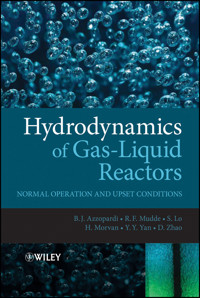
The design of chemical reactors and their safety are as critical to the success of a chemical process as the actual chemistry taking place within the reactor. This book provides a comprehensive overview of the practical aspects of multiphase reactor design and operation with an emphasis on safety and clean technology. It considers not only standard operation conditions, but also the problems of runaway reaction conditions and protection against ensuing over-pressure.
Hydrodynamics of Multiphase Reactors addresses both practical and theoretical aspects of this topic. Initial chapters discuss various different types of gas/liquid reactors from a practical viewpoint, and later chapters focus on the modelling of multiphase systems and computational methods for reactor design and problem solving. The material is written by experts in their specific fields and will include chapters on the following topics: Multiphase flow, Bubble columns, Sparged stirred vessels, Macroscale modelling, Microscale modelling, Runaway conditions, Behaviour of vessel contents, Choked flow, Measurement techniques.
Sie lesen das E-Book in den Legimi-Apps auf:
Seitenzahl: 505
Veröffentlichungsjahr: 2011
Ähnliche



















Contents
Cover
Title Page
Copyright
List of Figures
List of Tables
Preface
Nomenclature
Chapter 1: Introduction
Part One
Chapter 2: Bubble Columns
2.1 Introduction
2.2 Types of Bubble Columns
2.3 Introduction of Gas
2.4 Disengagement of Liquid from Gas
References
Chapter 3: Sparged Stirred Vessels
3.1 Introduction
3.2 Flow Regimes
3.3 Variations
3.4 Spargers
3.5 Impellers
3.6 Baffles
3.7 Power Requirements
3.8 Gas Fraction
3.9 Mass Transfer
3.10 Mixing Times
References
Chapter 4: Thin Film Reactors
4.1 Introduction
4.2 Falling Film Reactors
4.3 Rotating Disc Reactors
4.4 Two-Phase Tubular Reactors
4.5 Monolith Reactors
References
Chapter 5: Macroscale Modelling
5.1 Introduction
5.2 Eulerian Multiphase Flow Model
5.3 Poly-Dispersed Flows
5.4 Gassed Stirred Vessels
5.5 Summary
References
Chapter 6: Mesoscale Modelling Using the Lattice Boltzmann Method
6.1 Introduction
6.2 Lattice Boltzmann Method and the Advantages
6.3 Numerical Simulation of Single-Phase Flow and Heat Transfer
6.4 Numerical Simulation of Two-Phase Flow
References
Part Two
Chapter 7: Upset Conditions
7.1 Introduction
7.2 Active Relief Methods
7.3 Passive Relief Methods
References
Chapter 8: Behaviour of Vessel Contents and Outflow Calculations
8.1 Introduction
8.2 Modelling of the Level Swell Process
8.3 Vent Sizing and Vent Performance Calculations
8.4 Computer Codes for Level Swell and Venting Calculations
8.5 Obtaining Necessary Data
8.6 Performance of Models and Codes
References
Chapter 9: Choked Flow
9.1 Introduction
9.2 Single-Phase Flow
9.3 Two-Phase Flow
9.4 Effect of Vent Pipework
References
Part Three
Chapter 10: Measurement Techniques
10.1 Bubble Columns
10.2 Sparged Stirred Tanks
10.3 Falling Film Reactors
References
Color Plates
Index
This edition first published 2011.
© 2011 John Wiley & Sons, Ltd.
Registered office
John Wiley & Sons Ltd, The Atrium, Southern Gate, Chichester, West Sussex, PO19 8SQ, United Kingdom
For details of our global editorial offices, for customer services and for information about how to apply for permission to reuse the copyright material in this book please see our website at www.wiley.com.
The right of the author to be identified as the author of this work has been asserted in accordance with the Copyright, Designs and Patents Act 1988.
All rights reserved. No part of this publication may be reproduced, stored in a retrieval system, or transmitted, in any form or by any means, electronic, mechanical, photocopying, recording or otherwise, except as permitted by the UK Copyright, Designs and Patents Act 1988, without the prior permission of the publisher.
Wiley also publishes its books in a variety of electronic formats. Some content that appears in print may not be available in electronic books.
Designations used by companies to distinguish their products are often claimed as trademarks. All brand names and product names used in this book are trade names, service marks, trademarks or registered trademarks of their respective owners. The publisher is not associated with any product or vendor mentioned in this book. This publication is designed to provide accurate and authoritative information in regard to the subject matter covered. It is sold on the understanding that the publisher is not engaged in rendering professional services. If professional advice or other expert assistance is required, the services of a competent professional should be sought.
The publisher and the author make no representations or warranties with respect to the accuracy or completeness of the contents of this work and specifically disclaim all warranties, including without limitation any implied warranties of fitness for a particular purpose. This work is sold with the understanding that the publisher is not engaged in rendering professional services. The advice and strategies contained herein may not be suitable for every situation. In view of ongoing research, equipment modifications, changes in governmental regulations, and the constant flow of information relating to the use of experimental reagents, equipment, and devices, the reader is urged to review and evaluate the information provided in the package insert or instructions for each chemical, piece of equipment, reagent, or device for, among other things, any changes in the instructions or indication of usage and for added warnings and precautions. The fact that an organization orWebsite is referred to in this work as a citation and/or a potential source of further information does not mean that the author or the publisher endorses the information the organization or Website may provide or recommendations it may make. Further, readers should be aware that Internet Websites listed in this work may have changed or disappeared between when this work was written and when it is read. No warranty may be created or extended by any promotional statements for this work. Neither the publisher nor the author shall be liable for any damages arising herefrom.
Library of Congress Cataloging-in-Publication Data
Hydrodynamics of gas-liquid reactors : normal operation and upset conditions / B.J. Azzopardi . . . [et al.].
p. cm.
Includes bibliographical references and index.
ISBN 978-0-470-74771-1
1. Chemical reactors–Design and construction. 2. Chemical reactors–Fluid dynamics–Mathematical models. 3. Gas-liquid interfaces. I. Azzopardi, B.J. (Barry J.)
TP157.H93 2011
660'.2832–dc22
2011004546
A catalogue record for this book is available from the British Library.
Print ISBN: 9780470747711
ePDF ISBN: 9781119970323
oBook ISBN: 9781119970712
ePub ISBN: 9781119971405
Mobi ISBN: 9781119971412
List of Tables
Table 2.1Dependence of exponent of Richardson and Zaki [31] on Reynolds number
Table 2.Q.1Properties of the fluids employed at process conditions
Table 4.1Constants [1] for Equation 4.28
Table 5.1Drag coefficients for a single rising bubble in water by Wang [4]
Table 5.2Case definition and parameters used
Table 7.1Causes of runaways
Table 8.1Examples of experiments involving chemical reactions employed in runaway/venting studies
Table 8.2Properties of the reactants and reaction product for the esterification of acetic anhydride by methanol or its hydrolysis by water
Table 8.3Effect of fill level and presence of surfactant on major parameters during the runaway hydrolysis of acetic anhydride in a 2500 l vessel
Table 8.4Characteristics of codes used in level swell/venting calculations
Table 8.Q.1Contents of reactor after all chemicals added
Table 8.Q.2Data for Question 4
Table 10.1Comparison of gas fraction
Table 10.Q.1Solutions to Question 10.1
Preface
One way of identifying areas of importance in Chemical Engineering is to look at the subject groups or working parties of national or transnational professional bodies. Amongst the Working Parties of the European Federation of Chemical Engineers, there are two that are relevant to the present text, one on Chemical Reaction Engineering and the other on Multiphase Flow. Although each has its own programme of events, they come together once in a while to air matters of common interest. Multiphase flow, the simultaneous flow of more than one phase, has applications in: electrical power generation – nuclear and fossil fired; oil and natural gas production and refining; distillation and absorption and in heat transfer. This has produced a body of knowledge that can be drawn on for the benefit of the design of chemical reactors.
The relative efforts in the two facets of reactor design have been very succinctly illustrated in Figure A A, by Professor Octave Levenspiel [Levenspiel, O. (1999) Chemical Reaction Engineering, Ind. Eng. Chem. Res. 38, 4140–4143]. This text aims at strengthening the weaker link of the chain shown.
Figure A Reprinted with permission from Industrial & Engineering Chemistry Research, 38, 11, Chemical Reaction Engineering, Levenspiel © 1999, Americal Chemical Society
The preparation of this present work brought together a team with complimentary skills. All are firmly based in multiphase flows and they research into chemical reactor applications in addition to other industrial applications. The work presented here is an expression of the realization that there is the need for more and more complex modeling methods. There are also requirements to consider not just mixing but also separation of gas and liquid and to look into the upset conditions, which might lead to accidents, as well as a steady state. All of these have found a place in this book from the point of view of multiphase flows, in a combination of well proven engineering concepts and modern developments, both numerically and experimentally.
Nomenclature
Aconstant in Equation 2.45 [–]Aconstant in film thickness correlating equation [–]Aconstant in mass transfer equation (Chapter 4) [–]Across-sectional area of vessel (Chapter 8) [m2]Aconstant in Antoine equation (Chapter 8) [–]ADdrag force coefficient [–]AHHamaker constant [–]Approjected area of one wire [m2]atransverse dimension of elliptical bubble [m]aconstant in Equation 2.45 [–]aparameter in upper limit log normal equation [–]aconstant in Equation 5.14a′specific interfacial area (also known as interfacial area density) [1/m]Bconstant in film thickness correlating equation [–]Bconstant in mass transfer equation (Chapter 4) [–]Bratio of latent heat to gas constant in Antoine equation (Chapter 8)baxial dimension of elliptical bubble [m]bconstant in Equation 2.45 [–]bconstant in Equation 5.14Cconstant of integration in falling film analysis [kg/m s]Cconstant in mass transfer equation (Chapter 4) [–]C′constant of integration in falling film analysis [m/s]Lesen Sie weiter in der vollständigen Ausgabe!
Lesen Sie weiter in der vollständigen Ausgabe!
Lesen Sie weiter in der vollständigen Ausgabe!
Lesen Sie weiter in der vollständigen Ausgabe!
Lesen Sie weiter in der vollständigen Ausgabe!
Lesen Sie weiter in der vollständigen Ausgabe!
Lesen Sie weiter in der vollständigen Ausgabe!
Lesen Sie weiter in der vollständigen Ausgabe!
Lesen Sie weiter in der vollständigen Ausgabe!
Lesen Sie weiter in der vollständigen Ausgabe!
Lesen Sie weiter in der vollständigen Ausgabe!
Lesen Sie weiter in der vollständigen Ausgabe!
Lesen Sie weiter in der vollständigen Ausgabe!
Lesen Sie weiter in der vollständigen Ausgabe!
Lesen Sie weiter in der vollständigen Ausgabe!




