


Erhalten Sie Zugang zu diesem und mehr als 300000 Büchern ab EUR 5,99 monatlich.
- Herausgeber: Prototype Publishing
- Kategorie: Gesellschafts- und Liebesromane
- Sprache: Englisch
A novelist questions why she's been shortlisted for the Prize of Prize's Prize; an artist duo has a messy break up; a schoolgirl is saved from a predator by a flash flood and a gang of dead animals; a surgeon has an incurable identity crisis; a budding actor can't see what's so funny; a pregnant food writer gets a craving for luxury consumerism. These thirteen stories by writer and literary translator Jen Calleja pick apart the hidden motivations behind our desires, and the ways we seek out distraction from difficult truths. They investigate histories, power dynamics, rituals, institutions – the roles we adopt, as well as the ones we inherit. Known for her acclaimed poetry and translations, and as a performer in numerous bands, these facets manifest in an attention to the latent ambivalence of language, and the nature of storytelling itself. This writing is direct and considered – it asks to be read, read out loud, retold, refashioned into fables with a distinctive mouthfeel. I'm Afraid That's All We've Got Time For is a sharp, bold, inventive and prescient fictional debut from a versatile and brilliant writer.
Sie lesen das E-Book in den Legimi-Apps auf:
Seitenzahl: 176
Veröffentlichungsjahr: 2020
Das E-Book (TTS) können Sie hören im Abo „Legimi Premium” in Legimi-Apps auf:
Ähnliche


















()
Jen Calleja is a writer and literary translator originally from Shoreham-By-Sea, West Sussex, and now based in London. Her debut collection of poetry, Serious Justice, was published by Test Centre (2016), followed by the pamphlet Hamburger in the Archive (If a Leaf Falls Press, 2019). Her short fiction and poetry have appeared in many publications and anthologies including Ambit, 3:AM, Somesuch Stories, Funhouse, Another Gaze, Hotel, Structo, PROTOTYPE and Spells: 21st Century Occult Poetry (Ignota, 2018), among others. She was shortlisted for the Man Booker International Prize 2019 for her translation of Marion Poschmann’s The Pine Islands (Serpent’s Tail) and was the inaugural Translator in Residence at the British Library. She plays or has played in the bands Sauna Youth, Feature, Monotony, and others.
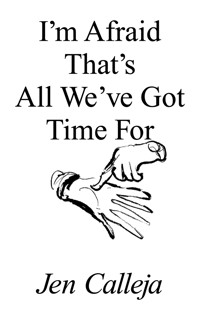
I’m Afraid That’sAll We’ve Got Time For
by Jen Calleja
Town Called Distraction
Literary Quartet
The Turn
The Debt Collector
Divination
Befriended
The Natural
The Amnesty
The Binding Reach
Due Process
Half-Learnt Lessons
Gross Cravings
Apart From When
for Richard
I’m Afraid That’s All We’ve Got Time For
I need it to be perfect / I need it to be real
That’s just what I’m saying / That’s just how I feelfrom ‘Perfect’ by Murderer
Town Called Distraction
I loosely calculated faint figures in my hand. The bridge to the east side of town would be down and crossable for a quarter of an hour from quarter past twelve, and for ten minutes at twelve forty-five. Even if I were to make the close of the first window, I would still be fifteen minutes late, yet the second window glowed in pink neon next to the faded twelve-fifteen. I knew I would be distracted by the world. The world requests time. I’d been listening to the news on the radio before leaving and had to spring back upstairs to note down names mentioned in the broadcast to look up later on. The bus pulled in while I was scanning the headlines in the news-agent’s in front of the bus stop and I rushed out to meet it. It had been the wrong bus, so I waited and wondered how long ago the council had had the bus shelter replaced, if ever.
Once on the correct bus I sat beside a woman completely unlike myself reading a newspaper. I sought out the important parts out of the corner of my eye. I completely agreed with the style of dress chosen by a French politician. I read all the stories about America. I had to unpick the tears sitting on my lower lashes after reading about a memorial service up north. I didn’t notice the woman leave, but remember picking up the newspaper from her empty seat to continue reading it. My fingertips felt roughened and dry from the paper; I looked around in my bag for hand cream. There is so much space between molecules that we never really touch anyone or anything. I moisturised more air than skin. As the bus took a detour due to the Carrutherson Pass being closed on Thursdays, which I’d forgotten about, I was notified that my book was ready to be picked up and would be available for the next three weeks. I got off a stop early to pick it up.
There was no one at the counter, so I went around the back to try and find someone who worked in the stockroom who could find the book. I’d ordered it because the blurb used a turn of phrase I’d always admired and I was half serious about highlighting any word in the book that I felt proved the existence of an ideology I’d been playing around with for almost two years. It started off as a miraculous discovery, a new way of seeing, but now it was the only way I saw, the only way I wanted to see. Not many others knew about it though, so I wasn’t a fanatic, I was just very interested. The depot had a TV in the corridor outside the stockroom and I leant as if bored against its screen, with a flat palm on the end of my stiff arm, to twist my head and shoulders in for the thrill of guilt and culpability the international news would give me. Television perfectly illustrates the theory of quantum physics; I birthed this intellivision in my head. Those pixels everywhere in every colour being everything – being there but not being there, I reasoned – they could be everything, though they will never be real, they will never really exist outside imagination. Possibilities mean so much more than reality these days. They certainly do to me. If only he wanted to confuse me or contradict himself and smile because of it.
I started walking towards the bridge, but very slowly. I was worrying, I remember, about whether things would turn out alright in the end, if things had already gone wrong sometime up to this point. On the way I saw a cash machine, but decided not to check my balance. It looked a lot like an arcade game with its fully-flashing colour screen, full quantum. Where is my money? There’s more money than there is money, there’s more money than is needed for the whole world to be OK.
I thought of a joke I could tell if I thought he was trying to make us feel serious. I read it through in my head while my facial muscles held a tech rehearsal. I knew I’d missed my chance to cross the bridge, but by this I had saved myself.
Literary Quartet
I arrived at the entrance to the Literature House at the exact time set out on the invitation, turned my back on its facade, waded through the orange leaves on the opposing green, and climbed a tree. Sitting on a branch, I thought of the other shortlisted writers already inside, the cameras roving around trying to capture their famous targets, the lights heating up, the countdown to showtime running ever faster.
I wish I could know what story I’m trying to write when I’m writing it, was the magnified quote underneath my photo in the concertina brochure for the prize-giving that they were handing out at the Literary Exchange. I scannedit over and over throughout the journey. I go to the Literary Exchange to write. It used to be Bridge Gallery, that building by the river as big and open and bright as an airport terminal. They left the final exhibition up when the place went bankrupt. Now the space is full of reclining armchairs, all pointed at different angles towards different garish, neon paintings. Each armchair is next to a small, cuboid bookshelf, where you can choose from a selection of volumes wrapped in uniform grey packing paper, covering the title page and colophon; inside, all traces of the authors’ identities have been erased, too. I had read another Blank Book to focus my mind that afternoon.
After a surreal three years that began with my acceptances outweighing my rejections, and included winning a regional award, things were on the up – potentially stratospheric, depending on how tonight turned out. It was finally happening. Every year, for over twenty years, I had watched this historic occasion. The drama of it, the fuss, the prestige. I knew everything about the Prize of Prizes Prize; the compères, the scandals, the rumours, the winners. I still own a badge, jumper and notebook, all with the pre-1990s logo.
For the past ten years I’d wanted it in the opening line of my biography – and for it to be the reason I didn’t need an introduction. Five years ago, I’d signed up for the offer to receive specially bound copies of each winner’s book – always white, with black embossed font – as a way of affirming to myself that I, too, could be a winning writer.
Perched in the tree, under the street lamps’ cold light, I stroked my fragrant, freshly conditioned hair. I had been to the hairdresser that morning. Someone wearing a headset waved me down from the tree and handed me a glass of sherry. I followed them inside the Literature House to take part in, and perhaps become, an institution.
My coat was whisked away, a microphone clipped to my dress, and I was ushered into the ceremonial hall. Swirling around its five zoned-off areas, one for each stage of the evening, were hundreds of gaudy, volatile people. Cameras zoomed around, intruding on conversations. I was led to the zone nearest the entrance. As I approached, the other shortlisted writers, standing around two corpulent beer barrels, fell silent. I air-kissed all three. The lights dimmed with an ooooo from the crowd and a spotlight descended on us as the compère of the last twelve years, Audrey Wollen, began the proceedings:
‘Ladies and gentlemen, we’re gathered here for the live, televised judging of the fifty-ninth Prize of Prizes Prize. Please give your warmest welcome to our four shortlisted authors: Bobi Entré, Thomas Grech, Hester Heller and F.F. Tine.
‘Our three esteemed judges will soon commence their private deliberations while seated on the platform nearest the Victory Chamber, where the exclusive party for the triumphant author will take place after the winner has been announced.
‘Each nominee’s book will also be discussed live by the nominated writers themselves – peers among peers – in an attempt to persuade our eavesdropping audience that they are most deserving of the Prize.
‘During the evening, each member of our four-hundred-strong audience – made up of readers chosen by ballot and special guest critics – will place a token in one of the centrally positioned glass vases, each representing a shortlisted author. The tokens all have different values. Readers’ bronze tokens are worth one vote. Critics’ silver ones are worth ten votes. The writers’ gold tokens are worth twenty-five votes. And no, they cannot vote for themselves – however much they long to. And, lastly, the author chosen bythe judges will receive two hundred and fifty additional votes. Whoever receives the most votes overall will win the Prize of Prizes Prize, instant fame, glory, the works.
‘But that’s not it, for, as usual, there are also consolation prizes to be awarded. The unsuccessful author with the highest number of gold tokens will win the exquisite Writers’ Choice Prize. The runner-up with the most silver tokens will get the coveted Critics’ Choice trophy. And, for light entertainment, the writer with the most bronze tokens will take home the Public Choice gong. Should an author qualify for multiple titles, the judges will share out the goodies. And we promise that, unlike last year (and every other year), we will not throw a custard pie in the Public Choice winner’s face.’
Tittering laughter, and one guffaw.
‘So, with all that out of the way – let us begin… Evening Drinks with Canapés!’
Aperitif! Aperitif! cheered the crowd.
As drums rolled, two large silver dishes of oysters were placed on the barrels in front of us. Flutes of champagne were handed around as our four books, each on a silver stand, were placed by our feet. The crowd relaxed and began to edge closer, occasionally penetrating the spotlight. We slurped oysters determinedly and began our discussion.
‘So, Mr Grech, Thomas if I may,’ Bobi Entré smiled, tossing an oyster shell onto the sawdust-covered floor of the zone. ‘A main character.’ He let it stand.
‘Yes,’ Thomas Grech nodded, lifting his champagne glass.
‘Don’t you think having a main character has been done to death?’
I was proud to be here – and, I assumed, the others were too. We had worked hard and produced the finest works of the year, perhaps of our generation. We deserved this honour. But I, and maybe the others too, considered the nominations with some suspicion. I had to admit, I knew all three people who had got me on the longlist, which wasn’t (technically) allowed. One was a publisher that I had read submissions for; another a non-fiction publisher who was courting me for a book; the third that well-meaning essayist everyone knows.
One of Hester Heller’s nominators, an ageing poet, is the brother of her publisher’s editorial director. One of the others is in her writing collective and shares her love of white space and absurd juxtaposition. A third taught her Persuasive Writing at university.
Bobi Entré’s manifold sponsors included a Scottish novelist who he once had an affair with and a widely despised aristocratic author who writes working-class characters with cringeworthy dialogue.
As for Thomas Grech, he was already lambasted in the media for being a ‘personality’ before even a single word of his book had been published. Barely twenty-one. Part-time model. Did not give a shit about being championed solely by his father’s friends, including one seventy-year-old writer who explained his choice: ‘It would be great to have a meeting of minds – and to get a photo with him.’
Still, the nomination that I was most suspicious of was the public’s, whose votes had whittled the longlist down to a final four after repeated televised adverts featuring jolly readings of book extracts with designated phone number extensions running along the bottom of the screen. What was their agenda? What did they gain? Did they just like the look of me? Had they read the review that said I was influenced by that monstrosity of a book? Did they know who my ex-boyfriend was? Or were they really struck by the two pages I had read while balanced on the roof of a river boat?
‘And what about your process?’ Hester queried.
‘My process is embedded within an aesthetic of relatability,’ Thomas enthused. ‘I chose popular names from the past year, overpopulated cities, popular items of clothing, most-searched-for turns of phrase and words of the year, made sure to mention the characters are reading the latest bestseller and watching the highest-grossing films. My publisher also sent me their three-year plan of what their predictive focuses were going to be thematically, so I took from that as well.’
‘And your next book?’ Bobi asked.
‘Oh, the same I think. But I’ll…’
‘…update everything…?’
‘…update everything and then we’ll do seasonal reissues.’
‘Some of us were a bit confused about the length…’ I ventured.
‘Well, it’s clearly just the first chapter.’
‘Right, with some bullet points across blank pages to set out what people can expect?’
‘Yeah, the book hasn’t been written yet, but people are really excited about it. That’s why we also submitted the Petition of Interest signed by everyone who will read it, once it’s written. Naturally, it’s going to go through a few changes, like plot and… Oh, here comes father!’
Applause rose as the illustrious playwright Edgar Rosalvo Grech entered, followed by an assistant bearing a candle.
‘Good evening everyone! I’m here to give the seal of approval to my son’s book.’
He rocked a stick of green wax in the candle’s flame, pressed the melted end onto Thomas’s (mostly blank) book and stampedhis dolphin-adorned metal seal over it, before marching off through the fawning crowd.
The retreating candlelight swam in the glass of the vases. They were darkly coloured, but I could make out that they already had a few tokens glinting inside them. Some people must have already cast their vote when they came in. The mounds of salt cradling the oysters glittered magically, sending a refraction of light onto the hand of my barrel partner, Hester Heller. It made her seem special, this gesture from the mineral. I could almost hear the sound of the sea, or applause off in the distance.
‘And now, would the authors please… Join Us for Dinner.’
Be our guest! Be our guest!
The spotlight followed us to a large, round table with a white tablecloth while theband swayed against their violins. Red wine was poured into mauve glasses. The four books were brought over and arranged as a centrepiece. Four bloody steaks were placed in front of us. I had told them I didn’t eat red meat; was this a test?
‘Hester, what made you tackle this particular subject?’ Grech asked, a cube of meat readied on his fork.
‘Hm, as you know, the collective I’m part of – Fresh Pillow – establishes leitmotifs and methods and styles of performative reading at our annual meeting and we all work from those as a blueprint. Our showcase portfolio will be coming out soon with profiles, photos, suggested “big work” and contact information for all twelve of us, and we’ll open up our events diaries for appearances shortly after that.’
‘And what other writers are you interested in right now?’
‘Definitely John Free, Wendy Quaid and Tish Gupta. All exquisite and important writers.’
‘And also part of Fresh Pillow?’
‘Yes, yes they are.’
I had forgotten to have lunch. When my concentration lapsed again, my eyes drifted to the judges’ zone.
Had I really been trying to ignore the fact that among the three judges was Charles?
The writer Charles Vivard had been a junior lecturer when I was in my first year at writing school. After I finished school his reputation grew, and we had remained in the same networks – how could we not have.
A few months ago he had contacted me to say that he had pushed one of my real nominators, his publisher, to select me. The email had read: ‘Don’t worry about getting on the list, it’s sorted… your greatest work to date… very proud.’
The morning’s haircut slid into my mind, pressure set in around my shoulders. I blinked, forcing my focus back to the table.
‘And what kind of writer do you want to be remembered as down the line, Hester?’ Thomas was saying.
‘I’d like to be a Rediscovered Author, so in the next couple of years I’m probably going to stop publishing my writing, store my unpublished work in an archive and then in a couple of decades my publisher will offer it up to a literary journal as an exclusive.’
Hester had been tipped for the Prize in certain circles five years ago, while still in her second year at university. That had been a difficult thought to handle the last couple of weeks. She must have had a dozen nominations, maybe more. I heard a rumour that her name had been engraved in the Victory Chamber while she was still a teenager and they had just plugged up the letter grooves with white plasticine. A toothpick awaited the announcement: either this year, or next year, or whatever year. It would come eventually, and she was impatient for it while she was still young. I had noticed toothpicks on the bar when I came in. She had been shortlisted multiple times, her nominations rising steadily each year, spurred on somehow by the inevitability of it all. Everyone likes to back a winner. I needed to pick my teeth, they felt itchy.
The ones who persevered, and didn’t crack, would get there eventually – unless no one liked you, and I doubted anyone particularly liked me. But this award breeds awards. More would follow shortly after, including a couple of new ones looking to establish themselves with the promise of money… What was I even doing here? It was impossible.
My head throbbed. The audience shifted as my vision blurred. Everything around me seemed to hint that it could be peeled back. Pulling up the chair upholstery would reveal hidden papers,I was sure of it; under the glass coaster and paper doilies were notes written backward in pencil, the floor tiles could be lifted, twisted, rearranged to form a message. Looking down at the floor I could already make out something, letters formed by the grouting. It appeared that there was something written on the ceiling, in dangling cobwebs. I focused again. Some of the audience were listening intently, others were gesticulating at the books, arguing, and one or two seemed to be sleeping.
Charles caught my eye from the judging corner. I smiled robotically as my hand nervously tousled my hair. While I had his eye, I mouthed: ‘Which was your favourite part?’ He replied with a shrug and a smile: ‘I couldn’t possibly choose.’ Had he even read it?
‘And now, Just Dessert!’
Sweet stuff! Sweet stuff!
I stopped thinking about it all while we moved zones to the tinkle of the piano. We all sank into plush, purple armchairs. A trolley bearing miniature cinnamon swirls dipped in powdered sugar and presented on translucent plates appeared. A ginormous piping bag filled with thick hot chocolate was lying over the shoulder of a chef like a fat baby. He encouraged florets of it into boiling-hot frosted-glass tumblers braced within wooden holders. The cold mixture gradually relaxed into a warmed drinking chocolate. The conversation had moved on, and I hadn’t spoken for at least thirty minutes. I still wasn’t used to the sweeping cameras and the hot lamps, to the crowd’s relentless whispering.
We’re in a labyrinth of ladders, arcing and curling around one another, following others’ routes, occasionally being given a hand over treacherous rungs. Some ladders end in dead ends, others lead to platforms from where we can shout down encouragement or ignore all those beneath us. No one knows how anyone gets up there, the routes are not well lit.
‘Bobi, Bobi, Bobi, there was so much I loved about this book,’ Heller said, blowing on her hot chocolate. ‘There’s the repeated use of the word “lush” that I really enjoyed. There was also the enchanting cadence of each sentence. And when Rizzo turns to Gregoire and says “You’re as mad as a hatter!” that was such a great moment. But – ’




