


Erhalten Sie Zugang zu diesem und mehr als 300000 Büchern ab EUR 5,99 monatlich.
- Herausgeber: Rough Trade Books
- Kategorie: Geisteswissenschaft
- Serie: Rough Trade Books
- Sprache: Englisch
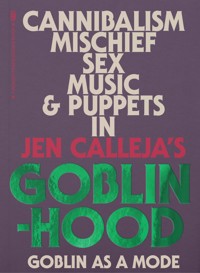
As formally inventive as readers have come to expect from one of the most daring writers around, and as wild and tricky as its subject matter requires, Goblinhood: Goblin as a Mode presents us with a series of essays and poems that playfully, artfully propound Jen Calleja's theory of 'goblinhood'——a theory that takes in all aspects of pop culture from film, tv, literature and art as well as the author's personal and original examinations of grief, lust, family histories and the physical fact of living in the world as it is. Goblinhood is a perpetually and variously curious, visceral addition to Calleja's remarkable oeuvre.
Sie lesen das E-Book in den Legimi-Apps auf:
Seitenzahl: 227
Veröffentlichungsjahr: 2024
Das E-Book (TTS) können Sie hören im Abo „Legimi Premium” in Legimi-Apps auf:
Ähnliche



















For Mum, who built herself a grotto, and Shelley Duvall.
‘Man, I’ve got to get back into mischief-writing. Writing stuff that I know no one else will approve of, just for me, because I think it’s neat or I want to chase something down. Writing is always easier when you think of it as mischief.’
—Tim Clare, X, 23 March 2022
Dennis: …What are some of your ‘likes’?
Charlie: Uh, ghouls.
Mac: Son of a bitch. What are you talking about now?
Charlie: You know, funny little green ghouls.
Dennis: What, like in movies? In cartoons?
Charlie: Little green ghouls, buddy!
—“The Waitress Is Getting Married” (2009), It’s Always Sunny in Philadelphia
Mages & Monsters Master (Shirley): Should I do my goblin thing or should I play it safe?
Bob: I don’t know what you’re talking about.
—“Loft in Bedslation” (2021), Bob’s Burgers
In March 2020, right at the start of the pandemic, Rough Trade Books published my pamphlet memoir-essay Goblins, a proto-text for this book. In December 2022, ‘goblin mode’ was voted Oxford Word of the Year through a public vote. Coincidence?
The BBC article reporting on the popularity of the choice said, ‘many of us can feel a little goblin-like occasionally.’ Casper Grathwohl, president of Oxford Languages, who was quoted in the article, said, ‘the strength of the response highlights how important our vocabulary is to understanding who we are and processing what's happening to the world around us.’
Defining a goblin is tricky: ‘they are ascribed conflicting abilities, temperaments, and appearances depending on the story’ and can be anything from ‘household spirits to malicious, bestial thieves’, often having ‘magical abilities similar to a fairy or demon, such as the ability to shapeshift’. How would I define “goblin”? I, like many others, consider it an umbrella term. Anything that behaves mischievously and in its own best interest, that is bold and all body, could be a goblin. We can also be made into goblins, stalked by goblins, whether we like it or not. Some things are out of our control.
CONTENTS
GROT
GREEN
GREENSWARD
GURN
GUTTER
GOBBLE
GORGE
GAG
GRIMACE
GRUNT
GATHER
GROTTO
GIRD
__
GOODBYE
GROT
I’d finally hedged the vines of the duvet yet
wake washed-up on a bed of soil
leather mushrooms sprouting from my leather jacket
denim toadstools spreading across my jeans
phosphorescent spores emit in heartbeat puffs
from my fingertips
I tawt I taw a puddy tat with eyes of green but failed
to clock the landslide from the never-ending rain
roll over onto a mud path to Old Raw Gill
a waterfall long lacking its cascade
soon hear water prosperous, blink at a sparkling screen
a portal right out of here.
GREEN
ON EMBLEMATIC EMERALD
As a rule, I always look for green objects in charity and antique shops. It’s a particular kind of green I have in mind, a kind of deep jade, or, if made of glass or plastic, emerald. It’s so I have one particular thing to search for among the junk rather than aimlessly browsing; it’s a microcosm of how I experience the whole world all at once and often need a key to navigate it. This game-for-one is inspired by the film Return to Oz, the 1985 non-musical and not-really-a-sequel sequel to The Wizard of Oz. In the film, the Nome King has turned the citizens of the Emerald City into stone, trapped Ozma—Princess of Oz—inside the mirror world, and transformed King Scarecrow into a green ornament, which the Nome King has hidden in his cavernous ornament room. Dorothy Gale and her friends the Gump, Jack Pumpkinhead and Tik-Tok the clockwork soldier travel to Nome Mountain to demand the Nome King return the emeralds he’s stolen from the Emerald City and de-stone the people of Oz. But they’re no match for him—he imprisons Dorothy and takes away her gang of adoring misfits, secretly greenifying them for his collection. The Nome King wants to play a game. He tells Dorothy she can walk around his hall of objects to find her friends, without her knowing that they are green. She must place her hands on the object she thinks might be a friend and shout, ‘OZ!’ If she’s right, they will transform back. She has three guesses, and each wrong guess makes the heavens roll with thunder. She picks a green object by chance, guesses correctly, and goes on to release many friends. King Scarecrow is a huge emerald, clearly someone precious. I have a memory of finding a piece of green sea glass with my grandad that was so perfect, a smooth green pebble like a big gemstone, but I can’t remember if it was real or if I dreamed it, or if I lost it and had dreams where I found it again. We had a set of Disney encyclopaedias growing up that a family friend had given us, and I was obsessed with a set of pages that displayed all the varieties of precious stones—pebble-sized and neatly lined up on the display case page. I think I loved some of them so much I scribbled over them, like when you use a coin on a scratch card in the hope of winning treasure.
After everyone is freed, the Nome King is brought down by Dorothy’s pet chicken Billina, who drops an egg into the King’s hollow eye socket—‘Don’t you know’ the Nome King booms sadly, ‘eggs are poison to gnomes.’ The claymation here is terrifying, the grown-huge King, who harnesses the power of the mountain rock, melts in fire, briefly holding onto himself in the form of a fracturing skull before his final collapse. (He looks like he’s been hit by the ‘malevolent green’ torpedo Todd McEwen mentions in his essay about seeing 20,000 Leagues Under the Sea as a kid, rather than an egg—McEwen is also taken by the film’s monster squid: ‘just a big marionette’.)
‘Eggs kill the Nome King? I killed the Nome King!’ This is how Doug Aberle begins his charming homemade video about creating the clay animation for this and other sequences in Return to Oz, showing the four agonising attempts he needed to make the Nome King’s crumbling death work. Claymation really sets a film in a particular time, like any technological advancement in film does—puppets with visible strings, shonky CGI. Instagram comedian Claire Manning does a skit about a fictional 80s children’s film, a send-up of Labyrinth and possibly Return to Oz called Sewer Town complete with little songs where the main character’s parents are kidnapped by goblins and there’s ‘randomly claymation’.
The Nome King in Return to Oz abducted the citizens of the Emerald City, and the King of England stole the Green Man. In her essay “The Kidnap of the Green Man by the King”, poet and essayist Rebecca Tamás speaks of how ‘disturbed’ she felt to see the image of the Green Man (who we find everywhere here in Hastings, where we moved three years ago, and who looks like the Nome King) on the coronation invitation of King Charles and Queen Camilla. I admit I can only think of the Royal Family as Spitting Image puppets. My imaginary friend growing up was Lovejoy, the fictional antiques dealer, and when Spitting Image ended they gave the actor who played him, Ian McShane, his puppet doppelgänger: ‘I used to have it in a canvas chair in L.A.,’ McShane said in an interview, ‘with full-size leather jacket propped on top, like a work of art. Over the years, the puppet crumbled beneath it rather like a modern version of Dorian Gray.’ Tamás acknowledges that the inclusion of the Green Man is a nod to Charles’ self-image as an ‘eco-King’, but argues that it’s grossly inappropriate because the Green Man, with links to May Day and Robin Hood and the commons, is ‘a figure of folklore that is tricksy, rebellious and powerful’ and Charles and Camilla are massively wealthy landlords. Tamás ends her essay by placing a kind of curse on the King: ‘I hope that the Green Man’s kidnapped image will flicker out, freeing itself from the misguided invitations, escaping through the haze of bunting and confetti, to haunt the King and his coronation, and to haunt his reign beyond.’ Her bad spell continues: ‘I hope that its green leaf-ridden voice might echo in the thicket, the river, the hedge and the wood, to remind Charles that nothing lasts—that everything, however old, however powerful, will burn down to ash and fall away.’ Two of my favourite green men are Alistair Green and Anthony Green. Alistair Green (does he ever get called Ali G, I wonder, after the tracksuited demon?) is a comedian and actor who posts videos on Instagram of him playing cringeworthy characters such as moaners from middle England who could be a new version of Monty Python’s troglodyte Britons with hankies on their heads (did you know that Terry Jones wrote Labyrinth?), inept and posh social media influencers, and an array of desperate and unself-aware men. His general persona is a guy who’s a bit of a killjoy who talks to camera from his generic white flat and spends his weekends sending dispatches of himself being miserable in public and mocking local gentrification. One of his best creations is a spoof of what might be BrewDog (‘punks’ who rescinded the London Living Wage from their staff and tried to sue anyone that used the word punk in their branding) about a fictional microbrewery fronted by ‘Matt’ and ‘Matt’. One Matt used the profits from his buy-to-let properties to invest in the business, and the other Matt brings his experience as a senior creative at Saatchi & Saatchi (Goblin & Goblin). They reveal at the end that they sold the majority of the company to Budweiser (remember those frogs? Bud-weis-errrr) for a hundred million, and that Matt can only see his kids every other weekend. Every Halloween, Green reposts a video where he plays the ‘night goblin.’ A pale and inexplicably shirtless Green enters the bedroom of a man under the covers (also played by Green) threatening in song to tell a ghost story—it is time for your spoooooky story! it’s time, it’s time, it’s time!—with the Green man in bed ultimately submitting and the video ending before the story is told. He also recently posted a selfie with three horrific-looking abandoned dolls that are eerily reminiscent of the Tots from Tots TV with the caption:
Family isn’t just the best thing. It is EVERYTHING. Heck knows my little tribe (Jared 28, Chas 1, Teet also 1) can be trying at times but there’s not a day that goes by where I don’t thank the good lord for blessing me with these guys. Xxx #family #god #mykidsaremyworld #iddieformykids #andkill #love
Green had a small recurring part as a builder (odd odd-job man?) in the hidden-away ‘black comedy-drama sitcom’ Flowers, which I found by chance on Channel 4, maybe drawn in by Olivia Colman and Julian Barratt, a devilishly intriguing combo! Colman (the wicked stepmother in Fleabag, goblin queen in The Favourite, and goblin prey in Peep Show) and Barratt (the pretentious jazz toad Howard Moon in The Mighty Boosh and the pervy doll-loving cretin in Killing Eve) are Maurice and Deborah Flowers, a married couple on the brink of dissolution living in the middle of the British countryside with their adult twins.
Maurice Flowers is a depressed children’s book writer whose hit is a series of books about The Grubbs, a family of goblins. He is numb to everything including his family, missing his deadlines, distressed by his live-in mother’s dementia, and haunted by the disappearance of his stage magician father when he was a child. The Grubbs, we surmise, have been an outlet for him to explore his despair and sense of abandonment, and that they are clearly doppelgängers of his own family, until that is, he becomes so suicidal he finds he can no longer even write stories.
Tired of her husband hiding in his writing shed and exhausted by her deranged children, a sexually and maternally frustrated Deborah wants to smash up their whole grotto of domesticity, no longer able to wait for the day that the twins might leave the grubby nest. The twins, Donald and Amy, are both feral and frightening for different reasons. Amy’s own mental health declines to the point of hallucination and the dissolution of reality—she thinks she has become a young woman from hundreds of years ago who ran away through the forest—and she repeatedly goes AWOL. She reminds me of my mum, who also lived with mental illness and would go missing on occasion when I was young, and who, like Dorothy Gale in Return to Oz, was institutionalised due to her poor mental health. Amy is always being screamed at by a jealous Donald who is constantly having explosive toddler-like tantrums and inventing useless contraptions, like if Caractacus Potts from Chitty Chitty Bang Bang had awful anger issues. Donald is played by Daniel Rigby, who won a BAFTA for playing Eric Morecambe in a double biopic of gentlemen gnomes Morecambe and Wise, narrated the Teletubbies reboot (Dipsey is obviously a goblin), played Bottom in A Midsummer Night’s Dream, and is currently in a stage production of Roald Dahl’s The Witches. Amy is played by Sophia Di Martino, who is currently playing a variant of the green God-lin of chaos Loki in the second series of Loki.
Flowers was written by Will Sharpe, who also plays Japanese art student Shun in the show. Shun comes to stay with this dysfunctional family so he can be the new illustrator of The Grubbs. (The illustrations you see in the programme are actually done by artist Staffan Gnosspelius.) The Grubbs books had helped Shun get through grief after his family were all killed in a tsunami, and he is desperate for Maurice to keep The Grubbs going and for the Flowers family to stay together; both are the only family and home he has left. Will Sharpe recently starred in The White Lotus opposite a domestic-bliss-terrorist Aubrey Plaza (the mischievous and lazy April in Parks and Recreation, who marries accident prone gremlin Andy—they live in goblin bliss eating cereal off of Frisbees).
The intimacy and claustrophobia of domesticity are also explored in the work of the second green man, Anthony Green, an artist whose fisheye paintings draw you in with their from-above perspective, like looking into a hole in the ground and finding the Mad Hatter’s tea party, though it’s actually a couple in a bathroom, one of them in the bath and the other sitting on the closed toilet seat, coat hangers hovering on a washing line above them like bird skeletons. I discovered that painting, The Bathroom at No. 29—one of a series—as well as his celebration/commiseration of green called My Mother Alone in Her Dining Room 74-75 in the gift shop at the Sainsbury Centre, the art gallery based at the University of East Anglia, after I had already missed the exhibition of his work. The perspective of My Mother Alone… is as if you’re standing at the head of a dining room table with your back to a window facing the seated mother in black, whose reflection is mirrored in the unbearably shiny wooden table, behind her the room is drowning in green, a garish green carpet that looks like an aerial view of a hedge maze, similar to the one in The Shining, green lampshades, greenish walls, a refracted kind of watery green on the ceiling, green objects placed around the room, an ornate and gilded green cigarette box, a green marble ashtray, both ready to be touched—OZ!—to bring back old friends, absent family, or the dead. On the back wall is a small oval mirror which shows that no one is standing at the foot of the table at all, not Ozma, and especially not you; a trick mirror making her both alone and not alone.
There was an avocado bathroom when R and I went on a honeymoon a year after we got married. We drove around Portugal for a couple of weeks staying in hostels, an Airbnb, a B&B, but we did spend a couple of nights in a hotel as a treat. A hotel is like a stack of goblin caves, where we regress to becoming both sloth-like and re-energised teenagers, not tidying up, chucking stuff on the floor, getting sweaty, maybe puking from overindulgence. You couldn’t get away with that at Fawlty Towers, the Slenderman Basil, trying so hard to raise the standards in his crumbling cave, would hunt you down. My dad migrated to the UK in 1975, the year the sitcom began, and I’ve always found it interesting that he, a Maltese economic migrant, found the goblinified Spanish waiter Manuel—played by an Englishman—so hilarious. The avocado bathroom at the hotel we found was incongruous with the rest of the room, it felt ominous at first, like opening a bathroom and finding a shit in the toilet or hair in the plughole (which reminds me of the scene in the remake of The Grudge where Sarah Michelle Gellar, best known as Buffy the slayer of vampires, feels the Grudge’s hand coming out the back of her head through her hair as she’s washing it. On the drive back from the cinema with my oldest friend Abby, who I don’t see enough of, I had the uncanny feeling that the Grudge was in the car and I had to sleep with the light on for two weeks.) A retro, kitschy green bathroom might feel like a bad omen in a young marriage. It felt like something that might be the hinge in a short story about a melancholic and doomed trip away. I personally loved the bathroom because we had triumphed over it and its connotations—it wasn’t a projection of tension and sadness in our actual marriage or a reminder of how our relationship will age and become outdated—it was just an avocado bathroom, nothing more. (Because I was googling avocado bathroom, I just got an advert from a 70s avocado kitchen set, a family of overcooked-pea-green cookware.)
In the novella Self Portrait in Green written by Marie NDiaye and translated by Jordan Stump, described in a review by Jennifer Brough as being filled with ‘an uncanny valley of “slippery silhouettes”’, green might signify many things including defiance, misbehaviour, and a shift in reality. There are a series of women in green who become the protagonist’s doppelgängers in her inclusion and fixation on them and not herself, including the protagonist’s mother, who Brough describes as starting a ‘green-tinged life’ because she left to have another family, and two green women who seemingly perish and yet return. (Author Naomi Klein writes in her book Doppelganger: A Trip Into The Mirror World about becoming obsessed with her Doppel, the disgraced author Naomi Wolf, who went from cultural commentator to right wing conspiracy theorist, defining the doppelgänger after Freud as something familiar that is ‘suddenly alien’.) Another woman in green is the feminised river that sloshes either end of the book, perhaps the menacing green of the constantly rising threat of climate crisis. Today, as in right now, Hastings is flooded for the fifth time in three years, the shopping centre in New Town was built on a former quagmire, I technically live in a ghost bog.
I recently misread a tweet by Lucy Writers Platform editor and critic Hannah Hutchings-Georgiou where she said something about having had an essay published called “Seeing Green in The London Magazine”, and mistakenly thought—or my brain took a frog hop—that it was an essay about all the mentions of the colour green in the whole history of the magazine.
I plucked, re-landscaped and replanted all the greens from her essay, about the artist Megan Barker, to quench my green thirst:
‘Seeing Green in “Seeing Green”’
After Hannah Hutchings-Georgiou
seeing green
the woman in the half-state of it all fades green too
greens fade to browns to greens again
alone in a wild wilderness of transporting greens
this here pillow of dense green
shrubs and soil obscure her green-clad form
the green-streaked sky
the unblemished blur of breezy greens
magnificently fluctuating greens
yellowing decay growing green again come spring
forged of self and darkening green beneath
variegated palette of greens
and greens
there in the greens
this whole green and greening vision
ocular field of green and greening vision
in these green and greening visions
a green passage, a parsing green, a green that passes
in seeing green she sees
what is now green
Choosing what to read, by the way, doesn’t have to be an intellectual conundrum or canonical or chronological, it can be elemental. ‘A lot of reading in green this weekend’, a Bookstagrammer writes under a photo of a selection of green-covered books, ‘Matcha and some greenish translated fiction go together quite nicely, if not spiritually, then at least aesthetically’, Dead Ink Bookshop post on X with a photo of a stack of green books and a mug filled with a pale pondy green foam; a choice as arbitrary as choosing a specific coloured object in a charity shop.
Lydia Bunt reviewed Self Portrait in Green during the pandemic: ‘we have experienced stagnation, the sense of time repeating itself—the failure to progress beyond the same old norms, returning into lockdown time and again. NDiaye’s circular narrative, lacking progressive chronology, hits close to home.’ I don’t think I’ve broken free of pandemic time, I feel locked into it, time was paused and I haven’t heard the clock ticking since. Incidentally, I’m sure someone’s already writing a book about literary criticism during the pandemic, every time it’s mentioned and used to frame or focus an essay, what a handy anchor it was, like saying boomers, millennials, Gen X, Gen Z. It’s not easy being Gen Z… Kermit the Frog’s song “It’s Not Easy Being Green” was about how hard it is being a different colour, but is also about being proud to be different.
Green means safety, the green man at the traffic crossing, the green light, and being correct, a green tick, but also something dangerous, poisonous, toxic (though frogs are usually green, it’s the not-green ones that you have to watch for). The COVID virus has been portrayed as a goblin (I also saw a poster where long COVID was depicted as Shrek), as have germs, there’s one I see on a poster in a local café I frequent reminding you to wash your hands thoroughly illustrated by a gremliny, slimy, snag-toothed and green-as-hell germ, like an acid green inkblot. Looking and feeling green—as opposed to looking and feeling blue (or being yellow like the Cowardly Lion)—connotes illness, sickness, though you can also be blue and green at the same time. Being blue-green is when The Blues make you a creature: ‘Have never been one to personally ascribe to Seasonal Affective Disorder but the impact January sun is having on me is mental’, the writer Elise Bell wrote on X, ‘literal night and day. The sun comes out and I go from goblin to beam of joy.’ To be a goblin is to be lethargic, but perhaps mostly it has come to mean reclusiveness, shunning sunlight, lying around. Teenagers have been described as goblins for years due to their slovenliness and shutting themselves away in their rooms, hunched in front of magazines, books, consoles, TVs, laptops, gaming rigs, and there were others who would be called goblins pejoratively, those who never left the house, those who hoarded, those who didn’t want to focus on their appearance. But suddenly, those who weren’t allowed to leave the house during the pandemic, who had to stay indoors and could let their grooming slide and who found that their energy levels were dropping, those who felt somehow rebellious and naughty because they weren’t being their most productive, embraced the term goblin, and goblin mode became the word of the year in ‘post-pandemic’ (that is, after-pandemic-started-happening) 2022.
When goblin mode started being used to describe this new shared experience, writers who are disabled pointed out that goblin mode had been around for a long time and couldn’t solely be depicted as a lifestyle choice. Hannah Turner starts her essay “As a Disabled Woman, Goblin Mode Doesn’t Sit Right With Me” describing the blink-in-the-cave-and-you’d-miss-it trajectory of how the concept of goblin mode went from its proto principles of pushing back against capitalist and perfectionist modes of being and presentation, to its adoption as simply quirkiness and mild rebellion (cue the minimising manic pixie dream girl; the photo with the article is a girl looking at her phone in front of a fridge with an open can of squirty cream in her hand), through to those ‘waking up before the sun to drink green things’ for me-time and those wealthy enough to escape cities for the countryside right at the start of the pandemic to live out their cottagecore fantasies.
As the pandemic went on people let go of the trappings, responsibilities and routines of society and a social life, shed moisturised skin, and went goblin. But Turner speaks of her own experience of being disabled and how it wasn’t a moment of self-actualisation or a respite from life, it is her reality:
Crip communities often embody goblin mode because there is often no choice not to. I am writing this in the same outfit I have been wearing since last Sunday, my hair is over a week unwashed and, truly, I stink. I do not tell you that as a badge of honour, to prove how goblin I am. It is simply a regular occurrence in my life as a disabled person, working and living amid the often hellish landscape we are all trying to navigate.
Though there are positives to many people questioning and rebelling against the kind of perfection society dictates, Turner argues that only some people get to show themselves being goblins: ‘…who gets to join in? I haven’t ever publicised my goblin mode, except in private groups with online disabled friends. I keep up appearances as a good, working, disabled woman on my social media, mostly to ensure I retain work as a member of the precarious gig economy.’ I know my mum would not have been the poster girl for goblin mode.
It can be empowering to find a double or role model in the wild, no matter how slimy they are. Let us for a moment consider the slug, as Abi Palmer does in Slug: A Manifesto, which is about embracing slugness as a ‘marginalised girlie’: ‘My brain is thick and foggy. I am soft and wet and oily’; or how about the moss-covered sloth: ‘[S]loth communism is the next big thing’ Richard Chapman, a neurodivergent philosopher and author of Empire of Normality: Neurodiversity and Capitalism writes on X, ‘Slovenliness, degrowth, taking the day off. The age of productivist hyper-consumption is over. We’re moving into a new and peaceful age marked by a decrease in the pace of living and working. I can’t wait.’
As Turner points out in her article, however, not every disabled person would want to be considered a goblin (or a slug, or a sloth) for pretty obvious reasons, such as its othering potential, but also because illness or being neurodivergent can feel like the creature you’re trying to escape, like paintings depicting sleep paralysis and nightmares where a demon is sitting on the non-sleeper’s chest (which has been somewhat usurped by memes of cats sitting on the chest of their owner).




