


13,99 €
Mehr erfahren.
- Herausgeber: Parkstone International
- Kategorie: Geisteswissenschaft
- Sprache: Englisch
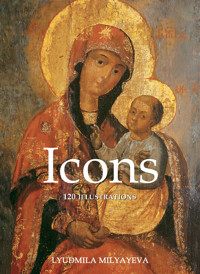
This book analyses the evolution of iconic art from its beginning in Byzantium to the time of the Russian Empire. Icons are a fundamental element in the history of art, and it is therefore crucial to understand how this form of expression began and how it developed over centuries. Icons are discussed by one of the world-renowned experts on early Christian iconography, offering a valuable point of reference for specialists, as well as students.
Das E-Book können Sie in Legimi-Apps oder einer beliebigen App lesen, die das folgende Format unterstützen:
Seitenzahl: 63
Veröffentlichungsjahr: 2022
Ähnliche




















Lyudmila Milyayeva
© 2014, Confidential Concepts, Worldwide, USA
© 2014, Parkstone Press USA, New York
© Image-Barwww.image-bar.com
All rights reserved. No part of this may be reproduced or adapted without the permission of the copyright holder, throughout the world.
Unless otherwise specified, copyright on the works reproduced lies with the respective photographers. Despite intensive research, it has not always been possible to establish copyright ownership. Where this is the case, we would appreciate notification.
ISBN: 978-1-78160-851-7
Contents
FROM THE ELEVENTH TO THE EIGHTEENTH CENTURY
LIST OF ILLUSTRATIONS
A
A male and a female martyr
Abraham Entertaining the Three Angels (Trinity Icon)
C
Christ Before Herod
Christ Before Pilate
Christ in Majesty
Christ in the House of Mary and Martha
Christ of the Vine
Christ Pantocrator
Christ Pantocrator
Christ Pantocrator
D
Deesis
Deesis
Deesis
Denys, the Great Prophets Daniel, Jeremiah and Jessaia
M
Menologion of the Month of February
R
Royal Doors
St Anne
St George
St George on the Horse and Scenes from His Life
St John Chrysostom (from the Deesis)
St John the Baptist
St John the Baptist
St John the Baptist (from the Deesis)
St John the Evangelist and Prochorus
St Juliana
St Luke the Evangelist
St Luke the Evangelist
St Mark the Evangelist
St Matthew the Evangelist
St Nicetas and the Demon
St Nicholas of Myra
St Nicolas and scenes of his life
St Paraskieva and Saint Barbara
St Peter
St Sergius and Saint Bacchus
Sts Blase and Spiridon with the Herd
Sts Vladimir, Boris and Gleb
T
The Adoration of the Magi
The Annunciation
The Annunciation and the Conception of St Anne
The Apostle Paul (from the Deesis)
The Apostle Peter
The Apostle Peter
The Apostle Peter and the Virgin
The Apostle Philip
The Apostle Thomas
The Apostles Simon and Bartholomew
The Appearance of Christ to Mary Magdalene
The Archangel Gabriel
The Archangel Gabriel
The Archangel Gabriel (from the Deesis)
The Archangel Gabriel (The Angel with the Golden Hair)
The Archangel Michael
The Archangel Michael (from the Deesis)
The Archangel Michael with Scenes of his Deeds
The Ascension
The Ascension
The Baptism of Christ
The Baptism of Christ
The Baptism of Christ
The Crucifixion
The Crucifixion
The Crucifixion, with a Portrait of the Cossack Colonel Leonty Svechka
The Descent into Hell
The Descent into Hell
The Descent into Limbo
The Descent into Limbo
The Descent into Limbo
The Descent of the Holy Spirit
The Dormition
The Dormition
The Entombment
The Exaltation of the Holy Cross
The Flight into Egypt
The Flight of Lot from Sodom and Gomorrah
The Great Panagea (The Virgin Orans)
The Intercession of the Virgin
The Intercession of the Virgin
The Judgement of the Sanhedrin
The Miracle of St George and the Dragon
The Miracle of St George and the Dragon
The Nativity of Christ
The Nativity of St. John the Baptist
The Nativity of the Virgin
The Nativity of the Virgin
The Old-Testament Trinity
The Passion of Christ
The Presentation in the Temple
The Presentation in the Temple
The Presentation in the Temple, the Baptism, the Anastasia (or the Descent into Limbo), the Transfiguration
The Presentation of the Virgin in the Temple
The Prophet Daniel
The Prophet Elias in the Desert
The Raising of Lazarus
The Raising of Lazarus, the Moving into Jerusalem, the Ascension, the Pentecost
The Resurrection
The Saints Martyrs Juliana and Anastasia
The Saints Marytyrs Barbara and Katharina
The Synaxis of the Nine Archangels
The Synaxis of the Saint Bishops
The Transfiguration
The Transfiguration
The Vernicle
The Vernicle
The Vernicle
The Virgin (Bratskaya)
The Virgin (Yeletskaya)
The Virgin (Yeletskaya)
The Virgin Elusa
The Virgin Hodigitria
The Virgin Hodigitria
The Virgin Hodigitria
The Virgin of Elusa
The Virgin of Haghiosoritisa, called “Monasterium Tempuli”
The Virgin of the Akcathistos Hymn
The Virgin of the Caves (Svenskaya)
The Virgin of Tolg
The Virgin of Vladimir
The Virgin with Child between Two Angels
The Washing of Feet
V
Virgin and Child
Virgin of Khobi
Christ Pantocrator
6th century. St Catherine’s Monastery, Mount Sinaï, Egypt
FROM THE ELEVENTH TO THE EIGHTEENTH CENTURY
(From Byzantine origins to the Baroque)
For the Eastern Slavs, as for all Christian peoples, the cult of the icon was synonymous with Byzantium, the mighty medieval empire with Constantinople — “The New Rome” — as its capital. From the fourth century on, Byzantium exerted a political and religious influence on the whole of Christian Europe.
In the Byzantine Empire the veneration of icons became an integral part of the Holy Liturgy, though the practice only won official approval after the dramatic events of the years of iconoclasm (eighth-ninth centuries). The struggle between the iconoclasts and the supporters of icons led to the formulation of a doctrinal justification for the icon’s role in religious ceremonies, and created a decorative aesthetic art that came to be known as the “Byzantine” style. It changed markedly through the centuries, but the religious painting of every Orthodox country preserved the “Byzantine tradition” for centuries to come.
Although icon painting rapidly became an integral part of Russian culture, initially it was an imported art form, brought to Russia from Constantinople. The name “icon” is itself indicative of its Byzantine origin, being a transliteration of the Greek word for a “likeness” or image. In 988, after sending out envoys to report on the various religious options available, Prince Vladimir of Kiev Rus (the first Russian state) adopted Christianity both for himself and his subjects, staging a mass baptism in the River Dnieper.
In order to build and embellish Christian places of worship, he invited Byzantine architects and artists to Kiev. As a result, the grand stone churches in Kiev were endowed with magnificent frescos and mosaics. However, many of the early Kiev churches were built of wood, which made mural decoration impractical. Instead, religious images were painted on wooden panels. And these were often displayed on a screen separating the sanctuary from the body of the church — which eventually evolved into the iconostasis, an elaborate tiered partition adorned with icons.
The most famous of these early icons, The Virgin of Vladimir, now in the Tretyakov Gallery, in Moscow, is thought to have been painted in Constantinople during the first quarter of the twelfth century. Between then and the time of Simon Ushakov (1626-86), arguably the last icon painter of stature, a great variety of schools and styles of icon painting developed, most notably those of Vladimir Suzdal, Yaroslavi, Pskov, Novgorod and Moscow.
Though the earliest icon painters remain anonymous, it is known that they were not all monks, and before long workshops special-ising in icons and other forms of church decoration became common in many parts of Russia. Of the masters of icon painting, Theophanes the Greek (1340-1405) came from Constantinople to Russia and greatly influenced both the Novgorod and Moscow schools. Other well-known masters include Andreï Rublev whose most famous work, the Old Testament Trinity, is in the Tretyakov Gallery; his friend and collaborator Daniel Cherniy (a monk, as was Rublev); and Dionysius (c. 1440-1508), one of the first laymen to become a leading icon painter. At the time when Dionysius and his sons were active, private ownership of icons became increasingly common. Previously nobles and merchants had begun the practice of displaying them in a place of honour in their homes, sometimes even in a special room, but now even peasant families who could afford it began to hang icons in a krasny ugol,




